Open Weights, Closed License, Robots Dry-Running · Morning Gist
Sunday, October 185 stories · 16 min
Open Weights, Closed License, Robots Dry-Running
Meta ships a strong but tightly licensed open model, Cloudflare's traffic data steers OpenAI's crawler, and AI agents get tested on molecules and lab robots.
Picked from 27 new articles across 23 sources · arrow keys for other days
Today in 30 seconds
30s left
Meta's 816B-parameter Muse Spark Open is now the best American open-weight model, but its custom license limits what you can do with it. story 1 ↓
In a pilot on about 1% of its network, Cloudflare shared page metadata, never content, to help OpenAI's crawler find hundreds of millions of pages. story 2 ↓
Leash Bio's Minos arena gives an agent 100 experiments to find top binders among 6.5M molecules, with an open dataset and preprint. story 3 ↓
Black Forest Labs' FLUX.3 Klein takes bounding boxes written into the text prompt; its distilled version makes a 1024px image in 1.93s on an H100. story 4 ↓
Google's lab digital twin blocks impossible robot pipetting commands from AI agents, and its closed-loop molecule design reached 33–42% hit rates. story 5 ↓
1/5Interconnects (Nathan Lambert)· Nathan Lambert· Oct 17
Meta releases Muse Spark Open, now the strongest American open-weight model
Meta published the weights of Muse Spark Open, a large coding and agent model. Nathan Lambert says it roughly halves America's lag behind Chinese open models, though its license comes with many conditions.
Why it matters · If you might self-host or fine-tune a model, this changes which Western open models are good enough to use, and the license decides what you may legally do with one.
Know this first
Context from the editor, not the article · 36 sec
1 · Open versus closed models
A closed model such as Claude or GPT can only be reached through its maker's API (programming interface). An open-weight model publishes its trained parameters, the weights, so anyone can download it, run it on their own hardware and fine-tune it. That does not make it open source in the software sense. The license can still restrict how it is used.
2 · Chinese labs lead open models
In recent years, Chinese companies such as DeepSeek, Zhipu AI (maker of the GLM models), Moonshot (Kimi) and Alibaba (Qwen) have released the strongest open-weight models. Before this week, more than 20 Chinese open models outscored the best Western one.
3 · How models get compared
2/5Cloudflare· Matthew Conroy· Oct 15
Cloudflare traffic data helped OpenAI's crawler find hundreds of millions of pages
Since July 2026, Cloudflare has passed OpenAI signals about which web pages exist, which have changed and which are junk. OpenAI's search crawler used them to add hundreds of millions of new pages to ChatGPT's search index.
Why it matters · A large share of web traffic flows through Cloudflare. If AI search engines start using its view of that traffic to decide what to crawl, how sites get found by AI changes.
Know this first
Context from the editor, not the article · 38 sec
1 · Crawlers and search indexes
Search engines run crawlers: programs that download web pages and follow their links. The pages they fetch go into an index, a searchable database. A page that no other site links to may never be found. Crawlers also have to decide how often to re-fetch pages so the index stays current.
2 · What Cloudflare sees
Cloudflare sits between millions of websites and their visitors. It acts as a reverse proxy and content delivery network (CDN), so requests to those sites pass through its servers first. That gives it a view of which addresses actually get requested, which return errors or redirects, and roughly when content changes.
3 · Crawling has a cost
3/5Latent Space· Brandon Anderson· Oct 14
Leash Bio turns years of drug-binding data into a test arena for AI agents
Leash Bio measures, at huge scale, which small molecules stick to which proteins. On a podcast, its cofounder Ian Quigley explained how that data exposed shortcut learning in AI models and became Minos, an arena where agents practice scientific reasoning.
Why it matters · The story reaches past chemistry: leaked benchmarks, models learning shortcuts, and reinforcement-learning environments with checkable answers are all problems AI engineers face directly.
Know this first
Context from the editor, not the article · 39 sec
1 · Proteins and binders
Most drugs are small molecules that work by sticking to a pocket on a target protein. Early drug discovery is largely a search for molecules that bind tightly to the right protein and leave others alone. Measuring binding one molecule at a time is slow and expensive.
2 · DNA-encoded libraries
A DNA-encoded library (DEL) attaches a short DNA barcode to each molecule that records how it was made. Millions of these tagged molecules go into one tube with a protein. Unbound ones are washed away, and DNA sequencing reads off which barcodes stayed, showing which molecules bound.
3 · Co-folding models
4/5Hugging Face· Oct 15
FLUX.3 Image Klein lets you place image regions with bounding boxes
Black Forest Labs released FLUX.3 Image Klein, an open image model that generates and edits pictures. You can type box coordinates into the prompt to place objects or move them. On an H100 GPU it makes a 1024×1024 image in about 2 seconds.
Why it matters · The release shows a practical idea in model design: structured instructions like box coordinates get written into the text prompt. The model needs no new input channels or extra control networks to read them.
Know this first
Context from the editor, not the article · 37 sec
1 · How diffusion models draw
Modern image generators start from random noise and remove it over many small steps until a picture remains. A neural network predicts each step from the text prompt. More steps usually means better quality but slower generation. Most of these models work on a compressed version of the image rather than raw pixels, which saves compute.
2 · Transformers and attention
A transformer is a neural network that splits its input into tokens: word pieces, or small image patches. In attention, each token looks at every other token to decide what matters. The cost grows with the number of tokens, so more tokens means slower and more memory-hungry runs.
3 · FLUX and Diffusers
5/5Google Research· Oct 16
Google builds a simulator that vets AI agents' lab-robot commands
Google Research built a live simulated copy of a lab robot that checks every command an AI agent issues before hardware runs it, then used agents to run real design-test-learn cycles on molecules, improving hit rates round over round.
Why it matters · It is agentic code execution moved into the physical world, and the safeguards — dry runs, state tracking, full traces, human approval — mirror the CI and staging discipline engineers already use.
Know this first
Context from the editor, not the article · 37 sec
1 · Wet lab versus in silico
"In silico" means done on a computer: predicting how a molecule folds, or generating candidate sequences. A "wet lab" is the physical bench where real liquids are mixed and measured. Models now propose candidates far faster than labs can test them, so physical experiments are the bottleneck.
2 · Liquid-handling robots
Programmable machines that move microliter volumes between plastic plates. A plate holds dozens or hundreds of small wells; the robot uses disposable pipette tips, often eight at a time on one head. Scientists write protocols in code telling it where to draw liquid from and where to dispense.
Artificial Analysis is an independent firm that runs many models through a common set of benchmarks. It combines the results into one number, its Intelligence Index, so different labs' models can be compared on a single scale.
synthetic data
Training data generated by one model and used to train another model.
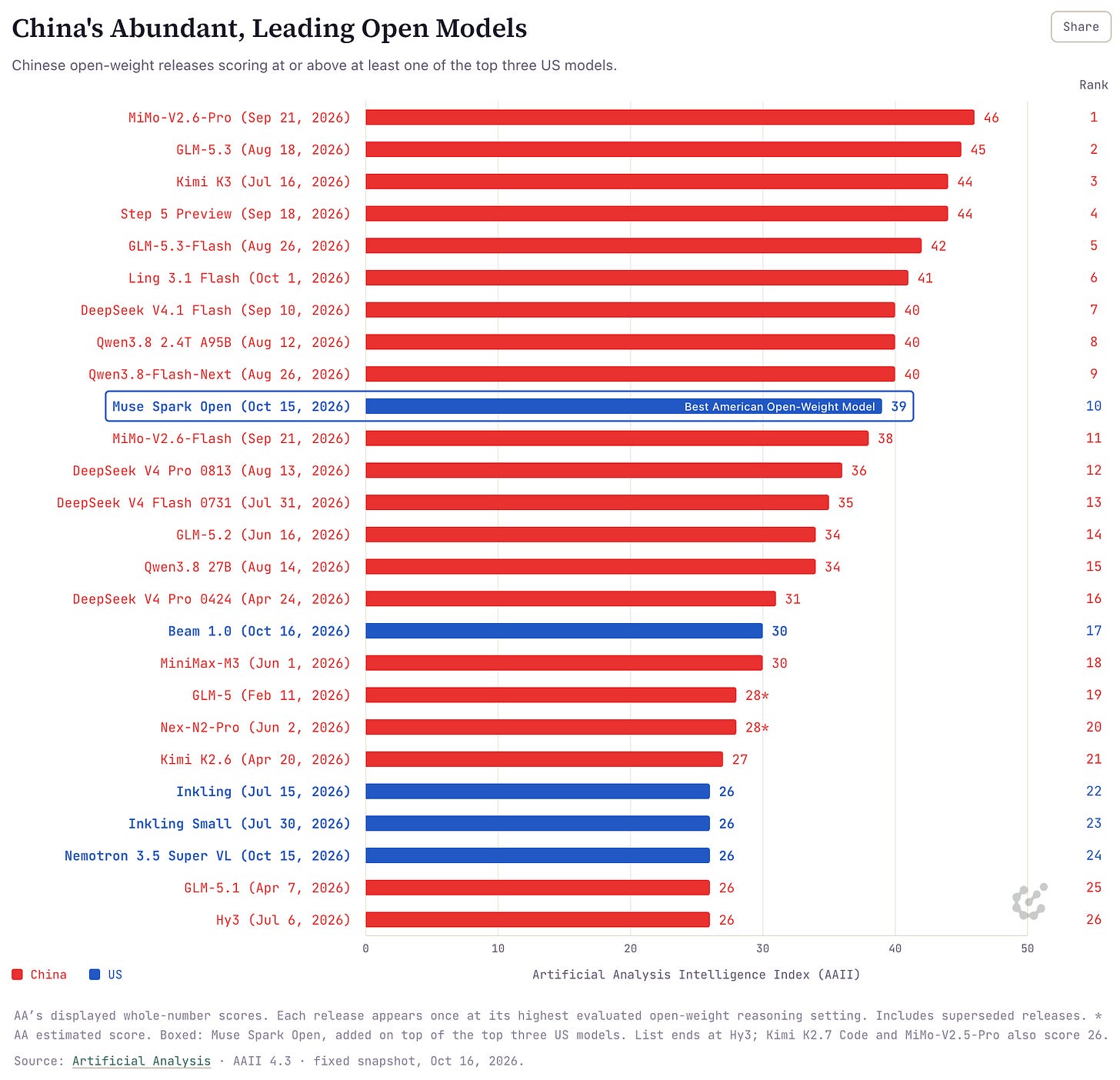
Chart: Lambert estimates the gap between the best American and Chinese open models has roughly halved.1 / 3
The news
Meta has released the weights of Muse Spark Open, the trained model itself, so anyone can download and run it. Nathan Lambert of the Interconnects newsletter calls it the strongest American 1 model by a wide margin. Before it, and before Reflection's first model Beam arrived the same week, more than 20 Chinese open models outscored the best Western one. Lambert estimates the gap between American and Chinese open models has now roughly halved. American models have gone from irrelevant to "behind but relevant."
What it is
The model has 816 billion parameters, of which 42 billion are active for each token (a word or word fragment). That split is typical of a 2 design, where only a few specialised sub-networks run at a time, so the model costs about as much to run as a much smaller one. It can consider up to 1 million tokens at once, handles images as well as text, and targets coding and 3 work, where the model plans and acts in several steps with tools.
Lambert places it above Zhipu's GLM 5.2 and behind the newest Chinese models, GLM 5.3 and Moonshot's Kimi K3. In his view that is good enough to serve growing demand from enterprises that want to run their own models.
The open version received extra safety training so it resists misuse without Meta's hosted filters. It scores a little below Meta's latest hosted model. Lambert thinks it is a safety-tuned copy of the older Muse Spark 1.2, which would cost only about 1 point on the index, rather than a model the safety training damaged.
The catch: the license
Lambert's main worry is the license. Products using the model must display "Built with Muse." Companies earning more than $20M a month from deploying it need a separate deal with Meta. Users must accept an 4. Because the terms also cover outputs and derived models, it is unclear whether you can use the model to generate training data for other models. He expects many builders to ignore the terms, but calls them "an unnecessary strategic risk."
Meta's place among the labs
Days earlier, Meta released closed models, Muse Wonder and Muse Wonder Full, which trail only Anthropic's Opus 5.5 on benchmarks. Meta is the only US company at the frontier with both open and closed models. Lambert credits a flat organisation: AI chief Alexandr Wang has more than 200 direct reports. His ranking is Anthropic > OpenAI > Meta ≈ Gemini > xAI ≈ Chinese open > US open.
He sees the US frontier narrowing to five labs, because frontier models now cost billions each. Yet even the leading labs still can't reliably predict which models will be hits in real use.
What happened
Meta has released the weights of Muse Spark Open. Open weights means anyone can download the trained model and run it. Nathan Lambert, who writes the Interconnects newsletter and studies open models, calls it the strongest American 1 model "by quite some margin." Reflection, a smaller US lab, released its first model, Beam, in the same week. Mistral, a French lab, announced Mistral Large 4 with a score of 38 on the 2, but has not yet released its weights.
Lambert says that without Muse Spark Open and Beam, more than 20 open-weight models from Chinese companies would rank above the best Western one. With them, he estimates the gap between the best American and the best Chinese open models has shrunk by roughly half. American open models have gone from irrelevant to anyone who needs top performance to "behind but relevant."
What the model is
According to Meta's model card on 3 (the main site for sharing models), Muse Spark Open has 816 billion total parameters, of which 42 billion are active. That split is the signature of a 4 design: the network holds many specialised sub-networks, and only a few of them run for each token (a word or word fragment). Running a model this way costs roughly what a 42B model costs, while it stores the knowledge of a much larger one. Its is 1 million tokens, which is how much text it can consider at once. It is built for coding and work, meaning tasks where the model plans and takes multi-step actions with tools. It is also natively multimodal: it handles images and other inputs as well as text.
Lambert places its performance above GLM 5.2, close to DeepSeek V4.1 Flash, and behind GLM 5.3 and Kimi K3. He argues that is "good enough" for today's demand. Agents built on open models have become practical at around GLM 5.2's level. Inference providers, the companies that host models and sell access per token, are growing fast. And many enterprises want to "own their intelligence" by running models themselves.
The safety-tuning question
Meta says the open version received extra safety 7. Post-training is the training done after the main run to shape behaviour. Here it was meant to make the model resist misuse when it runs without the protective filters Meta wraps around its hosted product. The open model came out after Muse Spark 1.3 but scores lower, so some observers guessed safety training had damaged it. Lambert thinks it is more likely a safety-tuned version of the older Muse Spark 1.2, which would cost only about 1 point on the Artificial Analysis index. That reading fits what Meta's AI chief Alexandr Wang said when the company released Muse Glimmer, a 30B agent model: Meta was preparing to open-source Muse Spark 1.2.
The license problem
Lambert sees the license as the main thing that could hold the model back. It includes almost every restriction he has criticised in recent years:
Products that use it must display "Built with Muse." Meta required the same for Llama, and Lambert says almost nobody complies.
Companies earning more than $20M per month across their whole business from deploying it need a separate license from Meta. Labs use this kind of clause to set up revenue sharing with resellers.
Users must agree to an 8. In open-source software terms, that makes the model "extremely not open-source."
The terms also cover the model's outputs and any derived models. That leaves it legally unclear whether you can use it to generate synthetic training data for other models.
Internal research and applications are allowed.
Lambert expects that many people will simply ignore the terms and that Meta will pursue only egregious violations. Licenses have not yet decided which models people adopt. Even so, he calls a complex, non-standard license "an unnecessary strategic risk" for a lab trying to win users back. He also notes that Western open models usually get far more adoption than Chinese ones with similar performance for their size, which works in Meta's favour.
Meta among the frontier labs
A few days earlier, Meta announced two closed models, Muse Wonder and Muse Wonder Full. On standard benchmarks they trail only Anthropic's Opus 5.5 and are roughly level with OpenAI's GPT-6-Astra and Google's Gemini-4-Argon. Meta is now the only American company with frontier models both open and closed. These releases come just over a year after Mark Zuckerberg's "Personal Superintelligence" post, which redirected the company's AI work.
Lambert puts part of the turnaround down to how Meta organises the work. Wang has more than 200 direct reports, a very flat structure in which each researcher gets a lot of compute. Lambert contrasts this with the failure of Meta's earlier Llama models, which he attributes to decisions being made by politics rather than performance. He also mentions reports that it is hard to get work done at Google's Gemini team and that xAI has high staff turnover. His ranking is Anthropic > OpenAI > Meta ≈ Gemini > xAI ≈ Chinese open weights > US open weights. What sets the top two apart, he argues, is that they have stayed at the frontier consistently, not just occasionally.
What remains open
Fewer serious players. Lambert thinks the US frontier is narrowing to five labs: Anthropic, OpenAI, Meta, Gemini and xAI. Microsoft could join if it starts releasing models. "Tier 3" labs such as Mistral, Nvidia's Nemotron, Reflection and Arcee struggle to move either frontier, because a frontier model now costs billions of dollars to build.
Labs still can't predict hits. Despite all that spending, labs cannot reliably forecast how a model will do in real use. Lambert's example is Anthropic going from Claude Fable 5, a hit, to Claude Opus 5, a dud, and back to a hit with Opus 5.5.
Valuations. Meta is valued under $2 trillion. Anthropic is heading toward an IPO at about the same figure. Lambert argues that one of these valuations has to "correct massively," and that the longer strong competitors survive, the more pressure falls on the pure AI labs' valuations.
Lambert does not explain what separates Muse Wonder from Muse Wonder Full, and he says Meta has not made it clear either.
Remember
Its 816B total but 42B active parameters mean it runs at roughly the cost of a much smaller model.
License terms cover outputs too, which makes it unclear whether the model can be used for synthetic training data.
Lambert sees the US frontier narrowing to five labs, because frontier models now cost billions each.
Every fetch costs the crawler compute and adds load to the website's servers. Fetching a page that doesn't exist, redirects elsewhere, or hasn't changed is wasted work for both sides. That is why the order in which a crawler visits pages, and how often, matters.
Image: Cloudflare
What happened
Cloudflare runs a network that sits in front of millions of websites and handles their traffic. In July 2026 it started a research pilot with OpenAI, the maker of ChatGPT. The question was whether Cloudflare's view of web traffic could help OpenAI's 1 find pages it was missing. A search crawler is the program that downloads web pages so they can be searched. Cloudflare now reports early results. Using sites that make up about 1% of its network, OpenAI added "hundreds of millions" of previously unknown pages to the 2 behind 3, the feature that pulls current web pages into ChatGPT's answers and cites them.
The problem
Crawlers mostly find pages by following links. Many useful pages, such as a specific appliance manual, current passport fees or a restaurant's menu, have few inbound links, so they get missed. Keeping the index current by re-fetching everything often is wasteful for both sides. The crawler spends compute, and site owners serve unchanged pages again and again.
How the signals work
Cloudflare's traffic flows through its servers, so it knows which addresses are real and how sites respond. The pilot turns that into signals for OpenAI's crawler:
Discovery: pages that exist and the crawler hasn't seen.
Filtering: addresses to skip. These include files that bots request but that don't exist, sites that redirect almost every address to the homepage, and duplicate copies of the same content.
Change: whether a page has been updated and is worth fetching again.
Safety (still being tested): flagging a single compromised page, such as a fake login form planted by an attacker, without penalising the whole site.
OpenAI then independently decides what to rank and show. Cloudflare stresses two limits. A signal does not grant permission to crawl a site that has blocked AI crawlers. And only 4 about pages is shared, not their content, with nothing used for model training.
Caveats
The numbers are thin. Beyond the 1% cohort and "hundreds of millions" of pages, the post gives no figures for:
how useful those pages turned out to be,
how much crawler load fell for site owners,
how well the change signals perform.
Cloudflare also admits that finding new pages can increase crawling at first. Next it plans better page selection, faster change signals, and measuring whether being found actually brings sites visitors or business.
The news
Cloudflare runs a network that sits in front of millions of websites and handles their traffic. OpenAI makes ChatGPT. In July 2026 the two companies started a research pilot. The question was whether data from Cloudflare's network could help OpenAI's 1 find web pages it was missing. A search crawler is the program that downloads pages so they can be searched. On October 15, Cloudflare's Matthew Conroy reported early results. With a group of participating sites making up about 1% of Cloudflare's network, OpenAI found and indexed "hundreds of millions" of pages it had never seen before. Those pages are now available to 2, the feature that lets ChatGPT pull current web pages into its answers and cite them.
The problem: useful pages nobody links to
Crawlers have traditionally found new pages by following links from pages they already know. That misses a lot of the specific material people actually ask about. Conroy's examples are the manual for one exact washing-machine model, current passport fees, and a local restaurant's latest menu and opening hours. Such pages "can be valuable even if few other sites link to them," so link-following may never reach them.
The second problem is staying current. One brute-force fix is to re-fetch every known page often. Conroy points out that this is expensive for everyone. The crawler spends compute, and site owners serve the same unchanged page again and again for no benefit.
What Cloudflare contributes
Cloudflare sits in the request path for its customers' sites, so it sees which addresses get requested and how the sites respond. The pilot turns that view into signals about pages that it passes to OpenAI's crawler. The article describes three kinds:
Discovery signals. These point to pages that exist and that the crawler doesn't yet know about.
Filtering signals. These steer the crawler away from addresses that would waste a fetch. Conroy lists the patterns they learned to spot:
Bots repeatedly ask for files that don't exist, which makes an address look popular when it isn't.
Some sites redirect almost any address to their homepage, so thousands of different (web addresses) all return the same page.
A fourth kind is still being tested: safety signals that flag individual harmful pages. Conroy's example is a legitimate site with one compromised page, such as a fake login form an attacker planted to steal passwords. Flagging just that page, rather than the whole domain, keeps it out of the 4 without penalising the site owner. "Early results suggest" this works. No figures are given.
A simple illustration of why filtering matters (an invented example, not from the article): say a site sends every unknown URL to its homepage. Bots probe 10,000 made-up addresses on it. A naive crawler that treats requested URLs as candidates would make 10,000 fetches and get the same homepage each time. A filter that recognises the "everything redirects home" pattern cuts that to one fetch.
Who decides what
The division of labour is explicit. Cloudflare supplies hints about pages. OpenAI "independently evaluates and ranks" whatever it fetches, based on relevance and helpfulness. Conroy describes the result as a feedback loop that improves both discovery and the quality of answers.
Two limits are spelled out:
A signal is not permission. If a site owner has blocked AI crawlers, a Cloudflare signal about their page does not override that choice. Owners can manage this with 5, Cloudflare's tool for seeing and controlling how AI systems access a site.
Metadata only, no training. The pilot shares 6 about pages (existence, changes, quality patterns), not their content. It is for search and discovery, not for training AI models.
Results
The figures in the post are thin:
Cohort: about 1% of Cloudflare's network.
Outcome: hundreds of millions of previously unknown pages indexed.
The post does not say how many of those pages turned out to be useful or ever appeared in answers. It doesn't say how much crawler load fell on participating sites, or how the change signals compare with ordinary re-crawl schedules. It also admits a trade-off: finding new pages "can initially increase crawling" while they are evaluated. So participating sites may see more crawler traffic before they see less.
What's left open
The post is a partnership announcement more than an engineering write-up. It doesn't explain how the signals are computed, how fresh they are, or how sites joined the cohort. It also doesn't say whether sites outside it are affected. It mentions OpenAI's GPT-6 and "Intelligent UI" only in passing, as product context.
Cloudflare says the next phase will:
choose pages more carefully,
test faster and more reliable change signals,
measure what happens after a page is found, framed as "real business outcomes" for site owners.
That last item is the real open question. It isn't yet shown whether being indexed by an AI search engine sends visitors to a site, or whether the site's information just gets absorbed into answers.
For engineers, the core idea is familiar. Here the 7 (content delivery network) acts as a source of truth about which URLs are real, which are duplicates, and which have changed, so a crawler can spend its fetches better. The open question is whether those savings show up in practice. This post doesn't yet give numbers that would settle it.
Remember
Cloudflare's signals are hints about pages; OpenAI still decides on its own what to rank and show.
Filtering out phantom, redirecting and duplicate URLs saves fetches before the crawler makes any request.
The post doesn't show whether being indexed brings sites any traffic; Cloudflare lists that as its next step.
Co-folding models, such as AlphaFold 3 and the open model Boltz, predict the 3D structure of a protein and a molecule together. They learn from the Protein Data Bank (PDB), a public archive of solved structures. A test molecule that already sits in the PDB can make a model's score look better than it is.
Image: Latent Space
Leash Bio, a biotech company that measures which small molecules stick to which proteins, has released Minos, an environment where AI agents practice scientific reasoning. It comes with a preprint, a blog post and an open dataset. Cofounder Ian Quigley previewed the idea on the Latent Space podcast. The episode notes also describe how Leash's data caught AI models taking shortcuts.
How the data is made
Leash uses 1 (DELs). Each molecule carries a DNA barcode that records how it was built. Millions of them are mixed with a protein, unbound molecules are washed away, and DNA sequencing counts which barcodes stayed. One common failure is a protein grabbing the DNA instead of the molecule. Leash catches this by putting dozens of different barcodes on each molecule: a real binder should show up across all of them. Quigley's rule is that biology scales in only two ways: taking pictures and sequencing DNA.
Models that fool themselves
2 contest: about 4 billion measurements and about 2,000 teams. No team beat chance on a library of molecules built from chemistry the models hadn't seen.
3 in 4 (named for a horse that "did arithmetic" by reading its handler; ChEMBL is a public database of molecule activity): models can tell which chemist made a molecule, and "who made it" predicts activity about as well as the structure does.
Leaky benchmarks: Hermes, Leash's model trained only on its own data, kept pace with 5, an open structure-prediction model. But one test molecule was already in the 6 that Boltz trained on.
Nicknames: Hermes was memorizing which protein it was looking at instead of learning binding sites. Leash responded by engineering mutant proteins at scale.
Minos
In a "7" setup, a model proposes experiments and real lab results guide its next guess. Leash realized its stored data could stand in for the lab across tens of thousands of simulated campaigns. In each one, a large language model reasons in plain English about 8 (how changes to a molecule change its binding) and tries to find the best binders among 6.5 million molecules using a budget of 100 tests. Every answer can be checked, which is what reinforcement learning, training by trial and reward, needs.
Caveats
These are show notes. They give no error bars, no measure of how close Hermes came to Boltz, and no Minos results, which are in the separate preprint. The episode also touches on a six-month path from a DEL hit to good results in mice for an inflammation drug.
Latent Space, a podcast and newsletter about AI engineering, interviewed Ian Quigley of Leash Bio. Leash is a biotech company that produces enormous amounts of data on which small molecules bind which proteins. The episode notes are short, but they cover three things a software engineer will recognize: benchmarks that leak, models that learn shortcuts, and a new reinforcement-learning environment for AI agents. That environment, Minos, launched alongside the episode with a preprint, a blog post and an open dataset.
The data problem
Drug discovery starts by finding small molecules that bind a target protein. Leash collects this data with 1 (DELs). Each molecule is built in steps, and each step adds a matching piece to a DNA barcode attached to it. Millions of barcoded molecules are mixed with a protein in one tube. Whatever doesn't bind is washed away, and 2 (fast, massively parallel DNA reading) counts the barcodes that remain. The notes describe the general trick as mapping a problem onto a combinatorial library plus a sequencing readout. Quigley's rule is that biology scales in only two ways: taking pictures and sequencing DNA.
The interviewer, Brandon Anderson, says he had heard "nothing but horror stories" from people who use DELs. A common failure is that a protein sticks to the DNA barcode rather than to the drug-like molecule, so the readout reports a binder that doesn't exist. Leash's fix is to put dozens of different barcodes on each molecule. A real binder should be enriched across all of its barcodes. If only one barcode sequence keeps showing up, that points to DNA binding. Anderson credits Leash's clean, reproducible data to "epistemic rigor" and a willingness to simply run the experiments.
Three ways models fool themselves
The 3 competition. Leash ran a public machine-learning contest on Kaggle using about 4 billion measurements, which the notes say came from "a basement". About 2,000 teams entered. On a held-out chemical library, meaning molecules built from chemistry the models had never seen, no team beat chance. The models could interpolate within familiar chemistry but could not generalize beyond it. The notes also say Leash had quietly feared that co-folding models, which predict protein and molecule structures together, would make its data obsolete.
4 in 5. Clever Hans was a horse that seemed to do arithmetic but was actually reading cues from its handler. ChEMBL is a large public database of molecules and their measured activity, collected from published papers. Leash found that a model can guess which chemist made a molecule from its structure alone, and that knowing "who made it" predicts activity about as well as the structure does. Each lab has its own style and its own targets, so a model can score well by recognizing the lab instead of learning the chemistry.
Leakage in public benchmarks. Leash trained a model called Hermes only on its own DEL data. It kept pace with 6, an open co-folding model trained on the 7 (PDB), on public benchmarks. One benchmark molecule, a binder for BRD4 (a heavily studied protein), was already in the PDB, so Boltz had effectively seen the answer during training.
Hermes had its own shortcut. Leash found it memorizing "nicknames" for proteins, identifiers that let it recognize which protein it was looking at, rather than learning what makes a binding pocket bind. Leash's response, called "breaking the pocket", was to engineer mutant versions of proteins at scale. If a model's prediction doesn't change when the pocket is altered, it wasn't looking at the pocket. The notes don't give numbers on how much this helped.
One more finding: some hits resembled lumacaftor, a cystic fibrosis drug that helps a misfolded protein fold correctly. Those hits worked as an accidental detector that a protein sample was misfolded.
Minos: a 8 for agents
Near the end of the recording, Quigley described a sandbox in which large language models (LLMs) reason in plain English about 9 (SAR), meaning how changes to a molecule's structure change its activity. The task: find the best binders among 6.5 million molecules while testing only 100.
In a real "lab-in-the-loop" setup, a model proposes experiments, the lab runs them, and the results guide the next round. Each round takes days or weeks. Leash realized its existing data could stand in for the lab across tens of thousands of such simulations. The notes don't spell out the mechanics. Presumably, because the measurements already exist, an agent's chosen experiment is answered by looking up a real result. That is what reinforcement learning (RL) needs: many episodes, each scored by a reward that can be checked against ground truth. A useful analogy is a game environment for training agents, except the "game" is recorded experimental chemistry. Two months after the recording, the sandbox had become Minos. The notes give no benchmark results for it. Those are in the preprint, which this write-up doesn't cover.
Other threads
The Recursion alumni. Recursion is a drug-discovery company built around automated cell imaging. The notes say companies founded by its former staff "all rhyme".
The Kosuri paradox. If you can collect the data directly, why do you need a model? The notes don't explain the name.
A drug program. Leash went from a DEL hit to good mouse 10 in six months on an inflammation program. PKPD covers pharmacokinetics (how the body absorbs and clears a drug) and pharmacodynamics (what the drug does). Quigley makes the case for pills over antibodies against cytokine targets, the signaling proteins that drive inflammation.
What's open
These are show notes, so the claims arrive without methods or error bars. "Keeping pace with Boltz" isn't quantified. The Minos results live in a separate preprint. The general lessons still carry over: hold out whole distributions rather than random rows, check whether your test set appears in someone's training data, and run perturbation tests to see what a model actually relies on.
Remember
About 2,000 Kaggle teams with 4 billion data points still couldn't beat chance on unseen chemistry.
In ChEMBL, knowing a molecule's author predicts its activity about as well as knowing its structure does.
Minos gives agents 100 tests to find the best binders among 6.5 million molecules, and every answer can be checked.
FLUX is a family of image models from Black Forest Labs, a lab founded by researchers behind Stable Diffusion. FLUX.1 and FLUX.2 came before this one. Diffusers is Hugging Face's open-source Python library for running and fine-tuning image-generation models.
The modes in one model: text-to-image, image-to-image, box-placed layout, and moving an object between boxes.1 / 4
Black Forest Labs has released FLUX.3 Image Klein, an open-weights image model. Hugging Face's 1 library, the standard Python toolkit for running image generators, supports it from launch. One model handles three jobs:
Text-to-image: you describe a scene and it draws it.
Image-to-image: you pass one or more reference images and describe a change. You can say "the fox from <ref_image_0> on the bench from <ref_image_1>."
Layout control: this is the new part. You add a JSON list of regions after the caption, each with a box and a description.
Boxes in the prompt
A box is written as [y_min, x_min, y_max, x_max] on a 0–1000 scale, so the same box works at any image size. When generating a new image, each region's description is drawn inside its box. When editing, a region gets a src_bbox (where something sits in the reference) and a tgt_bbox (where it should go). If the two boxes are the same, that region stays put. In the release's example, a knitted knight moves up and to the left while the dragon, cliff and backdrop stay fixed.
How the model reads it
The model is a 2, a network that processes everything as tokens. An image is compressed by a 3, an encoder that shrinks it, until each token covers a 16×16-pixel patch. A 1024×1024 image therefore becomes 4,096 tokens. Text, the image being generated and any reference images first go through five blocks each, with separate weights per stream. Then all of them merge into one sequence for 28 shared blocks.
Each token gets a position tag. References use the same row and column coordinates as the output, so "the same spot in the reference" has an exact meaning to the model. The box-based editing depends on this.
Speed and memory
Two 4 (saved sets of weights) ship:
Distilled: trained to work in fewer, larger steps. It uses 16 steps and no 5, a quality trick that costs a second pass per step.
Base: 50 steps with CFG. This is the one to fine-tune.
On one H100 GPU, the distilled model takes 1.93 s for a 1024×1024 image. With one reference image it takes 3.87 s, because the reference adds 4,096 tokens to every pass. Smaller compressed weight formats cut peak memory from 20.7 GiB (16-bit) to 16.3 GiB (FP8) and 15.3 GiB (6). They only run faster on recent NVIDIA GPUs.
Diffusers also ships 7 training scripts. LoRA is a cheap way to teach the model a new style.
What's missing
The post doesn't compare image quality with other models. It also doesn't give the parameter count or the license, and it doesn't say how reliably the model obeys the boxes.
Black Forest Labs has released FLUX.3 Image Klein, an open-weights image model, and Hugging Face's 1 library supported it on day one. Diffusers is the standard open-source Python toolkit for running and fine-tuning image generators. One model covers three jobs: text-to-image, image-to-image with several reference images, and a new layout control feature. With layout control, you write bounding boxes into the prompt to say where things go, or which parts of a reference image to move.
Two 2
A checkpoint is a saved set of model weights. Two are published:
flux-3-image-klein is "timestep distilled": trained to reach a good image in fewer, larger denoising steps. It defaults to 16 steps and skips 3. CFG runs the model twice per step, with and without the prompt, and pushes the result toward the prompted version. It improves prompt-following but doubles the cost.
flux-3-image-klein-base uses 50 steps with CFG. This is the one to fine-tune.
What you can ask for
For text-to-image, the authors recommend a full scene description covering subject, setting, light, composition and style. For image-to-image, you pass reference images and write the prompt as a caption of the image you want. With several references you name them in the prompt as <ref_image_0>, <ref_image_1> and so on. The post's example: "The fox from <ref_image_0> sitting on the wooden bench from <ref_image_1> in a snowy setting."
Layout control adds a JSON list after the caption. Each region has an id, a bbox and a desc, and the caption refers to it as <id>. Boxes are written y-first as [y_min, x_min, y_max, x_max] on a 0–1000 scale. Because the scale is normalized, the same box works at any resolution. A worked example from the post: a background region [0, 0, 1000, 1000] described as "a flat field of neon yellow-green." A silhouette region [150, 150, 850, 850] describes a stippled-ink running figure. The figure comes out inside that inner box.
For edits, each region names its source image and gives a src_bbox (where it is now) and a tgt_bbox (where it should be). In the post's example, a knitted knight moves from [500, 150, 850, 350] to [194, 55, 544, 255], up and to the left. Five other regions (backdrop, cliff, needle, dragon, fire) have identical source and target boxes, which pins them in place.
How images and text become tokens
FLUX.3 is a latent model: it doesn't work on pixels directly. A 4 (variational autoencoder, a network that compresses images and decompresses them later) shrinks the image 8× in each direction into 32 channels. That compressed form is called a latent. Each 2×2 patch of the latent is then packed into one token with 128 channels. So one token covers a 16×16-pixel patch, and a 1024×1024 image becomes a 64×64 grid of 4,096 tokens. Reference images go through the same encoder and keep their own size.
The text encoder is 5, a vision-language model from Alibaba. Instead of using only its final layer, FLUX.3 takes hidden states from 8 of its 36 layers (layers 4, 8, …, 32) and stacks them. Each text token becomes an 8 × 2560 = 20,480-number vector, which a linear layer projects down to the 6's width of 3,072. Prompts are padded to a multiple of 80 tokens. The transformer also attends to that padding, which the authors give as the reason the pipeline accepts only one prompt per call.
Two stages of transformer blocks
The transformer is the network that does the denoising. It runs in two stages.
Per-mode stage. Text, the noisy image and the references each pass through 5 blocks with their own weights. Each stream attends only to itself.
Joint stage. The streams are concatenated as [text | image | reference] and pass through 28 blocks with shared weights, where every token attends to every other.
For comparison, FLUX.2's "double-stream" blocks also gave text and image separate weights, but let them attend to each other from the start. FLUX.3 keeps the streams fully apart first. At the end, the text and reference tokens are thrown away, and only the image tokens predict the next denoising step.
Inside each block, attention and an MLP (a feed-forward layer, here the SwiGLU variant) run side by side on the same normalized input. Their sum is added back to the running state. The normalization has no learned parameters of its own. Its scale, shift and gate come from an embedding of the timestep, a technique called modulation. Text, image and reference tokens each get their own modulation values even in the shared blocks.
There is also a twist on timesteps. In FLUX.1 and FLUX.2, one timestep modulated every token. In FLUX.3, only the noisy image tokens get the current timestep t. Text and reference tokens always get timestep 0, which means "clean, nothing to denoise." The model therefore treats a reference as given context even when it looks almost identical to the output. The distilled checkpoint is also told which timestep each step jumps to, which lets each of its 16 steps take a bigger stride.
Positions in four dimensions
Attention on its own has no sense of order or location. 7 (rotary position embeddings) fixes this by rotating each query and key vector by an amount tied to the token's position. FLUX.3 uses four position axes: timestep, height, width and sequence length. Each axis gets 32 of the 128 dimensions in every attention head. Text tokens are laid out along the length axis like words in a sentence. The output image and the references are 2D grids on height and width. Reference k sits at length −(k+1) so it doesn't collide with the output. Because references share the output's row and column coordinates, "the same spot in the reference" is well defined, and src_bbox/tgt_bbox editing depends on that.
The denoising loop
FLUX.3 is a 8 model. Starting from pure noise, the transformer predicts a velocity at each step: the direction from noise toward a clean image. A scheduler then moves the image a step along it. The model's current guess of the final image can be read off at any step as x0 = x_t − σ·v, where x_t is the current noisy latent, σ the noise level and v the predicted velocity. By step 10 of 50 the fox's pose and lighting are already set, at a noise level of 0.97. Fur texture and snow-laden branches only appear near the end. The scheduler uses a large time shift (6.93), so 44 of the 50 steps happen at noise level σ above 0.5.
Cost, measured
All timings are for the distilled model on one H100 80GB GPU, averaged over three runs:
Workflow
Time
Text-to-image, 1024×1024
1.93 s
Image-to-image, one 1024×1024 reference
3.87 s
Layout edit, 1360×768
4.10 s
Peak memory in these runs was 23.8 GiB. References roughly double the time because they join the same attention sequence. Text-to-image uses 4,256 tokens per transformer call and image-to-image uses 8,272.
The transformer also ships as a single file in quantized formats, which store weights in fewer bits:
Format (GPU)
Peak memory after inference
bf16, 16-bit (H100)
20.72 GiB
fp8r, rowwise 8-bit (H100)
16.27 GiB
9, NVIDIA's 4-bit format (RTX 6000)
These are fast only on recent hardware. FP8 needs NVIDIA compute capability 8.9 or newer (the Ada, Hopper and Blackwell generations). NVFP4 needs Blackwell plus the FlashInfer library. On older GPUs the weights are unpacked every step, which saves memory but gives no speedup. Running the text encoder once and freeing it, or CPU offloading (which the authors didn't benchmark), saves more memory.
Fine-tuning and modular pipelines
Diffusers includes DreamBooth 10 training scripts. LoRA trains small add-on weight matrices instead of the whole model, and DreamBooth is a recipe for teaching it a style or subject from a few examples. The example script learns a tarot-card style triggered by the word "trtcrd": rank 16, learning rate 1e-4, 1,500 steps. Flags such as gradient checkpointing and 8-bit Adam cut memory use. A second script trains editing behavior from (reference, target, instruction) triplets.
The model ships as a Modular Diffusers pipeline, made of named blocks you can remove or insert. Two examples from the post: popping out the text encoder to encode a prompt once and reuse it across seeds, and inserting a small preview block in the loop to record the image's progress step by step.
What's left open
The post is a launch and integration guide. It doesn't compare image quality with FLUX.2 or other models. It doesn't give the parameter count or license terms, and it doesn't measure how precisely outputs follow the boxes.
Remember
Layout control is plain JSON in the prompt. Matching source and target boxes pin a region during edits.
Reference images are tagged as clean (timestep 0) and share the output's grid coordinates.
Each 1024×1024 reference adds 4,096 tokens to every transformer pass, roughly doubling generation time.
Molecular discovery runs in cycles: design candidates, make them, measure which bind the target, use the results to design better ones. Each cycle takes days to weeks, so a round that teaches little is costly. "Hit rate" is the fraction of designs that actually work.
Image: Google Research
Google Research has described three connected projects with one aim: AI agents that don't just propose biology experiments but run them on lab robots, read the results, and design the next round. For a software reader the shape is familiar — an agent emits code, and something must catch bad code before it reaches a machine that cannot roll back.
Code that compiles but breaks the bench
The robots here are 1: machines that move reagents between plates of tiny wells. An agent can write a protocol that passes every syntax check and is still wrong in the room — lowering an eight-channel pipette head into a trough too narrow for it, or 2 (drawing liquid up) from a well already emptied. Correctness depends on the live state of the bench, not the text of the program.
So Google built 3 (VERified Infrastructure for Discovery Laboratories): a live 3D model of the lab workcell that tracks arm geometry, each well's volume, reagent identities, and remaining pipette tips. It sits on 4, an open-source Python framework for lab hardware. Agents query state before acting; protocols get a virtual dry run in seconds to catch collisions or empty wells; invalid commands are blocked before reaching hardware; video and action logs are recorded together. Loosely, it's a staging environment plus runtime assertions, where the assertions concern geometry and volume.
It paid off concretely. Video traces revealed uneven dye mixing from dispensing too close to the well floor. Persistent state let an agent resume after a plate-reader failure without re-pipetting. A rejected aspiration prompted a replan that isolated a bias from liquid clinging to tip walls. In a self-play run reconstructing blinded dye mixtures from camera images, an agent found its own optical artifacts and improved accuracy more than fivefold.
Learning from being wrong
5 — short DNA strands that fold into shapes binding a target protein — give a 7–10 day design-test cycle. Over three rounds, confirmed on-target hit rates hit 33.5% (myoglobin) and 42.1% (α-thrombin). The failures matter more. On α-thrombin, round 1 scored 0%: fixed sequencing overhangs broke folding in 48% of designs; adding clamped stems lifted it to 26.0%, then 42.1%. On myoglobin, agents chased raw binding and packed 63% of designs with 6, which stick to everything — 7 crashed from 75.0% to 19.1%. Reading that data, the agents capped those motifs and recovered to 72.4% specificity and a ninefold hit-rate jump.
For proteins, targeting the tumor receptor 8, designs reached single-digit 9 (drug-like) binding in a few runs. Trimming the folding step to just the binding pocket cut cycle cost more than eightfold; at equal compute, scientist-plus-agent nearly doubled a scientist's 10 hit rate.
Scale is prototype: two aptamer targets, one protein target, no external baseline, humans approving every sequence and run.
Google Research has published a progress report on three connected projects whose shared aim is to let AI agents not just propose biology experiments but physically run them on lab robots, read the results, and design the next round. The common thread for a software reader is familiar: an agent emits code, and something has to stop bad code before it reaches a machine that cannot roll back.
The problem: syntactically valid, physically impossible
The post names two obstacles. First, frontier models — the largest general-purpose AI models — still reason poorly about three-dimensional geometry and physical state. That matters because the robots in question are 1: machines that move reagents between plates of small wells, track volumes, and execute molecular biology protocols. Second, 2 design (candidate generation on a computer) has raced ahead of the wet lab (the physical bench), so real measurements have become the limiting step. The search spaces are enormous: the post notes a single 100-amino-acid protein spans at least 20^100 possible sequences.
The failure mode the post emphasizes is subtle. An agent can write code that compiles and passes every syntax check and is still wrong in the room. Three flavors are given: physically impossible, such as lowering an eight-channel pipette head into a trough too narrow to accept it; logistically invalid, such as 3 — drawing liquid up — from a well that has already been emptied; or scientifically compromised by fluid effects nobody modeled. A type checker cannot catch any of these, because correctness depends on the live state of the bench, not the text of the program.
4: a digital twin as the type system for a bench
The answer is VERID, for VERified Infrastructure for Discovery Laboratories. It is a semantic digital twin of the lab workcell — a live, stateful 3D model of the physical setup, held as a volumetric entity tree that tracks robotic arm geometry, individual well volumes, reagent identities, and how many pipette tips remain. It is built on 5, an open-source Python framework for driving lab hardware.
VERID offers four capabilities. Agents can query live 3D state — deck layout, well volumes, available tips — before acting. They can run fast virtual dry runs, simulating a protocol in seconds to catch collisions or empty wells before any reagent moves. Hardware safety checks block invalid commands from reaching the robot at all. And synchronized video and action logs record every run for reproducibility and debugging.
The analogy, and it is an analogy: VERID is a staging environment plus a runtime assertion layer, where the staging environment holds a model of the world rather than a copy of a database, and the assertions are about geometry and volume rather than nulls.
The case studies show the loop working. Synchronized video and execution traces exposed uneven dye stratification caused by dispensing too close to the well floor; the agent revised its mixing strategy. In the same campaign, because the digital twin kept persistent state, the agent recovered mid-run from a plate-reader failure without re-pipetting — the equivalent of resuming a job from a checkpoint instead of restarting it. When the simulator rejected an eight-channel aspiration that would not fit a narrow trough, the agent replanned and instead designed a targeted factorial diagnostic that isolated a bias from residual liquid clinging to tip walls, a subtle artifact that simply repeating the experiment would have averaged over. And in a closed-loop self-play campaign — the agent repeatedly setting itself a task and scoring its own result — it reconstructed blinded dye mixtures from overhead camera images, identified its own optical and fluidic artifacts across runs, and improved accuracy more than fivefold.
6: a fast loop where the agent learns from being wrong
The second project uses aptamers — short DNA strands that fold into shapes which stick to a specific target protein — as a testbed, because the cycle is fast. DNA can be chemically synthesized in pooled libraries and read out directly by sequencing, so a full design-test-analyze cycle takes 7–10 days. Each round: agents design sequences, those are screened against target proteins immobilized on magnetic beads to pull out binders, and sequencing returns quantitative data for the next round.
Over three rounds against two targets, confirmed on-target hit rates reached 33.5% for myoglobin and 42.1% for α-thrombin. The interesting part is the failures in between.
On α-thrombin, round 1 produced 0% binders: fixed primer overhangs — short constant DNA sequences needed for sequencing — disrupted folding in 48% of designs. The agents added clamped flanking stems in round 2, reaching 26.0%, then diversified in round 3 to 42.1% at 98.5% 7.
On myoglobin, the agents optimized the wrong thing. Chasing raw binding affinity in round 2, they loaded 63% of designs with G-quadruplex motifs, a DNA structure that binds strongly but indiscriminately. Raw pull-down went up; specificity fell from 75.0% to 19.1%, and the true bead-corrected hit rate fell from 10.2% to 3.7% — the sequences were sticking to off-target proteins and to the bare beads. Reading that round-2 data, the agents capped promiscuous motifs, subtracted bead binders, and pivoted to non-G4 scaffolds, recovering 72.4% specificity and a ninefold jump to 33.5% on-target hits. That is reward hacking caught and corrected by physical measurement.
Protein binders: making the expensive step cheaper
Proteins close the loop more slowly, since they must be biologically expressed and folded rather than chemically synthesized. Targeting fibroblast activation protein alpha (8), a receptor overexpressed in solid tumors, the pipeline produced binders with single-digit 9 affinity — tight, drug-like binding — in a few experimental runs.
The compute trick: designing a binder from scratch means generating backbones, designing sequences for them, then re-folding the complex to predict binding. That last step dominates GPU cost and scales quadratically with target length. Excising just the local binding pocket during folding sped each cycle up more than eightfold without losing structural accuracy. At equal compute, a scientist setting strategy with an agent executing nearly doubled the in-silico hit rate versus the scientist alone, across a broader range of target sites. Screening uses yeast surface display with fluorescence-activated cell sorting (FACS), which sorts large variant libraries by fluorescence.
Caveats
The numbers are prototype-scale: two aptamer targets, one protein target, few runs, no external baseline. Testbeds were deliberately chosen as non-infectious systems without gain-of-function risk; every sequence goes through biosecurity screening; humans authorize sequences and supervise runs. The post names the open problems plainly — making agents optimize true binding rather than experimental shortcuts, verifying multi-step protocols, and monitoring reasoning traces continuously.
Remember
Correctness here depends on live physical state, so simulation against a digital twin replaces the type checks code alone can't provide.
Some addresses lead to duplicate copies of the same content.
Change signals. These tell the crawler when a page has changed and is worth another visit, and when it hasn't.
Competition. The episode asks what stops a better-funded lab from outscaling Leash. Quigley's wish, if he could have anything by fiat, is massively parallel purification, meaning many proteins produced and cleaned up at once.