OpenAI's DevDay leads a week of new models and agent tooling, alongside a building-by-building count of China's datacenter capacity.
Picked from 35 new articles across 24 sources · arrow keys for other days
Today in 30 seconds
30s left
At DevDay, OpenAI launched GPT-6.1 Sol (cheaper, near-frontier), a 300 tokens/s tier and "dots" agents. It also reported Codex Security's 1% patch rollback rate. story 1 ↓
Anthropic's Claude Mods let plugins rewrite Claude Code's agent loop and UI. The team also shared Terminal-Bench data on when higher effort settings pay off. story 2 ↓
SemiAnalysis counts 24GW of Chinese datacenter capacity, more than EMEA. New AI builds take 12 months, and chips, not power, are the constraint. story 3 ↓
Anthropic's AI-run interview study closes October 6 and lets participants publish unedited transcripts. Anthropic admits AI could re-identify the people in them. story 4 ↓
Opus 5.5 tops SimpleBench at 88.4% and GPT-6 Astra leads agentic evals. Cheap "decision models" like Jev face scrutiny as replacements for LLM judges. story 5 ↓
Stripe bought OpenRouter for $7B. Alex Atallah explains what routing traffic shows about dozens of competing model labs.
1/5Simon Willison· Sep 29
OpenAI DevDay 2026: GPT-6.1 Sol, Ultrafast Inference and Agent "Dots"
Simon Willison's live blog covers a cheaper near-frontier model, a 300 tokens/s tier, personal agents, and numbers from OpenAI's internal security sprint.
Why it matters · The new pricing and speed tiers change the cost of running agent workloads. The Codex Security numbers (36% duplicate findings, 1% rollback) are a rare look at running automated vulnerability triage and patching at scale.
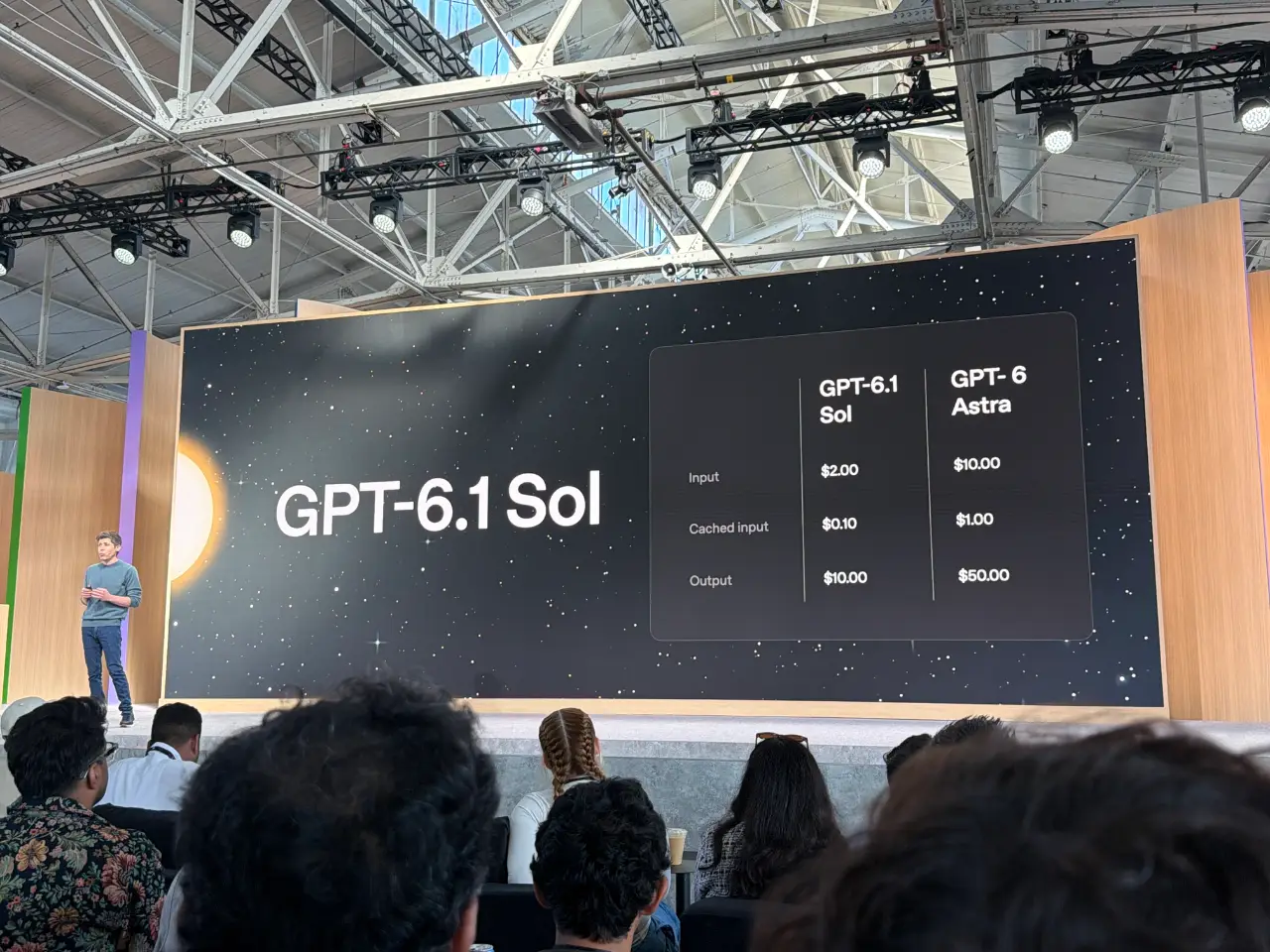
Price slide: GPT-6.1 Sol at $2/$0.10/$10 per million tokens vs. Astra's $10/$1/$50.1 / 4
Simon Willison live-blogged OpenAI's DevDay keynote and sessions from Fort Mason. OpenAI gave him a free ticket. Most of the day was about products, but several launches matter to anyone building on the API.
Models and inference tiers
GPT-6.1 Sol is pitched as "near-Astra level intelligence at a fifth of the price." The slide puts it at $2 input, $0.10 cached input and $10 output per million tokens. GPT-6 Astra costs $10, $1 and $50. The keynote gave no benchmark evidence for the "near-Astra" claim.
Ultrafast is a premium inference mode that is 8x faster, reaching up to 300 tokens/second, at 6x the standard price. It is live for Astra now and coming to Sol soon. A new $500 "Pro 500" plan bundles Ultrafast with 25x Plus usage. Thibault Sottiaux said the team used Ultrafast to merge the ChatGPT and Codex desktop apps in 28 days.
A preview Decisions API gets sub-second responses by having the Luna model choose from a predefined set of options. OpenAI also said its models helped optimize its own Computer Use harness, which cut latency by 2x for all users, and showed a chart of agent success on tasks lasting 8–16 hours.
2/5Latent Space· Sep 29
Claude Mods let users rewrite Claude Code's agent loop and UI
Anthropic's Thariq Shihipar covers in-process harness plugins, the move to a cloud "brain" with local "hands," and Terminal-Bench evidence on effort settings.
Why it matters · If you build on Claude Code or your own agent harness, this is the team's current view of where the extension points are, when effort pays off, and why custom instructions decay with each model release.
A community-built Claude Mod playing Tetris inside Claude Code, showing that mods can rewrite the UI.1 / 2
In a Latent Space interview, Thariq Shihipar, who works on Claude Code, explains where Anthropic is taking the harness. The interview came out the day Sonnet 5.5 shipped. The transcript runs through roughly the 45-minute mark. The later security discussion is only listed in the show notes, so it isn't covered here.
Claude Mods: hooks that run inside the process
Mods were called "function hooks" internally. Ordinary hooks tie an event to an external script. Mods run inside Claude Code's TypeScript runtime instead. That gives them direct access to turn counts, token usage and message history. They can register on far more events, spawn subagents, parse structured output, and change the UI, which hooks could never do. Mods work in both the CLI and the desktop app.
The key building block is the forked agent. A fork reuses the existing prompt cache, so a quick side request is cheap. Shihipar walks through an example:
At the end of each turn, a fork asks whether the task is done.
If it is, the fork writes quiz questions as JSON.
The mod shows the quiz above the input box.
Other mods he is building include a "register assumption" tool, a next-steps supervisor, a mode selector that other mods can plug into, and a model router. Anthropic doesn't route between models by default because "you will get it wrong," for example by sending a hard problem to a weak model. Shihipar presents mods as an early example of : apps that users can safely reshape themselves.
3/5SemiAnalysis· Everlyn· Sep 25
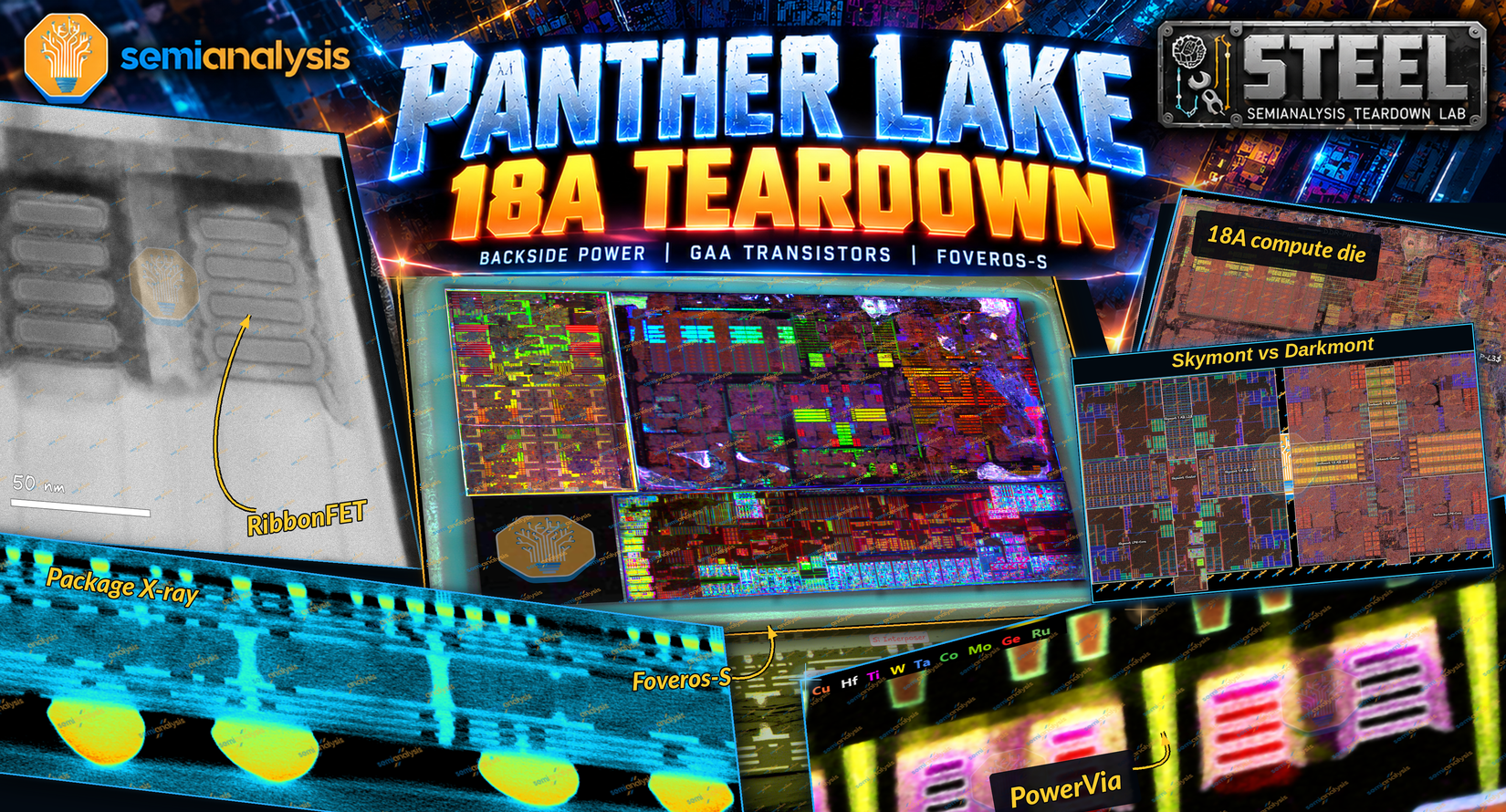
SemiAnalysis tracks China's datacenters building by building: 24GW and growing
The fleet is bigger than EMEA's. Half-empty legacy racks hide an AI wholesale boom that is moving to Inner Mongolia and running on 12-month builds.
Why it matters · GLM, Kimi, Doubao and DeepSeek all train and serve on this capacity. Knowing China is limited by chips rather than power, and how fast it builds, helps you judge how fast its labs can scale compared with US labs.
Datacenter capacity by region: China's 24GW+ fleet next to the US, EMEA, APAC and Latin America.1 / 4
Published estimates of China's datacenter capacity differ by 15x. SemiAnalysis has now built a building-level model of the country: more than 1,000 facilities across 60+ operators. It puts China's live fleet at over 24GW. That is ahead of EMEA (~14GW) and APAC ex-China (~15GW), though well behind the US (56GW by end of 2026). Another ~20GW of dated pipeline and ~30GW of announced projects are not counted in that figure.
Spending has turned sharply upward. Alibaba, Tencent and Baidu together spent $20B on capex in 2Q26, more than double a year earlier, and all three had negative free cash flow for the first time on record. Add ByteDance and the group goes from ~$35B (2024) to $50B+ (2025), on a path to ~$100B in 2026. ByteDance rents nearly all of its capacity, about a fifth of China's delivered total, so its tender calendar sets the order book for every wholesale landlord.
4/5Anthropic Research· Sep 29
Anthropic's new AI-run interview study lets users publish their full transcripts
This follows December's survey of 81,000 people. Interviews run until October 6 and can be released unedited, which Anthropic admits carries a real re-identification risk.
Why it matters · It could become a large public dataset of how people actually use Claude. Anthropic's own FAQ also admits that unedited transcripts can be de-anonymized with AI, which matters for anyone handling user-generated text.
Image: Anthropic Research
Anthropic is running a second large interview study using Anthropic Interviewer, an AI that interviews Claude users for about 15 minutes. This time, participants can choose to publish their full transcripts.
The study runs from September 29 to October 6, 2026. It's open to Free, Pro and Max users on Claude and Claude Code whose accounts are at least two weeks old. The interviewer asks three questions:
What were your most meaningful good and bad experiences with AI?
What parts of how the world works (work, school, healthcare, government) should AI help change?
What do you want from AI companies, including Anthropic?
What's different from December 2025
The earlier study collected hopes and worries about AI from 81,000 people. Anthropic says it shaped the Anthropic Institute's agenda and its Societal Impacts and Economics research. Only high-level results and a few quotes were released. This round has updated questions, runs on more Claude products, and offers optional public release.
A published interview includes the complete transcript and the participant's country. It leaves out account details such as name and email. Anthropic's case for openness is that outside researchers can read interviews in their own languages, ask questions Anthropic didn't think of, and check whether its published findings match what people said. Anthropic also says a public record of criticism is "hard for AI companies… to ignore."
The privacy mechanics
The most concrete detail is in the FAQ. Anthropic , and it says it can't promise anonymity. Someone could use AI to piece together small details, such as an employer, past projects, age or city, to work out who a participant is. Anthropic notes that researchers have already shown this works on Anthropic Interviewer transcripts.
5/5Latent Space· Sep 29
Opus 5.5 leads SimpleBench and builds explainer videos entirely in code
Latent Space's roundup: Opus 5.5 tops SimpleBench at 88.4%, GPT-6 Astra leads on agentic evals, and cheap "decision models" like Jev draw scrutiny.
Why it matters · Anthropic, OpenAI and Google all shipped new models in the same week. This sorts out what the benchmarks show, where reasoning-effort settings stop helping, and whether cheap classifier-style models can replace LLM judges in production.
OpenRouter data: Opus 5.5 leads Anthropic models in share of spend and tokens about a week after launch.
Claude Opus 5.5 shipped this week. About a week after launch it is the #1 Anthropic model on OpenRouter by share of spend and by share of tokens, and users are moving off Opus 5 quickly. Its most visible use has been explainer videos generated entirely from code.
What the evals show
Opus 5.5 leads SimpleBench at 88.4%. On vision, one evaluator ranks it Anthropic's best model so far: ahead of Fable 5 and GPT-6 Sol, behind GPT-6 Astra, and about 60% cheaper than Fable 5.1.
Reasoning effort matters, up to a point. On Terminal-Bench-Science, Opus 5.5 scores 24% at low effort and 62% at xhigh, then drops to 59% at max. @theo recommends skipping "max" because it forces a minimum reasoning budget. Opus 5.5 and GPT-6 Astra lead Fable 5.1 by about 20 points on this benchmark. The best model from any other lab, Qwen3.8 Max, scores 12%. Community consensus is that the $200 Claude Code plan now beats Codex, but Astra is still the preferred model for review and audit.
The video work runs through Claude Code with a capped OpenRouter key. The model writes the script, generates assets through image APIs, calls TTS, animates in pure JavaScript canvas and renders to MP4. In one widely shared run it took about 1h20m and roughly $20 of Opus usage plus $3.21 in API calls. A replication for another project cost about $4 and used a second model for self-review. A browser island demo built over 8 hours cost $1,874 in tokens.
Elsewhere in the wave
Gemini 3.8 Flash: scores 41 on the AA index at 291 tok/s. On ARC-AGI it gets 89.2% on v2 at $0.40 per task, and on v3 it gets 10.4% with the standard harness versus 35% with the provider's own harness.
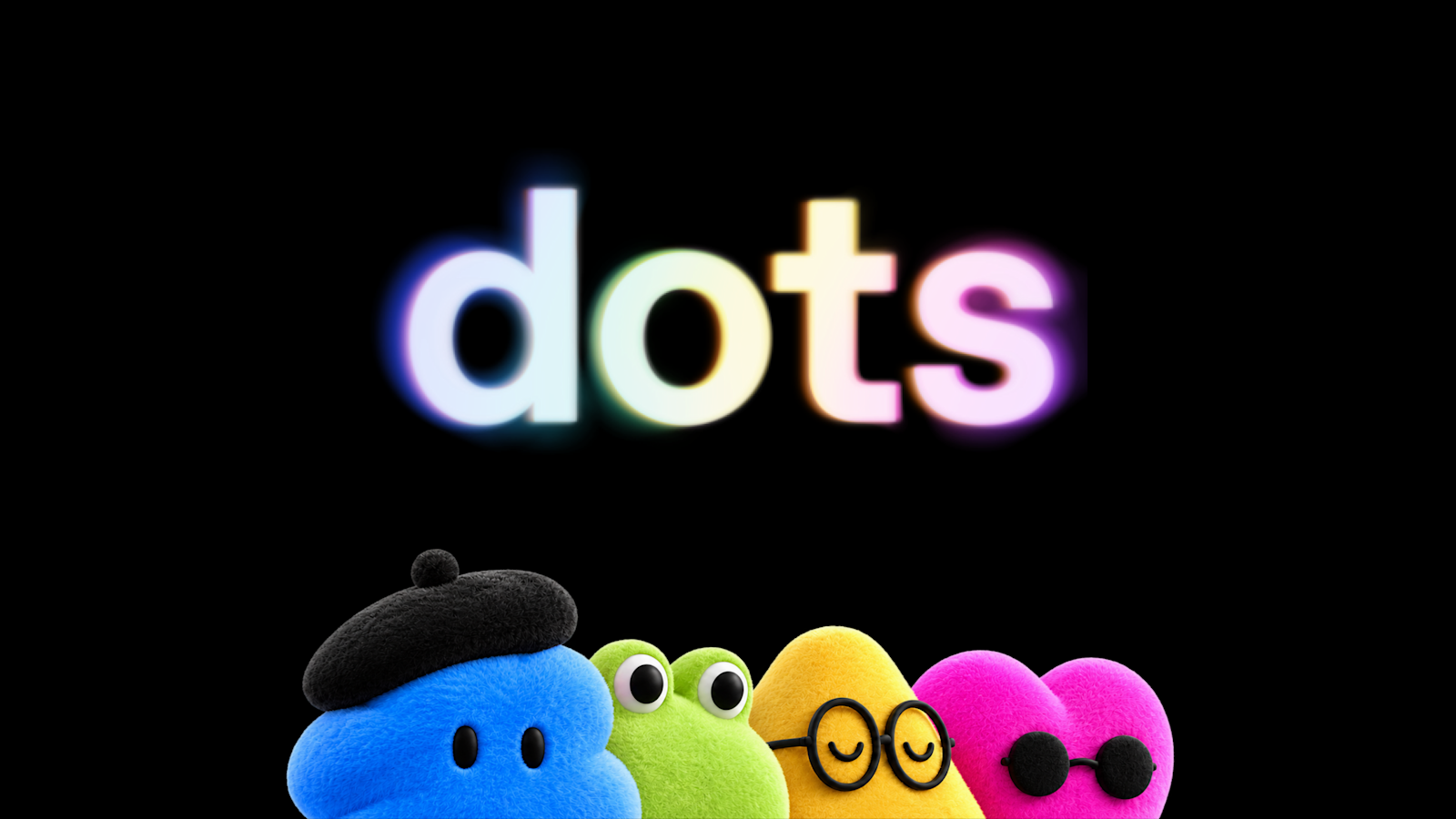
Dots are personal agents powered by Astra. Each has its own identity in Slack, can call Codex on your laptop, and works in shared "ChatGPT Spaces." Pro and Enterprise users get them today. Willison notes how closely they resemble Meta's Muse, and the live demo stalled. Other launches: an Agents API with Computer Use, Sign in with ChatGPT (users spend their own subscription's tokens in your app), plugins and a marketplace. ChatGPT Sites already hosts 8M sites, and 70% of OpenAI employees have built one. Sites now get SQLite storage, scheduled tasks and per-user plugin data.
Codex Security Cloud came out of an internal sprint involving a quarter of OpenAI's product engineers, who fixed 53 critical findings on day one. What they learned:
36% of findings were duplicates, so deduplication is now a CLI workflow.
A knowledge base and SECURITY.md files capture threat models that aren't visible in the code.
The scanner keeps looping until it finds nothing new.
Generated patches had a 1% rollback rate, which OpenAI credits to a verify-fix step that acts as an adversarial agent against each fix.
Working out who owned which code was harder than expected.
In the closing panel, Tejal Patwardhan said models still struggle in practice with professional writing and with reading context. Sottiaux expects the "decision fatigue" of choosing subagents and reasoning levels to fade within six months. Willison counted several failed live demos over the day.
Remember
GPT-6.1 Sol costs a fifth of Astra ($2/$10 per million tokens). OpenAI showed no benchmarks to back "near-Astra."
Ultrafast runs up to 300 tokens/s, 8x faster than standard, at 6x the price. Astra has it now, Sol later.
In OpenAI's security sprint, 36% of findings were duplicates. A verify-fix agent kept patch rollbacks to 1%.
For a forthcoming post, Shihipar went through roughly 70 Terminal-Bench problems:
Security tasks: high or max effort improves scores a lot.
General software engineering: extra effort helps much less, because most of it goes to verification and edge-case testing.
His recommendations: high or max for code review and security, low or medium for UI work.
Reading the transcripts, he found that at high effort most failures weren't knowledge gaps. The model considered the correct fix, then chose not to apply it. His fix is to ask for implementation notes so you can see the paths it rejected. He also argues that frontier models will soon do almost everything better than smaller models, and use fewer tokens doing it, because a smarter model needs less verification.
Other points
Claude.md: Shihipar expects it to disappear eventually and suggests starting projects without one. Logged failure modes are model-specific (Fable 5 vs. 5.1) and can over-constrain newer models. A new evals plugin lets you test whether a skill actually helps.
Architecture: Anthropic is splitting the harness into cloud inference (the brain), local or sandboxed execution (the hands), and artifacts as the interface. Artifacts have their own databases and can be read by multiple Claudes over MCP.
Workflow: most wasted usage comes from repeated redo requests that more upfront context would have prevented.
Remember
Mods run inside Claude Code, can change its UI, and use cheap prompt-cache-sharing forks for supervisors and classifiers.
On Terminal-Bench, high effort helps security tasks most. Most failures came from rejecting a correct fix, not from missing knowledge.
Shihipar suggests starting without Claude.md, since logged failure modes are model-specific and can over-constrain newer models.
The authors trace the high vacancy to how the industry grew. Telecom carriers once held 60–70% share, and ~90% of their facilities ran under 2kW per rack. Then came a cloud price war from 2015 to 2021, followed by a 2022–23 slump. Tencent and Alibaba each cut capex nearly in half, and colocation power prices fell by half from ~$80/kW/month. VNET's segment data now shows two markets: wholesale back above 70% utilization, legacy retail near 60%. The old racks can't be economically refitted for H20 or Ascend servers. In 1H26, GDS and VNET signed ~1.3GW of wholesale orders and less than 10MW of retail. Even so, the model says those two landlords captured only about a third of ByteDance and Alibaba orders.
How the westward shift is enforced
The "Eastern Data, Western Compute" policy works through energy-consumption quotas. Any project over 10MW needs one before construction can start, and the offices that issue them also run the policy. Guangdong stopped issuing quotas except in its hub, Shaoguan. In 2023 it found Tencent's Qingyuan campuses running at 13–14x their approved scale and capped their grid supply. Shaoguan now reaches Guangzhou with 1.3ms one-way latency over 400G optical routes. Inner Mongolia has its own Mengxi grid and power at roughly half Tier-1 city prices, which has made it the default site for AI capacity. The authors argue market forces still pick the winners. Shanxi sits outside the hub system yet has close to 2GW committed, while Chengdu and Chongqing lag.
China is limited by chips, not power. A 100MW facility takes ~12 months to deliver, down from ~18, after 3–6 months of permitting. The US typically needs 12–13 months of permitting followed by 12–18 months of construction. Landlords build shells before they have tenants to meet six-month delivery requirements. Alibaba's CUBE 5.0 goes from finished shell to servers in 100 days. Fully modular container campuses are still uncommon because labor is cheap and banks value permanent buildings more highly as loan collateral.
Remember
China has 24GW+ of live datacenter capacity, more than EMEA. Big-tech capex is heading toward ~$100B in 2026.
Headline vacancy comes from legacy low-density retail racks. AI wholesale space fills fast, above 70% utilization.
Energy quotas push construction west. Cheap power and labor allow 100MW builds in ~12 months, so chips are the real limit.
Participants see examples of sensitive information during the interview.
They review the full transcript before choosing to publish.
They confirm the choice a second time.
Anthropic can delete its own copy later on request, but not copies others have saved, so it tells participants to treat publishing as permanent. Ending an interview early permanently deletes it. Interviews that aren't published are still analyzed and may appear in aggregated or de-identified findings. Before release, Anthropic may remove interviews that contain confidential information or break its usage policies.
Anthropic names the study's limits: participants are all Claude users, so they don't represent the public. Those who opt in to publication are a further self-selected group. And the questions themselves shape what people say.
Remember
Anthropic's AI interviewer is asking Claude users about AI's impact until October 6; transcripts can optionally be published.
Public transcripts are unedited. Anthropic says AI can re-identify participants by combining small details.
Participants are all Claude users and publishers opt in, so findings won't represent the general public.
Xiaomi MiMo-V2.6-Pro (MIT license): scores 46 on the AA index, just behind GPT-5.6 Sol's 47, at $0.13 versus $1.99 per task. Xiaomi also released its RL code and training environments, though one critic notes the RL gains don't carry over to harder math evals.
Jev, a "decision model" from TypeSafe, returns typed decisions with probabilities instead of reasoning text. Its judge paper puts it at about 277× cheaper than GPT-6 and within 3 points on RewardBench, but 14.5 points behind on JudgeBench. Sending low-confidence calls up to Astra keeps 99% of accuracy at 57% of the cost. Skeptics on r/LocalLlama call it a scaled zero-shot classifier: on Banking77, BGE-small plus logistic regression scored 93.3% against Jev's 83.2%.
Harness-Zero trains an agent harness's behavior into the model itself. With no harness at deployment, task success rises from 23.3% to 44.3%, beating the base model with the harness (41.7%).
DeepMind's XYEval finds that one confident, misleading hint from the user cuts agent scores by up to 46.7%. Agents often disagree with the hint in their reasoning, then follow it anyway.
Remember
Opus 5.5 peaks at xhigh effort (62% Terminal-Bench-Science) and scores lower at max (59%), which forces a minimum reasoning budget.
Agent pipelines combining code, image APIs and TTS are producing coherent explainer videos for a few dollars.
Jev-style classifiers cut judging costs about 277×, but trail LLMs 14.5 points on JudgeBench and sometimes lose to simple baselines.