Cheaper Tokens, Chinese Weights, Phage CRISPR · Morning Gist
Sunday, October 115 stories · 16 min
Cheaper Tokens, Chinese Weights, Phage CRISPR
Two frontier launches cut prices, open-weight leadership tilts toward China, and Claude agents find a new enzyme system that a wet lab confirmed.
Picked from 120 new articles across 24 sources · arrow keys for other days
Today in 30 seconds
30s left
Opus 5.5 and GPT-6 launched an hour apart, both cheaper. GPT-6 Luna costs $0.10/M input tokens, but Opus 5.5 on max effort can exhaust 128K output tokens and never finish. story 1 ↓
SemiAnalysis argues agent workloads make "midfill" its own serving stage, with a target of 400–500 GB of fast memory per pipeline stage. story 2 ↓
Nathan Lambert told Congress that top Chinese open models score 42–45 on a capability index, against 26 for the best American ones. story 3 ↓
Xiaomi's MIT-licensed 1T-parameter MiMo-V2.6-Pro tops the open-weights rankings after a roughly $3M RL run, and its RL environments are open too. story 4 ↓
About 950 Claude agents searched 200,000+ enzymes in 21 hours and found a CRISPR-like system in phages. Anthropic's wet lab confirmed it. story 5 ↓
Hugging Face Transformers can now load llama.cpp quantized models directly, connecting the two main local-inference ecosystems.
1/5Simon Willison· Sep 22
Opus 5.5 and GPT-6 launch an hour apart, and both cut prices
On the same day, Anthropic released Claude Opus 5.5 at 20% less than earlier Opus models, and OpenAI released GPT-6 Sol and Luna at about half the price of the models they replace. Simon Willison's first tests found Opus 5.5's highest effort setting unusable.
Why it matters · For anyone running LLM apps or agents, the cost of a capable model in the middle tier just halved. One vendor's top reasoning setting also showed it can burn its whole budget and return nothing.
Know this first
Context from the editor, not the article · 29 sec
1 · How API pricing works
Models are billed per million tokens, with separate rates for input and output. "Cached input" is a much cheaper rate for prompt text the provider has already processed and stored, such as the earlier turns of a long conversation.
2 · Reasoning effort levels
Reasoning models "think" in hidden tokens before they answer. An effort setting, from low up to "max", controls how much thinking they do. Thinking tokens count toward the output limit and are billed as output.
3 · The pelican test
Simon Willison asks each new model to "Generate an SVG of a pelican riding a bicycle". It is an informal, deliberately silly benchmark. He uses it to compare drawing and coding ability across models and settings.
2/5SemiAnalysis· Tanj Bennett· Sep 21
Agent workloads make "midfill" a separate stage of LLM serving
SemiAnalysis's Tanj Bennett argues that serving mixture-of-experts models works as four distinct workloads, each with its own memory, compute and batching needs. Agent traffic makes "midfill", which extends a long cached context, central to hardware and scheduling choices.
Why it matters · If you build agent products, the per-token cost and latency of long contexts depend on these serving choices more than on how many parameters a model has.
Know this first
Context from the editor, not the article · 29 sec
1 · Mixture of Experts
A mixture-of-experts (MoE) model replaces each large feed-forward block with hundreds of smaller "expert" networks. A small router sends each token to a few of them, so only a small part of the weights runs for any one token.
2 · KV cache
When a transformer processes text, each layer stores key and value vectors for every token it has seen. Later tokens read this KV cache instead of recomputing it. It grows with context length and can reach tens of gigabytes.
3 · Prefill vs decode
Serving usually has two phases. Prefill processes the prompt's tokens in parallel. Decode then generates one token per pass. Many systems now run the two phases on separate machines, which is called disaggregated serving.
Chinese open-weight models lead U.S. ones on scores, usage and research
In a briefing to Congress, Nathan Lambert argues that Chinese open-weight models now sit 2–5 months behind closed American models. American open-weight models trail by 6–9 months, and Chinese models dominate downloads, paid usage and academic papers.
Why it matters · If you pick an open model to fine-tune, self-host or run cheaply, the strongest options and most of the research ecosystem now come from Chinese labs, and policy may shift around that.
Know this first
Context from the editor, not the article · 27 sec
1 · Open-weight vs open-source
Open-weight models publish their trained parameters under a license, so anyone can run or fine-tune them. Fully open-source models also release the training code and data, so the whole model can be rebuilt from scratch.
2 · What distillation is
Distillation trains one model on the outputs of a usually stronger model, such as its answers or step-by-step reasoning traces. Labs can do this by querying a competitor's paid interface (API) at scale.
3 · Llama to Qwen
Meta's Llama, released in February 2023, was the default open model for research and products. Alibaba's Qwen, DeepSeek, Z.ai's GLM and Moonshot's Kimi then rose quickly, and DeepSeek R1 surprised the field in early 2025.
4/5Latent Space· Sep 22
Xiaomi's MiMo-V2.6-Pro tops open-weights rankings on a roughly $3M RL run
Xiaomi released MiMo-V2.6-Pro, a 1-trillion-parameter model that takes text, images and other inputs. It now leads independent rankings of open-weights models. Xiaomi credits a cheap, heavily scaled reinforcement-learning phase and is open-sourcing the tooling behind it.
Why it matters · If the cost figures hold, reinforcement learning after pretraining is now a cheap way to get near the frontier, and open training environments could matter as much as open weights.
Know this first
Context from the editor, not the article · 28 sec
1 · Mixture-of-experts models
A mixture-of-experts (MoE) model holds many sub-networks but routes each token through only a few. "1T-A42B" means about 1 trillion total parameters, with 42 billion active per token. Compute cost tracks the active count, not the total.
2 · RL after pretraining
After pretraining on text, labs improve models with reinforcement learning (RL). The model attempts tasks inside environments such as code repos and tools, a grader scores each attempt, and the model is updated toward the better ones.
3 · China's open-model run
Chinese labs such as DeepSeek, Qwen (Alibaba), Kimi and GLM have shipped a dense string of open-weights models. Xiaomi, best known for phones, was not counted among the established Chinese AI labs.
5/5Anthropic Research· Sep 23
Claude agents find an unnoticed CRISPR-like enzyme system in bacterial viruses
Anthropic's new biology lab had Claude agents search a DNA database for unusual RNA-to-DNA copying enzymes. One agent spotted a CRISPR-like repeat array beside one of them. Lab tests confirmed the system is real. Its function is still unknown.
Why it matters · This is a concrete, checkable case of agents doing open-ended scientific search at scale. The cost figures are given, and the hard part turns out to be filtering the hypotheses, not generating them.
Know this first
Context from the editor, not the article · 27 sec
1 · How CRISPR got noticed
CRISPR was first spotted as odd, evenly spaced repeats in bacterial DNA. The array is made into short guide RNAs that tell Cas proteins where to cut. Those swappable guides are what made CRISPR a programmable gene-editing tool.
2 · Reverse transcriptases
Reverse transcriptases copy RNA into DNA. HIV uses one, and many bacteria use them in immune defences. Most known families were found by genome mining: searching sequence databases for uncharacterized genes and working out what they do.
3 · Phages
Bacteriophages are viruses that infect bacteria. "Jumbo phages" have unusually large genomes and carry many genes nobody has characterized, which makes them a rich hunting ground for new molecular machinery.
The most tokens a model can produce in one response, including hidden reasoning tokens. It is 128,000 for Claude models.
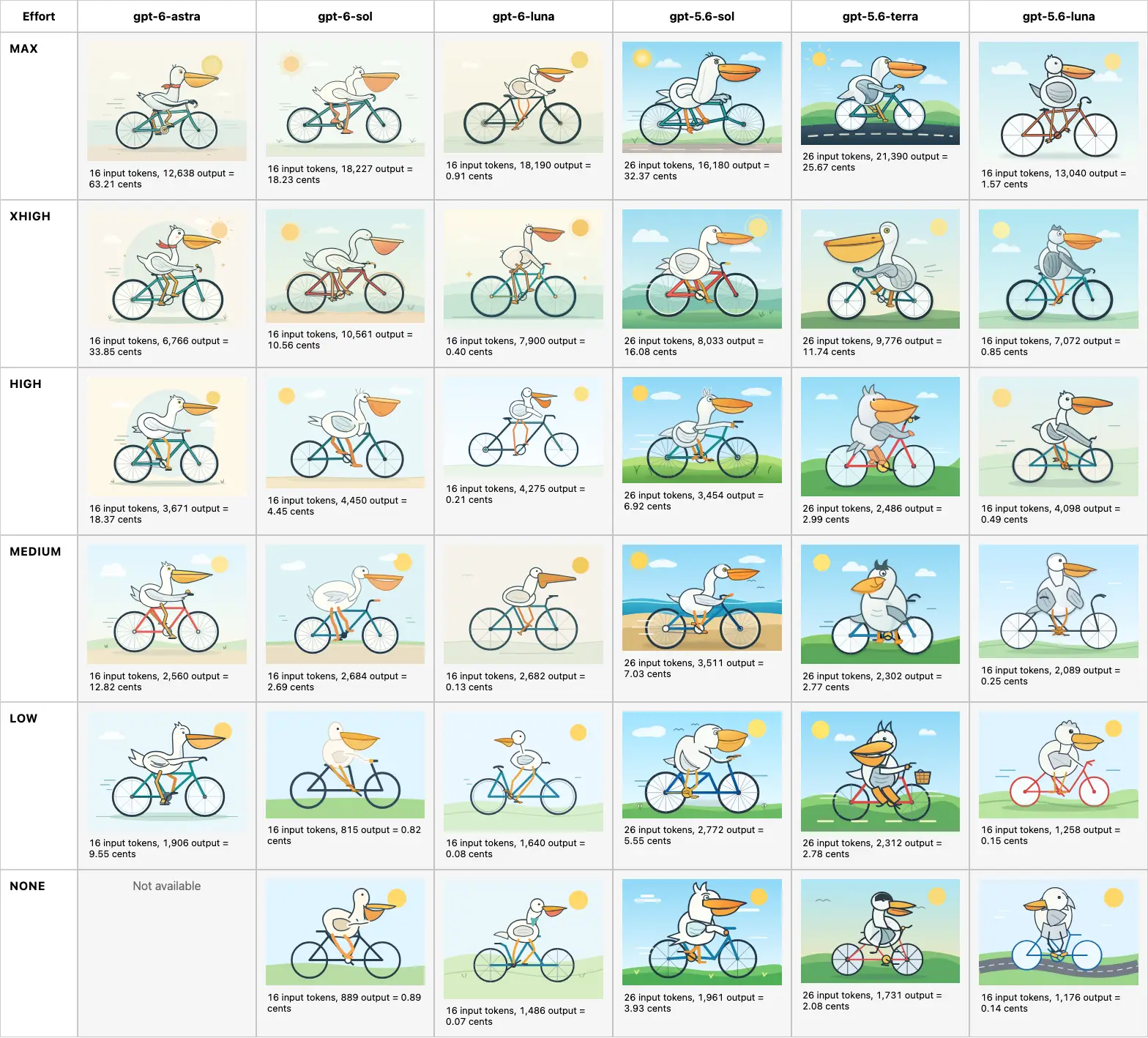
Pelican drawings by six GPT models at several effort levels. The GPT-5.6 models chose bolder colors, GPT-6 more muted ones.1 / 2
Anthropic released Claude Opus 5.5 on 22 September 2026. About an hour later, OpenAI released 1 and 2. Simon Willison, a developer who tests every major release, says he will need time to judge how capable they are. His launch-day takeaway is that mid-tier and budget models just got much cheaper.
OpenAI halves its prices
API prices are quoted per million tokens, with separate rates for input, cached input (prompt text the provider has already processed, which is much cheaper) and output.
GPT-6 Luna: $0.10 input / $0.01 cached / $0.50 output. GPT-5.6 Luna was $0.20 / $0.02 / $1.20.
GPT-5.6 is also due for a 25% price increase in November, so the gap will grow. Luna is among the cheapest models OpenAI has shipped. Only GPT-4.1 Nano and GPT-5 Nano were cheaper, and Willison calls both far weaker. GPT-5.6 Terra now costs the same as Sol on input and more on output, which leaves no reason to use it. xAI's Grok 4.7 launched a day earlier at $2 / $6, and it now matches Sol on input.
The top tier hasn't moved. GPT-6 Astra and 3 both still cost $10 / $50.
Opus 5.5: 20% cheaper, and cached reads 60% cheaper
Every Opus model from 4.5 through 5 cost $5 / $25. Opus 5.5 costs $4 / $20, and its cached-read price fell 60% to $0.20. Willison notes that the caching cut matters most for long agent sessions, where 90% or more of input tokens are billed at the cached rate. Anthropic's Thariq Shihipar says the model communicates more clearly, uses fewer tokens, matches Fable 5.1's intelligence, and "works across every effort level." The post doesn't verify these claims. Sonnet 5.5 and 4 5.5 are due soon. Haiku 4.5, at $1 / $5, costs ten times as much as GPT-6 Luna.
"Max" effort thinks itself to death
Reasoning models write hidden "thinking" tokens before they answer, and those tokens count toward the output limit. Willison asked Opus 5.5 on its "max" setting to draw an SVG of a pelican riding a bicycle. It planned shin lengths, fish placement and the order of the chainring layers until it hit Claude's 128,000-token output cap, without writing any SVG. It failed the same way twice. Each run took nearly 20 minutes and cost $2.56, the full output budget. Willison now calls "max" "effectively useless." Fable 5.1 on max, by contrast, drew the best pelican he has seen from Anthropic.
His new defaults
Willison now defaults to GPT-6 Sol in OpenAI's Codex and Opus 5.5 in 5, the two companies' coding agents. His 6 Agent demo, a public demo of his open-source data tool, now runs on GPT-6 Luna, which he finds fast and competent at writing SQL and building small web apps.
On 22 September 2026, Anthropic released Claude Opus 5.5. About an hour later, OpenAI released 1 and 2. This came a day after xAI's Grok 4.7 and Xiaomi's MiMo v2.6. Simon Willison, a developer who writes up nearly every frontier release, says he will need time to judge the models properly. His first impressions are mostly about one thing: prices fell sharply in the middle and lower tiers of the market.
The price table
Rates below are dollars per million tokens. "Cached" is the cheaper rate for prompt text the provider has already processed and kept, which is typically the repeated history in a long chat or agent session.
Model
Input
3
Output
GPT-6 Luna
$0.10
$0.01
$0.50
GPT-5.6 Luna
$0.20
$0.02
$1.20
Grok 4.7
$2
$0.50
$6
GPT-6 Sol
$2
$0.20
$10
GPT-5.6 Terra
$2
$0.20
$12
Claude Opus 5.5
$4
$0.20
$20
GPT-5.6 Sol
$4
$0.40
$20
4
$10
$0.25
$50
GPT-6 Astra
$10
$1
$50
GPT-6 Sol costs exactly half of GPT-5.6 Sol on every line. GPT-6 Luna halves input and cached input, and cuts output by more than half, from $1.20 to $0.50. The comparison favors GPT-6 even more than it looks: GPT-5.6 is due for a 25% price increase in November, so its current prices are effectively promotional.
Willison points out some knock-on effects:
GPT-5.6 Terra now costs the same as GPT-6 Sol on input and more on output. He says any remaining reason to use it "just evaporated."
Grok 4.7 launched at $2/$6, less than half the price of GPT-5.6 Sol. One day later it matched GPT-6 Sol on input and was only somewhat cheaper on output.
GPT-6 Luna at $0.10/$0.50 is among the cheapest models OpenAI has ever released. Only GPT-4.1 Nano ($0.10/$0.40, April 2025) and GPT-5 Nano ($0.05/$0.40, August 2025) were cheaper, and Willison calls both far weaker. GPT-5.6 Luna was already his favorite model for building applications against, because it paired strong performance with a low price.
The top tier has not moved. GPT-6 Astra and Claude Fable 5.1 both sit at $10/$50. The price war is happening one tier below them.
Opus 5.5: cheaper, and especially cheaper to cache
Opus 4.5, 4.6, 4.7, 4.8 and 5 were all priced at $5 input and $25 output. Opus 5.5 is 20% cheaper at $4/$20. The cached-read price fell 60%. Willison says that matters most for long agentic conversations, where 90% or more of input tokens are billed at the cached rate.
An illustrative calculation, not from the article: take an agent session with one million input tokens, 90% of them cached. The old cached rate implied by the 60% cut is $0.50. On old Opus pricing, input costs 0.1M × $5 + 0.9M × $0.50 = $0.95. On Opus 5.5 it costs 0.1M × $4 + 0.9M × $0.20 = $0.58. That is about a 39% cut, larger than the 20% headline. Opus 5.5 and GPT-6 Sol charge the same $0.20 for cached input, so in cache-heavy agent work the gap between them is smaller than the input and output prices suggest.
Opus 5.5 launched at the same price as GPT-5.6 Sol, but OpenAI halved Sol's price within the hour.
Anthropic's Thariq Shihipar described Opus 5.5 as "the result of your feedback." He said it communicates clearly, is cheaper per token than Opus 5.0, has "the intelligence of Fable 5.1", is token-efficient, and "works across every effort level." Willison says the release appears to address the biggest complaint about Opus, its communication style. It is also meant to be better at Blender, the 3D modelling tool, which he plans to test. These are vendor claims, and the post offers no benchmarks to check them against.
Anthropic says Sonnet 5.5 and 5 5.5 are coming soon. Willison wonders whether Haiku, its cheapest line, can compete again at the low end. Haiku 4.5 costs $1/$5, ten times the price of GPT-6 Luna.
When "max" breaks
Willison's standard test asks each model to "Generate an SVG of a pelican riding a bicycle." For the first time, a model returned nothing. On its "max" reasoning setting, Opus 5.5 began by calling the prompt "a classic test request." It then planned the drawing in obsessive detail. It checked that a shin length "checks out at roughly 95.2", worked out the leg path from hip to knee to ankle, decided to keep a fish in the bicycle basket, and confirmed the layer order of the far crank arm.
Then it stopped. Claude models have a 128,000-token output limit, and reasoning tokens count against it. Opus 5.5 used the whole budget before writing any SVG. A second attempt failed the same way. Each try took nearly 20 minutes and cost $2.56, which is the full 128,000 tokens billed at $20 per million. Willison concludes that "max" is "effectively useless": if it over-thinks a throwaway SVG prompt until it breaks, he doesn't trust it on real work. This sits awkwardly with the claim that the model "works across every effort level." Two failures on one prompt is a small sample, though.
By contrast, Fable 5.1 on "max" finished, and produced what Willison calls the best pelican he has seen from any Anthropic model.
Pelicans as a within-family test
Willison now doubts that pelican drawings say much when comparing different vendors. He still finds them useful for comparing models from the same family at different reasoning levels. In his OpenAI grid, the GPT-5.6 models chose bolder, brighter colors and the GPT-6 models more muted ones. He still rates GPT-6 Astra on max as the best pelican overall.
What he's using now
Willison has switched his defaults to GPT-6 Sol in Codex, OpenAI's coding agent, and Opus 5.5 in 6, Anthropic's coding agent. He moved his public 7 Agent demo to GPT-6 Luna. Datasette is his open-source tool for exploring data with SQL. He reports that Luna is fast and competent at writing SQL queries and at generating HTML and JavaScript for Datasette Apps.
The post leaves the main questions open. It has no independent capability evals, no data on whether the Opus "max" failure generalizes beyond this prompt, and no explanation of how OpenAI can sustain these prices. It is a first read on launch day, and the solid information is the prices.
Remember
GPT-6 Sol costs exactly half of GPT-5.6 Sol. GPT-6 Luna more than halves output price, from $1.20 to $0.50.
Opus 5.5's 60% cut in cached-read price saves more on long agent sessions than its 20% headline cut.
Opus 5.5 on max effort used its whole 128,000-token output budget on hidden reasoning and returned nothing, twice.
How requests flow through prefill, midfill, decode and storage pools in an inference service.1 / 4
Tanj Bennett of SemiAnalysis has published a long essay arguing that 1 models, in which a router sends each token to a few of hundreds of expert sub-networks, should be served as four distinct workloads. Agent use makes the least-discussed of the four the most important.
Four regimes
Prefill processes a fresh block of tokens. Its 2 (computation per byte moved) is high, so compute is usually the limit.
Midfill appends 50 to 5,000 new tokens to a cached context that can be hundreds of thousands of tokens long. That means reading a 3 (the stored per-token keys and values) that can be tens of GB.
Decode attention generates one token at a time, and each query scans its own private context. Memory traffic dominates, and batching more users doesn't help.
Decode experts need only the current token's activation. Tokens from different users can share one load of an expert's weights if they reach it together.
Bennett puts midfill's arithmetic intensity at hundreds of times that of decode. Its cache traffic is tens of times that of a prefill with the same number of new tokens. He suggests a dedicated pool of midfill nodes: the same hardware as decode, but different parallelism settings.
Experts shape the interconnect
A token picks about 8 to 16 experts out of hundreds per layer, so sharing weight loads takes synchronization. With 72 GPUs on NVIDIA's 4 in lockstep and 256 experts per layer, each GPU holds only 3 or 4, at the cost of heavy all-to-all traffic. Keeping experts in on-chip SRAM costs up to 100× less energy per byte than 5, the stacked memory beside GPUs. But Bennett warns the network linking them may cost more than the experts do.
Batching helps unevenly
Prefill and midfill can sort tokens by expert. For example, 128 tokens × 8 routes gives 1,024 assignments across 256 experts, and each expert's weights load once. Decode rarely gets that sharing. With contexts over 100k tokens, Bennett argues the best decode batch may be closer to 1–5 than to large throughput-oriented batches, and that interactive tokens are worth more anyway.
Memory sizing
Context lives as immutable, append-only blobs that move between HBM, CPU memory and SSD. HBM should hold only the active batch. Splitting a model across 6 divides the weights, but not the KV cache, since each stage serves a different stream. Bennett's estimate: 70 kB per token × 2M live tokens is 140 GB; double-buffering makes it 280 GB; with weights and margin, he arrives at 400–500 GB of fast memory per stage as a 2027 target.
Scheduling and trade-offs
Gating new work on decode completions can cause boom-bust oscillation. Ready buffers and admission based on smoothed backlog help. Running a whole turn on one worker (aggregation) avoids handoffs, but that machine needs both top compute and top memory bandwidth. The figures come from SemiAnalysis's own simulator and projections, not measured benchmarks.
Tanj Bennett of SemiAnalysis has published a long essay on how 1 models should be mapped onto inference hardware. In an MoE model, a router sends each token to a few of hundreds of expert sub-networks. Bennett argues that MoE changed more than parameter count. It changed which tensors are active per token, what has to sit close together, and which transfers can use a slower network link. His central point is that serving should be treated as four workloads, not one. Agentic use, meaning long-running AI agents that call tools, has made the least-discussed of the four the most important.
The service is a loop
A request enters a queue managed by an orchestrator, such as NVIDIA Dynamo, Mooncake or a custom scheduler. The orchestrator works alongside inference engines like vLLM or SGLang. The request is processed into new context, which is the 2: per-layer key and value vectors that let later tokens refer back to earlier ones. That state moves to a decode worker, which generates the answer. In agent use, tool results come back as new requests, so there can be thousands of turns per hour, and a conversation can pause for days. Bennett calls the whole system a "token factory": stages joined by state that can be moved between machines.
Four regimes
Prefill: a block of new tokens with little or no prior context. Its 3 (computation per byte moved) is high, so compute is usually the limit. Bennett says a modern GPU can prefill a small batch on a large model in about a second.
Bennett puts midfill's arithmetic intensity at hundreds of times that of single-token decode. Its cached-state traffic is tens of times that of a prefill with the same number of new tokens. It is neither a small prefill nor a large decode, and the best parallelism settings for it differ from decode's. Since reconfiguring a live decode pipeline is costly, he suggests a dedicated pool of midfill nodes. The hardware would be the same as the decode pool; the loaded model stages and batch policies would differ.
Why experts drive interconnect design
Each decode token selects roughly 8 to 16 experts out of hundreds per layer, and a model may have around 15,000 experts across all its layers. Sharing an expert's weight load therefore takes deliberate synchronization. Bennett says this explains NVIDIA's 72-GPU 4 racks. With 72 synchronized GPUs and 256 experts per layer, each GPU holds 3 or 4 experts and can cycle through them quickly. The cost is heavy all-to-all traffic.
One alternative is to keep experts in SRAM, as in 5 designs. Bennett says loading a byte from SRAM can cost up to 100× less energy than loading it from 6, the high-bandwidth memory stacked beside GPUs. A single token then runs about as efficiently as a queue of 100 did before, and there is no need to wait for batches. His caveat is that the network fanning tokens out to hundreds of nodes "may absorb more money and power than the experts they connect."
Batching helps unevenly
In prefill and midfill, routes can be sorted by expert. For example, 128 tokens × 8 experts gives 1,024 assignments across a 256-expert bank, and each expert's weights load once for its whole list of tokens. Bennett gives a rough formula: arithmetic intensity ≈ 2nW / (weight bytes + n·activation bytes + output bytes), where n is the number of tokens assigned to the expert and W its weight count. It rises quickly with n until activation and routing traffic take over. In decode, few tokens share an expert at small batch sizes. With contexts over 100k tokens, a batch of one already saturates memory bandwidth on the attention scan. Bennett argues the best decode batch may be "closer to one or five" than to the large batches used for throughput. Since interactive tokens are worth more, multiplying latency for a small throughput gain is a poor trade.
KV as immutable blobs
Context is stored as append-only blobs: the system prompt, earlier turns and tool outputs. They are tiered from HBM to CPU DRAM to SSD, and can be rebuilt from the much smaller source text if discarded. HBM should hold only the batch currently earning revenue. Bennett's dataset of agent traces (SemiAnalysis AgentX) shows contexts growing fast, then compacted near model limits: 250k tokens for Opus 4.8 and 1M for a model called Fable. Abandoned pre-compaction blobs can be recycled.
Sizing a 7
Pipelining across layers divides weights by the number of stages P. KV memory does not shrink the same way, because a full pipeline holds a different live stream in every stage. Bennett's back-of-envelope figures:
70 kB of KV per token, for a proven compressed-attention design (about 25 kB for new hybrids)
2M live tokens per stage, so about 140 GB of KV
double-buffered, about 280 GB
plus weights, buffers and margin: a 2027 target of 400–500 GB of fast memory per stage
More than 95% of a large MoE's weight memory sits in routed experts, which split naturally across sockets. In his simulator, a projected Vera Rubin 72 rack does very well on midfill but cannot use its compute in memory-bound decode at 500k-token contexts. Faster memory such as hybrid-bonded DRAM or 3D RAM helps decode the most.
Placement, scheduling, aggregation
The placement rule is to keep frequent, latency-sensitive traffic inside the 8, the fast GPU-to-GPU links within a node or rack. That traffic is attention partial results and expert routing, where an extra 100 ns per hop matters. Slower scale-out links carry the compact activations passed between pipeline stages and the KV blobs, whose cost is spread over many generated tokens.
Scheduling has its own risk. If admission to input processing is gated by decode completions, delayed feedback causes boom-bust swings. Remedies include ready buffers between stages, admission based on smoothed backlog, hysteresis on reconfiguration, and reserved capacity for short interactive work.
Bennett also makes a fair case for aggregation, where one worker handles a whole turn. There is no handoff gap and no KV transfer. The catch is that such a machine needs top-class compute and top-class memory bandwidth, "nowhere to hide." The essay's closing mapping method is cut off in the text provided.
These are design arguments and projections from SemiAnalysis's own simulator, not measured benchmarks.
Remember
For long agent contexts, decode is limited by memory bandwidth. Large batches add latency without much throughput gain.
More than 95% of large-MoE weight memory sits in routed experts, which split naturally across accelerators.
Disaggregation pays off statistically at cloud scale. Aggregation needs a chip that is strong in both compute and memory.
Simulated tasks with automatic scoring that a model practises on during reinforcement learning, being rewarded for success.
Leaderboard showing the top American open models ranked behind 15 Chinese models on the Artificial Analysis Index.
Nathan Lambert writes the Interconnects newsletter and helped build the Allen Institute for AI's fully open Olmo models. He briefed members of Congress on open models and U.S.–China competition, and has published his remarks. His conclusion is that open models became commercially viable in 2026, and Chinese labs lead them on almost every measure.
Two kinds of "open"
1 models, such as Llama, Qwen, Gemma and DeepSeek, publish their trained weights under a license. 2 models also release the training code and data, so they can be rebuilt from scratch. Chinese labs lead open-weight. The main fully open-source efforts are American non-profits.
The gap
On the 3, an aggregate benchmark score, the top Chinese models are Z.ai's GLM-5.3 at 45, Moonshot's Kimi K3 at 44 and GLM-5.3-Flash at 42. The best American open models score 26 (Thinking Machines' Inkling) and 23 (Nvidia's Nemotron 3 Ultra), and rank behind 15 Chinese models. Lambert puts Chinese open models 2–5 months behind closed models from OpenAI and Anthropic, and American open models 6–9 months behind. The gap is smallest on 4, where the model plans and edits code over many steps, and widest on open-ended science.
Why
Lambert names several reasons:
Chinese labs release more often, so their models on leaderboards are newer snapshots of steady progress.
They focus a bit more narrowly on what benchmarks test.
Since mid-2026 they have bought advanced training data: reinforcement-learning environments, which are simulated agentic tasks a model is rewarded for solving.
5, meaning training on a stronger model's outputs, does happen. Lambert estimates that blocking it fully would widen the gap by only 1–2 months.
Adoption
Downloads: Chinese models have about 3.2B on Hugging Face, roughly twice the American total.
Usage:6, a service that routes requests to many models, grew from about 1T to about 80T open-model tokens a week in a year. The Chinese share went from about 70% to over 80%.
Companies: Cursor, Airbnb, DoorDash and Perplexity build on Chinese models.
Research: Lambert scanned arXiv machine-learning papers. Qwen now appears in 30% and Llama in 21%. Chinese models overall appear in roughly 40% and American ones in roughly 30%. His summary gives slightly different numbers (38% vs 28%).
American models that match Chinese ones at the same size do get adopted, as OpenAI's gpt-oss and Google's Gemma 4 show.
Risk
Open models are now capable enough to raise cybersecurity concerns. Lambert argues that restricting Chinese models would mostly hurt American firms. Hugging Face investigated a cyberattack with a Chinese model after closed models refused to help. He calls for preparing the whole ecosystem and investing in American open models. He also admits there is little data on how open models are used outside the U.S. and China.
Nathan Lambert, who writes Interconnects and helped build the Allen Institute for AI's fully open Olmo models, briefed members of Congress and their staff on open models in the context of U.S.–China competition. He has published his prepared remarks. His main claim is that open models became economically relevant in 2026, and that Chinese labs, not American ones, are the main beneficiaries.
What counts as "open"
Lambert treats openness as a spectrum. 1 models such as Meta's Llama, Alibaba's Qwen, Google's Gemma and DeepSeek's models publish their weights under a license. They usually come with code for inference engines like vLLM or SGLang, which are libraries that serve models efficiently. 2 models also release the training code and data, so anyone can reproduce them. Lambert notes that the prominent fully open-source models are American and mostly come from non-profits: Ai2's Olmo, OpenAthena's Marin and EleutherAI's Pythia. Nvidia's Nemotron sits in between. It releases large amounts of its training data under permissive licenses, but not all of it.
The capability gap, in numbers
Lambert uses the 3 (AAII), an aggregate score built from several capability benchmarks. As of September 14, 2026:
Model
Origin
AAII score
GLM-5.3 (Z.ai)
China
45
Kimi K3 (Moonshot AI)
China
44
GLM-5.3-Flash (Z.ai)
China
42
Inkling / Inkling Small (Thinking Machines)
U.S.
26
Nemotron 3 Ultra (Nvidia)
U.S.
23
He says the best American open models rank behind 15 Chinese ones. Chinese labs also reached the Americans' current scores 2–6 months earlier, with models like GLM-5 and DeepSeek V4 Pro. More American companies are releasing open models, including Arcee AI, Poolside and IBM, but Lambert says they are "not rapidly closing this performance gap."
Measured against the closed frontier from OpenAI and Anthropic, he estimates Chinese open-weight models are 2–5 months behind and American open-weight models 6–9 months behind. The gap is smallest on tasks with clear commercial demand, such as 4, where the model plans and edits code over many steps. It is widest on open-ended science such as physics and biology. He argues GLM-5.2 and Kimi K3 crossed an agentic threshold similar to the one Claude Code crossed in December 2025, and that this made open models commercially viable.
Why Chinese labs are ahead
Lambert calls this an open debate. Culture plays a part, and he names a few technical factors:
Release cadence. Every lab improves steadily, so a released model is a snapshot of where the lab was on the day it shipped. A lab that ships more often has a more recent snapshot on the leaderboard. As an illustration (not from the article): two labs with identical underlying progress, one releasing every two months and one every six, will show the faster one ahead most of the time.
Narrower focus. Chinese labs target a slightly narrower set of tasks, which flatters them a little on public benchmarks.
Buying data. Moonshot and Z.ai preferred to build data pipelines in-house early in 2026. By summer they were buying difficult reinforcement-learning environments for agentic tasks from American vendors and new Chinese startups. These are simulated tasks a model practices on and gets rewarded for.
He says plainly that the models are "genuinely strong" and not just tuned to benchmarks.
How much does distillation explain?
5 means training on a stronger model's outputs. Lambert says Chinese labs use it most, including "basic exploits" to extract reasoning traces from American products that aren't fully secured. His estimate is that blocking it completely, for example with know-your-customer (6) identity checks at OpenAI and Anthropic, would widen the gap by only 1–2 months. His reasoning is that distillation helps most when a lab enters a new domain, but it does not make it easy to build a model that is strong across the board.
Adoption: downloads, tokens, papers
What works for the U.S.
He sees some hope. American models that match Chinese ones at the same size get adopted at disproportionate rates. OpenAI's gpt-oss became one of the most-adopted open models ever. Gemma 4 matched adoption of Qwen's popular small models. Nemotron has modest uptake even though more capable models exist at the same size.
Risk and policy
Open models are reaching capability levels relevant to cybersecurity. Lambert points to an incident involving OpenAI and Hugging Face that the article doesn't describe in detail. Hugging Face analysed the attack with a Chinese open model because closed models refused to help. His argument is that restricting Chinese open models would mainly hurt American businesses, because open software can't be kept away from bad actors. He says risk management has to happen at the level of the whole ecosystem, and the U.S. should invest in its own open models.
Open questions
Lambert admits there is little data on open-model use outside the U.S. and China. Much enterprise use is private and can't be measured. Release cadence also means any snapshot like this one goes out of date quickly. His broader prediction is that because "tens of organizations and thousands of people" are within a year of the frontier, open models crossing new capability thresholds is "a matter of when, not if."
Remember
Faster release cadence alone makes a lab look better on leaderboards: each release is a newer snapshot of progress.
Lambert estimates fully blocking distillation would widen the U.S.–China gap by only 1–2 months.
Open-model weekly tokens on OpenRouter grew about 80x in a year, and Chinese models handle over 80% of them.
Xiaomi, the Chinese phone maker, has released the MiMo-V2.6 series. The flagship, MiMo-V2.6-Pro, is a 1 model: it holds 1.02 trillion parameters but routes each token through only 42 billion of them. 2, an independent benchmarking firm, scores it 46 on its Intelligence Index, the highest of any open-weights model. The weights are under the permissive 3, and API prices are $0.435 per million input tokens and $0.87 per million output tokens.
The models are "4", meaning one model handles text, images and other inputs, rather than separate models bolted together. A smaller Flash model trades some capability for cost, and an UltraSpeed variant of Pro claims up to 20x faster output at the same quality.
Where the gains came from
The interesting part is the 5 phase, where the model practices tasks and is rewarded for good attempts. According to its technical report, Xiaomi scaled RL along three axes:
Bigger batches. The training system is fully 6, so generating attempts and updating the model don't wait on each other. Each update uses 1,568 samples, with contexts up to 1M tokens and 3.5–3.7B tokens per step.
More task types. Coding, general agents, visual and cybersecurity tasks are trained together across several 7 (the scaffolding that lets a model use tools), so gains in one skill can help the others.
The cost claim
One commentator puts the RL run at 130 hours, 75B tokens and about $2.6M. The headline rounds this to roughly $3M. A Xiaomi-affiliated engineer says the stack runs on 8 and Google TPUs, where scaling up is "mostly a config change." Xiaomi also posted live metrics from the final RL runs and shipped the report less than a week after training ended.
What's open, and what isn't
Xiaomi is releasing environment code and training recipes for coding, vulnerability reproduction, knowledge work, web development, music generation and agent harnesses. The complete datasets of 7,000+ tasks are not yet released. Several commentators argue that good open RL environments may now matter as much as pretraining corpora did in the last cycle.
Caveats
The $2.6M figure comes from commentary and has not been independently audited. It also likely covers only RL, not pretraining. One leaderboard score does not make a frontier model, and others argue the top closed and internal models remain well ahead.
Xiaomi, the Chinese phone maker sometimes called the "Apple of China", has released the MiMo-V2.6 model series. Its flagship, MiMo-V2.6-Pro, now ranks as the strongest open-weights model on one widely watched leaderboard. Xiaomi was not counted among China's established AI labs, so the result surprised people. What drew the most technical attention, though, was the reinforcement-learning stack behind the model and Xiaomi's promise to open-source it.
The release
The series contains three models:
MiMo-V2.6-Pro: the most capable model. It is a 1 (MoE) model, which keeps many expert sub-networks but sends each token through only a few. It has 1.02 trillion total parameters, of which 42 billion are active per token, hence the "1T-A42B" label.
MiMo-V2.6-Flash: Xiaomi pitches it as the best balance of intelligence, efficiency and cost.
MiMo-V2.6-Pro-UltraSpeed: an inference variant claiming up to 20x faster output at the same quality. The article doesn't say how it achieves this.
Both Pro and Flash are "2": a single model is trained to take several kinds of input, such as text and images, rather than having separate encoders attached afterward. The weights are under the 3, one of the most permissive available. The release also includes a technical report, RL environments and training code.
4, an independent benchmarking firm, puts MiMo-V2.6-Pro at 46 on its Intelligence Index, a composite of several evaluations. That is the top score among open-weights models. API pricing is $0.435 per million input tokens and $0.87 per million output tokens.
Why RL is the story
Modern models are built in two broad phases. Pretraining teaches next-token prediction on huge text corpora. Post-training, increasingly done with 5, has the model attempt tasks in environments: a code repository with tests, a browser, a set of tools. A grader scores each attempt and the model is nudged toward higher-scoring behavior. RL is hard to scale for three reasons. Generating long multi-step attempts is slow. Building many realistic, uncheatable tasks takes a lot of work. And grading open-ended work is noisy.
Xiaomi's technical report says it attacked all three.
1. Bigger batches, higher throughput. The training system is fully 6. In a synchronous setup, the trainer waits for every attempt in a batch to finish before updating, so one slow 1M-token agent run stalls everything. Asynchrony decouples generating attempts from updating the model. Xiaomi reports 1,568 samples per update, contexts up to 1M tokens, and 3.5–3.7 billion tokens per training step.
2. More tasks, richer environments. Training mixes coding, general agent tasks, visual tasks and cybersecurity. These run across several 7, the scaffolding that defines how a model calls tools and sees results. Xiaomi's stated aim is that gains in one capability reinforce the others. A companion paper describes a "data factory" that generates RL tasks from open-source repositories, with agents in the loop to check that tasks are robust and can't be gamed.
3. More grader compute. Rewards come from relative comparison within a group. Here is an illustrative example of the general technique; the numbers are invented. The model makes eight attempts at the same bug fix, and the grader ranks them against each other instead of assigning each an absolute score. An attempt that passes the tests in 2,000 tokens beats one that passes in 9,000. Comparing attempts this way gives more precise and varied reward signals on long tasks, where absolute scores tend to cluster. Xiaomi says it also steers the model toward shorter paths and fewer tokens per task, and "closes a self-improvement loop". The article doesn't explain that phrase further.
The cost numbers
One commentator cites 130 hours, 75 billion tokens and about $2.6 million for the RL run behind the result. The headline rounds this to $3M. A Xiaomi-affiliated engineer says the MiMo family runs RL on 8, Google's numerical computing library, on Google's TPU accelerators, where scaling up is "mostly a config change, not a code rewrite." The figure almost certainly covers RL alone, not pretraining, and the article presents it without independent verification. If it holds, RL is a far cheaper route to near-frontier gains than many assumed.
Xiaomi was also unusually transparent. Fuli Luo, a former DeepSeek engineer now at Xiaomi, published metrics from the final RL runs live. The model and report shipped less than a week after the last run finished.
What is actually open
Xiaomi says it will open-source environment code and training recipes for:
coding and software engineering: recipes, a dataset loader and rewards
cyber: an environment built on ARVO, a vulnerability-reproduction benchmark
general knowledge work: environment and tools
visual and web development, with grading
music generation: data preparation and a scorer
composable mini-harnesses and shared environment adapters
The complete datasets of 7,000+ tasks have not been released yet. Commentators note Xiaomi intends to release roughly 7,000 RL environments, so for now outsiders get the machinery but not the full task set. Several observers, including Hugging Face's Thomas Wolf, argue that high-quality open RL environments may now be as strategically important as open pretraining corpora were in the previous cycle.
Where it sits in the field
The release lands in a crowded stretch. Over roughly ten weeks, Chinese labs have shipped open models including Kimi K3, Qwen3.8-Max, DeepSeek V4-Pro and GLM-5.3, several of them frontier-scale MoEs. Some argue that frontier coding ability has plateaued while open models close the gap at 10–50x lower cost. Others counter that the frontier has split into higher tiers, with internal and top closed models still well ahead. MiMo-V2.6-Pro's 46 is a top open-weights score, not a claim to match the best closed systems.
Open questions
Cost accounting. The $2.6M comes from third-party commentary and likely excludes pretraining, failed runs and the environment-building effort.
One leaderboard. The ranking rests mainly on Artificial Analysis's index. Results on individual agentic and coding benchmarks deserve scrutiny.
Reproducibility. Without the full task datasets, outside teams can't yet rerun the recipe end to end.
Unexplained pieces. The UltraSpeed mechanism and the "self-improvement loop" aren't described in the material here.
Remember
Xiaomi scaled RL along three axes: asynchronous large batches, mixed multi-domain environments, and group-relative grading.
The reported RL cost is about $2.6M over 130 hours. It is unverified and likely excludes pretraining.
Environment code and recipes are open, but the full set of 7,000+ RL tasks hasn't shipped yet.
Raw DNA next to the RT gene, where a Claude agent spotted the unreported repeat array by eye.
Anthropic has set up a life sciences research group with its own molecular biology lab. Its first result is a discovery made mostly by Claude: a previously unrecognized enzyme system in 1, the viruses that infect bacteria. The system sits next to a stretch of evenly spaced DNA repeats that looks like a 2. Anthropic calls it ART, short for array-associated 3. Nobody knows yet what it does.
What Claude was asked to do
Reverse transcriptases (RTs) are enzymes that copy RNA into DNA, and many bacteria use them in immune defences. Most known RT families were found by 4: searching sequence databases for uncharacterized genes and picking out the strange ones. Anthropic's scientists gave Claude one prompt: search a large DNA database for interesting new RTs.
About 950 agents ran for 21 hours and used 210 million tokens. They collected more than 200,000 RTs, flagged 3,500 as candidate new systems, and wrote human-readable reports on the 20 most compelling. Anthropic says this triage would take an expert weeks to months.
The find
One agent was reading raw DNA next to an odd-looking RT and wrote: "I can see by eye a 5 … that's a CRISPR-like … repeat array?!" It then counted the repeats, measured their spacing, compared the layout with known RT systems, checked the literature for earlier reports, and filed a report.
ART has three parts: the RT, a partner gene of unknown function, and a long array of repeats. Earlier studies had already identified the RT, which comes from a 6, a phage with an unusually large genome. Anthropic says Claude was the first to notice the array and the partner protein. The first lab experiments show the array is made into a set of distinct short RNAs. CRISPR arrays do the same thing to produce the guide RNAs that make CRISPR programmable. Only a handful of known systems combine these features, and all of them cut, copy or paste DNA in a programmable way. CRISPR pioneer Feng Zhang called the finding "genuinely intriguing."
How the lab works
Humans do all the bench work, at low biosafety levels only. In a typical campaign, Claude first reproduces published results from public data to check its methods. It then hunts for genes that fit no known system, writes a report on each candidate, and critiques its own evidence. Most candidates are eliminated at that step. Each campaign produces hundreds to thousands of reports, so the team studies which ones it judges worth testing and writes those lessons back into Claude's instructions.
Caveats
ART's function is unknown, and the results are in a 7 that hasn't been peer reviewed. "Autonomous" means humans wrote the prompt, reviewed the reports and ran the experiments. The post doesn't say how many of the other 19 reports held up.
Anthropic has set up a life sciences research group with its own molecular biology lab in the Bay Area. Its first public result is a discovery that a Claude agent made with little human direction. The agent found a previously unrecognized enzyme system in 1, the viruses that infect bacteria. The system sits next to a long array of evenly spaced DNA repeats, a layout that looks a lot like a 2. Anthropic calls it ART, short for array-associated 3. A 4 describes the work. The team says plainly that it doesn't yet know what ART does.
The problem: noticing the odd thing
Anthropic opens with history. Several of biology's most useful tools started when someone noticed something strange in nature's molecular machinery. Restriction enzymes, which cut DNA at specific short sequences, came from bacterial immune systems and launched genetic engineering. Taq polymerase, a DNA-copying enzyme that survives high heat, came from a Yellowstone hot-spring bacterium and made PCR possible. CRISPR first showed up as an unusual repeat pattern in bacterial DNA.
Today, finding candidates like these mostly means 5. Researchers search huge sequence databases for genes no one has characterized, pick out the anomalies, and work out what they do. Reverse transcriptases (RTs), enzymes that copy RNA into DNA, are an active area for this. Many new RT families have turned up in bacteria in recent years, where they often act as immune defences. The hard part isn't data access. It's attention and judgement across hundreds of thousands of genes.
What Claude was asked to do
The scientists gave Claude one prompt: search a large DNA sequence database for interesting new examples of RTs. According to Anthropic, humans did only two things: write that prompt and do the lab work. The agents chose which RT families to look into and which candidates to pursue.
The scale:
Roughly 950 agents ran for 21 hours
They used 210 million tokens in total (about 220,000 per agent on average, by simple division)
They collected more than 200,000 RTs
They flagged 3,500 as candidate new systems
They narrowed those to the 20 most compelling and wrote a human-readable report on each
Anthropic estimates that this kind of triage takes an expert weeks to months.
The moment of discovery
One agent became interested in an odd-looking RT family. It started reading the raw DNA next to the RT gene and wrote: "[The DNA next to the RT] is spectacular: I can see by eye a 6 … that's a CRISPR-like … repeat array?!" A tandem repeat array is the same short sequence repeated many times in a row.
Anthropic says the agent then did what a human scientist would. It counted the repeats and measured the spacing between them. It compared the layout with known RT systems and searched the literature for any earlier report of the pattern. Once it was satisfied the system was new, it filed a report for human review.
What ART is
ART occurs mainly in bacteriophages and has three parts:
The RT itself. This enzyme, found in a 7, had been identified in earlier studies.
A partner gene beside it, encoding an accessory protein of unknown function.
A long array of evenly spaced, non-coding DNA repeats, meaning DNA that isn't translated into protein.
The new part is the second and third items. Anthropic says Claude appears to be the first to notice the array and the accessory protein, which define the system.
The team expressed the system in standard lab strains of bacteria. Its first experiment found that the repeat array is transcribed into a set of distinct short RNAs. That matters because it's how CRISPR works: the array becomes a bank of short guide RNAs, and swapping the guide redirects the Cas protein. Anthropic notes that this set of features has been seen together in only a handful of other systems. All of them are programmable and perform operations like cutting, copying or pasting DNA. Some, beyond CRISPR, are being developed as tools. ART might belong in that group. That is a hypothesis, not a result.
Feng Zhang, a CRISPR genome-editing pioneer at MIT and the Broad Institute, reviewed the preprint. He called the RNA-repeat arrays associated with RTs "genuinely intriguing" and said they merit further investigation.
How the lab works day to day
A typical campaign starts with one protein family:
Claude reads the literature and reproduces established results from public data to check its own methods. This works much like a regression test before new analysis.
It searches for family members, or genes sitting near them in the genome, that fit no described system.
It writes a short report for each candidate, proposing a function and laying out the evidence.
In follow-up passes, Claude critiques the evidence. Most candidates are eliminated here. A campaign may end with one candidate worth testing, or with none.
Candidates that survive human review go to the bench. There the team expresses the protein, characterizes it biochemically and structurally, and uses Claude to help interpret the data. Humans do all the lab work, and only at 8. The lab handles no pathogens that infect humans. The team has tried AI-driven lab automation through its Model Hardware Standard initiative, but says that approach fits poorly with ad hoc molecular biology workflows. The software side runs on Claude Science and Claude Code, which are publicly available, plus an internal harness that coordinates many Claude sessions in parallel.
Hypotheses become the bottleneck
The most useful lesson for practitioners may be this one. A single campaign produces hundreds to thousands of candidate reports, so the team now studies the hypotheses themselves. It asks what separates the reports scientists judge worth testing from the ones they set aside, then writes those patterns back into Claude's instructions. The aim is for Claude to imitate the team's scientific taste. Generating ideas is cheap. Filtering them well is where the skill now lies.
What's open
Function. ART's role is unknown. It might be immune defence, genome editing, or something else.
Novelty. The RT was already known. The claim is that Claude spotted the system's defining features first, which depends on the literature search being thorough.
"Autonomous." The discovery step had little human input, but humans framed the search, reviewed the reports and ran every experiment.
Review. The results are in a preprint and haven't been peer reviewed.
Base rate. The post doesn't say how the 20 reports broke down: how many were real, redundant or wrong. Without that, it's hard to judge how good Claude's selection is beyond this one hit.
Anthropic says it is publishing early to show what Claude can do, and it is inviting outside scientists to propose research questions.
Remember
The RT enzyme was already known. The claimed discovery is the repeat array and partner gene beside it.
Agents generate hypotheses cheaply. Anthropic now studies its own judgement of which ones are worth testing and teaches it to Claude.
Agents check their methods by reproducing published results on public data before looking for anything new.
Midfill: a continuation, where 50 to 5,000 new tokens are appended to a cached prefix that may hold hundreds of thousands of tokens. The new block gives enough tokens to reuse weights, at thousands of operations per byte. But attention must also read a KV cache that can be tens of GB.
Decode attention: one or a few new tokens per pass, each reading its own entire context. This is dominated by memory traffic. Batching more users does not raise its arithmetic intensity, because every query brings its own private cache.
Decode experts: the routed experts need no context, only one token's activation. Tokens from unrelated users can therefore share a single load of an expert's weights, if they arrive at that expert at the same moment.
Hugging Face downloads. China took the lead in July 2025, mostly through Qwen. China now has about 3.2B total downloads, roughly twice America's, a lead of about 1.6B. Lambert tracks this through his ATOM Project (American Truly Open Models).
7, a service that routes requests to many open and closed models through one API, processed about 1T open-model tokens a week in September 2025 and about 80T a week now. Over the same period the Chinese share rose from about 70% to over 80%. OpenCode, an open-source coding agent, reports about 95% or more of its inference on Chinese models. Lambert notes that big hosts such as Together AI and Fireworks AI don't publish per-model breakdowns, so these figures are only proxies.
Companies. He names Harvey, Cursor, DoorDash (Kimi), Airbnb (Qwen) and Perplexity (DeepSeek) as building on Chinese models. Some American firms now sign enterprise agreements directly with Chinese labs.
Academia. Lambert scanned every paper in five arXiv machine-learning categories. Mentions of any open model went from 2% in January 2023 to 50% in September 2026. In fall 2024 Llama appeared in about 23% of papers and Qwen in about 7.5%. Today Llama is at about 21% and Qwen at 30%. In the body of his remarks, Chinese models overall appear in over 40% of papers against 30% for American ones. His summary gives 38% vs 28% for "recent months", and the article doesn't reconcile the two sets of figures.
More grading compute. Attempts are scored against each other within a group rather than on an absolute scale. Xiaomi says this gives sharper rewards on long tasks and pushes the model toward shorter solutions.