Fifty Gigawatts and a Voice From a Prompt · Morning Gist
Monday, October 195 stories · 15 min
Fifty Gigawatts and a Voice From a Prompt
A forecast of huge datacenter growth leads today, along with Google's promptable voices, NVIDIA's new multi-GPU and agent tooling, and OpenAI's terms for outside safety auditors.
Picked from 120 new articles across 24 sources · arrow keys for other days
Today in 30 seconds
30s left
SemiAnalysis forecasts about 50 GW of new datacenters in 2027, citing $1 trillion in binding leases. One prominent investor calls that too aggressive. story 1 ↓
Google's Gemini 3.8 Flash TTS can design a voice from a text prompt or clone one from 30 seconds of audio. Google gave no prices or latency figures. story 2 ↓
NVIDIA's Triton server can now split one TensorRT model across eight GPUs, cutting a video job from 157 to 34 seconds. story 3 ↓
OpenAI set out what outside safety auditors should examine. Labs still get to fix problems before any report is published. story 4 ↓
NVIDIA packaged its audit for moving ROS 2 robot data onto the GPU as a coding-agent skill with built-in checks, but published no speedup figures. story 5 ↓
1/5SemiAnalysis· Jeremie Eliahou Ontiveros· Oct 19
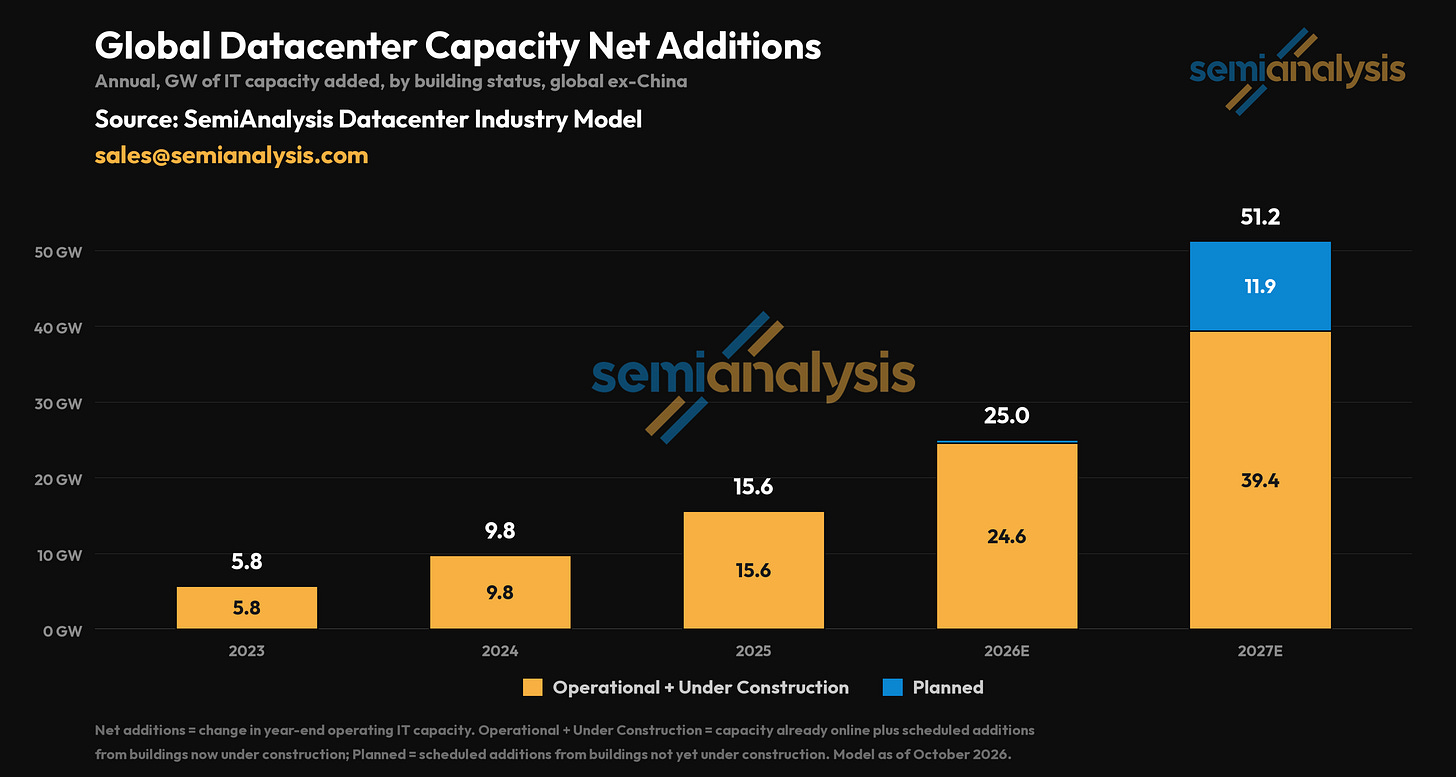
SemiAnalysis forecasts roughly 50 gigawatts of new datacenters in 2027
SemiAnalysis, an industry research firm, expects about 50 gigawatts of datacenter capacity to come online worldwide in 2027. It points to record construction starts, about $1 trillion in signed leases, faster modular building and on-site power plants.
Why it matters · If this much capacity arrives, compute stops being the main limit on AI labs in 2027–28, and the bottleneck moves to memory and logic chips.
Know this first
Context from the editor, not the article · 29 sec
1 · Datacenters measured in gigawatts
AI datacenter size is quoted in power, usually megawatts (MW) or gigawatts (GW) of IT load. One GW holds very roughly hundreds of thousands of top-end GPUs. Power is now the standard way to count compute capacity.
2 · Who builds the buildings
Hyperscalers (Amazon, Microsoft, Google, Meta) build some datacenters themselves, called 'self-build'. They also lease from developers, who construct the campuses and rent them out on long contracts. Labs like OpenAI and Anthropic now sign leases directly too.
3 · The bottleneck debate
Since 2024, power grid access, skilled labor, equipment such as turbines and transformers, and financing have all been named as limits on how fast AI compute can grow. Skeptics argue these limits will push announced projects years behind schedule.
2/5Google DeepMind· Sep 23
Google releases Gemini 3.8 Flash TTS models with voice design and cloning
Google DeepMind released two Gemini 3.8 text-to-speech models. They can design voices from text descriptions, clone a voice from a 30-second sample, and act out two-speaker scripts. Both lead third-party quality leaderboards.
Why it matters · Speech output is moving from picking a preset voice to writing a prompt, the same shift text models made. The evidence behind these claims comes from leaderboards and is thin.
Know this first
Context from the editor, not the article · 28 sec
1 · How TTS has worked
Text-to-speech (TTS) APIs usually offer a fixed set of preset voices, plus a few knobs such as speed and pitch. Newer models built on large language models take natural-language instructions about how to deliver each line.
2 · Gemini's earlier TTS
Google's previous model, Gemini 3.1 Flash TTS, offered 30 preset voices. "Flash" and "Flash-Lite" are Google's names for its faster, cheaper tiers. Flash-Lite trades some capability for lower cost at high volume.
3 · Voice leaderboards
Speech quality is hard to score automatically, so the field relies on human ratings. Arena-style leaderboards play two anonymous clips side by side and ask listeners which one they prefer, then turn many such votes into a ranking.
3/5NVIDIA Technical Blog· Tanya Lenz· Sep 21
NVIDIA's Triton server can now run one TensorRT model across eight GPUs
NVIDIA's Dynamo-Triton 26.07 can serve a single TensorRT model spread across several GPUs behind one endpoint. In NVIDIA's test, eight GPUs cut one Cosmos 3 video generation from 156.6 to 34.2 seconds.
Why it matters · Splitting one request across GPUs used to mean writing your own rank and communicator code. Now it is a server config option, with clear limits on how far the latency gains scale.
Know this first
Context from the editor, not the article · 30 sec
1 · TensorRT and Triton
TensorRT is NVIDIA's compiler that turns a trained model into an optimized GPU "engine" (a plan file). Triton, now renamed Dynamo-Triton, is NVIDIA's open-source server that loads such models and exposes them over HTTP or gRPC.
2 · Splitting a model across GPUs
When one GPU is too slow or too small, the work is split across several GPUs, called "ranks". The ranks exchange data through collective operations such as all-gather or all-to-all, usually run by NCCL, NVIDIA's GPU communication library.
3 · Diffusion video generation
Video diffusion models start from noise and refine it over many steps. Each step runs a large transformer. Classifier-free guidance runs two predictions per step, one with the prompt and one without, and combines them to follow the prompt more closely.
4/5OpenAI· Sep 22
OpenAI sets out what outside safety auditors should examine, and on what terms
OpenAI published four areas where independent assessors should test its safety work, plus seven rules for doing it. The rules cover agreed scope, access, independence, security, and how findings get published or redacted.
Why it matters · Lab safety claims are only as credible as the outside checks on them. This document shows what OpenAI is willing to open up to auditors and which controls it keeps for itself.
Know this first
Context from the editor, not the article · 28 sec
1 · Third-party AI assessments
Outside groups, such as nonprofit evaluators and government AI safety institutes, test frontier models for dangerous capabilities and weak safeguards. Until now the lab has largely decided what access they get, how long they have, and what they can publish.
2 · Preparedness Framework
OpenAI's internal policy for tracking catastrophic risk. It sets capability thresholds in categories like bio/chem, cybersecurity and AI self-improvement. Crossing a threshold requires stronger safeguards before a model can be deployed.
3 · Safety cases
Borrowed from aviation and nuclear engineering: a structured argument, backed by evidence, that a system is safe enough for a given use. Individual safety claims, such as 'this monitor catches X', serve as its building blocks.
5/5NVIDIA Technical Blog· Tanya Lenz· Sep 22
NVIDIA uses a coding-agent skill to move ROS 2 robot data onto the GPU
NVIDIA shows an AI coding agent, following a scripted "skill", converting a GPU depth-estimation robot node to pass camera data between programs in GPU memory without CPU copies. It keeps standard messages and a CPU fallback.
Why it matters · It is a concrete case of packaging an expert code audit as a repeatable agent workflow, with verification steps built in instead of trusting the agent's diff.
Know this first
Context from the editor, not the article · 31 sec
1 · How ROS 2 moves data
ROS 2, the standard robotics framework, splits a robot's software into nodes (separate processes) that publish and subscribe to typed messages on topics. Messages are usually serialized and copied through CPU memory, even when both ends compute on a GPU.
2 · Why copies hurt on GPUs
A GPU has its own memory. Moving a camera frame from GPU to CPU and back adds latency and uses memory bandwidth. With several perception nodes in a chain, those copies can cancel out much of what fast CUDA kernels gained.
3 · Agent skills
A "skill" is a packaged set of instructions, and sometimes scripts, that a coding agent loads to carry out a specific task in a fixed sequence. It turns expert know-how into a checklist the agent works through.
SemiAnalysis forecast of global datacenter capacity additions, showing the 2027 jump.1 / 4
SemiAnalysis, a research firm that sells datacenter data, forecasts that about 50 gigawatts (GW) of new datacenter capacity will come online worldwide in 2027. That is roughly the whole global datacenter stock built through 2024, added in a single year. The post answers investor Brad Gerstner, who called the firm's earlier +43 GW figure "too aggressive" and guessed about 25 GW. The post doesn't explain the gap between 43 and 50.
The evidence comes from SemiAnalysis's own paid models, so outsiders can't verify it. The firm says it already discounts optimistic timelines and has called past delays.
The evidence
Buildings nearly done. More than 24 GW across just 40 campuses is in advanced construction for 2027, most of it past halfway with cooling and electrical gear installed. SemiAnalysis tracks several hundred such sites.
Construction starts. Quarterly megawatts entering construction at US 1 (the big cloud companies) are "going parabolic," driven mostly by two of them, which the firm doesn't name in the free text.
Leases. Developers spend only 5–10% of a project's capital before signing a tenant. A 2, typically 15–20 years and worth $30–50B per GW, is what lets them borrow the rest. Leasing was flat from mid-2023 to mid-2025 while Microsoft paused, then took off when Oracle signed about 4.5 GW in late 2025. More than $1 trillion of binding leases has been signed in 2026 so far, and most of the matching debt has been raised. A rough check of our own: $1T at those prices is about 20–33 GW.
How it gets built
Prefabrication. Google uses factory-built electrical modules, Meta uses tent structures, and AWS prefabricates whole data halls. Builds now take under 10 months. Mechanical, electrical and plumbing (3) labor, normally 7–11 months of work, can fall by up to 63%. Developer DayOne builds in about 9 months, against more than 18 for traditional developers.
4 power. Grid connections take 5–10 years, so builders generate their own power on site with fuel cells, truck engines and refurbished turbines. The author calls power "broadly solved," a strong claim with little data in the free text.
So what
The author expects much more, and cheaper, compute; faster model progress; huge capital spending; and higher interest rates. He suggests memory and logic chips, not buildings, may become the main constraint in 2027–28. Whether that leaves datacenters oversupplied is covered in the paywalled section.
SemiAnalysis, a research firm that sells datacenter and semiconductor data models, has published a forecast that about 50 GW of new datacenter capacity will come online worldwide in 2027. By its own comparison, that roughly equals the entire global datacenter stock built through 2024, added in one year. The post responds directly to Brad Gerstner of the investment firm Altimeter. On the All-In Podcast, Gerstner showed SemiAnalysis's earlier figure of +43 GW for 2027, called it "too aggressive," and said his "hunch" was about 25 GW. The post doesn't explain the move from 43 GW to roughly 50 GW. The headline uses the larger number.
A caveat applies throughout. Most of the evidence comes from SemiAnalysis's own paid products, including its Datacenter Industry Model, Industrials Model and Energy Model. Outsiders can't check the underlying data. The section on whether all this capacity leads to oversupply is behind a paywall.
Why skeptics doubt it
Nobody disputes the constraints. The author lists labor shortages, workers not showing up, delayed vendors, the difficulty of raising money, and a US grid that can't absorb new load quickly. SemiAnalysis also points to its record of calling delays, such as Oracle's New Mexico site, which declared 1 in April. Its argument is that the model already discounts developers' optimistic timelines and still shows a large acceleration.
Evidence 1: buildings that are nearly finished
The most concrete evidence is physical. SemiAnalysis says more than 24 GW of capacity across just 40 campuses is in an advanced stage of construction and due in 2027. Most of these sites are past the halfway point, with outdoor cooling and electrical equipment already installed. It says those 40 are a small fraction of the "multiple hundred" advanced-stage sites it tracks. It also points to giant sites that were delivered, such as Crusoe's in Abilene, AWS's in Indiana, and QTS/Microsoft's in Georgia. It credits these sites with training frontier models it names as GPT-6 and Fable 5.5.
Evidence 2: leading indicators
Two indicators move ahead of completions.
Self-build construction starts. SemiAnalysis tracks every building that US 2 put up. It says quarterly megawatts entering construction are "going parabolic," driven mostly by two hyperscalers. It doesn't name them; that detail is paywalled.
Leasing. A multi-hundred-megawatt campus costs too much to build on speculation. Developers typically spend only 5–10% of a project's capital before they have a tenant. A signed 3, usually 15–20 years long with a 4 of $30–50B per GW, is what lets them borrow the rest. So the order of events is lease, then debt, then construction, and leases are the earliest signal.
That order explains why 2026 growth looks modest next to 2025. Leasing was flat from the second half of 2023 to the first half of 2025, mostly because Microsoft had been the dominant tenant and then paused (SemiAnalysis says it flagged this "freeze" in December 2024). The pattern changed in late 2025. Oracle closed about 4.5 GW across three sites between August and October 2025. Meta, AWS, Microsoft, Google, Nvidia, AMD, Anthropic and OpenAI then all went looking for gigawatt-scale leases, and smaller "5" (GPU-rental cloud providers) signed hundred-megawatt deals.
The headline figure is that more than $1 trillion of binding, non-cancellable lease value has been signed in 2026 so far. SemiAnalysis says most of the debt backed by these leases has already been raised. As an illustrative check of our own, not one from the article: at $30–50B per GW, $1T works out to roughly 20–33 GW of contracted capacity. That fits a build that lands across 2027–28.
How you build 50 GW in a year
Big equipment orders are already flowing to suppliers such as Vertiv, ABB and Sterling Infrastructure. The hard part now is turning orders into finished buildings, and the article describes three responses.
Simpler, prefabricated designs. Google has modularized its electrical architecture. It replaced outdoor cabling that crews had to assemble on site with prefabricated electrical modules. Meta uses tent-style structures. AWS has a simplified shell design called "SAMDC" and prefabricates whole data halls under "Project Houdini." SemiAnalysis calls these "LEGO datacenters." It says construction timelines are now under 10 months and that mechanical, electrical and plumbing (6) labor, normally 7–11 months of work, can drop by up to 63%. Third-party developers do the same. Singapore-based DayOne has leased about 3 GW since early 2023 and builds in roughly 9 months, against more than 18 for traditional developers. SemiAnalysis credits that speed with winning deals from Firmus, OpenAI and Nvidia.
7 power. Getting connected to the grid takes 5–10 years, and SemiAnalysis expects spare US grid capacity to go negative by the end of 2027. Labs and hyperscalers have responded by building their own generation on site. Incumbent turbine makers like GE Vernova hit production limits. New manufacturers and stopgap sources then filled the gap: fuel cells, truck engines adapted as generators, and refurbished turbines. The author calls power generation "broadly solved." That is the boldest claim in the piece, and the free section gives little data to back it.
Building outside the US. Building abroad avoids US limits on labor and power, and in some countries permitting. SemiAnalysis shows ex-US construction accelerating sharply in 2027 and expects it to gain a lot of market share in 2028.
What follows, and what's left open
The author expects much more compute supply. In his view that means cheaper and smarter AI, faster model progress, a revenue jump for the leading labs, "unthinkable" capital spending, and upward pressure on interest rates as the buildout competes for capital. He also suggests datacenters and power may stop being the binding constraint. Pointing to the firm's earlier "Great Silicon Shortage" analysis, he argues that memory and logic chips could become the main bottleneck in 2027–28. If so, some of the new buildings could wait for chips, which is the oversupply question the paywalled section takes up.
Three questions are left open. The data can't be verified independently. "Broadly solved" power isn't backed with numbers in the free text. And the 43 GW versus 50 GW figures aren't reconciled.
Remember
Leases come before debt, and debt before construction; about $1T of binding 2026 leases implies a 2027–28 build surge.
Prefabricated 'LEGO' designs cut build times to under 10 months and MEP labor by up to 63%.
SemiAnalysis suggests the next bottleneck is memory and logic chips, not buildings or power.
Hume AI's overall quality ranking, with Flash TTS first and Flash-Lite TTS second.1 / 3
Google DeepMind has released two 1 models. Gemini 3.8 Flash TTS is aimed at creative work: designing characters and directing performances. Gemini 3.8 Flash-Lite TTS is the cheaper tier, meant for high-volume dubbing and voice agents. Both are available now in the Gemini API and in 2, Google's developer playground.
From presets to prompts
The previous model, Gemini 3.1 Flash TTS, had 30 preset voices. Flash TTS now offers four ways to get a voice:
Voice design: describe a voice in plain language, covering role, accent and character, in any of 100+ languages and dialects.
A library of more than 2,000 ready-made voices, including regional varieties such as Quebec French and Scots English.
Voice replication (cloning) from a 30-second audio sample.
Saved voices that you can reuse across projects with "minimal drift," meaning the voice shouldn't slowly change over time.
Google says "voice remixing," which adjusts a library voice with prompts like "soften the delivery," is coming later.
Directing the delivery
Both models take stage directions written into the script, either line by line or as general cues. A single script can stage two speakers with natural turn-taking. Inline tags add non-verbal sounds such as <laughs> or <sigh>, and 3 interjections such as |mhm|. Google also claims the models hold voice quality and timbre steady across hours of continuous audio.
The evidence
All of the numbers come from third-party leaderboards:
On 4's Voice Design Benchmark, Flash TTS ranks first overall (71.4) and first in accent modeling (60.8).
On Hume's Overall Quality Index, Flash ranks first and Flash-Lite second.
In blind human-preference votes on 5, both models take "top positions" in Japanese, Brazilian Portuguese, Vietnamese, Modern Standard Arabic, Mexican Spanish and Hindi.
The post doesn't say how big the gaps are, which competitors were tested, or how the scores are built. It also gives no latency, pricing or architecture details. It says long-form and two-speaker performance improved "majorly" over 3.1 but gives no figure.
Safeguards
Before cloning a voice, the system requires a spoken consent recording from the voice owner, and that recording must match the reference speaker. Every output carries 6, Google's inaudible watermark. Cloned voices also carry 7 content credentials, a standard for attaching provenance metadata to media.
Flash TTS is also shipping in Gemini Notebook, and Flash-Lite in Google Vids. Access through Gemini Enterprise is "coming soon."
Google DeepMind has added two 1 models to its Gemini family:
Gemini 3.8 Flash TTS is built for creative direction: designing new voices and directing performances line by line.
Gemini 3.8 Flash-Lite TTS is the cheaper tier, for high-volume dubbing, content production and expressive voice agents.
Both are rolling out now in the Gemini API and 2, Google's browser-based developer playground. Flash TTS is also going into Gemini Notebook and Flash-Lite into Google Vids, Google's video editor. Access through Gemini Enterprise is "coming soon." The models join other recent Gemini Audio releases: 3.5 Live Translate, 3.5 Transcribe, 3.8 Live and 3.8 Live Extended Thinking.
The post is a product announcement. It is detailed about features and light on evidence.
What problem this addresses
Developers building with TTS usually hit the same limit: a fixed menu of voices with a few knobs for speed and pitch. Gemini 3.1 Flash TTS offered 30 voices. That's enough for a voice assistant but too few for a game with dozens of characters, or for a dubbing pipeline that needs a voice to fit a regional audience. Expressive delivery is the harder part. The way a line is read depends on context: sarcasm, a whisper in a suspense scene, a listener saying "mhm" while someone else talks. Older systems either can't express these or need hand-written markup.
Google's answer is the approach LLMs brought to text: describe what you want in natural language.
Getting a voice
Flash TTS offers four routes:
Generative voice design. You write a prompt describing role, accent and voice characteristics, in any of more than 100 languages and dialects. Google's examples range from "a dramatic, fire-breathing dragon" to a narrator with a regional cadence.
A library of 2,000+ production-ready voices. It includes regional varieties such as Mexican Spanish, Quebec French and Scots English.
Voice replication. This builds a consistent voice profile from a 30-second sample of your own voice, or of a voice you have the rights to use.
Save and scale. Designed voices can be saved and reused across projects with "minimal drift," meaning the voice shouldn't gradually change from session to session.
A fifth feature, voice remixing, isn't out yet. It would let you take a library voice and adjust timbre, pitch, pace and accent with prompts such as "add subtle Southern US accent."
Directing the performance
Both models accept performance direction, in two ways. You can write explicit stage directions for each line, or let the model infer delivery from cues in the script. Google's examples run from "a calm customer service agent" to "a whispered suspense scene."
Further capabilities:
Here is how a script might look, as an illustration: a narrator line with the direction "hushed, slow," then Speaker B replying <gasp> You heard that too?, then Speaker A answering |mhm| before continuing. The post shows the tag syntax but doesn't publish a full API schema, so check the docs for the exact format.
The evidence
Every quantitative claim comes from external leaderboards, not from Google's own evaluations:
4 Voice Design Benchmark: Flash TTS ranks first overall at 71.4 and first in accent modeling at 60.8.
Hume AI Overall Quality Index: Flash TTS is first and Flash-Lite TTS second.
5: in blind side-by-side human preference votes, both models take "top positions" in Japanese, Brazilian Portuguese, Vietnamese, Modern Standard Arabic, Mexican Spanish and Hindi.
Third-party rankings, and especially blind human preference, are more credible than a lab grading itself. Still, the post leaves out:
the runner-up scores or the margins, so a lead of 71.4 over 70 can't be told apart from 71.4 over 50
which competitor models were included
what the Hume scales measure or how they are built
confidence intervals, or how many votes the arena rankings rest on
why only those six languages are named; it may be that the models aren't top-ranked in others, such as English
Google also says the models show "major improvements" over Gemini 3.1 Flash TTS on long-form content and two-speaker control, but gives no number.
Practitioners will also notice that there are no latency figures, no time-to-first-audio, no streaming details and no pricing. For voice agents, latency usually decides whether a model is usable. And the whole point of Flash-Lite is cost, yet the post never quantifies that saving. There is nothing on architecture or training either.
Safeguards
Voice cloning raises obvious risks of impersonation and fraud. Google describes three layers of protection:
Consent verification. Before a voice can be cloned, the user must upload a spoken consent recording from the voice owner, and that recording must match the reference speaker. This stops the simplest abuse, cloning someone from a clip they never authorized. How robust the speaker matching is against a determined attacker isn't discussed.
6, Google DeepMind's watermark, is built into every clip generated by Gemini Audio models. It is inaudible to listeners but detectable by Google's tools.
7 credentials are attached to replicated voices. C2PA is an industry standard for attaching signed provenance metadata to media files.
Watermarks only help if somebody checks for them. And metadata like C2PA is easily stripped when audio is re-encoded or re-recorded, which is a general limit of these methods rather than something the post addresses. The model card has more detail.
How to read it
The main change is in how you interact with the model. Voice selection and delivery both become prompt-driven, and a small catalog becomes something close to unlimited. The leaderboard results suggest the quality is competitive. But without margins, latency or prices, the post doesn't give enough to choose a production TTS provider. Developers should run their own blind comparisons against current vendors in their target languages before switching.
Remember
Voice cloning needs only a 30-second sample, plus a spoken consent recording that must match the reference speaker.
Script tags like <laughs> and |mhm| give direct control over non-verbal sounds and listener interjections.
Google gives no latency, pricing or score margins, so test it yourself before switching production voice workloads.
Diffusers handles orchestration while Triton runs the transformer across GPUs behind one endpoint.1 / 4
NVIDIA has added multi-GPU support to 1, the inference server previously called Triton. Starting with release 26.07, one served model can run a 2 engine across several GPUs, using the multi-device feature that is fully supported from TensorRT 11.0. The client still calls a single gRPC endpoint. The server handles the per-GPU execution contexts, CUDA streams and 3 communicators (NCCL is NVIDIA's library for moving data between GPUs).
Why it matters
Splitting one request across GPUs lowers its latency, but until now the application usually had to coordinate the GPU "ranks" itself. Here that work moves into server configuration. A model instance of type KIND_MODEL gets two parameters, enable_multi_device and a list of GPUs. The distributed logic must already be compiled into the TensorRT plan, though. Triton only switches it on. It cannot convert a single-GPU engine into a multi-GPU one.
The test workload
NVIDIA's demo uses Cosmos 3 Nano, a video generation model. Hugging Face's Diffusers library still handles prompts, scheduling, decoding and frames. Triton serves only the 36-layer denoising transformer, which takes 93.4% of single-GPU time. Each clip uses 35 denoising steps. 4 needs two predictions per step, and they are sent sequentially, so one clip makes 70 server calls.
To split the work, the engine uses 5. The 44,160 video tokens are divided across GPUs, so each of eight GPUs holds 5,520. Around each attention layer, an 6 exchange regroups the data so every GPU sees the full sequence for a subset of attention heads. The compiled plan contains 2 reduce-scatters, 108 all-to-alls (three per layer) and 1 final all-gather.
Results
Each run produced a 1280×720 clip of 189 frames on one eight-GPU machine. Every figure is the mean of five runs after one warm-up.
GPUs
End-to-end
Speedup
Transformer calls
Speedup
1
156.6 s
1.00x
146.2 s
1.00x
2
88.0 s
1.78x
77.5 s
1.89x
4
53.1 s
2.95x
42.7 s
3.43x
8
34.2 s
4.58x
24.0 s
6.09x
The scaling is good but not linear. About 10.2–10.5 seconds of work outside the transformer stays fixed at every size, so the transformer's share of the total falls to 70.2% at eight GPUs. Outputs were checked against the single-GPU clip using the same random seed. They are close but not identical: mean absolute error was 16.3 and peak signal-to-noise ratio 19.4 dB at eight GPUs, both within NVIDIA's own pass thresholds.
Caveats
NVIDIA says it did not measure throughput under concurrent requests, cost per video, or total cost of ownership. By my arithmetic, the eight-GPU run uses about 1.75× the total GPU-seconds of the single-GPU run. You get faster answers by spending more GPU time on each one.
NVIDIA has added multi-GPU execution of a single model to 1, its inference server previously called Triton Inference Server. In release 26.07, Triton's 2 backend supports TensorRT multi-device inference, which is fully supported starting with TensorRT 11.0. With this feature, one compiled TensorRT network runs across several GPUs and keeps TensorRT's usual optimizations. The GPUs exchange data through distributed collectives backed by 3, NVIDIA's library for moving data between GPUs.
The practical change is where the coordination lives. One Triton model instance of type KIND_MODEL can now own several GPUs. It creates a TensorRT execution context, a CUDA stream and an NCCL communicator for each GPU (each "rank"), then launches all ranks together for every request. The application calls one named model over gRPC and never manages ranks.
The problem being solved
Generative models increasingly need more compute or memory than one GPU offers. Splitting a request across GPUs lowers its latency, but it usually forces the serving application to handle rank startup, communicator lifecycles and synchronization. NVIDIA's pitch is that this code can now leave the client, and the multi-GPU engine can be packaged as an ordinary versioned Triton model.
One limit matters. The parallelism must be compiled into the TensorRT plan before deployment. Triton's configuration activates a distributed plan; it does not turn a single-device engine into a distributed one. In the eight-GPU config, the instance group is { kind: KIND_MODEL count: 1 } and two parameters are set: enable_multi_device: "true" and multi_device_gpus: "0,1,2,3,4,5,6,7". The single-GPU baseline uses a normal instance pinned to GPU 0.
The workload: Cosmos 3 Nano video
The demo uses Cosmos 3 Nano, an NVIDIA video generation model featured in an earlier NVIDIA post on TensorRT multi-device inference. The work is split in two:
Hugging Face Diffusers still runs on the client. It handles prompts, latents, classifier-free guidance (CFG), the scheduler, VAE decoding (turning latents back into pixels) and frame postprocessing.
Dynamo-Triton serves only the 36-layer denoising transformer.
The split follows the cost. On one GPU, the transformer takes 93.4% of generation time. Generation uses 35 denoising steps. CFG needs two transformer predictions per step, one unconditional and one conditioned on the prompt, and the Diffusers client sends them as two sequential calls. That makes 70 transformer calls per video. Each call sends prepared tensors and gets back noise_patches. The article doesn't say why the two CFG predictions aren't batched into one call.
How the transformer is split: 4
This configuration produces 44,160 video tokens plus a 2,992-token text sequence. The engine uses Ulysses context parallelism, a scheme first published as DeepSpeed-Ulysses that splits long sequences across GPUs.
At context-parallel size 8 (CP8), each rank holds 5,520 video tokens, one eighth of the sequence. Most of a transformer layer works on each token independently, so the MLPs and projections run on that shard with no communication. The shorter text path is copied to every rank rather than split.
Attention is the exception, because every token must see every other token. Ulysses handles this by changing the split axis around attention. An 5 exchange regroups the data so each rank holds the full 44,160-token sequence for a non-overlapping subset of attention heads. Each rank runs ordinary attention on its heads, then another exchange returns the data to sequence shards.
An illustrative analogy: eight readers each hold one chapter of a book. To check cross-references, they swap pages so each reader holds the whole book but checks only one kind of reference. Then they swap back to their own chapters.
The engine was exported from PyTorch and compiled with Torch-TensorRT. Three custom converters map placeholder operations to TensorRT's public collective layers: reduce-scatter, all-to-all and all-gather. Each context-parallel plan contains 2 reduce-scatters at the start, 3 all-to-alls in each of the 36 layers (108 total), and 1 all-gather at the end. The attention itself uses standard attention with these collectives around it, not TensorRT's separate multi-device attention operator. The article doesn't say what each of the three per-layer all-to-alls carries.
Benchmark setup and results
All variants ran on the same eight-GPU NVIDIA system. The article doesn't name the GPU model or interconnect. Each run produced a 1280×720 clip of 189 frames at 24 FPS with 35 steps. The timings cover prompt work, the 70 Triton calls, CFG and scheduler updates, VAE decode and postprocessing. Model loading and mp4 encoding are excluded. Each figure is the mean of five full generations after one warm-up.
Variant
GPUs
End-to-end (s)
E2E speedup
Transformer calls (s)
Call speedup
Calls' share
SD
1
156.595
1.00x
146.192
1.00x
93.4%
CP2
2
87.999
1.78x
77.548
1.89x
88.1%
CP4
4
53.093
2.95x
42.661
3.43x
80.4%
CP8
8
34.183
4.58x
23.993
6.09x
70.2%
Two effects are visible:
Communication overhead. The transformer calls themselves reach 6.09× on eight GPUs, about 76% of linear scaling by my calculation. The collectives cost more as the number of ranks grows.
Fixed overhead (Amdahl's law). Work outside the transformer calls stays at 10.2–10.5 seconds in every configuration. As transformer time shrinks, that fixed part grows in share. End-to-end speedup is 4.58×, roughly 57% of linear. My extrapolation: with about 10.4 seconds that never shrinks, no number of GPUs could push end-to-end time below about 10 seconds.
Checking output quality
NVIDIA compared each parallel run against the single-GPU output using the same seed. It sampled frames 0, 47, 94, 141 and 188, and checked format and frame-to-frame variation. The pass thresholds were mean absolute error (MAE) ≤ 25 and peak signal-to-noise ratio (6) ≥ 18 dB. NVIDIA chose these thresholds itself.
CP2 and CP4 scored MAE 12.759 and PSNR 21.111 dB.
CP8 scored MAE 16.316 and PSNR 19.400 dB.
The outputs are explicitly not pixel-identical. Splitting the work changes the order of floating-point operations, and the differences grow over 35 steps. The sampled frames show the same scene in every run: a robot arm cleaning a plate. A PSNR around 19–21 dB is a loose match, so "same scene" is the honest claim, not "same video."
Trade-offs and open questions
NVIDIA frames this as trading GPUs for latency. A clip that took more than two and a half minutes now takes about 34 seconds. The cost is efficiency. By my arithmetic, CP8 uses about 273 GPU-seconds per video against about 157 for one GPU, roughly 1.75× the compute per result. On a busy service, eight single-GPU replicas would likely produce more videos per hour.
The article says plainly that it did not measure concurrent throughput, cost per video, or total cost of ownership, and tells teams to test against their own latency targets. Also untested: other parallelism strategies such as tensor parallelism or ring attention, batching the two CFG calls, and what happens across nodes rather than within one eight-GPU box. The case for this feature is interactive tools where a person waits for each result.
Remember
Triton only activates multi-GPU execution; the parallelism must already be compiled into the TensorRT plan.
Eight GPUs gave 6.09x on the transformer but 4.58x end to end, due to a fixed ~10-second non-transformer overhead.
Faster single requests cost about 1.75x more GPU-seconds per video; throughput and cost were not measured.
OpenAI has published a framework for how independent organizations should audit its safety work. It names four things to examine and seven rules for doing it. The document is a proposal, not a set of results. OpenAI says it is negotiating with several assessors but doesn't name them.
What changes
Outside evaluators have usually had short, pre-launch windows to test a model. OpenAI describes these new assessments as "launch-agnostic". They would run for weeks to months and test specific safety claims in depth, rather than approve a release. The scope is private and nonprofit assessors. Work with governments is handled separately.
Four things to examine
Safety cases: the evidence-backed arguments that a model is safe enough to train and deploy. Does the evidence hold up? Were the case's conditions followed? Does training avoid rewarding deception or 1 (gaming the training signal instead of doing the task)?
Safeguards: tested with "2" access, meaning partial knowledge of the internals. Questions include whether they resist jailbreaks, whether AI agents can get past sandboxes and access controls, and whether misalignment monitors have gaps. Another is how long 3 (reading the model's reasoning text) stays reliable as models improve. OpenAI admits that standards for 4, meaning models used inside the lab, are "still nascent".
Evaluation quality: checks on the tests behind its 5, the internal policy that sets risk thresholds for bio/chem, cyber and AI self-improvement. The concern is 6: once a model hits top scores on a test, the test no longer measures anything.
Misalignment incidents: cases where a model acts without authorization or evades oversight. OpenAI cites a "Hugging Face incident" it had investigated externally but doesn't describe what happened.
Seven rules
Claims are agreed and pre-registered before work begins. Assessors may also propose claims of their own. Access is proportionate but bounded by IP and security limits. Methods and uncertainty must be disclosed, and so must conflicts of interest. Sensitive work may happen on company devices. Labs get "a reasonable period" to fix problems before publication. Labs can request redactions, while assessors keep editorial control and can flag where substantive cuts were made.
How to read it
Pre-registration and assessor-proposed claims make it harder for the lab to pick which results count. But the lab still agrees the scope, limits access, controls timing and requests redactions. Some findings may go only to its own board. The document doesn't say who settles disagreements, or how long "reasonable" is. The first published reports will show whether this amounts to real accountability.
OpenAI has published a policy document on how it wants independent organizations to assess its safety work. It names four priority areas for assessment and seven principles for how assessments should run. The scope is private and nonprofit assessors doing technical safety work. OpenAI says work with governments is separate and may follow different rules. The document is a proposal, not a set of results. OpenAI says it is "in conversation with multiple third parties" about engagements that fit these priorities.
The problem it's addressing
A frontier lab's safety story usually depends on its own evaluations, its own safeguards and its own reading of the results. Outside evaluators have tended to get short windows before a launch, limited access, and little say over what they test. OpenAI frames the new work differently. It is meant to be "launch-agnostic", run over weeks to months, and aimed at testing specific safety claims in depth instead of approving a release.
OpenAI says it already gives assessors deep access. Its examples are information about technical safeguards, visible chain of thought (the model's intermediate reasoning text), and "unprecedented levels of confidential data and 1 access" for incident response and for red-teaming its monitors. The article does not say which assessors got this access or what they found.
The post uses the terms "2" and "safety claim" and says it will define them, but the definitions are missing from the published text. In standard usage, a safety case is a structured, evidence-backed argument that a system is acceptably safe. Safety claims are the individual assertions that make up that argument.
Four priority areas
1. Whole safety cases. Assessors would check whether the evidence behind a safety case actually supports it, across training, evaluation, internal deployment and external deployment. They would also check whether the case's conditions were followed in practice and whether it covers the most urgent risks. One question deals with training: does OpenAI effectively find and reduce incentives that reward deception, 3 (scoring well on the training signal without doing the intended task), destructive actions, or getting around restrictions? OpenAI expects no single assessor to cover all of this. The work would be split by expertise: alignment, control and monitoring, cybersecurity, bio/chem misuse, and red teaming.
2. Safeguards. OpenAI lists four layers of protection: model-level safeguards, enforcement safeguards, security safeguards, and misalignment monitors. The questions it proposes include:
Using "4" access (partial knowledge of internals, between black-box and full white-box testing), do safeguards hold up against jailbreaks, and do they prevent meaningful capability uplift in cyber and bio?
In authorized, realistic tests, how do AI agents interact with access controls, sandboxes, and detection-and-response systems? Which of these defenses prevent, detect or contain harmful actions, and where do they fail?
Do the misalignment monitors have gaps that could lead to loss of control? How reliable will 5 stay as models get more capable?
Is monitoring in place across training, evaluation and deployment in a way that "cannot easily be disabled"?
OpenAI notes that standards for internal deployment, meaning models used inside the lab, are "still nascent". That is a notable admission, because internal use is where a highly capable model might first act without anyone outside seeing it.
3. Evaluation quality. This area covers the Preparedness categories (chemical and biological, cybersecurity, AI self-improvement) plus alignment evaluations. The worry is 6: once models reach top scores on a test, it no longer tells you anything. Assessors would check whether evaluations actually match the threshold definitions, whether the thresholds are set in the right place, and whether replacement tests measure more advanced capability.
4. Misalignment incidents. These are cases where a model acts without authorization or evades oversight. OpenAI points to "the OpenAI Hugging Face incident" as a case where it brought in an outside investigator. The article doesn't describe what happened. Investigators would need cyber-forensics skills, alignment expertise, and the ability to analyze chain of thought at scale. They would answer two questions: what happened and why, and whether the fixes would prevent it happening again. Their findings would then feed back into the model's safety case.
Seven principles
Pre-registered scope. Claims are agreed and written down before work starts. Each claim is labeled as either one the lab puts forward or one the assessor chose and the lab agreed to. There should be a process for serious risks found outside the agreed scope. Final reports must say what was not assessed.
Proportionate access. Access should be within legal, security and IP limits. Where direct access isn't practical, assessors can work through a company representative or privacy-preserving mechanisms.
Transparent methodology. Reports should separate findings from interpretation and state their uncertainty. Assessors should justify their criteria where no standard exists.
Expertise and independence. Assessors disclose conflicts of interest, including financial ties, relationships with the developer, and prior work on the system being assessed. Recusal or exclusion periods help keep payment from shaping findings.
Security and confidentiality. Where an assessor's own environment isn't secure enough, work may happen on company-managed devices or premises.
Actionable findings and time to remediate. Labs get "a reasonable period" to fix problems before publication.
Responsible publication. Reports should be as open as possible. Labs can request redactions, and assessors keep editorial control and may note where substantive redactions were made and how they affect the report. Where public release isn't possible, results can go confidentially to bodies such as company boards.
Reading it critically
Some parts of the document point toward real accountability. Pre-registering claims stops a lab from choosing, after the fact, which results count. Allowing assessors to propose their own claims, and to flag redactions, gives them some leverage. Explicitly scoping in internal deployment and monitors that "cannot easily be disabled" goes beyond typical pre-launch red teaming.
The safeguards in the other direction are just as visible. The lab must agree to the scope. Access is bounded by IP and security. The lab gets time to fix problems before publication and can request redactions. Some findings may go only to the company's own board. Each condition is reasonable on its own. Together they mean the lab still controls much of what the public eventually sees. Nothing in the document says who decides when a "reasonable period" has run out, or what happens if lab and assessor disagree about a redaction.
The open questions are practical ones: which organizations OpenAI will work with, who pays them, and whether published reports will include negative findings. OpenAI says it wants these principles written into "shared international standards" through laws and private governance bodies. The first reports will show how much these principles change in practice.
Remember
Claims are pre-registered, and assessors can propose their own, which limits the lab picking results after the fact.
OpenAI admits safety standards for models used inside the lab are 'still nascent' and puts them in scope.
Labs keep real control: they agree the scope, get time to fix problems first, and can request redactions.
Before: each hop between three ROS 2 nodes copies the message through CPU memory.1 / 3
NVIDIA has published a tutorial in which an AI coding agent converts an existing GPU-accelerated robot software component so it can hand data to the next component without leaving GPU memory. The agent follows a scripted "skill" called migrate-node-to-rosidl-buffer.
The problem
1 (Robot Operating System 2) splits robot software into nodes that exchange messages. Payloads normally get serialized and copied through CPU memory, even when the sending and receiving nodes both compute on the GPU. Each hop then costs a device-to-host copy, serialization, and a copy back to the device. NVIDIA's point: a fast CUDA kernel does not make a fast ROS graph.
The mechanism
In the 2 release, array fields such as an image's pixel data become rosidl::Buffer. By default this behaves like std::vector, so old code still compiles, but the storage behind it is pluggable. NVIDIA contributed a CUDA backend. Two nodes can pass GPU memory directly, with no copies or serialization, if they share:
the same machine
the same GPU
the same Linux user
a supported middleware layer (Fast DDS or Zenoh)
Otherwise ROS falls back to the normal CPU path. All nodes in 3 5.0, NVIDIA's ROS package collection, now use this backend.
What the agent does
The example is a node running the Depth Anything 3 depth-estimation model through 4, NVIDIA's inference engine. The skill doesn't apply a template. It has the agent:
trace every message field from receipt to publish, including 5, strides and ownership
run a read-only audit of where copies happen
write a per-field plan
make the smallest patch that keeps the node's interface
verify the result independently
The ROS-side change is small:
one subscription option accepting "cuda"
one GPU allocation for the output image
two stream-aware buffer handles
an ordinary publish()
The model writes depth results straight into the outgoing message's GPU buffer. Closing the handle's scope records a CUDA event, so subscribers can't read the buffer before the write finishes. The message type is still the standard Image. Optional CPU-side features, point clouds and debug views, are left as separate paths.
Verification, and what's missing
The checks are:
profiling with 6, which should show no payload-sized host/device transfers at the node's boundary
asserting that a test subscriber reports the "cuda" backend
running the unchanged node in two generated test pipelines, one fed CPU messages and one fed GPU messages
The tutorial gives no latency or throughput numbers. It only tells readers to measure before and after. It also doesn't say which agent was used or how reliable it was. The useful pattern for agent builders is the skill's structure: audit first, minimal diff, then checks against profiler traces and tests rather than trust.
NVIDIA has published a tutorial in which an AI coding agent converts an existing GPU-accelerated 1 node so it can pass data to its neighbours without leaving GPU memory. ROS 2 (Robot Operating System 2) is the standard framework for splitting robot software into communicating processes. The agent follows a purpose-built skill called migrate-node-to-rosidl-buffer. The code change turns out to be small. NVIDIA's point is that the hard part is the audit around it, and that a scripted agent can do that audit repeatably.
The problem: fast kernels, slow plumbing
In ROS 2, nodes exchange typed messages over topics. Usually a message's payload is serialized and copied through CPU memory on its way from one node to the next. Suppose a perception node runs on the GPU and its downstream consumer also runs on the GPU. Each hop still copies the frame from device to host, serializes it, deserializes it, and copies it back to the device. The article's argument is that "a fast CUDA kernel alone does not guarantee a fast ROS 2 graph."
The mechanism: 2 and a CUDA backend
3, a recent ROS 2 release, changes how generated C++ code represents variable-length primitive arrays such as uint8[], the field that holds an image's pixels. They become rosidl::Buffer<uint8_t> instead of a plain std::vector. The default backend is CPU-based and behaves like std::vector, so existing code still compiles. The abstraction is pluggable, so a vendor can supply different storage without defining a new message type.
NVIDIA contributed a CUDA buffer backend built on CUDA Virtual Memory Management, the CUDA API for reserving and mapping GPU memory explicitly. When a publisher and a subscriber both meet its requirements, the payload moves between them with no serialization and no host copies. The requirements are:
same machine
same GPU
same Linux user
a supported 4 (ROS middleware) layer: rmw_fastrtps_cpp or rmw_zenoh_cpp
If any condition fails, ROS 2 falls back to the normal CPU path, so older nodes still interoperate. The two sides agree on a backend per connection, much as two network peers agree on a protocol version. All 5 5.0 nodes (NVIDIA's ROS package collection) now use this backend.
The worked example: Depth Anything 3
The example is a ROS 2 node that runs Depth Anything 3 (DA3), a model that estimates depth from images, through 6, NVIDIA's inference engine. The original callback does four things:
converts the incoming ROS image into an OpenCV matrix
runs depth inference on the GPU
converts the resulting cv::Mat back into a ROS image
publishes a 32-bit float depth image
So the GPU-native model is wrapped in CPU-side boundaries: two payload-sized host transfers, a host allocation, and serialization.
What the skill makes the agent do
The skill is not a template and does not rewrite code automatically. It directs the agent to:
record the starting revision, the ROS environment and any local changes
confirm that the generated field type is compatible, and add the cuda_buffer and cuda_buffer_backend dependencies
trace each message field from receipt to publication, including transitive CUDA calls, strides, , optional outputs and ownership
The resulting patch
Most of the edits adapt the TensorRT wrapper so it accepts CUDA buffer handles while keeping its existing API. On the ROS side the change amounts to:
one subscription option, acceptable_buffer_backends = "cuda"
one allocate_buffer() call, which gives the outgoing Image.data CUDA-backed storage
two stream-aware handle extractions: from_input_buffer(), which uses CUDA input directly and promotes CPU input when needed, and from_output_buffer(), which provides a write handle
one ordinary publish()
The model's postprocessing writes the depth result straight into the outgoing message's GPU buffer. That avoids a device-to-host copy and an intermediate device-to-device copy.
One detail is easy to get wrong. The handles live in an inner scope. Closing that scope releases the write handle, which records a CUDA event after the GPU work is enqueued, so subscribers cannot read the buffer before the write finishes. The message type stays sensor_msgs/msg/Image. There is no custom message, no duplicate GPU-only topic, and no separate CPU and GPU publisher branches.
Optional CPU consumers inside the node, point-cloud construction and debug visualization, are deliberately left alone. When enabled, they still copy to the host. The migration keeps them as explicit side paths so they don't complicate the main publication path.
Building and verifying
The backends ship as ROS 2 plugins in the ros2/rosidl_buffer_backends repository. You build cuda_buffer_backend with colcon (ROS's build tool) in the same workspace, source it, and set the RMW. Core ROS 2 does not need rebuilding.
Verification has three layers:
Profiling.8, NVIDIA's profiler, should show no payload-sized host-to-device or device-to-host transfers at the node's ROS boundary.
Negotiation check. A test subscriber checks that msg->data.get_backend_type() returns "cuda".
Two test pipelines. The skill generates source and sink test nodes and runs the same unchanged node twice: once fed CPU-backed messages, which get promoted to the GPU, and once fed CUDA-backed messages, which arrive with no copies.
What's missing
The tutorial reports no latency or throughput numbers. It tells readers to "record comparable latency measurements before and after," but doesn't publish its own. It also says nothing about how reliably the agent completes the skill, which agent or model was used, or how much human correction was needed. The only result shown is that the depth output looks unchanged (Figure 3).
The zero-copy path also has tight limits. Both nodes must share a host, a GPU and a Linux user, so it does not help across machines or containers running as different users. And any CPU consumer on the topic still forces the fallback path.
The broader lesson
For people building with agents, the interesting part is the shape of the skill rather than the robotics. It is investigative first: trace the data and audit before editing. It asks for a minimal, contract-preserving diff. And it requires checking the result against ground truth (profiler traces, the negotiated backend, tests over both CPU and GPU paths) instead of trusting the patch. NVIDIA says the same workflow applies to any CUDA-accelerated ROS 2 node with variable-length primitive fields.
Remember
Zero-copy GPU transport needs the same host, GPU, Linux user and supported middleware; otherwise ROS silently uses the CPU path.
The code diff is tiny; NVIDIA frames the real work as auditing copy boundaries, streams and buffer lifetimes.
The tutorial publishes no speedup numbers; readers are told to measure latency themselves.
Building abroad. Construction outside the US is accelerating sharply in 2027 to get around US labor, power and permitting limits.
Native two-speaker staging. One script drives a multi-turn conversation between two voices, which stay distinct and take turns naturally. This suits podcast-style output and drama.
Vocal bursts and backchanneling. Inline tags insert non-verbal sounds (<laughs>, <sigh>, <gasp>). Pipe-delimited tags insert active-listening interjections (|mhm|, |yeah|) for comic timing and reactions.
Long-form generation. Google claims voice quality, pacing and character timbre stay stable across hours of continuous audio, with minimal 3. That matters for audiobooks, where a narrator who slowly changes over a ten-hour book is a well-known failure.
7
run a read-only audit of copy boundaries and inspect each hit in context
write a per-field plan: which copies to remove, what must be promoted to or materialized from the GPU, and what should stay unchanged
implement the smallest patch that keeps the interface intact
verify semantics, backend negotiation, transport across separate processes, buffer lifetime and actual copy behaviour, each independently