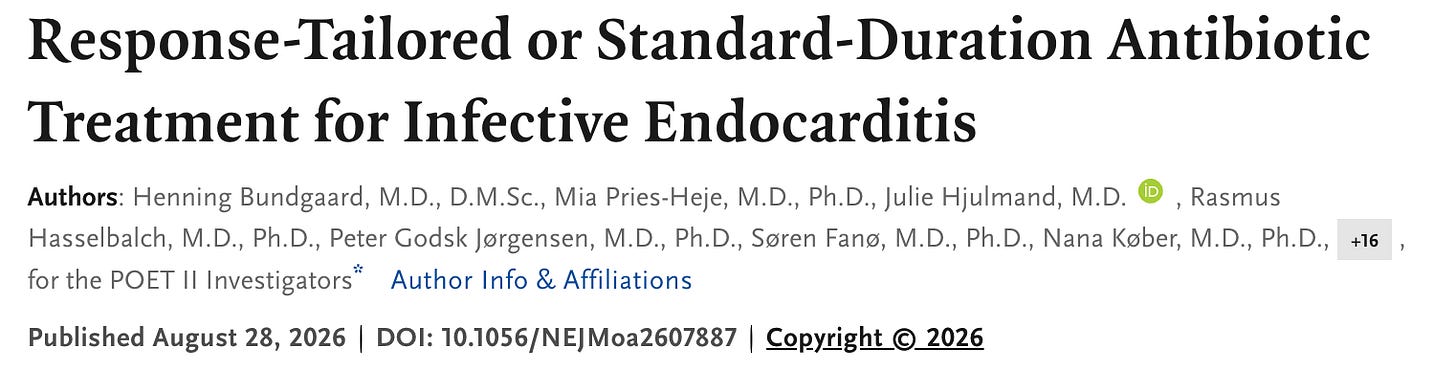
Shorter Antibiotics for Endocarditis Tripled Relapse in POET II
POET II's authors call the shorter antibiotic course safe and superior. John Mandrola argues the trial's own secondary endpoint shows the opposite.
Why it matters · The ESC presentation and the news coverage pushed a shorter antibiotic course for a deadly heart infection. How you read the trial depends on which endpoint you treat as the one that matters, and Mandrola argues the authors chose the wrong one.
Mandrola uses the Danish-led POET II trial as a lesson in critical appraisal. His point: a trial's primary endpoint should be its most important outcome. In POET II, he argues, the outcome that matters most was listed as a secondary endpoint.
The trial
Bacterial endocarditis is an infection of the heart valves. It can destroy a valve, or keep seeding the bloodstream with bacteria from a mass (vegetation) on the valve until the patient develops sepsis. The earlier POET I trial showed that patients could switch from IV to oral antibiotics once they met "POET criteria," signs that the infection was resolving, such as falling white count and inflammatory markers and no fever.
POET II enrolled about 500 patients with left-sided endocarditis. All had already received the standard 2 to 4 weeks of antibiotics and met POET criteria for stabilization. Half were randomized to stop antibiotics ("response-tailored" therapy) and half continued for the standard duration.
- Primary endpoint (superiority): days alive without antibiotics over 6 months. Result: 183 vs 169 days, a statistically significant gain of about two weeks for the tailored arm.
- Primary safety endpoint (non-inferiority): death, unplanned heart surgery or embolic events. Result: 8.2% vs 10.7% (risk difference −2.4 points; 95% CI −7.7 to 2.7; P<0.001 for non-inferiority).