Who Pays: Bills, Disclosures and Billionaires · Morning Gist
Sunday, October 185 stories · 16 min
Who Pays: Bills, Disclosures and Billionaires
Today's stories ask who covers the cost of care: Texas hospital billing, unpriced conflicts of interest, California's wealth-tax vote, plus lice and a stroke study in mice.
Picked from 46 new articles across 12 sources · arrow keys for other days
Today in 30 seconds
30s left
Only Memorial Hermann, of 166 Texas nonprofit hospitals, requires in writing that aid be applied before any bill goes out. Just 10 promise full refunds. story 1 ↓
Former JAMA editors Bauchner and Rivara want conflict-of-interest disclosures to show dollar amounts in five bands, from under $10,000 to over $100,000. story 2 ↓
Over-the-counter lice treatments usually work and home remedies don't, a pediatrician says. Kids should stay in school, and "No Nit" rules don't help. story 3 ↓
A cell-free mix of molecules from tooth-pulp stem cells shrank stroke damage in mice. No effect sizes were given and there's no human data yet. story 4 ↓
California's Proposition 40 would tax billionaires once to offset federal health cuts. It doesn't say how the health fund getting 90% of the money must be spent. story 5 ↓
Pope Leo has lung cancer. Oncologist Otis Brawley explains what is known about the diagnosis and what it could mean for him.
1/5KFF Health News· Melanie Evans, Tradeoffs, Jo Craven McGinty, Tradeoffs and Ryan Levi, Tradeoffs· Oct 15
Texas nonprofit hospitals often bill low-income patients before checking aid eligibility
Tradeoffs reviewed the financial-aid policies of 166 Texas nonprofit hospitals. It found that 44% say they bill patients before checking whether they qualify for free care, and few refund money already paid or tell patients their debt is gone.
Why it matters · Research suggests aid helps health only when it arrives quickly. These policy details decide whether a low-income patient gets that help or ends up in debt and skips care.
Know this first
Context from the editor, not the article · 30 sec
1 · What charity care is
Most U.S. hospitals offer free or discounted care to patients who can't pay. Nonprofit hospitals are tax-exempt partly because they provide this community benefit, but patients usually have to know about the aid and apply for it.
2 · Federal rules for nonprofits
Since the Affordable Care Act, the federal tax rules for nonprofit hospitals require a published financial assistance policy. They also require reasonable efforts to check a patient's eligibility before 'extraordinary collection actions' such as garnishing wages or selling the debt.
3 · Presumptive eligibility
2/5Sensible Medicine· Howard Bauchner· Oct 17
Former JAMA editors argue conflict-of-interest disclosures should state the dollar amount
Howard Bauchner and Frederick Rivara, both former editors of journals in the JAMA family, say long lists of industry ties with no amounts attached tell readers little. They propose bringing back banded dollar categories for disclosures.
Why it matters · When you weigh a trial, a guideline or a doctor's recommendation, a disclosure only helps if you can tell a $25 lunch from $100,000 in stock options.
Know this first
Context from the editor, not the article · 29 sec
1 · What a COI statement is
Journals, guideline panels and universities ask authors to list ties to companies that could bias their judgment, such as consulting fees, speaking fees, stock and research grants. Readers see these lists printed at the end of papers.
2 · Why sponsors matter
Most drug and device trials are paid for by the manufacturer. Industry-funded studies have repeatedly been found more likely to report results that favor the sponsor, so who funds a trial, and who controls its data, shapes how much readers trust it.
3 · Disclosure versus amounts
In the US, the federal Open Payments database publishes what industry pays individual physicians. Journal disclosures usually name the company but not the sum, which leaves readers guessing how large a tie is.
3/5The Conversation: Health· Emily J. C. Wong, Associate Professor of Pediatrics, University of Virginia· Oct 14
A pediatrician's guide to treating head lice and keeping kids in school
A University of Virginia pediatrician sets out how lice spread, which approved treatments to use and when to repeat them. She argues children shouldn't miss school over lice, in line with pediatric and federal health guidance.
Why it matters · Lice are common and harmless, yet they still cost children school days. Knowing which treatments work and which school rules are pointless saves time, money and embarrassment.
Know this first
Context from the editor, not the article · 30 sec
1 · What head lice are
Head lice are small blood-feeding insects that live only on the human scalp. They are most common in young children. They don't carry disease and aren't a sign of poor hygiene. The main harm is itching, plus the social stigma.
2 · Lice, eggs and nits
Females glue eggs to hair shafts near the scalp. Once a louse hatches, the empty shell, called a nit, stays stuck to the hair and moves outward as the hair grows. It can stay there for weeks or months.
3 · This is guidance, not a study
The piece is a practical explainer based on American Academy of Pediatrics (AAP) and CDC guidance. It cites no trial data or cure rates. The author is affiliated with the AAP and receives funding from it.
4/5Fight Aging!· Reason· Oct 14
Molecules from tooth-pulp stem cells reduced stroke damage in mice
Researchers grew human stem cells from tooth pulp, collected the molecules they released, and gave that mix to mice after a stroke. Brain damage shrank and movement and memory improved. Human benefit is unknown.
Why it matters · Cell-free "secretome" treatments are a growing alternative to stem cell transplants, and stroke recovery badly needs new options. Still, stroke is a field where many animal successes have failed in people.
Know this first
Context from the editor, not the article · 29 sec
1 · Why stem cells may help
Transplanted stem cells mostly die or get cleared within days. Many researchers think any benefit comes from the signals the cells release in that short window, the paracrine hypothesis, not from the cells settling in and replacing tissue.
2 · What a secretome is
Stem cells are grown in culture, and the liquid they grow in is collected. It holds proteins, growth factors and extracellular vesicles (tiny membrane packets of cargo). That collected mix, with no cells in it, is the secretome.
3 · Stroke drugs' track record
In ischemic stroke a clot blocks blood flow to part of the brain. Over a thousand neuroprotective compounds have worked in animals, yet nearly all failed in human trials. Treatment today centres on restoring blood flow quickly.
5/5KFF Health News· Jackie Fortiér· Oct 14
California votes on a one-time billionaire tax to offset federal health cuts
California voters will decide in November whether to tax about 200 billionaires 5% of their wealth, one time only, to help cover federal health cuts. The amount raised, the timing and the spending are all unclear.
Why it matters · Federal Medicaid and subsidy cuts are coming, and this is the first state to test a wealth tax as a way to fill the gap. Other states are watching.
Know this first
Context from the editor, not the article · 27 sec
1 · The federal cuts
The One Big Beautiful Bill Act, passed by congressional Republicans in 2025, reduces federal Medicaid funding and adds work requirements for some enrollees. States must either cover the gap themselves or let coverage shrink.
2 · Wealth tax vs income tax
An income tax takes a share of what you earn in a year. A wealth tax takes a share of what you own, such as stock or art, whether or not you sold anything. No US state has ever levied one.
3 · California ballot measures
California lets groups gather signatures to put laws directly before voters. Competing measures often appear on the same ballot, and their wording can leave legislators wide latitude afterward.
Instead of waiting for an application, a hospital can screen patients using data it already has or can obtain, such as enrollment in Medicaid or food stamps, or homelessness. It then reduces or erases their bills automatically.
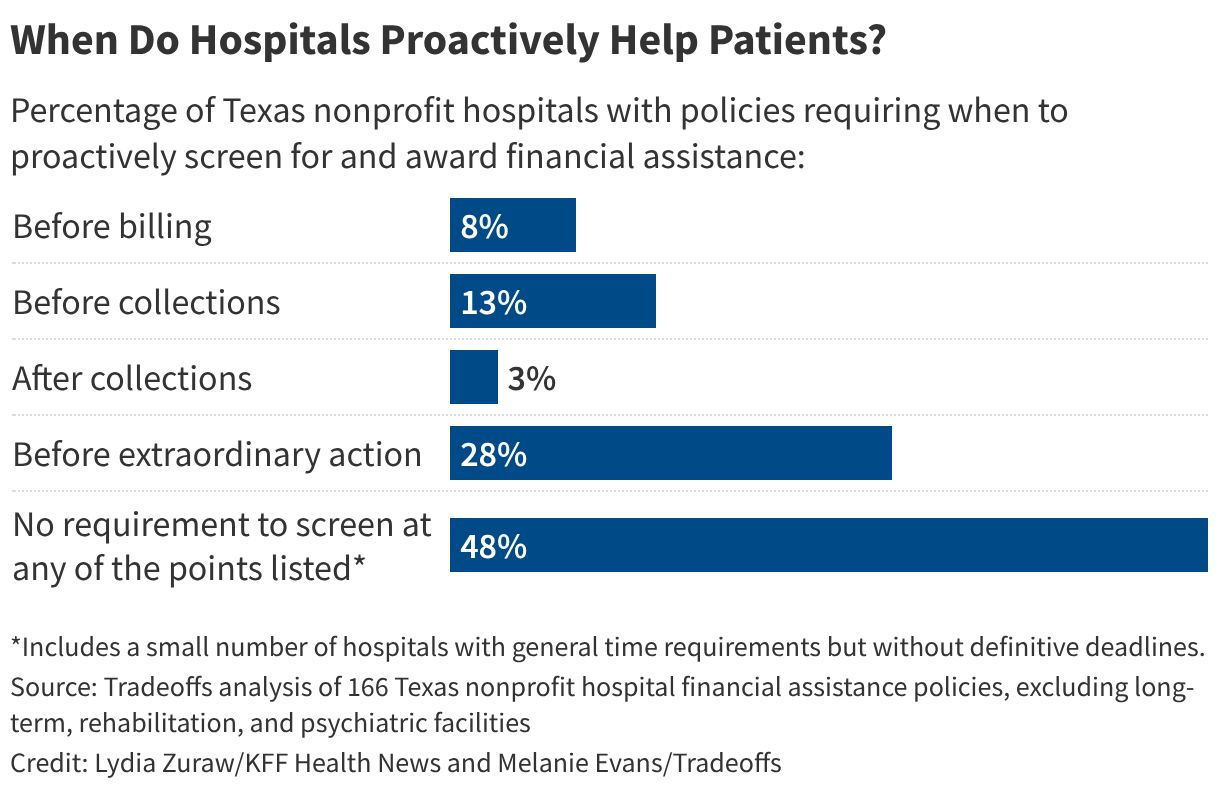
Bar chart: when Texas nonprofit hospitals screen patients for aid, from before billing to before collections.1 / 3
Tradeoffs, a nonprofit health-policy newsroom, worked with KFF Health News to review the financial-aid policies of all 166 nonprofit general and children's hospitals in Texas. The question was how easily low-income patients can get free or discounted care, called 1, without filling out an application. Texas has among the highest state rates of medical debt, and lawmakers there are considering a bill that would require nonprofit hospitals to screen patients before billing them.
The tool: 2
Charity care usually requires patients to find and complete an application. With presumptive eligibility, the hospital does the checking itself, often looking at 3 or food-stamp enrollment or homelessness. It then cuts or erases the bill automatically. Federal rules for nonprofit hospitals only require eligibility checks before "4" such as wage garnishment or selling the debt.
What the policies say
44% bill first. Nearly half of the hospitals say they will bill before screening. Only one system, Memorial Hermann, requires in writing that bills be reduced or erased before any bill goes out. The Texas Hospital Association says hospitals look for other payers first: "Charity care is the relief of last resort."
Few refunds. Only 10 of 166 guarantee full refunds to patients who later qualify. One woman paid $5,500 up front for surgery. She later qualified for free care and had $16,000 erased, but she never got the $5,500 back.
No notice. Large systems including Christus, Texas Health Resources and CommonSpirit's Texas hospitals don't tell patients when a bill has been forgiven automatically.
Policy differs from practice. Some systems say they screen earlier than their policies require. One, Covenant Health, has written criteria for automatic aid but stopped using them in 2019.
Patchy rules. Who qualifies varies by hospital, and automatic aid is sometimes less generous than aid granted through an application. Policies were often hard to find; reporters needed a public-records request for some.
Why timing may matter
The article cites a 2022 study in which patients who got aid within weeks of care were much more likely to return for treatment of conditions like diabetes. A 2024 randomized study that erased years-old medical debt found no effect on health, use of care or finances. A 2026 study linked medical debt to three to four times higher odds of delaying care, but that is an association, not proof that debt causes the delay. Taken together, the studies suggest that fast aid matters more than late forgiveness.
Caveats
The review covers written policies, not what hospitals actually do. Several hospitals admit the two differ, and many didn't respond to questions. The article doesn't measure how many patients are screened or how much aid is granted.
Tradeoffs, a nonprofit health-policy newsroom, partnered with KFF Health News to review the written financial-aid policies of all 166 nonprofit general and children's hospitals in Texas. The reporters call it a first-of-its-kind analysis. They wanted to know how easy each hospital makes it for low-income patients to get free or discounted care, known as 1, without filling out an application.
The timing matters. Texas has among the highest state rates of medical debt. Its lawmakers are considering a bill that would require nonprofit hospitals to screen patients for aid before sending a bill. Researchers and policymakers in other states are pushing similar ideas, and expected federal funding cuts are likely to increase the number of uninsured people.
The tool at issue: 2
Charity care normally depends on the patient. You have to know it exists, find the form and prove you are poor. Presumptive eligibility reverses that. The hospital checks whether a patient already meets its criteria, typically homelessness, death, or enrollment in a means-tested program such as 3, food stamps, housing or prescription aid. It then cuts or erases the bill itself.
Since the Affordable Care Act, federal tax rules have required nonprofit hospitals to publish a financial assistance policy. They must also make reasonable efforts to determine eligibility before taking "4": garnishing wages, selling the debt to a collector, or refusing further care until old bills are paid. That rule sets the minimum. It does not require screening before the first bill.
What the review found
Billing usually comes first. In their policies, 44% of hospitals say they will bill patients before screening them for aid. Some screen after one bill. Others send several bills and use collection agencies before checking. The most common approach is to screen just before extraordinary collection actions, which is the federal minimum. Only Memorial Hermann Health System has a written policy requiring its hospitals to check and proactively reduce or erase what patients owe before billing.
Anna Stelter of the Texas Hospital Association defended the order. Hospitals first look for other payers, such as Medicaid or county safety-net programs. "Charity care is the relief of last resort," she said.
Refunds are rare. Only 10 of the 166 hospitals guarantee a full refund to patients who later qualify for aid. Federal rules only require refunds of amounts paid above what the hospital usually charges insured patients. One example is Aimee Carlock, a self-employed housecleaner. Texas Health Resources required her to pay $5,500 before it would schedule uterus surgery. She later qualified for free care, and the hospital erased her remaining $16,000 balance, but it kept the $5,500. Some hospitals require a second, demanding application just to seek a refund. Hendrick Health in Abilene asks for two pay stubs, a tax return, two months of bank statements, the Social Security numbers of household members, and a written explanation of the hardship.
Patients often aren't told. Several large systems, including Christus Health, Texas Health Resources and CommonSpirit Health's Texas hospitals, do not notify patients when a bill has been forgiven automatically. Federal law requires notice only when a patient gets less than the maximum discount, so they can appeal. Stelter said short-staffed billing offices put these notices low on the list. Erin Fuse Brown, a health policy researcher at Brown University, said that without a notice the possibility of a bill "hangs like a sword over their neck."
Written policy and actual practice differ. AdventHealth and Houston Methodist say they screen some patients before billing, though their policies don't require it. Covenant Health in Lubbock has written criteria for presumptive eligibility but stopped using it in 2019, citing "regulatory requirements and administrative complexities." Covenant's owner, Providence, previously agreed to refund or erase more than $150 million in bills after investigators found it had failed to tell patients about charity care.
Eligibility rules vary. Each hospital sets its own criteria. One hospital writes off bills for members of religious orders who took a vow of poverty. Thirteen Ascension hospitals say only that they may screen patients "with a sufficient unpaid balance."
Automatic aid can be less generous. At CommonSpirit's southeast Texas hospitals, auto-enrolled patients get help with the prior 12 months of bills. People who apply get that plus six months of future free or discounted care. North Texas Medical Center limits automatic aid to single visits, while applicants can get coverage reaching back 12 months.
Policies are hard to find. Tradeoffs started from a list kept by the nonprofit 5, clicked through hospital websites, requested documents from hospitals and filed a state public-records request. Ray Kluender, a Harvard economist who studies medical debt, said you have to know what you're looking for "or you're never going to find it."
Why timing may matter: the evidence
The article cites three studies, and they differ in strength.
A 2022 study found that patients who got hospital aid within weeks of care were much more likely to return for treatment of conditions such as diabetes and depression. The article doesn't describe its design or give effect sizes.
A landmark 2024 study, a randomized experiment that bought and erased people's old medical debt, found no effect on mental or physical health, healthcare use or finances. The debt it erased was years old.
A 2026 study found people with medical debt were three to four times as likely to delay physical and mental healthcare. That is an association. People with debt may differ in other ways, so it doesn't show that debt itself causes the delays.
Together these studies suggest that early aid may help and late forgiveness may not. They don't prove it, and that is the case for screening before billing.
Caveats and open questions
The review covers written policies, which several hospitals say don't match what they actually do, in both directions. It doesn't measure how many patients are screened, how much aid is granted, or how much debt results. Many hospitals didn't respond to questions. The article doesn't explain the legislation's details or estimate what pre-billing screening would cost hospitals. Readers can search all 166 hospitals' policies in a table published with the original story.
Remember
Federal rules only require aid screening before aggressive collections, not before the first bill.
Most of the 166 hospitals keep money that patients paid before they were found eligible for free care.
Evidence suggests aid helps when it arrives within weeks; erasing years-old debt showed no health benefit.
Howard Bauchner and Frederick Rivara, both former editors of journals in the JAMA family, argue in Sensible Medicine that 1 disclosure in medicine has become a box-ticking exercise. Their fix is to bring back dollar bands. This is an opinion piece based on their years as editors, not new data.
The problem
The authors use the 2009 definition from the 2 (now the National Academy of Medicine): a COI is a situation where a secondary interest, such as a consulting fee, risks unduly influencing professional judgment about a primary interest, such as getting a trial's answer right.
Over recent decades, they write, journals and institutions have required more disclosure while dropping any requirement to say how much money is involved. Many authors paste the same standard list into every form, relevant or not. Some papers now carry dozens of listed ties, which makes it hard to see which ones matter. Their point is that a $25 lunch, a $10,000 speaking fee and $100,000 in stock options are very different, yet a plain list makes them look the same.
They also take up 3. Following researchers Bero and Grundy, they separate these from ordinary "interests" like religion or training, which everyone has. Even so, they question whether people with fixed, strongly held beliefs should sit on 4.
What they propose
Five dollar bands for disclosures: under $10,000; $10,000–25,000; over $25,000–50,000; over $50,000–100,000; and over $100,000. They apply the bands to their own ties, all of which fall in the lowest two bands.
Research funding declared by guideline authors, even when it doesn't pay their salary.
Sponsor roles spelled out in the methods section of 5 of drugs and devices: who designed the study, held the data, ran the analysis and decided to publish.
Where they hedge
At the bedside, doctors almost never tell patients about ties to device makers. Hospitals also rarely say when they profit from a treatment they recommend, such as 6 they make themselves. The authors suggest that institutional safeguards may be enough, for example keeping conflicted clinicians out of purchasing decisions. They concede that some patients would still want to know.
Caveats
The piece doesn't test whether dollar amounts change how readers judge research. It also doesn't say how self-reported bands would be checked or how stock options would be valued.
Howard Bauchner, editor-in-chief of JAMA from 2011 to 2021, and Frederick Rivara, who ran JAMA Pediatrics and later JAMA Network Open, have written an opinion piece in Sensible Medicine arguing that medicine's current system for disclosing conflicts of interest (COI) has stopped working. Their main proposal is to bring back dollar bands in disclosures. This is an argument from experience, not a study. The authors present no data on how readers interpret disclosures, and they say so in effect by framing the piece as a response to reader comments on an earlier post about clinical guidelines.
What counts as a conflict
The authors start from the 2009 definition by the 1 (IOM, now the National Academy of Medicine). It defines a COI as "circumstances that create a risk that professional judgments or actions regarding a primary interest will be unduly influenced by a secondary interest." For a trialist, the primary interest is getting the answer right. The secondary interest might be a consulting contract with the company whose drug is being tested.
The IOM focused on money. Since then, attention has spread to non-financial COI: relationships that could sway a decision without any payment. The authors cite researchers Lisa Bero and Quinn Grundy, who draw a line between non-financial conflicts and plain interests. Personal experience, religion and training are interests. Everyone has them and nobody can remove them, so calling them conflicts makes the term meaningless.
Bauchner and Rivara accept that line but say it is hard to apply. Their example is a guideline panel. Should someone with strongly held, fixed views on the question sit on it? They suggest not, because a fixed belief seems at odds with fair weighing of evidence, even though no money changes hands.
How disclosure drifted
The authors describe a two-way shift over recent decades. Institutions, societies and journals now require more financial disclosure than before. At the same time, they have dropped the requirement to say how much money, stock or other compensation is involved.
Two habits make this worse, in their account. Many people keep one standard disclosure block and paste it into every form, whether or not each tie is relevant to the paper at hand. And some authors list dozens of relationships. The piece cites two recent papers, an opinion article and a research report, in which authors declared so many ties that picking out the relevant ones was difficult. The article doesn't name those papers.
The result, they argue, is transparency in form only. A reader sees a company's name but cannot tell a trivial tie from a large one. Their illustration: most clinicians and patients would treat a $25 lunch, a $10,000 speaking fee and $100,000 in stock options very differently. Today's lists often present all three the same way. They note that stock options are hard to value, which is one practical reason journals stopped asking for amounts.
The proposal: dollar bands
The authors suggest returning to banded categories of financial support:
Category 1: $1 to under $10,000
Category 2: $10,000 to $25,000
Category 3: over $25,000 to $50,000
Category 4: over $50,000 to $100,000
Category 5: over $100,000
They apply the scheme to themselves at the end of the piece. Bauchner lists consulting for Vivli, a data-sharing platform (Category 1), and for Medeloop, Paper-Wizard and CBMRT (each Category 2). Rivara lists NIH funding and a Category 1 consultancy. A worked example shows how this helps: a reader can see at once that none of their ties tops $25,000. An unbanded list would show only four company names.
For guideline authors, they add one more rule. Research funding from a company should also be declared, even when it doesn't pay the author's salary, because any research support brings a financial benefit.
Sponsors, data and analysis
Funding sources usually appear in papers. Who controlled the data and ran the analysis often doesn't. The authors praise journals that now make the methods section spell out the sponsor's role in study design, data collection, analysis, writing and the decision to submit. They want this to be standard for 2 of drugs and devices in particular. Their reasoning is that these trials change practice and push up health care costs.
The clinic
At the bedside the authors are more hesitant. Doctors may have ties to drug or device makers or have a financial stake in services such as imaging. Institutions may profit too; the authors' example is a hospital that makes its own CAR T-cells, a personalized cell therapy for cancer, and then recommends them. Almost none of this is disclosed to patients, who trust that decisions are made in their interest.
Bauchner and Rivara say that if an institution has safeguards, extra disclosure may not be needed. One safeguard would bar clinicians with industry ties from choosing which products the hospital buys. Another would send treatments that directly benefit the institution to independent review. They concede that some patients would still want to know. This is the least resolved part of the piece.
Podcasts
Their last point is newer. Many journals now run podcasts, often with an editor interviewing an author or a prominent physician. The authors say they know of no journal podcast that reports conflicts of interest for host or guest. They argue that podcasts published by journals should follow the same COI rules as the journals' written articles.
What's left open
The piece doesn't address the costs of its own proposal: whether bands would be self-reported and unchecked, how to value stock options within a band, or whether amounts change how readers actually judge a paper. Disclosure research has found mixed effects on trust and on behavior. That evidence isn't covered here, so it remains unknown whether bands would restore trust, which is the authors' stated goal at "a time of waning trust in medicine and science."
Remember
Disclosure lists have grown longer while dropping dollar amounts, so the key detail is often missing.
The authors want the sponsor's role in design, analysis and publication spelled out for drug and device trials.
Clinical care has almost no disclosure to patients, and the authors don't fully resolve whether that should change.
A prescription insecticide lotion for lice in children 6 and older. It is highly flammable.
spinosad
A prescription insecticide made from soil bacteria, sold as Natroba, for lice from age 6 months.
Image: The Conversation: Health
Emily J. C. Wong, a University of Virginia pediatrician and mother of two, has written a practical guide to head lice. Her argument: lice are harmless, common and treatable, and shaming children or sending them home makes things worse. The advice follows American Academy of Pediatrics (AAP) and Centers for Disease Control and Prevention (CDC) guidance rather than new trial data. Wong discloses that the AAP funds her.
How lice spread
Head lice are sesame-seed-sized insects that feed on scalp blood. They don't carry disease and aren't a sign of poor hygiene. They can't jump or fly, so they spread mostly through head-to-head contact. Shared hats and brushes matter less, because lice die within 48 hours off the head. No hair type is resistant. Eggs hatch in 8–9 days.
The itch is an allergic-type reaction to lice saliva. In a child who has never had lice, it takes four to six weeks to develop, so by the time a child scratches, the infestation is usually weeks old.
Treating it
First check the scalp, especially behind the ears and at the nape of the neck. Look for fast-moving lice and for eggs glued to the hair (dandruff flakes off; eggs don't). Treat everyone in the household who has lice, plus anyone who shares the child's bed.
Over-the-counter options approved by the US Food and Drug Administration (FDA):
1% 1 (Nix), from age 2 months.
Pyrethrins plus 2 (Rid), from age 2 years.
0.5% 3 lotion, from age 6 months.
The first two don't kill eggs, so you reapply after 9–10 days to catch newly hatched lice. Ivermectin keeps killing lice as they hatch, so one dose usually does it. After treatment, comb with a fine-toothed comb; no product is 100% effective.
Itching after treatment may just be irritation. Check for live lice or fresh eggs within 1–2 mm of the scalp. If treatment really failed, from user error, re-exposure or resistance, there are prescription options:
Malathion: highly flammable, so no hair dryers.
Spinosad.
Oral ivermectin: prescribed 4 for children.
Removing lice by hand with a 5 lotion has limited evidence behind it. Mayonnaise, oil, saline, hot air and electronic combs haven't been shown to work. At home, hot-wash anything that touched the child's head in the past two days, vacuum, and bag unwashable items for two weeks.
School
The AAP and CDC reject the "6" exclusion policies many US schools adopted in the 1980s. A child with lice should stay in class while being treated and avoid head contact. Checking hair for 7 afterwards is pointless, because empty egg shells can stay in the hair for months.
Emily J. C. Wong is a primary care pediatrician at the University of Virginia, trained in infections and infestations, and a mother of two. She has written a practical guide to head lice for parents and schools. Her central argument: lice are a nuisance, not a health threat, and the usual response of shaming children and sending them home does more harm than the lice. The guide follows American Academy of Pediatrics (AAP) and Centers for Disease Control and Prevention (CDC) recommendations. It doesn't present new trial data. Wong discloses that she is affiliated with the AAP and receives funding from it.
The parasite
Head lice (1) are gray-tan, six-legged insects about 2–3 mm long, roughly the size of a sesame seed. They live only on humans. They bite the scalp to feed on blood, and their saliva keeps the blood from clotting. Females glue eggs firmly to hair shafts close to the scalp, and the eggs hatch in 8–9 days.
Lice can't jump or fly. They crawl, and they climb well. Most spread happens through direct head-to-head contact, such as children sitting close together or napping side by side. Shared hats and brushes can pass lice on too, but this is much less common because lice don't survive long off the head. Wong says there is no medical evidence that any hair type resists infestation.
Why you find out late
The itch is not caused by the bite itself. It is a sensitivity reaction to lice saliva. In a child who has never had lice, that sensitivity takes four to six weeks to develop. So by the time a child is scratching, the infestation has probably been going for weeks. This is one reason Wong regards urgent exclusion from school as pointless: classmates have already been exposed.
Confirming it
Look for live lice, which move fast and avoid light, and for eggs. Eggs usually sit behind the ears or at the nape of the neck, and they stick to the hair rather than flaking off like dandruff. If one child has lice, check everyone in the household. The AAP recommends treating every household member who has lice, plus anyone who shares a bed with the child, even if no lice or eggs are found on them.
First-line treatments
All three are FDA-approved, sold over the counter and inexpensive:
The timing of the repeat follows from the life cycle. Eggs take 8–9 days to hatch, so a second application at 9–10 days catches the lice that hatched after the first one. It should land before those new lice are old enough to lay eggs of their own, though the article doesn't spell out that last step. Ivermectin lotion avoids the second round because it goes on killing newly hatched lice.
After any treatment, comb through the hair with a fine-toothed comb. A creamy conditioner makes lice easier to see. No treatment is 100% effective, so combing removes eggs that would otherwise hatch. Removing empty 4 isn't medically necessary, but it can spare the child some embarrassment.
When treatment seems to fail
An itchy scalp afterwards may just be a reaction to the product. The question is whether there are live lice or new eggs, which sit within 1–2 mm of the scalp. Old empty nits are whiter and farther out along the hair. Real failures come from user error, re-exposure, or lice that have become resistant to the treatment. The article doesn't say how common resistance is.
At that point the options are a lice-removal salon or clinic, if you can afford one, or one of three prescription treatments:
Malathion 0.5% lotion (Ovide): ages 6 and up. It is highly flammable, so keep treated hair away from all heat, including hair dryers. Repeat if live lice appear at 7–9 days.
Spinosad 0.9% suspension (Natroba): ages 6 months and up. Repeat if live lice appear at 7 days.
Oral 5 tablets: approved for lice in adults only. Because they are approved in children weighing at least 33 lb for other parasitic infections, doctors can prescribe them 6 (for a use regulators haven't formally approved).
What doesn't work, or is unproven
Wong is clear about the weak evidence here. Removing every louse by hand and applying a 7 emollient (a silicone-based moisturizer) is a chemical-free option, but research on whether it works is limited. Popular home remedies have not been shown to work: smothering lice with mayonnaise or oil, drying them out with saline or hot air, or zapping them with electronic combs.
The house
Lice survive no more than 48 hours off the head. That sets the limits of cleaning. Wash clothing, bedding, headwear and toys that touched the child's head in the past two days in hot water and dry them on high heat. Vacuum furniture and carpets. Seal anything you can't wash in a plastic bag for two weeks.
School policy
Starting in the 1980s, many US schools adopted "8" policies, which kept children home if any eggs or empty nits were found. The AAP and CDC reject these policies as unnecessary and ineffective, and say they feed stigma. Current guidance: don't send a child home early. Notify parents, keep the child in class during treatment, and ask them to avoid head-to-head contact and shared hats, scarves and brushes. Checking hair for nits after treatment is also not useful, because empty nits can stay in the hair for weeks or months after the live lice are gone.
What's left open
The guide gives no numbers on how effective each product is, how widespread resistance is, or how much school is lost to exclusion policies. Readers who want to compare treatments head-to-head will need the underlying trials. The practical takeaways still hold: use an approved treatment, repeat it on schedule, comb, and keep the child in school.
Remember
The itch takes four to six weeks to appear, so lice found today have likely been spreading for weeks.
Permethrin and pyrethrin products need a second dose at 9–10 days; ivermectin lotion usually needs one.
Mayonnaise, oil, hot air and electronic combs haven't been shown to work; dimethicone has only limited evidence.
A team reports in Advanced Science that a treatment made from the secretions of human dental pulp stem cells (hDPSCs) reduced brain damage in mice after an 1. Ischemic stroke is the common kind, caused by a clot. hDPSCs come from the soft tissue inside teeth. The treatment is their 2: the cell-free mix of proteins and 3 (tiny membrane packets) that the cells release into the liquid they're grown in.
Why give signals instead of cells
Reason, who writes Fight Aging!, where the paper surfaced, explains the logic. Transplanted stem cells don't survive long. Their benefit seems to come from a short burst of signalling. So you can grow the cells, collect what they secrete, and give that instead. A cell-free product should be easier to standardise and carries no risk of transplanted cells growing out of control. Different stem cell types release different signals, so each source needs testing for each disease.
What the study did
A stroke starves brain tissue of oxygen. Damaging 4 build up, 5 (the brain's immune cells) set off inflammation, and neurons and their connections die. The researchers caused small, precisely placed strokes in mice by shining light on an injected light-sensitive dye, which forms a clot. They also tested microglia in a dish under chemically simulated low oxygen.
Protein profiling showed the secretome contains antioxidant enzymes such as SOD2, along with factors that calm microglia.
Results
According to the abstract, treated mice had:
smaller 6 (the area of dead brain tissue)
less neuron death and ROS buildup
less signalling through 7, a central switch for inflammatory genes
microglia shifted toward a repair-oriented "M2" profile
better new neuron growth, blood vessel repair and synapse organisation
They also did better on tests of motor coordination, spatial learning, memory and anxiety-like behaviour.
Caveats
This is a mouse study, and the abstract gives no effect sizes. It also doesn't say the dose, the route, or how soon after the stroke treatment started. Timing matters most for real patients.
The light-induced model makes small, uniform strokes in young, healthy animals. That is unlike strokes in older patients with other diseases. Many pathways shifted together, but the study doesn't pin down which component does the work. Secretome batches also vary from donor to donor.
Stroke research has seen over a thousand neuroprotective compounds work in animals and almost none succeed in people. Proven treatment still means restoring blood flow fast. This is a candidate worth following, not a therapy.
The finding
A team reports in Advanced Science that the 1 of human dental pulp stem cells (hDPSCs) improved outcomes in mice after an 2. A secretome is the cell-free mix of molecules that cultured cells release into the liquid they grow in. hDPSCs come from the soft tissue inside teeth and are often harvested from extracted wisdom teeth. Treated mice had smaller brain lesions, less brain inflammation, and better scores on tests of movement, memory and anxiety-like behaviour.
Fight Aging!, where the paper surfaced, publishes the paper's abstract with a short commentary by Reason, the site's author. The abstract reports directions of effect but not their size, so this write-up can't say how large the benefits were.
Why give the signals and not the cells
Reason sets out the rationale. Stem cell transplants appear to work through "a short burst of signaling" before the cells die off. If so, you could skip the cells and deliver the signals directly. Making a secretome works like this:
grow the stem cells in culture
collect the medium, meaning the liquid they grow in
purify the secreted proteins and 3 (small membrane-wrapped packets of proteins and RNA)
give that material to the patient
Compared with live cells, a cell-free product should be easier to store, standardise and dose, and it carries no risk of transplanted cells growing where they shouldn't. Reason notes that different stem cell types release different signals, so researchers have to test which source suits which disease. This paper tests dental pulp cells in stroke.
What a stroke does to the brain
When a clot cuts off blood supply, the affected tissue is starved of oxygen. The abstract lists the harm that follows:
Oxidative stress: 4, chemically aggressive by-products, build up and damage cells.
Neuroinflammation: 5, the brain's resident immune cells, become activated.
Neuronal death and synaptic dysfunction: neurons die and the connections between them weaken.
Together these leave lasting motor and cognitive deficits. A useful therapy would need to dampen several of these processes at once. The authors argue a secretome may do that because it carries many factors together.
How the study was done
The researchers used two models:
Photothrombotic stroke in mice. A light-sensitive dye is injected and a light is shone through the skull onto one spot. The dye forms a clot in the vessels there, producing a small, precisely placed cortical stroke.
Hypoxic microglia in a dish. BV2 cells, a standard mouse microglia cell line, were exposed to cobalt chloride (CoCl₂). This chemical mimics low-oxygen conditions.
They first used proteomics, broad profiling of the proteins in a sample, to see what the secretome contained. They found antioxidant enzymes, including SOD2 (superoxide dismutase 2), glutathione reductase (GSR) and GSTP1. They also found proteins that shape microglial behaviour: progranulin (GRN), CSF1 (a growth factor that keeps microglia alive) and LRP1.
Results
According to the abstract, secretome treatment:
reduced 6 volume, the amount of brain tissue killed by the stroke
reduced neuronal apoptosis (programmed cell death) and ROS buildup in neurons in the cortex and hippocampus
reduced NF-κB-associated signalling. 7 is a master switch for inflammatory genes.
shifted microglial markers toward an "M2" profile. M2 is the label for a repair-oriented, anti-inflammatory state, as opposed to a pro-inflammatory "M1" state.
improved new neuron formation in the hippocampus, blood vessel remodelling and synaptic organisation
Proteomic analysis of the brain tissue showed coordinated changes in several pathways. These covered mitochondrial energy production (oxidative phosphorylation), inflammation, calcium signalling, SNARE-dependent vesicle transport (the machinery that releases neurotransmitters), and ROBO–Rho cytoskeletal remodelling, which steers how neurons grow and wire. On the behavioural side, treated mice did better on motor coordination, spatial learning and memory, and contextual memory, and showed less anxiety-like behaviour.
How much weight to put on this
This is preclinical evidence, and the abstract is thin on details that would let a reader judge it:
What's left open
The open questions are whether the effect holds in older animals with other diseases, in larger-stroke models, and when treatment is delayed. Researchers would also need to know which secreted factors do the work, whether a standardised product can be made, and whether it adds anything on top of clot removal. Until there is a human trial, this is an interesting candidate in a crowded preclinical field, not a treatment.
Remember
Cell-free secretomes are based on the idea that stem cells help through brief signalling, not lasting engraftment.
The abstract reports only directions of effect: no effect sizes, dose, route or treatment timing.
Small, uniform light-induced strokes in healthy mice differ from human strokes; many stroke drugs that worked in animals failed in people.
In November, California voters will decide on 1. It would be the first wealth tax in any US state, and its supporters pitch it as a way to replace federal healthcare money that is about to disappear. KFF Health News reports that the measure leaves three questions open: how much it would raise, when the money would arrive, and what it would pay for.
What the measure does
Prop 40 would charge a one-time tax of 5% of net worth on the roughly 200 Californians worth at least $1 billion who lived in the state on Jan. 1, 2026. Stock, yachts and art would count toward net worth. Real estate, pensions and retirement accounts would generally be exempt. The measure was put on the ballot by SEIU-United Healthcare Workers West, a union of hospital workers.
Of the money raised, 90% would go to a state healthcare fund. The other 10% would be split between food assistance and education. The governor and legislature would decide how to spend it.
The gap it targets
The 2, the 2025 Republican budget law, is expected to cost California about $30 billion a year. The UC Berkeley Labor Center projects that over four years, state and federal cuts will nearly double the number of uninsured Californians from about 2.4 million.
Supporters say the tax could raise up to $100 billion over five years. California's nonpartisan 3 gives a vaguer estimate: "tens of billions of dollars." By simple arithmetic, five years of losses comes to about $150 billion, so even the supporters' top figure would cover only part of the gap.
Why health groups are wary
No specific targets. The money could go to people who lose 4 (California's Medicaid program) under new work requirements, to restoring coverage for legal immigrants, to higher doctor payments, or to subsidies on , the state insurance marketplace. Union president Dave Regan argues that this flexibility is the point, because nobody can predict where the cuts will hit hardest.
The fight
Google co-founder Sergey Brin moved some of his businesses to Nevada. He has given more than $100 million to promote Propositions 41 and 42, which would limit or block the tax. A study by the conservative 6 projects the tax would cost California $25 billion on net, partly because billionaires are leaving. Two September polls put support between 45% and 52%. Governor Gavin Newsom and Xavier Becerra, the Democratic nominee for governor, oppose it. Bernie Sanders and the state Democratic Party support it.
California voters will decide on November's ballot whether to pass 1, which would be the first wealth tax in any US state. Its backers present it simply: tax the richest residents of the richest state to replace federal money for healthcare, food assistance and education. Jackie Fortiér of KFF Health News reports that the details are much less settled. Nobody knows how much the tax would raise or how fast the money would come in. And the people it is supposed to help, including clinics, doctors and health-policy analysts, are not sure where it would end up.
"I'm not sure that you can say, with full security, that this will stop clinics from being closed or healthcare workers from being laid off, or people from losing their healthcare," said Chris Hoene of the California Budget & Policy Center, a left-leaning nonprofit.
The problem it is meant to solve
The 2, the budget law congressional Republicans passed in 2025, is expected to cost California about $30 billion a year. Much of that comes from Medicaid. California runs Medicaid as 3, and the law adds work requirements that will remove some enrollees. According to the UC Berkeley Labor Center, state and federal cuts together are projected to nearly double the state's uninsured population over the next four years, from about 2.4 million today.
There is a separate problem in the individual market. Last year Congress let the enhanced premium subsidies from the pandemic era expire. Enrollees in 4, the state's Affordable Care Act marketplace, lost millions of dollars in federal help, and their premiums have risen sharply.
According to Dave Regan, state lawmakers have not found a way to pay for the services these cuts will hit. Regan is president of SEIU-United Healthcare Workers West, the hospital workers' union that put Prop 40 on the ballot.
How the tax works
Who pays: about 200 Californians with a net worth of at least $1 billion who were state residents on Jan. 1, 2026. Setting the date in the past is meant to stop people from avoiding the tax by moving out now.
Rate: a one-time charge of 5% of net worth.
What counts: most stock holdings, plus yachts and artwork. Real estate, pensions and retirement accounts are generally exempt.
Payment: billionaires can spread their payments over five years.
Where it goes: 90% to a state healthcare fund, and 10% split between food assistance and education however lawmakers choose.
Estimates of the revenue vary widely. California's nonpartisan 5, the office that scores ballot measures, says only "tens of billions of dollars." Backers say up to $100 billion over five years. One way to see the scale is a rough calculation (ours, not the article's): five years of $30 billion losses is about $150 billion. Even if the most optimistic estimate held, the tax would cover about two-thirds of that, all at once, with nothing after.
The fight over flexibility
The biggest objection comes from healthcare groups that might expect to benefit. Prop 40 does not say which programs get the money. The next governor and legislature would have to choose among several needs:
covering people removed from Medi-Cal by the federal work requirements
reversing recent state rollbacks of coverage for immigrants with legal status
raising Medi-Cal's low payments to doctors, which make some providers reluctant to take Medi-Cal patients
propping up Covered California subsidies to bring premiums down
Regan defends the open wording. "Figuring out or predicting exactly what the fallout will be, of where reductions and cuts get made, in a complicated healthcare system, it's just too difficult to predict," he said. His point is that money tied to specific programs can't follow the cuts wherever they actually land.
Critics see a blank check instead. Glenn Melnick, a healthcare economist at the University of Southern California, worries about 6: lawmakers using the new fund to replace health dollars the state already spends and moving the freed-up money elsewhere. The measure's text forbids this, but experts say its loose wording might allow it anyway. "A lot of times these propositions are written in a way to get attention and get support," Melnick said. "But in fact, they can be used for other things later."
René Bravo, a pediatrician who is president of the California Medical Association, raises a different objection: money that arrives once "is going to run out." He argues for "a more sustainable, durable funding mechanism for the Medi-Cal system." The timing makes it harder. Doctors are already asking him what happens when the biggest Medi-Cal eligibility cuts begin next year. Even if the measure passes, collection would take months, and the option to pay over five years means the money would come in slowly.
The opposition and the politics
Opponents warn that wealth will leave the state. Google co-founder Sergey Brin bought a home in Nevada late last year, moved some of his businesses there, and has given more than $100 million to a nonprofit promoting two competing measures:
Proposition 41 would count some new state taxes toward California's overall spending limit and require the state auditor to review new tax proposals before they go to voters.
Proposition 42 would ban new state taxes on personal property, intellectual property, retirement accounts and other assets.
In March, a study by the conservative 7 at Stanford projected that the tax would cost California $25 billion, partly because of income-tax revenue lost from billionaires who have already left. Republican gubernatorial candidate Steve Hilton said on CNN that "trillions of dollars, by some estimates" had already left. The article gives no source for that figure, and it should be treated as campaign rhetoric. Some voters also doubt the tax would really happen only once. "Taxes have a way of being needed over and over," said Lynne Wines, a retired banker from Pasadena.
Two independent polls in September put support between 45% and 52%. Democrats are split. Bernie Sanders and the California Democratic Party endorse Prop 40. Governor Gavin Newsom and Xavier Becerra, the party's nominee for governor, oppose it, though both say the very wealthy should pay more. Newsom prefers a federal wealth tax, and that idea has stalled in Congress.
What's at stake beyond California
Hawai'i, Maine, Massachusetts and Rhode Island already have extra taxes on millionaires, but they apply to income, not total wealth. Washington state voters will decide this fall whether to keep theirs. Analysts say a win for Prop 40 could encourage other states facing federal health cuts to try something similar. "I do think this is just the beginning of these proposals nationwide," Melnick said.
Several questions remain open: how much wealth is really taxable once real estate and retirement accounts are excluded, how many billionaires can show they were not residents on the cutoff date, and whether the legislature would spend the money on new coverage or use it to plug its existing budget. None of these can be answered before the vote.
Remember
Even the backers' top estimate, $100 billion over five years, is less than five years of projected federal losses (about $150 billion).
Health groups worry the vague spending rules could let lawmakers swap the new money in for existing health funding.
Billionaires could pay over five years, so the money arrives slowly while Medi-Cal cuts begin next year.
COI rules for journal podcasts. They know of no journal podcast that discloses conflicts for its host or guests.
Treatment
Minimum age
Kills eggs?
Repeat?
1% 2 lotion/cream rinse (Nix, generics)
2 months
No
Yes, at 9–10 days
Pyrethrins + 3 shampoo (Rid, generics)
24 months
No
Generally, at 9–10 days
Ivermectin 0.5% lotion
6 months
Keeps killing lice as they hatch
Usually one application
No effect sizes. We don't know how much smaller the infarcts were, or how much behaviour improved.
Missing protocol details. The abstract doesn't give the dose, the route (for example, injection into a vein or into the brain), or how soon after the stroke treatment began. Timing matters most for real patients, who often reach hospital hours after symptoms start.
The model's limits. Photothrombotic strokes are small, consistent and easy to reproduce. But they lack much of the 8, the at-risk but salvageable tissue around the core that human strokes have and that therapies aim to rescue. They are also usually done in young, healthy mice. Human stroke patients tend to be older, with high blood pressure or diabetes.
Correlation within mechanisms. Many pathways moved together, which fits a multi-factor product. But the study doesn't show which components cause the benefit. The M1/M2 classification is also widely seen as an oversimplification of how microglia actually behave.
Manufacturing. Secretomes vary with the donor, how the cells were cultured and how many times they were passaged. That makes consistent batches, and eventually regulatory approval, harder than for a single defined drug.
History. Stroke neuroprotection has a long record of animal successes that failed in humans. Treatment that works today restores blood flow: clot-dissolving drugs and mechanical thrombectomy, in which a catheter pulls the clot out.
5
Swapping out existing funds. USC economist Glenn Melnick warns that loose wording could let lawmakers use the new money to replace state health dollars they already spend, even though the text forbids it.
It only happens once. California Medical Association president René Bravo says a single payment "is going to run out" and argues that Medi-Cal needs a lasting funding source.
Timing. The biggest Medi-Cal eligibility cuts start next year. Collection would take months, and billionaires could pay in installments over five years.