Washington moves to loosen limits on peptides as Pennsylvania tightens rules on vapes, plus a gut-inflammation link, a new women's health order and a hard essay.
Picked from 26 new articles across 12 sources · arrow keys for other days
Today in 30 seconds
30s left
A White House plan would let pharmacies sell BPC-157 and five other unapproved peptides, despite warnings from FDA scientists. story 1 ↓
Danish adults with a gut bacteria type called Bacteroides 2 had inflammation typical of much older people and 21% higher disease risk. The study shows a link, not a cause. story 2 ↓
Pennsylvania now bans vapes not on a state list of six makers, including Juul and NJoy. Stores that keep selling them face fines that add up daily. story 3 ↓
Trump ordered a new NIH women's health division within 90 days, but the order includes no budget for it. story 4 ↓
STAT's opinion editor argues for assisted dying for mental illness, drawing on her mother's 20 years of treatment-resistant illness and her suicide. story 5 ↓
The IRC's Congo director says the Ebola outbreak is spreading faster than the response, which is held back by budget cuts and missing data.
1/5KFF Health News· Amy Maxmen· Oct 19
White House plan would let pharmacies sell unapproved peptides despite FDA scientists' warnings
A proposed White House policy would let licensed pharmacies make and sell six unapproved peptides, including the popular BPC-157. KFF Health News checks the selling claims and finds almost no human trial evidence behind them.
Why it matters · Peptides are now a staple of longevity clinics, and a federal policy may soon put them on sale with no trial evidence that they are safe or work.
Know this first
Context from the editor, not the article · 33 sec
1 · What a peptide is
A peptide is a short chain of amino acids, smaller than a protein but built from the same parts. Insulin and the GLP-1 drugs such as Ozempic are peptides. The word says nothing about whether a substance is safe or works.
2 · Compounding pharmacies
Compounding pharmacies mix drugs to order for individual patients. Their products do not go through FDA approval, so the FDA controls which raw ingredients they may use. That list decides whether a compounder can sell an unapproved peptide.
3 · How drugs earn approval
Before the FDA approves a drug, it normally has to pass phased clinical trials, with placebo-controlled studies at the core. These trials cost millions and catch harms that only appear over time or in some patients. Most candidates that look good in the lab fail them.
2/5Fight Aging!· Reason· Oct 19
Gut bacteria track inflammation better than age in Danish adults
Danish researchers profiled gut bacteria, 30 blood immune markers and 19 health measures in 1,199 adults. The gut bacteria mix tracked inflammation more closely than age did. One bacteria type was linked to modestly higher disease risk.
Why it matters · If this holds up, gut bacteria may be a changeable driver of inflammation, unlike age. But this is observational work, so it shows a link, not cause and effect.
Know this first
Context from the editor, not the article · 28 sec
1 · What inflammaging means
As people age, their blood carries a low, chronic level of inflammation. Researchers call this inflammaging. It is linked to heart disease, diabetes and frailty, but its level varies a lot between people of the same age.
2 · Gut bacteria types
People's gut bacteria tend to fall into a few broad types called enterotypes, each named for its dominant bacteria. Bacteroides 2 is a low-diversity type. Earlier research has linked it to obesity and inflammatory bowel disease.
3 · Measuring inflammation
Cytokines are signalling proteins that immune cells release. Measuring a panel of them in blood plasma gives a snapshot of how inflamed the body is overall, with no infection or injury needed to explain it.
3/5The Conversation: Health· Ana Santos Rutschman, Professor of Law, Villanova University· Oct 19
Pennsylvania now bans vapes that aren't on a state-approved list
Since Oct. 19, 2026, Pennsylvania stores may sell only vapes from six makers whose products the FDA has reviewed. Shops face escalating fines and can lose their license. Buyers face no penalty and can still shop across state lines.
Why it matters · More states are curbing youth vaping with product registries rather than flavor bans, and this one shows the limits: it covers only one state's shops, and nothing yet shows whether it works.
Know this first
Context from the editor, not the article · 28 sec
1 · What ENDS are
Electronic nicotine delivery systems (ENDS) are e-cigarettes and vapes. They heat a liquid into an aerosol that contains nicotine, flavorings and other chemicals. They are the most common form of tobacco use among US teens.
2 · FDA review of vapes
Federal law requires vape makers to get FDA marketing authorization by filing a premarket application. The FDA has authorized relatively few products, yet many unreviewed ones, especially cheap disposables, are still widely sold.
3 · State registry laws
Because federal enforcement against unauthorized vapes has been patchy, more than a dozen states keep their own directories of approved products. Retailers may sell only listed products. States can restrict sales to protect health even though the FDA regulates the products.
4/5STAT· Elizabeth Cooney· Oct 19
Trump orders new NIH women's health division and White House task force
President Trump signed an executive order creating a women's health research division at the National Institutes of Health and a cabinet-level task force. It sets no funding for the division, and no research has started.
Why it matters · Women still get drug side effects more often and heart attacks diagnosed later, so what counts is whether this order brings research money, after a year of grant cuts and flagged grants.
Know this first
Context from the editor, not the article · 27 sec
1 · NIH's existing women's office
The National Institutes of Health has had an Office of Research on Women's Health since 1990. It coordinates and co-funds research across NIH's institutes, but it does not hand out most grants itself.
2 · Women in clinical trials
A 1993 law required NIH-funded clinical trials to include women. Since 2016, NIH has also expected grant applicants to treat sex as a biological variable, meaning they study and report male and female differences, including in animal and cell work.
3 · A year of research cuts
In 2025 the administration cut and froze academic research grants and targeted work on diversity and "gender ideology." Grant applications that used words like "women" were sent for extra review at NIH.
5/5STAT· Torie Bosch· Oct 19
After Canada shelves assisted dying for mental illness, a daughter argues for it
On October 7, Canada indefinitely suspended its plan to allow assisted dying for mental illness. In a STAT essay, Torie Bosch draws on her mother's suicide to argue that rare, exhausted cases should qualify.
Why it matters · The essay gives a vivid account of the hardest case for psychiatric assisted dying: a patient who tried nearly every treatment. But it is one family's story, not evidence on how such programs work.
Know this first
Context from the editor, not the article · 28 sec
1 · What assisted dying means
Medical aid in dying (MAiD) means a clinician provides or gives drugs to end a patient's life when the patient asks and legal criteria are met. Most jurisdictions limit it to terminal physical illness.
2 · Canada's long delay
Canada legalized MAiD in 2016. In 2021 it extended eligibility to people who are not dying, but excluded those whose only condition is mental illness. That exclusion was due to end in 2023, then in 2024, then in March 2027.
3 · The core clinical dispute
Most eligibility rules require a condition to be "grievous and irremediable". Critics argue psychiatry cannot reliably predict which mental illnesses will never improve, and that the illness itself can distort a patient's wish to die.
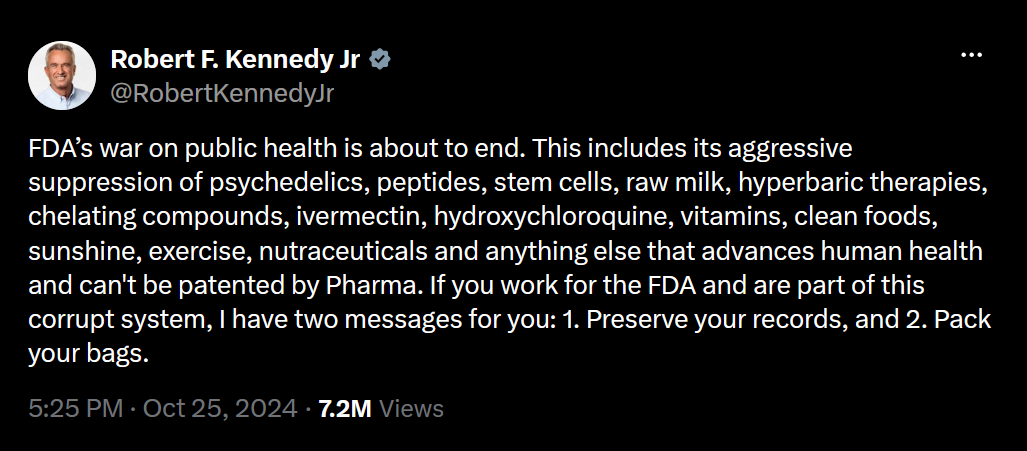
Kennedy's pre-HHS post on X listing peptides among therapies he said the FDA suppresses.
A temporary "access policy" posted to a White House docket on Oct. 14 would let licensed pharmacies make and sell certain peptides the Food and Drug Administration (FDA) has never approved. The list includes 1, a favorite of longevity clinics, and five others. FDA scientists advised against the move in July because the drugs haven't been properly tested in clinical trials. An outside panel that advises the agency voted to loosen the rules anyway. KFF Health News reports that many of its new members have a financial stake in peptide sales. One is chief medical officer of a men's clinic that sells them. The health department says all members meet FDA ethics rules.
Amy Maxmen checks four claims behind the push, which Health Secretary Robert F. Kennedy Jr.'s 2 movement backs.
"Peptides aren't drugs"
They are drugs if you use them to treat a condition or change how the body works. "Peptide" just means a short chain of amino acids. Insulin is one, and it counts as a drug when injected.
"They're safe because they're natural"
BPC-157 was isolated from stomach juices, but a Stanford peptide scientist says it doesn't appear in the human genome, so the body doesn't make it. Natural substances can still be toxic. People have died from insulin overdoses. Harms like liver damage only show up in controlled trials.
"They heal injuries and treat disease"
The human evidence is very thin. A 2005 bowel-disease trial summary was too sketchy for FDA reviewers, who called it "inadequate." A knee-pain study reported relief in 14 of 16 patients but had no 3, so improvement could have come from placebo or natural recovery. A 2025 review urged caution. Lab findings, such as a peptide stimulating blood-vessel growth, say nothing about safety in people. That same growth could feed a tumor.
"They can't be patented"
Hundreds of peptide patents exist. A natural molecule can't be patented, but modified or stabilized versions can. The 4 drugs behind Ozempic are peptides, and their market may reach $190 billion. Companies skip trials for peptides like BPC-157 because the commercial case looks weak, not because patents are impossible. Investors dropped one peptide, 5, because it overlapped with GLP-1 drugs. Researchers and the drug industry trade group 6 both warn that letting pharmacies sell these peptides without approval would remove any reason to fund trials.
The true part
The U.S. spends the most per person on healthcare and has the lowest life expectancy among wealthy nations. Six in 10 adults worry about drug costs. Maxmen argues that selling unproven treatments without trials is not one of the fixes researchers have proposed.
On Oct. 14, a temporary "access policy" appeared on a White House docket. It would let licensed pharmacies make and sell certain peptides that the Food and Drug Administration (FDA) has never approved for safety or effectiveness. The FDA's own scientists argued against the move at a July meeting, saying the drugs hadn't been properly tested in clinical trials. An outside panel that advises the agency disagreed and voted to loosen the restrictions.
Amy Maxmen of KFF Health News reports that many of the panel members are new appointees with money at stake in the peptide business. One of them, Haleem Mohammed, is chief medical officer of Gameday Men's Health, a clinic that sells peptides. At the meeting he said he voted yes "for patient safety, the greater good, and medical freedom." A spokesperson for the Department of Health and Human Services (HHS) said every member meets FDA ethics requirements.
The policy would cover 1 and five other experimental peptides. None has been through high-quality clinical trials. Health Secretary Robert F. Kennedy Jr. and other leaders of 2, his health movement, have pushed for wider access. Maxmen's piece takes four common sales claims in turn, and grants one point the movement gets right.
Claim 1: "Peptides aren't drugs"
Gary Brecka, co-chair of the MAHA Action committee, said on his podcast that peptides aren't drugs, and also described using them to "help regulate cortisol" and "improve circulation." Under the legal definition, anything used to treat, prevent or cure a condition, or to change how the body works, is a drug. "Peptide" only describes the molecule's size and structure. Insulin is a peptide your body makes, and it is a drug once you inject it to control blood sugar. Jacob Sherkow, a biotechnology law professor at the University of Illinois Urbana-Champaign, notes that many drugs started out as natural substances: "Heroin is natural. No one in their right mind would call it not a drug." Brecka's spokesperson said his podcast is not medical advice.
Claim 2: "They're safe because they're natural"
Promoters including Brigham Buhler, who co-wrote The Peptide Revolution and owns a compounding pharmacy, have suggested that natural origin means safety. Some influencers go further and say the body makes these peptides itself.
BPC-157 shows the problem. Croatian researchers isolated it from gastric juice and named it "body protective compound." But Stanford peptide scientist Katrin Svensson says no trace of it has turned up in the human genome, so humans don't make it. Researchers in Taiwan have suggested stomach microbes produce it.
Even a truly natural substance can be toxic. People have died from too much insulin. Placebo-controlled trials exist to catch problems that don't show up right away, such as liver damage, and to spot underlying conditions that can turn a minor side effect into a serious one. Svensson's own lab is developing peptides into drugs. "I am excited about peptides too," she said. "But you need to show they're not harmful."
Claim 3: "They treat illness and heal injuries"
Kris Wusterhausen, another new panel appointee, founded an antiaging company that sells BPC-157. He has said it can reduce acid reflux and treat "neurologic disorders." Promoters also claim experimental peptides treat muscle injuries, covid and inflammatory bowel disease. The human evidence behind these claims is very thin:
Inflammatory bowel disease: a 2005 summary of a small trial left out key details of how the study was run. FDA reviewers called it "inadequate."
Knee pain: a small study reported relief in 14 of 16 patients but had no 3. Without one, there is no way to separate any drug effect from placebo, other treatments, or pain that would have eased anyway.
Musculoskeletal injuries: a 2025 review said BPC-157 should be "approached with caution" because the evidence is lacking. One author, University of Utah rehabilitation doctor Flynn McGuire, says stories of miraculous recoveries are even less reliable, and he won't prescribe it until good studies exist.
Supporters also point to lab findings, such as a peptide that stimulates blood vessel growth. Work like that is where drug development starts, but it shows nothing about safety, effectiveness or off-target harm in people. Growing new blood vessels, for example, could also feed a tumor. Most compounds that look good at this stage go on to fail in human trials.
Claim 4: "They can't be patented, so pharma ignores them"
Before he took over HHS, Kennedy posted on X that the FDA suppressed peptides and other alternative therapies. The usual explanation, common in Reddit posts researchers have analyzed, is that drug companies can't patent peptides and so can't profit from them.
That isn't true. The U.S. Patent and Trademark Office lists hundreds of peptide patents, and a patent on an early formulation of BPC-157 is for sale. Sherkow explains that a natural molecule itself can't be patented, but a slightly modified version can, and so can a stabilized formulation or a version attached to something that makes it injectable. 4 peptides show how much money is involved. Companies are suing each other over GLP-1 patents, and Morgan Stanley expects that market to reach $190 billion within a decade.
Why, then, has no company run big trials of BPC-157? Trials cost millions, so companies first need signs that a drug could win approval and beat existing treatments. Svensson says some companies may have done early tests and been put off by the results. Pinchas Cohen, a gerontologist at the University of Southern California, says investors pulled funding for trials of 5, a peptide he helped discover, because they didn't think it could compete with GLP-1 drugs.
Researchers warn that the new policy could make trials even less likely: if compounders can sell a peptide without approval, nobody has a reason to pay for the studies. 6, the drug industry's trade group, told the FDA the same thing in a letter. This is the industry's own commercial argument, but here it lines up with the researchers' view.
The one true claim
MAHA leaders are right that the U.S. spends more per person on healthcare than any other country and has the lowest life expectancy among wealthy nations. Costs are a real burden. In a recent KFF poll, 6 in 10 adults said they worry about paying for prescription drugs, and 4 in 10 said they had skipped doses or cut back in other ways because of price. Researchers have proposed fixes such as limiting drug monopolies and improving access to healthy food. Maxmen notes that skipping clinical trials is not on that list.
What's still unknown
The article doesn't name all six peptides, say when the policy might take effect, or explain what safety monitoring, if any, would go with it. Readers should also keep in mind that "no good evidence" isn't the same as "shown not to work." For BPC-157, the trials that would answer the question have simply never been done, and this policy may make sure they never are.
Remember
The BPC-157 knee study reported 14 of 16 patients improved, but without a control group that result means little.
Peptides can be patented. Companies skip these trials because the commercial case is weak, not because of patent law.
Letting pharmacies sell peptides without approval may stop anyone from paying for the trials that would settle the question.
A study of 1,199 Danish adults, published in Nature Communications, finds that the makeup of a person's gut bacteria is more closely tied to body-wide inflammation than their age is. It also links one bacterial pattern to a modestly higher risk of later disease. The longevity blog Fight Aging! highlighted the paper, mostly reproducing its abstract, so few methodological details are available.
The question
Low-grade chronic inflammation rises with age. Researchers call this "1", and it accompanies many chronic diseases. But people of the same age vary widely in how inflamed they are. Gut bacteria help regulate the immune system, so they are a natural candidate to explain some of that spread.
What was measured
The researchers drew on 2, a population-based Danish cohort, and studied adults aged 20 to 72. For each person they had:
a stool-based profile of gut bacteria
blood levels of 30 3 (immune signalling proteins that serve as a readout of inflammation)
19 biochemical and physiological measures
They compared how much variation in each marker was explained by age and how much by bacterial composition. They then followed participants for new diagnoses.
Findings
Caveats
This is observational. Diet, body weight and medications shape both gut bacteria and inflammation, so Bacteroides 2 may mark an unhealthy metabolic state rather than cause it. Earlier research has tied this enterotype to obesity.
"More variance than age" also compares a detailed profile of many bacterial groups against a single number. A many-variable predictor will usually win that contest. The post gives no absolute risks, follow-up length or event counts, so the real-world size of the 21% can't be judged. The authors call composition a "stronger correlate", not a proven cause.
The pitch
Reason, the blog's author, argues for developing lasting microbiome rejuvenation. He names fecal microbiota transplantation, which moves donor stool bacteria into a patient and is approved for recurrent C. difficile infection, and flagellin immunization, which so far is largely animal-stage. This study didn't test either. Only intervention trials can show whether changing someone's gut bacteria lowers their inflammation.
A study in Nature Communications finds that the makeup of a person's gut bacteria is more closely tied to their level of inflammation than their age is. It also finds that one common bacterial pattern is linked to a modestly higher risk of developing disease later on. Reason, who writes the longevity blog Fight Aging!, highlighted the paper. He argues it strengthens the case for treatments that could durably "rejuvenate" the gut microbiome. The post mostly reproduces the paper's abstract, so many methodological details are not available here.
The problem
Low-grade, body-wide inflammation rises with age. Researchers call this "1", and it accompanies many chronic diseases of later life. Yet people of the same age differ widely in how inflamed they are, so age alone explains only part of the picture. The gut microbiota (the bacteria living in the intestine) helps regulate the immune system, which makes it an obvious place to look for the rest. The difficulty is untangling the two, because the microbiome itself changes with age. The question is whether microbial composition carries information about inflammation that age does not.
What the researchers measured
The team used the 2 cohort, a population-based study of Danish adults. From 1,199 participants aged 20 to 72, they had three kinds of data:
stool samples profiling each person's gut bacteria
levels of 30 3 in blood plasma (cytokines are signalling proteins released by immune cells, used here as a readout of inflammation)
19 biochemical and physiological measures, such as metabolic markers
They then asked how much of the person-to-person variation in each marker could be explained by age and how much by microbiota composition. Separately, they followed participants for new diagnoses over time.
Results
How to read these numbers
The abstract's "explained more variance than age" is a striking claim, but it compares unequal things. Age is a single number. Microbiota composition is a high-dimensional profile of hundreds of bacterial groups. A many-variable predictor will almost always soak up more variance than a single variable. How much of that advantage survives proper adjustment and validation depends on methods the post does not describe.
The "37 years earlier" figure is a comparison of profiles across age groups. It does not mean anyone's biological age was measured as 37 years older.
A hazard ratio of 1.21 is a modest relative increase. The post gives neither absolute risks, nor the length of follow-up, nor the number of disease events, so the size of the real-world difference can't be judged from here.
Correlation, not cause
This is an observational study. Enterotypes are shaped by diet, body weight, medications and other lifestyle factors, and those same factors drive inflammation. In earlier research (general background, not from this paper), the Bacteroides 2 enterotype has been linked to obesity, inflammatory bowel disease and low microbial load. Bacteroides 2 might therefore be a marker of an unhealthy metabolic state rather than its cause. Reverse causation is also plausible: inflammation can reshape the gut environment. The mediation result fits a causal pathway from bacteria to cytokines to disease, but it can't prove that ordering from data like these. The authors' own wording is careful. They call composition a "stronger correlate" and a "potentially modifiable determinant".
The therapeutic argument
Reason uses the findings to argue for more work on lasting gut-microbiome rejuvenation. He names two approaches:
8 (FMT): moving stool bacteria from a donor into a recipient. It is an established treatment for recurrent C. difficile infection, but it is experimental for aging.
9: vaccinating against flagellin, a protein on bacterial tails, to suppress inflammatory microbes. So far this has been studied mainly in animals.
That is his position, not something this study tested. Showing that changing the microbiome actually lowers inflammation and disease risk would take intervention trials.
Open questions
Do the variance comparisons hold after adjusting for diet, BMI and medications such as statins?
What are the absolute disease risks, and which diseases drive the 1.21 hazard ratio?
Do the results replicate in cohorts outside Denmark?
Does moving someone out of Bacteroides 2 lower their cytokine levels?
Remember
Gut bacteria composition explained more variance than age for 97% of the 30 inflammatory markers measured.
People with the Bacteroides 2 gut type had a 21% higher rate of later disease, partly explained by inflammation.
The study is observational, and the post gives no absolute risks, so a causal role is not shown.
Vape products for sale. Pennsylvania's list still includes some of the most popular brands.
Since Oct. 19, 2026, Pennsylvania stores have been barred from selling any nicotine vape that isn't on a state-run list. For now the list covers products from just six manufacturers. Ana Santos Rutschman, a health law professor at Villanova University, explains the law in The Conversation.
Why the state acted
The law covers electronic nicotine delivery systems (1): e-cigarettes and vapes that turn a liquid into an inhalable aerosol of nicotine and flavorings. ENDS are the most common form of tobacco used by teens, and flavored versions appeal most to them. The US surgeon general called youth vaping an epidemic in 2018. Rutschman cites concerns about nicotine addiction and possibly cancer-causing chemicals, but the article gives no study numbers. It also offers no evidence on whether laws like this reduce teen vaping.
How it works
The state attorney general keeps a directory of approved products. A product gets listed if the 2 has evaluated it. The listed makers are Juul Labs, R.J. Reynolds Vapor Co., NJoy, Blue Nine, Custom Technologies and Schwartz E-Liquid. That list still includes very popular brands such as Juul. Many disposable vapes and brands of 3, the refill liquid, are now illegal to sell. More than a dozen other states have similar registry laws.
Penalties
Only sellers are penalized:
First violation: up to $500 per product.
Second within a year: $1,000 per product per day until the product is removed or gets listed, plus a license suspension of at least 14 days.
Third within a year: $1,500 per product per day, and the shop loses its tobacco license.
Inspectors can visit unannounced and check a shop's records. Banned stock can be seized and destroyed at the shop's expense. Attorney General David Sunday promises "targeted enforcement" but hasn't said what that means. Buyers face no penalty.
The Philadelphia gap
Philadelphia already banned some flavored vapes in 2019. Statewide policy has lagged: the 4 grades Pennsylvania between D and F, below New Jersey, New York and Delaware. Rutschman notes that a short trip to New Jersey or Delaware still gets Philadelphians the disposables that are banned at home. Because the law only reaches in-state shops, it can't stop that.
The city may go further. A bill introduced Oct. 15 would change zoning rules to block new tobacco and vape shops from opening in much of the city.
What's unknown
The article doesn't say how strict enforcement will be or how new products get added to the list. It has no data on whether registry laws elsewhere have cut youth vaping. Any health benefit is still a prediction, not a measured result.
On Oct. 19, 2026, a Pennsylvania law took effect that bans the sale of any nicotine vape not listed in a state directory. Right now the directory holds products from only six manufacturers. Ana Santos Rutschman, a health law professor at Villanova University, explains in The Conversation how the law works, who it hits and where it falls short, especially in Philadelphia, which borders states with different rules.
The problem it targets
The law covers e-cigarettes, vapes and other electronic nicotine delivery systems (1). These devices turn a liquid into an inhalable aerosol of nicotine, flavorings and other chemicals. ENDS are the most common form of tobacco used by teens and young adults, and flavored products appeal most to middle and high school students. The US surgeon general declared youth vaping an epidemic in 2018.
Rutschman cites research that raises two concerns: long-term nicotine addiction, and exposure to chemicals that may cause cancer or other harm. The article gives no study figures or effect sizes. It also offers no evidence on how much harm vaping does compared with smoking cigarettes, or on whether laws like this one reduce youth vaping.
The 2 regulates ENDS at the federal level. States can also restrict sales to protect their residents' health. Pennsylvania has now joined more than a dozen states that use this kind of registry law.
How the registry works
The state attorney general keeps a directory of ENDS approved for sale. If a product isn't listed, it can't legally be sold. A product qualifies if the FDA has evaluated it. The law was written specifically to remove unevaluated products from shelves.
The six manufacturers currently listed are:
Juul Labs
R.J. Reynolds Vapor Co.
NJoy
Blue Nine
Custom Technologies
Schwartz E-Liquid
That short list still includes some of the best-known brands, Juul among them. The products shut out include many popular disposable vapes and many brands of 3, the refill liquid for open-tank devices.
In effect, the law borrows the FDA's review as a gatekeeper and adds state enforcement on top. Federal review applies everywhere, but federal enforcement against unauthorized products has been uneven. A state directory gives local inspectors a simple test: is this product on the list or not?
Penalties fall on sellers, not buyers
Fines escalate with repeat violations within a year:
Violation
Fine
License
First
Up to $500 per product
No action
Second within a year
$1,000 per product per day until removed or listed
Suspended at least 14 days
Third within a year
$1,500 per product per day
Revoked
Here is an illustrative example (not from the article). A shop caught a second time with three unlisted products that takes five days to clear them would owe 3 × 5 × $1,000 = $15,000, plus at least two weeks without a tobacco license.
Illegal stock can be seized and forfeited, then destroyed at the shop's expense. The law allows unannounced inspections of both the store and its books and records. Attorney General David Sunday has promised "targeted enforcement," but Rutschman notes he hasn't said what that means. How hard the state enforces the law will probably decide how much it achieves.
Consumers face no penalty for buying or owning unlisted products.
Philadelphia's particular problem
Philadelphia moved earlier than the rest of the state. In 2019 it banned certain flavored ENDS that were popular with adolescents. Statewide policy has lagged. The 4 grades Pennsylvania's tobacco control between D and F, below New Jersey, New York and Delaware.
Geography is the weak point. Rutschman points out that a Philadelphian can easily drive to New Jersey or Delaware and buy products banned at home, including popular disposables. Because the law penalizes only in-state sellers, it does nothing about these cross-border purchases.
The city may go further. On Oct. 15, a city council member introduced a bill to change zoning rules so that new tobacco and vape shops could not open in many parts of the city. That would limit how many places sell these products, not just which products they sell.
What's still open
Several questions remain:
Enforcement. How intense will "targeted enforcement" be, and will inspectors focus on shops near schools or on repeat offenders?
Who gets onto the list. The directory is tied to FDA evaluation, so its size depends on how quickly the FDA reviews applications. The article doesn't explain how products get added.
Health effects. The article gives no data on whether registry laws in other states have reduced youth vaping, or whether some users switch to cigarettes or buy online or out of state. Any claim that the law will improve health is a prediction for now, not a measured result.
One consequence is clear: the legal market moves toward a handful of large manufacturers, while cheap disposables, which many teens use, lose their legal outlet in Pennsylvania stores.
Remember
Being on the list depends on FDA review, so the legal market shrinks to a few large manufacturers.
Fines on shops become daily and per product after a second violation; buyers are never penalized.
Neighboring states sell the banned disposables, which limits the law's reach in Philadelphia.
President Trump signed an 1 on Monday that creates a women's health research division inside the 2 (NIH), the main federal funder of medical research. The division must be set up within 90 days. The order also creates a White House task force on women's health, which met for the first time the same day. First lady Melania Trump announced the plan.
What the division is supposed to do
An NIH spokesperson told STAT the division will work alongside the existing 3 (ORWH) and will not replace it. ORWH has coordinated women's health research across NIH since 1990. The new division's goals are to:
expand research on understudied conditions in women at every stage of life;
improve diagnosis and treatment;
get more women and girls into clinical trials;
hold researchers more accountable for treating 4, meaning they study and report how results differ between males and females.
The task force is led by White House chief of staff Susie Wiles, who recently finished breast cancer treatment. Its members include Robert F. Kennedy Jr., the health secretary, and Erica Schwartz, the new director of the Centers for Disease Control and Prevention (CDC).
The missing piece: money
The order says the Department of Health and Human Services will pay the task force's administrative costs. It sets no research budget for the division and doesn't say who will lead it.
That matters given the past year. Women's health researchers say their grants were caught up in the administration's campaign against "gender ideology." At NIH, grant applications that used the word "women" were sent for extra review. Broader cuts to research funding stalled academic work. Trump said he was surprised NIH had no women's health division. In fact, it has had a women's health office for 35 years, so the new division adds to that office rather than filling an empty space.
Why more research is needed
The case for more study is well documented, mostly in 5 data on how care is delivered:
A 2025 review in Science Advances found women have more adverse drug reactions than men, die more often from strokes that go undiagnosed, and get less effective treatment for chronic pain.
A 2000 study found women were seven times more likely to have a heart attack misdiagnosed or to be sent home during one.
2024 research found women hospitalized for heart problems were less often sent home with drugs to prevent another one.
With federal funding uncertain, researchers are looking elsewhere. Yale's Basmah Safdar argued in The Lancet in August that new ways to fund this research are needed.
The deadline falls in mid-January. Whether the order matters will depend on a budget, a leader for the division, and whether the extra review of women's health grants ends.
On Monday, President Trump signed an 1 that creates two things. One is a new division for women's health research inside the 2 (NIH), the federal government's main funder of biomedical research. It must be set up within 90 days. The other is a White House task force on women's health, which held its first meeting the same day. First lady Melania Trump announced the initiative and said the division would set "a new standard for women's health."
What the order spells out is mostly structure. What it leaves out is money and detail.
What the order sets up
According to an NIH spokesperson who spoke to STAT on background, the new division will work with the existing NIH 3 (ORWH) and will not replace it. ORWH has existed since 1990. It coordinates and co-funds women's health research across NIH's 27 institutes and centers, but it does not issue most grants itself. The new division's stated jobs are to:
expand and coordinate research on understudied women's health conditions at every stage of life;
improve diagnosis and treatment;
strengthen the inclusion of women and girls in clinical trials;
hold NIH-funded researchers more accountable for considering 4 (SABV). SABV is NIH's policy, in place since 2016, that studies should account for male and female differences, including in animal and cell experiments.
The task force is led by White House chief of staff Susie Wiles, who recently finished a round of breast cancer treatment. Its members include Health and Human Services Secretary Robert F. Kennedy Jr., Defense Secretary Pete Hegseth, acting Food and Drug Administration Commissioner Kyle Diamantas, and Erica Schwartz, the newly confirmed director of the Centers for Disease Control and Prevention (CDC).
What's missing
The order says the Department of Health and Human Services will cover the task force's administrative costs. It says nothing about money for the division's research. It does not say how big the division will be, who will lead it, or how it will share work with ORWH.
That gap matters because of recent history. Since early in Trump's second term, women's health researchers have said their work was caught in the "blast zone" of the administration's campaign against "gender ideology." Grant applications that used the word "women" were sent for special review at NIH. Across academic research, funding cuts and orders to strip out diversity language stalled work.
Trump also said he was surprised NIH had no women's health division ("Who the hell wouldn't have a women's health division?"). In fact, NIH has had a women's health office for 35 years. The new unit adds a layer on top of it rather than filling an empty space. Whether that layer adds research capacity or only reorganizes it depends on the budget, and the order doesn't give one.
Some planning was already underway. In June, Nicole Kleinstreuer, an NIH deputy director for program coordination and strategic initiatives, told a Yale conference that NIH would refresh its agency-wide strategic plan for women's health research this fall. She said the new plan would emphasize "innovative methods and technologies and data science." The article doesn't say how that plan connects to the new division.
The evidence gap the order targets
The case for more research rests on well-documented differences in how women are diagnosed and treated:
A 2025 review in Science Advances found that women face higher risk of adverse drug reactions than men, are more likely to die from a stroke that goes undiagnosed, and get less effective treatment for chronic pain.
A landmark study from 2000 found women were seven times more likely than men to have a heart condition misdiagnosed or to be sent home from the hospital during a heart attack.
Research presented in 2024 found that women admitted for heart problems were less likely than men to leave with prescriptions meant to prevent another cardiac event.
Together, these help explain why women are more likely to die after a heart attack. They are mainly findings about who gets diagnosed and treated, and how, often drawn from 5 and registry data. They show that care is unequal. They don't show which research investment would close the gap fastest.
Where funding may come from instead
With federal support uncertain, academics and investors have been looking for money elsewhere. In an August 17 commentary in The Lancet, Basmah Safdar, an emergency physician who directs Women's Health Research at Yale, argued that chronic underinvestment calls for new funding structures. She also argued for reframing women's health around a "rigorous, biology-based framework." That wording fits the administration's own emphasis on biological sex.
What to watch
The 90-day deadline falls in mid-January 2027. The questions that will decide whether this matters to patients:
Budget: Does the division get new research money, or does it redistribute existing NIH dollars?
Grants: Does the review of grants that mention "women" end, and are cut grants restored?
Enforcement: Do the SABV and trial-inclusion goals come with teeth? For example, does NIH score grant applications on them or require results broken down by sex?
Task force output: Does the task force publish recommendations or a timeline?
So far the order is a commitment on paper. The article reports no funding figure, no leader for the division, and no research agenda beyond broad goals.
Remember
The new division adds to NIH's existing women's health office, which dates to 1990. It does not replace it.
The order sets no research budget, so it is unclear whether the division brings new money or just reorganizes.
Evidence that women's care is unequal is solid, but it says little about which research would best close the gap.
Regina Bosch brushing her daughter's hair, about 1989. She later lived through decades of treatment-resistant illness.
On Oct. 7, Canada indefinitely suspended its plan to let people whose only condition is a mental illness qualify for 1, in which a clinician provides drugs to end a patient's life at their request. After years of delay, the change had been due in March 2027. Justice Minister Simon Fraser gave two reasons: concerns about people living in communities with poor access to mental health services, and a recent report questioning whether any mental illness can be called incurable. Only Belgium, the Netherlands, Switzerland and Luxembourg currently allow MAiD for psychiatric illness.
In STAT, Torie Bosch, who edits the outlet's First Opinion section, argues for the other side from personal experience.
Her mother's illness
Bosch's mother, Regina Bosch, earned an MBA from Wharton in the 1970s. Her husband died by suicide in 1995. She then had two unexplained seizures, and the second caused a 1996 car crash that left her with a 2. Her doctors argued over whether the cause was grief, the brain injury, bipolar disorder she had had since adolescence, a personality disorder or something else. Bosch thinks it was probably a mix of these.
From 1999 to 2016, her mother attempted suicide perhaps two dozen times. The most effective drug she took was very high doses of the antipsychotic 3, which dulled her thinking and raised her cardiovascular risk. She was told she couldn't have 4 because of her seizures. Nobody offered 5, care aimed at easing suffering rather than curing it. In 2016 she died alone, and her body lay undiscovered for up to two days.
The argument
Bosch argues that "sometimes mental illness is terminal." If her family and doctors had been allowed to acknowledge that, she believes her mother might have felt some relief. Her mother might also have decided she didn't really want to die. If she had gone ahead, her children could have been with her.
Bosch accepts the main objections. Exhausted families can put pressure on patients. Access to care is unequal. Depression can impair the capacity to decide. She says she doesn't know how to design a program that solves these problems, and that MAiD should be the "absolute last" option. Her father would not have qualified, she writes, because he never sought psychiatric treatment.
How to read it
This is a personal essay. It offers no data on outcomes, and the article does not take on the question at the center of Canada's decision: whether doctors can reliably tell which patients will never get better.
If you or someone you know is struggling, call or text 988 in the U.S.
On Oct. 7, Canada indefinitely suspended its plan to extend 1 to people whose only condition is a mental illness. MAiD is the legal practice in which a clinician provides or gives drugs to end a patient's life at their request. The expansion had been scheduled for March 2027 after several delays. Justice Minister Simon Fraser pointed to "very real concerns about people who live in communities with inadequate access to mental health services." He also cited a recent report questioning whether a mental illness can be called incurable. That leaves Belgium, the Netherlands, Switzerland and Luxembourg as the only countries that allow MAiD for psychiatric illness.
A week later, Torie Bosch, who edits STAT's First Opinion section, published an essay making the case that Canada's government just turned down. Her argument rests on her mother's life and death.
The patient
Regina Claire Setzer Bosch earned an MBA from Wharton in the 1970s, worked in consulting, and then stayed home to raise three children. In 1995 her husband died by suicide, which Bosch connects to his gambling addiction. A few months later Regina had an unexplained seizure. A second seizure came in 1996 while she was driving. She hit a school bus and suffered a 2, meaning damage to the brain from an external blow.
She went on to finish a master's degree and work in university career counseling, but over time she became unable to work and relied on Social Security Disability Insurance. Her neurologists and psychiatrists never settled on a diagnosis. The candidates included grief reacting to her husband's death, the brain injury, bipolar disorder dating back to adolescence, a personality disorder, and whatever had caused the seizures (one doctor suggested encephalitis, inflammation of the brain). Bosch thinks it was probably a combination, and that the combination made treatment harder.
Her symptoms included hearing voices, among them her dead husband's, telling her she was worthless and should die. She saw hallucinations such as moving stairs and pulsing walls, and went through episodes of paranoia and rage followed by intense regret. She also lived with chronic physical pain. A 2006 suicide attempt shattered her knee. During a hospitalization around 2013 or 2014, she had what Bosch calls an apparent "3," a toxic overload of the brain chemical serotonin that is usually caused by medication, and she pulled out one of her own teeth. The resulting infection troubled her until she died.
What treatment was tried
Bosch describes "massive amounts" of care:
Medications, more than Bosch can remember. The most effective was very high doses of (quetiapine), an antipsychotic. Her mother hated it because it made her sluggish, clouded her thinking and caused weight gain, and it carried metabolic and cardiovascular risks. Her cholesterol rose. She tapered off it several times with her psychiatrist and restarted each time the voices and mania came back.
From 1999 to 2016 her mother made perhaps two dozen suicide attempts, sometimes a year apart and sometimes three in three months. In 2016 Bosch checked her mother's Netflix history, which she used as an informal way of knowing her mother was alive, and saw nothing watched in two days. Her mother had died alone and may have lain undiscovered for up to two days. She left what Bosch calls "a rather cruel note."
The argument
Bosch's central claim is that "sometimes mental illness is terminal," and that her mother was "always going to die this way." Given that, she argues, the death could have been better. She sets out three possible outcomes:
Acknowledgment as relief. If family and doctors could have said, "We've tried everything; if you want to die, we support you," the option alone might have worked like an emergency backstop. It would also have ended years of what Bosch calls the lie that "It'll be OK."
Second thoughts. Faced with a real, sanctioned way to die, her mother might have backed away and realized that the attempts had become a compulsion rather than a settled wish.
A gentler death. If she had gone through with it, her children could have been there holding her hand, the family would have known it was what she truly wanted, and her last words might have been kind.
Bosch says she isn't romantic about how assisted dying actually looks. She cites a 2012 Frontline documentary showing a death in a Swiss clinic room that resembled a cheap hotel. She also cites Rachel Aviv's 2015 New Yorker account of a woman seeking MAiD for "psychological distress" and how hard it was for her son.
What she concedes
Bosch grants the main objections. Families who are worn out may pressure patients. Access to mental health care is unequal. Severe depression can undermine 6, the legal and clinical ability to understand a choice and its consequences, because the illness itself can make a person feel hopeless. She says she doesn't know how to build a program that handles these problems. She would limit MAiD to "rare, extreme circumstances" and make it the "absolute last" option.
She uses her father as the contrasting case. His life had collapsed in the year before he died, he sought no treatment beyond Gamblers Anonymous, and "he might have responded to psychiatric care." He should not have qualified, she writes.
What the essay leaves open
This is a personal essay, and it should be read as one. It offers no data on outcomes in the countries that allow psychiatric MAiD, and it does not engage with the question behind Canada's decision: whether clinicians can reliably tell when a mental illness is beyond treatment. That question is hard. Some patients with long, treatment-resistant illness do recover, and the essay's own details show the diagnostic uncertainty: no agreed diagnosis, one therapy ruled out on grounds the author can't confirm, and palliative psychiatry never tried. Bosch's best case for her mother is also partly conditional, because she allows that the option might have saved her. She is candid about these limits, and she offers a firsthand account of what the status quo cost one family, not a policy design.
If you or someone you know may be considering suicide, call or text 988 in the U.S., or chat at 988lifeline.org.
Remember
Canada suspended psychiatric MAiD indefinitely on Oct. 7, citing unequal access to care and doubts that mental illness is ever incurable.
Bosch would limit it to extreme cases where treatment has been exhausted, and says her father would not have qualified.
The essay grants the capacity and pressure objections but offers no data or program design to address them.
Age was associated with 40% of the cytokines and with most physiological measures.
Bacterial composition explained more variance than age for 97% of cytokines and 84% of physiological measures.
Enterotypes are broad categories based on which bacteria dominate a person's gut. People with the 45 already showed raised inflammatory markers and worse metabolic profiles in early adulthood. The authors describe this as an inflammaging-like pattern up to 37 years earlier than in other enterotypes.
Bacteroides 2 carried a 6 of 1.21 for new disease across several organ systems, meaning roughly a 21% higher rate of new diagnoses. A statistical test called 7 suggested that inflammation explains part of that extra risk.
A high-diversity enterotype was linked to lower inflammation and lower risk.
Age mattered, but less. Age was associated with 40% of the inflammatory cytokines and with most of the physiological variables.
Microbiota mattered more. Gut microbiota composition explained more variance than age for 97% of cytokines and 84% of physiological variables.
One 4 stood out. Enterotypes are broad categories people fall into based on their dominant gut bacteria. People with the 5 enterotype already had higher pro-inflammatory cytokines and worse metabolic profiles in early adulthood. The authors describe this as an inflammaging-like profile appearing up to 37 years earlier than in people with other enterotypes.
Higher disease risk. Bacteroides 2 was associated with a 6 of 1.21 for new disease across multiple organ systems. A hazard ratio compares how often an event occurs in two groups over time, so 1.21 means about a 21% higher rate of new diagnoses.
Inflammation as a partial pathway. A 7 is a statistical test of how much of a link runs through an intermediate variable. Here it suggested that inflammatory cytokines account for part of the extra disease risk.
The flip side. A high-diversity enterotype was linked to lower inflammation and lower disease risk.
4
Electroconvulsive therapy, which treats severe depression by inducing a brief controlled seizure under anesthesia. She wanted to try it but was told her seizure history ruled her out. Bosch admits she doesn't know whether that was true, since her mother "could be an unreliable narrator."
Many kinds of therapy, including family sessions, plus repeated turns to religion.
Never offered: 5, an approach for severe, persistent mental illness that aims to reduce suffering and improve quality of life rather than cure the illness.