A Vaccine Delivers, a Blood Test Doesn't · Morning Gist
Sunday, October 255 stories · 16 min
A Vaccine Delivers, a Blood Test Doesn't
A cancer vaccine clears a high bar and a cancer blood test misses its own, while FDA advisers back peptides with almost no supporting data.
Picked from 72 new articles across 12 sources · arrow keys for other days
Today in 30 seconds
30s left
Personalized mRNA vaccine plus Keytruda kept 82.2% of melanoma patients relapse-free at two years, versus 70% on Keytruda alone. story 1 ↓
Grail's Galleri blood test didn't reduce stage III–IV cancers in a 140,000-person trial, yet Medicare coverage still looks likely. story 2 ↓
A UCSF geriatrician finds no human longevity evidence for rapamycin, NAD+ or metformin; fiber, creatine and hearing screening make her list. story 3 ↓
US opioid deaths have nearly halved since 2022; researchers say naloxone, treatment and border policy don't fit the timing. story 4 ↓
FDA advisers, overruling agency staff, backed pharmacy compounding of six unapproved peptides, including BPC-157, despite thin human evidence. story 5 ↓
1/5In the Pipeline (Derek Lowe)· · Oct 23
Personalized mRNA cancer vaccine plus Keytruda cuts melanoma relapse by 42%
Merck and Moderna's Phase III trial in melanoma patients who had surgery found that adding a personalized mRNA vaccine to Keytruda cut the risk of relapse or death by 42% over two years.
Why it matters · Doctors have tried for decades to make a therapeutic cancer vaccine work. This is late-stage evidence that one can improve on Keytruda, an already strong standard drug.
Know this first
Context from the editor, not the article · 26 sec
1 · Keytruda and checkpoint inhibitors
Keytruda (pembrolizumab) is a checkpoint inhibitor. It blocks PD-1, a brake on T cells, so the immune system can attack tumors. After melanoma surgery it is a standard treatment to prevent the cancer coming back.
2 · Neoantigens
Tumors carry mutations that produce abnormal protein fragments found nowhere else in the body. These are called neoantigens. Because the immune system can recognize them as foreign, they make attractive targets for a vaccine.
3 · Therapeutic vs preventive vaccines
Most vaccines prevent infection. A therapeutic cancer vaccine instead trains the immune system against a cancer the patient already has. Decades of attempts have mostly failed in late-stage trials.
2/5Sensible Medicine· Adam Cifu, MD· Oct 23
Grail's Galleri cancer blood test misses its main goal in 140,000-person trial
A three-year trial of 140,000 people found that Grail's Galleri blood test, which looks for many cancers at once, did not cut late-stage cancer diagnoses. Physician Adam Cifu argues no one has shown it saves lives.
Why it matters · Galleri is already sold to consumers and is moving toward Medicare coverage. Whether public money pays for it should depend on outcome data, and that data is currently negative.
Know this first
Context from the editor, not the article · 30 sec
1 · Multicancer blood tests
Tumors shed fragments of their DNA into the bloodstream, called cell-free DNA. A multicancer early detection test looks for these signals in one blood draw and tries to flag dozens of cancer types, plus where in the body the cancer probably is.
2 · How screening is judged
A screening test earns its place by reducing illness or death from a disease, not by finding more of it. The gold standard is a randomized trial that compares deaths in screened and unscreened groups over many years.
3 · Stage shift as a proxy
Deaths take years to measure, so trials often use 'stage shift' as an early stand-in. If screening works, fewer people should be diagnosed at advanced stage III or IV, because their cancers were caught earlier.
3/5Your Local Epidemiologist· Anna Chodos, MD· Oct 21
Geriatrician sorts longevity claims into hype, modest help and proven habits
UCSF geriatrician Anna Chodos reviewed popular anti-aging products and found none proven to extend human life. Exercise, a plant-heavy diet, sleep, social ties and hearing care have the best evidence for staying healthy longer.
Why it matters · It sorts what you're being sold into three tiers of evidence, unproven, modestly supported and well established, and it comes from a clinician who treats the conditions longevity products claim to prevent.
Know this first
Context from the editor, not the article · 30 sec
1 · Lifespan versus healthspan
Lifespan is how long you live. Healthspan is how many of those years you spend healthy and independent. Many geriatricians treat healthspan as the more realistic goal, because large gains in maximum lifespan haven't been shown in humans.
2 · Why mouse results mislead
Many anti-aging candidates first extend lifespan in short-lived lab mice. Mice age differently from people and live in controlled conditions, so a mouse result often fails in humans. Proving a human lifespan effect would take long, large trials.
3 · Treatment versus prevention
4/5STAT· J. Travis Donahoe, David T. Zhu,and Michael L. Barnett· Oct 23
Opioid deaths nearly halved since 2022, and nobody can say why
US opioid overdose deaths fell from 81,806 in 2022 to 44,564 in 2025. Three researchers argue in an opinion piece that a fentanyl supply shock explains this better than naloxone, treatment or border policy, but the data to confirm it doesn't exist.
Why it matters · If we can't say what cut deaths by about 37,000 a year, we can't protect that gain, and we won't know what to do if deaths rise again.
Know this first
Context from the editor, not the article · 26 sec
1 · The fentanyl era
Since the mid-2010s, illicitly made fentanyl, a synthetic opioid many times stronger than heroin, has driven most US overdose deaths. It is often made from precursor chemicals sourced from China and trafficked by Mexican cartels.
2 · Naloxone and treatment
Naloxone (brand name Narcan) reverses an opioid overdose. Medications for opioid use disorder, such as buprenorphine and methadone, lower the risk of death. Both have been central to public health strategy.
3 · Why timing matters
To show a cause, its timing and size have to match the effect. A policy that came after the decline began, or that grew too slowly to explain it, can't be the main driver.
5/5Science-Based Medicine· Scott Gavura· Oct 22
FDA advisers back letting pharmacies compound six unapproved peptides, including BPC-157
In July, an FDA advisory committee voted to let pharmacies make six unapproved peptides, including the popular BPC-157, against its own staff's advice. Pharmacist Scott Gavura argues the evidence and quality checks fall short.
Why it matters · Peptides like BPC-157 are sold widely for injuries and gut problems, and this decision could make them legally available without anyone showing they work or are safe.
Know this first
Context from the editor, not the article · 25 sec
1 · What compounding is
Compounding means a pharmacist mixes a drug for one patient, for example a liquid form or a version without an allergen. Compounded drugs skip FDA premarket approval and factory manufacturing standards.
2 · How US drug rules grew
US law first required accurate labels (1906). It required proof of safety before sale in 1938, after Elixir Sulfanilamide killed over 100 people, and proof of efficacy in 1962, after thalidomide.
3 · Peptides on social media
Peptides are short chains of amino acids. Some are approved drugs, such as insulin and semaglutide (Ozempic). Others, like BPC-157, are promoted online and in clinics for healing and recovery with little human data.
Merck and Moderna have reported Phase III results for 1, a personalized 2 cancer vaccine, given with Merck's immunotherapy drug 3 to melanoma patients after surgery. Adding the vaccine cut the risk of relapse or death by 42% at a median follow-up of two years. The numbers leaked before a medical meeting, which pushed the companies into an early press release. Full data are due at the meeting presentation on Saturday.
The bar it had to clear
After melanoma surgery, the standard treatment to stop the cancer coming back is Keytruda (pembrolizumab), a 4 that takes a brake off the immune system's T cells. Derek Lowe, the chemist who writes Science's In the Pipeline blog, stresses that it is hard to beat. At two years, 70% of patients on Keytruda alone had not relapsed. With the vaccine added, 82.2% had not.
By our rough arithmetic (not the article's), that is about 12 percentage points. Roughly eight patients would need treatment for one more to be relapse-free at two years.
The result fits earlier findings. An interim Phase III analysis in August met its primary endpoint, 5 (the time a patient lives without the cancer returning). The Phase II trial had shown a 49% lower rate of recurrence or death.
How it works
Each vaccine is made for one patient. Tumors carry mutations that produce abnormal protein fragments, called 6, which the immune system can recognize as foreign. Intismeran encodes up to 34 of a patient's own neoantigens as mRNA, genetic instructions that the body's cells use to briefly make these fragments and show them to the immune system. Keytruda releases the brakes. The vaccine tells the immune cells what to attack. Lowe calls this expensive, but "the way we have" for now.
Why it matters, and the caveats
Therapeutic cancer vaccines, meant to treat a cancer the patient already has, have failed for decades, and Lowe calls this "a really significant result." Still:
The data so far come from a press release. Detailed results and side-effect data are still to come.
Overall survival data are not mature yet. Fewer relapses does not yet prove patients live longer.
Lowe expects the approach to work better in some cancers, and in some patients, than in others.
Both companies' stocks fell on the news. Lowe puts that down to selling on the news, hopes for a tabloid "cancer superjab," and share prices that had already risen too far for any realistic result to justify. Trials of the combination in bladder and kidney cancer are expected to report next.
Merck and Moderna have released Phase III results for 1, a personalized 2 cancer vaccine, given together with Merck's immunotherapy drug 3 to melanoma patients after surgery. Adding the vaccine cut the risk of the cancer coming back, or of death, by 42% at a median follow-up of two years. The release was rushed. According to Derek Lowe, the chemist who writes Science's In the Pipeline blog, the numbers leaked before a scheduled medical-meeting presentation, so the companies had to put out a press release. The full data are due at that presentation on Saturday.
The problem being attacked
Surgery can remove a melanoma, but in higher-risk patients some cancer cells often survive and the disease returns. The standard way to lower that risk is 4, meaning treatment given after surgery to mop up hidden disease. Here that means Keytruda (pembrolizumab), a 5 that takes a brake off the immune system's T cells.
Lowe points out that Keytruda is a hard drug to beat. Two years after surgery, 70% of patients who got Keytruda alone had not relapsed. Any add-on has to improve on a control group that is already doing well, and it has to do so with another immune-based treatment working through related biology.
Therapeutic cancer vaccines are a large part of why this result stands out. These are vaccines meant to train the immune system against a cancer the patient already has, not to prevent disease. They have been pursued for decades with very little late-stage success, and Lowe calls this "a really significant result" against that background.
How the vaccine works
Intismeran is built separately for each patient. As commonly described for this approach, the tumor removed at surgery is sequenced to find its mutations. Some mutations produce abnormal protein fragments, called 6, that the immune system can see as foreign. The vaccine is made from up to 34 of these neoantigens chosen for that patient. Each one is encoded as an mRNA construct (a strand of genetic instructions) in the dose, so the patient's cells briefly make the neoantigens and display them to the immune system.
Here is an analogy, offered only as an illustration. Keytruda takes the handcuffs off the police. The vaccine gives them a set of mugshots of the specific suspects in this particular tumor. In principle the two should work better together than either does alone.
Lowe doesn't hide the cost of this approach. Each batch is a one-off product for one patient, and he calls it "an expensive way to do it, but in the current state of the art it's the way we have." The article doesn't give prices or say how long manufacturing takes.
The numbers
Phase III: a 42% reduction in the risk of recurrence or death at a median of two years' follow-up. The trial's primary endpoint is 7, meaning the time a patient lives without the cancer returning.
Two-year relapse-free rate: 82.2% with the combination against 70% with Keytruda alone.
Earlier evidence: in August an interim Phase III analysis was reported as "statistically significant and clinically meaningful" and as having met the primary endpoint. The earlier Phase II trial showed a 49% lower rate of recurrence or death. Lowe notes that the new figure is "right in line" with both.
To put that in absolute terms (this is our arithmetic, not a figure from the article): the gap is about 12 percentage points. The share of patients who relapsed or died fell from 30% to roughly 18%. That works out to treating about eight patients for one extra patient to be relapse-free at two years. This is a rough guide only, since hazard ratios and two-year snapshots don't convert exactly.
Why the stocks fell anyway
Both companies' shares dropped on the news. Lowe gives three reasons. Some traders were "selling on the news" after buying on the hype. Some investors were hoping for the tabloid "cancer superjab." And both stocks had been climbing all year on earlier results, arguably to levels no realistic trial outcome could support. His main point is that a biopharma result should be judged on its science, not on how the stock moved.
Caveats
Press-release data. Readers don't yet have the full trial details, subgroup analyses or side-effect data. These should come with Saturday's presentation.
Surrogate endpoint. Recurrence-free survival is a strong endpoint in the adjuvant setting, but it is not overall survival. Whether fewer relapses means patients live longer remains to be seen.
Short follow-up. Two years is a median. Whether the gap between the groups holds, grows or narrows needs longer observation.
Uneven benefit. Lowe expects the approach to work better in some cancers than others, and better in some patients than others within each cancer. That matters because melanoma is a tumor with many mutations, which gives the immune system plenty to target, and not all cancers are like that.
Cost and logistics. A personalized mRNA product for every patient is expensive and complicated to deliver at scale.
What comes next
The combination is being tested in several other cancers. Lowe says bladder cancer and 8 (the most common kidney cancer) are likely to report first. He describes the field as long-running and unfinished: there is still a great deal nobody understands about the immune system and how tumors behave. He calls this result a real step forward in turning the immune system against cancer, and a reason to expect better ones.
Remember
The absolute gain is about 12 percentage points at two years, measured against a strong Keytruda control group.
Overall survival data aren't mature yet, so whether patients live longer is still unproven.
Each dose is made for one patient from up to 34 tumor neoantigens, which makes it powerful but costly.
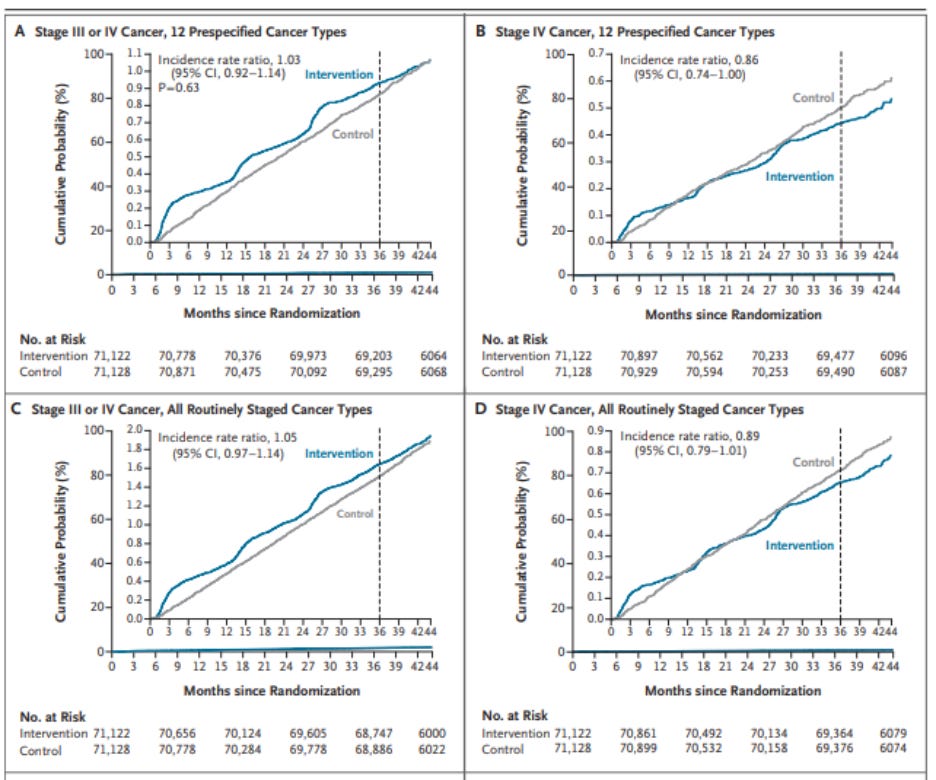
Trial incidence curves for stage III/IV cancer. Screened and unscreened groups barely differ at three years.
The largest test so far of Grail's Galleri blood test came up empty on its main question. In a 3-year randomized trial of about 140,000 people, the screened group was diagnosed with stage III or IV cancer as often as the unscreened group: 1 1.03, 95% confidence interval 0.92 to 1.14, P=0.63. Writing in Sensible Medicine, internist Adam Cifu argues the result fits a pattern. He also predicts that Medicare will pay for the test anyway.
What Galleri does
Galleri is a single blood test. It looks for 2, fragments that tumors shed into the blood, along with other circulating signals, and tries to detect many cancer types at once. Early accuracy studies set specificity close to 100% to keep false alarms rare. 3 is the share of cancer-free people who correctly test negative. At that setting, 4, the share of cancers the test catches, topped 50% only for stage III cancers. Cifu's point is that the test works best on cancers that are already advanced, which are the ones least likely to benefit from earlier detection.
What the new trial measured
The trial's primary endpoint was 5: whether screening reduced the number of advanced (stage III or IV) diagnoses. That is a short-term stand-in for the outcome that matters, which is fewer deaths. Galleri didn't even achieve the stand-in. Cifu concedes there is a small reason for hope: the incidence curves look as if they might separate in later years. Any benefit would be small and slow, though, and fewer late-stage cancers still wouldn't prove that lives are saved, much less at a reasonable cost.
The trial Cifu says we need
He wants what he would ask of any screening test. Randomize at-risk people to screening or no screening, follow them for a set number of years, and compare deaths from all causes. That design avoids three traps that make screening look better than it is:
6: catching a cancer earlier makes survival after diagnosis look longer, even if the person dies at the same age.
7: screening tends to find slow-growing cancers, and those patients do better regardless.
8: finding tumors that would never have caused harm.
Cifu acknowledges that such a trial is hard. Cancer is uncommon in the general population. Not everyone offered the test takes it, so the analysis has to count people by the group they were assigned to ("9"), which means enrolling even more of them. Deaths take years to show up. Healthy volunteers can be harmed by false positives and overtreatment. And because cancer treatment keeps improving, results eventually go out of date.
Bottom line
No randomized evidence yet shows that Galleri reduces deaths. Cifu predicts that true stories of cancers caught early will drive coverage decisions anyway. He compares the situation to public spending on Tamiflu and Paxlovid, two drugs he argues delivered little in return.
The biggest randomized test yet of Grail's Galleri test, a blood draw meant to screen for many cancers at once, missed its primary goal. About 140,000 people were followed for three years. Those offered screening were diagnosed with stage III or IV cancer at the same rate as those who weren't: 1 1.03 (95% confidence interval 0.92 to 1.14, P=0.63). A ratio of 1.0 means no difference, and the interval runs from an 8% reduction to a 14% increase. Adam Cifu, an internist who writes for Sensible Medicine, had been putting off commenting. His prediction is bleak. Medicare will approve and pay for an expensive test that offers little or no benefit, Grail's leadership and investors will profit, and taxpayers will spend more on healthcare without getting healthier.
The article doesn't name the trial or say where it ran. Its size and length match NHS-Galleri, the large randomized trial in England.
How the test works and what earlier studies showed
Galleri looks for 2, fragments shed into the bloodstream by tumors, along with other circulating substances. From that signal it tries to say whether cancer is present among many cancer types. The early studies were about accuracy, and Cifu calls them disappointing. Any screening test trades two numbers against each other:
3: of people without cancer, the share who correctly test negative. High specificity means few false alarms.
Sensitivity: of people with cancer, the share the test catches.
When Galleri's specificity was set near 100%, 4 topped 50% only for stage III cancers. Cifu reads this as the test being "mostly good at detecting cancer when it is clinically detectable and/or when we are not very good at treating it." The cancers most worth catching early, small and curable ones, are the ones it misses most.
What the new trial measured, and why that's a proxy
The trial's primary endpoint was 5: did screening move diagnoses from advanced stages (III and IV) to earlier ones over a short period? Researchers use this endpoint because deaths take far longer to count. It is still only a stand-in. Cancers caught earlier can still kill, and some early-caught cancers would never have mattered. Galleri didn't achieve even the stand-in.
Cifu offers what he calls "itzy-bitty" reasons for optimism. Looking at the incidence curves, he says, you could almost imagine stage III and IV diagnoses eventually falling in the screened group. He then lists what limits that hope. No difference appeared in 140,000 people over three years, so any later benefit is likely small and slow to build. And a slight drop in late-stage cancers within a trial population doesn't guarantee lives saved across the whole population, let alone at a cost-effective rate.
The trial Cifu says every screening test needs
His standard is the same one he applies to any screening test. Randomize at-risk people to screening or no screening, follow them for a prespecified number of years, and compare overall mortality. If enough fewer screened people die to justify the cost, adopt the test. If not, don't. Because Galleri targets many cancers at once, he notes, the usual argument over whether to count all deaths or only cancer deaths mostly goes away. All-cause mortality is the natural endpoint.
This design matters because, in Cifu's words, the goal of screening "is not to find more disease or to find it earlier; it is to decrease morbidity and/or mortality." Comparing deaths between randomized groups avoids three biases:
6. Here is an illustrative example, not taken from the article. Two people get the same incurable cancer, and both die at 70. One is diagnosed by screening at 64, the other at 68 when symptoms appear. The first seems to have "survived" six years and the second two, but screening changed nothing except how long the person lived knowing about the disease. Cifu argues this is harmful in itself.
Why that trial is hard
Cifu lists five obstacles:
Low incidence. In a general population, few people develop any given cancer in a few years, so the trial must be "between large and enormous."
Intention to screen. Not everyone offered the test takes it. People have to be analyzed by the group they were assigned to, which waters down any effect and pushes the size toward "enormous."
Long lag. Years can pass between catching an early cancer and the death it would have caused, so the trial must run for a long time.
Harm to healthy people. The participants are healthy, so the risk of harming more than helping is real. Sensitivity, specificity and the harms of overtesting, overdiagnosis and overtreatment all have to be measured.
Expiring evidence. Treatment keeps improving, and screening matters less for cancers that treatment handles well, so trials need repeating. "Evidence should come with an expiration date."
Costs beyond the price tag
Cifu expects true anecdotes: someone whose pancreatic cancer Galleri caught early, and who survived. He argues the policy question is different. Does the test save lives, and if so, at what financial and other cost? Without asking that, he warns, public money goes to private companies for nothing in return. He cites Tamiflu (Roche, Genentech, Gilead) and Paxlovid (Pfizer) as earlier examples, though he doesn't lay out that case here. A footnote points to a JAMA study on cancer diagnostic delay rates in a population trial of a cell-free DNA multicancer test. It concerns knock-on effects on the rest of the health system, such as positive results needing follow-up work. Cifu doesn't summarize its findings.
What's left open
This is an opinion piece by a known skeptic of screening, but the central number comes from a randomized trial and supports him. What is still unknown: whether late-stage incidence separates with longer follow-up, whether any trial will be powered for mortality, and how many false positives and diagnostic workups the test creates. The article gives no false-positive rates, costs, or details of Medicare's pending decision.
Remember
Galleri's primary result was a stage III/IV rate ratio of 1.03 (0.92–1.14): no detectable stage shift after three years.
Earlier studies found Galleri catches most cancers only once they reach stage III, when treatment helps less.
Cifu argues that only randomized trials measuring deaths can rule out lead time, length time and overdiagnosis biases.
A drug that lowers deaths in a sick group, such as people with diabetes, isn't proven to help healthy people. Benefits and harms change with baseline risk, so the drug needs its own trials in the healthy population.
Image: Your Local Epidemiologist
Anna Chodos, a geriatrician at UCSF (the University of California, San Francisco), has written a guide to the longevity market for the public-health newsletter Your Local Epidemiologist. Her view is that large extensions of human lifespan aren't realistic right now. She argues the target should be 1, the years you spend healthy and independent. This is an expert opinion piece, not a new study, and it cites no specific trials or effect sizes.
Why the hype spreads
Chodos says most longevity marketing makes one of two leaps. The first is "it worked on mice," with no human evidence behind it. The second is "it helps sick people, so it must help everyone," with no trials in healthy people.
No human longevity evidence
2, a transplant drug that suppresses the immune system, extends mouse lifespan. Small human trials gave mixed results on aging markers and showed no longer life.
3, a cell molecule involved in energy and DNA repair, can be raised by IV drips. Human studies were small, lasted weeks and found no gain in physical function.
4, a diabetes drug, is linked to lower death rates in people with diabetes. In one trial, older adults taking it gained less muscle from strength training. A longevity trial hasn't started.
5 such as semaglutide cut deaths in people with obesity plus heart disease, or with diabetes. They are unproven for average-risk people and can cause muscle loss.
Intermittent fasting works for weight loss about as well as ordinary calorie-cutting. It hasn't been shown to extend human life.
Modest and low-risk
6 taken with strength training may modestly increase strength in older adults. Many older people eat too little protein, and protein combined with resistance exercise helps preserve muscle. Fiber is linked to lower risk of early death, heart disease, diabetes and colorectal cancer, and trials show it modestly lowers cholesterol and blood pressure.
What she tells patients
Ignore "biological age" scores. No method is standard, and different tests disagree.
Eat a mostly plant-based, whole-grain diet with healthy fats, and drink less alcohol.
Stay socially, mentally and physically active. Guidelines call for 150 minutes of aerobic exercise a week plus two days of resistance training.
Sleep 7–8 hours on a regular schedule.
Get screened for hearing loss. Treating it is linked to lower dementia risk.
A caveat
Exercise guidelines have strong evidence behind them. Much of the support for diet, social connection and sleep is observational, though, so it shows association rather than cause, and Chodos's "linked to" wording reflects that. These habits are cheap and low-risk, which is the case for doing them anyway.
Anna Chodos, a geriatrician and Professor of Medicine at UCSF (the University of California, San Francisco), has written a sorting guide to the longevity market for Your Local Epidemiologist, a public-health newsletter. Her conclusion is that large extensions of human lifespan are "not a reasonable expectation right now." She argues the goal should be 1, the years you spend healthy and independent. Her daily work is with older patients who live with the conditions the anti-aging industry promises to prevent.
This is an expert review and opinion piece, not a new study. It cites no specific trials and gives no effect sizes, so read it as a clinician's summary of where the evidence stands, not as primary data.
Two arguments that keep repeating
Chodos says most longevity marketing rests on one of two leaps:
"It worked on mice." A compound extends life in lab animals, and the marketing jumps to humans before any human research has.
"It helps sick people, so it must help everyone." A drug proven in one disease group gets sold to healthy people with no trials in that population.
The hype tier: no human longevity evidence
2 (brand name Rapamune) is a transplant drug that suppresses the immune system to prevent organ rejection. It makes mice live longer. Small human trials gave mixed results on markers of healthy aging, including immune responses, lean tissue and abdominal fat. There is no evidence that it lengthens human life.
3 (nicotinamide adenine dinucleotide) is a molecule in every cell that helps turn food into energy and repair DNA, and its levels can fall with age. IV drips and patches do raise blood levels, and raising NAD+ improves aging markers in old animals. Human studies have been small and lasted only weeks, and they found no improvement in physical function. Chodos also notes that the FDA (the US Food and Drug Administration) doesn't regulate supplements the way it regulates drugs, and that the drips are expensive.
4 (brand name Glucophage), a diabetes drug, is linked to lower death rates in people with diabetes. That is the second leap. In one randomized trial, older adults taking metformin gained less muscle from strength training than those on placebo. A trial testing it for longevity hasn't started yet. Chodos doesn't name it, but the planned trial is widely understood to be TAME (Targeting Aging with Metformin).
5, the class that includes semaglutide (sold as Ozempic and Wegovy), mimic a gut hormone that controls appetite and blood sugar. Trials show lower death rates and less chronic disease in people with obesity plus heart disease, or with diabetes. For people at average risk, Chodos says, the evidence isn't there, and the drugs carry a risk of muscle loss. One sentence in the published piece reads "trials have shown they slow aging." That contradicts the paragraph around it and is probably a missing "no."
Intermittent fasting, meaning eating only within a set daily window, can help people eat less and lose weight. It generally works no better than ordinary calorie-cutting. Some fasting regimens extended lab animals' lives, but none has been shown to extend human life.
The modest tier: low risk, small benefits
6 helps muscles quickly replenish energy during exercise. In older adults, taking creatine monohydrate alongside strength training may modestly improve strength compared with training alone. Many studies show gains in lean body mass, but results on muscle size are less consistent. The piece calls creatine an amino acid. It is more accurately an amino-acid derivative.
Protein. Chodos is skeptical of "proteinmaxxing," the trend of adding protein to everything, including soda. Animal research and one observational study suggest the right amount may depend on age, and nothing shows that eating more protein extends life. Her concern runs the other way: many older adults don't get enough. Protein plus regular strength training helps preserve muscle, and active people may need more than the baseline recommendation.
Fiber is the trend she endorses. Higher fiber intake is linked to lower risk of early death, heart disease, type 2 diabetes and colorectal cancer, though those links are observational. Randomized trials show fiber modestly lowers cholesterol and blood pressure. Her sources are beans, lentils, whole grains, fruit, vegetables and nuts, with intake raised gradually to limit gas and bloating.
What she tells patients
Her stated aim is resilience: a reserve of strength, brain health and social connection that helps people recover from illness, a fall or a loss.
Reading it critically
The split between tiers is useful, but the evidence inside the top "proven" tier also varies. Exercise guidelines rest on extensive data. The diet, social-connection and sleep findings come largely from observational studies, where healthier and wealthier people tend to do all of these things at once. Chodos says "linked to" in many places, and that wording is accurate. These habits are low-risk and cheap, which is why clinicians recommend them despite the uncertainty. They aren't proven to the standard the piece applies to rapamycin. What remains open is whether any drug will ever pass a proper human longevity trial. The first such trial for metformin hasn't started yet.
Remember
Watch for two marketing leaps: mouse results sold as human ones, and drugs for sick people sold to the healthy.
Fiber has trial evidence for modest cholesterol and blood pressure cuts. The lower death and cancer risk is observational.
Hearing loss is under-treated from middle age on, and treating it is linked to lower dementia risk.
US opioid overdose deaths rose for more than 30 years, peaked at 81,806 in 2022, and fell to 44,564 in 2025, a drop of about 45%. It is the fastest decline in the modern history of the epidemic, and it helped push US life expectancy to a record high in 2024. In a STAT opinion piece, health-policy researchers J. Travis Donahoe (Pittsburgh), David T. Zhu (Virginia Commonwealth) and Michael L. Barnett (Brown) argue that no one actually knows why it happened.
The usual explanations don't fit the timing
Border policy. Vice President JD Vance credits the administration's border crackdown. But deaths began falling in mid-2023, months before the 2025 inauguration.
Naloxone, the drug that reverses overdoses. The authors' new paper in 1, a major medical journal, finds that 2 given by 3 has fallen since mid-2023, and so has bystander use that EMS crews witnessed. Naloxone still reverses tens of thousands of overdoses a year, but its use didn't rise as deaths fell.
Treatment. Use of medications for opioid addiction has grown, but slowly and steadily. That growth is far too small to explain a sudden drop of this size.
The likeliest cause: a change in the supply
A recent paper in Science found that street fentanyl became more diluted and harder to find as deaths fell, with users online talking about "fentanyl droughts." That is the most plausible explanation so far. But the source of the shock is unknown. The Science authors point to trade talks and crackdowns on 4 in China. Other possibilities include the 5's announced ban on fentanyl production and violence around it, or people quitting opioids because the supply was laced with sedatives like and .
The answer matters for policy. If China's precursor controls saved tens of thousands of lives, trade policy is a public health tool. If cartel violence or adulteration drove the drop, such policies may do little.
Looking under the streetlight
The authors argue that research has focused on treatment and harm reduction because those fields have rich data, like insurance claims. They compare this to a drunk man looking for his keys under the streetlight. The main national drug survey misses people who are homeless or incarcerated. It asks almost nothing about street prices, and it didn't ask about fentanyl until 2022.
They call for a survey that reaches people in shelters and jails, records what drugs people use and what they pay, and tests drug samples. Australia has run one for decades. They also want the Drug Enforcement Administration to share supply data routinely. Their warning: if we can't explain the decline, we won't know what to do when deaths rise again.
This is an argument piece. The supply-shock explanation is plausible but unproven, and the authors say so.
US opioid overdose deaths, after rising for more than three decades, peaked at 81,806 in 2022 and fell to 44,564 in 2025. That is about 37,000 fewer deaths a year, a decline of roughly 45%. It is the fastest fall in the modern history of the epidemic, and it helped lift US life expectancy to a record high in 2024. In an opinion piece for STAT, three health-policy researchers argue that despite intense study, nobody knows what caused it. They are J. Travis Donahoe of the University of Pittsburgh, David T. Zhu of Virginia Commonwealth University, and Michael L. Barnett of Brown University, who is also a primary care physician at Brigham and Women's Hospital.
Three popular explanations that don't fit
The authors test each claimed cause against two questions. Did it happen at the right time? Was it big enough?
Border enforcement. Vice President JD Vance has credited the administration's sealing of the border. But deaths started falling in mid-2023, well before President Trump's inauguration in January 2025 and the border crackdown that followed. A cause can't come after its effect.
Naloxone saturation. Public health agencies often point to flooding communities with 1, the medication that reverses opioid overdoses. The authors have just published a paper in 2 (the Journal of the American Medical Association) on this. They found that naloxone given by 3 has declined since mid-2023. So has naloxone given by bystanders in cases where EMS crews witnessed it. The authors stress that naloxone remains lifesaving and reverses tens of thousands of overdoses a year. Their point is narrower: its use fell while deaths fell, so rising naloxone use can't explain the drop. One caveat the piece doesn't address: EMS records don't capture naloxone given by bystanders when no ambulance is called. So this measure is partial.
Treatment access. Medications for opioid use disorder, such as buprenorphine and methadone, cut the risk of death. Their use has grown, but in the authors' words "steadily and incrementally." That is nowhere near the order of magnitude needed to explain a sudden halving of deaths.
Their conclusion is that forces outside medical care and public health policy "must be playing the major role."
The leading suspect: the drug supply
The most plausible driver so far is a change in illicit fentanyl itself. A recent paper in Science reported that, as deaths fell, fentanyl became more diluted and harder to find. Online posts from users described "fentanyl droughts." The mechanism is easy to follow. Fentanyl is so potent that small differences in dose separate a high from a fatal overdose. If street drugs carry less fentanyl, or people can't get it at all, fewer of them die.
The authors note big gaps, though. It is not certain what the supply shock was or what caused it. They list several candidates:
Chinese precursor controls. The paper links the shock to trade negotiations and crackdowns on producing the used to make fentanyl in China.
These are not mutually exclusive, and the piece offers no way to weigh them against each other. That is exactly the authors' complaint.
Why the cause matters for policy
The policy lessons differ sharply depending on the answer. If decisions about precursor chemicals in China saved tens of thousands of American lives, trade policy becomes a frontline public health tool. If cartel violence or adulteration drove the decline, the authors write, "it is unclear that such policies would help much." Knowing the cause also matters for the future. A supply shock can reverse, and the authors warn that the gains of the past three years are not guaranteed.
Searching under the streetlight
Why so little is known, the authors argue, comes down to where the data is. They compare it to the old joke about the drunk man who looks for his keys under a streetlight because the light is better there, not because he lost them there. Researchers, the authors included, have spent years on treatment and harm reduction because those fields have plenty of data, such as insurance claims. They credit that work with lowering barriers to care. But studying the illicit supply has had no comparable investment.
They describe specific weaknesses in the 8, the main US survey of illicit drug use:
It misses many of the people at highest risk, including those who are homeless or incarcerated.
It asks almost nothing about street prices, which are the main economic signal of supply changes.
It added a question on illicit fentanyl use only in 2022, the year deaths peaked.
Data on rare behaviors like heroin use is often unavailable below the national level, even though supply varies widely by region.
What they propose
They point to existing models. The Centers for Disease Control and Prevention already tracks HIV risk behaviors among high-risk groups nationwide. Australia has surveyed people about illicit drug use, prices and purity for decades. A better US survey, they argue, would reach people in shelters and jails. It would ask what drugs people use, how they use them and what they paid. It would also chemically test drug samples. Together, that would show whether the supply is changing and how it affects risk.
They also want federal agencies to share what they hold. The Drug Enforcement Administration (DEA) has supply data that researchers see only when it is forced into the open. Their example is the DEA's Automation of Reports and Consolidated Orders System (9), which tracks opioid shipments from distributors to pharmacies. It was released under court order in 2019, about eight years after prescribing peaked. The authors say studies built on it identified interventions that could have saved thousands of lives if they had come earlier.
How to read this
This is an argument piece, not a study. The naloxone timing finding comes from the authors' own JAMA paper. The supply-shock explanation rests on one Science paper plus indirect signals like online posts. The authors themselves call it the most plausible explanation, not a proven one. What they make convincing is the negative case: the explanations most often credited don't fit the timing. They also identify a real blind spot in how the US measures its drug supply.
Remember
Deaths began falling in mid-2023, before the 2025 border crackdown, so the timing rules that out as the main cause.
EMS naloxone use has fallen since mid-2023, so more naloxone can't explain the drop in deaths.
US drug surveys miss high-risk people and ignore street prices. Australia's long-running purity and price survey is a model.
In July, the FDA's 1 voted to add six of seven nominated peptides to the "2". That list names the raw substances licensed pharmacies may use to make drugs for individual patients. The vote went against the FDA's own staff, whose briefing documents raised serious concerns about thin safety and efficacy evidence. The vote is only advice, but the FDA usually follows its committees. A final decision is pending.
Writing in Science-Based Medicine, pharmacist Scott Gavura argues that this move skips the safeguards US drug law took decades to build.
Why the list matters
A peptide is a chain of amino acids. It is a type of molecule, not a regulatory category, and being one doesn't make a substance safe or effective. Insulin and semaglutide (Ozempic) went through years of trials and review before approval. Drugs compounded under Section 503A skip premarket approval, the factory quality rules known as 3, and some labelling rules. Being on the bulks list would not make these peptides approved. It would only make them legal to compound.
The evidence for 4
BPC-157 is the best known of the group. FDA reviewers assessed it for just one use, 5, an inflammatory bowel disease. They found a single small trial, available only as a meeting abstract, and judged it inadequate to support claims of either benefit or safety. No human studies tested injection under the skin, or delivery by mouth, nose or skin. Most other research is in animals. Clinics and pharmacies still promote it for tendon injuries, bone healing and gut disorders. Those uses weren't reviewed because there was no evidence to review.
What's in the vial
Supplier certificates for BPC-157 mostly listed purity alone. They lacked results for impurities, aggregates (clumped peptide), microbial load and 6, fragments of bacteria that cause fever and shock when injected. Gavura says these are gaps in documentation, not proof of contamination. The risk is real, though: compounded IV glutathione made from supplement-grade powder was linked to at least 30 adverse events this year, and contaminated powder caused reactions in 2019.
Can harm be detected?
The FDA's database held three BPC-157 reports, none clearly caused by the product. But 503A compounders generally don't report adverse events to the FDA. Gavura's own concern, which he labels as unproven, is that slow harms would be hard to trace to a product. One example is the body making antibodies against an injected peptide, which can blunt it or neutralize the body's own version. He doesn't claim BPC-157 is harmful. His point is that nothing in this pathway will find out. He urges people to report suspected reactions to 7, the FDA's adverse event reporting system.
This July, the FDA's 1, an outside panel that advises the agency on what pharmacies may compound, recommended adding six of seven nominated peptides to the "2". The list names the raw drug substances that licensed pharmacists and physicians may use to compound medicines for individual patients. The committee voted against the advice of FDA staff, whose briefing documents raised significant concerns about limited evidence on safety and effectiveness. The vote is advisory and a final FDA decision is pending, but the agency generally follows its committees.
Scott Gavura, a pharmacist writing in Science-Based Medicine, uses 3, the best known of the peptides, to argue that the decision would bring back problems that US drug regulation was built to solve.
The history he invokes
Clark Stanley's Snake Oil Liniment claimed to treat rheumatism, sciatica, toothache and frostbite. When federal investigators finally tested it, it held mineral oil, fat, red pepper and turpentine, and no snake. The Pure Food and Drugs Act of 1906 only required that a product's contents match its label, and it took another decade before Stanley's product was tested. Proof of safety before sale came in 1938, after Elixir Sulfanilamide killed more than 100 people. Proof of efficacy came in 1962, after the thalidomide disaster. Gavura says plainly that he is not calling peptides snake oil. His parallel is about regulation: what happens when the vial may not match the label, and the claims go well beyond the evidence.
What "peptide" does and doesn't mean
A peptide is a chain of amino acids. It is a type of molecule, not a special category of medicine. Some peptides are powerful drugs. Insulin transformed Type 1 diabetes, and semaglutide (Ozempic) went through a large research program before its 2017 approval. In both cases, safety, dosing and manufacturing were established through research and regulatory review. Many peptides promoted on social media have no comparable evidence. As Gavura puts it, the question is not whether something is a peptide. It is whether that particular peptide has been shown safe and effective for the use being claimed.
How the 503A pathway works
Section 503A of US drug law lets compounded products skip three things when its conditions are met: FDA premarket approval, current 4 requirements (the quality-control rules drug factories must follow), and certain labelling rules. This serves real needs. A patient may need a liquid version of a drug sold only as a tablet, or a version without an ingredient they're allergic to. The bulks list goes further. It lets pharmacies compound with substances that aren't part of any FDA-approved drug. If the peptides are added, they still would not be approved drugs, and the FDA would not have found compounded versions safe or effective. The substances would simply become legal to compound, and the products would never go through premarket review.
The evidence for BPC-157
FDA reviewers assessed BPC-157 for one use only: 5, a chronic inflammatory bowel disease. They found one small human trial, published only as a meeting abstract, and judged it inadequate to support claims of efficacy or safety. They found no human studies of delivery by injection under the skin, by mouth, by nose or on the skin, though these are the routes people use. Most other research is in rodents and other animals, where the dose-response relationship and relevance to humans are unproven. The FDA nonetheless documented clinics and compounding pharmacies promoting BPC-157 for gut disorders, tendon and ligament injuries, and bone healing. Those uses weren't reviewed at all because there was no evidence to assess.
Quality of the starting material
A compounded injectable is only as good as its raw chemical and the sterile process used to make it. Gavura gives two glutathione cases. In 2019, the FDA warned compounders about glutathione powder from one distributor after patients had reactions within minutes of infusion. FDA testing then found excessive bacterial endotoxin, fragments of bacterial cell walls that cause fever and shock when injected. Earlier this year, the FDA linked at least 30 adverse events to IV glutathione made from supplement-grade ingredients that weren't fit for injection, which led to recalls.
For BPC-157, the reviewers found that most public certificates of analysis for the free-base form reported only purity, with nothing showing control of impurities. Certificates for the acetate form, submitted with the nominations, lacked results for specified impurities, aggregates (clumps of peptide), bioburden (microbial load) and endotoxins. The reviewers concluded that neither form was well characterized. They also flagged a possible risk of 6, meaning the immune system reacting to an injected peptide, and noted that no study had examined it. Gavura stresses that these are gaps in documentation, not evidence of contamination.
Why few reports isn't reassuring
The FDA's adverse event database held three reports involving BPC-157, and the agency couldn't tell whether the product caused any of them. But compounders under 503A generally don't report adverse events to the FDA, so the agency hears only when a patient or clinician files a report themselves. The FDA also couldn't tell whether pharmacies currently compound BPC-157, or how many people use it.
The glutathione problems came on fast and traced back to a single supplier, so they were caught, though only after patients were hospitalized. Gavura's worry, which he labels his own concern rather than an established fact, is harm that develops slowly. For example, antibodies could form and gradually blunt the peptide's effect, or neutralize the body's own version of it. Patients and doctors might never link that to an injection. The human studies were small and short, with no long-term data.
What remains open
Gavura doesn't claim BPC-157 is harmful, and he allows it may help in some conditions. His point is that nobody knows whether it works, for what, at what dose, or whether long-term use is safe. Premarket review is the process that answers those questions, and compounded products bypass it. The article doesn't name the other five peptides or say when the FDA will rule. In the meantime, he urges anyone with a suspected reaction to a compounded product to report it to 7, the FDA's adverse event reporting program. Under current rules, a report may be the only way the agency finds out.
Remember
Being on the bulks list would make these peptides legal to compound, not FDA-approved or proven safe or effective.
FDA reviewers found BPC-157's only human evidence was one small trial in ulcerative colitis, available only as an abstract.
503A compounders generally don't report adverse events, so few reports in the FDA database say little about safety.
Overall survival: not mature yet. Those numbers are, in Lowe's words, "still counting up."
7. Slow-growing cancers sit in the body undetected for longer, so a screening test is more likely to find them. Screen-detected patients do better on average because they had the "less bad" cancers to begin with, not because screening helped.
8. Screening finds tumors that would never have caused symptoms, which inflates apparent success. Cifu points to a 2012 New England Journal of Medicine paper by Bleyer and Welch that explains this for breast cancer screening.
Ignore your "biological age." Fitness trackers estimate it from heart rate and fitness. Blood tests use proteins, inflammation markers or 7 (chemical tags on DNA that shift with age). No method is standard, and different tests give different answers. They are research tools, not a diagnosis or a prediction of how long you'll live.
Eat a mostly plant-based, whole-grain, healthy-fat diet. People who eat this way for decades are more likely to reach old age without major chronic disease and with physical and mental function intact. Take protein from lean animal sources or from beans, lentils, tofu and nuts, and drink less alcohol. This evidence comes mostly from long-term cohort studies.
Stay busy socially, mentally and physically. Loneliness and isolation are linked to higher risk of disease, dementia and early death. She recommends learning new things that stretch you. For exercise, she cites current guidelines: 150 minutes of aerobic activity a week plus two days of resistance training.
Protect sleep. She defines good sleep as enough of it (7–8 hours for most people), good quality (falling and staying asleep fairly easily) and a regular schedule. She links it to lower risk of heart disease, diabetes, cognitive decline and earlier death.
Bonus: get screened for hearing loss. It often starts in middle age and is under-detected and under-treated. Treating it is linked to better brain health, lower dementia risk and less social isolation.
6
7
Science
4
Cartel decisions. Around the same time, the 5, a major Mexican trafficking organization, announced a ban on fentanyl production. News reports described violence and deaths that followed.
Changes in user behavior. Some people may have stopped using opioids because the supply became less appealing. It was increasingly laced with sedatives such as 6, a veterinary tranquilizer, and 7, a related sedative.