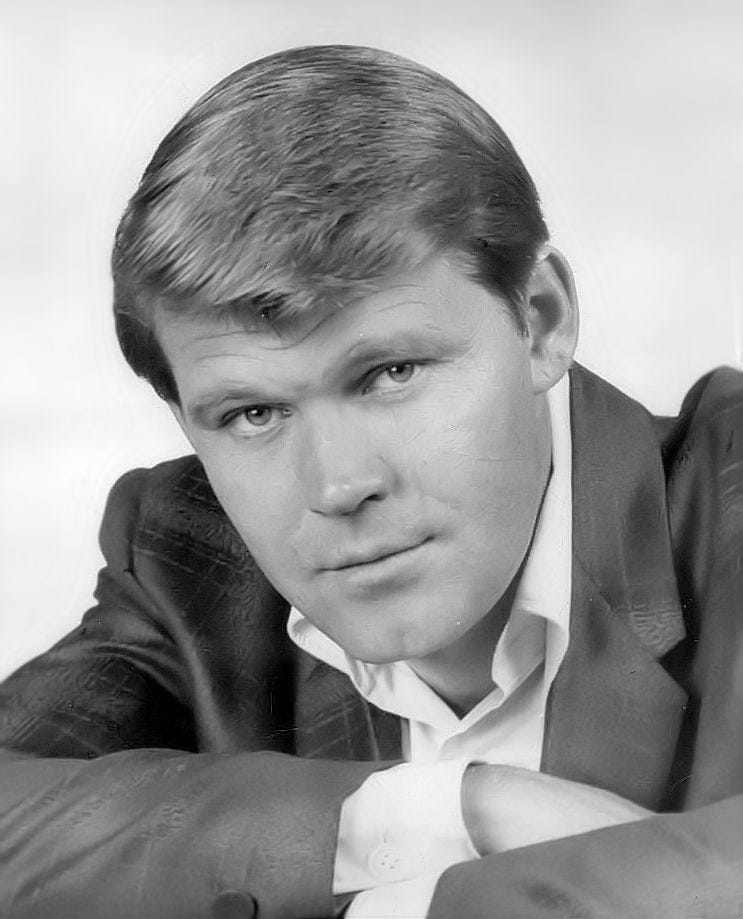
Glen Campbell: Session Ace, Five Flops, Then the Voice of Homesickness
Ted Gioia traces how a sharecropper's son who couldn't read music played on 586 songs in one year before stardom finally came.
Why it matters · Gioia makes a real argument about why some songs work. In a decade of rebellion anthems, Campbell's hits were about lonely men who wanted to go home. He also shows that a song with obvious technical flaws can still be close to perfect.
Ted Gioia's profile of Glen Campbell starts from the odd shape of his career. Campbell was famous on the radio years before anyone knew his name.
The invisible years
Campbell arrived in Los Angeles in 1960 and joined the first-call studio players now known as the Wrecking Crew. He played guitar for Sinatra, Elvis, Phil Spector, Nat King Cole, the Everly Brothers and dozens of others. He couldn't read music. On a new song he sometimes sat out the first run-through so he could hear it, then played on the second take. The pay was union scale, $65 for a three-hour session. Back in Arkansas he had picked cotton for $1.25 per hundred pounds. In 1963 alone he played on 586 recorded songs. Leon Russell called him the best guitarist he had ever heard, and Eddie Van Halen travelled to Arizona to get a lesson from him.
He failed again and again as a solo act. Capitol released a bluegrass album (1962), a country album (1963), a 12-string virtuoso record (1964) and a rock album (1965), and all four flopped. Then he briefly took Brian Wilson's place with the Beach Boys, and fans wanted Wilson back. Gioia notes that Capitol could afford to keep trying because Beatles money was pouring in. "Gentle on My Mind" (1967) finally broke through and won two Grammys. Over the next 34 months he released twelve albums, acted in films and hosted a CBS variety show with Steve Martin and Rob Reiner on the writing staff.