Today's long reads ask what counts as belief, soul or research, and follow the people whose convictions, obsessions and early ideas outran their labels.
Picked from 21 new articles across 14 sources · arrow keys for other days
Today in 30 seconds
30s left
Delusion researcher Ryan McKay rethinks belief after his seven-year-old trans son explains gender through "Baby Heaven", where children choose it before birth. story 1 ↓
Marian Wawrzeniecki found Poland's first obsidian artifacts, then spent decades painting pagan rituals and attacking critics, Gothic architecture and the Renaissance. story 2 ↓
"Research" entered Oxford and Cambridge's statutes only in 1877, after a dinner club of nine scientists lobbied and an MP's deletion attempt failed. story 3 ↓
Bruce Haack built a twelve-voice music computer from spare parts and left 213 tapes, of which only fragments have been released. story 4 ↓
Gary Kowalski's 1991 book redefines soul as morality, beauty, creativity and wonder, then finds them in an elephant's drawings and terns rescuing a comrade. story 5 ↓
1/5Psyche· Ryan McKay· Nov 4
A delusion researcher's trans son changes how he sees belief
Psychologist Ryan McKay, who built a career dissecting false beliefs, recounts raising a trans son and argues that rising trans identification is partly a wave of visibility, not a wave of delusion.
Why it matters · It turns a delusion researcher's tools on his own convictions, showing how a label that seems reasonable in theory lands differently when applied to someone you love.
Know this first
Context from the editor, not the article · 29 sec
1 · What counts as delusion
Psychiatry generally defines a delusion as a fixed false belief held despite contrary evidence. Its standard manual adds a cultural test: beliefs widely accepted in a person's community, such as religious doctrines, don't qualify.
2 · Culture-bound syndromes
Some forms of distress appear mainly in particular societies. A well-known example is koro, the fear that one's genitals are shrinking or vanishing, which has spread through communities in outbreaks. Such episodes show that culture can shape illness.
3 · The gender dysphoria dispute
Gender dysphoria is distress from a mismatch between someone's gender identity and their sex recorded at birth. Trans identification among young people has risen in many Western countries; people disagree over whether social influence or greater acceptance explains it.
2/5The Public Domain Review· Nov 4
The Polish archaeologist who painted a lost pagan Slavic paradise
The Public Domain Review collects 30 works by Marian Wawrzeniecki, a Polish painter and pioneering archaeologist whose digs convinced him that Christianity had colonized a pagan Slavic paradise, a belief that consumed his later art.
Why it matters · It shows how the imagination needed to read fragments of the past can harden into a worldview, and how a failed artist's obsession can still shape a culture's later self-image.
Know this first
Context from the editor, not the article · 29 sec
1 · Poland without a state
From 1795 to 1918, Russia, Prussia and Austria divided Polish lands between them. With no state of their own, Poles leaned on painting, literature and music to sustain a national identity, which gave historical art unusual weight.
2 · Why Slavic paganism is elusive
Pagan Slavs left almost no writing of their own. What survives comes mainly from Christian chroniclers, archaeology and later folklore. Poland's conventional Christian starting point is 966, so anyone reconstructing its pagan past must fill large gaps.
3 · The Wawel Dragon
In a well-known Kraków legend, a dragon living beneath Wawel Hill terrorizes the city and demands victims until it is tricked and destroyed. The tale gave Polish artists a native monster rooted in the old royal capital.
3/5Nautilus· Thomas W. Hodgkinson· Nov 4
How a Dinner Club of Nine Scientists Put Research into British Universities
Professors at Oxford and Cambridge had no formal duty to do research until the late 1800s. Thomas Hodgkinson argues a private club of nine Victorian scientists won that change by taking over Britain's key scientific institutions.
Why it matters · It shows that a seemingly timeless feature of academic life is a recent, contested invention, won through lobbying and institutional politics and driven partly by fear of a foreign rival.
Know this first
Context from the editor, not the article · 29 sec
1 · Gentleman science
For much of the 19th century, British science had few paid research posts. Many investigators relied on private money or other employment. Charles Darwin, working from his home in Kent on family wealth, is the best-known example.
2 · The German research university
In the early 1800s, German universities, with Berlin (founded 1810) as the emblem, began treating the creation of new knowledge as part of a professor's job. By mid-century the model attracted foreign students, including some from Britain.
3 · Darwin's divisive theory
Darwin's On the Origin of Species appeared in 1859 and set off a fight over science's authority relative to the church. Oxford and Cambridge still had deep religious ties, so backing Darwin and reforming universities were culturally linked causes.
4/5The Honest Broker (Ted Gioia)· Ted Gioia· Nov 4
Bruce Haack, the electronic music pioneer who lived in a friend's basement
Ted Gioia profiles Bruce Haack, a self-taught instrument builder who anticipated rave setups and electronic pop, earned his living from TV jingles, spent his last years in a friend's basement, and was later sampled by pop stars.
Why it matters · Haack's career suggests that being early can look exactly like being a novelty, and that the genres and jobs that make an innovator legible may arrive only after death.
Know this first
Context from the editor, not the article · 31 sec
1 · Early electronic music
In the 1960s, synthesizers were rare, costly and mostly found in studios and universities. Moog's commercial instruments appeared mid-decade, and building your own required real electronics knowledge. Few listeners yet heard electronic sound as pop rather than as experiment or sound effect.
2 · What a vocoder does
A vocoder splits a voice into frequency bands and uses their changing loudness to shape another sound, such as a synthesizer tone. The result is the familiar talking-machine voice. It began as telecommunications technology, not as a musical instrument.
3 · The Columbia moment
5/5The Marginalian (Maria Popova)· Maria Popova· Nov 4
A minister's 1991 book argued that animals have souls
Maria Popova revisits Gary Kowalski's The Souls of Animals, which redefines soul as moral sense, creativity and wonder, finds those traits in elephants and birds, and argues humans need other creatures to know themselves.
Why it matters · It shows how much a debate over animal minds depends on definitions: change what "soul" means and a theological question becomes one about observable behavior and human identity.
Know this first
Context from the editor, not the article · 28 sec
1 · Who gets a soul
Aristotle granted animals a perceiving soul but reserved reason for humans. Christian theology made only the rational human soul immortal, and Descartes described animals as machines. That legacy shapes what "animals have no souls" usually means.
2 · The anthropomorphism worry
Scientists have long warned against reading human feelings into animal behavior. Evidence for animal cognition has since eased that caution; the 2012 Cambridge Declaration on Consciousness said many animals have the neural machinery for conscious states.
3 · How The Marginalian works
The Marginalian is Maria Popova's one-person essay site. Her pieces usually weave long quotations from an older book with poems, art and other writers, so this is a reading of one book rather than new reporting.
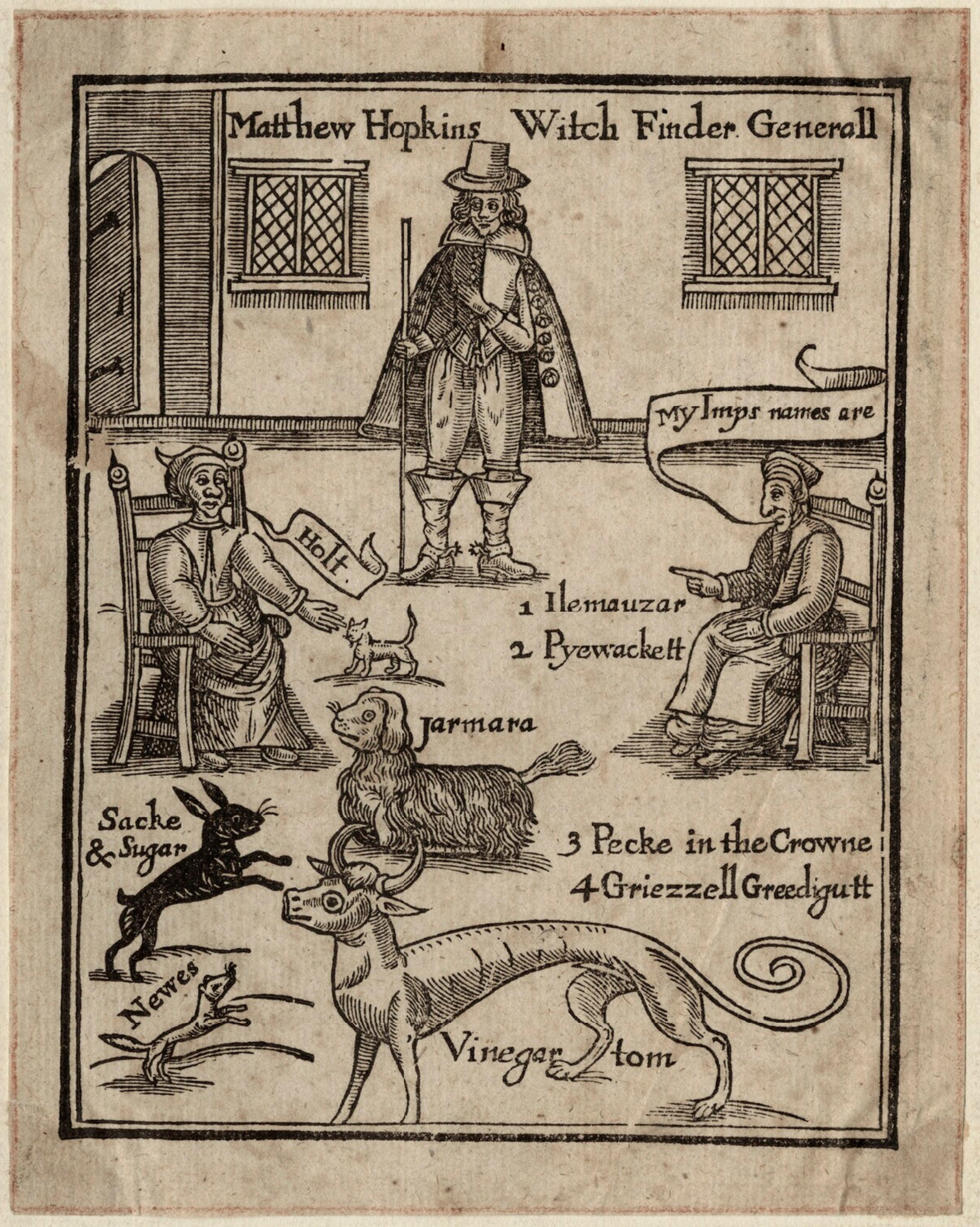
A 1792 etching after an earlier woodcut, placed beside McKay's discussion of how harmful beliefs spread collectively.
In an essay for Psyche, Ryan McKay, who has spent his career studying delusions, describes the night his seven-year-old told him: "I might have selected the wrong gender in Baby Heaven."
The expert's habit
McKay's patients have included a young woman certain she had died, a belief known as 1. In the clinic, he writes, separating who someone is from what has gone wrong with them is often simple, and the theorist can stay detached.
He also takes seriously Sigmund Freud's idea of delusion as a 2: a belief that protects the self. He applies it to himself. After his father died suddenly, grief briefly opened him to real religious belief. Then he stepped back, and "rigid analysis and brittle abstraction became both shields and weapons."
As a graduate student he argued that religious belief is delusional. The 3, psychiatry's standard reference, disagrees, exempting beliefs with wide cultural acceptance. McKay objected that false, harmful ideas can also spread collectively, as in 4, community scares about stolen genitals.
The same reasoning now drives scepticism about gender identity. Some commentators call rising 5, distress at a mismatch between gender identity and birth sex, a 6: a local, culturally shaped expression of distress. McKay admits he felt the pull.
Baby Heaven
Then came bedtime. His child's cosmology is an endless playground, reached by flying bus, where you choose your gender, eye colour and skin colour before birth. God picks your country and parents.
McKay's counter-argument comes from his boarding school. No boy admitted to being gay, and signs of it were policed. A close friend came out years later, to McKay's complete surprise. Being gay had seemed rare because of taboo, not absence. So he sees the rise in trans identification "in part" as a wave of visibility: "less a contagion of identity than of permission to be seen." That is an analogy rather than data, and he doesn't estimate how much of the rise it explains.
The speech nobody heard
Later, his son asks if he was happy to realise he was trans. McKay delivers a careful answer in the car, leaving unsaid his old irritation at pronouns in email signatures. His son hadn't been listening. McKay is annoyed, then relieved: this isn't everything in his son's life.
The essay ends with a picture book in which a scientist tells a 7, a creature of Australian folklore, that bunyips don't exist. "What a pity," it says. McKay argues that the 8 line, "There is no such thing as a transgender child", may be an abstraction to those who say it, but can land on a child as annihilation.
He never settles how to tell a delusion from an identity. What changes is his stance: people's beliefs, he writes, are not "my intellectual playthings".
Ryan McKay has spent his career studying delusions, and in an essay for Psyche he describes the moment that professional habit stopped working at home. His younger child, then seven, told him: "I might have selected the wrong gender in Baby Heaven." The essay uses that sentence to ask what it means to call a belief about yourself a delusion, and who gets to decide.
The clinic, where the line seems clear
McKay opens with a patient. In his cluttered, over-lit office, a young woman says she died two weeks ago and no longer exists. Then she asks whether this is heaven. Her belief matches 1, the conviction that one is dead, though McKay doesn't use the name. He lists its relatives: people who see a stranger in the mirror; people sure that loved ones have been replaced by identical impostors, known as 2; and a man in a case published in 2018, who came to an Australian emergency department convinced his penis had been stolen and swapped for someone else's.
The hard part, McKay writes, is separating who a person is from what has gone wrong with them. In the clinic this is often simple, and the theorist gets "a measure of certainty, and the possibility of detachment."
Broken brain or 3?
One view treats delusions as the output of a damaged brain. Another, descended from Sigmund Freud, who called a delusion a kind of psychic bandage, sees them as purposeful constructions that protect the self. On this reading, believing you are dead means you have nothing left to fear from dying. Some Freudians went further, casting a young woman's belief in an impostor father as a way to deny incestuous feelings.
McKay finds such theories easy to mock, and used to lighten his lectures with a family anecdote. His two-year-old, spotting an older brother's penis in the bath, asked for one. The seven-year-old replied: "Boys have willies, and girls have pyjamas."
Still, he takes the core idea seriously: beliefs can do emotional work, inside the clinic and outside it. He applies it to himself. His father died suddenly when McKay was on the cusp of adulthood. That summer, working on an outback gold mine, he felt his father beside him in the cab of a fuel truck on a night shift. For a short time grief opened him to real belief. If his father was in heaven, why the grim faces? He wanted to tell his family the death was wonderful. "I was approaching an edge," he writes. "But then I stepped back." Afterwards, "rigid analysis and brittle abstraction became both shields and weapons."
Some psychologists have linked atheism to feelings of abandonment, including losing a father young. McKay says the theory lacks much support today, but it appealed to him for a while.
The cultural exemption
As a graduate student, McKay wrote a paper titled "Hallucinating God?" It argued that beliefs such as virgin birth, bodily resurrection and transubstantiation (the doctrine that communion bread and wine become Christ's body and blood) break as many scientific principles as clinical delusions do.
The 4, psychiatry's standard reference, blocks that move: religious beliefs aren't delusional because they enjoy wide cultural acceptance. On this view, the Australian patient qualified not only because his belief was false and harmful (he had cut and burned his penis) but because it lacked cultural scaffolding.
McKay was impatient with this. False, harmful beliefs have also spread collectively, as in 5, outbreaks of fear about genital theft reported in various countries, and the episodes in Charles Mackay's 1841 book Extraordinary Popular Delusions and the Madness of Crowds.
Here the essay springs its trap. The same reasoning now drives one form of scepticism about gender identity: that rising 6 is a Western 7, a local, culturally shaped expression of distress. One unnamed "prominent commentator" has called it the clearest case of social contagion in history. McKay concedes he could feel the pull. The tool he built to take apart religion fits the argument against his own child.
Baby Heaven
The turn comes at bedtime, under a rabbit-shaped lamp. A story uses the word "queer", and McKay explains that some people who are gay or uncomfortable with their gender use it for themselves. His child says, "I'm not comfortable with my gender", something that had been clear for years, and adds: "It's not your fault, Dad."
Baby Heaven, McKay learns, is an endless playground reached by flying bus. You play there until you are born, choosing your gender, eye colour and skin colour. God picks your country and your parents. "I'm glad I got you and Mum as parents," his son says. McKay no longer tells the pyjamas story in class; the two-year-old in it was this child.
Contagion or permission?
His counter-argument comes from his boarding school. No boy would have admitted to being gay, signs of homosexuality were closely policed, and a boy caught masturbating became a pariah. McKay recalls feeling "anthropological curiosity and contempt" towards him. Both behaviours seemed rare, he now sees, because of taboo rather than absence. A close friend later phoned to say he was gay, and McKay had suspected nothing.
The logic is that an observed rate reflects both how common something is and what it costs to show it. Lower the cost and the visible number climbs. So McKay reads the rise in trans identification "in part" as "less a contagion of identity than of permission to be seen", even though these young people are still bullied at twice the rate of their peers.
"In part" is doing real work. The boarding school is an analogy, not evidence, and the essay offers no estimate of how much of the rise visibility explains.
The speech nobody heard
A year or two later, in a pool changing room, his son asks: "Dad, were you happy when you realised I was trans?" In the car, McKay gives a careful answer about wanting his child unmasked while fearing a hard path. He lists what he leaves out: his past irritation at "assigned at birth" and at pronouns in email signatures, and his recognition that people's identities are not "my intellectual playthings". When he asks if that makes sense, his son looks up: "What?" He hadn't been listening. McKay is annoyed, then mostly relieved. For now, this is not everything in his son's life.
Authorship and its price
McKay is inspired and frightened by the same feature of Baby Heaven: his son claims authority over who he is, rather than ceding it to God or biology. That invites pride if others acknowledge what he has authored, and shame or erasure if they don't.
He ends with The Bunyip of Berkeley's Creek (1973), Jenny Wagner's picture book about a 8, a creature of Australian folklore, who asks others what bunyips look like. A scientist says they don't exist. "What a pity," the bunyip replies. McKay sets this beside the 9 refrain, "There is no such thing as a transgender child." For commentators it may be "a swish of the lab coat". To a trans child, he argues, it may land "closer to annihilation".
What stays open
The essay never says how to tell a delusion from an identity, or what becomes of McKay's old objection to the cultural test. It also leaves aside clinical research and medical treatment. What shifts is his stance, from specimen collector to parent. He admits it took "a deeply personal stake" to get there, and a sceptic could turn his own question on him: what emotional work is this belief doing? The essay's force is that he raised that question first.
Remember
Observed rates reflect both how common a trait is and how costly it is to show.
An argument built against one target can transfer unexpectedly: McKay's case against religion also fits the case against his son.
The DSM's cultural test means a belief's social acceptance, not just its falsity, helps decide whether it counts as delusional.
Old Truths Lie in Books (1910): a skull-faced nude across a tome, framed by Art Nouveau illustrations.1 / 4
The Public Domain Review has gathered 30 works by Marian Wawrzeniecki, a Polish painter and archaeologist, dated from about 1894 to 1923. Its essay treats them as the record of a man who dug up prehistory and then could not stop imagining it.
A minor painter, an important digger
Wawrzeniecki trained in Kraków in 1, the academic genre of large scenes from the past. In Poland it served 2, the movement that blended high art and folk forms to build identities distinct from western Europe's empires.
The essay calls him "by any measure, a minor painter" but a majorly influential archaeologist. He discovered the first obsidian artifacts on Polish lands, along with early shelters, ceramics and 3, or upright carved stones.
His The Excavated Burial Mound (1891–92) is among the earliest paintings of an archaeological dig. It uses the conventions of history painting to show not an idealized past, but the gulf between the diggers and the puzzling fragments they uncover.
From evidence to creed
That gulf later closed. Archaeology requires imagination, and the essay says his "ran wild." He came to see pagan prehistory as the region's true essence, a paradise ruptured by Christianity. Gothic architecture and Renaissance painting became, in his view, Germanic and Italic aberrations, part of a thousand-year cultural colonization of pagan Slavdom.
His art changed with his beliefs. By the 1910s and 1920s he mostly made brightly colored illustrations of pagan rituals, closer to textbook plates than oil paintings. When critics attacked his theories, he answered with ethnographic studies, open letters and takedowns of younger 4 painters, who favored mood and inner vision.
The bound women
The recurring image in the later work is uncomfortable. Plump, often faceless nudes are tied to trees or strung between pillars, while a 5, a mythical serpent-like monster, lurks nearby. He was accused in his lifetime of something close to pulp erotica.
The essay proposes a less reductive reading: the nudes as allegories for an elusive pagan-Slavic essence, for creative devotion, and for artworks packaged and judged by critics. It offers this as a possibility and cites none of his writing in support. The charge and the allegory could both be true.
A failure with descendants
The essay argues he was trying to build a 6 visual archive, reinventing pagan religion in images strong enough to rival the Christian West's. He never fully succeeded. But his visual language paved the way for the Polish-American artist Stanisław Szukalski, and his theories found new life in Maria Janion's 2006 book Uncanny Slavdom, which argues that Polish culture's obsession with ghosts and monsters shows the pagan past never stopped haunting it.
The Public Domain Review has assembled 30 works by Marian Wawrzeniecki, a Polish painter and archaeologist, running from about 1894 to 1923. Its short essay offers more than a gallery note. It reads the pictures as the trail of a man whose research slowly turned into a creed.
The picture that poses the riddle
The essay opens with Old Truths Lie in Books (Stara prawda w księgach leży), from 1910. A nude lies across an open tome, holding a bloodied branch. Her body is fleshed, but her face is a skull. Above and below her are illustrations in the style of 1, the flowing decorative style of the period: a red-haired woman circled by a serpent, and a colder figure whose face disappears behind a forest of hair.
The essay wonders whether these are one woman at three depths of time, and whether the image works as a 2, an artwork that reminds the viewer of death. It leaves both questions open. The title is the sharper puzzle. It suggests that truth waits in old pages, yet the picture makes the book look like an altar, or a grave.
Training in the national style
Wawrzeniecki trained in Kraków in 3, the academic genre of large, densely detailed scenes from the past. The Polish version mixed national subjects with allegory. It belonged to 4, the broader movement that blended high art and folk forms to give peoples an identity distinct from the empires and colonial powers of western Europe. The essay's examples are the Czech composer Antonín Dvořák's Slavonic Dances and the masterpieces of the Polish painter Jan Matejko.
The essay's claim is that Wawrzeniecki outran this tradition by reaching further back than his teachers and peers could have imagined. Matejko's kind of national history had kings and battles to draw on. Wawrzeniecki went looking below that, in the ground.
The archaeologist
Here the essay delivers its neatest reversal: he was "by any measure, a minor painter" but a majorly influential archaeologist. He discovered the first obsidian artifacts on Polish lands, along with early earthen shelters, ceramics and 5, which are upright carved or inscribed stones.
The two careers met in The Excavated Burial Mound (Rozkopany kurhan), painted in 1891–92 and among the earliest paintings of an archaeological dig. It borrows the conventions of history painting but subverts their purpose. Instead of an idealized past, it shows the distance between the people digging and the strange fragments they find. At this stage, the essay suggests, he could still paint the gap honestly.
When the gap closed
Archaeologists have to use imagination to interpret what they find. The essay says Wawrzeniecki's "ran wild." He came to regard his region's pagan prehistory as its true essence, a paradise broken by a Christianized, fallen world. He eventually classed Gothic architecture and Renaissance painting as Germanic and Italic aberrations, successive regimes in a thousand-year cultural colonization of pagan Slavdom.
His style followed his beliefs. By the 1910s and 1920s he mostly produced colored illustrations of pagan rituals, giving up oil-painting technique for the bright look of textbook plates. The late titles in the collection trace the shift: A Proto-Slavic Scene (1917), The Cult of the Sun (1918), Holy Entrance to the Slavic Mystery Place (ca. 1920).
Critics were hostile to his theories, and he did not take it quietly. From the 1910s he published ethnographic studies, defenses of history painting, attacks on younger 6 painters (artists who favored mood and inner vision over depiction), and open letters to his critics.
The bound women
The hardest part of the work is its recurring image. Plump, often faceless female nudes are tied to trees or strung between pillars, and a 7, a mythical serpent-like monster, lurks close by, sometimes with a creepy smile. The titles include Naked Woman Tied to a Tree and Woman by the Whipping Post, both from 1911. These figures became an 8, and he was accused in his own lifetime of something like pulp erotica.
The essay accepts that this is the easy reading and proposes another. Taken as symbols, the nudes are layered allegories for an elusive pagan-Slavic essence, for creative devotion, and for artworks packaged and judged by critics. On that last reading, the bound woman is partly the artist's own work on display, exposed to hostile judges.
It is a generous interpretation, and the essay presents it only as a possibility. It quotes none of Wawrzeniecki's writing to support it, and the two readings do not exclude each other. An allegory can also be a fetish.
What he left behind
The essay's explanation of his career is that he was trying to build a 9 visual archive, a modern reinvention of pagan religion in images, strong enough to rival the iconic power of the Christian West. Seen that way, the drop in painterly polish was no great loss to him, because conventional standards of quality had stopped mattering.
It concludes that he never achieved "escape velocity," but that others carried on. The Polish-American artist Stanisław Szukalski (1893–1987), the subject of a 2018 documentary, worked in a neopagan experimental style. The literary scholar Maria Janion's 2006 book Niesamowita Słowiańszczyzna (Uncanny Slavdom) argued that Polish culture's persistent obsession with ghosts, monsters and phantoms shows the pagan past never stopped haunting its art and poetry.
The essay leaves some things unexplored. It does not name his critics or describe his digs in detail, and it does not trace how directly his work reached Szukalski or Janion. Nor does it weigh his findings against his theories, or ask what politics might follow from a myth of ethnic purity and foreign corruption. Its case is suggestive rather than proven, but the 30 pictures let readers test it for themselves.
Remember
His early burial-mound painting shows the distance from the past; his later rituals act as if that distance had vanished.
Abandoning oil technique for textbook-bright color may have been a choice of purpose, not simply a decline in skill.
Wawrzeniecki treated Gothic and Renaissance art, Europe's canon, as colonial impositions on Slavic culture, an unusually sweeping claim for his time.
In October 1926, Cambridge University gave its academics the right to take every seventh term off. In a Nautilus essay, Thomas Hodgkinson treats that 1 rule as one marker of a larger change: the moment universities decided professors should produce new knowledge, not just pass on old knowledge. He credits a private dining club of Victorian scientists with starting it.
A recent invention
Most academics, Hodgkinson says, assume the split between teaching and research is ancient. He read Cambridge endowment documents back to Tudor times and found no mention of research before the 19th century. The terms of the 2, created in 1663 and later held by Newton and Hawking, require only lectures and being at home on certain days to talk to students.
The club
In 1864, nine scientists began dining monthly at a Mayfair hotel. They called themselves the 3, signalling no shared doctrine, though they agreed that Darwin was right and that British science must become a profession. Members included the biologist Thomas Huxley, the physicist John Tyndall, the chemist Edward Frankland and the botanist Joseph Hooker. They also gave one another nicknames such as Xalted Huxley and Xcentric Tyndall.
Their complaint was practical: few jobs paid anyone to do research. Huxley said in 1874 that a drunkard had better worldly prospects than an original investigator. Meanwhile Germany had made professors divide their time between teaching and research, and was challenging Britain in science, industry and military power.
The takeover
Huxley saw two fixes: government laboratories, or research as a formal duty of university scholars. Historian Frank James says Huxley's fear of state interference ruled out the first. So the club went after the institutions. In the 1870s, two of the three presidents of the 4, Britain's national science academy, were members. Others ran or held posts at the 5, a London centre for research and public lectures.
The key prize was the 6, a government-appointed inquiry into British universities, where Huxley and John Lubbock both sat. Its recommendations led to an 1877 bill redefining the purpose of Oxford and Cambridge from "religion" and "learning" to "religion, learning, and research." An MP, Lord Francis Hervey, tried to strike the last word to protect "the English character" of the universities. He lost the vote.
How far to trust it
The change took decades: PhDs reached Oxford in 1917 and Cambridge in 1919. Hodgkinson shows the club's members in the right rooms, but not how much they mattered compared with the German threat itself. He also works at a research-only institute, which he promotes as a rare escape from teaching.
In October 1926, almost exactly a century ago, Cambridge University amended its statutes so that academics could take every seventh term off. The word 1 comes from the Hebrew shabbat, rest, but an academic sabbatical is mostly a rest from one kind of work in order to do another: teaching gives way to original research. In a Nautilus essay, Thomas Hodgkinson treats this small rule as one milestone in a much bigger change, and he credits that change largely to a private dining club of nine Victorian scientists.
A younger idea than it looks
Most academics, Hodgkinson says, assume the split between teaching and research is ancient. It isn't. Oxford and Cambridge began in the Middle Ages mainly as training grounds for the church, and over the centuries became something closer to intellectual finishing schools. Original research as a professor's duty did not enter seriously until the late 19th century.
To check this, Hodgkinson read endowment documents for professorships in Cambridge's University Library, going back to Tudor times. Before the 19th century, he reports, they say nothing about research. His best example is the 2, a professorship created in 1663 and later held by Isaac Newton and Stephen Hawking. Its terms ask only that the holder give lectures and be at home on certain days to talk to students. Frank James, a historian of science at University College London, describes the attitude that still prevailed in the 1860s: "So long as you gave your lectures, they couldn't care less."
Nine men and a letter
In 1864, nine British scientists began meeting for a monthly dinner at the St George's Hotel in Mayfair. They called themselves the 3, to signal that they held no doctrine. They did agree on two things: Darwin was right, and British science had to become a profession.
The members ranged widely:
George Busk, a surgeon
Edward Frankland, a pioneer of 4, the study of compounds that bond carbon to metals
Herbert Spencer, a philosopher who reportedly carried earplugs to use if he was losing an argument
Thomas Huxley, the biologist known as "Darwin's bulldog"
John Lubbock, the archaeologist who coined "paleolithic" and "neolithic"
John Tyndall, an Irish physicist and daring mountaineer
They were also playful. On a picnic at Maidenhead they awarded themselves nicknames: Xalted Huxley, Xcentric Tyndall, Xhaustive Spencer, Xtravagant Hirst.
The problem: no jobs
The complaint was literal. Science was not yet a profession, because there were few posts that paid anyone to do it. Huxley put it sharply in an 1874 speech: in Britain, "It is better for a man's worldly prospects to be a drunkard, than to be smitten with the divine 5 of the original investigator." A drunk might hold down a job; a researcher had no job to hold. The result, Huxley said, was that Britain was "far behind France, and infinitely behind Germany."
That anxiety reached well beyond the laboratory. Matthew Arnold, the poet and critic, was dismayed to hear German friends call Oxford a mere "6," meaning a glorified secondary school. In George Eliot's Middlemarch, published in the early 1870s, the scholar Casaubon appears an amateur partly because he seems unaware that "the Germans have taken the lead in historical inquiries."
Tyndall, Frankland and Hirst had studied in Germany and knew its system firsthand. German universities had, decades earlier, made professors divide their time between teaching and research. Hodgkinson's account is that this helped Germany challenge British preeminence in science, industry and military power, which turned an academic grievance into a national concern.
Two routes, and why one was closed
Huxley saw two remedies: a set of government-funded laboratories, or the German approach of making research a formal duty of university scholars. According to James, Huxley would never have chosen the first, because he feared state interference in science. That left the universities, and the universities could only be changed through the institutions and committees that had the government's ear.
Taking over the institutions
The X Club's method, as Hodgkinson tells it, was to occupy those bodies. In the 1870s, two of the three presidents of the 7, Britain's national academy of science, were club members: Hooker and Spottiswoode. At the 8, a London centre for scientific research and public lectures, Tyndall took over from Michael Faraday in 1867. Huxley and Frankland were professors there, and Busk and Spottiswoode served as Treasurer and Secretary.
The decisive target was the 9, a nine-member body led by the Duke of Devonshire and appointed in the early 1870s to investigate the state of British universities. Lubbock and Huxley were among its members. In a Commission report, Frankland wrote that the weakness of British science "lies in the entire non-recognition of original research by any of our Universities."
One word, one vote
The Commission's recommendations led to the 10, put before Parliament in 1877. Earlier legislation had defined the essence of the universities as "religion" and "learning." The bill proposed adding a third word: "religion, learning, and research."
At the last moment Lord Francis Hervey, MP for Bury St Edmunds, moved to delete "research" to preserve "the English character" of the universities. The word, he said, had only been added "to conciliate a small and enthusiastic clique." Hodgkinson assumes he meant the X Club. The War Minister, Gathorne Hardy, replied that research would not "pervert the purposes of the University" and would probably improve teaching by exposing students to the latest advances. Hervey lost. Nature, itself founded only in 1869, said the phrase should be posted at Cambridge "in letters of gold on the Senate House."
What the story leaves open
Hodgkinson concedes that a statute doesn't change a culture overnight. Later steps came slowly: PhDs at Oxford in 1917 and Cambridge in 1919, the Cambridge sabbatical in 1926, and the PhD becoming a prerequisite for a professorship in the 1970s.
His causal claim is also stronger than the evidence he presents. He shows the club's members in the right rooms and quotes their arguments, but not how much their influence, rather than the German challenge itself, moved Parliament. Hardy's assurance about teaching was an argument, not a finding, and the essay doesn't test it. Readers should also know that Hodgkinson works for the London Institute for Mathematical Sciences, a research-only body housed in the Royal Institution, and he closes by holding it up as one of the few places free of the teaching half of the bargain.
Remember
Newton's Lucasian Chair formally required only lectures and student office hours; its terms never asked for research.
Huxley rejected state-run laboratories for fear of government interference, which steered British research into universities.
The British case for academic research rested heavily on rivalry with Germany, in industry and military power as well as science.
Switched-On Bach, Wendy Carlos's 1968 album of Bach played on a Moog synthesizer, became a surprise bestseller for Columbia Records. Its success briefly made major labels curious about electronic music, opening a door for stranger artists.
Bruce Haack at work, the self-taught builder who made his own electronic instruments.
Ted Gioia, a music critic and historian, has added Bruce Haack (1931–1988) to his 1, a series of essays on musicians who fit no existing category. His case: Haack was the most futuristic musician of his day, and the culture had no place for him until after he died.
A self-taught builder
Haack grew up in a tiny Alberta mining town, taught himself piano at four, won a scholarship to 2, the New York conservatory, and left within months. He learned instead by playing with First Nations musicians and building instruments from cheap spare parts.
The results were odd and far ahead of their time. The 3, a battery-powered analog synthesizer (one that makes sound from continuously varying electrical signals), sounded when rubbed against a human being. In 1968 he showed Fred Rogers, of the children's show Mister Rogers' Neighborhood, a homemade synthesizer, 4 and light show packed into a suitcase. Gioia calls it what we would now call a DJ's setup. That same year he built a 5, a device that imposes the contours of a voice on another sound, before Stevie Wonder or Daft Punk made it familiar.
Why it didn't pay
Columbia Records signed him after its synthesizer album 6 took off. His album The Electric Lucifer reworked William Blake's battle between heaven and hell as psychedelic electronic songs. His agent vanished with the $2,000 advance, Columbia soon grew cautious, and Haack never made another major-label record.
Gioia's explanation is timing. Today Haack could make a good living as a beatmaker, supplying electronic backing for pop stars, but that job didn't exist. His work was filed as novelty, good for selling Kraft cheese and Bazooka gum, not for radio. Children's records gave him his widest freedom, Gioia argues, because that genre tolerates absurdity: the same track that sounded too avant-garde for adults passed as fun for kids.
The basement
In 1972, as synthesizers were reaching radio hits, Haack moved into the Pennsylvania basement of a Juilliard classmate, Ted Pandel, and stayed until his death. There he spent 18 months building a music computer from spare parts, with no blueprints. It played twelve voices and stored 4,000 bits of data, or 500 bytes. Gioia rates his late albums, Captain Entropy and Haackula, as his best.
What survives
7 and Kanye West have sampled him, and Beck has covered him, so pop stars rediscovered him before critics did. But of the 213 reel-to-reel tapes he left, now in an Edmonton archive, just 61 minutes came out as Preservation Tapes, along with a few other tracks.
Gioia's essay is an appreciation, not a history: it shows Haack was early and later borrowed from, but doesn't prove he founded any genre.
Ted Gioia, a music critic and historian, has added Bruce Haack (1931–1988) to his 1, a five-year series of essays on musicians who fit no existing category. Earlier subjects include Raymond Scott, inventor of an early electronic composing machine called the Electronium, and Hans Jenny, who studied the patterns sound makes in physical matter. Gioia's claim for Haack is large and hedged at once: he was "the most futuristic musician of his day," and "you might even say" he helped invent techno, electronica, disco and synthesized funk. Yet he never had a real hit.
A prodigy who walked out
Haack grew up in Rocky Mountain House, a tiny mining town in Alberta, Canada. He taught himself piano at four and could play songs after one hearing, which earned him a scholarship to 2, the New York conservatory. He lasted a few months.
His real education happened elsewhere. Early on, Gioia writes, he sought out musicians from First Nations communities in Alberta and earned enough trust to join their rituals, where he also encountered peyote, a psychedelic cactus. He also began building electronic instruments from whatever parts he could find. The dancer Esther Nelson, an occasional collaborator, recalled him going to Grand Street to "buy a bag of parts for a dollar and build instruments with them for us to record with."
The machines
Three of his devices show how far this went.
The 3 was an analog synthesizer, meaning one that makes sound from continuously varying electrical signals, and it ran on a 9-volt battery. It sounded when rubbed against a human being. The pianist and comedian Victor Borge brought Haack onto the TV show I've Got a Secret in 1966 to demonstrate it, under the pitch "I'm going to make music by touching ten pretty girls."
In 1968 he appeared on Mister Rogers' Neighborhood with a homemade synthesizer, 4 and light show built into a suitcase. A sampler records sounds and plays them back as musical material. Viewers saw a gimmick. Gioia sees a DJ's rig, decades before the raves and EDM (electronic dance music) parties that would need one.
The most striking was a polyphonic music computer, polyphonic meaning able to sound several notes or voices at once. Working from parts bought at Ver-Tech Radio in Philadelphia, Haack spent 18 months building it with no blueprints and no formal electronics training. It could play twelve separate voices and store four thousand bits of data. For scale, by my arithmetic, 4,000 bits is 500 bytes, about the size of this paragraph as plain text. Gioia describes the results as "folk music for robots," and says that if the Star Wars cantina were a real venue, this would be its open mic night.
Haack also built his own 5 in 1968, a device that imposes the contours of a voice on another sound and that had been used to encrypt radio transmissions during World War II. He used it on a recording the following year, before Stevie Wonder, Herbie Hancock or Daft Punk made it familiar. Gioia also points to a 1968 clip of Haack rapping over an electronic beat.
Children's music as a loophole
The essay's most interesting idea concerns genre as permission. Haack made a country album, Together (1971), that Gioia nominates as the strangest ever. But he went furthest in children's records. Because kids' music tolerates goofiness and absurdity, Gioia argues, a track that would be dismissed as too avant-garde on an adult album became acceptable when aimed at children. The strangest electronic sounds of the era could reach the market by being labelled as silly.
The big break that wasn't
The peak came when Columbia Records signed him, two years after its synthesizer album 6 became a breakout success. Columbia was then also releasing Terry Riley, Karlheinz Stockhausen and Edgar Varèse. Haack's project, in the works since the early 1960s and mostly written in 1968–69, was a psychedelic electronic song cycle updating William Blake's poetic battle between heaven and hell. His friend and manager Chris Kachulis helped bring it to 7, the Columbia producer who had discovered Aretha Franklin and Bob Dylan.
Hammond gave Haack a $2,000 advance. Haack's agent took the money and disappeared. The album, The Electric Lucifer, came out anyway, and Gioia calls it a true meeting of modernist classical music and psychedelic rock, with a zaniness drawn from Haack's love of children's music. His nearest counterpart, Gioia suggests, is Frank Zappa, who found a route to stardom.
Columbia grew more cautious in the 1970s and Hammond lost influence before retiring in 1975. Haack never made another major-label record.
The basement
In 1972, still in his early forties, Haack moved into the Pennsylvania home of Ted Pandel, a Juilliard classmate and collaborator, and stayed until he died. Synthesizers were just reaching radio hits, and he had dropped out of the industry at the moment it caught up with him. His most widely heard music sold Kraft cheese, Goodyear tires and Bazooka gum, and even that didn't pay the bills.
He kept working. In Gioia's opinion, the best music came now: Captain Entropy (1974) and Haackula (1977), which fuse funk, electronics, rap and 8, the technique of composing from recorded real-world sounds.
Rediscovery, partial
The mechanism of Haack's failure, as Gioia tells it, was timing. Today he might prosper as a DJ or beatmaker supplying electronic backing for pop stars, but those jobs did not exist, so his work was filed as novelty: fine for a commercial or game show, wrong for radio. Then the mainstream moved. 9 and Kanye West have sampled him, and Beck, deeply influenced by The Electric Lucifer, has covered his work. The rediscovery, Gioia notes, came from pop stars, not from academics or critics.
Most of the music remains unheard. Haack left 213 reel-to-reel tapes, now in an archive in Edmonton. Only 61 minutes appeared as Preservation Tapes, thirty years after his death, along with a few other tracks.
What to weigh
This is an appreciation rather than a piece of music history. Gioia shows that Haack was early and that later stars borrowed from him, but sampling is not the same as founding a genre, and he offers no direct line from Haack to the birth of techno or disco. He doesn't explain how the music computer worked, why so little of the archive has been released, or exactly why Haack withdrew to Pennsylvania beyond the money.
Kachulis offers a counterweight to the tragedy, saying Haack "had a good life there." Haack himself said, "Whoever wants to know me will find me." Gioia closes with a flourish: at a time when robots are trying to take over human music, Haack did the reverse, taking the robot's music for himself.
Remember
A genre can work as a permission slip: children's records let Haack release sounds adult markets rejected as too avant-garde.
Innovators can be dismissed as novelties simply because the job that would make sense of them doesn't exist yet.
Haack's reputation rests on a sliver of his output: 213 tapes survive, but most remain unreleased in Edmonton.
Utagawa Yoshimori's 1863 elephant print, accompanying the story of Siri, the zoo elephant whose drawings impressed an art professor.1 / 3
Maria Popova's latest essay on The Marginalian, her one-person literary site, returns to a 1991 book that asked a question few scientists would touch: do animals have souls? Its author, Gary Kowalski, is a parish minister, not a biologist.
Changing the question
Everything depends on what "soul" means. Kowalski sets aside the usual sense, the part of a person that survives death. For him it is "the marrow of our existence as sentient, sensitive beings," showing up as a moral sense, a feeling for beauty, creativity, and wonder at the universe.
That definition does the book's key work. Soul can't be seen or measured, he says, but its "outward manifestations" can be observed. A metaphysical question becomes one about behavior. Popova adds a point from language: the word animal comes from the Latin for soul.
The evidence
Music. Kowalski argues that the best birdsong uses rhythm, theme and variation in deliberate patterns. He warns against human yardsticks: birds live at a faster tempo, so their compositions last seconds, not an hour, and sit high in pitch, as a phonograph record does when played fast.
Art. In 1982 Jerome Witkin, a Syracuse University professor and authority on 1, the postwar school of non-figurative painting, assessed drawings by a "mystery artist." He called them "very lyrical, very, very beautiful," and said most of his students couldn't fill a page that way. Only then did he learn the artist was Siri, a fourteen-year-old, 8,400-pound Asian elephant at a local zoo. Her keeper had seen her tracing lines in the dust and brought charcoal and paper, against the superintendent's wishes.
Morality. A nineteenth-century naturalist collecting specimens wounded a tern, which fell into the sea. Other terns lifted it by the wings, pair after pair, and carried it to shore. He had a clear shot at the bird on its rock and could not bring himself to take it.
The turn back to us
The most interesting argument concerns humans. Kowalski calls us "nothing special": without specialized gifts or strong instincts, we are adaptable but have no fixed identity. "In a fundamental way we need other creatures to tell us who we are." Lose the wild species, he warns, and we weaken the conditions of our own "ensoulment." Popova goes further, suggesting that other creatures may confer soul on us rather than the reverse.
What it leaves open
Popova's essay is an appreciation, not a test. The cases are anecdotes, and a critic's admiration for Siri's drawings says as much about the viewer as about any intent behind them. Anyone who means an immortal soul will find the question changed rather than answered. Still, the shift has force: if soul means love, play and wonder, denying it to animals now requires an argument.
Maria Popova's latest essay on The Marginalian, her one-person literary site, returns to a book published in 1991: The Souls of Animals by Gary Kowalski. He is a parish minister, not a biologist, and spends his days praying with the dying, blessing marriages and helping people through moral dilemmas. Popova found the book through a footnote in a collection by the poet May Sarton. She reads it as ahead of its time: it appeared long before people talked about the soul of an octopus, and before 1, two ways of recording brain activity, showed that birds dream and hinted at what they dream about.
Why the question is hard
The first obstacle is that nobody agrees what a soul is. Popova lines up two attempts. Carl Jung called it "partly in eternity and partly in time." Virginia Woolf said it could not be written about directly: "Looked at, it vanishes." The second obstacle is what Popova calls an age-old dogma that the soul belongs to humans alone. Even as people have reluctantly admitted other creatures into consciousness, she argues, they have withheld the richer inner life of imagination, love, grief and wonder, largely because our tools cannot probe it. Language, she points out, has been on the other side all along: the word animal comes from the Latin for soul.
"Dogma" compresses a longer history. Aristotle gave animals a soul of a lesser kind, and the sharper denials came later. The essay doesn't go into this.
The definitional move
Kowalski's central move is to change the question. Many people, he says, think of the soul as the part of a person that survives death. He means something "much more down-to-earth": "the marrow of our existence as sentient, sensitive beings." He defines spirituality as "the development of a moral sense, the appreciation of beauty, the capacity for creativity, and the awareness of one's self within a larger universe as well as a sense of mystery and wonder about it all." He treats it as a natural byproduct of biology and of the ecology all life shares.
This makes the inquiry possible. "Soul is not something we can see or measure," he writes, but we can observe its "outward manifestations": tears, courage, generosity, forgiveness. Asking whether animals have souls becomes asking whether they show these things. He claims he can do this "without anthropomorphizing," which means without simply projecting human traits onto animals.
The evidence: music
Birdsong is his first exhibit. He calls it "far from a mechanical performance." The best singers combine tone, interval, rhythm, theme and variation, and he asks what music is if not "the deliberate arrangement of sound in aesthetic patterns." Popova extends the point: music differs from noise through creative intent, and creativity may be the purest evidence of soul. She also recalls that a whale song joined Bach and Bulgarian folk music on 2, the disc of Earth's sounds sent aboard the Voyager spacecraft.
Influenced by the philosopher Martin Buber's 3 model, which treats another being as a presence to meet rather than an object to assess, Kowalski warns against judging birds by human standards. His explanation is a neat one. Birds live at a faster tempo, so their notes are so short that some can be separated only with a 4, an instrument that plots sound frequencies over time. Their compositions last seconds where a symphony lasts an hour. They sing high for a related reason, he says, just as a phonograph record rises in pitch when played fast. On this view, a bird's song may be a compressed symphony, and to a bird we must look "lazy and dim-brained."
The evidence: visual art
Kowalski cites the 1950s studies by the zoologist 5, in which non-human primates given pens and paints developed "a distinct feel for symmetry and balance" and individual styles. His showpiece is an elephant.
In 1982 Jerome Witkin, a Syracuse University art professor and authority on 6, the postwar school of non-figurative painting, was asked to assess drawings by a "mystery artist." He called them "very lyrical, very, very beautiful," adding of one, "I can't get most of my students to fill a page like this." Only afterward did he learn the artist was Siri, a fourteen-year-old, 8,400-pound Asian elephant at Syracuse's Burnet Park Zoo. Her keeper, David Gucwa, had seen her tracing lines in the dust and brought paper and charcoal against the wishes of the superintendent, who scoffed. A colleague who specialized in children's drawings, shown the work without context, concluded firmly that no child had made it. Witkin compared the drawings to those of 7, the abstract expressionist painter.
Sarton later turned the story into a poem, "The Artist." In her version de Kooning himself sees the drawings and delivers the verdict, while in Kowalski's account Witkin only wishes he could.
The evidence: moral feeling
Popova connects art and morality through Iris Murdoch's idea of "8," the shift of attention away from oneself. Kowalski notes pelicans and crows caring for blind companions, and Darwin's report of monkeys risking their lives to help one seized by an eagle.
The most vivid case comes from a nineteenth-century naturalist collecting specimens, who wounded a tern that fell into the sea. Other terns circled, then two dove down, lifted it by the wings, carried it several yards and set it down. Another pair took over, and so on to the shore. The naturalist had a clear shot at the rock where it lay and could not take it.
The turn back to us
The book's most interesting argument concerns humans. Kowalski says we are "nothing special," a judgment he calls both biological and moral. Lacking specialized gifts and strong instincts, we are adaptable but have no fixed identity, and so we need models for how to live. "In a fundamental way we need other creatures to tell us who we are." Humans could survive without chimpanzees and orangutans, he writes, but we would have weakened the conditions of our own "ensoulment."
Popova pushes further: perhaps other creatures confer soul-ness on us, rather than we on them. Kowalski locates the moment in eye contact: "I see you seeing me, and I am aware that you are aware that we are looking at each other."
What it leaves open
This is an appreciation, and it doesn't test Kowalski's evidence. His cases are anecdotes, some more than a century old and from a single witness. A critic's admiration for Siri's drawings tells us about the viewer as well as about any intent behind them. Kowalski's shore birds, which seem to share "a group mind," are also a warning: later research has explained flock movement largely through each bird tracking a few nearby neighbors.
The definition cuts both ways too. Anyone who means an immortal soul will find the question changed rather than answered. Kowalski's real achievement may be to shift the burden: if soul means love, play and wonder, denying it to animals now requires an argument.
Remember
Definitions can do most of the work: Kowalski makes soul a matter of observable behavior, not survival after death.
Judging birdsong by human tempo may mislead, since Kowalski argues a few seconds of song reflects a faster metabolism.
Kowalski's strongest claim concerns humans: lacking fixed instincts, we learn who we are partly through other species.