Batteries Got Safer; Permits Might Get Faster · Morning Gist
Wednesday, October 145 stories · 15 min
Batteries Got Safer; Permits Might Get Faster
New battery-safety data, a Senate bill to stop court-ordered construction halts, and fights over who pays for data centers and California's grid.
Picked from 22 new articles across 13 sources · arrow keys for other days
Today in 30 seconds
30s left
EPRI finds grid battery failures per GWh fell 98% from 2018 to 2025, to rates like oil-filled transformers. Older systems carry most remaining risk. story 1 ↓
A bipartisan Senate permitting bill would let NEPA lawsuit winners force a redone review but not stop construction. story 2 ↓
FERC rejected PJM's plan to cut data centers first in emergencies but approved a registry of every load of 50 MW or more. story 3 ↓
GridLab and Energy Innovation say fixing idle grid capacity and utilities' incentives to spend would cut California bills more than a rate freeze. story 4 ↓
Pennsylvania's two hydrogen hubs have drawn about a fifth of first-phase money, and their tax credits now expire in 2027, not 2032. story 5 ↓
Interior is reopening a key approval for Revolution Wind, a $6.2 billion offshore wind farm that is already running.
1/5Utility Dive· Brian Martucci· Oct 13
Grid battery failure rate per gigawatt-hour fell 98% from 2018 to 2025
An analysis of a worldwide incident database by the Electric Power Research Institute shows grid-battery failures per gigawatt-hour fell 98% from 2018 to 2025. Older systems built before current safety codes still fail more often.
Why it matters · Local fears about battery fires are a major permitting obstacle for storage. This gives communities and regulators a comparison point, and shows where the remaining risk sits.
Know this first
Context from the editor, not the article · 29 sec
1 · Thermal runaway
A damaged or faulty lithium-ion cell can heat itself uncontrollably, releasing flammable gases and heat that can spread to neighbouring cells. Once that happens, a single failing cell can turn into a fire or a gas explosion.
2 · What NFPA 855 is
NFPA 855 is the US National Fire Protection Association's installation standard for stationary energy storage. Its first edition came out around 2019–2020. It sets rules on spacing, unit size, ventilation, explosion control and fire testing, and local fire codes adopt it.
3 · Who EPRI is
The Electric Power Research Institute is a nonprofit research organisation funded largely by utilities. It runs a public database of battery energy storage failure incidents compiled from news reports and other sources worldwide.
2/5Heatmap· Emily Pontecorvo· Oct 13
Senate permitting bill would stop courts from halting projects over flawed reviews
A bipartisan Senate bill would stop judges from pausing projects or cancelling permits when an environmental review breaks the law. Legal experts say that matters more than the bill's other changes to environmental review.
Why it matters · Court-ordered stops are the main reason environmental reviews take so long, so this provision could change how fast transmission lines and power plants get built, and how much agencies bother to study.
Know this first
Context from the editor, not the article · 30 sec
1 · What NEPA requires
The National Environmental Policy Act (1970) makes federal agencies study, and take public comment on, the environmental effects of permits and rules before deciding. It is procedural: it requires an agency to look at the effects, not to choose the greener option.
2 · How NEPA gets enforced
NEPA has no penalties of its own. Its teeth come from lawsuits. When a court finds a review was inadequate, it can vacate (cancel) the decision or issue an injunction that pauses the project until the agency fixes the problem.
3 · The 2025 Supreme Court ruling
3/5Latitude Media· Maeve Allsup· Oct 14
Regulators reject PJM's plan to cut power to data centers first in emergencies
Federal regulators rejected PJM's plan to cut power first to data centers that don't bring their own new generation. They said it oversteps state authority and unfairly singles out large loads. That leaves bring-your-own-capacity deals in limbo.
Why it matters · Whoever pays for, and gets cut off to make room for, data center load growth in the largest US grid region will shape both power bills and where AI infrastructure gets built.
Know this first
Context from the editor, not the article · 27 sec
1 · PJM and its capacity market
PJM Interconnection runs the grid and wholesale power markets for 13 states plus Washington, DC. Through capacity auctions it pays generators years ahead to be available at peak. Data center demand has driven those prices sharply higher.
2 · Who regulates what
FERC, the Federal Energy Regulatory Commission, oversees wholesale markets and interstate transmission. States control retail electricity: rates, service terms and decisions about which customers lose power. Grid operators' rule changes need FERC approval.
3 · Firm service and curtailment
4/5Utility Dive· Ric O’Connell and Michael O’Boyle· Oct 13
Two clean-energy groups set out a plan to cut California's power bills
GridLab and Energy Innovation, two clean-energy policy groups, say California's power prices, now double the national average, come mostly from grid and wildfire spending, not clean energy. They propose reforms to regulation, rate design and utility incentives.
Why it matters · If high bills get blamed on clean energy, electrification loses political support. California's cost drivers, including idle grid capacity and utility incentives to spend, exist in most US states.
Know this first
Context from the editor, not the article · 31 sec
1 · Who sets California's rates
Most Californians buy power from investor-owned utilities (IOUs) such as PG&E, Southern California Edison and SDG&E. These are private monopolies. The California Public Utilities Commission (CPUC) approves their spending and sets the rates customers pay.
2 · What's in a power bill
A bill pays for three things. Generation is producing the power. Transmission is the high-voltage lines that carry it long distances. Distribution is the local poles, wires and substations. US utilities usually earn a regulated profit on the capital they invest in these networks.
3 · Wildfires and utilities
5/5Inside Climate News· By Rebecca McCarthy· Oct 13
Pennsylvania's two federal hydrogen hubs have stalled under Trump
Pennsylvania's two hydrogen hubs won $1.7 billion in federal awards in 2023. Today one has gone silent and the other is waiting. Deadlines are shorter, funding is uncertain, and some partners are now building gas plants for data centers.
Why it matters · The hubs were the main US test of whether subsidies could start a clean hydrogen industry. Seeing why they stalled shows which parts of that bet were weak from the start.
Know this first
Context from the editor, not the article · 27 sec
1 · Green, blue and grey hydrogen
Almost all hydrogen today is "grey": made from natural gas, with the CO2 released. "Blue" hydrogen uses the same process but captures the carbon. "Green" hydrogen comes from splitting water with clean electricity.
2 · The hydrogen hubs program
The 2021 infrastructure law funded regional "hubs" that group hydrogen producers, users and pipelines in one area. In 2023 the Energy Department picked seven of them to share $7 billion, paid out in phases as projects hit milestones.
3 · Tax credits 45V and 45Q
45V is a production tax credit worth up to $3 per kilogram of clean hydrogen. 45Q pays for each ton of CO2 captured and stored. Blue hydrogen projects rely on 45Q.
The 1 (EPRI) is a utility-funded nonprofit research group. It analysed its worldwide database of lithium-ion battery energy storage system (2) failures and found the failure rate per gigawatt-hour of installed storage fell 98% from 2018 to 2025. It fell 50% in the last year alone.
Annual failure rates for stationary storage now run from 0.04% to 0.14%. EPRI notes that this is about the same as the 0.1% rate for oil-filled transformers, which utilities already treat as a routine risk. Of the incidents reviewed worldwide, 93% caused no injuries or deaths.
One caution (our note, not the article's): storage deployment has grown very fast, so part of the per-GWh drop may come from that growth. The article doesn't give absolute incident counts.
Why newer systems are safer
The main danger is 3. A faulty cell overheats, releases flammable gas and can set off its neighbours. EPRI's Lakshmi Srinivasan says systems built in the past five years are markedly more reliable because they follow stricter codes. The main one is 4, the US fire-safety standard for stationary storage.
The last US injuries came in April 2019. An explosion at an Arizona Public Service battery site seriously hurt four firefighters, and that site predated NFPA 855. The largest US fire came later. In January 2025, at 5 in California, a fire destroyed most of Vistra's 300-megawatt battery array, which sat inside an old turbine hall. Nobody was hurt. EPRI finds indoor sites fail more often and suffer worse damage than outdoor ones. Barriers between units and measures that stop fire spreading within units help.
The older 3%
Sites built before 2021 are only 3% of global capacity but carry outsized risk. Srinivasan recommends risk assessments, especially for explosion risk. She calls explosions a bigger danger to people than fire. Fixes range from cheap flammable-gas detectors to new ventilation or structural changes that direct blast pressure upward. The larger fixes can void warranties, and sometimes retiring the system early makes more sense.
Permitting
Safer hardware hasn't made permits easy. Srinivasan says gaps in NFPA 855 push most developers to seek exemptions, for example for higher energy density. Many local officials lack the expertise to judge these requests. Since January, New York's fire code lets local authorities make developers pay for independent technical reviews of exemption requests.
The finding
Grid batteries have become much less likely to fail. The 1 (EPRI), a utility-funded nonprofit research group, analysed its worldwide database of failures in lithium-ion battery energy storage systems (2). Measured per gigawatt-hour (GWh) of installed storage, the failure rate fell 98% between 2018 and 2025, and by 50% between 2024 and 2025 alone. The report is titled Risk Factors and Failure Statistics of Lithium-Ion BESS.
EPRI puts the annual failure rate of stationary storage systems at 0.04% to 0.14%. The report compares this with the roughly 0.1% annual failure rate of oil-filled transformers, which every utility already runs in large numbers and treats as a normal, manageable risk. The article does not say exactly what one "failure" is for this rate, for example whether it is counted per site or per unit.
Why it is getting better
Lakshmi Srinivasan, a senior technical leader in EPRI's energy storage program and a principal investigator on the report, told Utility Dive that systems built in the past five years appear significantly more reliable than earlier ones. "There are things we know in 2026 that were not necessarily understood in 2019 or 2020, when the older systems were being put in place," she said.
The main changes are tighter codes and design practice, chiefly 3, the US fire-safety standard for stationary storage. The main hazard is 4. A faulty cell overheats, gives off flammable gas and heat, and can set off the cells around it. Newer designs aim to stop this from spreading between cells and units, and to stop the gas from building up into an explosive mix.
A caveat that is our reading, not the article's: global storage deployment has grown very fast. Some of the per-GWh drop may come from the denominator growing faster than the number of incidents. The article does not give absolute incident counts, so the two effects can't be separated here. The trend to newer systems being safer holds either way.
Outcomes of the failures that did happen
Of the incidents EPRI reviewed worldwide, 93% caused no injuries or deaths. In the US, no injuries or deaths have been reported from BESS failures since April 2019. That month, an explosion at an Arizona Public Service (APS) battery facility seriously injured four firefighters. A later investigation by 5 (Underwriters Laboratories, a safety-science organisation) noted the site was commissioned before NFPA 855 was first released.
The largest US failure was at 6, a former thermal power plant on California's central coast. Vistra installed a 300-megawatt battery array inside a 1950s-era turbine hall there and commissioned it in 2020. In January 2025, thermal runaway in one unit started a fire that spread through the indoor building and destroyed most of the array. Smoke poured out for days. No one was injured, and later soil and water monitoring found no significant threat to health or the environment. Experts called it a "learning opportunity" for the industry.
The report's data support that point. Indoor facilities fail more often than outdoor ones and suffer more damage on average. EPRI says two measures can limit spread indoors: propagation prevention inside each battery unit, and fire walls or similar barriers between units. Most modern projects instead use outdoor, containerised units spaced apart.
Where the risk sits now
Facilities commissioned before 2021 make up only 3% of global storage capacity. They account for a disproportionate share of the risk. Srinivasan suggests their owners run thorough risk assessments and fix problems where needed.
The APS explosion shows the main concern for these older sites. Srinivasan says explosion risk is "a different risk than fire and a bigger one from a personnel and equipment standpoint." The pressure wave can hit firefighters who open a door, which a slow-burning fire does not do. Retrofits range in difficulty:
Low difficulty: adding flammable-gas detectors inside battery enclosures, so a dangerous build-up is spotted early.
Higher difficulty: new ventilation systems to clear the gas, or structural changes that direct pressure waves upward and away from first responders.
The bigger retrofits usually mean modifying the battery unit's enclosure. That can void the manufacturer's warranty or interfere with other parts of the design. In some cases, Srinivasan says, retiring an outdated, higher-risk system early may make more sense than retrofitting it.
The permitting problem
Safer hardware has not made permitting easy. Srinivasan says NFPA 855 has limits that push most developers to apply for exemptions, for example to allow higher energy densities than the standard's default limits. Many local authorities don't have the in-house expertise to judge those requests.
New York has responded with a fire-code change that took effect in January. Local authorities can now make storage developers pay for independent technical reviews of exemption applications. That moves the cost of expert review onto the applicant rather than leaving small fire departments to decide alone. (An earlier version of the article mentioned a new NFPA standard due this fall. Utility Dive removed it. NFPA 855 remains the governing standard.)
What stays open
The article gives rates and percentages but not the underlying counts, the GWh denominator by year, or how EPRI's database finds incidents. Public databases built from reports can miss small events. It also doesn't say how many pre-2021 sites have actually been assessed or retrofitted, or whether other states will copy New York's approach. The overall picture is clear, though: failures are now rare, they cluster in older and indoor designs, and the remaining work is mostly on those older sites and on the permitting process.
Remember
Stationary batteries now fail about as often as oil-filled transformers: 0.04–0.14% per year.
For older battery sites, explosion from built-up gas is a bigger hazard than fire, and gas detectors are a cheap first fix.
Gaps in the main fire standard, NFPA 855, still force most projects into case-by-case exemptions, which slows permitting.
Last year the Supreme Court gave agencies more room to decide how far to study a project's upstream and downstream effects. Experts expected that to make injunctions and vacated permits harder to win.
Image: Heatmap
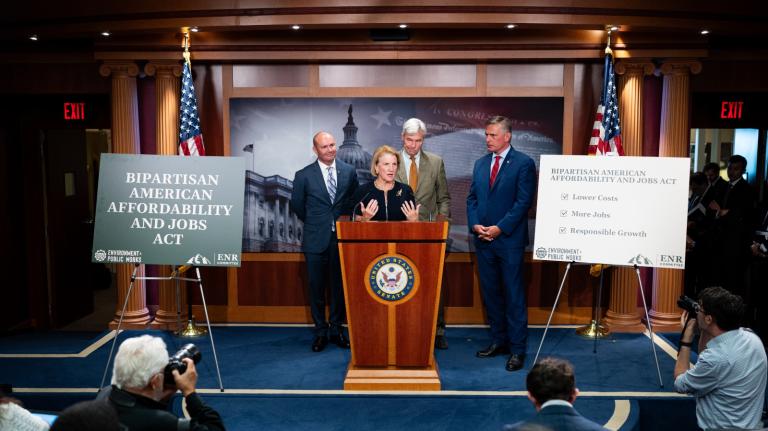
Last month a bipartisan group of senators proposed the Bipartisan American Affordability and Jobs Act (BAAJA), a broad rewrite of how federal environmental reviews work for energy projects. It limits who can sue, which courts can hear the case, and what plaintiffs can argue. Legal experts told Heatmap that one provision matters most: it narrows what a court can do once a plaintiff wins.
The problem it targets
The National Environmental Policy Act (1) makes agencies study a decision's environmental effects and compare alternatives before acting. Agencies don't have to act on what they find. The pressure to do the study well comes from the courts. If a review misses impacts or gets the analysis wrong, a judge can 2 the permit or issue an 3 pausing the project. Many Democrats backing the bill see those lawsuits as a big obstacle to clean energy and the transmission lines needed to connect it to the grid.
What changes
If someone sues under NEPA and wins, courts could no longer vacate or enjoin. They could only send the agency back to fill the gap in its analysis, and construction could keep going in the meantime. The same limit would apply to the National Historic Preservation Act (4), which requires a similar study of effects on historic and cultural sites.
Matthew Littleton, a former senior Justice Department environment lawyer in the Biden administration, argues this makes the bill's roughly 100 other pages of NEPA changes beside the point. Agencies are short on staff. If no court can stop them "even if you completely ignore the statute," he says, they have little reason to spend time on the review.
What's still available
Opponents can still sue under the 5 (APA), which bars agency actions that are "6." Alex Mechanick of Johns Hopkins says an agency that skipped a relevant impact, or found serious risks and ignored them without explanation, could still have its decision vacated. Littleton agrees. Under the bill, NEPA work might survive mainly as a way to make decisions hold up under the APA.
Wetlands permits get harder to challenge
The bill goes further for Clean Water Act 7 permits, which the Army Corps of Engineers issues for dumping dredged material into waters or wetlands. That review is not just procedural, because the Corps may be required to deny a permit. Courts couldn't vacate these permits under the APA either. The one exception is when the permitted work poses an "imminent and substantial danger" to health or the environment. Mechanick calls this a "timing rule": judges can step in only once harm is close, not earlier.
Last month a bipartisan group of senators introduced the Bipartisan American Affordability and Jobs Act (BAAJA), a permitting reform meant to speed up federal approval of energy projects of every kind. One of its biggest changes is to the role courts play in federal environmental reviews. The bill would limit who can challenge a federal environmental decision, which courts can hear the challenge, what plaintiffs can argue, and what remedies they get if they win.
That last item is the one several legal experts told Heatmap's Emily Pontecorvo matters most. Matthew Littleton was a deputy assistant attorney general in the Justice Department's Environment and Natural Resources Division under the Biden administration. He gave what he called a possibly "really cynical view": "the remaining 100 pages of the bill devoted to 1 are all going to be irrelevant in light of that remedy provision."
What NEPA does, and where its teeth come from
The National Environmental Policy Act (NEPA) is an information-gathering law. When the federal government makes certain decisions, such as issuing a permit or writing a rule, it has to consult the agencies with relevant expertise and invite public comment. If the decision could significantly affect the environment, it also has to do a broad assessment of those effects, including a comparison with alternatives.
Other laws require narrower reviews. A Clean Air Act analysis asks whether a project meets federal pollution limits. A NEPA analysis asks what that pollution does to nearby communities and wildlife, and whether putting the project somewhere else could meet the same goals with less risk.
What matters for this bill is that NEPA doesn't make an agency act on what it finds. If a review of an oil leasing program turns up big risks, the government can go ahead unchanged. The pressure comes from litigation. If an environmental group shows the agency missed impacts, studied too few alternatives, or got the analysis wrong, a court can 2 the decision (cancel it) or issue an 3 (pause it, for example halting a lease sale) until the agency fixes the problem. Many Democrats backing the bill see that litigation risk, and the delays it causes, as a major obstacle to clean energy projects and the grid infrastructure needed to connect them.
The courts have already narrowed NEPA. Last year the Supreme Court gave agencies more discretion over how much to analyze a project's upstream and downstream effects. Experts expected that to make injunctions and vacated permits much harder to win.
What the bill changes
BAAJA goes much further. If a community or other stakeholder sues under NEPA and wins, the court could no longer enjoin the project or vacate the decision. It would have one remedy left: ordering the agency to address the gap in its analysis that the lawsuit exposed. Construction could continue in the meantime.
An illustrative example: an agency approves a transmission line without studying its effects on a protected bird population. A group sues and wins. Today the judge could pause construction until the study is done. Under the bill, the judge could only order the study. By the time it's finished, the line might already be built.
Littleton says this removes the reason to do NEPA properly. Right now agencies and developers know that a sloppy review could get a decision suspended, a permit vacated or construction halted. It's hard to say how much that risk shapes agency behavior, but without it, nobody has a reason to invest in the analysis. Agencies are under-resourced, he noted: "If at the end of the day you know a court is not going to stop you, even if you completely ignore the statute, you're going to take the action as quickly as you can, consistent with your other obligations." The worst case becomes a court telling the agency to go back and do more paperwork.
The bill makes the same change to the National Historic Preservation Act (4), a similar procedural law that requires agencies to study effects on sites of cultural or historic significance. Littleton says lawmakers should be honest about what they're doing. "If Congress has decided that NEPA and the NHPA have outlived their usefulness or do more harm than good, people should be willing to own that and say it and explain why that's so." If not, he suggests, Congress could make the reviews much narrower but keep consequences for skipping them.
The remaining route: the 5
Projects can still be stopped. Alex Mechanick, an assistant professor at Johns Hopkins and a former senior counselor at the Office of Management and Budget under Biden, points to the Administrative Procedure Act (APA). That broader law forbids agency actions that violate the Constitution or federal regulations, or that are "6." "Arbitrary and capricious action is already unlawful under the APA and could lead to agency action being vacated or enjoined regardless of BAAJA," he said.
According to Mechanick, a court might find an APA violation if:
a decision's environmental costs plainly outweighed its benefits;
a less damaging option offered the same benefits; or
the agency didn't analyze a relevant part of the decision.
If the Interior Department adopted a new oil and gas leasing plan without considering effects on local wildlife, a court could call that arbitrary and capricious. The same goes if the department studied those effects, found significant risks and ignored them with no explanation. Littleton didn't dispute this. He suggested NEPA review could become the way agencies show they've complied with the APA rather than a goal in its own right.
A tougher rule for wetlands permits
The bill goes further on the Clean Water Act. Under 7, a developer needs a permit from the Army Corps of Engineers to place dredged material into a body of water or wetland. The Corps collects public comments, analyzes impacts and weighs alternatives, much like NEPA. The difference is that this review has legal force: depending on what it shows, the Corps may be required to deny the permit.
Under BAAJA, a court that finds a flaw in the Corps' analysis couldn't vacate a Section 404 permit, and the bill specifically blocks vacatur for APA challenges too. The one exception is when the permitted activities "would present an imminent and substantial danger to human health or the environment."
Mechanick calls this a "timing rule." What a court can do depends on how far along the project is: either the agency still has time to act before harm arrives, or it doesn't. "I don't understand why you should have to wait until the harm is imminent to enjoin the agency," he said, "but I suppose the idea is that this is a lighter touch remedy until it's really a do-or-die moment."
What's still open
The article doesn't measure how much NEPA litigation actually delays energy projects. It doesn't say whether the bill's limits on who can sue and where would change outcomes on their own. It also doesn't address the bill's chances of passing. The main open question is the one Littleton raises: whether agencies will keep doing thorough reviews once courts can no longer stop them, or whether the APA ends up doing the work NEPA used to do.
Remember
Under the bill, winning a NEPA lawsuit would only force the agency to redo its analysis, not stop construction.
The Administrative Procedure Act's 'arbitrary and capricious' standard would become the main legal route left for halting projects.
Wetlands permits could be vacated only if a court finds imminent, substantial danger, which Mechanick calls a timing rule.
Most customers take firm service, meaning power is expected to stay on. Curtailment means ordering a load to cut consumption during grid emergencies. Demand response programs pay customers to do this voluntarily.
Image: Latitude Media
The Federal Energy Regulatory Commission (1), which oversees wholesale power markets, on Friday rejected 2's plan to make data centers the first to lose power in grid emergencies. PJM Interconnection runs the grid for 13 states and Washington, DC.
FERC did approve PJM's large load registry, a central database of every existing and proposed load of 50 megawatts or more.
What PJM proposed
PJM's goal was to keep ordinary customers from paying for the surge in data center demand. Its enforcement tool was the 3. Any new large load that didn't procure its own new capacity would be curtailed at the earliest stage of an emergency, even before customers enrolled in voluntary 4, who are paid to cut use. States and utilities would decide who got cut and by how much.
Loads could avoid this through 5 deals, contracting directly for new supply. That supply could come from 6, which bundle many small batteries, solar systems and flexible loads into sellable capacity.
Why FERC objected
FERC found that IRAS intruded on states' authority over retail service and unfairly singled out new large loads. It also rejected PJM's BYOC rules on two points:
Locking in a resource's capacity credit for 10 years would favor those resources and could count capacity they can't deliver, pushing costs onto existing ratepayers.
Letting distributed capacity count from anywhere in PJM ignores transmission bottlenecks. A battery in an unconstrained area doesn't help a data center in a congested zone.
PJM can refile. To pass, a new plan must stay out of state authority, justify singling out large loads with evidence, and require capacity to be deliverable in the load's own zone. FERC suggested an alternative: a voluntary non-firm service, in which flexible data centers accept curtailment risk in exchange for lower capacity costs and faster grid connection.
Commissioner David Rosner wrote separately that non-critical data centers should be shut off before homes, hospitals and schools in an emergency, but that state regulators should set that order.
What happens to deals
Mary Yang, a former PJM counsel now at 804 Advisory, calls the ruling a setback but not a dealbreaker. Many BYOC deals were drafted but unsigned, waiting for clear rules, and she expects that uncertainty "is going to keep dragging." She says she hears anecdotally of developers moving to regions with more certainty.
Aggregators such as Voltus are calmer. Most stakeholders expect states to write their own curtailment rules, and the new registry gives states the data to do it.
On Friday, the Federal Energy Regulatory Commission (1), the federal body that oversees wholesale power markets and interstate transmission, rejected a central part of 2's plan for data centers. PJM Interconnection runs the grid for 13 states and Washington, DC. Its plan would have made data centers and other large loads that don't bring their own new capacity the first to lose power in a grid emergency.
FERC approved one smaller piece: a large load registry. This is a central database, run by PJM, of every existing and proposed load of 50 megawatts or more.
The problem PJM was trying to solve
Data centers are arriving in PJM faster than new generation and transmission can be built. That shows up as higher capacity prices, which every customer pays, and as a growing risk of shortfalls at peak demand. PJM's answer was a broader framework to keep ordinary consumers from paying for data center growth. Its enforcement mechanism was called the 3. Resource adequacy means having enough supply to meet demand reliably.
IRAS worked like this:
A new large load that didn't procure its own new capacity would be placed on curtailable status.
In an emergency, those loads would be cut at the earliest stage, before PJM called on customers enrolled in voluntary 4, who are paid to reduce use.
States and utilities, not PJM, would decide which large loads got curtailed, when, and by how much.
The way out was 5: a large load contracts directly for new supply and avoids IRAS curtailment. Tech companies and 6 have been negotiating a wave of these deals in the region. Aggregators are firms that bundle many small distributed energy resources, such as batteries, rooftop solar and flexible demand, into something that can be sold as capacity. Voltus is one aggregator offering distributed capacity for these deals.
Why FERC said no
FERC gave two main grounds. First, the plan intruded on state authority over retail service and shutoffs. Second, PJM hadn't justified treating new large loads differently from other new demand.
FERC also rejected PJM's proposed BYOC rules, including two features aggregators had liked because they widened who could take part:
10-year locked 7. Accreditation is how much reliable capacity a resource is credited with. PJM would have fixed those values for a decade. FERC said this gave BYOC resources preferential treatment and risked counting capacity they could not actually deliver, which would push costs onto existing ratepayers.
Deliver-anywhere capacity. PJM would have let distributed capacity count from anywhere in its footprint, not just inside the constrained zone where the data center sits. FERC said this ignores transmission limits between the two and could "exacerbate the resource adequacy shortfall." To illustrate: a battery fleet in one part of the region doesn't help a data center in a zone that power can't reach because the lines are full.
Mary Yang, a former PJM regulatory counsel who is now COO of 804 Advisory, says the order doesn't make clear whether FERC is rejecting these features outright or just wants better justification. A redesign could keep similar benefits in a different form.
What a refiling would need
FERC invited PJM to refile, with conditions. A new IRAS must:
Stay out of state authority over retail shutoffs and rates.
Provide concrete evidence for singling out large loads.
Require contracted capacity to be physically deliverable within the constrained zone where the load connects.
FERC also suggested a different model. Instead of forcing customers off firm service, PJM could offer a voluntary 8. Flexible large loads could accept curtailment risk in exchange for skipping firm capacity costs and getting faster interconnection. PJM should also explain how it would transition back to its traditional market structure without a long-term "bifurcation of loads," meaning a permanent split into two classes of customer.
The commission didn't throw out the idea of cutting data centers first. In a concurring opinion, Commissioner David Rosner wrote that "in an emergency, data centers not serving critical functions should be shut off before ordinary customers," such as homes, hospitals and schools. In his view, though, setting that order is a job for state regulators.
Who wins and who waits
IRAS had opponents across the board: merchant generators, state utility regulators and the AI companies themselves. Data centers' main objection was curtailment authority. With states and utilities enforcing it, a data center could bring new capacity and still be told to curtail. Supporters, including Pennsylvania Governor Josh Shapiro, argued the plan would stop the cost and strain of connecting data centers from landing on everyday consumers.
For BYOC deals, Yang calls the ruling a setback but not a dealbreaker. Many deals were already drafted but unsigned, waiting for the rules to become clear. That uncertainty "is going to keep dragging," she says, because rewriting IRAS probably isn't PJM's top priority. She says she is hearing anecdotally that some developers have decided to go to "a different region that's got more certainty."
Aggregators seem less worried. Most stakeholders expect states to create their own IRAS-style regimes, and the newly approved registry gives states the data to design them. An earlier FERC order had already sent back PJM's plan for a one-time central "backstop" auction to procure new supply. Aggregators saw that delay as useful extra time to close deals.
For generators, the effect depends on the deal. Some may want to sign bilateral contracts quickly to avoid the uncertain auction. Others may wait to see whether the auction pays better.
What's still open
The article doesn't say when PJM might refile or what a state-run version would look like. It also leaves open how deliverability rules would limit distributed capacity in constrained zones. Other grid operators are watching PJM, so the outcome will likely shape how data center load is handled well beyond its 13 states.
Remember
FERC wants transmission limits respected: BYOC capacity must be deliverable in the data center's constrained zone, not anywhere in PJM.
FERC's preferred route is voluntary: flexible data centers opt into curtailment for cheaper, faster grid access.
States are now expected to drive data center curtailment rules, using PJM's newly approved 50-megawatt load registry.
Utility equipment started several catastrophic California fires, including the 2018 Camp Fire. Since then, utilities have spent heavily on hardening, such as burying lines, clearing vegetation and shutting off power during high winds. Customers pay for most of it.
flexible grid connections
Arrangements that connect large new loads, such as data centers, on terms allowing their use to be curtailed at peak times.
California investor-owned utility costs by category, 2003–2024: distribution is the largest and fastest-growing share.
California's household electricity prices are now double the national average and the second highest in the US. Eighty percent of Californians say lowering utility bills should be a top priority for lawmakers. Xavier Becerra leads the polls for governor. He has proposed a rate freeze and two hours of free power at midday, when solar output peaks.
In a Utility Dive op-ed, Ric O'Connell of GridLab and Michael O'Boyle of Energy Innovation, two clean-energy policy groups, say those moves would bring relief but leave the causes of rising bills untouched. They also warn that if bills stay out of control, fossil fuel interests will blame clean-energy policy. The authors say that policy is not the cause.
Where the money goes
Their cost breakdown for California's 1 (IOUs, the private utilities that serve most of the state) shows:
Distribution (local poles and wires) is now the largest part of bills. It has doubled over two decades and jumped in 2019, when utilities began spending heavily to prevent wildfires.
Transmission (high-voltage lines) spending tripled, but it is still only about 10% of the bill.
Generation costs rose about 40% over 10 years.
Utilities in other states show the same trends, but California's distribution costs have risen much faster since 2019.
The proposed fixes
The two groups gathered more than 20 California power experts and turned the results into a roadmap. The main proposals:
Simplify oversight. "Tracking accounts" are side ledgers that let utilities record costs for separate review. They grew from $86 million in 2018 to $2.4 billion in 2024, which makes total spending hard to follow.
Redesign rates. California charges mostly per kilowatt-hour. Shifting more cost into fixed monthly charges that rise with income would lower per-kilowatt-hour prices. That makes electric cars and heat pumps cheaper to run, and it gets older rooftop-solar customers, who can nearly zero out their bills, to pay their share of the grid.
Pay for wildfires differently. Expand 2, which means financing costs with cheap state-backed bonds instead of utility capital that earns a profit. Use taxpayer money for large one-time projects that benefit the whole state.
Put utilities on a budget. Utilities would earn higher returns when service and affordability improve, and lower profits when they don't.
Use the grid you have
On average, California's grid now runs at about 48% of its capacity, down from about 60%. The authors argue that making customer demand more flexible, and connecting large new users such as data centers on terms that let them be curtailed, would spread fixed grid costs over more electricity sales.
The op-ed gives no estimate of how much any of these measures would save, and it doesn't say where the 48% figure comes from.
California's electricity prices are now double the US average and the second highest of any state. Eighty percent of Californians say lowering utility bills should be a top priority for lawmakers, and the issue is now part of the race for governor. Xavier Becerra, who leads statewide polls, has proposed a rate freeze and two hours of free power at midday, when solar generation peaks.
In an op-ed for Utility Dive, Ric O'Connell, executive director of the grid-research group GridLab, and Michael O'Boyle, senior director for policy and strategy at the think tank Energy Innovation, argue that these steps would bring relief but leave the causes of rising bills in place. They also make a political point: clean-energy policies are not driving the increases, but California's failure to control bills gives fossil fuel interests an argument against electrification. Electrification only saves households money if electricity is affordable.
What is driving costs
The authors break down average costs for California's 1 (IOUs), the private, regulated monopolies such as PG&E and Southern California Edison that serve most of the state, from 2003 to 2024:
Distribution, meaning local poles, wires and substations, is now the largest part of customer bills. These costs doubled over the two decades and jumped in 2019, after catastrophic wildfires pushed utilities into heavy spending to reduce future fire risk.
Transmission, the high-voltage long-distance lines, saw spending triple over the same period. It still makes up only about 10% of the bill.
Generation, the cost of producing power, rose less steeply: about 40% over 10 years.
In other words, the wires are pushing bills up, not the power plants. The authors say similar utilities in other states show the same rise in distribution and transmission costs. The difference is size: wildfire spending has made California IOUs' distribution costs grow faster than most peers' since 2019.
Wildfires are specific to California. The authors argue that its other cost drivers are common across the country. They list utilities' "2," falling 3, regulatory complexity, general inflation, inequitable rate design and growing climate risk.
The roadmap
GridLab and Energy Innovation convened more than 20 California power-sector experts and turned their input into a policy roadmap. It is aimed at the incoming governor, the California Public Utilities Commission (4, the regulator that approves utility spending and rates), the legislature and the utilities. The goal is to first stabilize rates and then lower them. The op-ed summarizes four areas.
1. Regulation that can be followed. The authors say utility regulators everywhere are stretched thin. Batteries, customer-owned resources and data-center demand make their core job of setting "just and reasonable" rates harder. California has added more on top: the CPUC also oversees research programs, public-purpose programs, mandates for specific technologies, resource planning, transportation electrification and wildfire planning.
The most concrete symptom is the spread of "5." These are side ledgers that let utilities record specific costs for separate review instead of including them in a single general rate case. According to UC Berkeley's Center for Law, Energy and Environment, the money in these accounts grew from $86 million in 2018 to $2.4 billion in 2024. When spending is split across many separate proceedings, it is harder for CPUC staff and consumer advocates to see the total and challenge it. The authors want the CPUC to consolidate its cost oversight. They also want the legislature to look at simplifying the commission's mission and structure.
2. Modern rate design. California recovers most grid costs through 6, meaning a charge per kilowatt-hour. A worked example, with illustrative numbers: suppose a utility's fixed wire costs rise and are spread over the same number of kilowatt-hours. Every kilowatt-hour then costs more. That is a penalty on the extra electricity a household uses after switching to an electric car or heat pump, which is the opposite of what decarbonization needs. The authors also say 7, which charge more at peak hours, give only modest savings, and only to the most attentive customers.
Legacy 8 makes this worse. Under that policy, rooftop-solar owners are credited at retail rates for power they export. Many of them can nearly zero out their bills while still relying on the grid, so the costs of the wires fall more heavily on everyone else. The authors' answer is to raise fixed monthly charges, which California has pioneered scaling to household income. Higher fixed charges would allow lower volumetric charges, which would make electrifying cheaper and share grid costs more fairly.
3. Paying for wildfires another way. The authors argue that utility-caused fires can be prevented through investment, but that utility rates are a regressive way to pay for it. They hit people who can least afford it and who did not cause the fires. California already allows 9 of wildfire costs: utilities issue low-interest bonds backed by a dedicated charge on bills, instead of financing with their own capital at a regulated profit. The authors call what has been done so far "a drop in the bucket" and want it expanded. They add that utilities shouldn't "earn twice" on investments that also lower their cost of capital. They also propose that taxpayers fund large one-time investments that benefit the whole state. They note that state help with local fire hardening could also lower home insurance costs.
4. A budget for utilities. US utilities earn a return on the capital they invest, so their incentive is to build. That is the capital bias. The authors propose setting utility budgets, with higher returns when service and affordability improve and limits on profits when they don't. In industry terms, this is a form of performance-based regulation, though the op-ed doesn't use the phrase.
Use the grid you have
The authors' last point is about underused equipment. They say California's grid utilization, roughly how much of its capacity is used on average, has fallen to about 48% from a high of about 60%, a decline they say most of the country shares. When fixed grid costs are spread over relatively fewer kilowatt-hours, rates rise. They argue that making customer demand more flexible can delay or avoid new grid investment. "Flexible grid connections," which connect large new loads such as data centers on terms that let their use be curtailed during peaks, could bring in new customers who use existing capacity more fully.
What the piece doesn't settle
This is a summary of a policy roadmap written by advocates, not a cost study. It gives no estimate of how much each measure would save. It doesn't say how the 48% utilization figure is measured. It also doesn't address what happens when costs move to taxpayers or to fixed charges: they don't disappear, they land on different people. Moving utilities to performance-based budgets is, by the authors' own description, a major long-term project. The authors' plan is staged: slow rate increases first, then cut rates over time. How long either stage would take is left open.
Remember
Wires drive California's bills: distribution costs doubled in 20 years, while generation costs rose only about 40% in 10.
Money in utility tracking accounts grew from $86 million in 2018 to $2.4 billion in 2024, making spending harder to follow.
Average grid utilization has fallen from about 60% to about 48%, so fixed grid costs are spread over relatively fewer sales.
Passing an electric current through water to split it into hydrogen and oxygen.
direct reduced iron
A furnace process that turns iron ore into iron using gas instead of coal. It can be switched to hydrogen.
Gov. Josh Shapiro promotes the MACH2 and ARCH2 hubs at a March 2024 energy-plan press conference.
Pennsylvania's two federal hydrogen hubs, announced in 2023, have largely stalled. Inside Climate News reports that 1 has gone dark: former partners deny they were involved or won't talk. 2 is waiting. Its CEO says the award is "active," but partners are moving "cautiously" because of budget uncertainty. In late September it was still circulating a January call for new partners.
What was promised
The hubs were part of a $7 billion Energy Department program that funded seven regional clusters of hydrogen producers and users. MACH2 won $750 million to make 3, which splits water using clean electricity, and promised 20,000 jobs. ARCH2 won $925 million to make 4 from natural gas with carbon capture, centered on western Pennsylvania's steel industry. Both had support from both parties.
Why it stalled
The delays started before Trump. A long lobbying fight over 5, a tax credit of up to $3 per kilogram of clean hydrogen, held up investment until almost the end of Biden's term. The physics was also against green hydrogen. Splitting water loses about 30% of the input energy. By the time hydrogen is stored, moved and turned back into electricity, about 70% is gone.
Under Trump, the hubs officially kept their awards. In practice:
Projects must now start work by end of 2027 to claim 45V, not 2032.
Each hub has drawn only about a fifth of its first-phase money. The Energy Department plans no more hub spending this year.
The 2027 budget request would permanently cancel unspent hydrogen money and shift funds to other priorities, including AI supercomputers.
Each hub also lost what it was built on. MACH2 needed offshore wind, which has largely collapsed on the East Coast. ARCH2 was meant to help gas producers meet emissions rules that are now being scrapped.
Supply without demand
Analyst Anika Juhn argues the program paid people to make hydrogen but did little to create buyers for it. In the US, she says, "the hydrogen story is really an ammonia story": clean hydrogen matters most for fertilizer. Ammonia uses about 2% of global energy. Without help for farmers paying more for clean fertilizer, US green ammonia would likely be exported. Steel has the same gap. Cleaner furnaces that could run on hydrogen exist, but Pennsylvania still relies on coal-fired blast furnaces.
Meanwhile, at least five former ARCH2 partners, including EQT and CNX Resources, are now building gas plants for data centers.
Three years after President Biden called them transformational, Pennsylvania's two federal hydrogen hubs have mostly stalled. Rebecca McCarthy reports for Inside Climate News that 1 has gone dark: former partners deny they were involved or don't answer reporters. 2 is "in a holding pattern," and its CEO says the award is still active. Several former partners have moved on to building gas power plants for data centers.
What was promised
In 2023 the Department of Energy (DOE) chose seven regional hubs to share $7 billion. A hub is a group of hydrogen producers, users and researchers in one region. Pennsylvania anchored two of them, which also covered Delaware, New Jersey, West Virginia and Ohio.
MACH2, the Mid Atlantic Regional Hydrogen Hub, won $750 million to make 3 from clean electricity. It promised more than 20,000 jobs in the Delaware Valley.
ARCH2, the Appalachian Hydrogen Hub, won $925 million to make 4 from natural gas, with the CO2 caught by carbon capture. It was built around western Pennsylvania's steel industry.
Both had support from both parties, including Democratic Gov. Josh Shapiro and Republican Sen. Dave McCormick.
Trouble began before Trump
The hubs were already stuck before the 2024 election. Their economics depended on 5, a tax credit worth up to $3 per kilogram of clean hydrogen. Who could claim it became a long lobbying fight. Oil and gas interests wanted room for blue hydrogen. Environmental groups wanted the credit limited to hydrogen made with genuinely clean power, not power drawn from Pennsylvania's gas-heavy grid. The rules took almost until Biden left office, and investment waited on them.
Underneath that fight is a physics problem. Electrolysis means passing an electric current through water to split it into hydrogen and oxygen. If a solar panel feeds an electrolyzer, the article says, about 30% of the panel's energy is lost in that step alone. Compressing or liquefying the hydrogen, moving it, and turning it back into electricity raises the total loss to about 70%. To illustrate: 100 kilowatt-hours of solar power ends up as roughly 30 kilowatt-hours of electricity again. Hydrogen is also the smallest element and leaks easily, even from sealed steel tanks.
The US makes about 10 million metric tons of hydrogen a year, almost all of it from oil and gas. Experts have warned that clean hydrogen, even with subsidies, will never compete for buses, cars or heating buildings. Where it matters is as a chemical feedstock, a raw material for industry. Ammonia, mainly used for fertilizer, accounts for about 2% of global energy use and 1.5% of greenhouse gas emissions. Green ammonia could also help clean up shipping, which produces another 3% of emissions.
MACH2 did make a show of testing hydrogen buses with SEPTA, Philadelphia's transit agency. But its application named local oil refineries as its main early customers. Community and environmental justice groups objected, citing flammability. They also pointed out that leaked hydrogen acts as an indirect greenhouse gas, because it makes methane, ozone and water vapor stronger warmers.
Funding saved on paper, money not spent
The Trump administration cut much of the Inflation Reduction Act, the 2022 climate law. Most hydrogen hubs survived on paper. The California and Pacific Northwest hubs lost their funding early and are now in court. In April, Energy Secretary Chris Wright said the remaining hubs would keep their awards. Experts describe a "will they, won't they" pattern from week to week.
Three changes make that promise thin:
Shorter deadlines. Projects must now start construction by December 31, 2027 to qualify for 45V, instead of 2032. The article calls that close to impossible.
No spending. DOE's July apportionment plan, its schedule for releasing appropriated money, shows no further hub spending this year. Each hub has drawn only about a fifth of its Phase One money, which Tom Torres of the Ohio River Valley Institute calls "a drop in the bucket."
Proposed cancellation. The 2027 President's Budget Request would "permanently cancel" unspent clean hydrogen money. It would move funds to "baseload power" upgrades, power plants that run around the clock, and put $1.2 billion into seven AI supercomputers at Argonne and Oak Ridge national labs.
BloombergNEF's Martin Tengler says what counts is whether individual projects go ahead, not hub status. That requires finding customers and meeting tax-credit deadlines. He says all of these have been hard except 6, the carbon-capture credit, which runs to 2033. That gives ARCH2 a narrow opening that MACH2 doesn't have.
Each hub lost what it was built on
MACH2 needed new solar and offshore wind to run its electrolyzers. Some solar is still being built. Offshore wind on the East Coast has largely collapsed. Atlantic Shores and Invenergy left their contracts in 2025. Early-stage projects ended as the administration paid companies to give up their leases. In April, New Jersey's Board of Public Utilities stopped building the grid connections for offshore wind.
ARCH2 existed mainly so gas producers could keep operating under tighter emissions rules. The administration is now moving to scrap power-plant emissions rules altogether, which removes much of that purpose.
Supply without demand
Anika Juhn of the Institute for Energy Economics and Financial Analysis argues the original design had a flaw. It paid people to produce hydrogen but did little to make anyone want to buy it. "The hydrogen story is really an ammonia story, in the U.S. at least," she says. Without help for farmers paying more for clean fertilizer, there is no domestic market, so any US green ammonia would likely be exported.
Steel shows the same gap. Hilary Lewis of Industrious Labs notes that most US steel still comes from coal-fired blast furnaces. Direct reduced iron (DRI) furnaces are cleaner. They run on methane today but could switch to hydrogen. Hyundai's $5.8 billion mill in Louisiana is one candidate. Lewis says Pennsylvania needs two things: clean hydrogen and new furnaces. It has neither.
Where the partners went
Torres says former partners are moving to data centers. Adams Fork Energy in West Virginia started as a coal-to-gas project. It joined ARCH2 with a plan for a large ammonia plant and was later dropped. This year it began building gas plants to power a data center. At least four other former ARCH2 partners have done the same: Hog Lick Aggregates, EQT, Fidelis New Energy and CNX Resources. "It's all gas plants and data centers now," Torres says.
Open questions
The article doesn't say how much MACH2's partners have actually committed, whether anyone will claim 45Q for ARCH2, or how the lawsuits over the West Coast hubs might affect these two. DOE did not respond to requests for comment.
Remember
The hubs paid people to produce hydrogen, but nothing helped create buyers such as fertilizer or steel makers.
The 45V credit deadline moved from 2032 to end of 2027, leaving too little time to build.
The hubs' gas partners are moving to data-center power plants, using the same assets for a new customer.