Gas Lines Skipped, Gas Wells Leaking · Morning Gist
Monday, October 195 stories · 16 min
Gas Lines Skipped, Gas Wells Leaking
Today's theme is who pays for US energy infrastructure, from gas pipes and leaking wells to the clean power projects that still get built.
Picked from 69 new articles across 13 sources · arrow keys for other days
Today in 30 seconds
30s left
Floating offshore wind nears commercial scale, but Maine's research array stalled in March. Ports cost over $1B each, and power costs twice fixed-bottom's price. story 1 ↓
California will pay households to electrify instead of replacing gas service lines, if the payment costs less than the pipe. Programs are capped at 1% of customers. story 2 ↓
A 1955 San Antonio gas well still leaks after six pluggings and over $1M in Texas money, with methane moving toward homes. story 3 ↓
A solar trade group is spending $250,000 to help two Democrats win Georgia regulator seats, which would give them a 3–2 commission majority. story 4 ↓
TotalEnergies is paying $1.2B for 700 MW of nearly finished Texas and Ohio solar after being paid to leave offshore wind. story 5 ↓
1/5Inside Climate News· By Nathaniel Eisen· Oct 18
Floating offshore wind nears commercial scale as US policy turns against it
After years of shared research across countries, floating wind turbines work at demonstration scale. High costs, unsolved cable problems and the Trump administration's pullback from offshore wind have now stalled the move to commercial projects.
Why it matters · Floating wind is the only offshore option where coastal waters drop off steeply, as off California. Whether it gets cheap enough depends on building projects at scale, and those projects are now stalling.
Know this first
Context from the editor, not the article · 28 sec
1 · Fixed-bottom versus floating
Most offshore turbines stand on foundations driven into the seabed, which works out to roughly 50–60 metres of water depth. Deeper than that, turbines sit on buoyant platforms anchored by mooring lines, which opens up windier, more distant sites.
2 · Levelized cost of electricity
Levelized cost of electricity (LCOE) is a project's lifetime building and running costs divided by the energy it produces, usually in dollars per megawatt-hour. It lets very different power sources be compared on price.
3 · How US offshore leasing works
2/5Grist· Alison F. Takemura, Canary Media· Oct 18
California will offer households electrification cash instead of new gas lines
A new California law makes gas utilities offer homes due for a replacement gas line a choice: take the new pipe, or take cash to go all-electric. The cash must cost less than the pipe would.
Why it matters · It aims at a large, little-noticed cost: utilities spend over $7 billion a year on service-line replacements that customers repay for decades, even as homes move off gas.
Know this first
Context from the editor, not the article · 28 sec
1 · Mains versus service lines
Gas reaches homes through two kinds of pipe. Distribution mains run under streets. A service line is the short branch from the main to a single building's meter. Utilities replace aging lines of both kinds on a schedule.
2 · Who pays for pipes
Regulated utilities don't usually bill one customer for a pipe. They add its cost to their asset base and recover it, plus an allowed return, from all customers over the asset's life, often 50 years or more.
3 · Stranded assets
A stranded asset is infrastructure that stops being useful before customers finish paying for it. As homes electrify, new gas pipes risk becoming stranded, which leaves the remaining gas customers paying more.
3/5Inside Climate News· By Martha Pskowski· Oct 18
San Antonio well keeps leaking gas toward homes after six pluggings
A 1955 oil well, first plugged in 2006 and now surrounded by a San Antonio subdivision, still leaks methane and hydrogen sulfide. Texas has replugged it five times at state expense, and the leaks continue.
Why it matters · Millions of old wells sit under expanding suburbs. This case shows that plugging can fail over and over, that taxpayers pick up the bill, and that buyers have no disclosure protections.
Know this first
Context from the editor, not the article · 33 sec
1 · What plugging a well means
When an oil or gas well stops producing, it is sealed with cement plugs inside the steel casing, and the surface equipment is removed. A good plug stops gas and fluids from moving up the borehole. Old or poorly done plugs can crack or get bypassed.
2 · Orphan wells
An orphan well has no solvent operator left to pay for plugging or repairs, so the state picks up the cost. Texas has drilled hundreds of thousands of wells since the 1800s, and many were abandoned or plugged to weaker historical standards.
3 · Who regulates what in Texas
The Railroad Commission (RRC), despite its name, regulates oil and gas, including well plugging. The Texas Commission on Environmental Quality (TCEQ) handles air pollution and public-health exposure. Responsibility for a leaking well is split between the two.
4/5Canary Media· Julian Spector· Oct 13
Solar trade group spends $250,000 to flip Georgia's utility regulator
A super PAC tied to the Solar Energy Industries Association is spending $250,000 on ads for two Democrats running for Georgia's Public Service Commission. If both win, they take a 3–2 majority over Georgia Power's spending.
Why it matters · State utility commissions decide whether rising data center demand gets met with gas or with solar and batteries, and who pays for it. These low-turnout races cost little to sway.
Know this first
Context from the editor, not the article · 25 sec
1 · What utility commissions do
Most US customers buy power from a regulated monopoly. State public utility commissions approve its new power plants and the rates it charges, which makes them the main check on how much bills rise.
2 · Georgia's regulator
Georgia's Public Service Commission has five elected members and oversees Georgia Power, the state's dominant utility. Until last year all five seats were held by Republicans.
3 · The 2025 tax credit cuts
In 2025 Congress passed a budget law that cut federal tax credits for wind and solar, even though the solar industry lobbied hard against it. Clean energy groups have been rethinking their political strategy since.
5/5Heatmap· Alexander C. Kaufman· Oct 13
TotalEnergies buys 700 MW of U.S. solar after its paid offshore wind exit
TotalEnergies took over $1 billion from the Trump administration to drop its U.S. offshore wind projects. Now its venture with KKR is paying $1.2 billion for 700 megawatts of nearly finished solar farms in Texas and Ohio.
Why it matters · It shows where large energy companies' U.S. renewables money is going while federal policy works against offshore wind: into solar that is close to finished.
Know this first
Context from the editor, not the article · 30 sec
1 · Offshore wind under Trump
The second Trump administration has opposed U.S. offshore wind. It has halted projects and arranged for developers to give up their federal seabed leases. TotalEnergies, the French oil and gas major, accepted more than $1 billion to cancel its projects.
2 · Megawatts and utility-scale
A megawatt (MW) is the most power a plant can produce at once. A gigawatt (GW) is 1,000 MW. Utility-scale solar farms sell power to the grid, not to one building, and usually range from tens to hundreds of megawatts.
3 · Korea vs. Westinghouse
Korea's state nuclear builder developed the APR1400 reactor. Westinghouse, the U.S. reactor company, claimed the design drew on its technology. The two settled last year, and the settlement limits where the Koreans can sell reactors.
The federal Bureau of Ocean Energy Management (BOEM) leases ocean areas to developers. To get financing, a project usually needs a long-term contract with a utility or state to buy its power, called an offtake agreement.
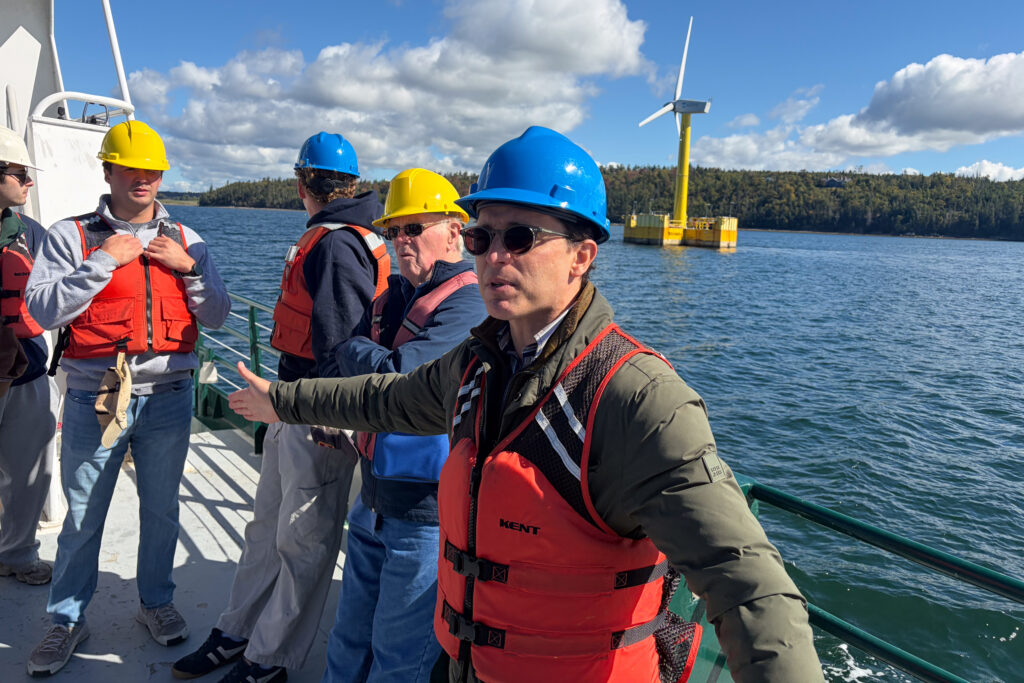
Chief engineer Anthony Viselli explains how a floating turbine works on a tour of Maine's test site.1 / 2
Floating offshore wind turbines now produce power at demonstration sites in Europe, Asia and one US site in Maine. Larger projects of 10 or more turbines are behind early projections, though, and a wind trade association warns that "the commercialisation window cannot be assumed to remain open indefinitely." Inside Climate News traces how the technology got this far and why it has stalled.
The idea and its difficulty
A floating turbine sits on a buoyant steel or concrete platform about the size of a baseball field, anchored to the seabed by mooring lines. It can work in water too deep for seabed foundations, far from shore where winds are stronger. Off California, where the seabed drops steeply, floating has been seen as the only offshore option. Keeping such a tall, vibrating structure stable is hard and expensive. Harrison Sholler of 1 says two problems are still unsolved: 2, which must flex as the platform moves, and offshore substations.
Maine's role
The University of Maine's Advanced Structures and Composites Center began work after the 2008 heating-fuel crisis. Maine voters approved a bond to fund it in 2010. Since May 2025 a quarter-scale concrete platform carrying a 108-foot turbine has floated off Castine. An Irish company, Dublin Offshore, is testing a shock-absorbing mooring device on it. The center also made its steel platform design openly available to other researchers. Its planned next step, a 10-to-12-turbine research array, has been in limbo since March. That is when the developer suspended talks on an 3, the long-term power-sales contract a project needs for financing.
Costs and politics
In 2022 the Biden administration set goals to cut floating-wind costs by 70% and install 15 GW by 2035. At the time, floating wind's 4 (lifetime cost per unit of power) was:
about double that of fixed-bottom wind
up to three times that of a gas plant
roughly equal to new nuclear
Each new or upgraded port it needs costs more than $1 billion.
The Trump administration has since:
tried to halt five fixed-bottom projects under construction (courts blocked it)
effectively stopped new offshore leasing
bought back existing leases, some of them suited to floating wind
cancelled grants for wind ports
Nine or more states are suing over the lease buybacks. Sholler says investors now see the US as "politically risky."
Where work continues
Canada has taken the lead in North America, with Nova Scotia seeking 5 GW of offshore wind. The Maine center's spinoff, 5, is bidding on European projects. Developer partnerships in Europe and Asia share data to lower risk. The open question is where the first commercial-scale projects will be built to bring costs down.
Floating offshore wind works. Demonstration and small projects in Europe, Asia and one US site in Maine are producing power, and several platform designs have been tested at sea. Larger projects of 10 or more turbines are behind early projections, though. A wind trade association recently warned that "the commercialisation window cannot be assumed to remain open indefinitely." Nathaniel Eisen's report for Inside Climate News follows the technology from a University of Maine lab to its present difficulties. Its main argument is that international collaboration built the industry and is what keeps it alive now.
What a floating turbine is and why it's hard
Picture a buoyant triangular steel or concrete platform about the size of a baseball field. On top sits a turbine taller than the London Eye (about 135 metres). Mooring lines tie it to the seabed and cables carry its power to the grid. The advantage over fixed-bottom turbines is location. Floating platforms can go far from shore, where winds are stronger and few people live. Where the seabed drops off steeply near the coast, as it does off California, floating has been seen as the only offshore option.
The price is engineering. Engineers must keep a buoyant, vibrating structure the height of a skyscraper stable in open ocean. Harrison Sholler, a wind analyst at 1 (Bloomberg's energy research arm), says commercial deployment is still held back by unsolved technical problems. He singles out two:
2, which must flex as the platform moves
offshore substations, which collect power and send it to shore
Maine's path
Habib Dagher heads the University of Maine's Advanced Structures and Composites Center. He traces Maine's effort to the 2008 energy crisis, when heating fuel passed $4 a gallon. (Today it is above $6.) The governor asked his lab what to do. Dagher visited one of Norway's earliest floating demonstration turbines and set up a program to design platforms suited to the deep Gulf of Maine and to local supply chains. In 2010 nearly 60% of Maine voters approved a bond to fund the research.
The result is now in the water off Castine: a concrete platform shaped like a plus sign. It is a quarter-scale model of the center's latest design and carries a 108-foot turbine. Cadets from the Maine Maritime Academy towed it into place in May 2025. Chief engineer Anthony Viselli calls Maine a "Goldilocks" site, with moderate water depths, a strong wind resource and waves that "aren't that bad." He says a full-scale version could withstand waves of about 60 feet.
The model also serves as a test bed for others. Dublin Offshore, an Irish mooring company, is testing a shock-absorbing mooring device on it after winning a competition for UK firms that the center co-sponsored. The center has also published the specifications and software parameters for its alternative steel platform. Emma Edwards, a floating-wind researcher at Oxford University, called that "incredibly instrumental" for outside research.
The next step was to be a "research array" of 10 to 12 full-size turbines. Maine signed a lease for it with 3, the federal agency that leases offshore areas, in 2024. Last March the developer suspended negotiations on an 4, the long-term power-purchase contract a project needs to get financing, citing "recent shifts in the energy landscape." The project is in limbo.
Building consent alongside the hardware
In 2021 Maine set up the Offshore Wind Research Consortium. It brings together state and tribal governments, fishing groups, environmental groups and developers, who jointly decide which questions about effects on fisheries and coastal communities to fund research on. Co-chair Alison Bates of Colby College says choosing priorities together has built "a shared understanding," and other jurisdictions have asked her how it works. The consortium paid for Maine fishing representatives to visit an operating five-turbine floating project east of Aberdeen in Scotland. Scottish fishers turned out to share many of their questions about the long-term effects of floating structures and cables. The other co-chair, groundfisherman Terry Alexander, remains skeptical of offshore wind. He still values the consortium's work collecting baseline data, so that changes after turbines go in can actually be measured.
The cost gap
In 2022 the Biden administration launched the "5," one of eight "energy earthshots" modeled on the earlier SunShot program for solar. Its goal was to cut the cost of floating-wind electricity by 70%, alongside a national target of 15 GW installed by 2035, starting from zero. It funded research, including a prize won by the Maine center, plus stakeholder meetings and infrastructure such as ports. By the end of Biden's term, BOEM had auctioned commercial floating lease areas in the Gulf of Maine and off California.
The starting point was expensive. When the WindShot began, floating wind's 6 (lifetime cost divided by lifetime output) was about:
double that of fixed-bottom wind
up to three times that of a combined-cycle gas plant
roughly equal to new nuclear
These figures come from Lazard and Department of Energy data. Those other technologies are mature, so floating wind has more room to get cheaper. The supporting infrastructure is also costly. Ports for floating wind need large staging areas right next to deep water, and WindShot studies priced new or upgraded ports at more than $1 billion each. Ports, supply chains and transmission lines all have to exist before a big project can go ahead.
Policy reversal
Inflation and policy shifts had already delayed auctions and permits in Europe and Asia. Some blame overambitious early targets. US policy then turned. Last December the Trump administration tried to halt five fixed-bottom offshore wind projects that were under construction, citing unspecified national security concerns. Courts rejected every attempt, but developers still lost millions of dollars a day. The administration has effectively stopped new offshore leasing. It has also bought back existing leases, some suited to floating wind, including from Invenergy, which held leases off California and Maine. In several of these deals the lessees agreed to reinvest the money in gas plants and export terminals in other regions. California, Maine and at least seven other states have sued to void the agreements. The administration also cancelled grants for wind ports in California and in Salem, Massachusetts. Sholler says financiers and developers now see the US as a "politically risky" market, and it is unclear whether they will return.
What continues
Edwards says some US researchers have struggled to keep collaborating, for lack of funding or because they can't be seen publicly doing the work. Work continues elsewhere:
Canada has taken the lead in North America. Nova Scotia opened a solicitation last year for 5 GW of offshore wind, including sites suitable for floating.
The Maine center has laid off or reassigned some wind staff but still signs contracts to test components. Its spinoff company, 7, is bidding to supply planned European projects.
The article does not answer the central question: whether costs can fall far enough without commercial-scale projects to drive them down, and where those first large projects will be built.
Remember
When the 2022 cost goal was set, floating wind cost about twice as much as fixed-bottom wind and roughly as much as new nuclear.
BloombergNEF says unsolved engineering problems remain: flexible power cables and offshore substations.
Within North America, the lead has shifted to Canada: Nova Scotia is seeking 5 GW of offshore wind, including floating sites.
How gas mains, service lines and meters connect; the law covers only the service-line segment to each home.
California has passed the Home Energy Choice Act (1). When a utility schedules a replacement of a home's gas 2, the short pipe from the street main to the house, it will have to offer the household a choice: take the new line, or take a cash incentive to switch to all-electric equipment and leave gas.
The problem it targets
Merrian Borgeson, a policy director at the 3 (NRDC), an environmental nonprofit, was partway through electrifying her Berkeley home. She asked Pacific Gas and Electric (PG&E) not to replace her old gas line because her stove, the last gas appliance in the house, was about to be swapped for an induction range. PG&E replaced the line that week anyway. In PG&E's territory such a job typically costs $20,000 to $30,000, plus interest and upkeep, and every gas customer pays for it over the life of the pipe. Her house now uses no gas. "The customers all around me are paying for that pipeline for the next 50 years," she said.
How the swap saves money
The law requires the incentive to cost less than replacing the line. The difference is a saving shared by all gas customers. The money can go toward equipment such as a 4 (an electric unit that heats and cools by moving heat), an induction stove or a heat-pump water heater. NRDC calculates that if PG&E gave 1,000 households $17,500 each instead of new lines, its gas customers would save $20 million in total. PG&E replaces about 15,000 service lines a year. Across the US, utilities spend more than $7 billion a year on service-line replacements, according to the clean energy nonprofit 5.
Limits and objections
The final bill was narrower than the version first introduced. Each program is capped at 1% of a utility's customers, and the law expires on January 1, 2035 unless it is renewed. San Diego Gas and Electric and SoCalGas opposed it. They argued that as customers leave gas, the people still on the system would carry more of its fixed costs. NRDC's Kiki Velez accepts that cost shift is a real problem for the transition overall. She argues this law is different, because it targets customers at the one moment when their leaving lowers costs for everyone else.
What comes next
The 6 must first set the rules, including incentive levels, which will be higher in disadvantaged communities. Utilities then have until January 1, 2028 to get their programs approved. One open question is how much notice households will get. RMI recommends one to five years. Con Edison in New York has run a similar program since 2024, offering up to $20,000. Colorado regulators approved one for the utility Xcel Energy in July. California is the first state to require it statewide.
California has enacted the Home Energy Choice Act, 1. It changes what happens when a gas utility decides a home's 2, the short pipe connecting the street main to the house, needs replacing. The utility will have to offer the household a choice: get the new line, or take a financial incentive, potentially worth several thousand dollars, to switch to all-electric equipment and disconnect from gas. California is the third jurisdiction to authorize this approach and the first to require it statewide.
The problem: pipes paid for by everyone, used by no one
Merrian Borgeson, California policy director for climate and energy at the 3 (NRDC), an environmental nonprofit, is the article's example. Pacific Gas and Electric (PG&E), one of the largest investor-owned utilities in the US, wanted to replace the aging gas service line at her Berkeley home. She asked it not to. She was fully electrifying the house, and the only gas appliance left was a stove that an induction range would replace during a planned kitchen remodel. After that she intended to have the gas shut off.
PG&E said it couldn't wait. That week it dug up her yard and installed a new pipe. She paid nothing directly. The work, which in PG&E's territory typically costs $20,000 to $30,000 plus interest and operations and maintenance costs, is recovered from all gas customers over the life of the infrastructure. This is how regulated utilities normally finance capital projects. A few years later the pipe sits unused. "Now, I have no gas in my house," Borgeson said. "But the customers all around me are paying for that pipeline for the next 50 years."
The general issue is that utilities replace service lines on safety and age schedules without checking whether the household plans to keep using gas. Each replacement adds decades of cost to the gas system at a time when state policy, including California's goal of a carbon-neutral economy by 2045, points toward using less gas.
How the law works
When a household is scheduled for a service-line replacement, the utility must offer the incentive as an alternative. The money goes toward all-electric equipment such as a 4 (an electric unit that heats and cools by moving heat rather than burning fuel), an induction stove or a heat-pump water heater.
The central rule is that the incentive must be smaller than the cost of replacing the line. The utility avoids a capital expense that every gas customer would otherwise repay, spends a smaller amount on the incentive, and the difference becomes a saving shared across all gas customers.
NRDC's worked example: if PG&E gave 1,000 households $17,500 each instead of replacing their lines, gas customers would save $20 million in total. Those figures imply an all-in avoided cost of about $37,500 per line once interest and maintenance are included. That is our inference; the article doesn't give a per-line total. For scale, PG&E replaces about 15,000 service lines a year. Nationally, utilities spend more than $7 billion a year on service-line replacements, according to the clean energy nonprofit 5. The article says that if similar programs were adopted across the country, the savings could rival the home-electrification spending of the Biden administration. It gives no calculation behind that comparison.
The compromise that passed
Brandon García, California director of the industry group Advanced Energy United, says the enacted law is less ambitious than the bill as introduced. Each utility's program is capped at 1% of its customers. The law expires on January 1, 2035, though it could be renewed before then. The bill's author, Assemblymember Marc Berman, called it "a very difficult bill to get through the Legislature." He argues that when homeowners electrify, utilities avoid investing in fossil infrastructure "that will eventually become a 6," meaning a pipe abandoned before it is paid off.
The utilities' objection
San Diego Gas and Electric and SoCalGas opposed the bill on cost-shift grounds. A gas network's costs are largely fixed, so as customers leave, the people who remain carry a larger share. Kiki Velez, who leads NRDC's work on an equitable gas transition, accepts that this is a real problem the state must deal with across the transition. She argues it doesn't apply to this law, which "is instead about trying to encourage people to leave at the exact time when they are saving money for everyone else by leaving." In other words, the departure is timed to cancel a new cost rather than leave an existing one behind. The article doesn't measure how much fixed cost remains with other customers when a household leaves.
Precedents and imitators
Con Edison, the New York utility, launched its 7 in 2024. It offers eligible households up to $20,000 to electrify, and Velez says other New York utilities are following. In July, the Colorado Public Utilities Commission authorized Xcel Energy to create a similar program, which she expects to launch within months. She names Illinois, Maryland, Minnesota, Oregon and Washington as states considering their own bills.
What happens next, and what's unresolved
The 8 must first write a framework for utilities to follow. It will set incentive levels, with larger amounts for customers in disadvantaged communities, which García sees as an important equity step. Utilities then have until January 1, 2028 to get their individual programs approved, so the first offers are more than a year away.
Several details are still open:
Notice. It isn't settled how far ahead households will hear about the option. "The worst case is you don't hear about [the incentive] until the last minute," Borgeson said. RMI recommends one to five years, at the point when the utility schedules the replacement. That would give households time to plan a project costing thousands of dollars.
Uptake. The article reports no participation data from New York, so it's unclear what share of eligible households accept the offer.
Scale. At 1% of customers, the cap limits how much of the $7-billion-a-year replacement pipeline the program can touch.
Incentive adequacy. Fully electrifying a home can cost more than the incentive. The article doesn't say what households pay out of pocket, or whether electric bills afterward help or hurt them.
The law is a test of a narrow idea: when a pipe would otherwise be replaced, paying the household to leave gas can cost less than the pipe. How much it saves will depend on the rules the regulator writes and how many households accept the offer.
Remember
By law, the incentive must cost less than the avoided pipe, so households that stay on gas save money too.
Programs are capped at 1% of each utility's customers and expire January 1, 2035 unless renewed.
Utility programs need approval by January 1, 2028; how much notice households get is still undecided.
The fenced, plugged well on an empty lot, with homes along Vesper Branch right next to it.1 / 2
A 1955 oil well in southwest San Antonio has been plugged six times and is still leaking gas. Its neighbors are now a subdivision of starter homes, and the latest warning is the most serious yet. In June 2026, an engineering contractor told the Texas 1 (RRC), the state's oil and gas regulator, that two plumes of methane were moving through the soil toward houses. It said air-conditioning systems could pull the gas inside, risking fire or explosion. Martha Pskowski reported the story for Inside Climate News.
A well the state keeps paying to fix
The Thompson Callaway Spears #1 well stopped producing in 2004, and its operator, Black Jack Services, plugged it in 2006. Nobody paid attention to it until construction on the Preserve at Medina subdivision began in 2019 and developers found gas leaking. By then the operator was delinquent, which made this an 2, one the state must fix at its own expense.
The RRC replugged it in 2019, January 2022, August 2022, May 2023 and November 2024, spending more than $1 million. The leaks continued. The agency says gas is migrating up the outside of the well 3, so a seal inside the pipe doesn't stop it. It plans another attempt using "a different strategy and materials." Inspectors returned on October 7.
What's been measured
Gas at the wellhead is above the 4, the concentration at which it can ignite. Hydrogen sulfide, a toxic gas that smells like rotten eggs, can cause headaches and nausea, according to the state's environmental agency. That agency found airborne volatile organic compounds below levels of short-term health concern. A Texas A&M atmospheric scientist said no one should stay near the wellhead for more than a few minutes without breathing protection. One resident lives less than 60 feet away and says she has had headaches since 2024. On New Year's Eve, she says, a firework briefly set the well on fire. The fence and the "flammable gas" sign went up only in 2025.
No rules for buyers
Texas doesn't require developers to tell buyers about old wells, and it has no statewide limits on building near them. A 2015 law, 5, restricts how far cities can regulate oil and gas. Fort Worth and Midland still restrict building on old wells. San Antonio does not. The subdivision has at least three other plugged wells with no surface markers, and the state's own map puts this one 110 feet from where it actually is.
Plugged wells usually hold. But failures have hit Wheatley, Ontario (20 people injured in 2021), Colorado and California. An Environmental Defense Fund lawyer notes that nobody knows how often they happen.
The Thompson Callaway Spears #1 well in southwest San Antonio last produced oil in February 2004 and was plugged in 2006. A subdivision called the Preserve at Medina now surrounds it, and it is still leaking methane, the flammable main component of natural gas, along with 1, a toxic gas that smells like rotten eggs. The Texas 2 (RRC), the state's oil and gas regulator, has replugged the well five times since 2019 and spent more than $1 million doing it. In June 2026, an engineering contractor told the agency that two methane plumes were moving through the soil toward houses. Inspectors came back on October 7 to get ready for a seventh plugging job. Martha Pskowski reported the story for Inside Climate News.
How a forgotten well ended up beside starter homes
J.D. Collins drilled the well in 1955 into the Austin Chalk, the formation that also supplied the limestone for the Alamo. At the time the site was rural land on the edge of San Antonio. The well changed hands several times, from Rainer Energy to Arben Oil to Black Jack Services, and its output dwindled. Black Jack plugged it in 2006. That same year Toyota opened a plant on the city's South Side, and development spread toward the Medina River.
Nobody thought about the well again until 2019, when construction began on the subdivision. Developers found gas leaking at the site, and in April 2019 RRC inspectors confirmed that methane and hydrogen sulfide were coming out of the ground. By then Black Jack was in delinquent status with the commission, so the state paid for the replug. A staffer wrote afterward that the fix "seemed to have worked this time around."
It hadn't. Here is the sequence after the original 2006 plug:
2019: first state replug
January 2022: another replug. A welder found a flammable methane leak during the job and refused to keep working
August 2022: another replug
May 2023: the fifth plugging overall
November 2024: the sixth. Drilling vibrations shook nearby houses, and one resident says her foundation cracked
Meanwhile, homes filled in around the lot. The developers left the well's parcel empty, and the homeowners association now owns it. In 2025 the RRC put up a permanent black metal fence with a sign reading "CAUTION flammable gas." On New Year's Eve 2026, a resident says, a firework briefly set the well on fire.
Why plugging hasn't worked
The RRC says its investigation found gas migrating up the outside of the well to the surface. That explains why more plugs keep failing. A plug seals the inside of the steel 3. If gas is moving through the gap between the casing and the surrounding rock, or through cracked cement in that gap, a new plug inside the pipe doesn't stop it. As an analogy (ours, not the article's): it is like corking a straw while liquid seeps up between the straw and the cup. The commission says the next attempt will use "a different strategy and materials." The proposal is under review, and the article doesn't say what the new approach is.
What the monitoring shows
Krystal Solis lives downwind, less than 60 feet from the well. She has had headaches since 2024 and has seen liquid bubble up after rain and stain the pavement orange. She and her neighbor Amanda Pacheco didn't know about the soil methane until reporters told them. "I just want to know if it's dangerous," Solis said.
A wider problem with weak rules
The subdivision has at least three more plugged wells, and reporters found no surface markers at any of them. The RRC's own GIS map, its online map of well locations, puts this well 110 feet northeast of where it actually is, according to oilfield surveyor Jackie Portsmouth of G-Forensic. Since Texas oil drilling began in the 1800s, hundreds of thousands of wells have been drilled in the state. Many were abandoned without plugs or plugged to standards weaker than today's.
The article lists similar incidents elsewhere. In 2021, hydrogen sulfide from a legacy well caused an explosion in Wheatley, Ontario, that injured 20 people. In 2007, a house under construction in Trinidad, Colorado, blew up over an abandoned gas well. In October 2025, homes in Newport Beach, California, were evacuated because of methane from a 1920s-era well. And this year, a plugged well failed at a Baptist church in Grandfalls, Texas, flooding the property with toxic wastewater. Adam Peltz of the Environmental Defense Fund says plugged-well failures "seem to be rare," but "we also don't know how often it happens." Nobody tracks them systematically.
The legal gaps are concrete:
Texas has no statewide rule on building near plugged wells, and developers don't have to tell buyers about them.
Texas counties have no authority to adopt building codes of this kind.
7, a 2015 state law, bars cities from regulating oil and gas except for "commercially reasonable" surface-level rules. Even so, Fort Worth bans construction on or within five feet of an abandoned gas well, and Midland bans building on top of one. San Antonio has no such ordinance.
According to Blake Scott of Waste Analytics, which researches legacy wells for property buyers, New Mexico is the only state that bans permanent structures on plugged wells without the regulator's approval.
Scott argues that neither the oil industry nor the real estate industry has any reason to disclose old wells. Julie Range of Commission Shift, a group that watches the RRC, wants disclosure requirements and building setbacks. The developers and the builders, D.R. Horton and LGI Homes, did not respond to requests for comment.
Still unanswered
The article leaves several things open. It doesn't say how big or how concentrated the soil plumes are, whether any gas has been measured inside homes, what the new plugging method will be, or how much the effort will cost on top of the $1 million already spent. Regulators have also never given residents a clear answer on whether it is safe to stay.
Remember
Replugging inside a well fails when gas is escaping up the outside of the casing.
The well's original operator went delinquent, so taxpayers have paid more than $1 million so far.
Official well maps can be off by 100+ feet, so buyers can't count on them.
The 1, the main US solar trade group, is spending $250,000 through an affiliated 2 on behalf of two Democrats running for the Georgia 3. The PSC is the five-member elected body that approves Georgia Power's investments and the rates it charges its customers. The money pays for digital ads and ads on 4, meaning streaming services.
The seat math
Last year Democrats won two seats on a commission that had been all-Republican. One of those winners, Peter Hubbard, has to run again this year because of a scheduling quirk. Another Democrat, Shelia Edwards, is running for an open seat. If both win, Democrats hold three of the five seats. Nine states elect utility regulators this November, but Georgia is one of the few where party control could change.
Why solar cares
Georgia Power plans to build large new gas plants to serve AI data centers. The article argues that a more critical commission could push for a bigger share of solar paired with batteries. Its case is that these build faster and lock in fuel-free power, while gas turbines keep getting more expensive and take longer to deliver. The article doesn't put numbers on the cost comparison.
SEIA's pitch to voters leans on the current commission's record:
It has approved six rate increases since 2023.
Last December, on the eve of the new Democratic commissioners' swearing-in, it approved 10 5 of new gas plants and batteries for expected data center demand. That is estimated to add about $20 a month to the average household bill.
Republican commissioner Tricia Pridemore resigned on Sept. 4 and began lobbying for DC Blox, a large AI infrastructure developer in Georgia. She says she won't appear before the commission for a year, the period Georgia's rule requires.
A small check, chosen carefully
$250,000 is small next to the $77.6 million spent on Georgia's US Senate race. Still, it is SEIA's largest election investment since the 2025 budget law cut renewable tax credits despite the industry's lobbying. Steph Bosh, a SEIA senior vice president, raised $2 million this cycle through the group's political nonprofit for its American Power Forward PAC. She says the group picked races with tight margins and low spending, where limited money "could actually move the needle the furthest." In races few voters know about, simply telling people the race exists can help.
A separate investor-backed group, the Invest in Tomorrow Coalition PAC, takes a more aggressive line. It has committed $15 million to negative ads against politicians who led the fight against clean energy credits. All five of its primary targets lost. SEIA has kept its distance from that effort.
The 1, the main US solar trade group, is backing two Democratic candidates for the Georgia 2. An affiliated 3 is spending $250,000 on digital ads and connected-TV ads, meaning ads on streaming services. The PSC is the five-member elected body that oversees Georgia Power, approving what the utility builds and what it can charge its captive customers. If both candidates win, the commission would move from Republican to Democratic control. Nine states elect utility regulators this November, and Georgia is one of the only ones where party control is in play.
How the seat math works
Until last year all five PSC seats were held by Republicans. As energy affordability became a national political issue in 2025, Democrats won two of them. One of those new commissioners, Peter Hubbard, has to run again this year because of a scheduling quirk. Another Democrat, Shelia Edwards, is running for an open seat. Democrats need both races. Hubbard winning only holds the current 2–3 split, and Edwards winning as well makes it 3–2 in their favour.
What's at stake on the grid
Georgia expects a wave of new grid investment, driven largely by AI data centers. The article sketches two paths for Georgia Power.
Build gas for every announced data center. At one realistic extreme, the utility adds up every data center that tech companies say they want to build in the state, then builds enough gas turbines to cover all of it.
A more critical commission. Regulators could question those demand projections and push for a bigger share of solar paired with batteries.
The article argues for the second path. Gas turbines keep getting more expensive and their delivery dates keep slipping, it says, while solar plus storage is cheap and fairly quick to build. Because sunlight costs nothing, solar would also shield customers from rising gas plant costs and lock in stable prices. That is the article's case, and it gives no cost-per-megawatt-hour figures or delivery timelines to back the comparison. The supply crunch for gas turbines is widely reported across the industry, though.
The record SEIA is running against
SEIA's case against the current majority rests on three points from its record.
Rate increases. The PSC has approved six requests from utilities to raise customer rates since 2023.
The December gas approval. Last December, after the Democratic wins but on the eve of the new commissioners' swearing-in, the commission approved a plan for Georgia Power to build 10 4 of new gas plants and batteries for expected data center demand. That approval is estimated to raise average household bills by about $20 a month. The article doesn't break down how much of the 10 gigawatts is gas and how much is batteries. Its timing meant the incoming Democrats never voted on it.
Why a quarter-million dollars might matter
$250,000 is small next to the $77.6 million spent on Georgia's US Senate race. Utility commission races, though, draw little money or attention, so a few hundred thousand dollars can make a dent. With so few voters aware these races exist, ads that simply announce the election can shift the result.
For SEIA, the spending is a strategy test. It is the group's largest election investment since the 2025 budget law, which cut federal tax credits for renewable energy despite heavy industry lobbying. Over the past 20 years solar has grown from a sideshow in the power sector into a driving force. But it has never built a political operation that can match long-established fossil fuel lobbies.
After that defeat, SEIA took a "hard look" at how to build lasting political power, according to Steph Bosh, its senior vice president of communications. Bosh now runs the Community Clean Energy Coalition, SEIA's 6, a type of nonprofit allowed to do political work. She raised $2 million from industry and philanthropic donors to spend this cycle through the affiliated American Power Forward PAC.
Her stated approach is to concentrate the money. "If you've got one or two million, you need to spend that money really wisely," she said. The group looked for places where politicians were blocking clean energy, then narrowed the list to races with tight margins and affordable levels of spending. Those were the races where a limited budget could "move the needle the furthest."
A different strategy from other clean energy money
A separate group of clean energy investors and entrepreneurs has taken a more aggressive line through the Invest in Tomorrow Coalition PAC. It targets politicians who led the push against clean energy policy in last year's federal budget fight. In this year's primaries all five of its targets lost, and a pro-renewables Republican it backed won. For the general election it has named a new slate of targets and committed $15 million to negative ads against them.
SEIA has stayed out of that effort. CEO Tim Pawlenty has said the group is "in the business of making more friends, not more enemies." The Georgia race shows what SEIA does instead: put small amounts of money into low-profile races where the payoff for clean energy could be large.
What's left open
The article doesn't report polling or vote margins for either race, so there is no way to judge how close they are. It also doesn't say whether a Democratic majority could revisit the 10-gigawatt approval already granted, or would only shape future plans. There is no estimate of what a solar-heavy alternative would cost ratepayers either. If Democrats win, Bosh says SEIA will point to the result as proof that small, targeted spending works. "Our goal is to raise a lot more in the future," she said.
Remember
Georgia's commission approved 10 GW of gas and batteries just before newly elected Democrats were sworn in.
Little-watched regulator races can be swayed with hundreds of thousands of dollars, not millions.
Clean energy money is splitting into two approaches: SEIA's targeted support for allies and investors' revenge campaigns.
A South Korean nuclear plant in Busan. Korea wants to sell its reactors in the U.S.
TotalEnergies, the French oil and gas major, took more than $1 billion from the Trump administration to cancel its U.S. offshore wind projects. It is still buying American renewables. Its 1 with private equity firm KKR announced a $1.2 billion purchase of 700 megawatts (MW) of solar. The venture already owns 1.4 gigawatts (1,400 MW), so the deal grows it by half, to about 2.1 GW.
The purchase covers three 2 solar farms in Texas and Ohio, meaning farms that sell power to the grid. They are expected to start commercial operation in the first quarter of next year. Because the farms are almost built, the buyer takes on little construction or permitting risk. My own rough math puts the price at about $1.7 per watt of capacity. Heatmap gives no per-project details and doesn't say why TotalEnergies picked solar.
The rest of the day's energy news
Oil. President Trump struck a deal with Russia to put millions of tons of diesel on the global market. Oil prices rose anyway. All three major crude benchmarks gained nearly 1.5% on Monday, because weekend attacks on Saudi Arabia by the Houthis, a Yemeni armed group, weighed more on traders. 3, the U.S. benchmark, was the only one still below $100 a barrel. Saudi Aramco's CEO Amin Nasser said that no single country, Saudi Arabia included, can protect all the shipping routes off its coasts.
Nuclear. Westinghouse is the U.S. reactor maker. Its settlement with the Korean state utility KEPCO bars the Koreans from bidding for reactor projects in Europe and North America. A new trade deal with Washington, made to avoid tariffs, has Korea helping to finance and build six Westinghouse 4 reactors and two of its own 5 in the U.S. KEPCO's CEO says the $2 billion per plant owed to Westinghouse is a ceiling, not a fixed fee. He also says KEPCO is considering buying 5% to 10% of Westinghouse. U.S. sources brushed off that idea when Heatmap asked them.
Lithium. The startup EnergyX signed a $2 billion, 10-year binding deal to supply the commodities trader Trafigura with lithium from Chile and the U.S. It is one of the largest deals yet for 6, a method that uses less water than conventional mining. Demand for lithium from grid batteries is growing while electric vehicle sales are uneven.
Heat pumps. Britain plans to cut hundreds of millions from its boiler upgrade program in England and Wales. The program offers £9,000 (about $12,000) per home to switch to a heat pump. The cut is part of a £2 billion budget reduction under Prime Minister Andy Burnham to make room for military spending.
TotalEnergies, the French oil and gas major, accepted more than $1 billion from the Trump administration to cancel its U.S. offshore wind projects. A week later it was buying renewables in America again. Its 1 with the private equity firm KKR announced a $1.2 billion purchase of 700 megawatts (MW) of solar. A joint venture is a company the two firms own together. The item leads Heatmap's daily AM newsletter, which also covers oil, nuclear, lithium and heat pumps. All five items are below.
The solar deal
The purchase covers three 2 solar farms in Texas and Ohio, meaning farms built to sell power into the grid. They are expected to reach commercial operation, the point where they start selling power under contract, in the first quarter of next year. The venture already holds 1.4 gigawatts (GW), or 1,400 MW. Adding 700 MW takes it to about 2.1 GW, an increase of 50%.
Some rough math, which is mine and not Heatmap's: $1.2 billion for 700 MW comes to about $1.7 million per megawatt, or roughly $1.7 per watt. Buying farms that are nearly finished means paying for construction that someone else has already done and risked. Permits, grid connection approvals and building are largely complete. In return, the buyer avoids the stages where projects most often slip or die.
Heatmap's point is that taking money to exit offshore wind did not mean TotalEnergies was leaving U.S. renewables. The piece doesn't explain the reasoning. It doesn't say whether the solar farms have long-term power purchase contracts, who sold them, or whether storage is included. A plausible reading, though the article doesn't confirm it, is that onshore solar in Texas and Ohio faces far less federal political risk than wind projects that need federal seabed leases.
Oil: diesel deal outweighed by attacks on Saudi Arabia
President Trump struck a deal with Russia to put millions of tons of diesel on the world market, which in theory should have pushed prices down. Instead, all three major crude benchmarks rose nearly 1.5% on Monday. Only 3 (WTI), the U.S. benchmark, stayed below $100 a barrel. According to Heatmap, WTI has largely avoided the worst knock-on effects of conflict in the Middle East. Weekend attacks on Saudi Arabia by the Houthis, the Yemeni armed group, weighed more on investors than the diesel deal did.
At an industry summit in Riyadh, executives from Western oil majors pulled out at the last minute after missiles struck the city's airport. Saudi Aramco's CEO Amin Nasser said no country could protect all the supply routes off Saudi Arabia's coasts by itself: "No nation, even one as capable and confident as ours, can safeguard them alone."
Nuclear: Korea wants a piece of Westinghouse
The Korea Electric Power Corporation (KEPCO) builds reactors through its subsidiary Korea Hydro & Nuclear Power. Heatmap calls it the most competent financier and builder of nuclear reactors in the democratic world. It built the United Arab Emirates' first nuclear plants roughly on time and on budget, which compares well with recent U.S., French and British projects. Its main reactor, the 4, allegedly borrowed from the pressurized water reactor design of Westinghouse, the U.S. nuclear company. A pressurized water reactor is the most common type worldwide. Years of legal fighting ended last year in a settlement that bars the Koreans from bidding on projects in Europe or North America.
This month, Seoul agreed to a deal with the Trump administration to avoid tariffs. Under it, Korea will help finance and build six Westinghouse 5 reactors and two of its own APR1400s in the U.S. The U.S. gets experienced builders, and Korea gets a foothold in North America.
Many Koreans see the settlement as unfair. KEPCO's CEO, Kim Dong-cheol, told the newspaper Business Korea that reports of a $2 billion payment to Westinghouse for every plant were a misunderstanding. "It is true that $2 billion is the ceiling, but it does not mean we will pay all of it," he said. He also said KEPCO is considering buying an equity stake of 5% to 10% in Westinghouse. Kaufman reports that every U.S. source he asked dismissed that possibility.
Lithium: EnergyX lands a large offtake deal
EnergyX, a lithium startup whose early press coverage industry insiders called credulous, signed a $2 billion binding 6 with the commodities trader Trafigura. An offtake agreement is a contract to buy a set amount of future output. The 10-year deal covers lithium from Chile and the U.S., and Reuters reports it is one of the largest ever tied to 7 (DLE). DLE pulls lithium out of brine chemically, using less water than the usual method of evaporating brine in large ponds. Heatmap links the deal to rising demand from stationary battery storage for the grid and data centers, which is picking up some of the slack left by uneven electric vehicle sales. The article doesn't give volumes, prices, or how far along EnergyX's commercial production is.
Britain cuts heat pump support
The British government plans to cut hundreds of millions from its program to replace boilers in England and Wales. The program provides £9,000, nearly $12,000, toward switching to a heat pump. The Financial Times reports the cut has drawn a backlash against the ruling Labour Party. It is part of Prime Minister Andy Burnham's plan to trim £2 billion from the budget to pay for more military spending. The review began in June under his predecessor, Keir Starmer. Starmer singled out the Department for Energy Security and Net Zero, which had just received a 16% annual budget increase to pay for the Sizewell C nuclear plant, carbon capture infrastructure and home insulation.
The timing contrasts with calls elsewhere to speed up heat pumps. Heating prices are high this winter because fossil fuel supply is tight, and Berkeley professor Daniel Aldana Cohen has argued the U.S. needs a "wartime mobilization" on heat pump production.
Kicker
Ford stopped making its all-electric F-150 Lightning pickup last year. Bloomberg reports that used Lightnings now sell for 50% to 60% of their original sticker price, a level one expert called "a sweet spot," and that the truck has become one of the most sought-after used EVs.
Remember
Leaving offshore wind didn't mean leaving U.S. renewables: TotalEnergies' venture is growing its solar portfolio by 50%.
Korea will help build eight U.S. reactors but is barred from bidding on its own in Europe and North America.
Grid battery demand is helping lithium suppliers like EnergyX sign large contracts while EV sales stay uneven.
Principle Power, another US firm, licensed its 8 platform to demonstration projects in Portugal, Scotland and France.
Developer partnerships in Europe and Asia, such as one run by Carbon Trust UK, share data so that, in Arturo Anderson's words, parts of the puzzle become "cheaper and less risky."
At the wellhead: flammable gas above the 4, the lowest concentration in air at which a gas can ignite.
In the air: the 5 (Texas Commission on Environmental Quality) found volatile organic compounds in 2023 and 2025, but below levels of short-term health concern. It says the hydrogen sulfide could cause headaches and nausea.
Independent checks: James Tim Doty, who spent 28 years at the TCEQ, filmed the site in September with an 6, which shows hydrocarbon plumes invisible to the eye. He called the leak "substantial." Gunnar Schade, an atmospheric scientist at Texas A&M, reviewed some of the data and wrote that nobody should stay near the wellhead "for more than a few minutes without protective breathing equipment."
Underground: Kleinfelder, the RRC's engineering contractor, reported the two soil methane plumes heading toward homes. It warned that heating, ventilation and air-conditioning systems could be pulling gas inside, creating "a risk of fire or explosion." The RRC calls the report preliminary.
6
The revolving door. Republican commissioner Tricia Pridemore resigned on Sept. 4. She then began lobbying for DC Blox, one of the largest AI infrastructure developers in Georgia. She told The Georgia Recorder she won't appear before the commission for her new employer for at least the first year, the period Georgia's 5 policy requires.