Voluntary Roadmaps and Optional Coal Retirements · Morning Gist
Thursday, November 55 stories · 16 min
Voluntary Roadmaps and Optional Coal Retirements
Before COP31, a fossil roadmap binds nobody and adaptation money falls short, while US utilities build plans on uncertain carbon capture and demand forecasts.
Picked from 45 new articles across 13 sources · arrow keys for other days
Today in 30 seconds
30s left
Brazil published a voluntary fossil-fuel roadmap with four country archetypes and three phases ending in 2033, days before COP31. story 1 ↓
Tripled adaptation finance would cover under a third of the $305 billion a year developing countries need by 2035, UNEP says. story 2 ↓
Critics say capture and pipeline costs could push DTE's $6.4 billion estimate for two Michigan gas plants higher, with ratepayers exposed. story 3 ↓
Arizona's largest utility expects sales to double, may run coal until 2038, and plans 4,000 MW of new gas through 2036. story 4 ↓
Enphase's co-founder wants to build a 5 MW transformer from 1,000 gallium-nitride converters, targeting AI data centers, with pilots expected in 2027. story 5 ↓
Georgia and Michigan voters demanded accountability for utility rate hikes and political spending in the midterms, Latitude Media reports.
1/5Carbon Brief· Daisy Dunne· Nov 4
Brazil publishes voluntary global roadmap for moving away from fossil fuels
Brazil, last year's UN climate summit host, published a voluntary fossil-fuel transition plan: countries assess their own readiness, choose tailored policies and act in three phases to 2033. Nothing obliges any country to follow it.
Why it matters · It turns a contested slogan into a planning framework days before COP31, but its real test is whether governments adopt it, since it has no legal force.
Know this first
Context from the editor, not the article · 26 sec
1 · How COP summits work
COPs are annual UN climate summits where nearly 200 countries negotiate shared texts. Decisions generally need consensus, so a determined group of countries can keep contested wording out of a formal outcome.
2 · The COP28 language
At COP28 in Dubai in 2023, countries called on all nations to contribute to transitioning away from fossil fuels. It set a direction but not a detailed route, leaving later summits to argue over how to proceed.
3 · The Paris Agreement's cycle
Under the 2015 Paris Agreement, countries file national climate pledges every five years. A periodic global stocktake assesses collective progress, and its findings are meant to inform the next round of pledges.
2/5Climate Home News· Vivian Chime· Nov 4
UN: tripled adaptation finance would cover under a third of 2035 needs
A UN report finds that even if rich countries meet their promise to triple climate adaptation funding for poorer nations by 2035, it would cover only 20-29% of what those nations will need.
Why it matters · The figures set the terms for the COP31 fight over adaptation money, and show how accounting choices in a pledge can shrink its real value by nearly half.
Know this first
Context from the editor, not the article · 30 sec
1 · Adaptation and loss and damage
Cutting emissions is mitigation. Adaptation prepares for impacts that can't be avoided, through measures such as sea walls, drought-tolerant crops and early warning systems. Loss and damage covers harm adaptation did not prevent, such as rebuilding after a flood.
2 · How climate pledges work
COPs are annual UN climate summits where nearly 200 countries negotiate by consensus. Their finance targets are not enforceable contracts, so definitions such as baseline year, price basis and what counts largely decide what a pledge is worth.
3 · The earlier adaptation pledge
At the 2021 Glasgow summit, developed countries were urged to double adaptation finance to about $40 billion a year by 2025. OECD figures reported in May 2026 suggest they likely missed that target as aid budgets were cut.
3/5Canary Media· Kari Lydersen· Nov 4
Michigan utility DTE's carbon capture plan for new gas plants faces doubts
DTE wants two new gas plants, estimated at $6.4 billion, that would eventually capture their carbon dioxide. Critics say the technology's cost, thin track record and loopholes in Michigan's clean energy law make that promise unreliable.
Why it matters · Utilities can use future carbon capture to justify gas plants under clean energy mandates; if capture never arrives, customers may still be paying for decades of unabated emissions.
Know this first
Context from the editor, not the article · 29 sec
1 · How carbon capture works
A chemical solvent typically pulls carbon dioxide from exhaust gas, then heat releases it for compression. The gas travels by pipeline to deep underground storage. Each step needs energy, equipment or new infrastructure, and each adds cost.
2 · Utility long-range plans
US utilities in many states file long-range plans, often called integrated resource plans, setting out which power plants they intend to build or retire. State regulators review them, and outside groups can formally intervene to contest the assumptions.
3 · Michigan's clean energy law
4/5Utility Dive· Robert Walton· Nov 4
Arizona's largest utility expects sales to double, may run coal until 2038
Arizona Public Service expects retail sales to more than double by 2041, driven by data centers and industry. Its plan adds solar, batteries and gas, and could keep a coal plant running until 2038.
Why it matters · It shows how large-load forecasts can reshape a fast-growing utility's plan: a coal retirement date becomes optional, on numbers the utility itself says may not fully materialize.
Know this first
Context from the editor, not the article · 26 sec
1 · Integrated resource plans
Utilities file these long-range plans to show how they would meet forecast demand reliably and affordably. Regulators review them, but individual plants and their costs generally face separate decisions later.
2 · Four Corners plant
Four Corners is a coal plant of roughly 1,500 MW on Navajo Nation land in northwestern New Mexico. Arizona Public Service operates it and holds the largest ownership share; partners own the rest.
3 · Why load shape matters
Homes in hot climates use the most power on summer afternoons and evenings, while data centers draw power almost constantly. A flat load adds a lot of energy per unit of peak, including overnight when solar produces nothing.
5/5Volts (David Roberts)· David Roberts· Nov 4
Enphase co-founder wants to rebuild the transformer from 5-kilowatt modules
Raghu Belur of Enphase, the microinverter maker, explains to Volts how stacks of small electronic converters could replace iron-and-copper transformers, starting with AI data centers. The public transcript ends before the crucial question of cost.
Why it matters · Transformers are a years-long bottleneck for grid and data center projects, so a version built on electronics supply chains could change both lead times and what local grids can control.
Know this first
Context from the editor, not the article · 28 sec
1 · Why voltage gets changed
Wire losses rise with the square of current. Raising voltage cuts the current needed for the same power, so electricity travels at high voltage, then gets stepped down to safe levels near where it is used.
2 · AC, DC and inverters
The grid runs on alternating current; solar panels and batteries produce direct current. Inverters convert between them. Rooftop systems traditionally wired all panels to one central inverter, a single point of failure for the whole array.
3 · What power electronics are
Power electronics use fast semiconductor switches to reshape electricity, as in phone chargers and EV drivetrains. Their controls are software, so behavior can change without new hardware. Most of the grid's distribution equipment still lacks them.
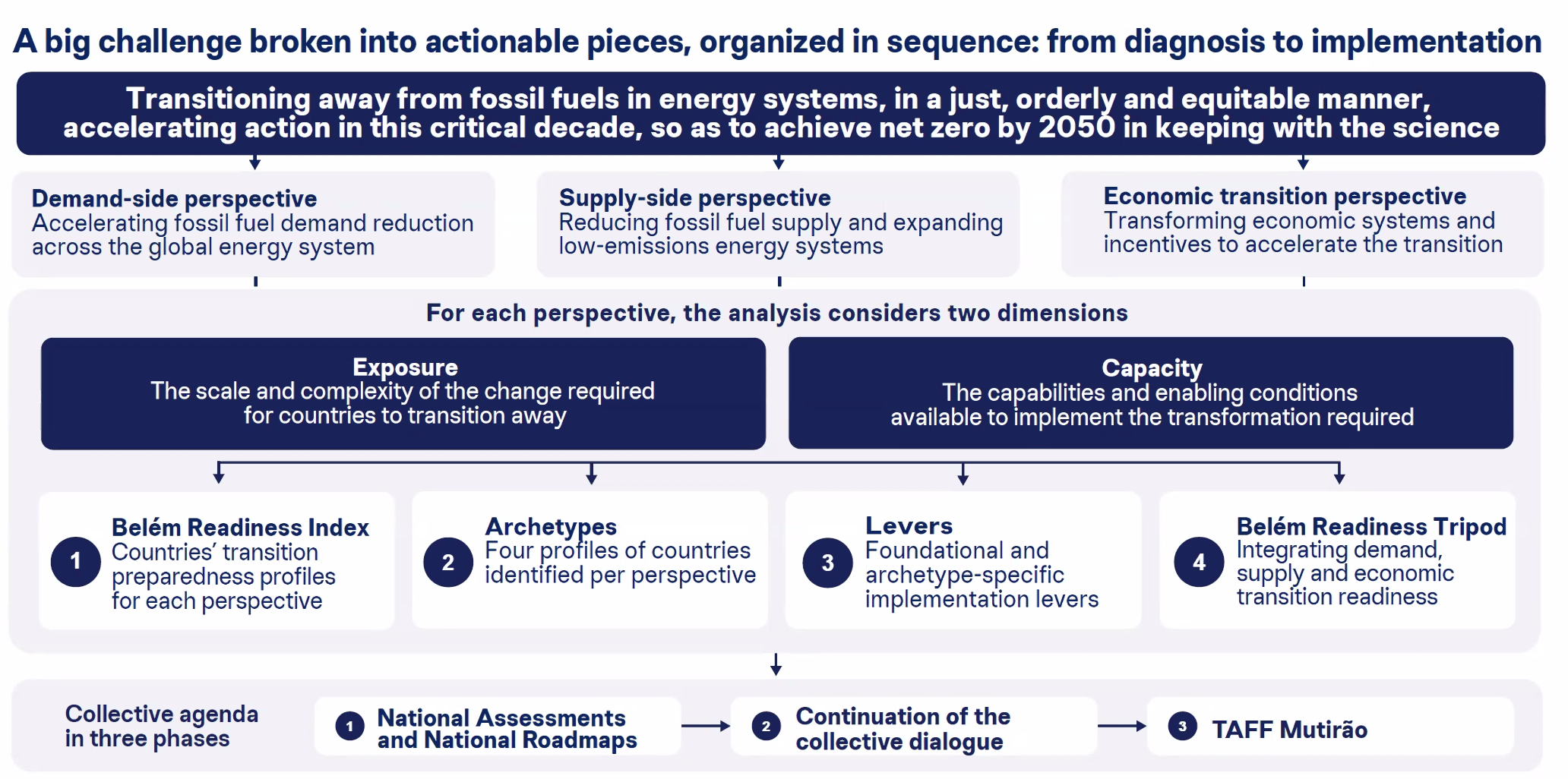
COP30 presidency graphic summarising the roadmap's readiness diagnosis, country archetypes, policy levers and three phases to 2033.
Brazil, host of last year's UN climate summit, 1, has published a global plan for moving away from coal, oil and gas. It arrived a week before the next summit, COP31, opens in Antalya, Turkey. The plan is voluntary, and countries are not obliged to respond to it.
Why it sits outside the talks
At COP30 in Belém, 85 countries wanted the formal outcome to mention a new fossil-fuel roadmap. They were building on the 2023 COP28 summit, which called on all countries to contribute to transitioning away from fossil fuels. Other countries objected. Their number was claimed to be 84, though Carbon Brief found errors in that list and thinks the real figure was probably lower.
After two weeks of argument, Brazil dropped the roadmap from the negotiated text and promised to write one independently. That let it proceed without the opponents' agreement, but the result has no negotiated mandate.
How it works
The roadmap concedes the world can no longer meet its 1.5C ambition without first "2", or passing that temperature before any later return. It says the necessary policies already exist, and calls the transition "as much a development question as a climate one".
So it starts with diagnosis. The 3, a voluntary self-assessment, has each country calculate its fossil-fuel dependence and its capacity to change. Countries are then sorted into four "4", each pointing to particular policy "levers". Carbon Brief's article doesn't name the archetypes.
Action then runs in three phases:
Now to 2028: institutions and long-term signals, up to the second 5, the UN's progress review.
2028–2030: physical change to energy systems, as new national climate pledges fall due.
2031–2033: scaling up, ending a decade after the COP28 call.
What it does and doesn't do
Experts quoted by Carbon Brief are positive. Dr Natalie Jones of the International Institute for Sustainable Development, a policy research group, calls it an "important political signal" with practical guidance. But the piece quotes no opponents, and its summary mentions no numerical targets for production or emissions and no phase-out dates. As described, this is a planning method, not a commitment.
The COP31 test
Co-hosts Turkey and Australia are instead promoting electrification: raising electricity's share of 6 use from almost 24% in 2023 to 35% by 2035. Brazil's COP30 president calls that "complementary", but some parties see it as a way to avoid another fossil-fuel fight, Carbon Brief understands.
Brazil's team says it is "hoping for the best". Jones wants COP31 to recognise the roadmap formally, more countries to publish national versions, and finance for revenue-dependent countries to diversify. Those are the signs that would show the plan is gaining traction.
Brazil, host of last year's UN climate summit, 1, has published what Carbon Brief describes as a first-of-its-kind global plan for moving away from coal, oil and gas. The roadmap calls the transition "urgent, inevitable and, yet, possible". It arrived a week before the next summit, COP31, opens in Antalya, Turkey.
The plan is voluntary, and countries are not obliged to respond to it. Its central idea is that there is no "one-size-fits-all" route. Each country is asked to assess its own position first and then choose policies to match.
How a failed negotiation produced the plan
The roadmap comes out of a dispute at COP30, held in the Amazonian city of Belém. The first "2", the UN's assessment of progress towards the world's climate goals, concluded at COP28 in 2023 and called on all countries to contribute to transitioning away from fossil fuels. It did not settle how.
At Belém, 85 countries wanted COP30's formal negotiated outcome to refer to a new roadmap for doing so. Another group opposed this. That group was claimed to number 84 countries, but Carbon Brief's analysis of the "informal list" found inconsistencies and errors, so the true figure was probably smaller.
After two weeks of fierce debate, Brazil left the roadmap out of the negotiated outcome and said its presidency would write one outside the UN process. That choice explains the document's status: it could be written without the opponents' agreement, but it carries no negotiated mandate.
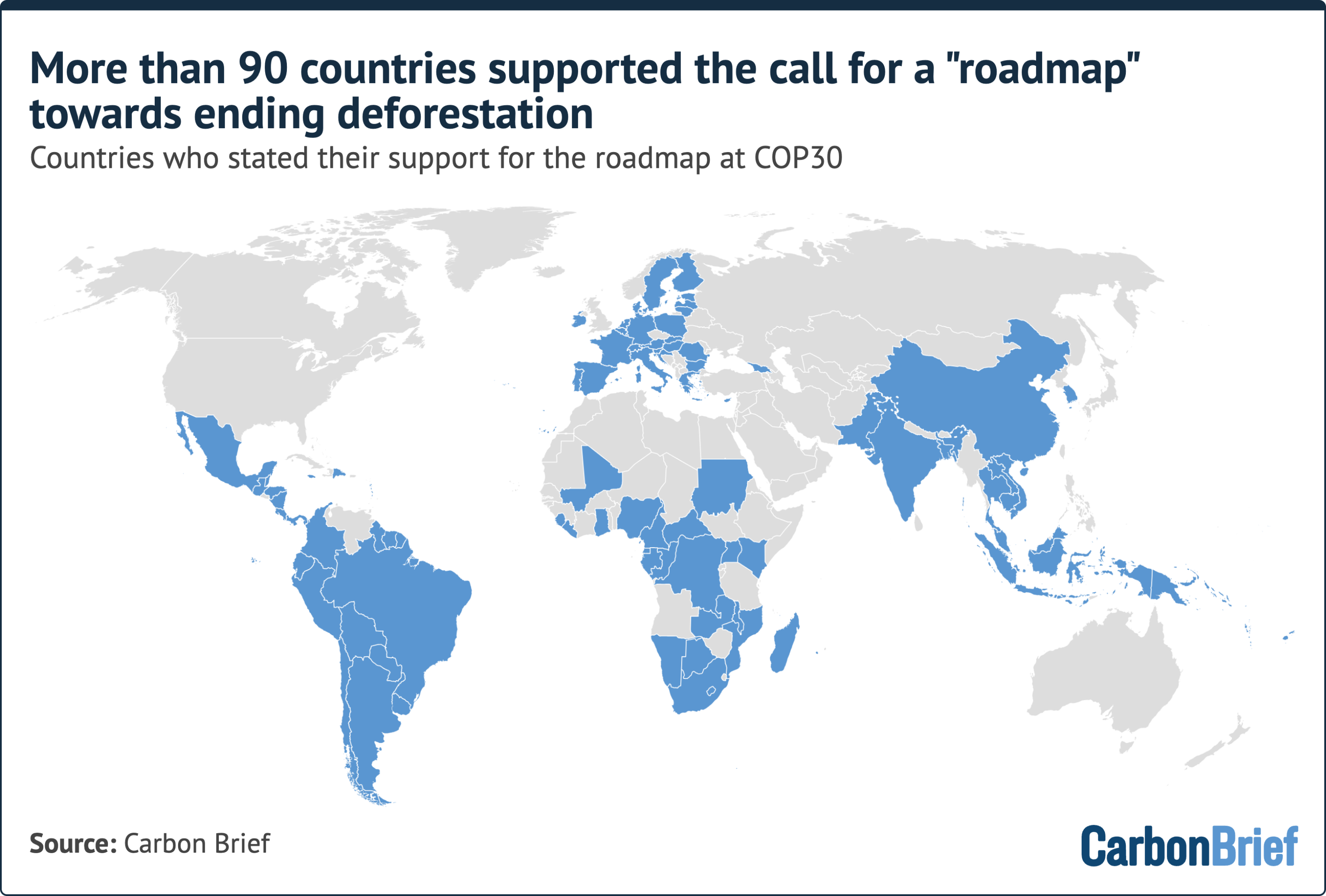
Two other inputs matter. The presidency said the roadmap would be informed by a conference in Santa Marta, Colombia, co-hosted by Colombia and the Netherlands in April, where ministers and climate envoys informally discussed the barriers they face. Avantika Goswami of the Centre for Science and Environment in New Delhi says the process also invited submissions from all parties and civil society. Brazil has produced a separate roadmap on ending deforestation.
The starting assumptions
The roadmap concedes that, after decades of delay, the world can no longer meet its 1.5C ambition without first "3" the target, meaning temperatures would pass 1.5C before any later return.
It then makes two claims that frame the rest. The global transition to clean energy is already underway, and the policies needed already exist and can be readily deployed. It also says the transition is "as much a development question as a climate one, especially for emerging markets and developing economies". In this framing, the main constraint for many countries is their economic and institutional position rather than a shortage of known policies.
The mechanism: diagnose, sort, act
The core tool is the "4", a "voluntary self-assessment tool". A country uses it to calculate two things: how dependent it is on fossil fuels and how much capacity it has to move away from them. COP30 chief executive Ana Toni calls this the "diagnosis" stage.
Countries are then sorted into four "5", which lead to specific policy "levers". Ploy Achakulwisut, a former UN adviser on fossil fuels, describes these as "exposure-capacity" archetypes. She says they can group countries facing similar conditions and help the international community match finance, technology and technical assistance to what each one needs.
Carbon Brief's text doesn't name the four archetypes or list the index's indicators. As an illustration of the logic only, not an example from the roadmap, consider two invented countries. One relies on oil revenue to fund public services and has little money or institutional capacity to diversify. The other imports its fuel and has a strong grid and access to cheap finance. The first would mainly need outside support to replace that revenue, while the second could move faster on its own.
Three phases to 2033
The roadmap's timetable is tied to existing dates in the UN process:
The end date of 2033 reflects COP28's reference to action in "this critical decade". Toni says each stage was designed to be "extremely pragmatic and easy for countries to take a look at".
Reception, and what to discount
The experts Carbon Brief quotes are broadly positive, and it reports that civil society and experts have generally welcomed the approach. Dr Natalie Jones of the International Institute for Sustainable Development, a policy research group, says the roadmap sends an "important political signal" and offers practical guidance. Goswami calls it a "unique and consultative method of multilateralism", notable for being put forward by a developing country. Achakulwisut says she is "deeply impressed".
The piece does not quote any government that opposed the roadmap, or any critic of it, so this is only a partial picture of how it has landed. Carbon Brief's summary also mentions no numerical targets for fossil-fuel production, demand or emissions, and no national phase-out dates. The summary may not be exhaustive, but on this account the roadmap is a method for planning, with no quantified commitments attached. Whether it cuts fossil-fuel use depends on what governments do with it.
COP31: a competing focus
COP31's co-presidents, Turkey and Australia, have set a range of priorities. One is raising electricity's share of global 7 consumption, the energy that end users actually consume, from almost 24% in 2023 to 35% by 2035. By our arithmetic, that is about 0.9 percentage points a year for 12 years.
COP30 president André Aranha Corrêa do Lago calls this goal "complementary" to the roadmap. However, Carbon Brief understands that some parties see the focus on electrification as an attempt to avoid repeating COP30's lengthy fossil-fuel debates.
Brazil's team would not predict how the roadmap will be taken up, with Toni saying they were "hoping for the best". Asked about the opponents, Corrêa do Lago did not address them directly, saying: "we already have a consensus and we already have the instruments."
Jones sets out what follow-through would look like. More governments would announce national transition roadmaps and explain how these feed into their climate plans. COP31 would formally recognise the global roadmap and create a route for its findings to inform the second global stocktake. Vulnerable countries dependent on fossil-fuel revenues would also receive finance to diversify their economies and sustain public services.
These are the things to watch in Antalya. The article leaves open whether the roadmap gets any formal foothold at COP31, how many countries will use the index, and who would pay for the support that revenue-dependent countries need.
Remember
The roadmap's voluntary status follows from the COP30 deadlock: Brazil could publish it only by leaving the negotiated process.
Its distinctive idea is sorting countries by fossil-fuel exposure and capacity, which could help direct finance and technical support.
Watch whether COP31 formally recognises the roadmap and links it to the 2028 global stocktake.
Residents wade through a flooded street north of Manila during Typhoon Yagi rains, September 2024.1 / 2
The UN Environment Programme (UNEP) has published its 2026 1, its annual comparison of what developing countries need to prepare for climate impacts with what they receive. The main finding: last year's promise to triple adaptation funding would meet only 20-29% of their needs in 2035, even if it is kept.
The gap
UNEP estimates developing countries will need about $305 billion a year by 2035 in today's prices, or around $420 billion with inflation. Developed countries provided $28.2-31.7 billion in international public adaptation finance in 2024, only slightly more than the year before.
The needs figure is a little below last year's $310-365 billion. UNEP says that is mainly because it now leans more on countries' own costings, reported in their national climate plans. So the drop is not mainly a sign of falling risk.
Why the pledge is weaker than it looks
At 2, the 2025 UN climate summit in Brazil, countries agreed to at least triple adaptation finance by 2035. The decision set no baseline year. Tripling today's flows gives about $85 billion a year, while tripling the $40 billion rich nations were meant to reach by 2025 gives $120 billion.
The decision also makes no adjustment for inflation. And it lets developing countries' own money count when it is channelled through 3, lenders such as the World Bank owned by groups of governments. With all that factored in, UNEP says developed countries' own contribution in 2035 could be as low as $45-66 billion a year in 2025 prices.
Poorer countries are paying more
Developing countries gave $9.65 billion in international adaptation finance in 2024, up from $3.81 billion in 2019. That is about a quarter of the total. The money flows through their MDB shares and through 4, meaning direct support between developing countries. The report does not say which countries provide it.
Loss and damage
Loss and damage means harm that adaptation did not prevent. The 5, set up to pay for it, is already overwhelmed. Its first allocation, $20 million for Nepal after an August flood, compares with estimated recovery costs of $4.8 billion. Its first funding round drew nearly 180 submissions seeking about $2.8 billion, against about $350 million available, and no projects have been approved yet.
What comes next
6 opens on Monday in Antalya, Turkey. Campaigners want a defined starting point, milestones and grants rather than loans. Climate Action Network International wants at least $120 billion a year well before 2035. The article does not say how current funding splits between grants and loans, or how much domestic budgets and private money might cover.
The UN Environment Programme (UNEP) has published its 2026 1, an annual comparison of what developing countries need to prepare for climate impacts with what they actually receive. It arrives days before 2, this year's UN climate summit, opens in Antalya, Turkey, on Monday.
The main finding concerns last year's headline promise. At 3, the 2025 summit in Brazil, countries agreed to at least triple adaptation finance for developing nations by 2035. UNEP calculates that, even if delivered, this would meet only 20-29% of those nations' needs that year.
The size of the gap
UNEP estimates developing countries will need about $305 billion a year by 2035 in today's prices, or around $420 billion once inflation is included. On the other side of the ledger, international public adaptation finance from developed countries reached $28.2-31.7 billion in 2024, a modest rise on the year before. The article does not explain why the 2024 figure is a range.
Set side by side, 2024 flows are roughly a tenth of the real-terms need projected for 2035. That comparison mixes a current flow with a future requirement, but it shows the distance to cover.
The needs estimate fell slightly from last year's $310-365 billion. UNEP attributes this mainly to a change in method: it now relies more on countries' own costings, reported through 4, the climate plans each country files under the Paris Agreement, and 5, their dedicated strategies for handling climate impacts. So the lower number is not mainly a sign that the risks have shrunk. Self-reported figures also have a built-in limit, in this digest's view: they are only as complete as the plans behind them.
Why the pledge is smaller than it looks
"Tripling" has no single meaning because the COP30 decision did not define its starting point. Tripling current flows gives about $85 billion a year. Tripling the $40 billion that rich nations were supposed to reach by 2025 gives $120 billion. That range, set against the $420 billion figure, produces UNEP's 20-29%.
UNEP then identifies three weaknesses in the wording:
No baseline year. The starting figure is open to interpretation, which accounts for the $35 billion spread above.
No inflation adjustment. A dollar promised for 2035 buys less than a dollar today.
Money from developing countries can count. Funds they channel through 6, lenders such as the World Bank that are owned by groups of governments, can be counted towards the target.
With all of these taken into account, UNEP says developed countries' own contribution in 2035 could be as low as $45-66 billion a year in 2025 prices.
Here is a rough illustration of how that shrinkage works. This is this digest's arithmetic, not UNEP's published method. UNEP's two needs figures imply prices rising about 38% by 2035 ($420 billion against $305 billion). Deflating the $85-120 billion by that ratio leaves about $62-87 billion in today's money. Remove about a quarter, the share developing countries currently supply, and you get about $46-65 billion, close to UNEP's range. On that basis the real contribution from rich countries would cover perhaps 15-22% of the $305 billion need.
Developing countries are paying more
While rich-country funding has flatlined, UNEP estimates developing countries contributed $9.65 billion to international public adaptation finance in 2024, up from $3.81 billion in 2019. That is about a quarter of the total.
The report does not break this down by country. Lead author Henry Neufeldt described the money as voluntary contributions from developing countries with the capacity to give, made through their shares in MDBs and through direct 7, meaning aid and knowledge-sharing between developing countries. Co-author Fatima Denton called such cooperation "comforting" because countries with similar ecosystems face similar problems.
This trend has two sides. It is real money, yet it is also what allows the rich-country share of the tripling target to look larger than it is.
Loss and damage is already outrunning its fund
The report warns that without stronger action on emissions and adaptation, climate losses will keep rising and overwhelm the 8, the UN-linked fund created to pay for climate harm that has already happened. It also says the fund's complex procedures make support hard to access.
The fund's early record supports that warning:
Nepal: last month the board set aside $20 million for recovery from a climate-driven flood in August, the first money the fund has allocated. Nepali officials called it symbolic against estimated recovery costs of $4.8 billion, so it covers about 0.4%. Nepal must still submit a proposal for how it will use the money.
First funding round: nearly 180 submissions asked for around $2.8 billion, against around $350 million available, about eight times the money on offer. No projects have yet been approved.
Mattias Söderberg of the aid group DanChurchAid argues that underfunding adaptation directly raises these losses, because communities are left more exposed to severe impacts.
What happens at COP31
UNEP's executive director, Inger Andersen, said the world is "not ready to adapt to current climatic conditions, never mind what 9 of 1.5°C will bring", overshoot meaning warming that passes the limit before any later decline. Secretary-General António Guterres called on developed countries to deliver "fast, simple, accessible support" and on development banks to scale up.
Campaigners want the definitions fixed. Pooja Dave of Climate Action Network International wants a credible plan to reach at least $120 billion a year well before 2035, in new public grants. Mohamed Adow of the think tank Power Shift Africa wants a clear starting point, milestones and a delivery plan, with grants rather than loans. Climate Home News has separately reported that the African Group of negotiators wants tripling adaptation finance on the COP31 agenda, which could set up a clash.
What remains open
The article does not say how current flows split between grants and loans, even though loans add to the debts of vulnerable countries. It also compares needs only with international public finance, and does not say how much domestic budgets or private investment might cover. It does not report which countries are behind the $9.65 billion. And it leaves unanswered the question that matters most in Antalya: whether rich countries will accept a definition of "tripling" that makes the pledge measurable.
Remember
Wording shrinks the pledge: no baseline, no inflation adjustment and counted development-bank money could cut it to $45-66 billion.
The slightly lower needs estimate mainly reflects a method change toward country-reported costs, not evidence of falling risk.
Developing countries now supply about a quarter of international public adaptation finance, $9.65 billion in 2024, up from $3.81 billion.
A 2023 Michigan law requires utilities to reach 100% clean electricity by 2040. Gas plants can count as clean if they capture most of their emissions, which is why capture matters to a utility planning new gas.
DTE's coal plant in Monroe, Michigan; the utility's long-range plans decide what replaces coal generation like this.
DTE, a Michigan utility, plans two new gas plants that it estimates will cost $6.4 billion, with their carbon dioxide to be captured and stored underground. The proposal sits inside DTE's 1, the regulatory filing that sets out what it intends to build. Environmental advocates doubt the capture will prove affordable, or even happen.
The text available for this digest starts mid-article. It omits the plants' size, capture rate, schedule and storage site, as well as DTE's own case.
A thin track record
2 (CCS) traps CO2 and stores it permanently underground. S&P Global, a financial analytics firm, calls it "mature and scalable," yet says that after more than 50 years it "remains at early stages of deployment." The firm blames cost, financial risk, market uncertainty and the complexity of the infrastructure.
Few sites use it worldwide, and most are tied to 3, which injects CO2 into aging oil fields to push out more oil. That sale of extra oil pays part of the bill. In US power, the sole commercial example is 4, at a Texas coal plant, which suffered a three-year shutdown and missed its targets.
Why costs could climb
Capture equipment consumes a lot of electricity, and that power must be clean if the goal is zero emissions. The CO2 also needs pipelines to a storage site. Charlotte Jameson of the Michigan Environmental Council, which has intervened in the regulatory case, says it would be "really easy at this juncture to undervalue what it would cost," calling the plan "a huge, risky bet for 5." The article gives no separate figure for capture.
The legal 6
Jameson's sharper point concerns Michigan's clean energy law. It allows repeated deadline extensions for reasons including grid reliability and the feasibility of installing renewables. These off-ramps were written before the data center boom. If new demand makes the standards too hard to meet, she warns, the targets could become "effectively meaningless," and the plants could simply run as ordinary gas plants.
Data centers also raise the question of who pays. On October 30, Michigan's attorney general asked the 7, the state's utility regulator, to reexamine DTE's contract to power a planned Google data center, citing the risk of unfair charges to ratepayers.
The alternative
8, an environmental law group, wants DTE to use renewables, storage, transmission and 9, which pays or contracts large users to cut consumption at peak times. The article includes no cost comparison, so that alternative remains an argument rather than a demonstrated result.
Mark Templeton, a University of Chicago environmental law clinic director, notes that DTE's 2022 plan set the schedule for closing coal, while this one decides the replacement. "Locking in continued use of gas is better than coal," he said, "but that's not saying much."
DTE, a Michigan utility, plans two new gas plants that it estimates will cost $6.4 billion, with their carbon dioxide to be captured and stored underground. Regulators are reviewing the proposal as part of DTE's 1, the filing that sets out what the utility intends to build. Canary Media's reporting finds environmental advocates skeptical on three counts: the technology's record, its cost, and whether state law would actually force the capture to happen.
The text available for this digest begins partway through the article. It does not give the plants' size, the capture rate, the schedule or the storage site, and it does not include DTE's own defense of the plan.
A mature technology that has barely been deployed
2 (CCS), which traps CO2 and stores it permanently underground, is not new. S&P Global, a financial analytics firm, calls it "a mature and scalable technology for decarbonizing 3 sectors," meaning industries with few other ways to cut emissions. But the same report adds that "despite over 50 years of operations, CCS remains at early stages of deployment."
S&P names four barriers: cost, financial risk, market uncertainty, and the complexity of building and monitoring the infrastructure. As a result, only a small number of sites worldwide use CCS. Most of them are tied to 4, in which CO2 is injected into aging reservoirs to push out more oil. That gives those projects an extra revenue stream, something a power plant burying CO2 for climate reasons would not automatically have.
In the US power sector, the record comes down to one commercial example. 5, a capture project at a Texas coal plant, went through a three-year shutdown and missed its targets.
The federal view is also pessimistic. The Environmental Protection Agency said last year it was "extremely unlikely that the extensive infrastructure for CCS can be deployed" by 2032, the compliance date in a Biden-era power plant rule. That finding should be read with some care: as general background not covered in the article, the agency made it while proposing to repeal that rule, so it had a policy interest in the conclusion.
Why the cost is hard to pin down
Capture equipment is expensive partly because it consumes a lot of electricity, and that electricity must itself be clean if the goal is zero emissions.
An illustrative calculation shows the scale, using typical industry figures rather than anything from DTE. A 1,000-megawatt gas plant running 60% of the time generates about 5.3 million megawatt-hours a year. At roughly 0.4 tons of CO2 per megawatt-hour, it emits about 2.1 million tons. Capturing 90% means piping and storing about 1.9 million tons every year, indefinitely, while about 0.2 million tons still reach the air. If capture also uses 15% of the plant's output, the plant has that much less power to sell, or it must burn more gas to make up the difference.
Charlotte Jameson, chief policy officer of the Michigan Environmental Council, a group that has intervened in the regulatory case, argues that the smokestack equipment is only part of the bill. Pipelines to a storage site must be built too. "I think it would be really easy at this juncture to undervalue what it would cost," she said, calling it "a huge, risky bet for 6 and Michigan as a whole." Because capture costs are hard to predict, the plants' price could rise well beyond the current estimate. The article gives no separate figure for capture.
The loophole question
Jameson's second concern is legal. Michigan's clean energy law sets deadlines, but it allows multiple extensions for reasons including grid reliability and the feasibility of installing renewables. "Those 7 are written pretty broadly," she said, noting that they were written before the data center boom.
Her worry runs like this. If data center demand makes the standards too hard to meet, DTE could seek extensions, the gas plants could keep running without capture, and the targets would become, in her words, "effectively meaningless." A plant built on the promise of capture would then stay on the system as an ordinary gas plant.
Data centers and who pays
Regulators have also spent recent months working out how much data centers should pay toward the generation they need. Those proceedings are separate from the long-range plan, but advocates see them as connected and fear residents will carry too much of the cost. On October 30, Michigan's attorney general asked the 8, the state's utility regulator, to reexamine DTE's contract to power a planned Google data center, citing the risk of unfair charges to ratepayers.
The alternatives, and what remains unknown
Li, of the environmental law group 9, wants DTE to maximize "renewables, storage, 10, transmission" rather than default to more fossil generation. Demand response means paying or contracting large users to cut consumption at peak times. Experts and regulators nationally have urged data centers to be flexible in this way, so utilities need not build capacity for a few peak hours.
The article offers no cost comparison between this portfolio and gas with capture, so the advocates' case that it could meet the load remains an assertion here rather than a demonstrated result.
Mark Templeton, director of the Abrams Environmental Law Clinic at the University of Chicago, who has represented community groups in other DTE proceedings, puts the stakes in context. DTE's 2022 plan set the schedule for closing major coal plants, and this one decides what replaces them. "Locking in continued use of gas is better than coal," he said, "but that's not saying much."
Remember
Most working capture projects earn money from enhanced oil recovery; a power plant storing CO2 for climate reasons may lack that revenue.
A capture promise binds only if the law does: broad extensions could let new gas plants run without capture.
The $6.4 billion estimate is a starting point; capture costs are uncertain and CO2 pipelines add a separate infrastructure bill.
Chart from APS's 2026 resource plan shows how its resource mix changes over 15 years.
Arizona Public Service (APS), the state's largest electric utility, told regulators on Friday it expects annual retail sales of about 80,600 GWh in 2041, up from about 34,200 GWh in 2025. To help serve that growth, it wants the option of running its Four Corners coal plant until as late as 2038, seven years past the planned 2031 retirement.
The filing is an 1, a long-range blueprint for meeting demand, which APS submits every three years to the 2, the state's utility regulator.
What is driving demand
Large industrial and data center customers account for the surge. APS projects peak demand above 14.5 GW in 2041, almost 60% over August's record of about 9.2 GW.
Our rough arithmetic shows why the customer mix matters. The added sales, spread across every hour of the year, average about 5.3 GW, and the peak also rises by about 5.3 GW. On paper, the new load looks like a nearly constant block running day and night, which solar alone can't serve.
What APS would build
Solar and batteries: about 2,000 MW of utility-scale solar and 2,500 MW of storage by 2029, reaching about 6 GW of batteries by 2030. The article doesn't say how many hours those batteries can run.
Gas: 4,000 MW through 2036, including the 1,238 MW Desert Sun plant in 2032. It is a 3 plant, which reuses a gas turbine's waste heat to drive a steam turbine.
Coal: APS says extending Four Corners could save customers close to $1 billion, though the article doesn't explain the comparison. The 2038 date isn't firm: APS will pick a closing date between 2031 and 2038 in future planning.
The forecast could miss
APS itself warns that "sustained record levels of interest" from large customers raise the risk of "unrealized loads," meaning projects that never arrive. Its protections are minimum-use contract terms, collateral and early exit fees. The article doesn't say how much of the forecast these cover.
Forecasts for smaller customers moved in mixed directions. APS cut its electric vehicle and 4 solar (panels on the customer's side of the meter) projections by 18% and 30%. But it expects customer-sited storage to grow from 69 MW today to 1.2 GW by 2045.
The objections
Sierra Club's Sandy Bahr says the plan "further delays our move from gas and coal to solar and wind." Kate Bowman of the advocacy group Vote Solar argues APS "failed to consider" rooftop solar, batteries and other distributed resources. APS counters that "reliability is nonnegotiable."
The article doesn't report emissions from the coal extension or the modeled cost of alternatives, so it can't settle the dispute. The commission's review is where those numbers should be tested.
Arizona Public Service (APS), the state's largest electric utility, filed a long-range plan with regulators on Friday that projects annual retail sales of about 80,600 GWh in 2041, up from about 34,200 GWh in 2025. APS describes this as a doubling over 15 years; on these figures it is closer to 2.4 times. Its preferred plan answers that growth with solar, batteries and gas, and with the option of running the Four Corners coal plant up to seven years past its planned 2031 retirement.
The document is an 1, a utility's long-range blueprint for meeting demand, which APS files every three years with the 2, the state's utility regulator. Critics are already asking the commission to push for changes.
The forecast
APS projects peak demand above 14.5 GW in 2041, almost 60% above its record of about 9.2 GW, set in August. It also cites annual peak growth of 3.4%, measured after customer resources such as 3, meaning programs that cut or shift electricity use. The article doesn't give the base year for that rate. Going straight from 9.2 GW to 14.5 GW over 15 years works out to nearer 3.1% a year.
Large industrial and data center customers drive the increase. Ordinary growth contributes too: APS expects to add up to 29,000 residential customers a year in the near term, with customer growth of 1.5% to 2.5% annually through 2030.
The two headline numbers together say something the filing's summary doesn't spell out. This is our arithmetic, not APS's:
Added sales are 46,400 GWh a year. Spread evenly across 8,760 hours, that is about 5.3 GW.
Added peak is also about 5.3 GW.
So on paper, the new load behaves almost like a constant block of demand running all year. System 4, meaning average demand divided by peak, moves from roughly 42% to roughly 63%. These are rough figures: retail sales exclude line losses, the peak is net of customer resources, and the sales and peak baselines come from different years. The direction is still clear. APS is planning for a system that needs far more energy per unit of peak, including at night.
What APS wants to build
Solar and storage. APS plans about 2,000 MW of utility-scale solar and 2,500 MW of batteries by 2029; its statement describes the same additions as arriving "in the next two years." It expects about 6 GW of batteries on its system by 2030, equal to about 65% of today's peak.
That comparison flatters batteries, because the article gives power in gigawatts but not duration. As an illustration, a 6 GW fleet with four hours of duration would hold 24 GWh. A flat 5.3 GW load running through a 12-hour night would use about 64 GWh, before counting any existing evening demand. Those durations are assumptions, not APS figures.
Gas. The plan adds 4,000 MW through 2036. The article itemizes about 2,730 MW of it:
387 MW from repowering the 5, a longtime coal station in northeastern Arizona, by 2030.
1,107 MW during 2026-2030 from new , which burn gas directly and start quickly, at existing APS sites, plus (increases in rated output) to , plants whose output APS contracts for from another owner.
Coal. APS says keeping Four Corners running beyond 2031 could save customers close to $1 billion. The article doesn't say what the comparison case is, over what period, or whether it prices carbon. Nor is 2038 a firm date: APS says it will choose a closing date between 2031 and 2038 through future planning, based on "customer needs, economics and other factors."
The risk of phantom load
APS openly flags the main weakness in its forecast. Even after refining how large customers connect, it says "sustained record levels of interest" create "a risk in increased potential for unrealized loads." In other words, some projects may never arrive, and the plants built for them could end up underused.
Its protections are contractual: minimum demand and energy terms, collateral in case of default, and early exit fees. These work like a lease with a guaranteed minimum rent, in that the customer pays even if it uses less or leaves. The article doesn't give the size of these commitments or say how much of the forecast they cover, so it isn't possible to judge how far ratepayers are shielded.
Smaller customers, smaller forecasts
Against the large-load surge, APS trimmed two forecasts for smaller customers while raising a third, compared with its previous projections.
Electric vehicles: 65,000 today to 1.1 million by 2045, using 5.2 TWh of charging. The 2042 figure is about 18% below the 2023 forecast. That implies roughly 4,700 kWh per vehicle per year. Even at 2045 volumes, EVs equal only about 11% of the sales growth APS projects to 2041.
Behind-the-meter solar, meaning panels on the customer's side of the meter: 2.1 GW today to 3.7 GW by 2045. Adoption slows relative to 2020-2023, and the forecast is 30% below the previous one.
Behind-the-meter storage: 69 MW today to 1.2 GW by 2045, about 17 times today's level. APS's 2032 figure is about 95% above its 2023 forecast.
The dispute
Sierra Club Grand Canyon Chapter Director Sandy Bahr says the plan "further delays our move from gas and coal to solar and wind" and accuses utilities of protecting "their own bottom lines." Kate Bowman of the advocacy group Vote Solar argues APS "failed to consider" how rooftop solar, batteries and other distributed resources could help. APS's position, in the words of resource planning director Mike Eugenis, is that "reliability is nonnegotiable."
Neither side's case can be settled from the article. It omits emissions from the coal extension, the modeled cost of alternatives, and battery durations. It also doesn't give APS's response to the claim about distributed resources. Those details are what the commission's review should test, along with the question underneath all of them: how much of the 5.3 GW will actually show up.
Remember
Added sales average about 5.3 GW, matching added peak, so the planned growth looks nearly flat around the clock.
The 2038 coal date is an outer limit, not a decision; APS will choose between 2031 and 2038 later.
EV charging is a minor driver: 5.2 TWh by 2045 against about 46 TWh of sales growth by 2041.
Enphase, the company that replaced big solar inverters with small ones under each panel, wants to do the same to transformers. Co-founder Raghu Belur laid out the plan on David Roberts's Volts podcast. The public transcript stops about an hour in, before the chapters on cost, neighborhood transformers, lifespan and grid faults, so those answers are missing here.
The problem
A conventional transformer is copper coils around an iron core. It changes AC voltage cheaply and reliably, and does nothing else. It can't produce DC, can't steer power, and passes electrical noise straight through. In the US, getting one takes years.
A 1 does the job mostly with transistors. They chop power at very high frequency, which lets the remaining magnetic component shrink, because each rapid cycle handles only a little energy. The device can convert between AC and DC in either direction and monitor what flows through it. The catch, Roberts writes, has been a price five to ten times higher.
Enphase's version
Rivals may use larger building blocks, around 100 kilowatts. Enphase would build a 5-megawatt unit from 1,000 5-kilowatt converters that switch up to 500,000 times per second, against the grid's 60 cycles.
The switches use 2, a fast semiconductor applied as a thin layer on silicon. Belur says it is simpler to manufacture than 3, the material most competitors use. He says 85 percent of the components overlap with Enphase's solar and battery products, with existing capacity of 3 million devices a quarter.
Why data centers come first
Server racks have grown from 30 to 250 kilowatts, with 1 megawatt under discussion. At the traditional 50 volts, a 1-megawatt rack needs 20,000 amps. At 800 volts DC, it needs 1,250.
Power now passes through a chain of equipment, including backup systems and several voltage conversions, each losing a little. A solid-state unit would go from 34,500 volts AC directly to 800 volts DC. Belur cites estimates of 4.5 to 5 percent efficiency savings, depending on configuration. It could also help, with batteries, to keep AI training swings, from 10 to 100 percent of load five times a second, off the grid. He expects pilots in 2027 and a ramp in 2028.
Solar farms and big batteries are the other early market, since they already produce DC.
What to weigh
These are a vendor's numbers. Enphase's 0.05 percent failure rate comes from solar and battery products, not grid-connected transformers. Asked about China's dominance in gallium, Belur says Enphase uses too little to be exposed, though small quantities don't by themselves remove a concentrated supply risk. On hacking, he concedes a permanent race with attackers.
The prize Roberts points to is the gray box on neighborhood poles. Whether the price can fall far enough to reach them is the question this transcript leaves unanswered.
Enphase Energy built its business by replacing big solar inverters with small ones mounted under each panel. Now it wants to do the same to transformers. Co-founder Raghu Belur explained the plan on Volts, David Roberts's energy podcast. One limit on this account: the public transcript cuts off about an hour in. Later chapters on solar and storage, cost, neighborhood transformers, lifespan, grid faults and standards are not available here.
What the old box can't do
A conventional transformer is copper coils wound around an iron core. Current in one coil creates a changing magnetic field in the core, which induces a voltage in the other coil. Belur gives the design its due: it is efficient, cheap and reliable. But it does one thing: AC in, AC out, at a different voltage.
That leaves three gaps. It can't produce or accept DC. It passes straight through 1, the distortions of the clean 60-hertz wave that loads such as data centers create. And it can't monitor or steer power, even as rooftop solar, batteries and EVs make flows two-way. The US also can't build enough of them; Roberts says getting one takes years.
How a 2 works
The idea traces to a patent by William McMurray around 1970. Transistors chop incoming power at high frequency. A small transformer changes the voltage and keeps input and output electrically separate, known as 3. More transistors then rebuild the output in whatever form is wanted: AC or DC, at any voltage, in either direction. Because chips control the switching, the device can also measure what passes through and reshape the waveform to smooth harmonics.
Frequency is why it shrinks. As an analogy, picture a bucket brigade: the core holds energy briefly each cycle, and more trips per second allow a smaller bucket for the same flow. The grid runs at 60 cycles per second. Belur cites 10 kilohertz as one example of a higher frequency; Enphase runs at 250 to 500 kilohertz, over 8,000 times grid frequency at the top end.
Belur credits two enablers: cheap computing and 4 semiconductors (5 and 6), materials suited to fast, high-power switching. The commercial obstacle, Roberts writes, was that nobody needed a smart transformer enough to pay five to ten times the price. Belur adds the grid's institutional caution, which exists because reliability comes first.
The bet on tiny modules
A rival design might build a 5-megawatt unit from 100-kilowatt converters. Enphase would use 1,000 5-kilowatt ones, arranged like books on a shelf. To change capacity, change the count, much as data centers scale by adding GPUs.
The module descends from Enphase's 7, per-panel solar inverters, of which it has shipped 90 million, totaling more than 30 gigawatts. Belur highlights three design choices:
Predictive control. Instead of the usual loop of switching, measuring the error and correcting, a custom chip (an 8) runs a mathematical model of the converter and calculates the next output in nanoseconds.
Soft switching. Devices switch only at the zero-crossing point, limiting harmonics and electromagnetic interference.
Gallium nitride (GaN). Enphase shipped silicon carbide in 2008 and moved to GaN about a decade ago. GaN allows higher frequencies, and it is a thin layer on a mostly silicon device, which Belur says is much simpler to make. Its bidirectional version also handles both power directions on one die, where silicon carbide needs two.
The supply-chain argument follows. Belur says 85 percent of the components overlap with Enphase's solar and battery products, and existing capacity is 3 million devices per quarter, or more than 50 gigawatts a year across all products. Asked about copper savings, he had no specific figure and guessed a hundredth to a thousandth of a conventional unit's. Each module's transformer weighs hundreds of grams; most of the weight is weatherproof silicone. Production moves from hand-built coils to automated circuit-board assembly.
His deeper claim is that copper and iron are bought by weight and hit a cost floor, while semiconductors and software keep improving. Physics still applies: at 98.5 to 99 percent efficiency, the remaining 1 to 1.5 percent is heat that must be removed.
Why data centers come first
Server racks have gone from 30 kilowatts to 250, and the industry is discussing 1 megawatt. At the traditional 50 volts, a 1-megawatt rack needs 20,000 amps. At 800 volts DC, straight arithmetic gives 1,250 amps, a 16-fold drop (Belur said roughly 18 to 20). Since resistive losses scale with the square of current, the same conductor would lose about 1/256 as much. The 800-volt figure comes from EV fast charging; the National Electrical Code limit sits at 1,500 volts DC.
Today's power path runs from a conventional transformer through power conversion equipment, an 9, more conversion, 415 or 480 volts AC, then 54 volts DC, then conversion again at the server. Each step loses a little. A solid-state unit would go from 34,500 volts AC straight to 800 volts DC. Servers still step down further, because GPUs run at about 1 volt. Belur cites estimates of 4.5 to 5 percent in efficiency savings, depending on configuration, plus fewer machines to buy.
The second need is smoothing. AI training can swing load from 10 to 100 percent five times a second, which Belur says harms rotating machinery if it reaches the grid. Solid-state units and batteries together can absorb that. His more ambitious pitch is that Enphase's fast response could let a big battery energy storage system (10) a quarter-mile away do the absorbing. A 1-gigawatt campus might have 4 gigawatt-hours on 30-plus acres. That could free the side racks now holding backup batteries and power gear for more computing.
Belur expects 800-volt pilots in 2027 and a ramp in 2028. The show notes cite an Enphase demonstration converting 13.8 kilovolts AC to 800 volts DC.
What to weigh
Almost every figure comes from a vendor. Enphase's 0.05 percent historical failure rate would mean about half a defective module per 1,000. But that record comes from solar and battery microinverters, not grid-connected transformers. The available transcript also doesn't explain how 5-kilowatt modules are arranged to withstand 34,500 volts.
Roberts raised China's dominance in gallium; Belur replied that Enphase uses so little that it has no exposure, and stressed compliance with US foreign entity of concern (11) rules. Small quantities don't by themselves remove a concentrated supply risk, and he allows that "things can change."
On hacking, Belur describes cryptographic "birth certificates" for devices, separated safety functions and controlled upgrades, while conceding a permanent race with attackers.
The largest question is the one missing here: whether the price falls enough to reach the gray boxes on neighborhood poles, which Roberts calls the long-term prize.
Remember
The first buyers aren't utilities: data centers will pay for speed, and solar and batteries already produce DC.
Enphase's reliability record comes from solar and battery microinverters, so it isn't evidence from grid-connected transformers.
Voltage drives the data center case: raising a 1-megawatt rack from 50 to 800 volts cuts current 16-fold.
1,238 MW from Desert Sun in 2032, a 9 plant, which uses a gas turbine's waste heat to drive a second, steam turbine. It would serve "large-customer subscription load," a term the article doesn't define.