Bills Before Charity, Peptides Before Proof · Morning Gist
Friday, October 165 stories · 16 min
Bills Before Charity, Peptides Before Proof
Texas hospitals bill before checking who qualifies for free care, HHS moves to let pharmacies make unproven peptides, and two aging reviews come with honest caveats.
Picked from 31 new articles across 12 sources · arrow keys for other days
Today in 30 seconds
30s left
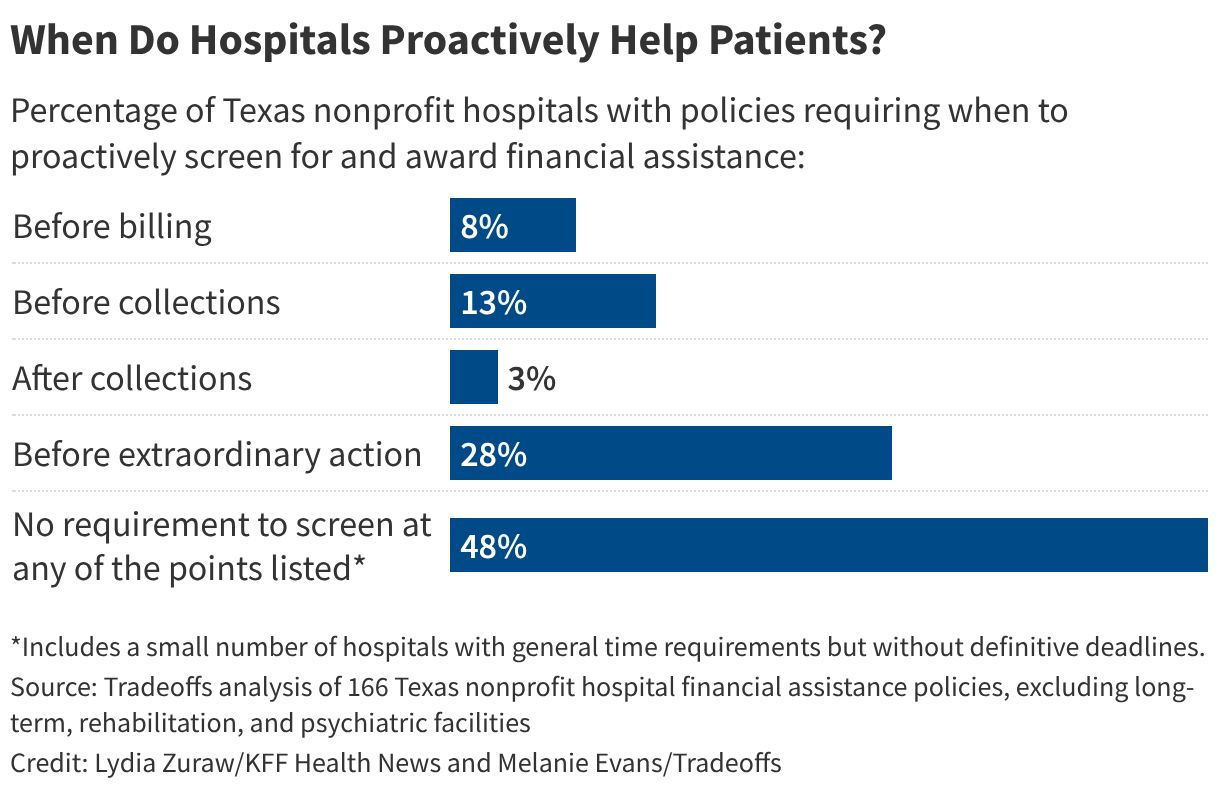
Only 8% of Texas's 166 nonprofit hospitals must check aid eligibility before billing patients, and about two-thirds refuse full refunds. story 1 ↓
In its first eating-disorder questions since 2015, a CDC survey finds 40% of US high schoolers report recent binge eating. story 2 ↓
HHS draft policy would have FDA hold off enforcement so pharmacies could make unproven peptides like BPC-157, which FDA called too risky. story 3 ↓
A review sorts existing drugs by whether they silence ancient viral DNA to curb inflammation or wake it to attack tumours. It has no new trial data. story 4 ↓
A review links gut bacteria to exercise's protection of aging muscle, but its own authors say cause and effect remain unproven. story 5 ↓
Kenya confirms a second Ebola case as Congo's outbreak passes 9,000 cases and 4,000 deaths.
1/5KFF Health News· Melanie Evans, Tradeoffs· Oct 15
Texas nonprofit hospitals often bill patients before checking aid eligibility
The newsroom Tradeoffs reviewed the aid policies of every Texas nonprofit hospital. Nearly all can screen patients for free care automatically, but few must do it before sending a bill, and most won't fully refund patients who later qualify.
Why it matters · Research suggests aid helps health only when it arrives within weeks of care, so when a hospital screens patients for free care can affect their health as well as their finances.
Know this first
Context from the editor, not the article · 25 sec
1 · Charity care and tax breaks
Nonprofit hospitals mostly don't pay income, sales or property taxes. In return they must provide community benefits, and the main one is charity care: free or discounted treatment for low-income patients.
2 · Presumptive eligibility
A hospital checks a patient's likely income using data it already has or can buy, and grants aid automatically. The patient doesn't have to fill in an application with bank statements and pay stubs.
3 · The ACA rule
The Affordable Care Act of 2010 penalizes nonprofit hospitals that take aggressive collection steps, such as wage garnishment, before making reasonable efforts to find out whether the patient qualifies for aid.
2/5STAT· Sarah Todd· Oct 15
CDC survey finds 40% of U.S. high schoolers report recent binge eating
In the 2025 Youth Risk Behavior Survey, a national CDC classroom survey, about 40% of high schoolers said they had binge eaten with a loss of control in the past month. Rates were higher among students of color.
Why it matters · This is the first national data on teen disordered eating in a decade. It cuts against the stereotype that eating disorders mainly affect white girls, and it may shift research funding.
Know this first
Context from the editor, not the article · 29 sec
1 · The Youth Risk Behavior Survey
Every two years the CDC gives U.S. high school students an anonymous questionnaire about health risks such as drinking, drugs, sex and violence. It has to fit in one 45-minute class period, so every question competes for space.
2 · Binge eating vs. the disorder
Binge eating means eating an unusually large amount quickly while feeling unable to stop. Binge-eating disorder is a clinical diagnosis: episodes recur, usually weekly for months, and cause marked distress. One binge in a month is not a diagnosis.
3 · Why the data went missing
In 2015 the CDC dropped the survey's disordered-eating questions to make room for items on emerging behaviors such as vaping. Since then, researchers have had no recent national picture of eating problems in teenagers.
3/5STAT· Associated Press· Oct 15
Health department moves to let pharmacies make unproven peptide injections
The Health and Human Services department sent the White House a plan that would let compounding pharmacies temporarily make popular peptide injections. FDA scientists say these products have never been shown to be safe or effective.
Why it matters · Products backed mostly by animal data could soon come from licensed pharmacies and big telehealth firms. That can make them look vetted to patients when they haven't been.
Know this first
Context from the editor, not the article · 31 sec
1 · What compounding pharmacies do
Compounding pharmacies mix custom medicines for patients whose needs approved drugs don't meet. Their products skip FDA approval trials. The FDA limits which raw ingredients they can use and keeps a list of substances it considers too risky.
2 · Approved versus wellness peptides
Peptides are short chains of amino acids. Some, like the GLP-1 drugs for diabetes and weight loss, went through full clinical trials. Others, like BPC-157, are sold online for muscle building and healing, backed mainly by animal studies.
3 · How federal rules get reviewed
4/5Fight Aging!· Reason· Oct 15
Review: switching 'jumping genes' off or on could treat aging and cancer
A new review in EMBO Molecular Medicine treats ancient viral DNA in our genome as an inflammation switch. Silencing it might ease age-related inflammation, and switching it on could help immune drugs attack tumours.
Why it matters · Chronic inflammation is a central idea in aging biology, and this points to one specific, drug-targetable source of it. Human evidence that targeting it helps is still thin.
Know this first
Context from the editor, not the article · 27 sec
1 · What transposable elements are
About half the human genome is repetitive DNA that once could copy and paste itself. Much of it comes from ancient viral infections. LINE-1 elements and endogenous retroviruses are the main families that can still become active.
2 · How cells normally keep them quiet
Chemical tags on DNA and on its packaging proteins keep these sequences tightly wound up and unread. With age, and in many diseases, this epigenetic control loosens and the sequences start to be read again.
3 · Why viral-looking DNA inflames
Cells carry sensors that watch for DNA or RNA outside the nucleus, a sign of infection. When the sensors trip, the cell releases type I interferon, an alarm signal that drives inflammation.
5/5Fight Aging!· Reason· Oct 15
Review asks whether gut bacteria help explain how exercise protects aging muscle
A new review argues that gut bacteria and the compounds they make may be one route by which exercise protects aging muscle from frailty. The human evidence is only correlational, and nobody has shown cause.
Why it matters · It tells you what we know and don't yet know about why exercise works, and gives you a reason to doubt "microbiome for muscle" product claims.
Know this first
Context from the editor, not the article · 25 sec
1 · Frailty and sarcopenia
Frailty is a loss of physiological reserve that leaves older people vulnerable to falls, disability and death. Sarcopenia is the age-related loss of muscle mass, strength and performance, and it drives much of frailty.
2 · The gut microbiome ages
The gut's bacteria, viruses and fungi shift with age. Microbes that produce harmful compounds or drive chronic inflammation tend to increase, and microbes that make useful metabolites tend to decline.
3 · Narrative versus systematic reviews
A narrative review is an expert's summary of selected literature. A systematic review or meta-analysis searches and pools studies by preset rules. Narrative reviews generate hypotheses and do not weigh evidence formally.
When Texas nonprofit hospitals screen for aid: before billing or only before collections.1 / 4
Aimee Carlock, a house cleaner who lives paycheck to paycheck, borrowed $5,500 from friends and family because Texas Health Resources, a large nonprofit hospital system, told her it wouldn't schedule her uterine surgery until she paid up front. Afterward she learned she qualified for financial aid and her care should have been free. The hospital wrote off the rest of her bill but kept the $5,500.
What the investigation found
1, a nonprofit health newsroom working with KFF Health News, read the financial aid policies of all 166 nonprofit general and children's hospitals in Texas. These hospitals avoid most taxes in exchange for community benefits, especially 2: free or discounted treatment for patients who can't pay.
Nearly all of them can use 3, meaning they estimate a patient's finances from available data and grant aid automatically, with no application full of bank statements and pay stubs. Their policies differ on timing:
Only about 8% must screen patients before sending a bill.
41% must screen only before handing debts to collectors, garnishing wages or refusing further care.
When a bill is forgiven, about 40% of policies say the patient won't be told.
About two in three policies rule out full refunds. Federal refund rules don't cover patients approved through automatic screening.
Becca Wahl, an uninsured yoga instructor, received a $38,000 emergency room bill from Memorial Hermann Katy Hospital, even though its own policy says patients should be screened before billing. The bill was erased only after a patient-help group, 4, filed an aid application for her.
Why timing matters
Studies co-authored by Harvard's Ray Kluender found that aid given within weeks of care made patients more likely to get diagnosed and treated for depression and diabetes and to keep follow-up visits. Relief that came months or years later showed no health benefit. These are observational studies, but they point the same way.
The hospitals' case
The Texas Hospital Association calls charity care "the relief of last resort." It says hospitals must first check for insurance, Medicaid or grants. It also says screening tools are unreliable and that granting aid before billing could let insurers avoid paying their share of 5. With federal cuts to insurance subsidies and Medicaid coming, Northwestern's Jill Horwitz argues that hospitals can't cover a federal coverage gap on their own.
Where mandates exist
By July 2027, six states will require automatic screening for some patients. Oregon requires hospitals to screen uninsured and Medicaid patients before billing them. In the first full year, its hospitals more than doubled their charity care on average, based on partial data. At OHSU Hospital in Portland, the share of patients receiving aid rose from 12% to 64%. Texas Rep. Tom Oliverson, a Republican physician, plans to reintroduce a screen-before-billing bill in 2027 after his 2025 version failed.
The Texas findings come from written policies, which may not match what hospitals actually do.
Aimee Carlock, a 35-year-old self-employed house cleaner, needed uterine surgery in August 2025. She says Texas Health Resources, one of the state's largest nonprofit hospital systems, wouldn't schedule it until she paid $5,500 up front. She borrowed the money from her best friend and her parents. After the surgery she learned she qualified for financial aid, so her care should have been free. The hospital wrote off the rest of her bill but kept the $5,500.
Her case opens an investigation by 1, a nonprofit health newsroom, published with KFF Health News. Tradeoffs read the financial assistance policies of all 166 nonprofit general and children's hospitals in Texas. The reporters believe it is the first detailed look at how nonprofit hospitals use 2.
The problem
Nonprofit hospitals are largely exempt from income, sales and property taxes. In exchange they are expected to provide community benefits, especially 3: free or discounted treatment for patients who can't pay. Getting that aid usually means filing an application. Patients may have to hand over bank statements, pay stubs, car loan documents, retirement accounts and even divorce records. Stanford health economist Neale Mahoney calls it "like going through a tax audit." Many patients never apply because they don't know the aid exists.
Presumptive eligibility is the alternative. The hospital estimates a patient's finances from data it already holds or can obtain, then grants aid without an application. How much this matters depends on when the hospital does it. Screening before a bill goes out means the patient never sees a debt. Screening only before sending an account to collectors means the patient may already have paid, borrowed or gone without.
A KFF Health News analysis estimates that about 100 million US adults carry healthcare debt. Texas has higher rates of medical debt than most states.
What the Texas analysis found
A second case shows the system working only after an outside group stepped in. Becca Wahl, an uninsured 33-year-old yoga instructor, received a $38,000 emergency room bill from Memorial Hermann Katy Hospital after fainting and getting a concussion. The hospital's own policy says patients should be screened before being billed. It cut her bill to an $11,000 cash price on a $1,000-a-month payment plan. A week after 6, a group that helps patients apply for aid, filed her application, the hospital erased the bill.
Why timing matters
Harvard's Ray Kluender worked on two studies that point the same way. In one, patients who received aid within weeks of their care were more likely to be diagnosed and treated for conditions such as depression and diabetes, and to make follow-up appointments. In the other, debt relief that came months or years later showed no health benefit. A separate recent study found that people with medical debt are three to four times as likely as people without it to delay physical and mental healthcare. These are observational findings that come mainly from different groups of patients, but together they suggest late aid relieves the bill without helping health.
The hospitals' side
Anna Stelter of the Texas Hospital Association calls charity care "the relief of last resort." She argues that hospitals first need to check for insurance, for Texas's narrow Medicaid eligibility, or for grants. She also says screening tools can be unreliable and billing departments are short-staffed. She argues that granting aid before billing could let insurers off the hook for 7, which now average about $2,100 for job-based coverage and $3,700 for marketplace plans.
Finances are tightening. Congress cut subsidies for Affordable Care Act marketplace insurance, and federal Medicaid cuts are expected to remove millions from the rolls. Northwestern's Jill Horwitz argues that nonprofit hospitals "do not have the money to solve what is ultimately a major federal problem." Texas already requires nonprofits to meet one of several benefit targets, such as spending 4% of patient revenue on charity care. Research on such targets is mixed: some hospitals expanded aid, while others cut charity care or other community benefits.
What mandates do
By July 2027, six states will require presumptive eligibility for some patients: California, Delaware, Illinois, Maryland, North Carolina and Oregon. Oregon's rule took effect in July 2024. It requires hospitals to screen, before billing, every Medicaid or uninsured patient and anyone owing more than $500. Lawmakers raised that threshold to $1,500 in 2026 over concerns about screening accuracy and hospital finances. In the first full year, Oregon hospitals more than doubled their charity care on average, based on Medicare data covering about two-thirds of hospitals. At OHSU Hospital in Portland, the share of patients receiving aid rose from 12% to 64%.
Texas Rep. Tom Oliverson, a Republican physician, filed a 2025 bill requiring screening and aid before billing, with penalties for hospitals that don't comply. Hospitals that already serve many low-income patients would be exempt. The bill failed, and he plans to reintroduce it in 2027.
What's left open
The analysis covers written policies, not what hospitals actually do. Some hospitals say their practice differs from their policies. The Oregon numbers are early and incomplete, and the article doesn't say whether the extra aid reached the right patients or how it affected hospital budgets.
Remember
Being able to grant automatic aid isn't the same as using it: 8% of Texas nonprofit hospitals must screen before billing.
Federal refund rules leave out patients approved through automatic screening, so money they paid up front can be kept.
Oregon's screen-before-billing mandate coincided with charity care more than doubling, though the data cover only part of the state's hospitals.
The 1 (CDC) has released new results from its 2 (YRBS), a national questionnaire given to U.S. high schoolers every two years. About 40% of students said they had binge eaten in the past month. This is the first time the survey has asked about binge eating, and the first data it has collected on any kind of 3 in ten years.
The question
Students were asked how many days in the past 30 they ate "an unusually large amount of food in a short period of time" and felt a loss of control, or felt they couldn't stop even when full. STAT reports that nearly 7,000 students answered, and that 17% said they had binge eaten within the last three days.
This captures the key symptom of 4, not the diagnosis itself. The diagnosis requires repeated episodes over months, plus distress, while a single day counts on the survey. So the 40% figure shows how common the behavior is, not how many teens have the clinical disorder.
Who reported it
Female students: 19%. Male students: 16%.
Hispanic and multiracial students: 20%. Black students: 19%. White students: 15%. Middle Eastern or North African students: 10%.
The article doesn't say which measure these subgroup rates use. They are close to the 17% figure, so they are not breakdowns of the 40%.
Ariel Beccia of Boston Children's Hospital argues that the pattern undercuts the stereotype that eating disorders mainly affect white girls. They affect marginalized youth "more, actually," she said. Binge eating was also linked to checking social media at least hourly, poor mental health and suicidality. These are associations from a single survey taken at one time, so they don't show cause.
Why the data was missing
In 2015 the CDC cut the survey's eating questions to make room for items on vaping. The survey has to fit in one 45-minute class. Advocacy and research groups spent a decade lobbying to get the questions back. They chose binge eating because it is the most common form of disordered eating in youth, and because it is more frequent among teens facing 5. Next they want a national question on fasting, dieting and purging, which currently exists only as an optional item for states.
Food or mind?
Nutrition epidemiologist Lindsey Smith-Taillie argues that 6 are "engineered for overconsumption" and are cheap and easy to stockpile. Researcher Ashley Gearhardt notes that binge eating rose alongside these foods but says the timing doesn't prove causation. Beccia calls disordered eating fundamentally a mental health issue. The survey can't settle this debate, and with only one year of data, it can't show trends either.
The finding
The 1 (CDC) has published new results from its 2 (YRBS), a national questionnaire given to U.S. high school students every two years. About 40% of students said they had binge eaten at least once in the past 30 days. STAT reports that the sample was nearly 7,000 students, and that 17% of them said they had binge eaten "within the last three days."
The 2025 survey was the first to ask about binge eating. It was also the first time in a decade that the YRBS collected any data on 3. "It was extremely alarming seeing how high those numbers were," said Ariel Beccia, a researcher in adolescent and children's medicine at Boston Children's Hospital.
What exactly was asked
The definition matters, because "binge" can mean anything from a big holiday dinner to a clinical symptom. The survey asked about eating with a loss of control:
"During the past 30 days, on how many days did you eat an unusually large amount of food in a short period of time and experience a loss of control over how much you were eating or a feeling that you could not stop eating even when full?"
This is close to the core feature of 4, but a single question is not a diagnosis. The clinical diagnosis requires episodes to recur over months, usually about weekly, and to cause distress. The survey picks up anyone who had even one such day in a month, so the 40% figure measures how common the behavior is, not how many teens have the disorder. Teenagers may also read "unusually large" and "loss of control" differently from clinicians, and the answers are self-reported.
Who reported it
The article gives these subgroup rates:
By sex: female 19%, male 16%
By race and ethnicity: Hispanic 20%, multiracial 20%, Black 19%, white 15%, Middle Eastern or North African 10%
The article does not say which measure these figures use. They sit close to the 17% figure, not the 40% one, so they are probably not past-month rates. Read them as relative differences between groups, not as a breakdown of the headline number.
Beccia argues that the racial pattern is the most important finding, because it contradicts the long-held stereotype that eating disorders mainly affect white girls and young women. Eating disorders affect everyone, she said, and "they affect marginalized youth more, actually."
The survey also found that binge eating was linked to frequent social media use (checking platforms at least hourly), poor mental health and suicidality. These are associations from a single survey taken at one point in time. They don't show which came first, or whether social media plays any causal role.
How the question got back on the survey
The space in the YRBS is limited because the whole survey has to fit in a 45-minute class period. In 2015 the CDC removed the disordered-eating questions to make room for items on behaviors such as vaping, which was then rising among teens. For the next ten years, a coalition of eating-disorder research and advocacy groups pushed to get questions back in.
For 2025 the coalition asked specifically for binge eating, for two reasons:
Earlier research showed binge eating is the most common form of disordered eating among young people.
Teens facing 5 or other economic strain are more likely to binge eat than better-off peers. A binge-eating question therefore lets researchers study inequities.
The groups now also want a question on restrictive and compensatory behaviors such as fasting, dieting and purging. That item exists today only in an optional question bank that state and local health departments can add to their own versions of the survey. It is not part of the national core.
The ultra-processed food question
The STAT story also brings in the food environment. Lindsey Smith-Taillie, a nutrition epidemiologist at UNC's Gillings School of Global Public Health, argues that many 6 are "engineered for overconsumption." She points to "flavor bursts that rapidly dissipate" and rapidly absorbed carbohydrates that "leave us wanting more." Because these foods are also cheap, shelf-stable, convenient and heavily marketed, she adds, households can keep them on hand in abundance.
Ashley Gearhardt, who studies ultra-processed food and addiction, notes that binge eating became a recognized clinical problem at the same time highly processed foods came to dominate the food supply. She is explicit that this timing does not establish causation. Beccia frames the issue differently. Fundamentally, she says, disordered eating is a mental health problem.
These are expert views, not findings of this survey. The YRBS question doesn't ask what foods students ate during binges, so the data can't test the processed-food hypothesis.
Caveats
Behavior, not diagnosis. One loss-of-control episode in 30 days counts. The share of teens who would meet clinical criteria is much lower and unknown from this survey.
Self-report and wording. Teens' sense of an "unusually large amount" varies, and nothing in the survey checks their answers against a clinical interview.
Snapshot. The survey captures one moment, so the links to social media, mental health and suicidality are correlations only.
No trend line. This is the first YRBS binge-eating question, so nobody can say whether rates are rising. The old pre-2015 questions measured different behaviors.
Unclear numbers. The article doesn't make clear how the 40%, 17% and subgroup figures relate to each other. The full CDC report should settle this.
What it could change
Beccia argues that eating disorders are underfunded and understudied partly because national 7 didn't exist. She hopes these numbers will persuade funders that disordered eating is "a true public health issue." The survey doesn't tell doctors what to do differently. But a 40% past-month figure, with higher rates among Black, Hispanic and multiracial teens, is a strong argument for screening teens more widely than the stereotype would suggest.
Remember
The survey question counts a single loss-of-control episode, so 40% measures the behavior, not cases of the disorder.
Hispanic, multiracial and Black teens reported binge eating more often than white teens, against the long-held stereotype.
This is the first year of data, so it can't show trends, and the social media links are only correlations.
Major federal rules and policies go to the White House Office of Management and Budget before release. Its job is to review regulations that could have a significant economic impact. A filing there means a policy is close to being issued.
Image: STAT
The Health and Human Services department (HHS), led by Robert F. Kennedy Jr., has sent the White House a peptides "interim access policy." According to a government website posting on Thursday, the plan is under review at the 1, which checks major federal rules before they take effect. The filing gives no details. Two people familiar with the plan told the Associated Press that it would let 2 temporarily make some popular peptide injections, including 3, which is promoted for building muscle and healing injuries.
What's being opened up
Peptides are short chains of amino acids that can trigger hormones involved in growth, metabolism and healing. Some are proven drugs, including diabetes and weight-loss treatments. The ones in this policy are not. People use them to bulk up, look younger or get more energy. None of those uses is FDA-approved, and most of the supporting data come from animal studies.
The FDA had listed BPC-157 and more than a dozen other injectable peptides as too risky for pharmacies to compound. It cited possible contamination, allergic reactions and tumor growth.
How the policy got here
Kennedy told the FDA to reconsider a short list of peptides favored by wellness influencers. In July, an outside advisory panel picked by his department recommended lifting restrictions on six of seven. The panel included doctors, pharmacists and consultants who work in the peptide field. The FDA's own scientists disagreed, saying none of the peptides had been studied enough to show they are safe or effective.
The new plan uses 4: the FDA would simply not go after pharmacies that make these peptides. Formally declaring the peptides acceptable to compound would require 5, a process that takes years and includes public comment. It's unclear whether the administration still plans to do that.
The arguments
Kennedy argues that Americans already buy "gray market" peptides made in China and elsewhere and sold on platforms like TikTok, so a US pharmacy product is safer. That argument addresses contamination. It doesn't address allergic reactions, tumor risk, or the lack of evidence that the products work.
Several prominent figures in Kennedy's 6 movement sell peptides. One of them, clinic operator Brigham Buhler, called the plan a win for "MEDICAL FREEDOM." Telehealth companies Hims & Hers and Noom say they will offer peptides if access eases. Analysts estimate the market at $2 billion to $3 billion.
The article doesn't say which other peptides would be covered, how long the "temporary" period would last, or whether pharmacies would have to monitor patients for side effects.
The news
On Thursday, a government website posting showed that the Department of Health and Human Services (HHS), led by Robert F. Kennedy Jr., had sent a peptides "interim access policy" to the White House 1 (OMB) for review. OMB checks federal rules that could have a significant economic impact. The filing itself gives no details. Two people familiar with the plan told the Associated Press that it would let 2 temporarily make some of the most popular injectable peptides, including 3, which is promoted for building muscle and healing injuries. HHS did not respond to requests for comment.
What these products are
Peptides are short chains of amino acids, the building blocks of proteins. Many act as signals in the body, triggering hormones involved in growth, metabolism and healing. Several have become approved drugs after full clinical development, including mainstay treatments for diabetes and weight loss.
The peptides in this policy have not been through that process. People use them to bulk up, look younger or get more energy. None of those uses is FDA-approved, and most of the evidence for them comes from animal studies, not human trials. Readers should treat claims about benefits in people as unproven.
Why the FDA restricted them
Compounding pharmacies mix customized medicines that traditional drugmakers don't supply. Their products don't go through approval trials, so the FDA controls which ingredients they may use. The agency had put BPC-157 and more than a dozen other injectable peptides on its list of substances too risky to compound. It cited three possible harms: contamination, allergic reactions and tumor growth. Tumor growth is a plausible concern for compounds marketed as speeding up tissue growth and repair.
How the restrictions are being unwound
The reversal has happened in stages:
Political direction. Before he took office, Kennedy said "FDA's war" on peptides and other wellness products would soon end. As secretary, he argued that pharmacies should be allowed to sell peptides because Americans were already buying "gray market" versions made in China and elsewhere. Those products remain easy to find on platforms like TikTok.
The legal difference matters. Formally adding these peptides to the FDA's list of substances that are acceptable to compound would require federal 5. That process can take years and includes several rounds of public comment. Enforcement discretion skips it. It is faster, but it is also easier to reverse, and it creates no formal record weighing the evidence. The article says it is unclear whether the administration still plans to pursue formal rulemaking.
The case for and against
Kennedy's argument is about reducing harm: people are already injecting unregulated imports, so a US pharmacy product is better than an unknown overseas powder. That has some logic where contamination is concerned, since domestic pharmacies are inspected and supply chains can be traced. But it doesn't touch the FDA's other concerns. A cleanly made compound can still cause allergic reactions or promote tumor growth, and a pharmacy label doesn't make a drug effective.
Supporters frame the issue differently. Brigham Buhler, a wellness clinic operator who sells peptides online, wrote on X that the question is "whether you're for or against MEDICAL FREEDOM." The article notes that some of the most prominent figures in the 6 movement, Kennedy's health campaign, sell peptide injections and supplements. Those people stand to gain directly.
The money
Telehealth companies Hims & Hers and Noom have both said they will offer peptides if the federal government eases access. Wall Street analysts estimate the market at $2 billion to $3 billion. That kind of distribution would move these products from niche online sellers to mainstream subscription services.
What's still unknown
Which peptides would be covered beyond BPC-157, and for how long the "temporary" period lasts.
Whether pharmacies would face any requirements on quality, dosing or tracking side effects.
Whether formal rulemaking will follow, which would require a public review of the evidence.
Whether anyone will fund human trials. Nothing in the article suggests the policy requires or encourages new studies, so the evidence would stay mostly at the animal-study stage while use grows.
Remember
The FDA's staff scientists found no peptide on the list had enough evidence of safety or effectiveness.
Enforcement discretion skips years of formal rulemaking, but it is easier to reverse and leaves no public review of the evidence.
A pharmacy-made peptide can still cause allergic reactions or tumor growth. Cleaner manufacturing only reduces contamination risk.
A new review in EMBO Molecular Medicine argues that the ancient viral DNA in our genome works like an immune switch, and that drugs could turn it either way. Reason, who writes the longevity blog Fight Aging!, highlighted it as a possible route to reducing age-related inflammation. This is a review of earlier research, so it brings no new trial results.
The problem
About half of human DNA consists of 1 (TEs): sequences that once copied themselves around the genome, many of them left behind by old viral infections. In young cells they are kept silent by epigenetic controls, chemical tags that keep DNA packed away and unread. The review says these controls loosen with age and in cancer, neurodegeneration and autoimmune disease.
Once TEs are read again, they cause trouble in two ways. New copies can land in genes and break them. More importantly, in Reason's view, TE activity leaves DNA and RNA in the cytoplasm, the part of the cell outside the nucleus. Sensors built to detect viruses pick it up and set off 2, the cell's antiviral alarm. The result is chronic "sterile" inflammation, meaning inflammation with no infection behind it.
Turning it down
To calm this inflammation, the review lists three approaches:
3. These HIV drugs block the enzyme TEs use to copy themselves.
4. Short custom-made strands that bind TE RNA so it gets destroyed.
Epigenetic silencing drugs. These try to restore the original silencing.
Turning it up, in cancer
The same alarm can be useful. Drugs that strip the silencing tags from tumour cells make those cells look virus-infected, a state called 5. That can make tumours respond better to checkpoint inhibitors, drugs that release the brakes on T cells, the immune cells that kill diseased cells. Tumours may also display TE protein fragments on their surface. Because many patients' tumours could share these fragments, they could become targets for off-the-shelf cancer vaccines or engineered T cells.
Caveats
No human aging data. The abstract cites no trial showing that suppressing TEs improves health in older people.
The size of the effect is unknown. Reason says TEs cause only "some fraction" of age-related inflammation, and nobody puts a number on it.
Opposite goals collide. Suppressing TEs to calm aging tissue could also dull immune defences against tumours.
Side effects. NRTIs carry known risks with long-term use.
The mechanism makes sense, and some of the drugs already exist. Whether they help people as they age has not been tested.
The news
A review in EMBO Molecular Medicine argues that 1, the self-copying stretches of DNA left over from ancient viruses, act as an immune switch that drugs could turn up or down. Reason, who writes the longevity blog Fight Aging!, highlighted the paper for its aging angle. He thinks quieting these elements could take away one source of the chronic inflammation that builds up with age.
This is a review of earlier research, not a new study. It reports no trial results or effect sizes. Its value is in how it organises the field and points to drugs that already exist.
The problem: old viruses waking up
Roughly half the human genome is made of transposable elements (TEs). Most are dead fragments, but some can still be read, and a few can still copy themselves into new places in the genome. LINE-1 is the main one that can still do this. In young, healthy cells they are kept silent by epigenetic controls: chemical tags such as DNA methylation, plus tightly packed DNA that the cell's reading machinery can't reach.
According to the review, these controls loosen in cancer, neurodegeneration, autoimmune disease and aging. Once that happens, TEs get read again. Reason describes two kinds of harm:
Insertions. New copies land in random places and can break the genes they land in.
False alarms. He calls this the more important harm. The TE activity produces DNA and RNA in the cytoplasm, the part of the cell outside the nucleus. Pattern-recognition receptors, sensors evolved to spot viruses there, react to it. The review says these signals all lead to 2, the cell's antiviral alarm. The result is "sterile" inflammation, meaning inflammation with no actual infection.
How it works, using general background the review summarises rather than spells out: an active LINE-1 element makes an enzyme called reverse transcriptase, which copies its RNA back into DNA. Some of that DNA ends up in the cytoplasm. There a sensor called 3 detects it and triggers the STING pathway, which turns on interferon genes. An aging cell can therefore behave as if it were mildly infected, all the time.
The hard part is that this alarm is not simply bad. The review's central point is that the same reaction that harms aging tissue can help the immune system find and kill cancer cells.
Strategy one: turn it down
For inflammatory disease and aging, the review lists three ways to suppress TEs:
4. These are HIV drugs, such as lamivudine, that block the copying enzyme. Blocking it cuts off the DNA that would set off cGAS. From general background, not this article: a 2019 mouse study found that lamivudine lowered interferon signalling and inflammation in old animals. That is why these drugs get attention in aging research.
5. These are short, made-to-order strands of genetic material that stick to TE RNA and mark it for destruction.
The abstract also says suppression may "restore other adaptive mechanisms governing homeostasis", meaning the cell's normal self-regulation. It does not explain what those mechanisms are.
Strategy two: turn it up, in tumours
Cancer cells often avoid the immune system by looking unremarkable. The review describes "epigenetic priming": drugs that strip away the silencing tags so that TEs in tumour cells get read. The tumour then shows 6, meaning it looks infected and sets off interferon signalling. That can make it more sensitive to 7, drugs that release the brakes on T cells, the immune cells that kill infected or cancerous cells.
There is a second angle. Cells display fragments of their proteins on 8 molecules, which work like a shop window that T cells inspect. When TEs are read in tumours, fragments of their proteins can end up on display. The review calls these TE-derived peptides a "largely unexploited reservoir of shared tumor antigens". "Shared" matters: most tumour targets are unique to one patient's mutations, so a shared target could support off-the-shelf vaccines or engineered T-cell therapies instead of made-to-order ones.
Trade-offs and what's left open
The same pathway works in opposite directions. A drug that suppresses TEs to calm aging tissue could, in principle, also weaken the immune response to early tumours. The reverse risk is that waking TEs to fight cancer could inflame healthy tissue. The abstract does not say how dosing or tissue targeting would keep the two apart.
How big the effect is remains unknown. Reason's own wording is careful: "some fraction" of age-related chronic inflammation comes from TE activity. Neither he nor the abstract estimates that fraction. Many other things also drive inflammation in aging, including senescent cells, gut-derived signals and mitochondrial debris.
The evidence is mostly preclinical. The abstract cites no human trial showing that suppressing TEs slows aging or improves health span. NRTIs have serious known side effects with long-term use, a real cost for anyone thinking of them as a preventive drug for healthy people.
Insertions vs. inflammation. Reason argues that inflammation does more harm than DNA damage from new insertions. This is a reasonable reading of the field, but it is his judgment, not a measured result.
Bottom line: the "tunable switch" idea makes sense biologically and has a clear mechanism, and some of the candidate drugs are already approved for other uses. Whether turning the switch down actually helps aging humans is still an open question.
Remember
This is a review of earlier research: no new trial data or effect sizes, and human evidence for the aging uses is lacking.
The same TE-driven interferon alarm harms aging tissue but can help the immune system attack tumours.
TE protein fragments shared across many patients' tumours could allow off-the-shelf cancer vaccines rather than personalised ones.
A new open-access paper, "The exercise-gut-muscle axis in physical 1: A 2," proposes that gut bacteria may be part of the reason exercise protects aging muscle. The longevity blog Fight Aging! highlighted it. It is a narrative review, meaning a summary of existing studies. No new data were collected, and the authors say clearly that cause and effect have not been shown.
The problem
Frailty is a loss of physiological reserve that leaves older people prone to falls, disability and death. A central driver is 3, the age-related loss of muscle mass, strength and performance. Aerobic exercise and strength training both improve strength, physical function and metabolic health in older adults. They are also linked to better 4, better insulin sensitivity and less chronic inflammation. Yet the review says how exercise does this in older people "remains unclear." Fight Aging!'s author, Reason, argues that the mechanism matters because "even the fittest people become frail eventually," and understanding it could lead to therapies.
Why look at the gut
The gut microbiome shifts with age. Inflammation-promoting microbes become more common and microbes that make beneficial compounds decline. In aged animals, 5, which moves gut contents from young donors into old recipients, has improved health and extended life. The causal evidence comes from these animal studies.
In humans the evidence is observational. Cohort studies link age-related microbiome changes to frailty and weaker physical function. Some report microbial "signatures" of early frailty. In older adults living at home, fitness tracks with diet, gut microbes and blood metabolite profiles. Because diet, activity and microbes all affect one another, these correlations cannot show which causes which.
The proposed mechanism
The review's main hypothesis is that microbial metabolites carry the signal. Gut bacteria ferment fibre into 6 such as acetate, propionate and butyrate. SCFAs affect inflammation, mitochondrial metabolism and insulin sensitivity. They also make bile acid derivatives and indole compounds. Exercise appears to change the microbiome. Habitual activity may increase microbial diversity "in certain settings" and enrich bacteria that produce SCFAs. If that holds, part of exercise's benefit to muscle would come by way of the gut.
What it means
For now, nothing changes for patients. Exercise remains the best-supported defence against sarcopenia, and its evidence base does not depend on this hypothesis. Nothing here supports probiotics or FMT for aging muscle in humans. The next step would be intervention trials in older people that change the microbiome and measure muscle outcomes. The article reports no such trials and no effect sizes.
The longevity blog Fight Aging! has highlighted an open-access paper, "The exercise-gut-muscle axis in physical 1: A 2." The review asks whether part of the benefit exercise gives aging muscle runs through the gut microbiome, the trillions of bacteria, viruses and fungi living in the intestine. A narrative review summarises selected literature. It does not test anything new, so the useful thing here is a map of a hypothesis and an honest look at how far the evidence goes.
The problem: exercise works, but we don't fully know why
Frailty is a decline in physiological reserve across several organ systems. Frail people handle stressors badly, and they are more likely to fall, lose function and die. The review names 3, the gradual loss of skeletal muscle mass, strength and physical performance with age, as a key biological driver of frailty.
The clinical case for exercise is strong. In older adults, both aerobic exercise and resistance (strength) training improve muscle strength, physical performance and metabolic health. Regular activity is also linked to better 4 (mitochondria are the cell's energy producers), better insulin sensitivity, more muscle protein turnover and less chronic inflammation. Even so, the authors write that the biological mechanisms behind these benefits in older adults "remain unclear." Knowing the mechanism matters for two reasons. It could explain why some people respond to exercise better than others. And, as the blog's author Reason argues, it might point to therapies for a problem exercise cannot fully solve: "even the fittest people become frail eventually."
Why the gut is a candidate
Gut microbes take part in nutrient metabolism, immune regulation and energy balance. The microbiome also changes with age. According to Reason's summary, microbes that produce harmful metabolites or keep the immune system in chronic inflammation become more common, and microbes that make beneficial metabolites become less common.
The strongest causal evidence comes from animals. In 5, gut contents from a young donor are moved into an old recipient. In aged animals this has improved health and extended life. Reason argues from these animal studies that the microbiome may matter for degenerative aging about as much as fitness and activity levels do. That is his reading of animal data, and no human result has shown it.
What the human evidence actually shows
The human data come from 6, which observe groups of people over time without intervening. These studies report that:
age-related changes in the gut microbiome are associated with frailty, lower physical function and poorer health in older people;
microbiome composition tracks with diet and overall health, and some studies report microbial "signatures" linked to early frailty;
in community-dwelling older adults, physical fitness is associated with diet, gut microbial composition and 7 (measurements of the small molecules circulating in the body).
The review says plainly that "causal relationships remain unclear." This is the main caveat. Diet, activity, the microbiome and muscle all affect one another. A fitter person may eat differently, which changes their microbes. A frail person may move less and eat less fibre, which also changes their microbes. Cross-sectional associations cannot tell you which way the arrows point.
The proposed mechanism: microbial metabolites
The review's main hypothesis is that gut bacteria affect muscle through the compounds they produce. These include:
Short-chain fatty acids (SCFAs) such as acetate, propionate and butyrate. Bacteria make them by fermenting dietary fibre. SCFAs affect inflammation, mitochondrial metabolism, blood-sugar control and insulin sensitivity.
Bile acid metabolites, which are bile acids chemically modified by gut bacteria.
Indole-derived compounds, made when bacteria break down the amino acid tryptophan.
Other products of amino acid metabolism.
The proposed chain goes like this. Regular exercise changes which microbes thrive. The review cites animal and human studies suggesting that habitual activity can raise microbial diversity "in certain settings" and enrich bacteria linked to SCFA production. More SCFAs could then reduce inflammation and improve metabolic function in muscle. In that picture the microbiome would amplify some of exercise's effects. Each link has some supporting data, but the excerpt does not show that the whole chain has been demonstrated in older humans. The hedge "in certain settings" suggests the exercise-to-diversity effect is not consistent.
What this changes and what it doesn't
For patients and clinicians, nothing changes yet. Aerobic and resistance exercise are still the best-supported ways to preserve muscle and lower frailty risk, and that evidence does not depend on the microbiome hypothesis. Nothing here supports probiotics, "gut health" supplements or FMT for sarcopenia in humans.
The open questions are the ones that would turn this hypothesis into evidence. Does changing the microbiome in older people change muscle outcomes? Do exercise's muscle benefits shrink when microbial changes are blocked? How large is any microbiome contribution compared with the direct effects of exercise on muscle? The article does not report effect sizes, specific trials or the authors' list of research priorities, so how big the effect might be remains unknown.
Remember
In humans, the gut-frailty link rests on observational cohort data. Causal evidence comes only from animal transplant studies.
Short-chain fatty acids from fibre fermentation are the leading candidate link between gut bacteria and muscle.
The exercise recommendation does not depend on this hypothesis. Trials are still needed before any microbiome therapy for frailty.
Almost every hospital can do it. Nearly all Texas nonprofit hospitals have policies that allow automatic screening and bill reduction. Nationally, about 90% of nonprofit hospitals reported this ability in 2022, up from 72% six years earlier, according to 4's analysis of federal data. The rise traces partly to the 5, which penalizes hospitals that pursue payment aggressively without first checking whether the patient needs help. Covenant Health, a five-hospital system in Lubbock, was the only Texas system to say it doesn't use automatic aid. A spokesperson cited "regulatory requirements and administrative complexities."
Few have to screen first. About 8% of policies require screening before a bill is sent. Another 41% require it only before handing debts to collectors or taking harsher steps, such as garnishing wages, placing liens on property or refusing further care. Texas hospitals owned by CommonSpirit Health, for example, wipe out bills only "after all other eligibility and payment sources have been exhausted." AdventHealth and Houston Methodist say they screen some patients before billing, though their written policies don't require it.
Forgiveness can be silent. When a hospital cancels a bill it has already sent, about 40% of policies say the patient won't be told. Only 8% require notification, and the rest don't address it.
Refunds are rare. About two in three policies say patients won't get full refunds. Federal rules require hospitals to refund amounts above what insured patients are typically charged. They also require full refunds for some patients who apply for aid, but experts told Tradeoffs those rules don't cover patients approved through automatic screening. That gap is how Carlock lost her $5,500.
Re-review. Earlier this year Kennedy told the FDA to reconsider a short list of peptides that wellness influencers and fitness celebrities have promoted heavily.
Advisory panel. In July, a panel of outside advisers recommended lifting restrictions on six of the seven peptides it reviewed. Kennedy's department picked the panel, which included several doctors, pharmacists and consultants who work in the peptide business. The FDA's own staff scientists reached the opposite conclusion: none of the peptides had been studied enough to establish safety or effectiveness.
Interim policy. The plan now at OMB uses 4, meaning the FDA simply chooses not to enforce some of its own rules. Compounding pharmacies would effectively be told they won't be targeted for making certain peptides.
Epigenetic silencing agents. These drugs try to restore the tags that kept TEs quiet in the first place.