Local Dengue, Fast Ebola, Slow Science · Morning Gist
Thursday, October 155 stories · 16 min
Local Dengue, Fast Ebola, Slow Science
Infections are spreading faster while the public-health and research capacity to answer them shrinks, plus two mouse studies on keeping muscle and arteries young.
Picked from 32 new articles across 12 sources · arrow keys for other days
Today in 30 seconds
30s left
Florida's local dengue cases outnumbered travel cases for the first time; flu is arriving early and ticks are rebounding this fall. story 1 ↓
Congo's Ebola outbreak, fastest on record, hit 9,066 cases in a year; no vaccine, and CDC sent 100 staff versus 2,000 before. story 2 ↓
Cystic fibrosis drugs rested on $4 billion in NIH research and 6,200+ papers; the author warns new grant rules endanger that pipeline. story 3 ↓
Blocking one microRNA restored muscle mass and strength in old mice and aided heart recovery, but it is still animal-only work. story 4 ↓
A review of vascular aging finds the best senolytic evidence, dasatinib plus quercetin improving aged mouse aortas, still comes from mice. story 5 ↓
Medicare open enrollment starts today, and insurers are closing Medicare Advantage plans, mostly rural; several million seniors must pick new coverage.
1/5Your Local Epidemiologist· Katelyn Jetelina· Oct 14
Early flu wave, fall tick rebound and record local dengue in Florida
Epidemiologist Katelyn Jetelina reports that flu has started early in the western U.S., with 9.5% of tests positive, and that fall tick bites are rising. In Florida, more dengue cases came from local mosquitoes than from travel.
Why it matters · It tells you when to get a flu shot and when to keep checking for ticks, and it shows how a warming climate is bringing dengue into the U.S. South.
Know this first
Context from the editor, not the article · 25 sec
1 · What test positivity means
Test positivity is the share of lab tests for a virus that come back positive. It is a rough gauge of how much virus is circulating, though it also depends on who gets tested.
2 · Dengue's four types
Dengue virus comes in four serotypes, DENV-1 to DENV-4. Infection with one gives lasting immunity only to that type. A later infection with a different type can be more severe.
3 · Measles "elimination"
The U.S. declared measles eliminated in 2000. That means no continuous spread inside the country for at least 12 months. Imported cases can still start outbreaks, mostly in under-vaccinated communities.
2/5Science-Based Medicine· Steven Novella· Oct 14
Congo's Ebola outbreak is the fastest-growing on record
An Ebola outbreak in the Democratic Republic of Congo has reached 9,066 cases and 4,381 deaths in under a year. Neurologist Steven Novella blames weakened outbreak response, not a nastier virus.
Why it matters · For a strain with no vaccine, Ebola outbreaks are stopped only by fast detection and containment, and that is the capacity the article says has been cut.
Know this first
Context from the editor, not the article · 25 sec
1 · How Ebola spreads
Ebola spreads through direct contact with the body fluids of sick or dead people, not through the air. Outbreaks are stopped by finding cases, tracing their contacts, isolating patients and making burials safe.
2 · Several Ebola species
Ebola is caused by several related viruses. The licensed vaccine, Ervebo, and the approved antibody treatments target only the Zaire species. Bundibugyo, the cause of this outbreak, has neither.
3 · The 2014–16 wake-up call
Before 2014, Ebola outbreaks stayed in the hundreds of cases. The West African epidemic infected more than 28,000 people and led to promises to build faster global outbreak response through WHO, CDC and USAID.
3/5The Conversation: Health· Fred D. Ledley, Director, Center for Integration of Science and Industry, Bentley University· Oct 14
Cystic fibrosis drugs rested on $4 billion in federal research, analysis finds
An analysis by pediatrician-economist Fred Ledley finds that about $4.1 billion in National Institutes of Health funding underpinned Vertex's cystic fibrosis drugs. He argues that Trump administration grant policies put similar future advances at risk.
Why it matters · These drugs show how long the road from basic research to treatment can be. Cuts to that research may only show up decades later, as drugs that never get made.
Know this first
Context from the editor, not the article · 29 sec
1 · What cystic fibrosis is
An inherited disease caused by faulty copies of the CFTR gene. The gene makes a channel that moves chloride across cell surfaces. When it fails, mucus turns thick, clogs the lungs and gut, and causes repeated infections.
2 · How the new drugs work
CFTR modulators target the faulty protein itself, not the symptoms. 'Correctors' help the misfolded channel reach the cell surface. 'Potentiators' such as ivacaftor hold it open. How well they work depends on which mutations a patient carries.
3 · Who funds drug discovery
4/5Fight Aging!· Reason· Oct 14
Blocking one microRNA restored muscle mass and strength in old mice
Researchers used a short synthetic DNA-like drug to block miR-128-3p, a small RNA that switches down other genes. Old mice regained muscle mass and function. The article gives no effect sizes, and there are no human data yet.
Why it matters · Drugs that keep muscle on during GLP-1 weight loss are drawing heavy investment. Any that work could also target age-related muscle loss and frailty, so early mechanisms like this one are worth tracking.
Know this first
Context from the editor, not the article · 32 sec
1 · What microRNAs do
MicroRNAs are RNA strands about 22 letters long that don't code for proteins. Each one binds the messenger RNAs of many genes, often hundreds, and turns down how much protein those genes make. Blocking one microRNA can therefore shift whole gene programs at once.
2 · Antisense oligonucleotides
An antisense oligonucleotide (ASO) is a short, chemically stabilised strand built to match a target RNA. It sticks to that RNA and blocks it. Several ASO drugs are already approved, for example nusinersen for spinal muscular atrophy.
3 · Why muscle loss is suddenly funded
5/5Fight Aging!· Reason· Oct 14
Review maps how aging damages blood vessels, focusing on senescent cells
A new review applies the "hallmarks of aging" framework to blood vessels. Its strongest section covers senescent cells: old cells that stop dividing but don't die. Clearing them improved vessel function in old mice, though not yet in people.
Why it matters · Vascular aging drives heart attacks and strokes, the leading causes of death. Senolytic drugs are one of the few anti-aging approaches with real evidence behind them, but that evidence is still mostly from mice.
Know this first
Context from the editor, not the article · 30 sec
1 · The Hallmarks of Aging
A framework first published in 2013 and updated in 2023 that sorts aging into about a dozen cellular processes, such as DNA damage, mitochondrial decline, chronic inflammation and cellular senescence. Researchers use it to organize what goes wrong in each tissue.
2 · Cellular senescence
Damaged or stressed cells can permanently stop dividing instead of dying. That protects against cancer, but the cells linger and release inflammatory signals. They build up with age, and removing them in mice delays several age-related diseases.
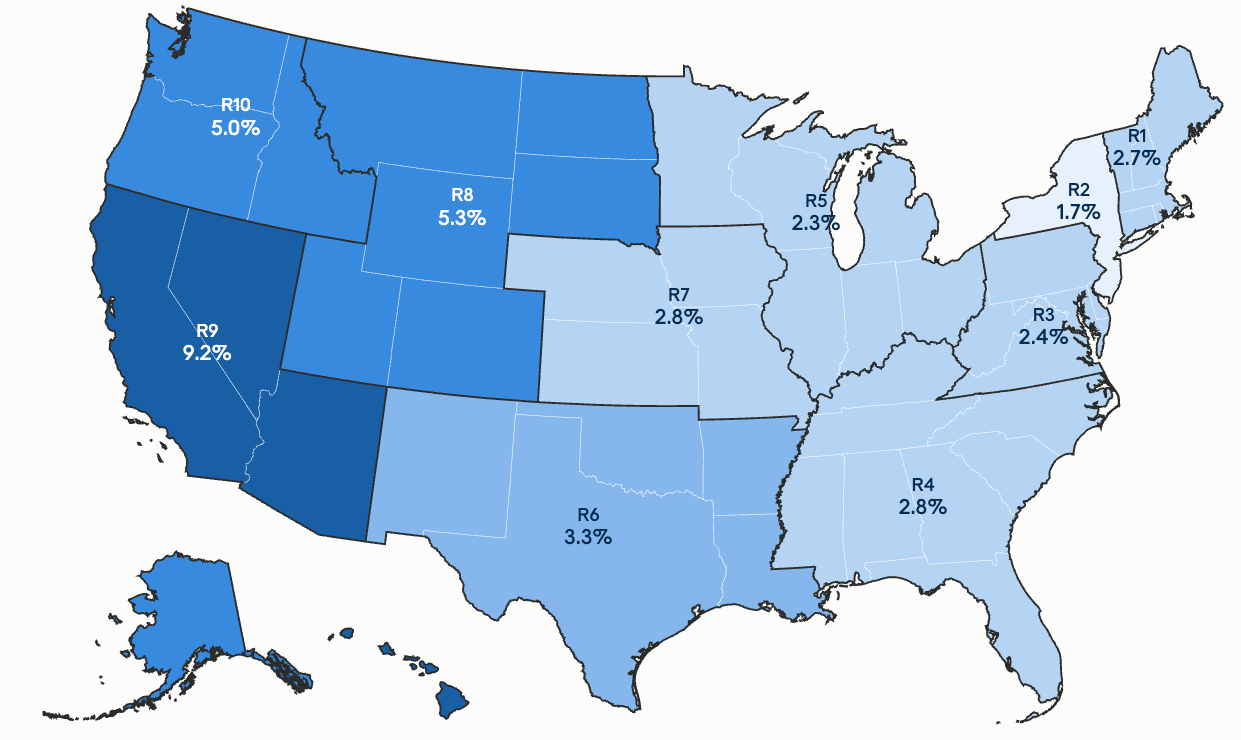
Map of flu test positivity by U.S. health region on October 3: high in the West, low in the Northeast.1 / 3
Epidemiologist Katelyn Jetelina's mid-October roundup in Your Local Epidemiologist (YLE) reads U.S. 1, meaning the routine case counts and test results health agencies collect. Her main points: flu has started early, ticks are back, and dengue is gaining ground in the South.
Flu is moving east from the West
2 is the share of flu lab tests that come back positive. In the western U.S. it has reached as high as 9.5%. Jetelina says a flu "season" usually starts at about 3% and peaks near 18%, so the West is well into its wave. CDC data for the Department of Health and Human Services (3) regions show the Northeast still low. She expects flu to move eastward and those rates to rise soon. Her advice is to get vaccinated now. Positivity is an early signal, not a count of infections, and the newsletter says nothing about how severe this season is.
Ticks have a second peak
Emergency department (ED) visits for tick bites are rising again. This is the usual 4 pattern, meaning two peaks a year. Young ticks called 5 cause a big summer wave. Adult ticks looking for a last meal before winter cause a smaller one that peaks in October. Keep checking for ticks after time outdoors.
Dengue in Florida
Dengue, called "break-bone fever," spreads by mosquito bite, not from person to person. For the first time, more of Florida's cases came from local mosquitoes than from travelers infected abroad. Jetelina writes that experts "almost guarantee" dengue will be 6 in the South by 2050. That means it would circulate there routinely. It is a projection, and she cites no model. She gives two reasons:
warmer weather spreads the mosquitoes and speeds up the virus inside them
a global surge brings in more infected travelers
The virus has four types. Immunity to one doesn't protect against the others, and a second infection with a different type can be more severe. Florida's outbreak is mostly type 7. Puerto Rico has mostly had DENV-3, so travel between them raises the risk of a second infection. This is also why vaccines are hard to make: they must cover all four types at once. U.S. cases are still rare, and the best protection is avoiding bites.
Measles and other news
New York's measles emergency order lets licensed midwives give vaccines. That could reach Amish and Mennonite families who trust familiar caregivers. The World Health Organization (WHO) reports global life expectancy rebounded to 73.3 years in 2023 after the Covid-19 drop.
Pennsylvania has now had six measles deaths. Jetelina argues that each one matters because the U.S. eliminated measles in 2000, so these deaths show a failure of prevention. Her colleague compares this to a cluster of childhood lead poisoning after rates fell more than 90% since the 1970s.
Katelyn Jetelina, an epidemiologist who writes the newsletter Your Local Epidemiologist (YLE), published a mid-October roundup of U.S. infectious-disease trends. It covers four things: flu is starting early in the West, tick bites are climbing again, Florida is having a record dengue year, and measles deaths keep making news. Most of it is a reading of 1, meaning the routine case counts and test results that health agencies collect, not new research. Each claim below is labeled by how strong its evidence is.
Flu: early, and moving east
Flu test positivity is the share of lab flu tests that come back positive. In the western U.S. it has reached as high as 9.5%. Jetelina says flu circulates all year, but a "season" usually starts officially at about 3% positivity and peaks around 18%. That puts the West well into its wave. Her map uses CDC data for the Department of Health and Human Services (2) regions as of October 3. It shows positivity still low in the Northeast. She expects flu to move from the Pacific eastward, so those lower rates should start climbing quickly.
Positivity is a useful early signal, but it is not a count of infections. It shifts with who decides to get tested. The newsletter gives no numbers for hospitalizations or for how severe this season is. Her advice is simple: get vaccinated now.
Ticks: the second, smaller wave
CDC data on emergency department (ED) visits for tick bites, per 100,000 visits, are rising again. Jetelina says this is the usual 3 pattern, meaning the year has two peaks. In summer, tiny 4 (young ticks that are hard to spot) cause a large wave. In October, adult ticks looking for a last blood meal before winter cause a smaller one. Ticks stay active until the ground freezes. So hikers, hunters and anyone raking leaves should keep checking themselves for ticks.
Dengue: local spread now beats imported cases in Florida
Dengue, nicknamed "break-bone fever," spreads through mosquito bites. It does not pass from person to person. Florida Department of Health data show something new this year. For the first time, locally acquired cases (people bitten by Florida mosquitoes) outnumber travel-associated cases (people infected abroad who fall ill after coming home). Jetelina notes that 20 years ago, dengue anywhere in the U.S. would have been a shock. Now it shows up every year across Southern states from California to Florida.
She writes that experts "almost guarantee" dengue will be 5 in the South by 2050. Endemic means it would circulate there routinely. Treat this as an expert projection: the newsletter cites no specific model or probability. She gives two reasons for it:
Climate. Warmer weather spreads the mosquitoes that carry dengue into new areas and lengthens their active season. Heat also makes the virus multiply faster inside a mosquito, so each one spreads it more efficiently.
Imports. Dengue has surged worldwide. More travelers arrive with the virus in their blood, which gives local mosquitoes more chances to pick it up and pass it on.
Why a second infection is the dangerous one. Dengue has four types. Antibodies from your first infection protect you only against that type. If you later catch a different type, Jetelina writes, "your old antibodies can do more damage." The newsletter doesn't name the process. Immunologists generally call it 6: leftover antibodies bind the new virus without neutralizing it and can help it get into immune cells.
Here is a concrete case from the newsletter. Florida's outbreak is mostly 7. Puerto Rico, which declared a dengue emergency in 2024, has mostly been fighting DENV-3. Many people travel between the two, so someone infected in one place could later catch the other type and face a higher risk of severe illness.
The same biology makes vaccines hard to design. A vaccine has to protect against all four types at once. Otherwise it could act like a first infection and make a later one worse. Dengue is still rare in the U.S., and cooler weather should bring it down soon. For now, the main defense is avoiding mosquito bites.
Two bits of good news
Measles in New York. New York declared a state of emergency over a measles outbreak in Amish and Mennonite communities. The order lets licensed midwives give vaccines. Many families in these communities prefer care from people they already know and trust over an unfamiliar clinic. Jetelina calls it a model other states could follow. It is too early to know whether it will raise vaccination rates.
Global life expectancy. A new World Health Organization (WHO) report puts global life expectancy at 73.3 years in 2023, back on its rising path after the drop caused by Covid-19.
Why one measles death gets so much attention
A reader asked why measles deaths get headlines while heart disease, opioids and hepatitis C kill far more people. Pennsylvania has now had six measles deaths. Jetelina argues that the U.S. eliminated measles in 2000, so a measles death in 2026 means the country is going backward on a disease it knows how to prevent.
Her colleague Chelsea Cipriano compares it to childhood lead poisoning. U.S. rates have fallen by more than 90% since the 1970s. That happened because of policy changes pushed by pediatricians, public health experts and families: removing lead from gasoline, paint and soil, and replacing old water pipes. So a cluster of lead-poisoned children now counts as an emergency and a failure of prevention.
Jetelina also grants part of the reader's point. Many people don't see public health fighting for the issues in their daily lives. What they see is political fights at the top, and measles has become political. She argues that the everyday work of local and state health departments, universities and private groups needs to be far more visible.
What's left open
The roundup is built on surveillance data and one expert projection. It says nothing about how well this year's flu vaccine matches the circulating strains, or whether a dengue vaccine could be used in the U.S. It also doesn't say how many people have died of dengue or how many have been hospitalized in Florida.
Remember
Flu season usually starts officially at about 3% test positivity. Parts of the West are already at 9.5%.
Fall tick bites peak in October from adult ticks, so tick checks still matter until the ground freezes.
In dengue, the second infection with a different type is the risky one, which is also why vaccines are hard to make.
Cumulative cases over the first 180 days: DRC 2026 rises far faster than West Africa 2014 or DRC 2018.
The Ebola outbreak in the Democratic Republic of Congo (DRC) has reached 9,066 cases and 4,381 deaths, and it is still in its first year. In a Science-Based Medicine column, Yale neurologist Steven Novella notes that this already makes it the second-largest Ebola outbreak on record. It is also the fastest growing. It passed 1,000 cases in 40 days. The 2018 DRC outbreak took 235 days to reach that mark.
How it compares
Before 2014: outbreaks stayed in the hundreds of cases. The worst, in 1976, killed 280 people.
West Africa, 2014–16: more than 28,000 cases and more than 11,000 deaths.
DRC, 2018–20: 3,481 cases and 2,299 deaths over roughly two years.
DRC, 2026: 9,066 cases so far. Novella expects it will take about two more years to know the final size, and it could become the largest.
Not a worse virus
This outbreak is caused by 1, one of several Ebola species. Novella says it is less deadly than some others. The problem is that it has no vaccine. The licensed vaccine protects only against the 2 species. A Zaire outbreak in 2025 ended at 64 cases and 45 deaths. Without a vaccine, the only tools are the traditional ones: find cases, trace their contacts, isolate patients and make burials safe.
Novella blames human factors for outbreaks that are now 10 to 100 times larger than before. Populations in affected areas are denser and travel more. Fighting displaces people, who carry the virus with them. Health systems weakened by political instability have also lost people's trust.
The response gap
Novella's main argument is political. He says the US withdrawal from the World Health Organization (WHO) and the dismantling of 3, the US foreign aid agency, removed the expert networks that spot new cases early. The WHO has lost 20% of its workforce. In an earlier large outbreak, the US Centers for Disease Control and Prevention (CDC) sent 2,000 health workers. This time it sent 100, and their main job is to keep Ebola out of the US, not to contain the outbreak. The US has given more than $182 million, but Novella argues that money sent to local governments cannot replace the expert networks that were lost.
Caveats
This is an opinion column. It gives no sources for its figures. The death count divided by cases gives a 4 of about 48%, but that figure is unreliable while an outbreak is still growing. Linking the cuts to the speed of spread is Novella's reading of events. The article presents no formal analysis showing it.
The Ebola outbreak in the Democratic Republic of Congo (DRC) has caused 9,066 cases and 4,381 deaths so far. Steven Novella, a Yale neurologist and executive editor of Science-Based Medicine, points out that this already makes it the second-largest Ebola outbreak on record, even though it has run for less than a year. Earlier large outbreaks lasted two to three years. This one is also spreading faster than any before it. It passed 1,000 cases in 40 days. The 2018 DRC outbreak took 235 days to get there.
What Ebola is and why outbreaks are hard to stop
Ebola is caused by a group of related viruses, the 1. Some outbreaks have killed up to 80–90% of the people infected. It spreads only through direct contact with body fluids, not through the air. That makes it containable, but containment depends on public health workers on the ground. They have to identify the sick, trace and monitor everyone they touched, isolate patients, and make sure burials don't expose families to infectious bodies. The virus lives in animal hosts, so it cannot be eradicated. It will keep spilling over into people, mostly in rural sub-Saharan Africa.
Novella describes every spillover as a roll of the dice. If it stays in a village, the outbreak stays small. If it reaches a town or a travel hub, it can grow 10- or 100-fold, and in the worst case become a regional epidemic or a pandemic.
The record
The article lays out how outbreak size has changed:
Outbreak
Cases
Deaths
1976 (largest before 2014)
—
280
West Africa, 2014–16
>28,000
>11,000
DRC, 2018–20
3,481 (3,323 confirmed, 158 probable)
2,299
DRC, 2025 (2 species)
64
45
DRC, 2026 (ongoing)
9,066
4,381
The article includes a chart of cumulative cases over each outbreak's first 180 days. The 2026 curve rises much more steeply than those of West Africa 2014 or DRC 2018. Novella expects about two more years before the final size is known. He thinks this outbreak may end up the largest ever.
Why outbreaks got bigger
Novella rules out the virus as the cause. The current outbreak is caused by 3, which he says is less lethal than other species. Its problem is that no vaccine exists for it. The licensed Ebola vaccine (4, approved in 2019) and the approved antibody treatments work only against the Zaire species. Novella sets the 2026 outbreak beside a 2025 Zaire outbreak, which ended at 64 cases and 45 deaths. That is suggestive, but it is a comparison of two outbreaks. It does not measure the vaccine's effect.
He gives two groups of reasons. The first is structural:
Denser populations in vulnerable areas, and more travel between towns and villages.
War. Outbreaks often happen in active combat zones, and people forced from their homes carry the virus with them.
The second is about response capacity:
Weakened health systems in regions hit by political instability.
Lost trust. When people don't trust health services, they are less likely to report symptoms, accept isolation or change burial practices. Those are the measures that stop spread when no vaccine is available.
The political argument
The second half of the column is an argument, and Novella makes it openly. After 2014–16, he writes, the world agreed to build a fast, coordinated outbreak response that could crush small outbreaks before they grew. COVID-19 then killed more than 7 million people. He would not have believed in 2016 that the world would be less prepared ten years later.
He attributes the decline mainly to US policy. The US left the World Health Organization (WHO), and its foreign aid agency, 5, was dismantled, or in the words he quotes, "fed into a woodchipper". He gives these figures:
The WHO has lost 20% of its workforce. It relies on those staff to support fragile health systems across sub-Saharan Africa.
In an earlier large outbreak, the US Centers for Disease Control and Prevention (CDC) sent 2,000 health workers. This time it sent 100, and Novella says their main goal is to stop Ebola reaching the US, not to contain the outbreak.
The US has given more than $182 million in aid. Novella argues that money sent to local governments cannot replace the expert networks that were lost. Without those networks, new cases are found later and every response starts late.
He calls the lack of a coordinated, well-funded early-detection response "a main reason" this is the fastest-spreading Ebola outbreak in history. The column ends with a broader warning. Many experts, he says, think the world is now less prepared for a pandemic than it was before COVID-19. He calls for political action to reverse cuts to health agencies and political attacks on scientific expertise.
How much weight to put on this
Separate the data from the interpretation. The case and death counts and the time-to-1,000-cases comparison are concrete, but the column gives no sources for them. Some quick arithmetic on its figures: 4,381 deaths among 9,066 cases is a 6 of about 48%. While an outbreak is still growing, that number is unreliable. Recent cases haven't yet had time to end in recovery or death, and counting may be incomplete. So it neither confirms nor contradicts Novella's point that Bundibugyo is a milder species.
The claim that response cuts caused the record speed is plausible. Detection and contact tracing are the only tools against a strain with no vaccine, and the drop from 2,000 to 100 CDC workers is large. But it is Novella's judgment, not a finding. Population density, conflict and the lack of a vaccine are also in play, and the article does not try to separate their effects. Questions it leaves open include where the outbreak is spreading, whether it has reached cities or crossed borders, and what is being done about Bundibugyo vaccines. Novella says only that work on vaccines for other species is "in progress."
Remember
It took 40 days to reach 1,000 cases, against 235 days for the 2018 Congo outbreak.
There is no vaccine for the Bundibugyo strain, so only contact tracing, isolation and safe burials can stop it.
The link between US cuts and the outbreak's speed is the author's argument, not a measured finding.
The National Institutes of Health (NIH) mostly funds basic research through peer-reviewed grants: how genes and diseases work. Companies usually take promising targets through the expensive clinical trials needed for Food and Drug Administration (FDA) approval.
A child with cystic fibrosis on oxygen. Before modulator drugs, the disease was fatal in youth.
Fred Ledley is a former pediatrician who now studies how drugs get discovered, at Bentley University. His group tallied the public money behind Vertex Pharmaceuticals' cystic fibrosis drugs, which families have called a "miracle drug". In a piece for The Conversation, he uses that tally to argue against Trump administration changes to federal research grants. It is an advocacy piece built around a funding analysis, not a new clinical trial.
From fatal to manageable
Cystic fibrosis is an inherited disease caused by a faulty 1 gene. Thick mucus blocks the airways and leads to chronic infections. When Ledley trained in the late 1970s, care meant physical therapy, drugs to open the airways and heavy antibiotic use that bred resistant infections. In 1979 the median age of death was 15.
That changed with Kalydeco (ivacaftor) in 2012, followed by Orkambi, Symdeko, Trikafta and, in 2024, Alyftrek. These 2 fix how the faulty protein behaves instead of just treating symptoms. The later combinations work for most patients, not just the small group Kalydeco helped. A US child born with the disease today has a 3 of 66 years. That is a projection based on current death rates, not an observed lifespan.
Following the money
Ledley's team traced cystic fibrosis papers back to their 4 (NIH) grants:
More than 6,200 papers in the 27 years before Kalydeco's approval
$3.2 billion for basic research, 1985 to 2012
About $940 million for applied research on possible drugs
At least $200 million from the 5, a patient charity, plus undisclosed spending by Vertex
Some of the papers were milestones, such as identifying the CFTR gene. Many repeated or refined earlier results, the checking that Ledley argues drug discovery depends on. Across drugs in general, he says, approvals rest on 20 to 30 years of basic research and average about $1.4 billion in NIH support.
One caveat: counting grant-linked papers shows how much money went into the field, not which grants were indispensable.
The policy fight
Ledley highlights an irony. Russell Vought heads the White House 6. His daughter has cystic fibrosis, and his office first proposed rules that would give political appointees more control over grants, limit 7 and restrict some research topics. Congress temporarily blocked them, but Ledley says agencies including the NIH are still pursuing parts of the agenda.
The article doesn't name the specific rules or how large the proposed cuts are, and it doesn't address what these drugs cost. Its main warning is about timing. If the 20-to-30-year lag holds, the cost of cutting research now will show up as drugs that never arrive, too late to reverse.
The news
Fred Ledley trained as a pediatrician in the late 1970s and now directs Bentley University's Center for Integration of Science and Industry. In a piece for The Conversation, he lays out how much public money sat behind what families call cystic fibrosis's "miracle drug". His group counted the federal research behind Vertex Pharmaceuticals' drugs for the disease. They found more than 6,200 papers funded by the 1 (NIH) in the 27 years before the first drug, Kalydeco, was approved in 2012. Those grants totaled about $3.2 billion for basic research and about $940 million for applied drug research.
He uses these numbers to argue a policy point. Trump administration proposals would give political appointees more control over federal research grants, limit 2 and restrict certain research topics. In his view, they threaten the long, slow science that produces drugs like these. This is an advocacy piece built around a funding analysis, not a new clinical study.
What the disease used to mean
Cystic fibrosis is inherited. It comes from faulty copies of the 3 gene, which makes a channel that moves chloride across cell membranes. When the channel fails, secretions become thick, block the airways and lead to chronic lung infection. Ledley describes care in his training years as purely supportive: physical therapy to clear mucus, drugs to open the airways, and heavy antibiotic use. Those antibiotics bred resistant infections that made patients harder to treat and endangered other people too. Doctors also had to manage diabetes, malnutrition and heart failure. None of it changed where the disease ended up. In 1979 the median age of death was 15.
What changed
Starting in 2012, Vertex launched a series of drugs that act on the CFTR protein itself:
The article doesn't explain how they work, so here is the general picture. These are 4. Ivacaftor is a "potentiator" that holds open channels that reach the cell surface but don't open properly. That fit only a small share of mutations. The "correctors" added in later combinations help the misfolded protein made by the most common mutation, 5, reach the surface at all. Combining correctors with a potentiator is why Trikafta and Alyftrek work for most patients. Kalydeco alone works for only a minority.
Ledley reports that a child born with cystic fibrosis in the US today has a 6 of 66 years. That figure is a registry projection based on current death rates, not an observed lifespan. Nobody who started these drugs in infancy has yet reached old age.
How the funding analysis works
Ledley's group traced cystic fibrosis papers back to their NIH grants, covering 1985 to 2012. Some of those 6,200-plus papers were famous milestones, such as identifying the CFTR gene and working out how the disease develops. Many more were less glamorous. They repeated, challenged or refined earlier findings. Ledley argues this checking work is what made the biology reliable enough to build drugs on.
The money splits roughly like this:
$3.2 billion in NIH basic research: genetics, cell biology and how the disease develops
About $940 million in NIH applied research aimed at possible drugs
At least $200 million from the 7, a patient charity, for drug discovery and development
An undisclosed amount from Vertex for development and commercialization
He places this within a wider pattern from his earlier work. FDA-approved drugs typically rest on 20 to 30 years of basic research and 8 to 9 years of clinical trials. They are backed by an average of $1.4 billion in NIH funding per drug, against as much as $1.4 billion in reported industry spending.
How to read these numbers
The figures show how much federal money flowed into the field. They can't show exactly which grants were essential, or what would have happened with less. Counting grant-linked papers is an attribution method, and it may include work that contributed little to the final drugs. It also can't put a number on Vertex's share, which went undisclosed. Still, the general point holds and is widely accepted: drugs that target a specific gene need the gene to be found and understood first. In this field, much of that work was publicly funded.
The piece also leaves out something cystic fibrosis families know well. Publicly funded science produced privately priced drugs that cost hundreds of thousands of dollars a year in the US. Ledley doesn't say whether that public investment should affect access or pricing.
The policy argument
Ledley points out an irony. Russell Vought heads the 8, the White House office that oversees the federal budget. His daughter has cystic fibrosis, and his former wife, Mary Vought, has publicly called her treatment a "miracle drug". Yet his office first proposed the grant policies Ledley criticizes. Congress temporarily blocked them, but Ledley says several agencies, the NIH among them, are still pursuing parts of the agenda. He also points to proposals to cut NIH funding, training and international research collaboration.
The Cystic Fibrosis Foundation wrote to Vought and other officials in 2025 that a "fully functional" NIH is "critical" for understanding the disease and developing treatments.
What's left open
The article doesn't name the specific rules, their current legal status, or how big the proposed NIH cuts are. Readers can't easily judge how much of the agenda is actually in effect. Ledley's claim that reduced funding will mean fewer future drugs is reasonable, but it can't be tested yet. With a 20-to-30-year lag, any harm would show up long after today's decisions. Some patients still don't respond to current modulators, mainly those with rare or "nonsense" mutations that produce little or no CFTR protein. Ledley names them as one group that would gain from continued basic research.
He also discloses research funding from the National Biomedical Research Foundation, the Institute for New Economic Thinking, West Health and the National Pharmaceutical Council.
Remember
Median age of death from cystic fibrosis was 15 in 1979; predicted median survival is now 66.
NIH funding linked to the drugs totals about $4.1 billion, far above the foundation's $200 million.
Drugs typically rest on 20–30 years of basic research, so funding cuts show up decades later.
GLP-1 receptor agonists such as semaglutide cut appetite. Part of the weight people lose on them is muscle. Drugmakers are now funding ways to protect muscle, and the same drugs could in principle treat sarcopenia, the muscle loss that comes with age.
Image: Fight Aging!
Researchers working with Elenae Therapeutics report that blocking one 1, miR-128-3p, restored muscle mass and function in old mice. A microRNA is a short RNA that turns down many other genes. The source is a brief commentary on Fight Aging!, a longevity blog, which quotes the paper's abstract. It gives no effect sizes and doesn't say whether the work has been peer reviewed.
Why look for muscle drugs now
Age-related muscle loss, called 2, drives frailty, and no drug is approved to treat it. The blog's author, Reason, notes that the field now has new funding. 3 weight-loss drugs such as semaglutide strip off some muscle along with fat, so companies are paying for ways to protect it. Most of those approaches could, in principle, also be tried against aging muscle.
Why this target
The gene that makes miR-128 sits in a region of chromosome 2 that shows signs of 4, meaning some versions spread through human populations faster than chance would predict. Differences in that region are associated with grip strength, lung function and heart and metabolic traits. That is an association, not evidence that the microRNA causes them.
How it works
A microRNA damps down the protein output of many genes at once, a bit like a dimmer switch wired to a whole room (an analogy). The team used an 5, a short synthetic strand built to match and stick to miR-128-3p, which takes it out of action. The genes it was holding down come back up together.
Results
According to the abstract, the treatment:
restored muscle mass and function in aged mice;
improved heart function and limited scarring after heart attacks in mice;
reduced muscle damage in mouse and pig models of 6, a genetic muscle-wasting disease.
In every setting, the same gene-activity pattern appeared. Mitochondrial (energy-production) genes switched on, and inflammatory and scar-forming signals were suppressed. The authors say this resembles the effects of known longevity interventions.
Caveats
All results come from animals, and the pig data cover dystrophy, not aging.
The commentary reports no figures for how much muscle or strength improved, no doses, and no safety data.
A microRNA has many targets. That may explain the broad benefit, but it also raises the risk of off-target effects with long-term use.
Looking like a longevity treatment at the gene-activity level doesn't show that it extends healthy lifespan.
Elenae is starting with serious, less common conditions such as heart repair after a heart attack. Uses in aging would only come later, if a drug is approved.
The finding
Researchers working with Elenae Therapeutics report that blocking one 1, miR-128-3p, restored muscle mass and function in aged mice. A microRNA is a short RNA that tones down many other genes. The paper is described in a short commentary on Fight Aging!, a longevity-advocacy blog written by its editor, Reason. The commentary quotes the paper's abstract and links to the full text. It doesn't say whether the paper has been peer reviewed, and it reports no effect sizes. Treat this as an early lead: the headline result comes from animals, and the size of the effect is unknown.
The problem being addressed
As skeletal muscle ages, it shrinks and weakens. The authors also describe worsening mitochondrial function (the cell's energy supply) and low-grade chronic inflammation. This decline, called 2, feeds directly into frailty, falls and loss of independence. No drug is approved to treat it.
Reason points to a commercial shift. 3 receptor agonists, the semaglutide and tirzepatide class of weight-loss drugs, work largely by cutting how much people eat, and some of the weight lost is muscle. Industry money is now going into drugs that protect muscle during that weight loss. Most candidates could, at least in principle, also be tried against age-related muscle loss.
Why this microRNA
The starting clue comes from human genetics. The gene that produces miR-128 (the miR-128-1 locus) sits in a stretch of chromosome 2 (region 2q21.3) that is inherited as a block, called a 4. That block shows signs of 5, meaning some variants spread through human populations faster than chance would predict. Variation in this region is associated with grip strength, lung function and cardiometabolic traits. These are associations, not proof that miR-128 causes the differences. They did, however, give the researchers a reason to test it.
How the treatment works
A microRNA works like a dimmer switch on many genes at once. It pairs with the messenger RNAs of its targets and cuts how much protein they make. The researchers used an 6 (ASO), a short synthetic strand built to match miR-128-3p. The ASO binds the microRNA and takes it out of action, so the genes it was suppressing come back up. One microRNA has many targets, so this one change can move a whole network rather than a single protein.
What they report
According to the abstract, blocking miR-128-3p:
restored muscle mass and function in aged mice;
improved heart function and limited harmful remodelling after a 7 (heart attack) in mice. Remodelling is the scarring and reshaping of the heart wall that follows the injury;
reduced skeletal and heart muscle damage in mouse and pig models of 8, a genetic disease in which muscle steadily breaks down.
Across all of these settings, the researchers saw the same pattern of gene activity. Mitochondrial programs switched on, while inflammatory and fibrotic (scar-forming) signalling was suppressed. The authors say this pattern resembles the effects of established longevity interventions such as calorie restriction. On that basis they call miR-128-3p a regulator of a "conserved aging-associated program."
The commentary gives none of the following:
how much muscle mass or strength improved;
the doses used;
how long the effect lasted;
the number of animals;
safety findings.
Caveats
Animal data only. Mouse muscle results often don't carry over to people. The pig Duchenne model is a step closer to humans, but it covers only the dystrophy result, not the aging one.
No numbers in the source. It's impossible to judge from the commentary whether the improvement is large or modest.
Broad targets cut both ways. One microRNA affects many genes. That breadth may explain the wide benefit, but it also raises the risk of off-target effects, especially for a treatment given for years to older adults. The commentary doesn't say what miR-128 does in other tissues.
The gene-activity signature is suggestive, not proof. Looking like a longevity intervention at the level of gene activity doesn't show that the treatment extends lifespan or healthy lifespan. The commentary reports no lifespan data.
Commercial path. Reason notes that Elenae, as is usual for young companies, is aiming first at serious, less common conditions such as heart repair after a heart attack. Uses in aging would only come up for discussion after a drug is approved.
What's still open
Key questions remain: how big the effect is, whether it holds up in independent labs, how the ASO reaches muscle and heart tissue in practice, and what long-term blocking of miR-128-3p does elsewhere in the body.
Remember
The rationale starts from human genetics: miR-128's genomic region is linked to grip strength and lung function.
Benefits appeared in aging, heart attack and Duchenne models, all in animals and with no effect sizes reported.
Human testing will start with serious, less common conditions such as heart repair; uses in aging would come only after approval.
Fatty plaques build up in artery walls and narrow the vessels. When a plaque ruptures, the clot that forms can block blood flow and cause a heart attack or stroke. It is the leading cause of death worldwide.
Image: Fight Aging!
An open-access review titled "Decoding Vascular Senescence: Cellular Insights and Therapeutic Strategies" surveys how blood vessels decline with age. It is organized around the 1, a common framework that splits aging into about a dozen cellular processes. Reason, who writes the Fight Aging! blog, highlighted the review, and in particular its section on senescent cells. The post does not name the authors or the journal.
Why vessels matter
Vascular aging drives atherosclerosis: fatty plaques that narrow arteries and can rupture to cause heart attacks and strokes. It is the single largest cause of death. Old vessels also leak and let disruptive cells and molecules into tissues. The networks of capillaries (the smallest vessels) thin out, a change called 2, so tissues get fewer nutrients. And the muscle around arteries loses its ability to tighten and relax, which disturbs blood pressure.
What goes wrong in the wall
Artery walls have three layers. The innermost is a single sheet of 3. The middle layer is made of smooth muscle cells and elastic fibers. The outer layer is connective tissue. With age, the cells in each layer change their behaviour. The supply of 4, which are repair cells for the vessel lining, runs down. The vessel wall shifts from a regenerating environment to one marked by chronic inflammation.
Senescent cells
Senescent cells have permanently stopped dividing. Two molecular brakes enforce this: the p53/p21 pathway and the 5/pRB pathway. According to the review:
Older people have higher p53, p21 and p16 in their vessel lining. Levels are lower in people who exercise regularly, though the post doesn't say whether that comes from observational or trial data.
Overactive p53 drives the loss of capillaries. Moderate amounts of p21 help repair cells, so these signals aren't simply harmful.
Most cells carrying a lot of p16, the standard marker of senescence, turn out to be vessel-lining cells.
The drug evidence
6 are drugs that kill senescent cells selectively. These cells survive by switching on internal pro-survival pathways. Senolytics shut those pathways down, so the cells die. In aged mice, an intermittent oral combination of 7 (a cancer drug) and quercetin (a plant compound) reduced senescent cells in the inner layer of the aorta and clearly improved the vessels' ability to relax and widen.
Caveats
This is a review, not new research, and the vascular evidence on drug treatment described here comes from mice. Reason, a long-time advocate of senolytics, argues that cheap senolytics are being held back until large, slow, expensive trials convince regulators and doctors. That is his opinion. Until such trials report, nobody knows whether clearing senescent cells prevents heart attacks or strokes in people.
An open-access review titled "Decoding Vascular Senescence: Cellular Insights and Therapeutic Strategies" pulls together what is known about how blood vessels age. It is organized around the 1, a framework that splits aging into about a dozen cellular processes, including DNA damage, mitochondrial decline, chronic inflammation and cellular senescence. It goes through each hallmark as it shows up in vascular tissue. Reason, who writes the Fight Aging! blog, highlighted the review and quoted its section on senescent cells. His reason: that is the only hallmark where therapies and preclinical evidence of rejuvenation are well developed, so it is the least speculative part. The post does not name the authors or the journal, and it quotes only part of the paper.
The problem: vessels fail first and fatally
Reason opens with Thomas Sydenham's 17th-century line, "a man is as old as his arteries." The clearest form of vascular aging is atherosclerosis. Fatty plaques build up in artery walls, narrow them, and can rupture into a clot that causes a heart attack or stroke. It is the single largest cause of death.
Aging vessels also decline in quieter ways:
Leakiness. Vessel walls let through cells and molecules that should stay in the blood, and these disrupt the surrounding tissue.
Capillary 2. The network of capillaries (the smallest vessels) gets sparser, so tissues receive fewer nutrients and less oxygen.
Stiffer muscle. The smooth muscle wrapped around arteries gets worse at constricting and relaxing. That causes problems with blood pressure and with the pulsing flow that arteries normally smooth out.
How the vessel wall is built, and how it changes
The review describes the artery wall as three layers:
Tunica intima: a single layer of 3 lining the vessel.
Tunica media: several layers of vascular smooth muscle cells interleaved with elastic fibers.
Tunica adventitia: fat cells, fibrous connective tissue and extracellular matrix, the protein scaffold between cells.
With age, endothelial cells, smooth muscle cells and pericytes (cells that wrap around capillaries) all change their behaviour. The pool of 4, circulating cells that help repair the vessel lining, runs down. The extracellular matrix is also remodeled. In the authors' words, the vascular "niche" shifts from regenerating itself to chronic inflammation and structural decay.
Senescence: the mechanism
A senescent cell has permanently stopped dividing. The review names two molecular brakes that enforce this:
p53 → p21. The protein p53 senses damage and switches on p21.
5 → pRB. The protein p16 keeps pRB active.
Both brakes block cyclin-dependent kinases, the enzymes that push a cell toward copying its DNA. With those enzymes blocked, the cell cannot divide. This most likely evolved to suppress cancer, because a damaged cell that can't divide can't form a tumor. The trouble is accumulation. Senescent cells pile up at different rates in different tissues, and in vessels the review argues they drive aging.
The review's specific points:
Older people have more of these markers. Levels of p53, p21 and p16 are significantly higher in the endothelium of elderly people, and lower in those who exercise regularly. The post doesn't say whether this comes from observational comparisons or exercise trials, so treat the exercise link as an association.
p21 cuts both ways. Moderate p21 keeps progenitor cells in a resting reserve state and supports angiogenesis (new vessel growth). So the answer isn't simply "less p21."
p16-high cells are mostly vessel-lining cells. p16 is the standard marker of senescence. Earlier mouse work showed that clearing p16-positive cells delayed age-related disease. Later studies found that p16 builds up gradually, and that most cells with high p16 are vascular endothelial cells. That puts vessels at the center of the senescent-cell story.
The result, according to the review, is a body-wide loss of vessel compliance (elasticity) and the collapse of capillary networks.
The intervention: senolytics
6 are drugs that selectively kill senescent cells. The idea behind them is that senescent cells survive by depending on 7, internal survival programs that stop them from self-destructing. Block those pathways and the senescent cells die, while normal cells, which depend on them less, are largely spared.
The best-known combination pairs two drugs that hit different SCAP nodes:
Dasatinib, a leukemia drug, mainly inhibits ephrin receptors and other tyrosine kinases.
Quercetin, a plant flavonoid, acts on the PI3K/AKT survival pathway, p21, and the BCL-2 family of anti-death proteins.
In aged mice, giving the pair by mouth intermittently, rather than every day, reduced the number of senescent cells in the inner layer of the aorta. Vasodilation, the vessels' ability to relax and widen, improved markedly. The excerpt gives no figures for how much. The review concludes that this approach "holds pivotal therapeutic potential" against disease in both large and small vessels.
Weighing it
This is a narrative review, not new data, and the drug evidence for vessels it describes comes from mice. Small human studies of 8 plus quercetin exist in other conditions, but the post cites no human vascular results. Nothing here shows that clearing senescent cells prevents heart attacks or strokes in people. The p21 findings also suggest that blunt suppression of senescence pathways could backfire on vessel repair.
Reason argues that the bottleneck is regulatory rather than scientific. Many early senolytics are cheap and already available. But regulators and doctors have not been persuaded, and large, slow, expensive clinical trials are the only practical way to persuade them, so these drugs "must sit on the sidelines." That is an advocate's position. The other view is that trials exist to find out whether mouse benefits carry over to people, and whether killing cells in old tissue is safe. The post doesn't say which trials are underway or when they might report.
Remember
Most cells with high levels of the senescence marker p16 turn out to be blood-vessel lining cells.