Pork Buns, Peasant Columns and Lost Futures · Morning Gist
Wednesday, October 285 stories · 16 min
Pork Buns, Peasant Columns and Lost Futures
Today's pieces look at why some things spread and others stay put, from architectural styles and record labels to grief and the smell of pork.
Picked from 31 new articles across 14 sources · arrow keys for other days
Today in 30 seconds
30s left
Art Nouveau died because it was too bespoke to copy. Modernism, partly its offspring, scaled so well it took over everywhere. story 1 ↓
A philosopher defines grief as mourning lost futures, which explains why breakups, illness and childlessness can hurt like a death. story 2 ↓
Dürer's 1525 'proportion lesson' shows a stabbed peasant atop a column of farm goods, a monument that won't say whose side it's on. story 3 ↓
Japan's Shinkansen pork-bun feud may come down to one smell-receptor gene that changes how people perceive a compound in pork fat. story 4 ↓
Universal Music is talking to private equity. Ted Gioia says the major labels became copyright managers and lost music to the tech platforms. story 5 ↓
1/5Asterisk· Oct 27
Why Art Nouveau burned out while modernism took over the world
Étienne Fortier-Dubois visited Barcelona's ornate Art Nouveau buildings and came away tired of them. He argues the style faded because only star architects could do it, while modernism could be built by anyone.
Why it matters · It turns a culture-war complaint ("we stopped building beautiful things") into a sharper question: which styles can be copied at scale, and what goes wrong when one style wins everywhere.
Know this first
Context from the editor, not the article · 28 sec
1 · What Art Nouveau was
An ornamental style in art and architecture, roughly 1890–1910, begun in Brussels. It used curves, asymmetry and plant-like decoration. Barcelona's version, Catalan Modernisme, produced Gaudí's Sagrada Família, whose main spire was finished in 2026.
2 · Historicism and classical orders
Most 19th-century architects revived past styles such as Neo-Gothic and Neoclassical. Classical architecture has a rulebook: five column types called orders, standard parts like pediments, and fixed proportions, all written down since Vitruvius in ancient Rome.
3 · Modernisme is not modernism
Catalan Modernisme was the ornate local form of Art Nouveau. Modernism is the plain, unornamented mid-20th-century style of glass, steel and grids. The names look alike, and the essay argues the two are more related than they seem.
2/5Aeon· Derek van Zoonen· Oct 27
A philosopher argues grief is about lost futures, not just death
Philosopher Derek van Zoonen argues that grief is a response to losing possibilities your identity was built around. Death is its most extreme case, and leaving the other cases unnamed harms people.
Why it matters · It offers a precise definition that explains why a parent's illness, a breakup or an unrealised future can hurt like bereavement, and why calling it grief matters.
Know this first
Context from the editor, not the article · 16 sec
1 · Emotions have objects
Philosophers of emotion say each emotion is 'about' something. Fear is about danger, anger about injustice. The specific trigger (a shark, a cliff) differs from the general kind of thing the emotion registers.
2 · Grief as bereavement
In Western psychology, philosophy and memoir, grief has mostly meant mourning a death. Societies support this with funerals, condolence cards and bereavement leave. Few comparable rituals exist for other losses.
Van Gogh's At Eternity's Gate (1890). The author stood silently before it with his father.
Derek van Zoonen, a philosopher who lives in Norway, has been grieving his mother for years, though she is still alive. Over time, the caring woman who came to say goodnight was replaced by an angry one. She and his brother were pulled into the brother's addiction together. There was no funeral, no condolence card and no leave from work. In an essay for Aeon, he asks what he was supposed to mourn. He argues that the question exposes a mistake in how Western culture thinks about grief.
3/5The Public Domain Review· Oct 27
Dürer's 1525 design for a monument to crushed rebel peasants
In 1525, just after the German Peasants' War was put down, Albrecht Dürer drew a monument to the defeated rebels: a stack of kitchen and farm objects topped by a stabbed peasant. Scholars still argue over what it means.
Why it matters · Monuments usually say clearly who won. This one, by one of Europe's great artists, will not say what it means, and that shows how art can work around censorship and political danger.
Know this first
Context from the editor, not the article · 30 sec
1 · The German Peasants' War
From 1524 to 1525, peasants across the Holy Roman Empire, a loose patchwork of German-speaking states, rebelled against nobles who had raised taxes and fenced off the common pastures and woods. Catholic and Lutheran princes joined forces and crushed them.
2 · Dürer and the Reformation
Albrecht Dürer (1471–1528), a printmaker and painter from Nuremberg, was famous across Europe for his engravings. He sympathised with Martin Luther. Luther himself urged the princes to crush the rebels, even though the radicals had drawn on his ideas.
3 · Why paper monuments matter
Renaissance artists published treatises that taught geometry and proportion through example designs. Because these designs were never meant to be built, they could carry jokes, satire or hidden meanings that a real public commission could not.
4/5Psyche· Yusuke Fujioka· Oct 27
Why Japan's bullet-train pork bun fights won't stop: different noses
Neurologist Yusuke Fujioka argues that Japan's recurring fights over pork buns eaten on bullet trains come from genes, not bad manners. Inherited smell receptors mean passengers in the same carriage may literally smell different things.
Why it matters · It turns a petty etiquette squabble into a clear case of a general problem: we assume a shared space means a shared experience, and courtesy depends on that assumption.
Know this first
Context from the editor, not the article · 29 sec
1 · The Shinkansen and 551 Horai
The Shinkansen is Japan's high-speed rail network. The Tokyo–Osaka line carries about half a million people a day in sealed carriages with assigned seats. 551 Horai is a popular Osaka chain whose hot steamed pork buns are sold at Shin-Osaka station.
2 · How smell receptors work
We detect odours with hundreds of olfactory receptor types, each coded by its own gene. Small differences in those genes can change how strongly a molecule registers, and even what it smells like.
3 · The coriander precedent
Some people find coriander (cilantro) fresh and others find it soapy. This split has been tied to a genetic variant near the smell-receptor gene OR6A2, and it is the textbook case of genes shaping taste in food.
5/5The Honest Broker (Ted Gioia)· Ted Gioia· Oct 27
Universal Music talks to private equity as corporate streaming stalls
Universal Music, the world's largest record label, is talking to private equity firms about going private after its shares fell 29% this year. Ted Gioia argues the major labels caused their own decline.
Why it matters · The argument reaches past music: Gioia is betting that corporate culture industries lose out to open platforms where creators deal with their audiences directly.
Know this first
Context from the editor, not the article · 29 sec
1 · What 'going private' means
When a private equity firm takes a listed company private, it buys out the public shareholders, often with borrowed money. These firms tend to show up when a share price is weak, because the company is cheap and open to restructuring.
2 · How labels earn from streaming
Record labels own recordings and license them to services like Spotify. The services pay out a share of subscription and ad revenue based on how often each recording is played. This makes play counts and bargaining power central to label income.
3 · The catalog-buying boom
Around 2020–2022, labels and investment funds paid large sums for the song rights of established artists. They were betting that streaming would earn steady income from old hits for decades.
The five standard column systems of Greco-Roman architecture: Doric, Ionic, Corinthian, Tuscan and Composite.
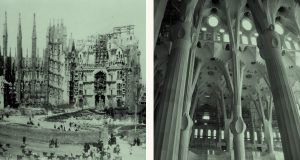
The Sagrada Família under construction around 1915, and its tree-like stone interior.1 / 4
The main spire of Barcelona's Sagrada Família was finished this February, 144 years after construction began, making it the world's tallest church. It is a masterpiece of Catalan 1, Barcelona's version of 2, an ornate style of curves and plant motifs from about 1890 to 1910. In Asterisk, Étienne Fortier-Dubois asks why so little of it was ever built.
The real puzzle
The question connects to what he calls the "trad critique," a traditionalist argument that humanity built beautiful, ornamented buildings until about 1945 and then switched to ugly modern boxes. He calls it naïve, but says it raises a real puzzle: if people prefer ornament, why don't rich societies build it? There are too many possible answers, so he studies one case instead.
Tired of wonder
At Barcelona's Sant Pau hospital (1901–1930), he found that the most lavish pavilion was the administration building. The architect and the patron's executors had pushed to build a showpiece first, against hospital leaders who wanted kitchens and wards. The pavilions built later are plainer because the money ran low. Arguments between beauty and practicality were nothing new. The ornament also wore him out. After half an hour he was used to it, and it became tiring. He liked the orange trees best.
The architects of the time felt the same way. Within about 15 years the style was fading everywhere. Riga's elaborate façades were criticized as too much, Nancy's school held its last exhibition in 1909, and Catalonia turned to 3, a sober classical style named in 1906.
Codified versus bespoke
His central argument is about reproduction. Classicism is a written-down language of standard columns, parts and proportions that ordinary builders can learn from books. A bad classical building is "boring but fine." Art Nouveau depended on genius and handmade ironwork, carving and mosaic, so it could not be copied at scale. It was "architecture meant for jewels."
Modernism, the plain glass-and-grid style, solved that problem. It had a clear doctrine, factory-made standard parts and prestige, so anyone could build a respectable building without a star architect. Its founders also came out of Art Nouveau: Le Corbusier, Gropius and Mies van der Rohe all trained in its orbit. In a sense, he says, industrialized Art Nouveau is the world we live in now.
What he concedes
Mies van der Rohe's 1929 German Pavilion was ignored by fairgoers, so people weren't tired of ornament. Fortier-Dubois still finds it beautiful. He argues modernism is resented because it "won too much," and warns that whatever style comes next shouldn't take over everything.
The main spire of the Sagrada Família, the Barcelona church Antoni Gaudí began designing in the 1880s, was finished this February, 144 years after construction started. That makes it the tallest church in the world. It is also one of the strangest buildings anywhere: its façades are covered in sculpture and its interior is a forest of stone columns. It belongs to Catalan 1, the regional form of 2, an ornate style of roughly 1890 to 1910. In an essay for Asterisk, Étienne Fortier-Dubois asks why so little of it was ever built. Only a small share of Barcelona's buildings are Modernista. The Barcelona Modernisme Route lists 120 of them, and he estimates a few hundred to a few thousand in total, in a city of tens of thousands of buildings.
The puzzle behind the puzzle
The question matters because of what Fortier-Dubois calls the "trad critique," a view common among traditionalist voices on social media. The story goes like this: for centuries people built beautiful, ornamented buildings, ending with Art Nouveau and Art Deco, and then around 1940–1950 everyone switched to plain, ugly modern buildings. He calls this naïve, but he grants that it points to a real puzzle. If most people prefer ornament, and he notes that surveys suggest they often do though the evidence is mixed, why do rich societies mostly build the opposite? He says the hard part is that there are too many candidate answers: labor costs, regulation, elite status games, software, architects' training, NIMBYism and more. So instead of tackling the whole question, he looks at one case: how Modernisme quickly gave way to a plainer Catalan style called 3.
Sant Pau: beauty with a budget
His main exhibit is the Hospital de la Santa Creu i Sant Pau, built from 1901 to 1930 by Lluís Domènech i Montaner and paid for by the will of a banker, Pau Gil. It is a set of pavilions with mosaics, stained glass, floral tiles and neo-Gothic turrets, linked by service tunnels and planted with orange trees. It worked as a hospital until 2009.
Two things took the shine off for him. First, the most lavish pavilion was the administration building, not a ward. According to the hospital's archivists, the hospital's leaders wanted to put up kitchens, a pharmacy and staff quarters first so they could move patients in quickly. Gil's executors and their architect wanted a showpiece first. The executors won, and the pavilions built later are plainer because the money was running out. So the idea that people back then simply valued beauty more than function doesn't hold up. The same arguments happened then too.
Second, the effect wore off. Photos online, some boosted to look more colorful, had raised his expectations. After half an hour he was used to the novelty, and the dense ornament became tiring rather than restful. What he liked best were the orange trees, which fits research showing that natural elements do most for patients' wellbeing. In a footnote he admits the research on whether people tire of buildings over time is thin and mixed. One study found ratings rose and then fell with longer exposure. Another found preferences stable over decades.
A style that tired itself out
The movement was short everywhere. The first true Art Nouveau houses in Brussels date to 1893, and by the mid-1900s the backlash had started. Riga, the Latvian capital, came closest to an Art Nouveau city. Its population roughly doubled between 1897 and 1913, and about 800 buildings in the style make up a third of its centre. But Mikhail Eisenstein's elaborate façades were criticized at the time as too much, and after 1907 Riga's version moved toward geometry and classicism. In Nancy, France, the École de Nancy had industrial backing and a planned housing development, yet only a few of its houses were built in the new style. Its last exhibition was in 1909, and its architects went back to classicism, which was still the way to get ahead in the profession. In Catalonia, the essayist Eugeni d'Ors coined "Noucentisme" in 1906. He set "the eccentric" against "the concentric, the classical," and the plain style he championed dominated Catalan architecture for about 20 years. Rafael Masó's work shows the switch: his 1910 flour mill is fully Modernista, and his 1913 buildings are classical.
The mechanism: codified versus bespoke
Fortier-Dubois's main explanation is about how each style could be reproduced. Classicism is a codified language: five orders of columns, standard parts like arches and pediments, and rules of proportion, written down from Vitruvius through Vignola. Anyone can learn it from a book. He argues this makes it forgiving: "A poorly executed classical building is boring but fine," and ordinary builders can work it into everyday construction without an architect. Art Nouveau relied on genius and handmade parts such as wrought iron, carved stone and 4, mosaics of broken tile or glass. He says it isn't even clear what a badly executed Art Nouveau building would be. Hector Guimard's cast-iron entrances to the Paris Metro are a rare mass-produced exception. In his words, Modernisme was "architecture meant for jewels," while Noucentisme was for the ordinary fabric of a city.
He also offers what he calls a "half-baked" theory: exaggerated subcultures burn out within a few years, as disco did in the 1970s and the flamboyant incroyables did in 1790s Paris. Buildings simply last longer than clothes.
How modernism won
Fortier-Dubois argues modernism succeeded by solving the problem Art Nouveau could not. It had a clear doctrine (form follows function, ornament is dishonest) and standard parts such as 5 (non-load-bearing outer skins) and modular grids. Unlike earlier cheap buildings, which looked poor, it carried prestige. That made it a "ruthlessly efficient meme": you could build any house or factory in the respectable style without hiring an expensive architect. It also descends from Art Nouveau. Le Corbusier began with chalets in a local Art Nouveau style. He, Walter Gropius and Ludwig Mies van der Rohe all worked in the studio of Peter Behrens, a former Art Nouveau architect. The 6 school was formed partly from a school founded by Henry van de Velde, one of Art Nouveau's originators. So we do know what an industrialized Art Nouveau looks like, he concludes: the world of the last hundred years.
What he concedes, and what stays open
He gives the trad critics some ground. Mies van der Rohe's 1929 German Pavilion in Barcelona was largely ignored at that year's World's Fair and torn down the next year, so people in the 1920s were not tired of ornament. Whole modernist cities such as Brasília are rarely loved. But he rejects the claim that the Pavilion is ugly. His diagnosis is that modernism is resented because "it won too much," and that, like Modernisme, it may have suited one-off showpieces best. He doesn't test this, and the essay leaves open how much of modernism's spread came down to codification rather than the many other causes he lists. His warning about ornament made cheap by robots and AI is not to let whatever comes next take over everything.
Remember
A style spreads when ordinary builders can copy it; one that depends on genius stays rare.
Arguments between beauty and usefulness were already happening when Art Nouveau buildings were going up.
Modernism partly grew out of Art Nouveau; its founders trained in or near the earlier style.
Psychology, philosophy and the best-known grief memoirs (Joan Didion's, C S Lewis's) treat grief almost entirely as a response to death. Van Zoonen says this is like restricting pain to cluster headaches: it takes the most extreme instance of something and calls it the thing itself.
His argument rests on a distinction from the philosophy of emotion. An emotion's 1 is what it is about. Fear is about danger. Its 2 is the specific trigger: sharks, heights, public speaking. Defining grief by death confuses the two.
So what is grief about? Loss alone isn't enough. Losing a pen brings annoyance, and missing out on a dream job brings disappointment. Drawing on the philosophers Matthew Ratcliffe and Louise Richardson, he argues that grief begins where your identity is disrupted. What you lose is a set of future possibilities woven into who you are. Death wipes out all of them at once, which is why it is grief's most intense form. Many other losses fit the same pattern: a father whose stroke ended his cycling, an academic identity slipping away, an unofficial love affair that ended suddenly. The clearest case is involuntary childlessness. One woman called it "the death of a future life", with nothing to point to.
Grief without a name
The therapist Pauline Boss calls many of these "3": someone is physically present but psychologically gone, or the reverse. Other people don't recognise the grief that follows. The scholar Kenneth Doka calls this "4". Worse, the person grieving may lack the concepts to understand it. The philosopher Miranda Fricker calls that "5". One respondent in Ratcliffe and Richardson's study said: "I never realised this was grief until I found others in a similar situation."
A long suspicion of attachment
Van Zoonen traces the narrow view to a tradition that distrusted attachment. It runs from Plato's self-sufficient good man and Epictetus comparing a lost child to a broken jug, through Augustine and Spinoza. Psychiatry has inherited it in its own way. Its main diagnostic manual added "6" in 2022, and one listed symptom is feeling that part of yourself has died. The diagnosis applies only after an actual death.
He argues the tradition got it backwards. Grief shows you what you loved, and grief that has a name can be shared with other people.
Derek van Zoonen, a philosopher living in Norway, opens his Aeon essay with a confession: he has been grieving his mother for years, though she is alive. Over time, the caring woman who came to say goodnight was replaced by an angry one, consumed by her own unhappiness. She and his brother were drawn together into the brother's addiction, "a parallel reality, cut off from the world beyond their heads". There was no funeral, no condolence card and no leave from work. "What was I supposed to mourn?"
His answer is that we grieve far more often than we realise, and that death is "grief's most visible occasion rather than its essence". He offers a short definition: grief is "love with nowhere to go".
A list of losses without funerals
Van Zoonen lists his own losses. A stroke left his father unable to walk or cycle, and cycling was what "made his thoughts liquid", in his father's phrase. Old friendships faded, first into mere updates and then into awkward silence. He feels his academic identity loosening after nearly two decades. He calls it a real vocation, but also "a way of living safely at one remove from where actual life takes place". And a woman he met in Norway, "a magical stranger", was part of his life for nine months. Then she left abruptly for another man.
That last loss shows the problem most sharply. They had been dating but were never officially a couple, and it happened alongside a long-term open partnership. Most people around him had no way to read it. It was "just a breakup", or barely that. He had "no scripts, no rituals, no recognised form, no legitimacy, no shared language".
Why the narrow view persists
Psychology, philosophy and Western culture treat grief almost entirely as a response to death. The famous memoirs, Joan Didion's The Year of Magical Thinking and C S Lewis's A Grief Observed, are about losing a spouse. Michael Cholbi's Grief: A Philosophical Guide (2021) also focuses mainly on bereavement. Van Zoonen gives two reasons. First, death is legible: it has "a body, a date, a medical certificate", and a social infrastructure of funerals, flowers and casseroles. Perhaps that infrastructure ends up defining what counts as grief. Second, bereavement is simply the most striking case of something that comes in degrees. Treating it as the whole thing, he says, is "like restricting pain to cluster headaches, anxiety to panic attacks".
The mechanism: formal versus 1
His central argument uses a distinction from the philosophy of emotion. Every emotion has a 2, the kind of thing it registers: fear is about danger, anger about injustice. It also has material objects, the particular triggers. Fear of sharks, fear of heights and fear of public speaking are one emotion, not three, because each registers a threat. Defining grief as "about death" mistakes one trigger for what the emotion means.
So what is grief's formal object? He narrows it step by step:
Loss alone is not enough. Losing a pen or an old sweater produces, at most, "a slight ripple of annoyance".
Losing something you love is not enough either. Losing a favourite book or missing out on a dream job brings frustration, disappointment or sadness, but not grief.
What sets grief apart is depth. "Grief begins where your identity is disrupted." What you lose is a cluster of future possibilities woven into your identity, the structure of your life or the world you experience. You lose "a version of yourself".
Here he follows Matthew Ratcliffe and Louise Richardson, philosophers at the University of York. In a 2023 paper on grief over non-death losses, they describe grief as recognising what lost possibilities mean for the structure of one's life, and slowly reorganising that life to fit. The reorganisation shows up in the body: the hand that still reaches for the phone. It shows up in places: the shared café that now feels hostile. It shows up in memory: the private joke nobody else gets.
Death is the extreme case because it wipes out every possibility at once, the dead person's and yours with them. But the same structure fits his other losses. His father survived. What is gone is the future with the man who cycled, including the trips planned in the south of France. Ratcliffe and Richardson's main example has no concrete object at all: involuntary childlessness. "In their minds, no baby meant no loss," one respondent said. Another described "the death of a future life".
Ambiguity, silence and harm
The family therapist Pauline Boss calls many of these "3": losses without clear edges, where someone is physically present but psychologically gone (Alzheimer's) or physically gone but psychologically present (a soldier missing in action). Grief over such losses tends to be what the scholar Kenneth Doka called "4": not acknowledged, validated or publicly mourned. Van Zoonen adds a third idea, from the philosopher Miranda Fricker. "Hermeneutical injustice" means being unable to make your own experience understandable to yourself or to others, because the shared concepts don't exist yet. Respondents said: "It took me a while to understand that what I was feeling was grief."
He says the cost is real. Sorrow nobody attends to goes underground. In his own case it showed up as a tight chest, a "hard belly, like wearing a harness", harrowing dreams, attempts to numb the pain, and a slow erosion of trust, including trust in his own feelings. Freud's "Mourning and Melancholia" (1917) saw this too. He treated grief that could not complete its work as the illness "5". Van Zoonen goes further: grief is how we learn what we loved. To deny someone the right to grieve is to deny them self-knowledge.
A tradition suspicious of love
He finds the roots of the problem in Western philosophy's distrust of attachment. Plato held that the good man is least shaken by loss. In the Phaedo, Socrates scolds his weeping friends. Epictetus compares losing a wife or child to a jug breaking. Augustine diagnoses his grief for a friend as "pouring out my soul onto the sand". Spinoza treats sadness as a loss of the mind's power, cured by understanding that nothing could have been kept. Even Schopenhauer valued suffering only because it breaks the will to want the world at all.
The culture followed, as did medicine. The anthropologist Geoffrey Gorer found in 1965 that Britons increasingly saw mourning as self-indulgence. In 2000, the philosopher Stephen Wilkinson argued that even normal grief meets the definition of a mental disorder. The 2022 revision of the 6 (DSM), psychiatry's standard reference, added "7". One possible symptom is feeling that part of oneself has died, but the diagnosis applies only after an actual death.
Open questions
Van Zoonen argues that the tradition "had it backwards". Grief that has a name can be held between people and shared. The essay is a personal argument, not a programme. It doesn't say what new rituals or language should look like, or where ordinary disappointment ends and identity-level loss begins. He ends at the Kröller-Müller Museum, standing silently with his father in front of Van Gogh's At Eternity's Gate. Something opened between them that had no name. "The painting said what neither of us could."
Remember
Defining grief by death confuses one trigger with what the emotion is about: a lost future your identity was built on.
Grief that goes unnamed doesn't disappear. Van Zoonen says it can resurface as physical tension, numbing and eroding trust.
Western thought from Plato to Spinoza treated attachment as a mistake, so it had little to say to people who grieve.
Dürer's engraved design for the monument's base, from his 1525 Treatise on Measurement.1 / 2
In 1525 Albrecht Dürer, Germany's most famous artist, published a design for a monument to rebels who had just been slaughtered. Five hundred years on, nobody agrees on what it means.
The uprising
The 1 of 1524–25 was the largest popular revolt in continental Europe until the French Revolution. It started in today's southwest Germany and Alsace. By spring 1525 it had spread past Salzburg and nearly to Leipzig. For decades, local nobles had raised taxes and cut off access to common pastures and woodland. The Protestant Reformation gave the peasants fresh energy, and radical preachers like 2 pushed them on. Müntzer believed that religious upheaval and social upheaval belonged together.
The peasants won some early fights, plundering Kempten abbey and taking Weinsberg castle. Then Catholic and Lutheran nobles joined forces. In May 1525 they defeated the rebels at Frankenhausen and captured Müntzer, who was later burned. At Böblingen they massacred several thousand retreating peasants. By summer the princes were back in charge, often on harsher terms than before.
The design
That same year Dürer printed his "Monument to the Vanquished Peasants" in his 3 (Treatise on Measurement). It was a worked example of how to proportion a monument. Read from the bottom up, it is a chest, an upside-down kettle, a cheese bowl covered by a plate, a butter keg, a bundle of farm tools, a chicken basket and a lard tub. On top crouches a peasant, dead or asleep, with a sword sticking out of his back. A careful written description gives every dimension. No one meant it to be built.
What does it mean?
On the surface it is a victory column. Dürer supported Luther, and his text talks about monuments for those who "prevailed over the mutinous peasant." But the slumped figure on top looks more pitiful than defeated. The book's publisher, Hieronymus Andreae, was jailed during the war for his views. The art historian Elizabeth Petcu points out that a treatise on weights and loads keeps asking the question behind the revolt: who should carry how much? Stephen Greenblatt argues that the design undermines the whole idea of a monument. Monuments honour victors and are clear about it. This one honours the losers and stays ambiguous.
It could be a rebuke, a parody of the peasants' idea of the good life, or a coded tribute. The war's reputation has shifted in a similar way. It was a bloody failure, yet 4 later recast it as a forerunner of the revolutions of his own century.
Built at last
For the 500th anniversary, the monument was finally built in Mühlhausen, the town where Müntzer preached. A few years earlier, the artist Andreas Siekmann had made 5 in Bonn. In his version the column lies toppled and broken into pieces. Only the peasant stays upright, hanging from a cargo drone that cannot lift him.
The Public Domain Review has revisited one of the strangest images of the Northern Renaissance. In 1525 Albrecht Dürer, Germany's most celebrated printmaker and painter, published a design for a "Monument to the Vanquished Peasants." He made it within months of the rebels being massacred. It was never built in his lifetime, and it has never been fully explained. The essay's argument is that the uncertainty is the point. A form whose usual job is to declare who won here refuses to say what it is honouring.
The largest revolt before 1789
The 1 was the biggest popular uprising on the European continent until the French Revolution, more than 250 years later. It broke out in 1524 in what is now southwestern Germany and in Alsace, now part of France. By spring 1525 it had spread across the 2, the loose federation of principalities, bishoprics and free cities that covered German-speaking Europe. It reached east beyond Salzburg and northeast almost to Leipzig.
The grievances had been building for decades. Local nobles kept raising taxes and cutting off peasants' access to common pastures and woodland. These were the shared lands where villagers grazed animals and gathered firewood. The Protestant Reformation added fuel. If ordinary Christians could read scripture and challenge the Church, why not their lords as well? Radical preachers such as 3 argued that religious change and social change belonged together.
The peasant bands won some early victories. They plundered the abbey at Kempten and captured the castle at Weinsberg. The reprisals came quickly. Crushing the revolt brought Catholic and Lutheran nobles together, despite the fact that they were otherwise fighting over religion. In May 1525 they defeated the peasants at Frankenhausen and captured Müntzer, who was later burned at the stake. At Böblingen they massacred several thousand retreating peasants. By summer the territorial princes had their power back, often on harsher terms than before. The essay sums up the war as a tangle of economic, social and religious motives that produced unexpected alliances and opened an age of autocratic rule.
A tower of household goods
Dürer's monument is as tangled as the war. He set it out from the ground up:
a chest
a kettle turned upside down
a cheese bowl covered by a plate
a butter keg
a bundle of peasant tools
a chicken basket
a lard tub
At the top, as the 4, crouches a peasant, slain or perhaps asleep, with the hilt of a sword sticking out of his back.
The design was never meant to stand in a town square. It appears in Dürer's 5 (Treatise on Measurement), a manual of applied geometry for artists and craftsmen. There it serves as a lesson in how to proportion a monument. The engraving comes with a precise written account of each part's dimensions. The next example in the book is just as odd: a monument for a drunkard, with a beer barrel on his grave and an epitaph that, in Dürer's words, "praises sensual pleasure mockingly."
The essay says that by arranging ordinary objects so carefully, Dürer seems to turn them into symbols. The hard part is deciding what they stand for.
Three readings
The loyalist reading. The art historian Erwin Panofsky argued that Dürer was a committed supporter of Martin Luther. Luther had turned against the rebels and urged the princes to crush them. Dürer's own text supports this reading. It describes monuments put up by those who have "prevailed over the mutinous peasant."
The subversive reading. Several details push the other way. The peasant on top does not look like a beaten enemy. The essay describes him as giving off a "resigned pathos" that undercuts any triumph. The book's publisher, Hieronymus Andreae, was jailed for his views during the war. The art historian Elizabeth Petcu notes that a treatise about measurement and load-bearing ends up asking the same questions that started the revolt: "Who or what bears the literal or metaphorical weight of labor commitments, taxation, or even physical weights, and how much should these agents carry?" In a column whose stacked goods all rest on peasant labour, that question is built into the structure.
The anti-monument reading. The literary scholar Stephen Greenblatt argues that the work undermines the conventions of its own genre. Monuments are normally built for victors, and they are unambiguous about what they celebrate. This one is dedicated to the losers, and its meaning is hidden on purpose. It was never placed in a real city, with a real patron and a dedication ceremony to fix its message. So, in the essay's phrase, it keeps "all the interpretive ambivalence of a dream image."
The essay does not choose between these readings. It sets out the options: a rebuke of the peasants' demands, a parody of their idea of the good life as food and farm tools, or a heartfelt tribute to the insurgents. Whichever it is, the monument "speaks at a loud volume, even if it is difficult to discern the meaning of its words."
A failure that kept being reinterpreted
The essay draws a parallel with the war's own afterlife. For those who fought, it was a complete failure. Thousands died, and the peasants won none of the concessions they wanted. In the nineteenth century 6 recast it as an early chapter in the revolutionary history of his own time. Müntzer, once an executed heretic, now ranks among Germany's major early modern reformers and political leaders. The recent 500th anniversary produced a widely reviewed and admiring biography of him by Andrew Drummond.
The anniversary also got Dürer's monument built at last, in Mühlhausen, the Thuringian town where Müntzer preached. Some years before that, the artist Andreas Siekmann had installed 7 in Bonn. Siekmann's version adds a reading of its own. The column has fallen over and broken into its separate parts. Only the resigned peasant stays upright, held up by a cargo drone that is trying, and failing, to lift him away.
What the essay leaves open
The piece is brief. It does not quote much of Dürer's own text, does not say how the Mühlhausen version was built or received, and does not weigh the scholarly readings against each other. It also does not settle the basic historical question of whether Dürer meant any irony, or whether later viewers are finding sympathy that a cautious Lutheran in Nuremberg never intended. The essay suggests the design survives because it can be read in all of these ways.
Remember
Dürer printed the monument as a lesson in proportion, which gave it cover to say things a real commission couldn't.
A treatise about how much weight things can bear quietly echoes the revolt's question of who carries the tax burden.
The war failed outright, yet later thinkers turned it into a precursor of modern revolutions.
Customers queue at a 551 Horai counter, the chain behind the Shinkansen's most contested snack.1 / 3
On Japan's 1 bullet trains, a fight that people online call "pork bun terrorism" keeps coming back. A passenger buys a hot pork bun at Shin-Osaka station, often from 2, a beloved Osaka chain, and opens it once the doors have shut. Doors stay shut for two to five hours between Osaka and Tokyo. The smell of dough, onion and pork fat spreads across the nearby rows, a neighbour objects, and sometimes it turns into a row.
The argument went viral in 2018 and has kept resurfacing. Rail operators have refused to ban smelly food and leave it to passengers' discretion. In 2026 an entrepreneur posted that a stranger had scolded him for eating a bun. Eating is allowed on board, he said, and the station sells the buns hot. To him the complaint was a stranger imposing a personal standard.
Same air, different smells
Writing in 3, neurologist Yusuke Fujioka (who openly hates the smell) argues that the two sides aren't really arguing about manners. Each treats its own experience as obvious, so each sees the other as rude. The root error, he says, is that we "mistake shared space for shared perception."
Etiquette depends on that assumption. We act considerately by imagining how others feel. Courtesy can also bridge differences we can see: you don't need to be pregnant to give up your seat to someone who is. It fails when a difference is invisible and nobody knows it exists.
Genes can create exactly that kind of hidden difference. Some people find coriander soapy, and that has been linked to a variant near 4, a smell-receptor gene. Pork fat can contain 5, a steroid with an animal-like odour. How people perceive it is strongly associated with a receptor gene called 6. People who inherit the "sensitive" version from both parents can detect tiny traces and find them unpleasant. A 2012 study by Kathrine Lunde's team at the Norwegian Meat Research Centre found that carriers of other variants find it less intense and less unpleasant.
Fujioka offers this as a model, not proof. He doesn't claim androstenone alone explains the smell of the buns.
Who decides what's reasonable
He sees the same pattern in 7, where ordinary sounds like chewing cause intense distress, and in office thermostat fights. The less-affected person usually decides what a reasonable reaction is, and the more-affected one gets called oversensitive. Because the burden isn't equal, he argues, rigid rules or demands for equal concessions won't settle it.
His remedy is to make these hidden differences known. Bun-eaters might then hold back voluntarily, and objectors might see that holding back as a favour rather than a duty, so "demands can then become requests." He admits some people won't change, and he doesn't say what better rules or carriage design would look like.
On the 1, Japan's high-speed rail network, a small fight keeps flaring up. About half a million passengers a day ride between Osaka and Tokyo. Once the doors of an express train close, nobody can get off until their stop, which may be two hours away or five. Into that sealed space, some passengers bring a steaming pork bun bought at Shin-Osaka station, often from 2, a much-loved Osaka chain. When the box opens, the smell of steamed dough, onion and hot pork fat drifts across the nearby rows. Sometimes a neighbour objects, and sometimes the exchange turns into a shouting match. Japanese social media calls this "pork bun terrorism."
The argument first spread widely online in 2018 and has come back regularly since. The railway companies have been asked to rule on it. They have not banned strong-smelling food and leave it to passengers' judgement. In 2026 it erupted again after an entrepreneur posted that a stranger had told him off for eating a 551 Horai bun. He saw the complaint as a stranger pushing a personal standard on him. Eating was allowed on board, he said, and the station sold the buns hot.
In a 3 essay, Yusuke Fujioka, a neurologist who studies the brain and sensory perception, asks why this dispute resists Japan's otherwise exacting public etiquette. His answer is that the two sides are not really disagreeing about manners. They may be experiencing different realities.
Shared space is not shared perception
Fujioka admits his own bias up front. The smell gives him "intense, visceral discomfort," and he has long been baffled that anyone would release it where others can't escape. Defenders of the buns are just as baffled. They are enjoying a local delicacy and meet what looks to them like hypersensitive anger. Each camp treats its own experience as obvious, so each reads the other as rude.
His diagnosis is a single misconception: because we sit in the same space and breathe the same air, we assume the person beside us perceives it as we do. In his words, we "mistake shared space for shared perception."
This matters because etiquette leans on that assumption. Fujioka defines manners as changing your behaviour voluntarily out of consideration for others. You can only do that if you can imagine what they feel. We queue because we assume others would mind queue-jumping, and we don't litter because we assume others dislike litter. Courtesy can also bridge differences we can see. You don't need to be pregnant or elderly to give up your seat, because the other person's difficulty is visible and easy to picture. The real trouble comes when a difference is invisible: the experience looks shared but has "unknowingly fractured beneath the surface." Ordinary manners cannot fix a gap that neither party knows exists.
The genetic mechanism
Coriander is the familiar example. Some people find it bright and herbal, while others smell soap or stink bugs. That split has been linked to a variant near 4, a gene involved in detecting smells, and the variant may change both how strong the herb smells and what it smells like.
Fujioka suggests pork works in a similar way. Pork fat can contain 5, a volatile steroid often described as smelling animal-like. How people perceive androstenone is strongly associated with variation in another receptor gene, 6. Everyone inherits two copies, one from each parent. People with the more "sensitive" version in both copies have a much lower detection threshold, so even a trace can register as unpleasant. Research from 2012 by Kathrine Lunde of the Norwegian Meat Research Centre and colleagues found that people with other variants tend to perceive androstenone as less intense and less unpleasant. Fujioka adds that as primates evolved to rely more on vision, many smell genes picked up mutations and stopped working, which leaves plenty of room for people to differ.
To picture it (an illustration, not data from the essay), seat two passengers side by side in front of one open box of buns. One has two sensitive copies of OR7D4, and to them the faint androstenone smells strong and barnyard-like, triggering involuntary disgust. The other has a different combination and smells only warm dough and savoury pork. Neither is exaggerating. Their brains, in Fujioka's phrase, are "constructing qualitatively different perceptual experiences from the same source." Neither knows their own genotype, let alone the other's.
Fujioka is careful about how far he takes this. He does not claim androstenone alone explains the smell of pork buns. He offers the OR7D4 link as a "useful conceptual model" of how the dispute is structured, not as proof of its cause. The essay cites no study of 551 Horai buns or of Shinkansen passengers.
The asymmetry problem
He sees the same pattern elsewhere. People with 7, a disorder in which certain sounds provoke disproportionate emotional reactions, can be intensely distressed by someone chewing or breathing. Office thermostat fights drag on because we assume one temperature feels the same to every body. In each case, he argues, the less-affected person usually decides what counts as a reasonable reaction. If something seems tolerable to them, they assume it should be tolerable to everyone, and the more-affected person gets labelled as overreacting.
That is why he thinks neither rigid rules nor demands for equal concessions will settle such conflicts: the burden isn't shared equally to begin with.
What he proposes
Fujioka's remedy is explanation more than regulation. Scientists, he argues, have a duty to make hidden asymmetries visible. Knowing the science "does not automatically make people kinder, but it can show us where empathy is needed." If bun-eaters understood the distress they might cause, more might hold off voluntarily. If objectors understood that their odour-free journey depends partly on other people giving up a small pleasure, they might feel grateful instead of entitled. "Demands can then become requests," he writes.
He concedes that some people will put their own pleasure first even when they understand. And the essay leaves the practical side open. It mentions "designing appropriate rules and environments" without saying what those would be, such as food-free cars or packaging that holds in the smell. It also doesn't address how much of the reaction is learned through culture rather than genetic. What it offers is a pause: before the first bite or the first rebuke, recognise that the same bun may be taking two noses "on very different journeys."
Remember
Etiquette assumes others perceive things roughly as we do; invisible biological differences quietly break that assumption.
Two copies of a 'sensitive' OR7D4 variant sharply lower a person's threshold for smelling androstenone in pork fat.
In sensory disputes, the less-affected person usually sets the standard of what counts as 'reasonable'.
The report Gioia cites on Universal Music discussing a take-private deal with private equity firms.1 / 4
The news
Universal Music Group, the world's largest record label, has been talking to 1 firms about going private. These firms would buy out its public shareholders, usually with borrowed money. According to Bloomberg, Universal's shares have fallen about 29% this year and are below the price at which it listed in 2021. Ted Gioia, a music historian who writes the newsletter 2, recalls a CFO who got calls from 15 private equity firms within three days of a disastrous quarter. These firms, he says, are drawn by "blood in the water."
Streaming is struggling too
Most people would blame streaming for hurting the labels. Gioia's point is that the streaming companies are also in trouble. Spotify's stock has fallen almost 30% in 16 months even as it keeps raising prices, and Wall Street now treats music streaming as a mature business with its best growth behind it. Across corporate streaming, Netflix just cut a thousand jobs. Disney has folded Hulu into Disney Plus, and Skydance may merge HBO Max with Paramount Plus. Apple was reportedly losing about a billion dollars a year on streaming. Advertising was supposed to replace lost subscribers, but Spotify's ad revenue missed forecasts, and Netflix is struggling to sell ads as well.
Gioia's word for this is corporate. Open platforms, where anyone can upload and reach an audience, are doing well: YouTube, 3, TikTok. On Netflix's latest earnings call, analysts pushed management toward "4." Independent musicians and live music are doing well too, with almost no help from the major labels.
What he says the labels got wrong
The caveats
Gioia points out that he warned of a collapse in June 2025, just as Universal's shares peaked. Still, this is an opinion essay without revenue figures, and the layoffs and mergers he lists could also be read as an industry consolidating, not collapsing. He says Universal could still recover, but only with sweeping changes he doesn't expect to see.
Private equity at the door
Ted Gioia, a music historian who writes the newsletter 1, opens with an old memory. He was once advising a large global company whose quarterly results had just collapsed. Its chief financial officer told him that 15 2 firms called within three days. All of them wanted to take the company private. Private equity firms buy out a company's public shareholders, often with borrowed money. As Gioia puts it, they are drawn by "blood in the water."
He was reminded of that conversation by a Bloomberg report. Universal Music Group, the world's largest record label, has been talking to private equity firms about going private. Bloomberg reports that its shares have fallen about 29% this year. They are now below the price at which Universal listed in 2021, after it was spun out of the French media group Vivendi. Gioia's question is whether this is just one company's bad year or a sign that something bigger is breaking.
Streaming is struggling too
The obvious answer would be that streaming has squeezed the labels. Gioia agrees, but adds that the streaming companies are in trouble as well. Spotify's share price has fallen almost 30% in 16 months, even though it keeps raising subscription prices. He says Wall Street now treats music streaming as a "mature" business whose fastest growth is over.
He then widens the frame to all corporate streaming, whether video, podcasts or music:
Netflix cut a thousand jobs last week.
Skydance might merge HBO Max and Paramount Plus into one service, to cut costs and gain scale.
Disney has already merged Hulu into Disney Plus. Hulu may disappear, and a Wells Fargo analyst has suggested Disney leave streaming altogether.
Apple does not report figures for its video or music streaming services. Gioia cites claims from two insiders last year that Apple was losing about a billion dollars a year on streaming.
Subscribers are cancelling, Gioia writes. The services say advertising will make up the difference, but he calls the results so far "dismal." Spotify's ad revenue missed Wall Street's expectations last quarter. The media writer Simon Owens suggests advertisers simply prefer video to audio. Gioia points out that this doesn't explain why Netflix, a video service, is also struggling to sell ads. His conclusion: "corporate entertainment is collapsing across the board."
The key word is "corporate"
The center of his argument is a contrast. Open platforms, where anyone can upload and reach an audience, are doing well. YouTube is the main example, along with 3, TikTok and Substack. In 2022 Gioia predicted that Netflix would eventually lose ground to a more open platform. He notes that on Netflix's latest earnings call, analysts pushed management to enter the "4 business," which he calls Wall Street's "quaint name" for freelance creative work.
He says music follows the same pattern. Independent musicians are doing strong work, almost all of it on open platforms. Live music is recovering. The major labels play almost no part in either.
Gioia's six charges against the labels
He sets out what he thinks went wrong:
The result, he says, is "coldness, sterility, and stagnation." He asks whether the people running these companies actually love music.
How much the evidence supports
Gioia stresses that he has made this argument for five years, and that he warned of a collapse in June 2025, days after Universal's share price hit its all-time high. That is a fair point in his favor, but a falling share price is not proof of every cause he names. The piece is an opinion essay, not an analysis. It gives no figures on label revenue or catalog returns, nothing on independent artists' earnings, and no numbers on live music. Several of the streaming problems he lists, such as layoffs, mergers and cost cutting, could equally reflect an industry consolidating after years of overspending, not a collapse.
The co-op idea also leaves a lot unanswered. He doesn't explain how labels would win listeners away from Spotify, or why earlier attempts by artists to own a streaming service would go differently this time. Tidal, which artists bought in 2015, is a well-known example.
Gioia does allow that Universal could still recover. In his view that would require "sweeping changes to their strategy and mindset," which he doesn't expect. Until then, he says, the label should expect more calls from private equity.
Remember
Gioia argues that open platforms like YouTube are doing well while corporate streaming services, both music and video, stall.
Old song catalogs lose value: apart from Christmas songs, little earns much after about 75 years.
Gioia's alternative was a streaming co-op owned by labels and artists. He says it never happened because of laziness or lack of vision.
They stopped developing new artists. As a result, young musicians learned to reach fans directly.
They overpaid for old songs. Gioia calls these "depleting assets." Apart from Christmas songs, he says, almost nothing earns much after about 75 years, roughly the lifespan of a fan.
They made deals with Spotify, which in his view benefits from 5. Playlists where listeners don't know who they are hearing give Spotify bargaining power but weaken the bond between fans and named artists.
They didn't partner with their artists to build a co-op streaming service of their own.
They have no clear position on AI, and they make almost nothing from it.
Lawyers and accountants run them. He argues this has turned the labels into "6," businesses that manage copyrights rather than make music.
They stopped developing new artists. So young musicians learned to reach fans directly on YouTube, Bandcamp and similar sites.
They bet on old songs. Labels paid large sums for twentieth-century music rights. Gioia calls these "depleting assets." The rule of thumb he offers: apart from Christmas songs, almost no commercial song earns much after about 75 years, roughly the lifespan of a typical fan. Most songs peak long before that. The audience fades well before the copyright ends.
They made bad deals with their "natural enemies." He argues Spotify benefits from 5, such as mood playlists and background streams where listeners often don't know who they are hearing. In the short run this gives the streaming service bargaining power. In the long run it wears away the thing music sales depend on: fans attached to named artists.
They betrayed their "natural allies." In Gioia's view, labels should have joined with their star artists to build their own streaming service, run as a co-op that shared profits with artists. He blames "sheer laziness or lack of vision" for why that never happened. Labels and artists alike now live in a world where tech executives "call all the shots."
They have no coherent position on AI. Some days labels warn about AI "slop," meaning low-quality machine-made music, and other days they praise AI's commercial opportunities. As far as Gioia can tell, they make almost nothing from AI businesses.
Lawyers and accountants run things. Their decisions favor short-term convenience. The majors, he writes, have become "6" (businesses that manage a portfolio of copyrights) rather than creative businesses.