Broomsticks, Vanishing Crystals and Happy Dilettantes · Morning Gist
Saturday, October 315 stories · 16 min
Broomsticks, Vanishing Crystals and Happy Dilettantes
For Halloween: the real story behind the witch's broom, a drug crystal that vanished, and essays on commitment, culture and compassion.
Picked from 20 new articles across 14 sources · arrow keys for other days
Today in 30 seconds
30s left
Philosopher Jay Miller draws on Goethe, Schiller, Kierkegaard and Nietzsche to argue that leaving a passion behind isn't a failure of commitment. story 1 ↓
Nathan Gardels argues that power shifts in years, ideology in decades and culture over generations, and that culture decides which systems last. story 2 ↓
In 1998 ritonavir's crystal form vanished and couldn't be made again. Patients lost the drug for about a year; Abbott spent roughly $250 million. story 3 ↓
Michael Pollan traces the witch's broomstick to a tool for applying mind-altering plants, from a time when gardens were grown for psychoactive plants, not pretty ones. story 4 ↓
ER nurse Anita Lambert describes how years of treating repeat patients, from 1990s Chicago through COVID's Delta wave, changed her belief in self-reliance. story 5 ↓
Also worth reading: a quantum information scientist bets a graviton will be found before dark matter, and explains why AI can't do creative physics.
1/5Aeon· Jay Miller· Oct 30
A philosopher argues that the dilettante shows another way to live well
In an Aeon essay, Jay Miller argues that the dilettante, who goes deep into many pursuits for the pleasure of it and settles in none, lives a life of abundance, not lack.
Why it matters · "Find your passion and stick with it" is advice almost everyone gets. Miller offers a reasoned case against it, and it's worth testing against your own habits of curiosity.
Know this first
Context from the editor, not the article · 30 sec
1 · Where the word comes from
'Dilettante' comes from the Italian dilettare, 'to delight'. In the Baroque era it meant someone who took up an art for pleasure rather than a living. The sneering sense of 'superficial amateur' that dictionaries give today came much later.
2 · Weimar classicism
Around 1800, Goethe and Schiller led a German literary movement in Weimar. It held art to timeless 'objective' rules taken from ancient Greece and Rome, and in that view the true artist stood far above everyone else.
3 · Kierkegaard's either/or
In Either/Or (1843), Søren Kierkegaard contrasts two ways of living. The aesthetic life chases pleasure and fights boredom. The ethical life is built on lasting commitment. He treats the aesthetic life as a stage to grow out of.
2/5Noema· Nathan Gardels· Oct 30
Why culture, not institutions, may decide which political systems endure
Nathan Gardels, Noema's editor, builds on a reader's reply to argue that China's long-term planning works because its institutions, ideology and deep culture point the same way. Western democracies, by this account, lack that alignment.
Why it matters · The essay gives a usable way to read today's political upheavals: ask whether a system's institutions fit the culture underneath them, not only who holds power.
Know this first
Context from the editor, not the article · 24 sec
1 · Base and superstructure
Marx argued that a society's economic "base" (who owns and produces what) determines its "superstructure" of law, politics and ideas. This essay deliberately flips that, putting culture at the bottom.
2 · China's imperial exams
For about 1,300 years, until 1905, Chinese officials were chosen through competitive exams on Confucian classics. The system tied status to learning and taught deference to a credentialed bureaucracy.
3 · The one-child policy
From 1980 to 2015 China limited most urban couples to one child. It slowed population growth but left a shrinking workforce supporting a fast-ageing population, which is now a major economic strain.
3/5Nautilus· Jake Currie· Oct 30
Why some drug crystal forms disappear and can't be made again
Sometimes a drug's crystal form suddenly can't be made anywhere, because a more stable form takes over. Chemists suspect stray seed crystals spread the new form. A 2024 study brought one lost form back.
Why it matters · It's a real case where how a molecule packs into a solid, not what it's made of, decides whether a medicine works, and the reason the change spreads is still unexplained.
Know this first
Context from the editor, not the article · 27 sec
1 · Same molecule, different crystal
Many solids can crystallize in more than one arrangement, called polymorphs. Carbon as graphite or diamond is the familiar case. For drugs, packing changes solubility, which controls how much of the dose the body absorbs.
2 · Stable versus fast
A crystal form can win because it forms faster, even when another form is more stable. Given time, matter tends to settle into the lowest-energy arrangement, but which form appears first depends on speed.
3 · How crystals start
Crystals grow from a tiny starting cluster, a step called nucleation. An existing crystal, or 'seed', can act as a template that the surrounding molecules copy, which is why chemists add seed crystals on purpose.
4/5The Marginalian (Maria Popova)· Maria Popova· Oct 30
Michael Pollan traces the witch's broomstick back to a drug-delivery tool
Maria Popova revisits Michael Pollan's 2001 argument that gardens were long grown for plants that alter the mind. In his telling, the flying witch's broomstick began as the tool for applying a hallucinogenic ointment.
Why it matters · It changes how you see a familiar symbol and a familiar place. The tidy, decorative garden is a recent invention, and it hides a long history of plants grown for power.
Know this first
Context from the editor, not the article · 25 sec
1 · Who Pollan and Popova are
Michael Pollan is an American writer on food, plants and drugs. Maria Popova writes The Marginalian, a long-running essay site that mostly reads and comments on older books, letters and poems.
2 · The Botany of Desire
Pollan's 2001 book argues that plants have used human desire to spread. It tells four plant histories: the apple, the tulip, cannabis and the potato. The witch passage comes from the cannabis chapter.
3 · The European witch trials
From roughly the 1400s to the 1700s, tens of thousands of people in Europe, most of them women, were tried as witches. Folk healers who worked with herbs were common targets.
5/5Psyche· Anita Lambert· Oct 30
An ER nurse on how her "regulars" undid her belief in self-reliance
Anita Lambert, a former emergency nurse, describes how the drunk, homeless and mentally ill patients who kept coming back taught her compassion, and how understaffing and COVID patients who denied the virus finally drove her to quit.
Why it matters · It is a first-hand account of how one person's moral outlook changed, and of how a hospital system can wear down the compassion it depends on.
Know this first
Context from the editor, not the article · 28 sec
1 · ER regulars
Most emergency rooms have a small group of 'frequent users', often people with addiction, mental illness or no home. They come back again and again because US emergency departments must assess everyone, whether or not they can pay.
2 · Burnout in nursing
Burnout means emotional exhaustion, cynicism and a sense of failing at the job. US nurses have long linked it to heavy patient loads and paperwork. The COVID-19 pandemic made it sharply worse from 2020 on.
3 · The 'heroes' moment
In spring 2020, people in Italy and elsewhere cheered healthcare workers from their windows. Hospitals put up 'Heroes Work Here' signs. Meanwhile many staff were reusing masks and other protective equipment because supplies had run short.
A German literary movement around 1800, led by Goethe and Schiller, that judged art by rules taken from ancient Greece and Rome.
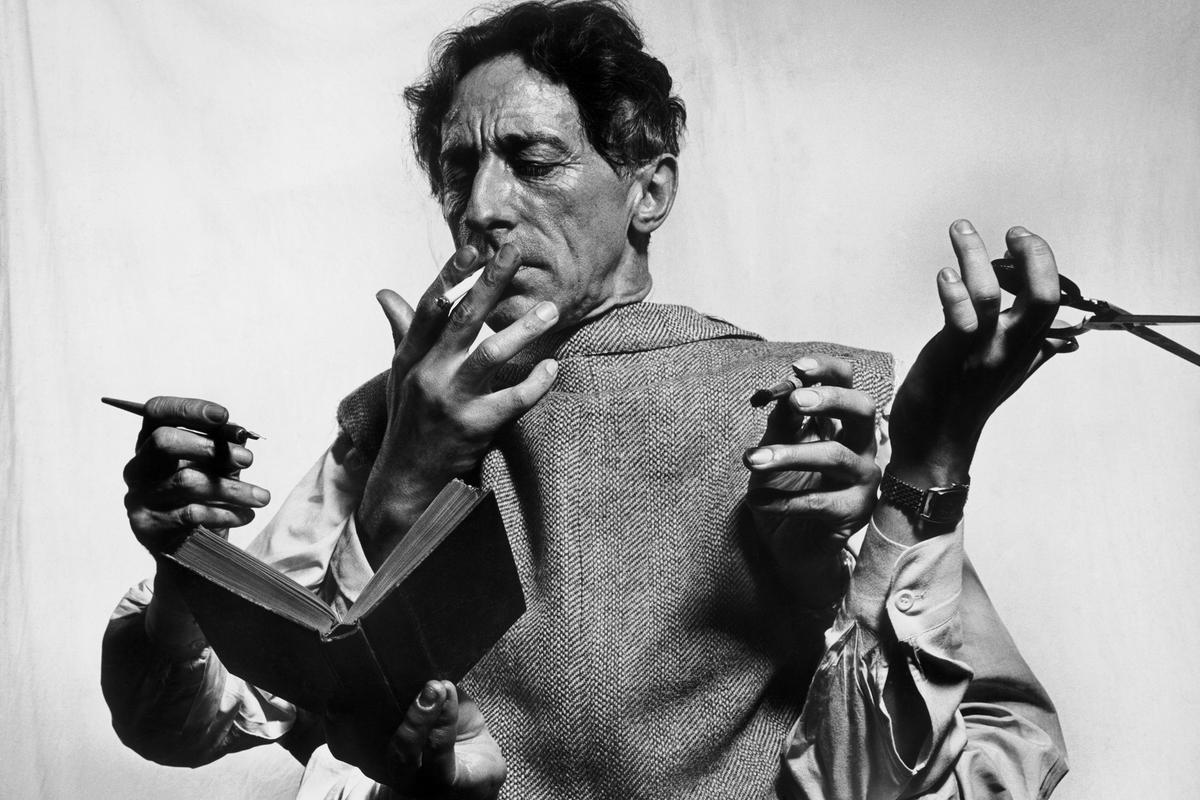
A many-armed man smokes, writes, reads and cuts all at once, a fitting picture of the dilettante's many pursuits.1 / 3
The dictionaries agree that a dilettante is someone with a superficial interest in an art or a field of knowledge. In an Aeon essay, the philosopher Jay Miller argues that this gets the figure backwards. The dilettante's constant movement from one pursuit to the next, he writes, is "a different and defensible way of being", and an over-specialised world needs more of it.
What he is pushing against
His target is the steady advice to find your passion and stick with it, which comes from graduation speeches, self-help books and corporate pep talks. In that story the specialist is the hero and the dilettante is a warning. Miller calls this the "1": seeing amateurism as a lack of skill, focus or seriousness. He wants readers to see it as abundance instead.
He defines the figure tightly. The dilettante is an amateur at many things, usually artistic ones. Unlike a dabbler, the dilettante can go deep. Unlike Baudelaire's 2, the city stroller who samples without committing, the dilettante takes part. What sets the dilettante apart is that no single interest becomes their identity. The word itself comes from the Italian for "delight" and was mostly neutral until critics like Theodor Adorno turned it into an insult.
Goethe and Schiller's ledger
Miller draws on "On Dilettantism" (1799), an unfinished fragment by Goethe and Schiller that weighs the dilettante's benefits against the harm. He accepts one charge: dilettantes can "jump over the steps" and claim mastery they haven't earned. Nobody wants a dilettante architect. But he argues that their contempt rested on a classicist belief in objective rules of beauty. Without that belief, the dilettante isn't a failed artist. They simply approach the practice differently, for pleasure rather than achievement.
Freedom, in two senses
Miller's central claim is that dilettantism is freedom. It is freedom from the constraints professionals live under, and from the walls between fields. It is also freedom to act on the human urge to explore and make. Dilettantes widen a practice's reach. His example is a "no drop" cycling group in Asheville, North Carolina, where riders wait for the slowest. As he puts it, "If biking is your thing, surely you want more butts on bike seats."
He traces the type to Kierkegaard's aesthete, who fights boredom by "3", and to Nietzsche's restless "4". The difference is that his dilettante moves on from vitality, not despair.
The costs
Miller admits the life is hard. Achievements come without recognition, or with an asterisk, as with Susan Sontag, who was praised for her range and criticised for lacking rigour. The dilettante stays a tourist in every community. It isn't for everyone, he says, but some gardens do better rotated than planted as a monoculture.
The philosopher Jay Miller has written a defence in Aeon of a figure almost nobody admires: the dilettante. The dictionaries aren't kind. Merriam-Webster calls a dilettante someone with "a superficial interest" in an art or a field of knowledge. Collins has someone who "does not really know very much" about the subject. Miller wants to overturn that verdict. His claim is that the dilettante's habit of moving from one pursuit to the next isn't a failure of nerve. He calls it "a different and defensible way of being", and argues that a hyper-specialised, over-optimised world needs it.
The pressure being resisted
Miller isn't pushing back against any organised campaign. His target is a diffuse pressure that sounds like advice: find your passion, pick a lane, follow your dreams. Graduation speeches, self-help books and corporate pep talks all say it. In that story the specialist is the hero, and the dilettante is a warning about someone who never committed or finished anything.
He separates his case from the familiar defences of the liberal arts and well-roundedness. Those defences are about what education or a career produces. His is about a "mental switch", away from seeing amateurism as a lack (he calls this the "1") and toward seeing it as abundance.
Defining the figure
Miller is careful with definitions. Every dilettante is an amateur, but not every amateur is a dilettante. Someone who only watches birds is just an amateur. The dilettante is an amateur at many things, and those things lean toward art and beauty. The dilettante is also not a dabbler, who only scratches the surface. Miller's dilettante can go deep, but doesn't build a sense of self around any one interest. Nor is the dilettante Baudelaire's 2, the urban stroller who samples everything and invests in nothing, because the dilettante takes part instead of watching. The closest relative is the "Renaissance man", without the gender or the period: someone driven by enjoyment rather than necessity or credentials.
The word's history backs him up. The Baroque Italian dilettante pursued an art for delight, and the term stayed mostly neutral for a long time. The sneer came later. In 1929 the critic Theodor Adorno dismissed the dilettante as someone "unable to establish any standards".
What Goethe and Schiller got right and wrong
Miller's main historical source is "On Dilettantism" (1799), an unfinished fragment by Goethe and Schiller. It is openly ambivalent. It praises the dilettante for cultivating "something serious in man" and also calls him a "plagiarist" and a "bungler". It weighs the advantages (Nutzen) and harms (Schaden) almost like a scientific ledger.
Miller grants part of the charge. Goethe and Schiller say the dilettante "jumps over the steps" and claims victory too early. He links this to Oscar Wilde's sentimentalist, who wants "the luxury of an emotion without paying for it". Progress is earned, he concedes, and a trained therapist watching therapy quackery on TikTok is right to be annoyed. Some practices barely tolerate dilettantes. Nobody wants a house built by a dilettante architect.
But he argues that the Weimar critique depends on a classicist ideal: the "true artist" obeying the "true objective rules" of beauty. Miller calls that assumption outdated and Eurocentric. Drop it, and the dilettante stops looking like a failed imitator and starts looking like someone with a different orientation to the practice: open-ended, done for delight rather than achievement. "For the dilettante," he writes, "every night is karaoke night."
Two kinds of freedom
Miller's central claim is that dilettantism is a form of freedom. He sees it in two senses.
3 means freedom from constraints. Within a single practice, the dilettante is free of the obligations that bind professionals. Goethe and Schiller admitted that dilettantes spread a taste for art "to where the artist would not be able to reach". Miller widens this. The dilettante connects experts and laypeople. His example is Mountain Haulers, a Tuesday-evening cycling group in Asheville, North Carolina. It runs "no drop" rides, where riders wait for the slowest to catch up, and the first ride of each month is an easy one along the river. Cycling is known for its competitive cliques, and Miller argues that a group like this loves the sport more genuinely: "If biking is your thing, surely you want more butts on bike seats." Between practices, the dilettante is also free of the walls separating them. Welding, beekeeping, sourdough and accordion are places to visit without "seeking citizenship".
Positive freedom means freedom to do something. Here it is the freedom to act on the basic human urge to explore and make things, which Miller ties to 4, "man the maker". He argues that this kind of play is as valuable for self-discovery as any single lifelong commitment.
He suspects (and says he's speculating) that the charge of superficiality comes from a work ethic that expects investment to pay dividends: authority, credibility, entry to guarded spaces like record stores, cocktail bars and philosophy classes. He calls this territorialism "quasi-capitalist" and at odds with real interest in the thing itself. Even Adorno conceded that the expert critic needs dilettantes around "to prove to himself that he isn't one".
A philosophical lineage
Miller describes the dilettante as the "love-child" of two figures. One is Kierkegaard's aesthete in 5, who beats boredom ("the root of all evil") through a "6", repeatedly changing what he cultivates. The other is Nietzsche's "7", a restless nomad who rejects convention. A scene from the film Adaptation (2002) shows the type. The orchid hunter John Laroche explains that his passion for tropical fish simply ran out one day: "Fuck fish." Turtles, fossils and Dutch mirrors had gone the same way before.
Miller departs from both philosophers. Kierkegaard's aesthete rotates crops out of despair and is meant to grow into commitment. Nietzsche's free spirit is recovering from an existential illness. Miller's dilettante does neither. Detachment and curiosity are the full self, not a stage on the way to it, and the motion is "a headlong rush at vitality". The rhythm can vary: years on one hobby, several at once, or serial novelty. What stays constant is the disposition to keep moving.
The costs
Miller is honest about the price. The dilettante's achievements come without accolades, or with an asterisk, as with Susan Sontag, who was praised for her range and criticised for lacking rigour. The dilettante also stays a tourist in every community, a "lone wolf at the margins". He doesn't argue that everyone should live this way. Those called to one passion should stay the course. For people drawn to the world's variety, he presents it as a real improvement in how they live, a garden kept by crop rotation rather than monoculture.
The essay leaves some questions open. It never says where the line falls between a dilettante's earned depth and the line-jumping it concedes is a problem. And it says little about the time, money and security that a life of serial passions usually requires.
Remember
'Dilettante' comes from the Italian for 'delight' and stayed mostly neutral until 20th-century critics like Adorno made it an insult.
Miller concedes that some practices, such as architecture, rightly resist dilettantes, and that skipping the work to claim mastery is a real fault.
He argues that welcoming amateurs, like a cycling group that waits for its slowest riders, is a truer way to love a practice.
Gardels's term for Western market democracies, where short-term voter and consumer demands crowd out long-term goals.
superstructure
In Marxist theory, the law, politics and ideas built on top of a society's economic base.
Image: Noema
Nathan Gardels, editor of the magazine Noema, has written a follow-up to his own essay. It builds on a reader's reply that, he says, offered a better frame than his own.
The original argument
In "When The Present Eats The Future," Gardels contrasted two kinds of system. Since Mao, China has set long-term goals and pursued them for decades. Decades ago it aimed to dominate electric vehicles and batteries, and largely has. "Consumer democracies," meanwhile, keep losing the thread. He called China's method the "1" approach: the whole system aimed at one problem. Its cost is repression, used to stop the consensus fraying.
The flaw made explicit
Carl Gay, an executive at Australian consultancy Cloudspago, pointed out what Gardels had only implied. Continuity blocks correction, so a wrong policy can run for decades. His example is the 2 (1980–2015), which left too few young people to support an ageing population. The 2022 COVID lockdown, by contrast, changed fairly quickly after viral online anger, some press exposure and street protests.
Gardels asks whether China can build political feedback that works the way market signals do in its economy. He sees two partial channels. Mass surveillance also records discontent. "Sousveillance," citizens watching officials, spreads corruption reports online quickly. A former Chinese cyber chief once told him that without elections, online opinion serves as a corrective signal. The scholar John Keane calls the result a "3," in which leaders campaign constantly for legitimacy.
Three speeds
Gay's bigger idea is that political order has three layers moving at different speeds:
Power (institutions, money, coercion) changes in years.
Ideology (the story justifying who rules) changes in decades.
Culture (what a people assumes without arguing) changes over generations.
China works, Gay argues, because the three line up. Fifty-year goals sit on top of an ideology of internal accountability, which sits on "two thousand years of 4 deference," inherited from the imperial civil-service exams. Democracies can catch errors but can't hold a course. You can't install a lasting consensus at the power layer if the culture isn't carrying it: "The rules change; the people don't." A constituency for the future will form once the damage becomes undeniable. That is slower than the climate allows.
Gay also argues that culture is mostly old power and ideology hardened over time, like flood silt compressing into rock. Gardels concludes that culture is the base on which politics and economics rest, the reverse of the Marxist view that economics comes first.
What's missing
The frame is suggestive but barely tested. Taiwan and South Korea share the Confucian exam legacy and became democracies anyway. And a theory that explains every success as "alignment" is hard to prove wrong.
Nathan Gardels, editor of the magazine Noema, has written a follow-up to one of his own essays. It is prompted by a reader's letter that, he says, gave him a better frame than the one he started with. The reader is Carl Gay, an executive at Cloudspago, an Australian consultancy. The frame is a theory of political order built from three layers that move at three speeds.
The argument being answered
Gardels's earlier essay, "When The Present Eats The Future: The Achilles Heel of Consumer Democracies," contrasted two kinds of system. Since Mao, China has been able to agree on long-term goals and pursue them for decades without a break. Gardels's main example was green technology: decades ago China set out to dominate electric vehicles and batteries, and it has largely done so while most Western democracies "sputtered behind." He called this the "1" approach, in which the resources of the entire system are brought to bear on one challenge.
He also noted that the strength and the flaw are linked. Keeping a consensus intact means enforcing order and repressing freedom.
The feedback problem
Gay made explicit what Gardels had only implied. A system built for continuity also blocks the signals that would correct it, so a bad Party policy can run in the wrong direction for a very long time. His example is the 2 of 1980 to 2015, which produced today's demographic implosion: too few young people to support an ageing society. Gardels's verdict is that assumptions fixed in one present, projected forward, "robbed the future of a balanced population."
The 2022 COVID lockdown is a milder counter-case. It outlasted public patience, but viral online rants, some journalistic exposure and occasional street protests pushed the policy to change fairly quickly.
So Gardels asks whether China's one-party system can build political feedback that works the way market signals do. In the economy, prices and profits already check state-backed policy that goes too far down the wrong path. He sees two partial channels:
Surveillance from above. Mass monitoring, built for control, also records what people are unhappy about. Even the keywords censors choose to block show what is worrying the public.
Sousveillance from below. Citizens watching officials. In a densely wired society, posts about corruption spread fast.
He gives three supporting details. In a 2015 conversation in Beijing, China's then cyber chief, Lu Wei, told him that without elections an active online public is a key channel for corrective signals from the grassroots. A founder of YouKu, China's equivalent of YouTube, told Gardels the Party polls opinion down to the neighbourhood level. And the scholar John Keane calls China a "3": fear of democracy makes leaders imitate electoral systems and act as if they are always campaigning for legitimacy.
Gardels adds the obvious limit. A signal only helps if the receiver is tuned to hear it.
Three layers, three speeds
Gardels says Gay's larger point goes deeper than feedback. In Gay's model:
Power is institutions, coercion, money and command. It can change within years, or even "in a season."
Ideology is the story that explains why the powerful deserve power and why everyone else should comply. It changes over decades.
Culture is "the slow accumulation of everything a people has lived through," settled so deep that people assume it rather than argue about it. It changes over generations.
On this view, China's continuity is simply what happens when all three layers line up. Power sets fifty-year goals. Ideology makes accountability "internal," meaning answerable within the Party rather than to voters. Gay doesn't spell this out, and that reading is an interpretation. Culture carries "two thousand years of 4 deference," a habit of trusting a credentialed bureaucracy that goes back to China's imperial civil-service exams.
Consumer democracies have the opposite shape. Elections and a free press give them a return channel for errors, but nothing holds a course steady. Gay's sharpest claim follows from this. Calls for "a governing consensus that sticks" try to fix the problem at the power layer, and that cannot work if the culture isn't carrying the consensus. "The rules change; the people don't." Democracies lack a constituency for the future, he argues, because the culture hasn't yet absorbed enough consequences to create one, not because voters are fickle. It will absorb them once the damage is undeniable. That is too slow for the climate, but Gay says it is "the only route the mechanism offers."
Culture as sediment
In a longer essay, "Power, Ideology And Culture: The Sediment Beneath Politics," Gay pushes the model further. Culture is not a third thing standing beside power and ideology. It is mostly those two, accumulated and hardened. He compares it to silt from past floods that settles and compresses into sedimentary rock. What a people will accept, resist or demand today is the residue of power arrangements and justifying stories absorbed before anyone now alive could question them. That is why culture moves slowest, and why power and ideology have to follow once it does move.
Gay also criticises how political commentary usually works. Institutionalists see only power, theorists only ideology, culture critics only identity: "Each is holding one limb of the animal."
Gardels adds an analogy of his own. Deep culture keeps returning to shape a society the way a person's emotional subconscious keeps "biting at the heels of rational cognition." Culture is the base and ideology, politics and economics sit on top of it. He notes this is the reverse of how modern thought, most famously Marx's economic determinism, arranges things. He ends by offering alignment between a political order and its cultural ground as a lens for the upheavals now under way around the world.
What the essay leaves open
The piece is short and builds on a frame more than on evidence, and several questions go unasked. Taiwan and South Korea share a Confucian examination heritage, yet both became functioning democracies. That suggests culture limits political outcomes without fixing them. Mao's Cultural Revolution tried to destroy exactly the tradition Gay credits, so the "sediment" either survived that attack or was rebuilt, and the essay doesn't say which. The model also risks being unfalsifiable: any success can be credited to alignment and any failure to misalignment. Finally, Gardels never quite joins his two halves. If China's culture favours deference, it is unclear whether new feedback channels such as 5 and constant polling can grow inside that culture, or whether they would mark the slow cultural shift that, on Gay's account, power would eventually have to follow.
Remember
Gay's model: power shifts in years, ideology in decades, culture over generations, and lasting policy needs all three aligned.
The trait that gives China continuity also shuts out correction, as the 35-year one-child policy showed.
Surveillance meant for control can also act as feedback, telling rulers what people resent.
Sometimes a drugmaker follows a proven recipe and gets a different crystal. After that, nobody anywhere can make the original form. Jake Currie's Nautilus piece explains what chemists know about these "disappearing 1" and where the explanation becomes guesswork.
Same formula, different solid
A polymorph is one of several ways the same molecule can pack into a crystal. The chemical formula doesn't change, but properties like solubility do. In a pill, solubility can decide whether the drug works at all. Currie's analogy: you bake a pie by the recipe and get a cobbler. Your friends try and get cobblers too. Even a finished pie a friend brings over turns into a cobbler while it sits on your table.
The 2 disaster
Abbott's HIV drug ritonavir was approved in 1996 and sold as Form I in gel capsules. In 1998 a new Form II appeared. It has the same formula but dissolves much less well, which made the product ineffective. Abbott pulled the drug until it brought out a reformulated caplet in 1999. The episode cost an estimated $250 million, and tens of thousands of patients went without the drug.
The problem also shows up in court. When a Canadian company planned to make Form I of 3 (Zantac) after its patent expired, Glaxo sued. Glaxo still held a patent on Form II and argued that any Form I batch would inevitably contain traces of Form II. Glaxo lost.
Fast first, stable later
Chemists explain the takeover with thermodynamics. Crystals grow by 4: a tiny cluster forms and acts as a template for the rest. A less stable form can nucleate faster and dominate production for years. Then a nucleus of the more stable form appears, and that form wins from then on.
Why it spreads
This part is speculative. The leading idea is that microscopic seeds of the stable form travel in the air and on people, and a single seed can in principle start crystallization. The evidence is anecdotal. Researchers who moved from Form II labs to Form I labs seemed to carry the "curse" with them. Some Form I samples have converted just from being in the same room as Form II.
Getting a form back
Chemists have sometimes recovered a vanished form in labs sealed against contamination. A 2024 paper remade ritonavir Form I using 5, which tumbles the material with hard balls. The article doesn't say whether this works at manufacturing scale.
Jake Currie's Nautilus piece describes one of chemistry's stranger problems. A drug company follows a proven recipe and gets the wrong crystal. Then every other lab that tries the recipe gets the wrong crystal too. The article is short, so this account adds some general background and points out where the evidence runs thin.
The pie that turns into a cobbler
Currie's analogy goes like this. You bake a pie exactly by the recipe and pull a cobbler out of the oven. A friend who has made the pie many times tries again and also gets a cobbler. A third friend brings over a pie he baked the day before, and while you talk it turns into a cobbler on the table.
In chemistry the pie is a 1: one of several ways the same molecule can pack into a solid crystal. The chemical formula stays the same, but the packing changes physical properties such as how easily the solid dissolves. For a pill, how well it dissolves often decides how much drug reaches the blood. In the cases Currie describes, a new polymorph turns up partway through a product's life, and the old one becomes impossible to make, both in the original lab and in labs elsewhere. Chemists call these "disappearing polymorphs."
Ritonavir: a $250 million cobbler
The best-known case is 2, an antiretroviral that Abbott Laboratories got approved for HIV/AIDS in 1996 and sold in gel capsules. That product used Form I. In 1998 a new crystal, Form II, appeared. Form II is much less soluble, which made the existing formulation ineffective. Abbott pulled the drug and only brought it back in 1999, reformulated as a caplet. Currie cites an estimated cost of $250 million, and tens of thousands of patients went without the medicine in the meantime.
The problem also reaches the courts. After the patent on Form I of 3 (Zantac) expired, a Canadian generic maker planned to produce it. Glaxo, which held patents on both Form I and Form II, sued. Its lawyers argued that any attempt to make Form I would unavoidably contain traces of the still-patented Form II. Glaxo lost. The argument shows how seriously the industry takes contamination by an unwanted form.
Why a stable form takes over
According to the solid-state chemists Currie cites, the first part of the explanation is thermodynamics plus speed. Form I may be the less stable arrangement but the one that nucleates, or starts forming crystals, faster. Crystals grow outward from a small starting cluster that acts as a template for the rest. If Form I's clusters form more easily, Form I dominates production. That can last for years, until a nucleus of the more stable Form II finally appears. From then on Form II tends to win, because it sits lower in energy. A rough analogy, not from the article: a ball can rest in a shallow dip on a hillside for a long time, but once something nudges it into the deeper valley it won't roll back out.
This matches an old pattern in chemistry, sometimes called 4: a system often passes through less stable forms before it reaches the most stable one. So the takeover itself is not the mystery.
Why the change spreads everywhere
The puzzle is why the change spreads to other places. Currie says this is where the explanation becomes speculative. The leading idea is that microscopic seeds of the stable form get everywhere: dust in the air, on equipment, on clothing. In principle one tiny nucleus is enough to start crystallization. Any lab trying to grow Form I can then end up seeded with Form II without knowing it.
The support for this is anecdotal. Researchers who moved from labs making Form II to labs making Form I seemed to bring the "curse" with them. Some Form I samples have reportedly converted after simply being kept in the same lab as Form II, like the third friend's pie. The article doesn't give controlled measurements, such as how many seeds are needed or how far they travel. Readers should treat airborne seeding as the most plausible hypothesis, not a demonstrated mechanism.
Can a lost form come back?
Currie says the field is young and active. In some cases chemists have recovered a vanished form by working in labs sealed off from airborne and accidental contamination, which is indirect evidence for the seeding idea. A 2024 paper reported making ritonavir Form I again using 5. A ball mill tumbles the material with hard balls, much like a rock tumbler, and the mechanical energy can push a solid into a different crystal form. The article doesn't describe the method in detail or say whether it scales to manufacturing.
What remains open
Currie's piece leaves several questions unanswered:
How common the problem is across all drugs.
Whether a company can test early on for a hidden, more stable form.
How a recovered form could be made reliably once seeds of its rival are everywhere.
The story still makes a useful point: the solid form of a medicine matters as much as the molecule in it, and it can change without warning.
Remember
A drug's crystal packing, not only its molecule, can decide whether it dissolves and works.
Stable forms take over because of thermodynamics. Why the change spreads worldwide is still unproven.
Lost forms aren't always gone for good. Sealed labs and ball-milling have recovered ritonavir Form I.
Red poppy from Elizabeth Blackwell's 1700s herbal, an early illustrated guide to medicinal plants. Opium poppies were a flying-ointment ingredient.
For Halloween, Maria Popova of The Marginalian revisits a passage from Michael Pollan's 2001 book The Botany of Desire. The book traces how four plants (the apple, the tulip, cannabis and the potato) shaped human history. In this passage, Pollan argues that we have tamed our idea of the garden. One thing the taming hid, he says, is where the flying witch's broomstick comes from.
The cleaned-up garden
Today we picture a garden as tidy: vegetables, kitchen herbs, pretty flowers, a mowed lawn around it. Pollan thinks that picture has been "1," meaning stripped of anything improper, after Thomas Bowdler's family-friendly Shakespeare. In his words, the garden's powers have been "sacrificed to a cult of plant prettiness."
His historical claim is that for most of human history, "gardens have been more concerned with the power of plants than with their beauty." He sketches the sequence:
Ancient peoples grew or gathered plants and fungi that brought on visions. Shamans used them to "journey to other worlds."
Medieval 2 gardens (an apothecary was an early pharmacist) ignored looks and grew plants that healed, intoxicated or poisoned.
Witches grew plants that could "cast spells." Today we would call them 3, meaning they act on the mind.
The broomstick
Pollan lists the ingredients of the witches' potions: 4, opium poppies, 5, hashish, fly-agaric mushrooms, and toad skins, which can contain 6, a strong hallucinogen. These went into a "flying ointment" made with hempseed oil. Witches applied it vaginally with a special dildo. "This was the 'broomstick,'" Pollan writes, "by which these women were said to travel."
The article doesn't explain why this would work. As general background, datura and belladonna contain compounds such as 7. These pass through skin and mucous membranes and can cause delirium and a sensation of flying.
Kepler's mother
Popova adds a historical detail. The astronomer Johannes Kepler spent six years defending his mother, an herbalist, at a witchcraft trial. In the same period, Europe's first orderly botanical gardens were being planted. Studying plants was becoming respectable science, while using them was still dangerous for some women.
She frames the piece with Emily Dickinson, a devoted gardener, who wrote in 1876: "The absence of the Witch does not / Invalidate the spell."
A caution
The essay is short and mostly a long quotation. Neither writer cites a source for the broomstick claim. Accounts of flying ointments often come from hostile trial records, so treat the idea as plausible rather than proven. Pollan's broader point holds up better: people grew plants for their power long before they grew them for beauty.
Maria Popova's Halloween essay on The Marginalian rests on a short passage from Michael Pollan's 2001 book The Botany of Desire. The book follows four plants that have bent human history: the apple, the tulip, cannabis and the potato. In the passage Popova picks, Pollan argues that the modern garden has been cleaned up. As one example of what was lost, he offers a startling origin for the flying witch's broomstick.
The 1 garden
Pollan's complaint is about the garden as we now picture it: a neat plot of vegetables, kitchen herbs and pretty flowers, set inside a mowed lawn. "I sometimes think we've allowed our gardens to be bowdlerized," he writes, "that the full range of their powers and possibilities has been sacrificed to a cult of plant prettiness that obscures more dubious truths about nature, our own included." To bowdlerize is to strip a text of whatever is thought indecent. The word comes from Thomas Bowdler, who published a "family" edition of Shakespeare in the early 1800s.
Pollan imagines that later generations may find our idea of the garden "almost Victorian in its repressions and elisions." His underlying point is historical. For most of human history, he writes, "gardens have been more concerned with the power of plants than with their beauty — with the power, that is, to change us in various ways, for good and for ill."
He gives a rough sequence:
Ancient sacred plants. People around the world grew or gathered plants and fungi that brought on visions. The people sometimes called shamans used them to "journey to other worlds" and came back with the kind of spiritual knowledge that "underwrites whole religions."
The medieval 2 garden. An apothecary was an early pharmacist. Pollan says these gardens "cared little for aesthetics" and grew species that healed, intoxicated, and sometimes poisoned.
Witches' gardens. Witches and sorcerers grew plants with the power to "cast spells." In modern terms, Pollan says, those are 3 plants, meaning they act on the mind.
From ointment to broomstick
Pollan lists the ingredients of the potions: 4, opium poppies, 5, hashish, fly-agaric mushrooms (Amanita muscaria), and toad skins, which he says can contain 6, a powerful hallucinogen. These were mixed into a "flying ointment" with hempseed oil as its base. Witches then applied it vaginally with a special dildo. "This was the 'broomstick,'" Pollan writes, "by which these women were said to travel."
The article doesn't explain the pharmacology. General knowledge fills part of the gap. Datura and belladonna belong to the nightshade family and contain compounds such as 7 and atropine. These can be absorbed through skin and mucous membranes and cause delirium, vivid hallucination, and sometimes a feeling of flying. That fits Pollan's account: a woman who used the ointment could sincerely report that she had flown, and the broom was the visible object tied to the experience.
Kepler's mother
Popova places the passage in a specific period. In the same years that Europe's first orderly botanical gardens were being planted, the astronomer Johannes Kepler spent six years away from his work on planetary laws to defend his mother, an herbalist, against charges of witchcraft. The pairing makes her point. One kind of garden was becoming respectable and scientific. Another kind, tended by women who knew what plants could do to a body, could get you tried as a witch.
Dickinson as a framing device
Popova opens with Emily Dickinson, who pressed some four hundred wildflowers into a herbarium as a teenager and kept a famous garden. In an 1876 letter she called witch-hazel "witch and witching too, to my joyful mind." That same year she wrote: "The absence of the Witch does not / Invalidate the spell." Popova reads Dickinson as someone who understood how plants and forbidden feelings intertwine. She also lists her own earlier themes: gardening as resistance, as a way through grief, and as "an exercise in supreme attentiveness." All of this frames the essay more than it argues anything. The real argument is Pollan's.
What to weigh
The broomstick claim is vivid, and neither Pollan's passage nor Popova's essay gives a source for it. Many accounts of flying ointments come from trial records and from writers hostile to the accused, and some confessions were extracted under torture. Readers should treat the explanation as plausible and widely repeated, not as settled history. Pollan's broader point is easier to defend. Long before ornamental gardens, the main reason to grow a plant was what it could do: heal, kill, or change someone's state of mind.
This is a short piece, mostly a long quotation with Popova's framing around it. It works best as a pointer to Pollan's book. For anyone who has only seen the modern garden as decoration, it suggests that much of that history was edited out.
Remember
Pollan argues that gardens long valued plants for their power to heal, intoxicate or poison, not for their looks.
Flying ointments reportedly mixed nightshades, opium and hashish in hempseed oil. The broom was how they were applied.
Neither writer cites a source for the broomstick origin, so treat it as plausible, not proven.
A healthcare worker in full protective gear with a COVID patient, the conditions Lambert describes.
Anita Lambert spent years as an 1 nurse. Her Psyche essay is about why she quit, and about how her difficult patients changed what she believed.
The creed she brought
Lambert grew up in a small town with, as she puts it, a narrow worldview and a loud ego. Her advice to anyone stuck in a rut was "personal responsibility": drag yourself out by your fingernails. She took that attitude to a busy Chicago ER in the 1990s.
There she met Charlene, a drunk woman who had to be held down in leather restraints, kicked at staff, wet herself and spat at Lambert. Charlene was one of the "regulars", the patients who came back night after night.
What changed her
During a quiet spell of 2 (writing up patient notes), an experienced nurse named June told Lambert that Charlene had been a teacher. Her son drowned, and she lost her job and her family. Lambert went to the bedside, saw for the first time how empty Charlene's eyes were, took off the restraints and squeezed her hand. "I haven't always been like this," Charlene whispered.
Later, at a required class, an instructor presented compassion as a cure for 3: your kindness may be the last one a patient receives. Lambert "began to wear compassion like armour".
Why the armour failed
Lambert blames management. Executives without medical training kept adding work that wasn't patient care: forms for back-office metrics, extra screening questions so the hospital could bill for them, hunts for working computers. She no longer had even three minutes to comfort a frightened patient. In December 2019 she planned to leave for Colombia.
COVID stranded her in the US, and a sense of duty brought her back to work. Hospitals hung "Heroes Work Here" signs. She had one 4 (a close-fitting respirator meant for single use), which she reused from a paper bag. In Florida, during the Delta wave, a man in his 40s with blue lips called COVID a hoax. When she told him he had tested positive, he called her a liar, ripped out his 5, tried to leave, then swung at her and spat. "He wasn't a regular."
The argument
Lambert argues that patients like him believed in personal responsibility, but their responsibility ended with themselves. She saw in them the person she might have become without Chicago. Her regulars had taught her that a world of people responsible only for themselves never gets better. She quit that day.
This is a memoir, and her claims about the system are her own experience, not data.
Anita Lambert worked for years as an 1 nurse, first in Chicago and later in hospitals across the US. In an essay for Psyche, she explains why she quit. Her story is also about how one belief was taken apart. She arrived believing in "personal responsibility" and left believing that responsibility has to reach past yourself. The people who changed her mind were her most difficult patients.
A small-town creed in a big-city ER
Lambert grew up in a small town. By her own account she had a narrow worldview and "an ego so loud that barely anyone else could be heard over it." When people complained about being stuck, she told them to "drag yourself out by your fingernails." In the 1990s she took that attitude to a busy Chicago emergency department.
The essay opens with a woman who reeks of a day's drinking, kicking and spitting while paramedics, nurses and police hold her down. Lambert grabs a leg. Staff strap the woman down with leather restraints. She wets herself, taunts them about cleaning it up, and spits at Lambert when her mask slips. Meanwhile Lambert has asthma medication in her pocket for a patient behind the next curtain, and someone in the waiting room is pressing on their own wound. A Chicago-born paramedic named Frank grins and introduces the woman: "Meet Charlene."
Charlene was one of the "regulars", the patients who came back night after night. Every ER has them, and Lambert was introduced to them by name.
What June knew
Things shifted during a quiet moment of 2, when nurses write up their notes on patients. Lambert groaned that she had to go check on Charlene. June, an experienced nurse, mentioned that Charlene used to be a teacher. Her son had drowned and she never recovered. She lost her job and then the rest of her family, and she had been coming in like this for years.
At the bedside, Lambert noticed for the first time how hollow Charlene's eyes were, and asked herself why she had never wondered about her. She sat down, carefully undid the restraints one limb at a time, and gave Charlene's hand a brief squeeze, which she had never done before. Charlene whispered: "I haven't always been like this." Lambert replied that she wasn't always like this now. Sober, Charlene left the ER giggling and flirting with Frank, remembered nothing of the night before, and apologised shyly when told.
The staff coped together. Their rule was "work hard, play hard": a dark humour only they found funny, nights of pool and bar food, and quiet toasts to regulars whose obituaries ended up pinned to the break-room wall.
Compassion as armour, until it failed
A few years in, by then more cynical, Lambert sat through a required class whose instructor offered compassion as a cure for 3. The line that stuck with her: your kindness may be the last kindness a patient ever gets. She promised herself to be kind even to patients she had already 4 (sorted by urgency) and discharged several times that day. She "began to wear compassion like armour". Soon she was learning the regulars' stories on her own, without June's help.
The armour worked "until it didn't." She describes the cause in some detail. Hospital executives with business or finance backgrounds and no medical training kept adding non-clinical work: extra forms for back-office metrics, five extra screening questions put to every patient so the hospital could bill for them, and ten minutes spent finding a free computer only to discover the scanner was broken. As the work sped up, the bar for doing it well moved further away. She no longer had three minutes to calm a frightened patient. The number of regulars went up, but there was no time to get to know them. "Nobody wants to feel like they're failing day in and day out," she writes. In December 2019 she planned her exit: Spanish classes in Colombia on a student visa, teaching English on the side.
The pandemic
Then came reports of a new illness abroad. Lambert says the hospitals she contacted were mostly unaware of it and took no precautions. When it reached them they were already full "in the name of 'efficiency'." Borders closed and she was stuck in the US. Short of money, and feeling a renewed sense of duty, she took pandemic contracts. One in North Carolina was cancelled before it started; then came New York and New Hampshire.
Lambert argues that the hospitals' "Heroes Work Here" signs were empty. Administrators kept their distance. She had one 5 (a close-fitting respirator meant to be thrown away after use), which she kept in a crumpled paper bag and reused again and again. She also washed and reused single-use face shields until they were scratched and fogged. The worn gear and the closed doors of isolation rooms made it hard to hear alarms or see monitors. Once again she was failing her patients, and her compassion "quickly morphed into despair."
A family tragedy then took her to northwest Florida. There bars were full, masks were mocked, and people repeated: "If you think you're at risk, YOU wear a mask and stay home!" She took an ER job where each nurse had more patients and there was no time for the bonding she had known in Chicago. Then the 6 arrived, and the patients were younger and often previously healthy.
The last patient
One man in his 40s came in with blue lips, barely able to speak. Lambert gave him oxygen and he improved on 7, but he called COVID a hoax. When she told him his test was positive, he called her a liar. He tore off his monitor leads and oxygen, ripped out his 8, and staggered toward the exit dripping blood before nearly collapsing. Back in bed, he took a weak swing at her and spat. "I don't remember his name. He wasn't a regular."
This is where the argument comes together. Lambert says these patients believed in personal responsibility, but their responsibility "ended with themselves", and they lived in an echo chamber. She recognised her teenage self in them, and what she might have become without Chicago, Frank, June and Charlene. Her regulars, "the intoxicated, psychotic, lost, and forgotten", had taught her that a world of people responsible only for themselves will never improve. She handed in her notice that day.
What the essay leaves open
This is a memoir, not a study. Lambert's account of executives and billing comes from her own experience, and she does not back it with data. She also doesn't say what she did after quitting. Her contrast between the two kinds of spitting patient is a moral reading, not a clinical one. Still, the structure of the essay makes its own point: compassion was taught to her as a personal fix for burnout, and it held up only as long as the system left her time to act on it.
Remember
Lambert's change began with a single fact from a colleague: why a patient had become the way she was.
She says compassion was offered to nurses as a personal fix for burnout, but it needs time the system stopped giving her.
She argues that personal responsibility which ends with yourself leaves the world no better.