Today's research and data show the same rate hike lands very differently depending on the firm, the country's debt load and the housing market.
Picked from 17 new articles across 16 sources · arrow keys for other days
Today in 30 seconds
30s left
NY Fed: most firms barely change investment after rate surprises; a small, shifting group cuts sharply, and much remains unexplained. story 1 ↓
With mortgage rates near 7.5%, refinance applications are down 56% and purchase applications 15% from a year ago; listings are up 4.4%. story 2 ↓
BIS: rate hikes in high-debt eurozone countries cut output more and inflation less; long-dated borrowers like the UK fare worst. story 3 ↓
Retail investors put record money into TLT as long yields rose, while August consumer spending grew faster than income. story 4 ↓
Brennan and Freiman apply market-failure logic to voting, suggesting paid civics exams and fines for deceptive campaign promises. story 5 ↓
As Anthropic nears an IPO, Klement compiles cost, revenue and compute data to ask whether AI labs can ever turn a profit.
1/5Liberty Street Economics (NY Fed)· Oct 7
Rate hikes barely move most firms' investment, but a few cut sharply
NY Fed research finds that how strongly a firm's investment reacts to rate surprises shifts a lot from quarter to quarter, and much of it remains unexplained.
Why it matters · Monetary policy reaches the real economy partly through business investment. If a small, shifting group of firms does most of the cutting, the average effect hides how policy actually works, and the impact of a given hike depends on timing.
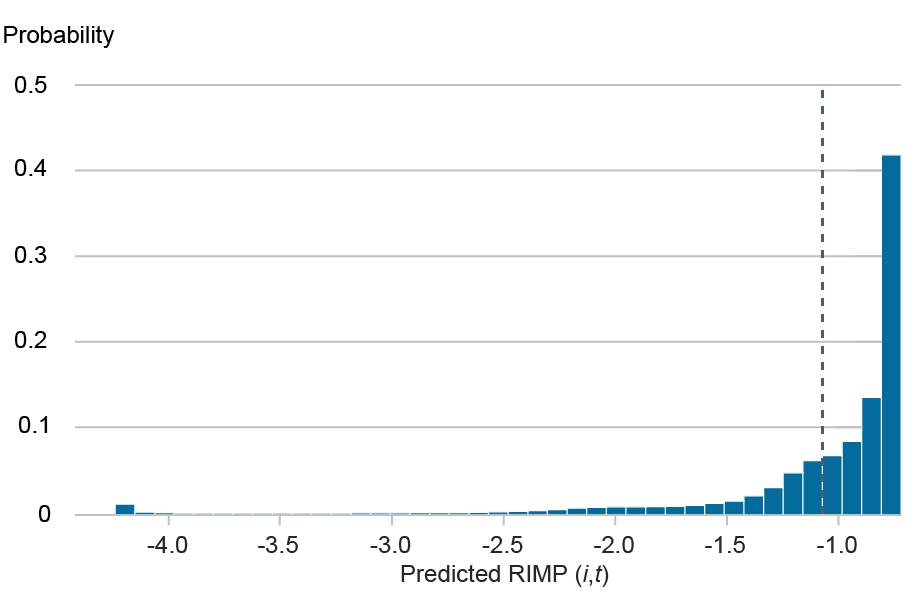
Distribution of firm-quarter investment responses to rate surprises: most sit near zero, with a long negative tail.1 / 2
Economists know that higher interest rates lead firms to invest less. They disagree about which firms cut the most. Past studies have usually tested one trait at a time, such as size, age or balance-sheet strength. A NY Fed Staff Report by Thomas Drechsel, Daniel Lewis, Davide Melcangi and Laura Pilossoph takes a different route. It estimates the full distribution of investment responses first and only then asks what explains them.
How they measured it
The authors build on Ottonello and Winberry (2020). They measure monetary policy surprises as the change in the fed funds rate implied by fed funds futures in a narrow window around each Fed announcement. They measure investment as quarterly growth in the capital stock of publicly listed firms in Compustat. They do not choose a candidate driver in advance. Instead, a clustering regression sorts each firm in each quarter into a high or low responder. The result is a distribution of the "response of investment to monetary policy," which they call RIMP.
What they found
Most responses are small. In most quarters, most firms' investment barely reacts to a surprise. Every firm still cuts at least somewhat after a hike. The pattern is lopsided, though. In about , a surprise 1-percentage-point increase in the fed funds rate cuts capital-stock growth by .
2/5Calculated Risk· CalculatedRisk by Bill McBride· Oct 7
Mortgage rates near 7.5% hit refinancing hard and slow home purchases
Refinance applications are down 56% from a year ago and purchase applications 15%, while listings are 4.4% above last year's level.
Why it matters · Mortgage rates are what connect bond-market moves to home prices and household budgets. These weekly numbers show how fast a one-point rise in rates cuts demand while the number of homes for sale slowly grows.
MBA purchase index, weekly and four-week average: buying demand is still weak and down 15% from a year ago.1 / 3
Bill McBride's weekly check of two housing indicators shows mortgage rates hitting their highest level in almost three years. Buyers are pulling back, and the number of homes for sale keeps creeping up.
Applications: refinancing drops hardest
The Mortgage Bankers Association's survey for the week ending October 2, 2026 showed total mortgage applications down 4.2% from the week before, seasonally adjusted. The refinance index fell 8% in the week and is 56% below the same week a year ago. The purchase index fell 2% in the week and is 15% lower than a year earlier on an unadjusted basis.
Two things pushed rates up, according to MBA deputy chief economist Joel Kan. Treasury yields rose. On top of that, the spread between mortgage rates and Treasuries widened because rates became more volatile. Together they lifted the average 30-year fixed rate to , about a percentage point higher than a year ago.
3/5Klement on Investing· Joachim Klement· Oct 8
High public debt makes rate hikes hurt growth more and inflation less
A BIS study finds rate hikes in high-debt eurozone countries cut output more but cool prices less. Long-dated borrowers like the UK fare worst.
Why it matters · Most rich countries now carry heavy debt. If that weakens the link between rate hikes and inflation, central banks may need bigger, more frequent rate moves. That means more volatile borrowing costs for mortgages, bonds and savings.
GDP and price responses to an ECB rate shock in stylised 60% and 120% debt-to-GDP countries.1 / 2
When a central bank raises rates, borrowing gets more expensive for households and businesses. It also gets more expensive for the biggest borrower in the economy, the government. Joachim Klement draws on a new Bank for International Settlements study (Johns et al., 2026) to show that this side effect changes what monetary policy actually does.
How debt changes the response
The mechanism works through the budget. As debt matures and is refinanced at higher rates, interest costs rise. The government then has two choices. It can let the deficit grow, in which case investors may expect inflation later to erode the debt. Or it can cut other spending, in which case they expect slower growth.
The BIS modelled two stylised eurozone countries, one with debt at 60% of GDP and one at 120%. Each faced a one-standard-deviation ECB rate shock, about 50 basis points:
Low-debt country: GDP falls about 1.75% after one year.
High-debt country: GDP falls about 2.25% after three quarters, because refinancing eats a bigger share of the budget.
4/5A Wealth of Common Sense· Ben Carlson· Oct 7
Retail Investors Pour Record Cash Into Long Treasuries as Yields Rise
Show notes for Ben Carlson's Animal Spirits podcast include two data points: record inflows into TLT and August spending that outpaced income.
Why it matters · The notes contain two useful data points. Retail investors are buying long bonds while prices fall, and consumer spending is rising faster than income. Both bear on where rates go next and how long consumer spending can hold up.
Image: A Wealth of Common Sense
This is the show-notes page for this week's Animal Spirits podcast, hosted by Ben Carlson and Michael Batnick. Most of it is a list of linked stories, and the analysis is in the audio. The page itself has only a few hard numbers. Here they are, along with the themes the episode covers.
Buying bonds while prices fall
JPMorgan's data on September retail flows, quoted by Luke Kawa, showed the largest rotation into long-dated Treasury ETFs on record. Most of it came from outsized inflows into TLT, the iShares 20+ year Treasury fund. The flows came while long yields kept rising, which means bond prices were falling. Long-duration bonds lose the most when yields go up, so these buyers are adding to positions as they lose money.
Bloomberg ETF analyst Eric Balchunas compares this to a bowl of ice cream that gets more tempting with every 1% drop. He argues that history favors walking past it. In other words, buying more of a falling long bond in the hope of a reversal has often been a losing bet. The post gives no return data to back that up.
A consumer running on savings
Heather Long points to a gap in August's personal income data. Spending rose 0.9% while income rose only 0.2%. Spending can only outrun income for long if people draw down savings or borrow, and Long says many households are doing that. The headline "strong consumer" story therefore looks less durable than it seems. One linked piece describes the consumer as "crashing through inflation and driving growth." Long's numbers suggest that growth is partly borrowed.
Other topics on the episode
5/5Marginal Revolution· Alex Tabarrok· Oct 7
Market-failure arguments apply to democracy too, Brennan and Freiman argue
A new paper says externalities and information problems run through voting, and suggests regulations such as paid civics exams and fines for deceptive campaign promises.
Why it matters · Anyone who uses market-failure reasoning to back economic regulation has to deal with this. The paper argues the same logic covers voting, and Tabarrok's closing point is that the usual replies to it are the standard case for laissez-faire.
Image: Marginal Revolution
Alex Tabarrok highlights a new paper by Jason Brennan and Christopher Freiman with a pointed claim. They say the standard arguments against laissez-faire capitalism work just as well against laissez-faire democracy. Tabarrok calls the case persuasive. The authors find the result startling: most people reject unregulated markets but accept unregulated democracy.
The market-failure toolkit, applied to voting
Economists use a familiar list of reasons to regulate markets: externalities, asymmetric information, principal-agent problems and behavioral biases. Brennan and Freiman argue that each one applies to politics.
Externalities get the most attention. In markets, the costs of a decision mostly fall on the people who make it, and spillovers are treated as exceptions to fix. Political decisions spill onto others by their nature. The authors use Brexit as their example. About 37% of eligible voters, or 26% of the UK's whole population, voted Leave. The effects fall on everyone, including people who voted the other way, people who abstained, children, future generations and foreigners.
They compare it to pollution from driving. Each voter, like each driver, gets the benefit of their own choice and passes much of the cost to others. One vote matters little, but many votes together matter a lot. They conclude that if pollution regulation is justified at first glance, regulating voting is justified on the same terms.
Democracy is already regulated
The authors say most people already accept rules that restrict democracy. Examples:
Sensitivity comes and goes. The authors split the variation in RIMP into three parts: what all firms share over time, permanent differences between firms, and changes within a firm over time. Very little is common to all firms. Permanent firm differences explain more, but still a limited share. Most of the variation is within firms over time. A firm can react strongly in one quarter and then hardly react for several quarters after.
Known traits matter, but only partly. Small firms (Gertler and Gilchrist, 1994) and young firms (Cloyne et al., 2024) are more sensitive, and the effects compound: small, young firms cut the most. Firms with shorter debt maturities are also more sensitive. Some results suggest behavior plays a role. A firm's own view of its discount rate and cost of capital tracks its sensitivity, and firms that describe themselves as optimistic cut less after a hike.
The authors stress that these traits act together and interact. Even taken together, they leave much of the variation in RIMP unexplained. The authors argue that policymakers and researchers should look at the whole distribution of responses rather than the average.
Remember
In 5% of firm-quarters, a surprise 1-point rate hike cuts capital-stock growth by 4 percentage points. Most firms barely react.
Most of the variation is within a firm over time. Strong sensitivity is temporary, not a fixed trait.
Small, young firms and firms with short-maturity debt react most, but much of the variation remains unexplained.
Refinancing reacts most because a homeowner only refinances if the new rate beats the old one. At 7.49%, Kan says, "very few homeowners have an incentive." Refinance applications fell to their lowest level since 2025, less than half of last year's pace.
Purchase applications fell across every loan type. FHA loans fell most, down 6%. FHA borrowers tend to be the most stretched on affordability, so they feel higher payments first. Some buyers are switching to adjustable-rate mortgages (ARMs) to get a lower starting payment. ARMs held steady at 10.3% of applications.
McBride's long-run chart puts the refinance index near the bottom of its range since 1990. In other words, it is low by historical standards, not just compared with last year.
Inventory: up from last year, still below 2019
Altos Research data through October 2 shows active single-family listings up 4.4% from the same week in 2025, compared with up 3.8% the week before. Listings are still 5.5% below 2019, the last pre-pandemic year. That gap is shrinking: the week before, it was 6.1%.
McBride's conclusion is that supply is rising a little while demand is weak. With 30-year rates above 7.5%, he expects existing-home sales to slow and house prices to come "under pressure." That is his forecast, not something the data has shown yet.
Remember
The 30-year fixed rate reached 7.49%, a near-three-year high, as Treasury yields rose and mortgage spreads widened.
Refinance applications are down 56% from a year ago and purchase applications 15%, with FHA buyers pulling back most.
Listings are 4.4% above last year but 5.5% below 2019. McBride expects slower sales and pressure on prices.
Prices: the drop is larger in the low-debt country. In the high-debt country, households and businesses expect the government to tolerate higher inflation, and those expectations prop up actual prices.
Put together, the high-debt economy takes more damage to output and gets less disinflation in return. Klement argues this means central banks in high-debt countries must hike and cut more aggressively to get the same effect. Since most developed economies are now heavily indebted, he expects policy to be less effective and interest-rate volatility to rise.
Debt maturity matters too
The study also split the effect across bond maturities and found a U-shape. Rising yields on short-term bonds and money-market rates hit output and inflation hardest, which is expected. The impact shrinks at intermediate maturities, then rises again beyond about eight years.
The reason is how long bonds get rolled over. A maturing long bond is usually replaced with another long bond. When rates are higher, that locks in the higher interest cost for years. So the UK, which issues a lot of very long debt, suffers more from rate hikes than France, which mostly borrows at intermediate maturities, even though their debt-to-GDP ratios are similar.
Klement calls this bad news for both countries. The US has rising debt and persistent large deficits, so Fed hikes now reduce inflation less than they used to. The UK's deficit is more manageable, but its high debt and long maturity profile mean the Bank of England will need bigger rate moves in both directions.
Remember
A ~50bp ECB hike cuts GDP 2.25% in a 120%-debt country, versus 1.75% at 60% debt.
Inflation falls less in high-debt countries because people expect governments to tolerate inflation to erode debt.
Rate effects are U-shaped by maturity, so very long issuers like the UK lock in higher costs.
deciding which questions go to voters, which to legislators and which to judges or bureaucrats
setting the voting age and who can run for office
limits on campaign donations and spending
banning the buying and selling of votes outright
They also describe public education funding as partly a subsidy meant to make voters more competent.
They then sketch further rules. For the sake of argument, they keep universal, equal suffrage: no weighted votes and no knowledge tests to vote. Their proposals:
paying citizens to pass a voluntary civics exam
tracking campaign promises and fining deceptive claims
regulating political ads the way drug ads are regulated
requiring supermajorities for some decisions
Tabarrok's post covers the proposals only briefly, so how they would work is left to the paper. He ends by addressing the obvious objections: special interests could capture these rules, biased officials could run them, and they could have unintended effects. His answer is "welcome to the argument for laissez-faire." Anyone who doubts regulators can manage democracy is making the same case that defenders of free markets make about government regulation of markets.
Remember
Brennan and Freiman argue that externalities, information gaps, principal-agent problems and behavioral biases affect voting as much as markets.
Brexit example: 37% of eligible voters (26% of the population) chose an outcome that affects everyone.
Tabarrok notes that worries about regulatory capture apply here too, and that those worries are the case for laissez-faire.