An Angled Obstacle Can Reverse Energy Flow in 2D Turbulence
Pittsburgh researchers studying swimming brine shrimp found that obstacle geometry can choose which way energy cascades in a flat turbulent flow.
Why it matters · For about 60 years, physicists assumed a turbulent system's dimensionality fixed the direction its energy flows. If a small, carefully angled obstacle can override that rule, turbulence becomes something we might steer.
Physicists have long treated one feature of turbulence as fixed: energy moves between scales in only one direction, and the number of dimensions decides which. A team at the University of Pittsburgh led by engineer Lei Fang reports that in a two-dimensional flow, a small obstacle set at the right angle can push the energy cascade the other way. "The geometry matters," Fang said.
The rule being rewritten
In 1922 Lewis Fry Richardson, the founder of modern weather forecasting, described how turbulence works in three dimensions. Large eddies hand their kinetic energy to smaller ones, which hand it to smaller ones still, until viscosity takes over and the energy is lost as heat. Starting in the 1940s, Andrey Kolmogorov gave this picture a rigorous mathematical footing.
In the late 1960s, Robert Kraichnan and George Batchelor showed that two-dimensional turbulence runs in reverse. Energy flows from small eddies up into large ones. Jupiter's Great Red Spot is an example: smaller vortices around its edge feed the giant storm at the center. According to the article, physicists spent the following decades without seriously asking whether that direction could change.
Where sea monkeys come in
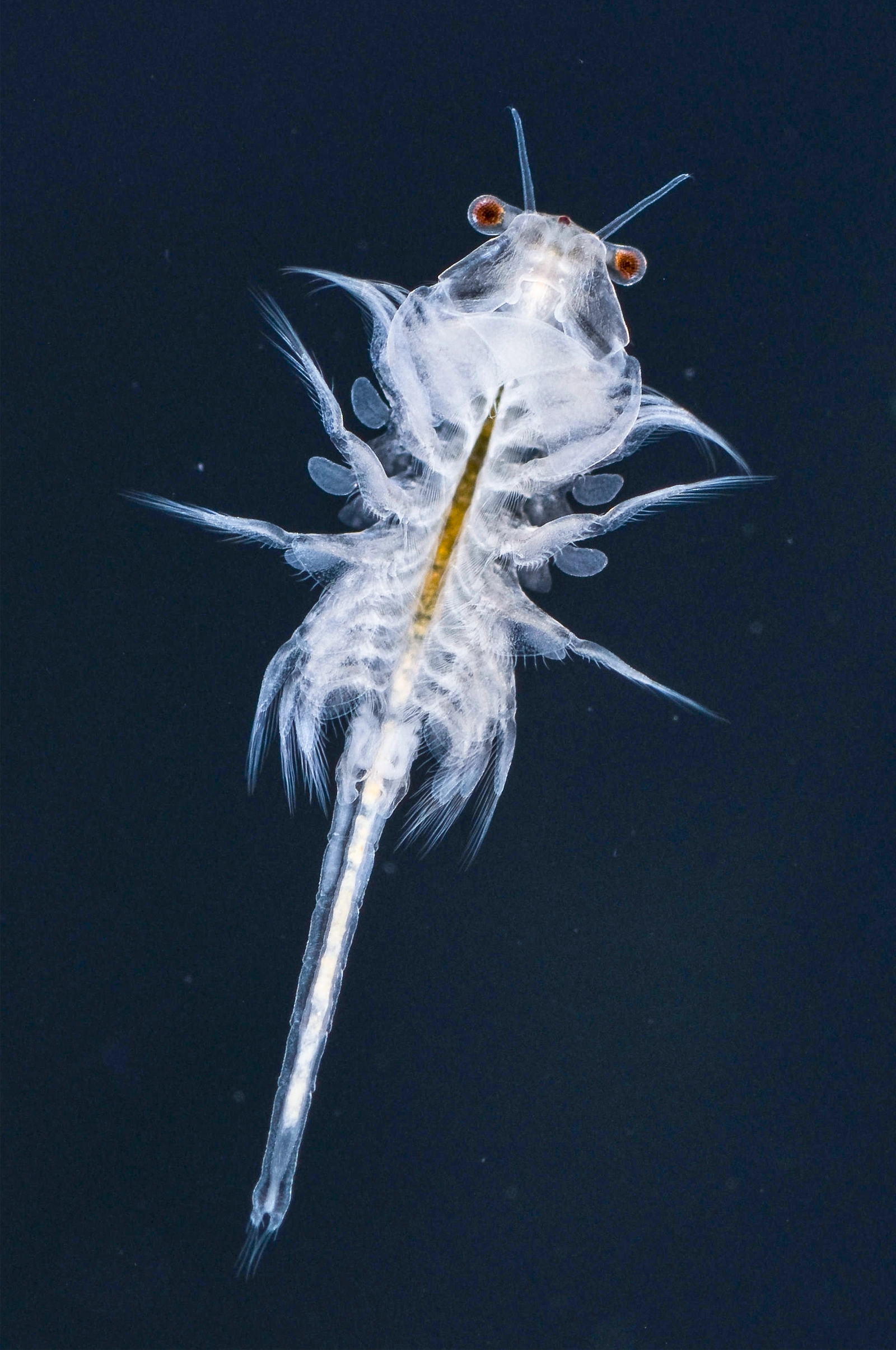
Fang's lab studies active matter, meaning things that move on their own and put energy into their surroundings, such as bacteria or tiny robots. Around 2021, graduate student Xinyu Si began studying brine shrimp, the "sea monkeys" once sold through comic-book ads. These animals are about 10 millimeters long and swim upside down. The team's hypothesis was that turbulence stirred up by billions of tiny organisms plays an underappreciated role in mixing natural waters. That work led them to the finding about energy direction.