Laser-levitated glass bead entangled with light inside an optical cavity
A Science paper reports entanglement between a trapped, cooled glass bead's motion and two light fields, read out from light leaking out of the cavity.
Why it matters · Large objects normally lose quantum correlations almost immediately. Entangling a levitated bead pushes quantum behaviour to bigger objects and could lead to mechanical memories for quantum information carried by light.
Researchers report in Science that they entangled the motion of a glass bead with light. The bead is large by quantum standards. That makes the result hard to get, because big objects interact constantly with their surroundings. Each interaction works like a measurement and destroys quantum correlations about as fast as they form. Normally a bead's size would erase any entanglement before anyone could detect it.
How the setup works
The bead floats in optical tweezers, meaning it is held by laser light. That light sits inside an optical cavity, a pair of mirrors with the bead at the centre. The spacing of the mirrors fixes the light's frequency and phase. It also creates a standing wave, a fixed pattern of bright and dark spots, like the vibration pattern on a guitar string. Because of this pattern, the bead and the light interact in a precisely defined way, as long as the bead stays nearly still.
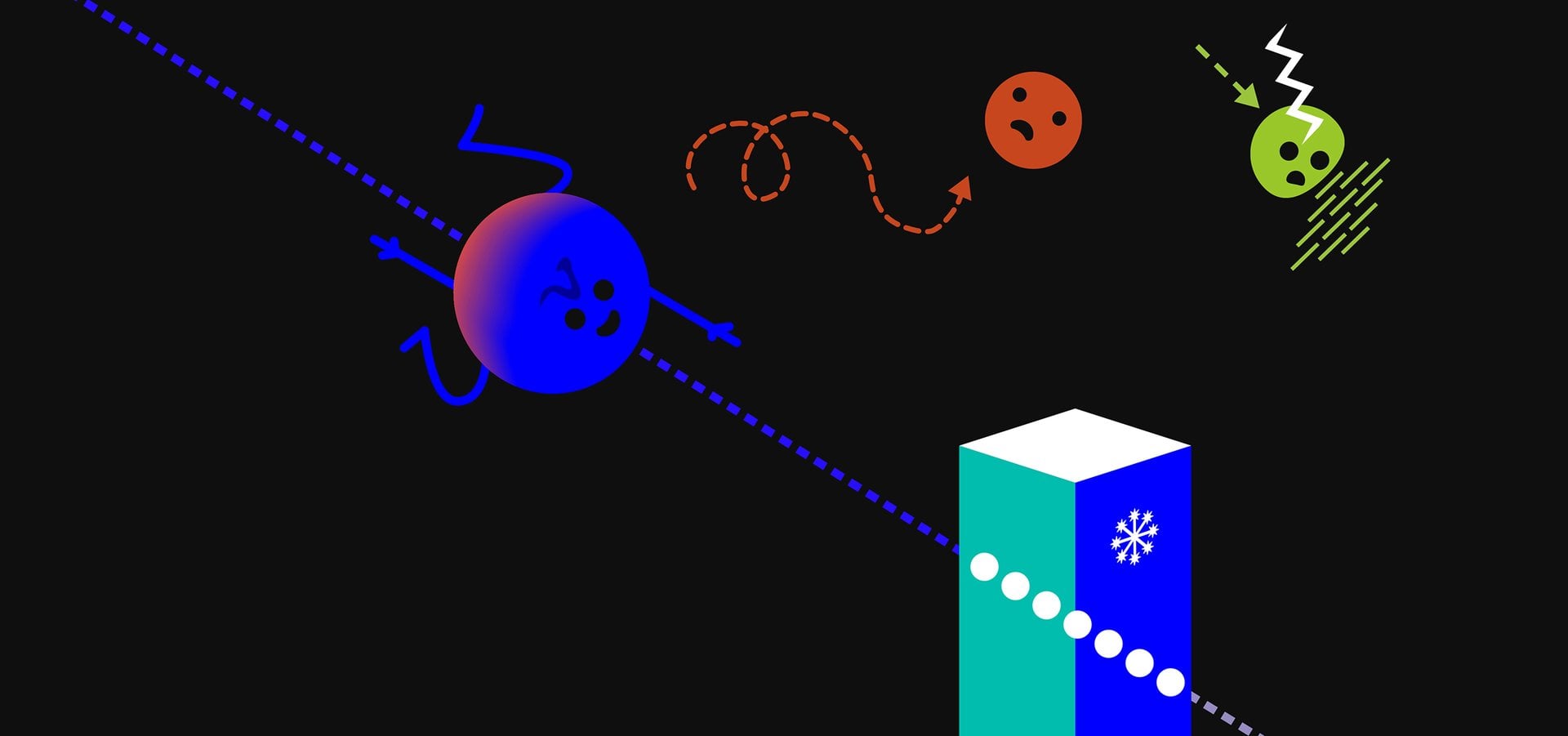
The trap holds the bead more like elastic bands than rigid tweezers, so the bead jiggles back and forth. In this sense it is "hot." To cool it, the team tunes the laser slightly toward red, just below the frequency that would leave the bead's energy unchanged. Through the Doppler effect, light scattering off the bead then picks up a little energy each time, so the bead keeps losing energy and slows toward its minimum possible motion. It can never be perfectly still.
To create entanglement, a second beam is tuned slightly toward blue. The same Doppler shift now adds energy to the bead, giving it a kick. The cooling beam can only remove motion if the bead is moving above its minimum, and the heating beam makes sure it is. The two light fields therefore become correlated through the bead's motion, and that ties both of them to the bead.