Cell Valleys, Ancient Cliffs, Hollow Spears · Morning Gist
Saturday, October 105 stories · 16 min
Cell Valleys, Ancient Cliffs, Hollow Spears
Today's landscapes come in three kinds: a cellular one being mapped, a geological one being rebuilt and a volcanic one still unexplained, plus Neanderthal woodwork and a young burst source.
Picked from 37 new articles across 10 sources · arrow keys for other days
Today in 30 seconds
30s left
Single-cell gene data is turning Waddington's 1950s sketch into real maps, with stable valleys where cell types settle on shifting ground. story 1 ↓
Models suggest a cliff 1–2 km high, running from Alaska to Arizona, may explain the Grand Canyon's missing billion years. The timing is still unresolved. story 2 ↓
USGS predicted each of Kilauea's 50+ lava fountains from summit swelling, but still can't say what drives them. story 3 ↓
A Spanish site preserved Neanderthal wooden tools as hollow molds in stone, including bark trays, spears and a club with no known parallel. story 4 ↓
Webb traced the most distant fast radio burst to a small galaxy whose stars formed within about 30 million years. That narrows the possible causes. story 5 ↓
1/5Quanta Magazine· Philip Ball· Oct 9
Biologists are turning Waddington's 1950s "cell landscape" sketch into real maps
Researchers are building measured maps of how embryonic cells pick their fates, using a 1950s metaphor of a ball rolling into valleys. The data largely back the old idea, but the landscape itself shifts as cells interact.
Why it matters · Knowing where cells' fate decisions happen could let scientists steer stem cells into chosen tissues, or coax cancer cells out of their harmful state.
Know this first
Context from the editor, not the article · 34 sec
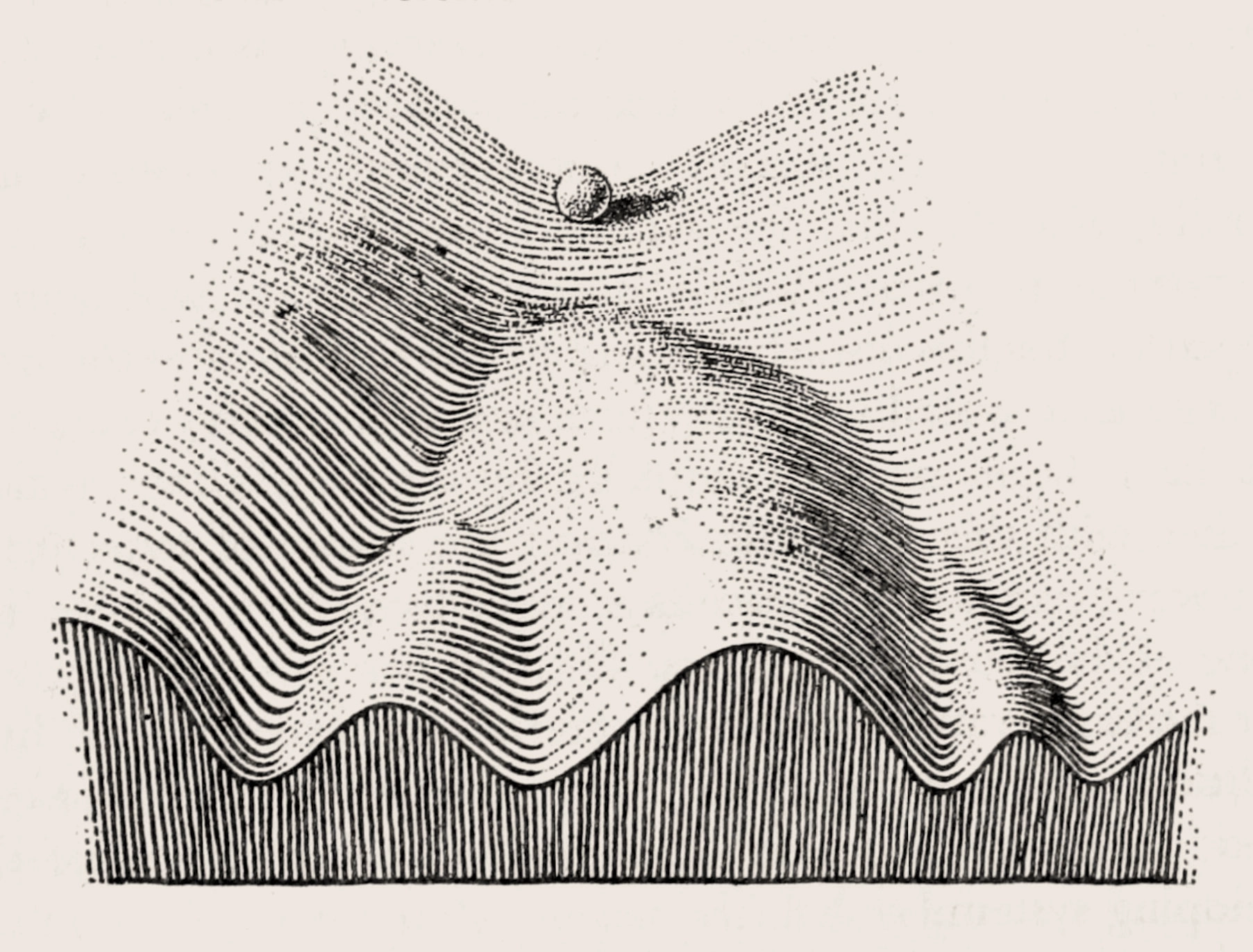
Every cell in your body carries the same genome, yet an embryo's identical early cells become hundreds of distinct types, from neurons to blood cells. How that happens reliably is a central question in developmental biology. In the 1940s and 1950s the British biologist C.H. Waddington drew it as a ball rolling down a hilly landscape. The ball is an undecided stem cell. Each fork in a valley is a fate decision, and each valley floor is a mature cell type. For decades this "epigenetic landscape" was a much-loved drawing with no numbers behind it. This Quanta feature by Philip Ball looks at how newer data and mathematics are giving it real content. It is a review of a research field, not a report of a single new study.
Waddington's original drawing: a ball, standing for a stem cell, above branching valleys that lead to cell types.1 / 2
From sketch to data
2/5Science News· Lucas Van Wyk Joel· Oct 9
A giant ancient cliff may explain the Grand Canyon's missing billion years
Geologists modeled an ancient cliff 1 to 2 kilometers high along western North America. They propose that erosion along it, helped by global ice ages, stripped away a billion years of rock from the Grand Canyon.
Why it matters · The missing rock is one of geology's biggest gaps. This study offers a testable mechanism for it, linked to known events, though the timing is still unresolved.
Know this first
Context from the editor, not the article · 33 sec
The Grand Canyon's walls are a layered archive of rock. At the bottom are very old "basement" rocks, about 1.8 billion years old or more. Sitting directly on top of them in many places are sandstones only about 520 million years old. The surface where the two meet is part of the Great Unconformity, a gap found across much of the world. Rock from the time in between either never formed there or was eroded away, and geologists have long argued about which. Two other events matter here. Rodinia, a supercontinent that assembled roughly 1.1 billion years ago, broke apart several hundred million years later. "Snowball Earth" refers to glaciations between about 720 and 635 million years ago, when ice may have reached the tropics.
Reconstructed map of ancient North America. The dotted line marks the proposed escarpment running from Alaska to Arizona.1 / 2
3/5Ars Technica Science·
John Timmer
· Oct 9
Kilauea's repeated lava fountains still don't reveal what powers them
US Geological Survey researchers documented over 50 lava-fountain eruptions at Hawaii's Kilauea volcano. They could forecast each one from swelling at the summit, but the gas data don't settle what drives the fountains.
Why it matters · Lava fountains are among the most violent forms of a usually gentle kind of volcanism, and knowing what drives them affects how well eruptions can be forecast.
Know this first
Context from the editor, not the article · 29 sec
Hawaii's volcanoes sit over a hotspot, a plume of hot material rising from deep in the Earth. Hotspot eruptions are usually gentle: runny basalt lava flows downhill slowly enough to walk away from. Sometimes, though, lava shoots out in fountains hundreds of meters high, at Kilauea and also at Etna and in Iceland. Like other volcanoes, Kilauea stores magma in shallow underground reservoirs. As a reservoir fills, the ground above it bulges. Instruments called tiltmeters measure that bulging very precisely. Kilauea is the youngest and most active volcano in Hawaii and one of the most closely watched on Earth. In 2018 a major eruption partly drained one of its reservoirs.
Image: Ars Technica Science
4/5Ars Technica Science·
Jacek Krywko
· Oct 9
Neanderthal wooden tools survived in Spain as hollow molds in stone
At a rock shelter near Barcelona, mineral-rich water encased Neanderthal wooden tools in stone, then the wood rotted away and left exact molds. Researchers identified 13 tools, including bark trays, spears and a unique club.
Why it matters · Wood was probably the main material Stone Age people worked, but it rarely survives. This site shows the everyday tools Neanderthals used at home, not only their hunting weapons.
Know this first
Context from the editor, not the article · 34 sec
Neanderthals lived in Europe and western Asia until about 40,000 years ago. Most of what we know about their technology comes from stone tools, because stone lasts. Wood usually rots within years unless it ends up somewhere without oxygen, such as a bog or waterlogged sediment. That is why the few wooden artifacts known from the Paleolithic (the Old Stone Age) are mostly spears from wet sites: Schöningen and Lehringen in Germany, and Clacton-on-Sea in England. As a result, we know a lot about how Neanderthals hunted and very little about how they used wood around the places where they lived. Over the past few decades, evidence that Neanderthals made cord and symbolic objects, and interbred with our own species, has steadily changed the old picture of them as dull-witted.
Reconstruction of how Neanderthals may have leaned poles against the shelter wall to make windbreaks or huts.
5/5Universe Today· Brian Koberlein· Oct 9
Webb finds young host galaxy for the most distant fast radio burst
Astronomers used the James Webb Space Telescope to find the faint galaxy behind a radio burst from 2024. The galaxy is distant and full of young stars, which points to a magnetar, an intensely magnetic dead star, as the source.
Why it matters · Nobody knows yet what causes fast radio bursts. The age of the stars around a burst is one of the few ways to rule possible causes in or out.
Know this first
Context from the editor, not the article · 33 sec
Fast radio bursts (FRBs) are flashes of radio waves that last a few milliseconds. The first was reported in 2007. Most come from other galaxies, so whatever makes them releases a huge amount of energy very quickly. There are two leading explanations. One is a pair of neutron stars (the dense, collapsed cores of dead stars) merging. The other is a flare from a magnetar, a neutron star with an extreme magnetic field. In 2020, a magnetar in our own galaxy gave off an FRB-like burst, which made that idea more credible. Still, a burst seen only in radio says little about what produced it. Pinning a burst to its home galaxy gives an outside clue: what kind of stars live there, and how old they are.
Artist's illustration of Webb studying the host galaxy of FRB 20240304B, the most distant fast radio burst known.
Waddington's landscape was a picture, not a model. As the developmental biologist James Briscoe of the Francis Crick Institute puts it, without mathematics it "could not distinguish between alternative mechanisms, make quantitative predictions, or be falsified." Waddington did guess at what shapes the hills. He drew the landscape from below as a sheet pulled by ropes tied to pegs. The pegs were genes, and the tangle of ropes is what biologists now call 1: genes switching one another up or down.
What changed is measurement. 2 counts the RNA copies of every gene inside thousands of individual cells. That gives each cell a position in a space with thousands of dimensions, one per gene. Tools such as 3 flatten that space to two dimensions, a bit like a shadow. On the flattened map, cell types show up as clusters, and lineages trace paths through time that look a lot like Waddington's valleys.
The biophysicist Julie Theriot cautions against reading these maps too literally. RNA counts don't track gene activity perfectly, and the way the data are flattened can build in assumptions about which cells belong together.
A fork you can measure
In 2007, Sui Huang (now at the Institute for Systems Biology) described a real Waddington-style fork. Blood-forming progenitor cells choose between red and white blood cell paths, and the choice depends mainly on two proteins. More GATA1 pushes a cell toward red, and more PU.1 pushes it toward white. That turns the landscape into a map with just two axes. The progenitor state starts as a single basin. As development goes on, that basin gets shallower and two new, deeper basins open on either side. Mathematicians call these basins 4: stable states that cells are drawn into.
Briscoe and the mathematician David Rand use 5, the maths of how sets of interacting variables change over time. Their work suggests that a few key genes make each fate decision and the rest of the network simply carries it out. Deep, well-separated valleys also explain robustness. Cells with slightly different, noisy gene levels still end up in the same place.
Where the metaphor falls short
In their framework, height stands for how stable a state is. "Time" is 6: cells are ordered by how far their gene expression has changed, not by the clock. Rand says this ordering works on unstable ridges but breaks down inside basins, where expression drifts at random. Most importantly, the landscape is not fixed. Cells reshape it as they signal to and physically push on one another, so attractors appear and disappear.
Uses
Briscoe says the framework helped his team make sense of neural-tube results that seemed to contradict each other: two routes lead to the same spot. Huang now treats cancer as one more attractor that cells can reach by many routes. That raises the idea of pushing tumour cells into a harmless basin rather than killing them. Regenerating tissue and converting one cell type into another are other hoped-for uses. All of these are still prospects, not results.
Remember
In blood cells, the levels of just two proteins, GATA1 and PU.1, decide between red and white fates.
A team led by Thomas Gernon, an earth scientist at the University of Southampton, offers a new suspect for the Grand Canyon's missing rock: a cliff on the scale of a continent. In a peer-reviewed paper published August 17 in Geology, they propose that this cliff, together with 1's ice, eroded away the record between about 1.8 billion and 520 million years ago.
What the models show
The team used computer models to simulate how the landscape changed over hundreds of millions of years. In the simulations, an 2 (a long, steep cliff separating high ground from low ground) began forming about 800 million years ago as 3 split apart. That is around the time rock in the region vanished.
The modeled cliff ran along much of 4, the ancient core of North America, from what is now Alaska to Arizona. It stood about 1 to 2 kilometers high. Its steep slopes would have left rock exposed and easy for rain, ice and gravity to break down and carry off, removing layer after layer. "No study has previously suggested the existence of a continental-scale escarpment in the Grand Canyon region," Gernon says.
Ice as an accomplice
The timing overlaps with Snowball Earth. Ice sheets grinding across continents would have scraped away large amounts of rock. The authors argue that the escarpment also helped the ice form: its high, exposed peaks would have "acted as glacier factories," Gernon says. In a separate study in Science, his group argued that a similar tectonically formed escarpment helped start the 5 about 34 million years ago. The team also cites present-day escarpments in Antarctica and South Africa where comparable erosion is happening now.
What's still unknown
The model doesn't show when the erosion happened relative to the glaciations: before, during or after. Gernon calls that "the real hole that needs filling." The next step is to pin down the erosion history, continent by continent, precisely enough to test the idea.
It's also worth being clear about what kind of evidence this is. The study shows that a giant escarpment is a plausible explanation, consistent with known events such as Rodinia's breakup. It does not directly detect the cliff. Alan Collins, a geologist at Adelaide University who was not involved, says tying the erosion to well-established events strengthens the case. "I find this very convincing," he says, though he stops short of calling the case closed.
Remember
The Grand Canyon's record jumps from about 1.8 billion to 520 million years ago, with almost nothing in between.
The proposed cliff comes from computer models, not direct field evidence.
The key open question is timing: did the erosion happen before, during or after Snowball Earth?
Hawaii's Kilauea has produced lava fountains only three times since 1823. Over the past two years it has made up for that, with dozens of fountaining eruptions. A paper in Science by 1 researchers describes the best-recorded fountain sequence so far. It also tests the two leading explanations for what drives fountains, without settling the question.
The buildup
After the 2018 eruption, the drained reservoir began to refill. From 2019 the summit rose by more than 22 cm a year. In 2023 that rate more than doubled to 57 cm a year, and the swelling spread to a nearby 2, the large crater left when a volcano's summit collapses.
In 2024 a swarm of earthquakes came with the opening of a 900-meter 3. For 13 hours it threw lava up to 160 meters high. A second eruption followed less than a day after the first ended. By last month there had been 52 more, and the largest sent lava more than 400 meters into the air. The volcano was watched by 35 monitoring stations: seismometers, 4 sensors that pick up low-frequency sound, ground-deformation gauges, gas sensors, and visible and thermal cameras.
Forecasting by 5
The most useful result was practical. Each eruption quickly deflated the summit, and the 6 magma reservoir then slowly refilled. The USGS saw that eruptions began when the summit tilt reached about the same level each time. That threshold drifted lower over time, but only a little from one eruption to the next. Watching the tilt let the agency issue alerts. This mattered because no clear earthquake signals came just before the fountains restarted.
Two candidate engines
Water/steam model: pressure keeps water dissolved in the magma until it rises shallow enough to escape as steam. The escaping steam breaks the magma into fragments, which lets it rise faster. That releases more steam, and the cycle runs away into a jet.
CO₂ foam model: carbon dioxide gathers as a foam at the roof of the magma chamber. When the foam reaches a critical point it escapes, carrying magma with it until the supply runs out.
Carbon dioxide stayed low throughout the cycle, which counts against the foam model. 7, a sign of gas leaving magma, rose during eruptions but stayed high between them as well. The evidence therefore leans toward the steam model. But it can't explain why degassing that goes on all the time should set off fountains when it increases only slightly.
Magnesium oxide in the lava is a rough gauge of magma temperature. It rose and fell with each cycle, which fits a reservoir that empties and then refills with hot magma. Other oxides rose steadily, which suggests the incoming magma has a different chemistry.
Limits
Gas is usually measured at infrared wavelengths, and those readings were swamped by the infrared glow of the eruptions. Fountains this tall also made it unsafe to install more instruments. One camera was destroyed while filming falling semi-molten rock.
Remember
Summit tilt reaching a similar level before each eruption let USGS forecast fountains, even without earthquake warnings.
Low carbon dioxide counts against the 'gas foam' explanation, but the steam model still can't explain the sudden onset.
Magma chemistry changed over time, suggesting the refill came from material with a different composition.
A peer-reviewed study in 1 catalogs 597 wooden remains from 2, a rock shelter in Capellades, west of Barcelona. They come from Neanderthal living floors dated between 62,000 and 40,000 years ago. Most are natural: trunks, fallen branches and firewood, mostly Scots pine. But 13 objects have shapes that, according to co-author M. Gema Chacón of the Catalan Institute of Human Paleoecology and Social Evolution (3), "are impossible to find in nature."
How wood survived without wood
The shelter sits under a cliff of 4, a limestone formed by calcium-rich spring water. As this water dripped across the floor, calcium carbonate built up as a crust on whatever lay there. The wood inside then decayed, leaving hollow molds. These are exact negative impressions, sometimes detailed enough to show the outlines of wood cells under a microscope.
The site has been excavated continuously since 1983, so the team has had time to develop a method for digging up empty space. Each find is mapped and photographed, and the fragile crust is stabilized before one part is carefully opened. The team used to fill the hollows with plaster or resin to make casts. Now it digitizes them with 3D scanning and 5, which builds 3D models from overlapping photos, and 3D-prints copies.
What Neanderthals made
Four bark trays made of juniper, the largest 55 × 20 cm, found near hearths. They may have been used to carry food or scoop embers, like the 6 (bark dishes) of Aboriginal Australians.
Crossed poles over a hearth, possibly the remains of a tripod for processing food.
A branchless pole more than 5 m long at the back of the shelter. Every excavated level has a row of small, tidy hearths along the back wall, about 50 cm wide and roughly a meter apart. Chacón suspects they were sleeping hearths, giving light and protection from predators. The team thinks the pole leaned against the wall as a windbreak or simple hut, and experiments showed that about five meters is the length such a structure needs.
Two spears and a pointed stick near red deer skulls. The best-preserved spear is 2.45 m long, and its tip shows an impact fracture of the kind made by striking bone.
A club carved from one piece of wood, with a 16 cm handle, a roughly triangular head about 14 cm tall, and a right-angle step that may have kept the hand from slipping. The only earlier possible club, from Kalambo Falls in Zambia, is about 400,000 years old. It was found among bones, stone tools and a hearth, so the team suspects it served for everyday work. Chacón admits, "we are not sure."
Reading the choices
The materials appear to have been chosen deliberately. Tools were made from fresh, easily worked pine, the trays from fibrous juniper bark, and firewood from dry wood. Chacón argues that this shows planning. Because worked wood turns up in level after level, woodworking looks like a routine activity rather than a rare one.
She also warns that similar finds elsewhere may have been photographed and thrown away. Identifying the Romaní tools took decades and a lot of money.
Remember
Wood is rarely preserved in the Paleolithic record, so the known examples are biased toward spears from waterlogged sites.
At Abric Romaní, stone crusts kept the shapes of wooden objects after the wood itself rotted away.
Neanderthals appear to have chosen specific woods for specific jobs, which points to planning.
In 2024, 1, an array of radio dishes in South Africa, recorded a burst named 2. MeerKAT located it on the sky very precisely. But when astronomers pointed optical telescopes at that spot, they saw nothing, so the burst had no known home.
Finding the galaxy
A team led by Manisha Caleb of the University of Sydney tried again with the 3 (JWST). JWST observes in infrared light, which makes it good at spotting faint, very distant galaxies. Light from the early Universe gets stretched to longer wavelengths as space expands, and that shifts it out of the visible range and into the infrared. At the burst's position, Webb found a small galaxy.
Reading its age and makeup
The team then took a 4 of the galaxy, splitting its light by wavelength. A spectrum tells you two things here. First, how much the light has been stretched shows how far away the galaxy is, and so how far back in time we are seeing it. The answer was a Universe only about 3 billion years old, which makes this the most distant FRB yet found. Second, a spectrum carries signs of the galaxy's stars, including their ages. These suggest most of its stars formed within about 30 million years, a very short time by cosmic standards. So we are seeing a young galaxy full of young stars.
Why that favors magnetars
The argument rests on timing.
5 mergers are slow. Two neutron stars orbiting each other can spiral inward for more than a billion years before they collide. If mergers caused FRBs, you would expect to find bursts mostly in large, mature galaxies with older stars.
6 are fast. Magnetars are thought to form in the deaths of massive stars, and those stars live only a few million years. A galaxy that has just finished a burst of star formation should have plenty of fresh magnetars.
A small, young host galaxy fits the second picture much better than the first.
Caveats
This is a single burst, and it says something only about where this burst came from. FRBs may have more than one cause. The study is a 7 posted to arXiv in 2025, and the article doesn't say whether it has since been peer-reviewed. The article also doesn't name the previous distance record or give the galaxy's exact 8, the standard measure of how far its light has been stretched.
If magnetars are the main source, FRBs should keep turning up at greater distances. That is because young stars, and therefore magnetars, were plentiful in the early Universe. The article suggests MeerKAT might eventually catch bursts from the Universe's first billion years.
Remember
Pinpointing a burst's home galaxy lets astronomers use the age of its stars to test what caused the burst.
Neutron star mergers can take over a billion years, so they should be rare in very young galaxies.
This is one burst, reported in a preprint. FRBs could still have more than one cause.