Fat maps, sticky dust and twisted ballots · Morning Gist
Tuesday, October 275 stories · 16 min
Fat maps, sticky dust and twisted ballots
Today: fats as a new layer of brain organization, a health hazard in Martian dust, a Klein bottle inside voting theory, and what eruptions did to past societies.
Picked from 40 new articles across 10 sources · arrow keys for other days
Today in 30 seconds
30s left
The first whole-brain lipid map splits the mouse brain into 539 fat zones; boosting one enzyme helped aging brain stem cells reactivate. story 1 ↓
Perseverance found ~100-nanometer dust, small enough to reach deep into lungs, clinging to spacesuit samples; static charge decides which grains stick. story 2 ↓
Mathematicians completed a 1993 geometric model of three-candidate voting; the only valid way to close it is a Klein bottle. story 3 ↓
The 38 largest eruptions since A.D. 1 each cooled northern summers ~0.5 °C; 11 of 17 major European famines followed one. story 4 ↓
A theory paper says a heavy neutrino may have briefly dominated the early universe, changing how matter beat antmatter; gravitational-wave observatories could test it. story 5 ↓
Colorectal cancer in children and young people has risen sixfold in two decades, and researchers still can't say why.
1/5The Transmitter· Lauren Schenkman· Oct 27
First whole-brain fat map shows mouse brains split into 539 lipid zones
Researchers mapped 172 membrane fats across the mouse brain and found 539 distinct "lipid zones" that gene maps miss. A separate study showed that changing one enzyme pushed aging brain stem cells back toward a younger state.
Why it matters · Brain maps have mostly tracked genes and wiring. These studies suggest fats form their own layer of brain organization, and that changing them can shift how cells behave.
Know this first
Context from the editor, not the article · 29 sec
1 · Why lipids matter in brains
Lipids (fats) make up every cell membrane, including the membranes around organelles and the nucleus. They also store energy and carry signals. About 40 percent of the brain is fat, much of it in myelin, the insulation wrapped around nerve fibers.
2 · How brains get mapped
Most brain atlases are transcriptomic, recording which genes are switched on where, or connectomic, recording which neurons connect to which. The Allen Brain Atlas is a widely used reference map of gene activity across the mouse brain.
3 · Sleeping stem cells
The adult brain keeps some neural stem cells in a quiescent state: not dividing, but able to reactivate and make new cells. With age, fewer of them reactivate, and the brain's capacity for renewal declines.
2/5NASA· Amanda Barnett· Oct 26
Perseverance rover finds lung-penetrating dust stuck to spacesuit samples on Mars
Over about four and a half years, NASA's Perseverance rover measured Martian dust on spacesuit fabric samples it carries. It found grains small enough to reach deep into human lungs, and they stayed put for years.
Why it matters · These are the first measurements on Mars itself of the dust sizes that matter most for human health, and NASA says it will use them to design suits and habitats.
Know this first
Context from the editor, not the article · 29 sec
1 · Why particle size matters
Health agencies on Earth track particulate matter below 2.5 micrometers, called PM2.5, because grains that small get past the nose and throat into the deep lungs. Grains around 100 nanometers can get into the bloodstream.
2 · Lessons from Apollo dust
On the Moon, sharp-edged dust scratched visors, wore down spacesuit outer layers and damaged seals. Some astronauts also had symptoms like hay fever after bringing dust into the lander. Dust has been a planning problem for Mars crews ever since.
3 · Calibration targets on rovers
Rover instruments carry small panels of known materials. They point at these panels to check their settings. Because the panels sit out on the rover deck for years, they also end up recording whatever dust lands on them.
3/5Quanta Magazine· Alex Stone· Oct 26
Mathematicians show Condorcet's 240-year-old voting paradox has the shape of a Klein bottle
Three researchers modelled every possible three-candidate ballot as a surface. To capture Condorcet's paradox, where majorities prefer candidates in a circle, they had to close that surface into a Klein bottle, which has only one side.
Why it matters · It's a clear case of geometry explaining an old impossibility result: why sensible voting rules can fail when combined. The researchers hope the same approach could explain other limits.
Know this first
Context from the editor, not the article · 28 sec
1 · Condorcet's paradox
In 1785 Nicolas de Condorcet noticed that with three or more candidates, majorities can prefer A to B, B to C, and C to A. Each voter's ranking is consistent, but the group's preferences go round in a circle.
2 · Arrow's impossibility theorem
In 1951 economist Kenneth Arrow proved that no method of combining ranked ballots can satisfy a short list of reasonable fairness conditions all at once. Every voting system has to give up at least one.
3 · Topology in brief
Topology studies shapes up to stretching and bending, without tearing. Gluing edges of simple pieces builds surfaces. A Möbius strip is a paper strip glued with a twist, and it has only one side.
4/5Science News· Carolyn Wilke· Oct 26
Review finds big volcanic eruptions often came before famines, disease and unrest
Volcanologists and climate historians reviewed 38 large eruptions from the past two millennia. On average each cooled the Northern Hemisphere by about 0.5 °C the next year, and many were followed by famine, disease or unrest.
Why it matters · Past eruptions work as natural experiments in sudden climate shocks, and they suggest that a society's vulnerability shapes the damage more than the size of the temperature drop.
Know this first
Context from the editor, not the article · 26 sec
1 · How eruptions cool climate
Large explosive eruptions push sulfur gases high into the atmosphere. There the gases turn into tiny sulfate particles that reflect sunlight and can circle the globe for months, cooling the surface below.
2 · Reading past climate
Ice cores from Greenland and Antarctica hold sulfur layers that mark old eruptions. Tree rings record each year's summer growing conditions. Matching the two dates an eruption and measures how much it cooled the climate.
3 · Tambora and 1816
Indonesia's Mount Tambora erupted in 1815, the largest eruption in recorded history. The next year became known as "the year without a summer", with frosts, crop failures and food riots across the Northern Hemisphere.
5/5Live Science· Andrey Feldman · Oct 26
A forgotten heavy neutrino may have briefly ruled the infant universe
Two physicists calculated that a hypothetical very heavy neutrino, usually ignored by theorists, could have dominated the early universe. That would have sped up expansion and changed the conditions under which matter outlasted antimatter.
Why it matters · Why the universe holds matter at all is one of physics' biggest open questions, and this work points to evidence that future gravitational-wave observatories could check.
Know this first
Context from the editor, not the article · 27 sec
1 · The matter-antimatter puzzle
The Big Bang should have made equal amounts of matter and antimatter, which would have annihilated each other. Something in the first instants must have tipped the balance slightly toward matter, and physicists still don't know what.
2 · Neutrinos shouldn't have mass
Neutrinos come in three flavors and switch between them as they travel. That only works if they have mass, but the Standard Model, physics' core theory of particles, predicts they are massless.
3 · Leptogenesis in brief
One leading idea: heavy, unseen neutrinos decayed in the early universe and left slightly more leptons (the electron's particle family) than antileptons. Known processes then turned this into today's surplus of ordinary matter.
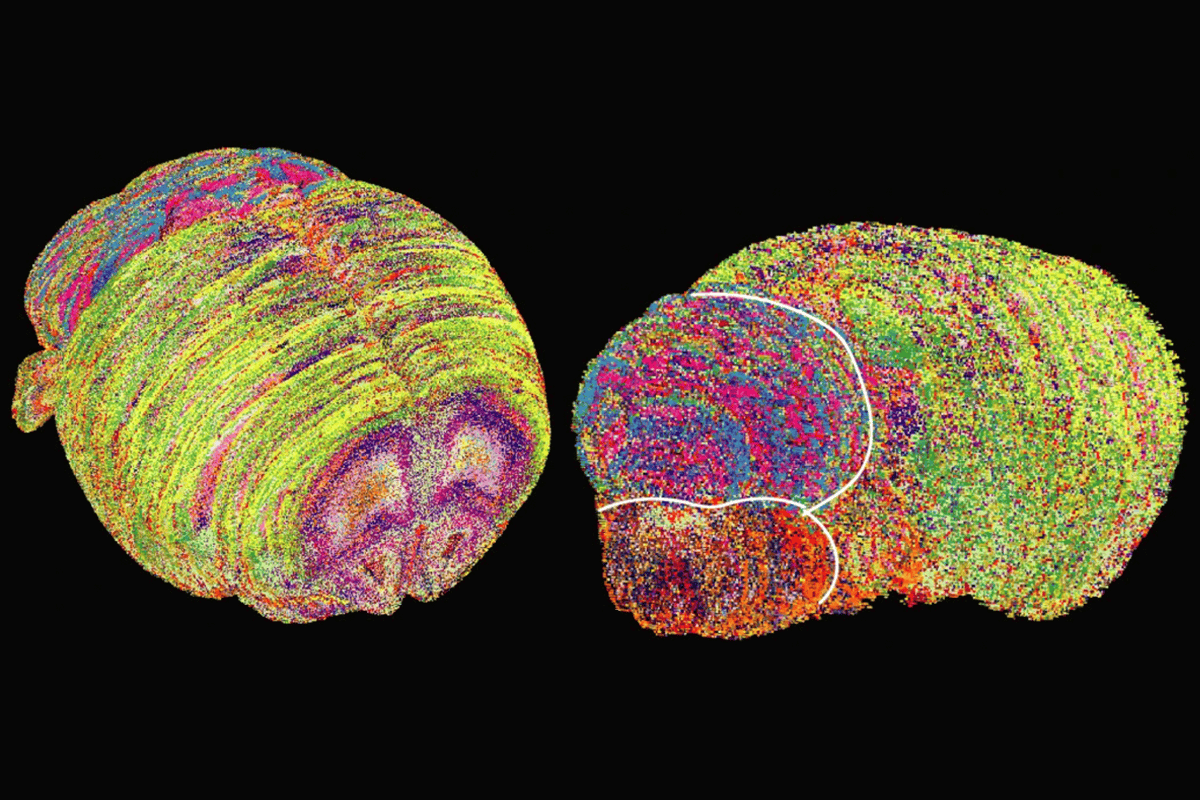
3D views of the mouse brain, each pixel colored by which of the 539 lipid zones it falls in.1 / 2
Researchers have published the first three-dimensional, high-resolution map of fats across a whole mouse brain. It shows that lipids, the molecules that build cell membranes, organize the brain in ways gene maps miss. A second study suggests lipid changes help drive brain aging rather than simply going along with it.
A map of 539 fat zones
The atlas, published in Nature, used 1. The technique identifies molecules spot by spot across a tissue slice and builds an image of where each one sits. The team tracked 172 membrane lipids across 109 brain sections from 11 mice and found 539 distinct regions, which they call "2."
These zones don't line up with existing maps of gene activity, including the 3, a standard reference. In one cortical region that handles whisker touch, the team found 14 lipizones that gene data couldn't tell apart. "You cannot, simply by looking at gene expression, understand the story," says co-author Gioele La Manno of the École Polytechnique Fédérale de Lausanne (EPFL).
4, the fatty insulation on long nerve fibers, also gave distant regions matching lipid signatures. That makes the map a rough "shadow" of brain wiring. Pregnancy changed the lipid map more than sex did, especially in sensory parts of the cortex. The researchers suggest this may sharpen mothers' sensitivity to their pups, possibly under the control of stress-hormone signals.
One enzyme and aging stem cells
The second study, in Science Advances, followed 5: brain cells that have stopped dividing but can restart. As mice aged, these cells built more of their membranes from 6, which pack loosely and make membranes less ordered.
Yale's Xiaoai Zhao and colleagues focused on 7, an enzyme that remodels these fats and is less active in old cells. Knocking it out pushed cells toward an older lipid profile. Boosting it did the reverse. It raised the cells' ability to reactivate by 9 percent in young cells and 32 percent in old ones, and nearly doubled (+97 percent) the share of dividing stem cells in old mice. Zhao argues this shows lipids are "not simply a bystander."
Caveats
Both studies were done in mice. Martin Giera of Leiden University Medical Center, who wasn't involved, calls the enzyme finding "new and solid" and a rare possible target for treating neurodegeneration. He adds two cautions. The stem-cell work measured only dozens of lipids where other methods can measure hundreds. And the rise in PUFAs with age might partly come from failing 8, the cell's recycling compartments, rather than from the enzyme alone.
Two new mouse studies make the case that lipids, the fats that make up cell membranes, deserve a place in brain mapping beside genes and wiring. The first, published in Nature, is the first three-dimensional, high-resolution atlas of lipids across a whole mouse brain. The second, published in July in Science Advances, follows how lipids change in the brain's stem cells as mice age. It also shows that adjusting a single enzyme can push old stem cells back toward a younger state.
Why lipids have been neglected
"Genes and proteins are the prom kings and queens" of neuroscience, says Bruce Cohen, a psychiatry professor at Harvard Medical School who worked on neither study. Lipids still do a great deal. They form the membranes of cells, organelles and the nucleus, they supply energy, and they act as signaling molecules. In people with late-onset Alzheimer's disease, lipids in astrocytes, a type of support cell, are altered. "Anything that goes on with a cell goes across a membrane, along a membrane, within a membrane," Cohen says.
Gioele La Manno of the École Polytechnique Fédérale de Lausanne (EPFL), an investigator on the atlas, says the field lags because lipids are hard to study. Cells can make the same lipid by several chemical routes. Changing one enzyme doesn't change one lipid; "you change maybe 100 of them." With genes, one gene makes one product, so you can trace cause and effect. With lipids, the links form a tangled network.
The atlas: 539 "1"
The team used 2. The technique works through a thin tissue slice spot by spot, identifies the molecules at each spot by their mass, and builds a picture pixel by pixel. They measured 172 membrane lipids across 109 brain sections from 11 mice. When they grouped pixels by lipid makeup, the brain sorted into 539 distinct regions, which they call "lipizones."
The lipizones don't line up neatly with existing gene-based maps. The team compared them with maps of where lipid-making enzymes are expressed, with maps of metabolism-related genes, and with the full transcriptome (all gene activity) in the 3. La Manno says the mismatch surprised him. Early in his PhD he had argued, in what he now calls an "overassertive tone," that any change in a cell should show up in its RNA. Years later he found 14 separate lipizones inside one cortical region that handles fine-grained whisker sensation, and gene expression alone could not tell them apart. "You cannot, simply by looking at gene expression, understand the story," he says.
The map also shows what La Manno calls a "shadow of connectivity." Long-range neurons are wrapped in myelin, a fatty insulating sheath, and that myelin leaves a lipid signature. So regions millimeters apart can carry "basically the same lipidome," the same overall set of lipids, which hints at the wiring between them. On this account, lipids give a view of connections that standard methods don't.
Pregnancy reshapes the map
Lipids differed less between male and female mice than between pregnant females at mid-gestation and females that weren't pregnant. Pregnancy affected most lipizones. Some changed size but kept their composition; others changed composition but kept their size. The cortical regions that changed most suggest the lipid shifts tune sensory circuits, perhaps making mothers more sensitive to their pups. That reading is the researchers' interpretation, not something they measured.
The team also proposes a control route. The enzymes that make these lipids are governed by master regulators, which in turn take signals from glucocorticoid receptors, the sensors for stress hormones. That chain suggests one way hormones could steer lipid tuning during pregnancy.
The aging study: from correlation to cause
Xiaoai Zhao, an assistant professor at Yale School of Medicine, and her team studied 4: cells that have paused dividing but can restart. As mice aged, these cells shifted toward lipids with polyunsaturated fatty acid (PUFA) side chains. PUFAs have many double bonds, which put kinks in the chains so they pack loosely, and older cells had less ordered membranes as a result. "This could be related to their functional decline," Zhao says.
To find enzymes that might drive this shift, the team set three criteria: the enzyme remodels PUFA side chains, it is highly expressed in quiescent neural stem cells, or its expression changes significantly with age. Five enzymes met two of the three. One, 5, is more active in young quiescent stem cells than in old ones in the subventricular zone, a stem-cell niche lining the brain's fluid-filled ventricles.
The researchers then manipulated it:
Knocking out MBOAT2 in young and old stem cells shifted their lipids toward an older profile.
Overexpressing MBOAT2 did the opposite. It raised the cells' ability to reactivate by 9 percent in young cells and 32 percent in old ones. In old mice, the proportion of dividing neural stem cells rose by 97 percent.
Adding membrane lipids taken from young stem cells to old ones gave a small increase in reactivation.
That last result matters for the argument. Lipid changes have long been seen in aging and neurodegeneration, but "there was always a question whether what you are seeing is the cause or the consequence," Zhao says. Because changing the lipid profile changed how the cells behaved, she argues the lipidome is "not simply a bystander. It is actually playing an active role."
Caveats and open questions
Martin Giera, a lipidomics researcher at Leiden University Medical Center who was not involved, calls the MBOAT2 finding "new and solid." He notes that few drug targets exist for neurodegeneration, so each new one is worth pursuing. He also raises two limits. First, the stem-cell work measured dozens of lipids in place, while other technologies can resolve hundreds, so finer detail is likely being missed. Second, the rise in PUFAs with age could come partly from lysosomal dysfunction, a breakdown of the cell's recycling system that is typical of aging neural stem cells, rather than from enzyme changes alone.
Both studies were done in mice, and the article doesn't say whether the patterns hold in humans. Cohen sees the atlas mainly as a baseline. You have to know what a normal brain looks like before you can spot what changes with disease, aging, drugs or toxins. Giera is blunter about how much is still unknown: "It's just ridiculously complicated, that's what it is, and we really understand very little of it."
Remember
Mapping lipids picked out brain regions that gene-activity maps couldn't tell apart, so RNA alone misses some of the brain's organization.
Changing lipid levels changed how stem cells behaved, which supports lipids causing aging effects rather than just accompanying them.
Pregnancy reshaped the brain's lipid map more than biological sex did, especially in sensory regions.
Where SHERLOC's calibration target sits on Perseverance, with a close-up of its sample swatches, including the spacesuit fabrics.1 / 2
NASA's Perseverance rover has measured Martian dust in the size ranges most dangerous to human lungs. It did this using small samples of spacesuit fabric it has carried for 1,645 1, roughly four and a half Earth years. The peer-reviewed results appear on 27 October in the Proceedings of the National Academy of Sciences.
Why dust worries mission planners
On Apollo, lunar dust scratched visors, wore down suits and damaged seals, and some astronauts had symptoms like hay fever. Mars dust is less sharp, because wind-driven collisions round its grains. But it contains 2, salts that can disrupt the thyroid, and reactive iron that damages cells. Dust storms also keep it circulating in the atmosphere. Earlier Mars instruments could only resolve grains down to about 3 micrometers. That is just above the 2.5-micrometer limit that health agencies on Earth use for "fine" particles, which reach deep into the lungs.
How the rover measured it
Two instruments on Perseverance's arm carry 3, reference panels used to check their settings. The target for 4, an instrument that searches for organic molecules, includes five 20-millimeter spacesuit swatches. The team analyzed two of them, Teflon and 5, a strong fiber used in suits. The target for , an X-ray instrument that identifies chemical elements, carries Teflon and .
PIXL took the measurements. Teflon contains no elements PIXL can detect, so any signal from the Teflon sample has to come from dust lying on it. The article doesn't explain how the team worked out particle sizes from this data.
What they found
Grains on PIXL's Teflon and on the Vectran averaged about 2 micrometers. A human hair is about 70 micrometers wide.
Grains on the basaltic glass and on SHERLOC's Teflon went down to 100–300 nanometers, the "ultrafine" range. On Earth, particles this small can enter the bloodstream or travel from the nose to the brain.
Static electricity seems to decide what sticks where. Grains pick up charge as they collide in the air, and each material attracts grains of particular sizes. Larger clumps shook off over time, but the finest grains stayed through years of driving and drilling. Lead author Scott VanBommel says these smallest particles are "the ones that pose the greatest challenge for human support systems."
The Teflon result matters because polymers like it are common in spacesuit outer layers, and they readily collect fine dust. Some other materials held less. The dust's chemistry matched earlier measurements, and it also contained phosphorus and signs of calcium sulfate.
What it means and what's missing
The results could guide the choice of suit materials and coatings, and designs that keep dust out of living quarters. One example is 8, where the suit stays attached to the outside of the habitat. NASA is already testing electric-field dust cleaners on the Moon. The samples are few and fixed to a rover deck, though, and the article gives no figures for how much dust built up. How much a crew would actually breathe in remains unknown.
NASA's Perseverance rover has made the first measurements on Mars of fine and ultrafine dust, the size ranges linked to health damage on Earth. It found this dust clinging to samples of spacesuit material that the rover has carried for 1,645 1, roughly four and a half Earth years. The paper is published on 27 October in the Proceedings of the National Academy of Sciences, a peer-reviewed journal. NASA says the results will inform spacesuit and habitat design, dust-removal procedures and health limits for future crews.
The problem: dust that gets everywhere
Dust has caused trouble for surface exploration since Apollo. On the Moon it scratched visors, wore down the outer layers of suits and damaged seals, and some astronauts had symptoms like hay fever. Mars dust differs in a few ways. Its grains have been rounded by wind-driven collisions, so they scratch less than lunar dust. They are richer in sulfur, chlorine and iron and contain more silica. And regional and global dust storms keep lifting grains back into the atmosphere, so a crew could not simply avoid dusty areas.
The dust is also chemically reactive. It contains 2, salts that can disrupt thyroid function, and reactive iron that damages cells. According to NASA, scientists think the health risk depends on how much dust a person takes in and for how long. Engineers therefore need to know which sizes of grain are present and which surfaces they cling to.
Earlier Mars instruments could only resolve particles down to about 3 micrometers. That is just above the 2.5-micrometer limit that defines "fine" particulate matter on Earth, so the most medically important range had never been measured.
What was done: reusing 3
Perseverance's robotic arm carries two instruments that were used here:
4 (Scanning Habitable Environments with Raman and Luminescence for Organics and Chemicals) looks for organic molecules. Its calibration target, the reference panel it uses to check its settings, includes five spacesuit-material swatches, each 20 millimeters square. NASA sent them to see how suit materials hold up on the Martian surface. The team analyzed two of them: Teflon and 5, a high-strength fiber used in suits.
PIXL made the dust measurements. Teflon contains no elements PIXL can detect directly, so any elemental signal from the Teflon sample has to come from dust sitting on it. As an analogy, it works like a black background in a photograph: whatever shows up is something on top of it. The article does not explain how the team worked out particle sizes from PIXL's data.
The approach reuses hardware built for other jobs. Lindsay Hays, acting director of NASA's Planetary Science Division, describes it as using existing data to answer questions it was never collected for.
Results
PIXL found two groups of particles smaller than anything resolved on Mars before:
Fine particles, under 2.5 micrometers. On PIXL's Teflon and SHERLOC's Vectran swatch, grains averaged about 2 micrometers. A human hair is about 70 micrometers wide.
Ultrafine particles, around 100 nanometers, about 700 times thinner than a hair. On PIXL's basaltic glass and SHERLOC's Teflon swatch, sizes went down to about 100–300 nanometers.
Different materials held different sizes of grain. The team attributes this to static electricity. Grains pick up charge when they collide in the air, and each material attracts grains of particular sizes. The finest particles stayed attached through years of driving and drilling, while larger clumps fell off. Lead author Scott VanBommel of Washington University in St. Louis said: "The larger clumps, the Martian dust bunnies, get shaken off over time. But the smallest particles stay behind, and those are the ones that pose the greatest challenge for human support systems."
One result is directly practical. Organic polymers like SHERLOC's Teflon swatch are common in the outer layers of spacesuits, and they readily collect fine dust. Some other materials held less dust, which could guide the choice of materials and coatings.
The dust's chemistry matched the iron- and sulfur-rich composition earlier missions measured. PIXL also found it enriched in phosphorus and saw signs of calcium sulfate.
Why the sizes matter for health
On Earth, particles under 2.5 micrometers are linked to a range of health effects because they reach deep into the lungs and can enter the bloodstream. Studies have also shown that particles of 100 nanometers or smaller can travel from the nasal cavity to the brain along the olfactory nerve, the nerve for smell. Mars dust in these sizes, carrying perchlorates and reactive iron, is the kind of material that indoor exposure limits for astronauts would need to cover.
Engineering responses
The article describes several approaches. Suitports let an astronaut climb into a suit that stays attached to the outside of the habitat, so the dusty suit never comes inside. Dual-chamber airlocks add an extra stage between outside and the living space. NASA is also testing electrostatic cleaning on the Moon. In March 2025 an Electrodynamic Dust Shield, built at Kennedy Space Center, used electric fields to clear lunar soil from glass and radiator surfaces aboard Firefly Aerospace's Blue Ghost Mission 1. At Johnson Space Center, engineers test suit parts and a handheld electrostatic dust tool in vacuum chambers filled with simulated lunar soil, ahead of the Artemis Moon missions.
The finding that static charge holds the finest dust in place helps explain why electric-field cleaning is a reasonable approach. The article does not say whether such tools work on 100-nanometer grains.
Caveats and open questions
The samples are small, few in number and fixed to a rover deck, not worn by a moving astronaut. The article does not say how many grains were measured, how uncertain the size estimates are, or how much dust built up over time. That makes it hard to estimate how much dust a crew would actually breathe in. The health concerns also come from studies of particles on Earth, not from tests of Martian dust in living tissue. The results show which grain sizes are present and that they cling. How harmful they are at realistic exposures remains unknown.
Remember
Fabric and glass samples the rover carried for other reasons gave the first on-Mars measurements of health-relevant dust sizes.
Static charge, not just grain size, decides which grains cling to which material, and the finest grains stay attached longest.
Teflon-like polymers common in spacesuit outer layers readily collect fine dust, so the choice of suit materials matters.
A Klein bottle, the one-sided surface the researchers use to model Condorcet's voting paradox.
A new shape for an old paradox
Three mathematicians have shown that Condorcet's voting paradox, first described in 1785, can be modelled as a 1: a closed surface with only one side and no edge. The team is Ori Livson, a doctoral student at the University of Sydney, his adviser Mikhail Prokopenko, and Siddharth Pritam of the Chennai Mathematical Institute. Quanta's article doesn't say whether the work has been peer-reviewed.
The paradox
Imagine three equal blocs of voters. One ranks Alice > Bob > Carol, one ranks Bob > Carol > Alice, and one ranks Carol > Alice > Bob. Each voter's ranking is consistent. But two blocs prefer Alice to Bob, two prefer Bob to Carol, and two prefer Carol to Alice. Every candidate loses a head-to-head race to someone.
In 1951 Kenneth Arrow showed the problem is general. No method of combining ranked ballots can satisfy every one of a handful of reasonable fairness conditions, such as "no dictator" and "if everyone prefers X to Y, so does the group." In 1980 Graciela Chichilnisky suggested in a footnote that Condorcet's paradox might be topological. 2 is the study of how shapes connect, ignoring stretching.
How the model is built
The work extends a 1993 construction by Yuliy Baryshnikov, now at the University of Illinois. With three candidates there are six possible ballots. Draw each one as a triangle whose corners are the three pairwise comparisons it implies. For example, Alice > Bob > Carol gives Alice over Bob, Bob over Carol and Alice over Carol.
Ballots that differ by one swap share two comparisons, so their triangles share an edge. Joining all six gives a strip, and gluing its ends gives a tube open at both ends. Baryshnikov used this tube to prove 3.
The tube's two rims are the interesting part. Going round one rim reads Alice over Bob, Bob over Carol, Carol over Alice, which is a 4. The other rim holds the reverse cycle. Baryshnikov ignored the rims.
Livson's team reasoned that both rims express the same impossibility, so they should be glued together. A straight join makes a 5, the surface of a doughnut, but it pairs up contradictory edges. Reversing one rim before gluing fixes that. "Gluing with the twist is the only valid option," Livson says. A tube glued with a twist is a Klein bottle.
What it means
The researchers point to a parallel. Each patch of a Klein bottle looks two-sided, but the whole surface has no consistent outside. Likewise, each ballot is coherent, but together they don't form one ranking. They hope topology might explain other impossibility results too. That is still a hope.
Choosing a voting system is still a matter of picking which fairness condition to give up. As Oxford's Iain McLean puts it, "It's a debate about values."
A paradox gets a shape
Condorcet's voting paradox is 240 years old, and three mathematicians have now given it a precise geometric form: a 1, a closed surface with only one side. Ori Livson, a doctoral student at the University of Sydney, worked with his adviser Mikhail Prokopenko and with Siddharth Pritam of the Chennai Mathematical Institute. They extended a 1993 model of ballots so that it also captures the circular group preferences at the heart of the paradox. Quanta's account traces Livson's rethink to April 2025. It doesn't say where, or whether, the work has been peer-reviewed.
The problem: majorities that go round in circles
With two candidates, majority rule is simple. With three, even the meaning of "winning" gets slippery. Suppose Alice gets 35% of the vote, Bob 34% and Carol 31%, and all of Carol's supporters prefer Bob to Alice. Plurality voting elects Alice, yet 65% of voters would rather have Bob.
One fix is to rank candidates and elect whoever beats every rival head to head. Condorcet found that sometimes no such candidate exists. Take three equal blocs of voters:
one third rank Alice > Bob > Carol
one third rank Bob > Carol > Alice
one third rank Carol > Alice > Bob
Two of the three blocs prefer Alice to Bob, two prefer Bob to Carol, and two prefer Carol to Alice. Every individual ballot is consistent. The group result is a loop.
Condorcet came across this while trying to make elections to the French Academy of Sciences fair. He later defended women's political rights, and he died in prison during the Reign of Terror.
In 1951 Kenneth Arrow showed the problem is general. He asked for a few conditions. Voters may rank candidates in any order. No single voter dictates the outcome. If everyone prefers X to Y, so does the group. And the group's ordering of two candidates depends only on how voters compare those two, so where Carol sits on ballots can't change whether Alice beats Bob. No method satisfies all of these. "Quite often the will of the people doesn't exist," says Iain McLean of the University of Oxford. In his view, designers must choose "which of the conditions it's most harmless to fail."
Why topology?
In 1980 the mathematician and economist Graciela Chichilnisky brought topology to these questions. In a footnote, she suggested that Condorcet's paradox in particular might be a topological problem. 2 asks how pieces connect globally, not about distances, so it suits a situation where everything looks fine locally but fails as a whole.
How the model is built
The starting point is a construction from 1993 by Yuliy Baryshnikov, now at the University of Illinois Urbana-Champaign. With three candidates there are six possible ballots. Each ballot implies three pairwise comparisons. Alice > Bob > Carol implies Alice over Bob, Bob over Carol and Alice over Carol. Draw the ballot as a triangle with those three comparisons at its corners.
Two ballots that differ by swapping adjacent candidates share two comparisons. Alice > Carol > Bob still has Alice over Bob and Alice over Carol, so its triangle shares an edge with the first one. Joining all six triangles along matching edges gives a strip. The strip's two end edges match too, so gluing them makes a tube open at both ends. Baryshnikov used this tube to give a topological proof of 3.
Look at the two open rims, though. Going round one rim, you read Alice over Bob, Bob over Carol, Carol over Alice. That is a 4. The other rim has the reverse cycle. These rims are exactly the combinations no single ballot can produce. Baryshnikov set them aside.
Closing the tube
Livson wanted a model that could tell apart settings where cycles are fine from settings where they aren't. Rock-paper-scissors is cyclic by design, but elections are supposed to produce a ranking. The team modelled the second case.
Their reasoning was that both rims say the same impossible thing: every candidate ranks above every other. In topology, as Livson puts it, "once you realize two things are the same, you can glue them together." The question was how to glue them.
Bending the tube until its ends meet straight on gives a 5, the surface of a doughnut. But that pairs up incompatible edges. For example, an edge meaning "Bob over Alice over Carol" gets glued to one meaning "Bob over Carol over Alice." The fix was to reverse the order around one rim before gluing, which makes the two cycles line up. "Gluing with the twist is the only valid option," Livson says.
A twisted strip gives a 6. A tube glued with a twist gives a Klein bottle: one-sided like a Möbius strip, but with no edge at all. In three dimensions it has to pass through itself. In four dimensions it closes without self-intersection.
What the shape says
The analogy the researchers draw goes like this. Any small patch of a Klein bottle looks two-sided, but you can't pick a consistent "outside" across the whole surface. In the same way, each voter's ranking is coherent, but the electorate's preferences can't be fitted into one order. In both cases, pieces that make sense locally fail to fit together globally. This is an interpretive parallel. The article doesn't say whether the Klein bottle model proves anything new about voting beyond what Condorcet and Arrow already established.
Open questions and limits
The model as described covers three candidates. The article doesn't say whether it extends to more. The researchers' bigger question is whether other fundamental impossibility results in mathematics, once given a shape, share a common geometric explanation. For now that is a hope, not a result.
None of this changes the practical situation. Choosing a voting system still means choosing which fairness condition to give up. "It's not really a mathematical debate," McLean says. "It's a debate about values."
Remember
Each three-candidate ballot can be drawn as a triangle, and all six triangles join into a tube.
The tube's open rims are exactly the circular majorities, which no single ballot can produce.
Joining the rims straight makes contradictory pairings. Only a twisted join, giving a Klein bottle, is consistent.
Indonesian stamp of Mount Tambora, whose 1815 eruption led to 1816's 'year without a summer.'1 / 2
A new review in the Annual Review of Earth and Planetary Sciences asks how much large volcanic eruptions have shaped human history. Clive Oppenheimer, Ulf Büntgen and colleagues at the University of Cambridge analyzed the 38 largest eruptions between A.D. 1 and 1900. They linked each eruption's climate effects to evidence of famine, disease, unrest and cultural change. The review pulls together existing studies, and many of its historical links are interpretations, not proofs.
The mechanism
Eruptions release sulfur gases. Over a few weeks these form 1, fine particles that block sunlight, stay aloft for months and spread around the globe. The best-known case is Indonesia's Mount Tambora in 1815. It killed more than 71,000 people nearby. The next year, summer frosts destroyed crops from New England to China and Ireland, bread riots broke out, and typhus may have spread faster. People at the time didn't know a volcano was behind any of it.
How researchers know
2 from Greenland and Antarctica hold sulfur layers that date eruptions. 3 record summer temperatures year by year. In very cold summers, trees can't finish forming wood, and a chemical test turns those rings blue. Büntgen's team found two blue rings in a row around 1345, which he calls very rare. In a 2025 study they connected those cold summers to failed Mediterranean harvests and to Italian imports of flea-ridden grain as the 4 spread.
The numbers
On average, each of the 38 eruptions cooled the Northern Hemisphere by about 0.5 °C the following year.
Temperatures recovered more slowly when an eruption came during an already cold period.
11 of 17 major European famines between 1300 and 1800 followed big eruptions. The article doesn't give a base rate, so it's hard to judge how unusual that is.
Society decides the damage
Heli Huhtamaa, a historian at the University of Bern, argues that a society's vulnerability matters more than the size of the cooling. In 5, a region of present-day Finland, the coldest of three 17th-century volcanic episodes came in 1695. Yet only about 7% of peasants lost their land then, compared with 20% after the earlier ones. The reason was tax relief from the crown, given to protect future revenue, not out of charity. She says historians long dismissed climate explanations as "lazy." Studying how past societies responded could help a warming world prepare.
The most speculative link involves religion. Oppenheimer's team suggests that the Icelandic poem 6 describes the 7 eruption of 939 and may have helped Iceland convert to Christianity around 1000.
A review in the 2026 Annual Review of Earth and Planetary Sciences tries to measure how much large volcanic eruptions have shaped human history. Cambridge volcanologist Clive Oppenheimer, paleoclimatologist Ulf Büntgen and colleagues analyzed the 38 largest eruptions between A.D. 1 and 1900. They pulled together studies that connect each eruption to its effect on climate and then to possible consequences for food, the economy, unrest, culture and religion. Science News reports the work. It is a synthesis of existing research, not a new experiment, and much of what it says about cause and effect is still interpretation.
The template: Tambora
The best-studied case is Mount Tambora in present-day Indonesia, which erupted in 1815 and killed more than 71,000 people nearby. Its 1, the fine airborne particles it released, changed weather far away. In the summer of 1816, frosts and snow destroyed corn in New England, rice and buckwheat in China, and wheat, oats and potatoes in Ireland. Bread prices rose and set off protests and riots, and the conditions may have helped typhus spread. People called it "the year without a summer" or "the year of the beggars." Lord Byron's poem Darkness, written that year, may have drawn on the gloom. "These climatic impacts of the Tambora eruption were recorded without any knowledge that this had anything to do with an eruption," Oppenheimer says. People wrote down the effects without knowing the cause, and that problem runs through the whole field.
How an eruption cools the planet
Volcanoes release sulfur-bearing gases. Over a few weeks these react in the atmosphere to form particles that block sunlight. The particles can stay up for many months and ride the jet streams around the globe. Paintings made in the years after eruptions show blood-red sunsets and hazy skies. A more explosive eruption sends its gases higher, and that changes where they travel and how long they last. Büntgen warns that no two eruptions behave alike: "If we understand the climate response of one [eruption], that does not mean that we understand the climate response of another."
How researchers date and measure them
Researchers use two kinds of natural archive. 2 from Greenland and Antarctica contain layers loaded with sulfur that record eruptions. Scientists try to date those layers precisely and then compare them with tree rings, which serve as a yearly log of summer growing conditions because temperature affects how much wood a tree lays down. By combining ring records from distant sites with statistics, they can estimate annual temperatures across a hemisphere.
Some cold years stand out sharply. In very cool summers, trees can't finish forming wood, and a chemical method used to estimate temperatures turns those incomplete rings blue. Büntgen's team found two blue rings in a row around 1345. "We never saw that two years in a row," he says. In a 2025 paper in Communications Earth & Environment, they linked those cold summers to poor Mediterranean grain harvests. Shipping records show that Italian city-states then imported grain from the Caucasus that carried plague-infested fleas, just as the 3 was spreading through Europe. That paper sets out a chain of plausible links. Each link is backed by evidence, but the chain as a whole is an argument, not a proof.
The numbers from the review
Across the 38 eruptions, Northern Hemisphere temperatures fell by about 0.5 °C on average in the year after each one. Temperatures recovered more slowly when an eruption hit during a period that was already cold. Very large eruptions, or several in a row, could keep aerosol levels high for years. The team's calculations show high aerosol levels lining up with some of the coldest spells of the past two thousand years, including the one before the Black Death.
On the human side, 11 of the 17 large-scale famines in Europe between 1300 and 1800 followed major eruptions. After crop failures and famine, the responses that studies described most often were disease outbreaks, political turmoil and migration. The article doesn't say how often major eruptions happened overall. Without that base rate, a reader can't tell how unlikely 11 of 17 would be by chance.
Vulnerability matters more than the cooling
Heli Huhtamaa, a climate and environmental historian at the University of Bern, argues that the society an eruption hits matters as much as how cold it gets. Her team studied 4, a region in what is now Finland, which went through cooling from three separate sets of 17th-century eruptions. The last one, in 1695, was the coldest. Even so, only about 7 percent of peasants lost their farmland then, compared with about 20 percent after the earlier episodes (Climate of the Past, 2022). People still starved. The difference, she says, was tax relief from the Swedish crown. That relief wasn't charity. It was meant to protect the tax base from decades of lost revenue. "It doesn't matter if it's 0.5 or 1.5 degrees cooler, because what really matters is the societal vulnerability," Huhtamaa says.
She also notes that historians have long been wary of climate explanations. They saw human agency as the only serious explanation for human affairs, and "climate explanations sounded lazy." She points to a recent report from the 5, the UN's climate science body, which said too little research has looked at how societies respond to climate shocks. Two research designs could help: comparing one place's responses to different eruptions, as in Ostrobothnia, or comparing how different places responded to the same eruption. Bringing in ecology, agronomy and economics would also help.
Culture and belief
Some evidence comes from culture. Stanza 57 of 6, a 10th-century Icelandic poem, describes a sun turning black and flames flying "high against heaven itself." Oppenheimer reads it as "like an eyewitness description of a phenomenal lava flood" from Iceland's 7 eruption in 939. The poem foretells a fiery end for pagan gods such as Odin, who are replaced by a single god. Oppenheimer and colleagues suggest this may have helped Iceland convert to Christianity around 1000. That is the most speculative claim in the story.
What remains open
The review can't place or date some eruptions behind notable cold spells. It also relies mostly on Northern Hemisphere tree rings and European records, so other regions are covered less well. The physical chain, from sulfur to aerosols to cooling, is well established. The links from cooling to social outcomes are case studies, and they hold only as well as their historical sources.
Remember
Ice-core sulfur layers matched with tree rings let scientists date eruptions and measure their cooling year by year.
Cooling recovered more slowly when eruptions struck already-cold periods, and back-to-back eruptions caused long cold spells.
In 1690s Finland, tax relief, not milder weather, kept most peasants on their land after the coldest eruption.
The IceCube neutrino detector at the South Pole. It finds ordinary neutrinos, but no right-handed neutrino has ever been detected.
The news
Physicists usually leave one hypothetical particle out of their models of the early universe. A new theoretical study argues it may have run the show. Rishav Roshan (University of Southampton) and Sudipta Show (Indian Institute of Technology Kanpur) report in Physical Review Letters (Sept. 8) that a very heavy "right-handed" neutrino could briefly have held more energy than everything else in the infant cosmos combined. If so, it would have changed when matter gained its edge over antimatter.
This is a calculation, not a detection. No right-handed neutrino has ever been observed.
Why these particles are proposed
Neutrinos switch between their three flavors as they travel, which requires mass. The 1, physics' core theory of particles, says they should be massless. A popular fix is the 2. Each ordinary neutrino carries a faint quantum trace of a heavy "right-handed" partner, one that spins the opposite way relative to its motion and doesn't feel the weak nuclear force. The heavier the partner, the lighter the ordinary neutrino.
The same partners could explain why matter exists. In 3, heavy neutrinos decaying soon after the Big Bang left slightly more 4 (the electron's family) than antileptons, and that surplus became today's matter. The framework has three such neutrinos, but two fit the data, so the third is usually ignored.
How the third one takes over
In the authors' main example, the neglected neutrino weighs about 100 trillion proton masses. While it moved near light speed, its energy faded like light's: spread out and stretched to longer wavelengths as space expanded. Once the universe cooled and it slowed down, its energy sat mostly in its mass, which only spreads out. Its share of the total therefore grew until it dominated, and it stayed dominant until it decayed.
More energy means faster expansion. A particle interaction only switches on once it happens faster than space is expanding, so several interactions had to wait for further cooling. These include the ones that let the universe tell lepton flavors apart. Because of that delay, the team found that a lighter right-handed neutrino, about 100 billion proton masses, could produce the observed amount of matter before flavors separated. This held even after the heavy neutrino's decay diluted part of it.
Can it be tested?
The heavy neutrino is far beyond any accelerator's reach. An era it dominated would, however, leave a kink in the background of gravitational waves from the early universe, such as waves from hypothetical "5." Two future facilities could look for it: 6, a European Space Agency space mission due around 2035, and the 7, which would time distant pulsars. Whether a kink, if seen, would point uniquely to this neutrino is still an open question.
The news
Theorists usually leave out one hypothetical particle when they model the early universe. Rishav Roshan of the University of Southampton and Sudipta Show of the Indian Institute of Technology Kanpur argue that this may be a mistake. In a paper published Sept. 8 in Physical Review Letters, they calculate that a very heavy "right-handed" neutrino could briefly have held more energy than everything else in the infant universe combined. That would have sped up cosmic expansion, delayed several key particle interactions and shifted the conditions under which matter won out over antimatter.
The work is a calculation, not an observation. No right-handed neutrino has ever been detected.
Why physicists invoke right-handed neutrinos
Neutrinos hardly interact with anything. A typical neutrino from the Sun could pass through a slab of lead a light-year thick before hitting an atom. They come in three flavors and change from one to another in flight. That quantum effect only works if they have mass, yet the 1, the established theory of particles, says they should have none.
A common fix adds right-handed neutrinos. "Handedness" describes how a particle spins relative to its direction of travel. A right-handed particle turns like an ordinary screw being driven in, clockwise as it moves away from you. Every neutrino ever detected is left-handed and turns the other way. Roshan describes the right-handed versions as particles with no electric charge that don't feel the weak nuclear force and are much heavier than ordinary neutrinos.
In the 2, each ordinary neutrino is a quantum blend that carries a faint trace of a heavy right-handed partner, and that trace gives it a tiny mass. The heavier the partner, the fainter the trace and the lighter the ordinary neutrino, like the two ends of a playground seesaw.
The same particles could explain matter's existence. In 3, heavy right-handed neutrinos decaying in the early universe left a small surplus of 4, the particle family that includes electrons. That surplus later became today's excess of matter over antimatter. Roshan says right-handed neutrinos could also bear on what dark matter is.
The standard seesaw framework includes three right-handed neutrinos. Two are enough to explain the data, so physicists often ignore the third and assume it is too heavy, or interacts too weakly, to matter.
How the neglected neutrino takes over
Roshan and Show asked what that third particle would actually do. In their main example it weighs about 100 trillion proton masses. That is roughly 10 billion times more energy than the Large Hadron Collider can reach. (This comparison is ours, not the article's.)
The mechanism comes down to how different kinds of energy thin out as space expands:
Fast-moving particles behave like light. As space stretches, they spread out and their wavelengths stretch, so their energy density falls doubly fast.
Slow, heavy particles behave like ordinary matter. Most of their energy is locked in their mass, which only spreads out.
As an illustration, double the size of the universe. Radiation's energy density drops to one-sixteenth, while the energy density of slow heavy particles drops to one-eighth. Every doubling therefore doubles the heavy particle's share relative to radiation. Early on the heavy neutrino moved near light speed and faded like radiation. Once the universe cooled enough for it to slow down, its share grew steadily until it dominated. Because it is long-lived, it stayed in charge until it decayed. The authors call this a period of "5."
Why that changes the matter story
The expansion rate depends on total energy, so a universe dominated by the heavy neutrino expands faster at a given temperature. Particle interactions only "switch on" once they happen faster than space is expanding. In a faster-expanding universe, several Standard Model interactions therefore had to wait until things cooled further.
Those delayed interactions are the ones that let the early universe tell lepton flavors (electron, muon, tau) apart, which affects how the lepton surplus forms. With the delay, the team found that a lighter right-handed neutrino, about 100 billion proton masses, could have produced the observed amount of matter before the flavors became distinguishable. This held even after the heavy neutrino's later decay diluted part of that surplus by releasing a burst of new radiation.
The article doesn't explain in detail why producing the asymmetry before flavors separate is an advantage. In leptogenesis generally, whether flavors are distinguishable changes how efficiently a surplus survives, so moving that threshold changes which neutrino masses can work.
How it could be tested
The heavy neutrino can't be made in any accelerator, so any test has to be indirect. The most promising route is gravitational waves, ripples in space-time. Many models predict a background of such waves from the early universe, for example from 6, hypothetical thread-like defects in space. An era of early matter domination would change how fast the universe expanded while those waves were produced, leaving a characteristic kink in their spectrum.
Roshan points to two future facilities:
7 (Laser Interferometer Space Antenna), a European Space Agency mission scheduled to launch around 2035.
SKAO (8), a giant radio telescope being built in Australia and South Africa. It could detect such waves by precisely timing distant pulsars, whose regular pulses shift slightly when a wave passes.
The hot primordial plasma would also have produced a faint gravitational hum carrying the era's imprint. Its frequencies, though, are beyond any existing detector.
What remains open
This result is entirely theoretical. It depends on right-handed neutrinos existing at all, on the seesaw picture being correct, and on the specific masses and lifetimes the authors chose. The gravitational-wave signal also depends on a background like the one from cosmic strings being there to carry it, and cosmic strings are themselves unconfirmed. A detected kink would be consistent with early matter domination but not unique proof of it, since other heavy, long-lived particles could produce a similar effect. The article doesn't say how distinctive the predicted signal is.
The paper's main point is more modest and holds regardless: a particle theorists routinely drop may not be negligible, and leaving it out could change the answer to why matter exists.
Remember
Slow heavy particles dilute more slowly than radiation, so even a small early share can grow until it dominates.
Faster expansion delays particle interactions, which shifts which neutrino masses can produce the observed amount of matter.
The prediction is a kink in the early-universe gravitational-wave background, which LISA or SKAO might detect.
6 (Planetary Instrument for X-ray Lithochemistry) is an X-ray spectrometer that measures which chemical elements a surface contains. Its own calibration target carries a Teflon sample and a 7 sample.