A new telescope spots a big world past Pluto, a speech implant proves itself at home, and AI proof claims meet hard questions about checking them.
Picked from 49 new articles across 10 sources · arrow keys for other days
Today in 30 seconds
30s left
Rubin Observatory found 2026 ED138, an icy world 600–1,500 km across beyond Pluto that earlier surveys missed against the Milky Way's crowded star fields. story 1 ↓
Casey Harrell, an ALS patient, has spoken 2 million words through his brain implant over 3,800 hours of home use, averaging 56 words per minute. story 2 ↓
A simulation in Neuron suggests inhibitory cells let neurons learn one dendritic branch at a time, so new memories need not overwrite old ones. story 3 ↓
A 32,000-year-old genome from France's Isturitz Cave carries Eastern European ancestry, showing Ice Age populations mixed earlier than thought. story 4 ↓
OpenAI claims AI proofs on Kakeya, Yang-Mills and a computing conjecture. Anthropic disproved that same conjecture within hours, and the Yang-Mills paper hasn't been released. story 5 ↓
Ancient DNA suggests the same seafaring group that settled Easter Island also discovered Hawaii.
1/5Scientific American· Oct 27
Rubin Observatory finds a large icy world beyond Pluto, possibly a dwarf planet
Astronomers using Chile's new Vera C. Rubin Observatory found 2026 ED138, an object 600–1,500 km wide orbiting beyond Pluto. If it turns out to be round, it would qualify as a dwarf planet.
Why it matters · A sky survey only months into operation found one of the largest known worlds beyond Neptune, which suggests earlier surveys missed objects in some parts of the sky.
Know this first
Context from the editor, not the article · 30 sec
1 · What makes a dwarf planet
Under the International Astronomical Union's 2006 rules, a dwarf planet orbits the Sun and has enough gravity to pull itself round, but hasn't cleared its orbit of other bodies. Five are officially recognized: Pluto, Ceres, Eris, Haumea and Makemake.
2 · The region beyond Neptune
Thousands of icy trans-Neptunian objects orbit beyond Neptune, about 30 times Earth's distance from the Sun. Most are small and faint. Several large ones, such as Quaoar and Gonggong, are widely considered likely dwarf planets but have not been formally classified.
3 · The Rubin Observatory
The Vera C. Rubin Observatory in Chile recently began a ten-year survey that images the whole southern sky every few nights. The repeated images let software pick out objects that shift position between visits.
2/5Science News· Laura Sanders· Oct 27
ALS patient's brain implant has turned his attempted speech into 2 million words
Casey Harrell lost his speech to ALS. Electrodes implanted in his brain now turn his attempts to speak into text and a synthetic version of his voice. He has used them daily for nearly two years.
Why it matters · This is the clearest long-term evidence yet that a speech implant can work as an everyday tool at home and not only as a lab demonstration, though so far it rests on one person.
Know this first
Context from the editor, not the article · 28 sec
1 · What ALS does
Amyotrophic lateral sclerosis kills the motor neurons that drive muscles, including the more than 100 used in speech. Thinking and understanding usually stay intact, so people can end up fully aware but unable to talk.
2 · Brain-computer interfaces
A brain-computer interface records neurons' electrical activity and uses software to turn it into commands. Since 2004 the BrainGate trials have let paralyzed people move cursors and robotic arms this way. Decoding speech is much newer.
3 · Phonemes
Phonemes are the basic sound units of a language. English has about 39 of them. Any word can be written as a short sequence of phonemes, so decoding phonemes is enough to rebuild any word.
3/5The Transmitter· Natalia Mesa· Oct 28
Model shows how neuron branches could let brains learn without overwriting
Computational neuroscientists built a simulated brain network in which context signals allow learning in only one branch of a neuron at a time. New memories form without erasing old ones. The idea still needs experimental confirmation.
Why it matters · It offers a concrete, testable explanation for one of the oldest gaps between brains and AI: how brains keep learning without overwriting what they already know.
Know this first
Context from the editor, not the article · 28 sec
1 · Catastrophic forgetting
When an artificial neural network is trained on a new task, adjusting its shared connection weights often wipes out what it learned before. Brains manage to keep learning all their lives without this happening, and nobody has fully explained how.
2 · Neurons have parts
A neuron has a cell body, the soma, and branching dendrites that receive its inputs. Dendrite branches can generate their own local electrical spikes, so one cell may behave like several semi-independent processing units.
3 · Assemblies as memories
Many neuroscientists think thoughts and memories are stored by assemblies: groups of neurons that strengthen their connections to each other so they fire together. Activating part of the group can then recall the whole.
4/5Live Science· Kristina Killgrove · Oct 27
Ice Age woman's DNA shows Eastern and Western Europeans mixed 30,000 years ago
Researchers sequenced three 30,000-year-old genomes from Spain, France and Italy. A woman from a cave in southwestern France had partly Eastern European ancestry, so Ice Age Europe's populations were less isolated than thought.
Why it matters · Ancient DNA is one of the few direct ways to test how Ice Age people moved and mixed, and here a single genome is enough to revise the picture.
Know this first
Context from the editor, not the article · 26 sec
1 · The Gravettian culture
A Stone Age culture that spread across Europe soon after the Neanderthals disappeared. It lasted roughly 34,000 to 25,000 years ago and is known for portable art such as the 'Venus figurines'.
2 · How ancient DNA works
Bones and teeth can keep fragments of DNA for tens of thousands of years. Researchers sequence these fragments and compare the genomes to find out how ancient groups were related and when they interbred.
3 · The earlier picture
Only about two dozen Gravettian genomes existed before this study. They suggested that hunter-gatherers in Western Europe and in Eastern Europe formed largely separate genetic groups, even though they shared a culture.
5/5Scientific American· Oct 27
OpenAI claims AI proofs on Kakeya, Yang-Mills and a core computing conjecture
OpenAI says its in-house AI model proved three major results: the Kakeya conjecture in every dimension, half of a Millennium Prize problem, and a disproof of a key computing hypothesis. None has been verified yet.
Why it matters · If even one of these holds up, AI will have settled a problem experts had worked on for decades. That makes it urgent to answer how anyone checks a proof whose maker hides how it was made.
Know this first
Context from the editor, not the article · 28 sec
1 · Conjecture versus proof
In mathematics a conjecture is a claim believed true but not yet proven. A proof counts only after other experts check every step. That usually means public release and peer review, which can take months or years for long, difficult work.
2 · Millennium Prize Problems
In 2000 the Clay Mathematics Institute named seven major unsolved problems and offered $1 million for each solution. Only the Poincaré conjecture has been officially solved. Yang-Mills and P versus NP are still on the list.
3 · AI's recent math run
Weeks before this news, OpenAI released hundreds of AI-generated math results in one batch, which critics called a "slop drop". Mathematicians objected, and OpenAI responded by setting up an expert advisory panel.
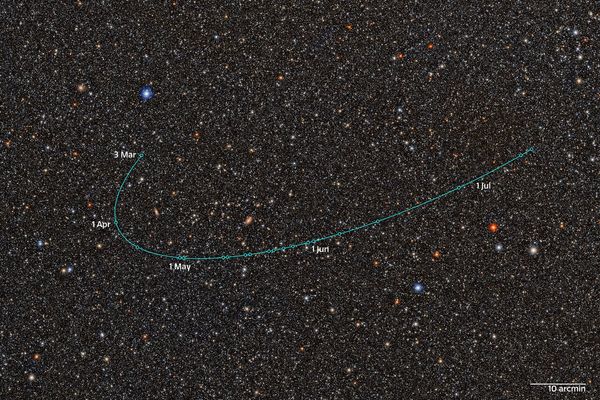
Rubin's image of 2026 ED138, the candidate dwarf planet found beyond Pluto's orbit.
Astronomers at the 1, a new survey telescope in Chile, announced on Tuesday that they have found a possible new 2. It orbits beyond Neptune and still carries its provisional catalog label, 2026 ED138. The result comes from an announcement, not a peer-reviewed paper, and the object's status is unconfirmed.
How it was found
Rubin photographs the southern sky over and over. The hard part is working out which of billions of detections are the same moving object seen on different nights. Matthew Holman and Kevin Napier, of the Center for Astrophysics | Harvard & Smithsonian, ran Rubin's data through search code they wrote for that job. The article doesn't say how the code works.
Holman said his first reaction was "excited disbelief," and that he started checking whether he or the code had made a mistake. Then he and Mario Jurić of the University of Washington found 30 more Rubin observations of the object, taken between March and July 2026. Older images from other telescopes went back to 2016. A ten-year record like that is what lets astronomers start working out an orbit.
What we know so far
Distance: about 46 times Earth's distance from the Sun. Pluto sits at about 40.
Tilt: its orbit is inclined about 25 degrees to the plane of the planets. That may be a result of Neptune's gravity pulling on it.
Size: 600 to 1,500 kilometers across. Even the low end makes it one of the largest dwarf planet candidates found. The range is wide because the object's brightness alone can't separate a small, shiny surface from a large, dark one.
Why it hid, and what's next
An object this big went unnoticed because it sits in front of the Milky Way. In that part of the sky, the light of crowded background stars drowned it out. Many older surveys avoided such regions.
Size alone doesn't make a dwarf planet. The object must also have enough mass for its gravity to pull it into a round shape, and follow-up observations are needed to check. The "sixth dwarf planet" label counts only the five the 3 officially recognizes. Several other large objects are widely considered dwarf planets without formal status.
Holman expects more finds like this. Rubin will keep imaging the southern sky for ten years, he said, so any others "hiding in the places earlier surveys skipped are now within reach."
On Tuesday, astronomers at the 1 announced a possible new 2 beyond Neptune. Rubin is a survey telescope in Chile, run by the US National Science Foundation and Department of Energy. The object has no name yet. It goes by its 3, 2026 ED138. This is a discovery announcement, not a peer-reviewed paper, and the "dwarf planet" part is still a hypothesis.
A label, not a name
Provisional designations follow a fixed code. The year comes first. The first letter marks the half-month of the discovery observations: "E" means the first half of March. The rest gives the object's place in the order of discoveries. That fits the article: the earliest Rubin detections of the object date from March 2026. A permanent number and name come later, once the orbit is secure.
The problem: connecting the dots
A survey like Rubin's records a huge number of points of light every night. Nearly all of them are stars, galaxies or noise. A distant object in our solar system moves only slightly against the background from night to night. So the job is to work out which faint detections, spread across many nights, belong to one object on one orbit. The number of possible pairings explodes, and objects beyond Neptune move slowly enough to look almost like stars.
The discovery came from feeding "billions of pieces of data" from Rubin into search code written by Matthew Holman and Kevin Napier of the Center for Astrophysics | Harvard & Smithsonian. The article doesn't describe how the code works.
Holman was cautious about the first hit. "My first reaction was one of excited disbelief," he said. "Objects like this are very rare, so I immediately started checking whether I or the code had done something wrong."
Checking the find
Holman and Mario Jurić of the University of Washington found 30 more Rubin observations of the object, taken between March and July 2026. They then searched older images from other telescopes and found sightings going back to 2016. Finding an object in old images taken before its discovery is called "4."
Precovery matters here because far-off objects move slowly. A few months of data cover only a tiny piece of an orbit that takes centuries, so many different orbits could fit. A record stretching back ten years narrows those options a lot. That is why the team can now "begin mapping out" the orbit. The wording shows the orbit is not yet final.
What the numbers say
Distance: about 46 times Earth's distance from the Sun (46 5). Pluto's average distance is about 40, so 2026 ED138 is currently farther out.
Inclination: its orbit is tilted about 25 degrees from the plane where the planets orbit. The article suggests this could come from disturbances caused by Neptune's gravity. Neptune is known to have scattered and tilted many objects in this region.
Diameter: 600 to 1,500 kilometers. Pluto is about 2,380 km across, so 2026 ED138 is smaller, but even its lower estimate puts it among the largest dwarf planet candidates.
The size range is wide for a general reason that applies to all distant objects. A telescope measures how bright the object looks, and brightness depends on both size and reflectivity. A small icy body that reflects most of the sunlight and a larger, darker one can look equally bright. Infrared measurements of the object's heat, or watching it pass in front of a star, can resolve this. The article doesn't say whether either is planned.
Why it was missed
An object this large usually gets found early. 2026 ED138 stayed hidden because it lies in front of the Milky Way, where crowded background stars swamp faint moving objects. Many earlier surveys skipped such fields. Rubin covers the whole southern sky repeatedly with sensitive instruments, so it can pick out objects in these regions.
What it would take to be a dwarf planet
Under the 6's definition, a dwarf planet must have enough mass for its own gravity to pull it into a roughly round shape. The article stresses that "size isn't all that matters." The mass and shape still need to be measured. One standard way to get a mass is to find a moon and time its orbit. The article doesn't say whether 2026 ED138 has a moon.
The headline's "sixth dwarf planet" needs some context. The IAU officially recognizes five dwarf planets: Pluto, Ceres, Eris, Haumea and Makemake. Several other objects beyond Neptune of similar size, including Quaoar and Gonggong, are widely treated as dwarf planets by researchers but have never been formally added. So "sixth" refers to the official list, and even if confirmed, 2026 ED138 wouldn't be the sixth large round world known out there.
What's still open
Several questions are unanswered: the final orbit, the true size and reflectivity, the mass, and whether the object is round. The broader point may matter more than this one object. Rubin has only just started a ten-year survey. "Rubin will image the whole southern sky again and again for ten years," Holman said, "so any others hiding in the places earlier surveys skipped are now within reach." If one large object was hiding in the star fields of the Milky Way, there may be others.
Remember
Old images going back to 2016 let astronomers start pinning down a slow orbit that would otherwise need years of tracking.
Its size ranges from 600 to 1,500 km because brightness alone can't tell size from reflectivity.
It hid in front of the Milky Way's crowded star fields, a region earlier surveys often skipped.
AI software that predicts likely word sequences, used here to turn decoded sounds into sentences.
Image: Science News
The news
A man with 1 has used a brain implant to talk every day for nearly two years. ALS is a disease that destroys the nerve cells that move muscles, including the ones used for speech. Casey Harrell began losing his speech after his 2020 diagnosis. By the time of his surgery, only his wife and his assistant could understand him. Speaking unaided, he manages about six intelligible words per minute.
In June 2026, UC Davis neurosurgeon David Brandman and his colleagues reported Harrell's results in the peer-reviewed journal Nature Neuroscience. He used the system for more than 3,800 hours at home, with no researchers present. He produced 183,060 sentences, nearly 2 million words, at an average of 56 words per minute. He rated 92 percent of the sentences as decoded at least mostly correctly. With it, he has kept working full time.
How it works
Harrell is part of 2, a long-running clinical trial of brain-computer interfaces, which are devices that turn recorded brain activity into actions. In July 2023, four peppercorn-sized electrode arrays holding 256 electrodes in total were placed in his 3. That region normally sends commands to the lips, tongue, jaw and larynx.
When Harrell tries to speak, the electrodes record the neural firing. Cables plugged into connectors on his scalp carry the signals to nearby computers. There, machine-learning models classify each pattern as one of 39 English 4, the basic sound units of speech. Language models then put the phonemes together into likely words and sentences. Harrell checks the text on a screen, and a synthetic version of his own voice speaks it.
On day one the team limited the vocabulary to 50 words. By the second session he could choose from more than 125,000. One of his first unscripted sentences was "I'm looking for a cheetah." A remote researcher assumed it was an error, but his four-year-old daughter had just walked in wearing a cheetah costume.
The team had expected a few hours of use a week. Instead, the US Food and Drug Administration approved a protocol change so his caregivers could connect the system themselves. He now uses it 10 to 14 hours a day.
Limits
About 50 words per minute is roughly a third of normal speech, which runs at 120 to 150 words per minute. In conversation, a gap of 200 milliseconds between speakers already feels long, so his pauses are very noticeable. The accuracy figure comes from his own ratings. The system needs wires through his scalp, power and an internet connection. Most important, Harrell is a single participant, the only person using a speech implant this heavily. The study shows what is possible, not how reliably it works across patients.
The news
In June 2026, neurosurgeon David Brandman of UC Davis and his colleagues published a study in Nature Neuroscience following one man with a speech implant over nearly two years. The man is Casey Harrell, a climate campaigner who began losing his speech to 1 (amyotrophic lateral sclerosis, a disease that destroys the nerve cells controlling muscles) after his 2020 diagnosis. The study reports that he used a brain-computer interface for more than 3,800 hours at home with no researchers present. In that time he produced 183,060 sentences, 1,960,163 words in total, at an average of 56 words per minute. He judged 92 percent of those sentences to have been decoded "at least mostly correctly." With the system he has kept working full time.
Laura Sanders describes the work in an episode of the Science News podcast The Deep End. She interviewed Harrell through the implant itself.
The problem
ALS leaves the mind working while it shuts down the body. By the time of his surgery, only Harrell's wife and his assistant could understand him. He wouldn't take even a video call without one of them there to translate. Speaking on his own, he manages about six intelligible words per minute.
Brain-computer interfaces (BCIs) record electrical activity from the brain and translate it into actions. The BrainGate trials, now about 22 years old, first implanted a device in 2004. With it, a paralyzed man named Matthew Nagle moved a computer cursor. Later participants browsed the web, played games and, in one case, drank a latte using a robotic arm. Speech is harder. Leigh Hochberg, who directs the BrainGate trials, says the field is at "the very beginning." Only a small handful of people worldwide have had implants that decode speech.
How the system works
Harrell is enrolled in the 2 clinical trial. In July 2023, Brandman placed four electrode arrays on the left side of his brain, over the 3. This region sends commands to the muscles of the lips, tongue, jaw and larynx. Each array is a square about the width of a peppercorn. Its fine spikes reach into the tissue, and Sanders compares them to a metal cat brush. Together the four arrays hold 256 electrodes.
Two connectors called 4 stick out through Harrell's scalp. Each morning he attaches cables to them that lead to nearby computers. He calls this "plugging into the Matrix." Decoding then happens in stages:
Record. As Harrell tries to say a word, the electrodes pick up the firing patterns of neurons that would normally move his speech muscles.
Classify 5. Machine-learning models match each pattern to one of 39 English phonemes, the sound units that make up words. Brandman's example is "hello," which breaks into roughly h–uh–l–oh.
Here is an analogy (ours, not the article's). The phoneme decoder works like a person catching sounds through a noisy phone line. The language model works like a listener who fills in the gaps from context.
Early tests
On day one the team limited the vocabulary to 50 words and had Harrell try to say scripted sentences, such as "What good is that?" Because the researchers knew the target words, they could check each output. When the system got it right, Harrell says, "everyone is crying."
At the second session they opened up the full dictionary. After "Is this thing on?" the decoder produced "I'm looking for a cheetah." Hochberg was watching remotely and assumed it was an error. In fact, Harrell's four-year-old daughter had just walked in wearing a cheetah costume. The scene shows the system decoding unscripted words that fit the moment, which is what a real speech prosthesis has to do.
From lab sessions to daily life
At first the researchers expected Harrell to use the BCI for a few hours of conversation a week, and only with a technologist present to connect it. His demand for it kept growing. The team asked the US Food and Drug Administration to change the trial protocol so his care partners could be trained to connect and disconnect the system themselves. He now uses it 10 to 14 hours a day, seven days a week.
What the numbers mean
Brandman puts Harrell's rate at around 50 words per minute. Normal speech runs at 120 to 150, so the implant gives him back roughly a third of his old pace. Timing is still a problem. UCLA's Greg Bryant points out that in normal conversation the gap between one speaker and the next is about 200 milliseconds at most. Harrell's replies take far longer. Sanders admits she interrupted him and stacked up questions during their interview. Speech pathologist Jessica Pietrowski says listeners feel the urge to fill silences. Brandman says clinicians often confuse an inability to speak with an inability to understand.
Caveats
One participant. Harrell is, in Sanders's words, "an 6": the only person using a speech BCI this heavily. The results show what is possible, not how well it works across patients.
Self-reported accuracy. The 92 percent figure comes from Harrell's own labels for each sentence, not from an independent transcript. He still hits errors where the decoder keeps changing what he means to say.
Harrell argues that the system is "good enough for now" and that devices like it deserve accelerated regulatory approval. Many companies are building similar systems, and the podcast promises to cover them in a later episode.
Remember
The implant decodes attempted sounds, not abstract thoughts: neural signals become phonemes, and AI language models assemble the words.
Over nearly two years, 3,800 hours of unsupervised home use make this a real-world test, not a lab demonstration.
At around 50 words per minute the system restores about a third of normal speaking speed, and its 92 percent accuracy is self-rated.
A simulation study published in Neuron in August suggests how a single neuron can belong to many memories without new learning erasing old learning. The team includes Julijana Gjorgjieva (Technical University of Munich), Sebastian Onasch and Christoph Miehl (Institute of Science and Technology Austria). It is a computer model only. No one has yet confirmed the mechanism in real brains.
The problem
Artificial neural networks suffer from 1: when they learn something new, they overwrite the shared connections that held older knowledge. Brains seem to avoid this, even though one neuron can join many 2, groups of cells that fire together to represent a memory. How they manage it is a long-standing puzzle.
The proposed mechanism
The model neurons are more lifelike than artificial ones. Each has a cell body and several 3, input branches that can each fire their own local spike and strengthen their own connections. Inhibitory neurons can silence individual branches, which blocks learning there.
Each of several "context" signals, standing in for a new environment or internal state, switches off some of the inhibitory cells. That unlocks learning in particular branches only. Here is a toy example (not from the paper): a neuron learns image X using branch A in one context, then image Y using branch B in another. A is never touched the second time, so memory X survives.
In simulations, the same input in different contexts formed separate assemblies. A partial cue recalled the whole assembly, but only in the context where it was learned. Linked brain areas could copy assemblies to one another and merge them, for example binding a sight and a sound into one concept. In one task, the model's downstream "concept" area separated look-alike characters such as "0" and "O" using their different sounds. It kept them apart even when given only the image, provided the context was right.
Christos Papadimitriou of Columbia, who was not involved, had earlier theorized that copying and merging assemblies could support any computation. He calls the study "a major advance."
Caveats and tests
The model assumes inhibition targets just one dendrite per neuron in each context, which is probably too tidy for real brains. Supporting hints exist. Attila Losonczy of UT Southwestern has found that distant dendrite branches can encode context separately, and a recent Science Advances paper found tiny constrictions that split dendrites into separate electrical compartments.
Losonczy says the model makes testable predictions. Distinct inhibitory subgroups should respond to distinct contexts and target specific branches, and dendritic activity should shift when context changes. The biggest unknown, Miehl says, is what "context" actually is in the brain and where the signal comes from.
A computational study published in Neuron in August proposes a biologically realistic way for the brain to store many overlapping memories without one overwriting another. The team includes Julijana Gjorgjieva at the Technical University of Munich, her former graduate student Sebastian Onasch, and Christoph Miehl, a postdoc in Tim Vogels' lab at the Institute of Science and Technology Austria. The work is a simulation. Its central mechanism has not yet been confirmed in real brains.
The problem
Artificial neural networks suffer from 1: train them on something new and older knowledge can disappear, because the same connection weights get rewritten. Computational models of the brain run into the same trouble. Real brains don't seem to. A neuron can take part in many 2, groups of neurons that fire together to represent a memory or concept. Every time a new assembly strengthens that neuron's connections, though, it could in principle disturb the older assemblies the neuron already belongs to. How the brain avoids this is a long-standing puzzle.
The model's answer is to divide the neuron up. Learning happens in one part of the cell and the other parts are left alone.
How the model works
The simulated network had every neuron connected to every other. Unlike the units in a standard artificial network, each model neuron had a 3 (the cell body) and several 4, branches that receive inputs. Each compartment could fire its own local spike, driven by , a type of glutamate receptor that triggers strong local electrical events and is closely tied to learning. Each compartment could also strengthen its own connections to other neurons independently. The model also included both excitatory and neurons. Gjorgjieva says this mix of somas, dendrites and two neuron types makes the model "biologically plausible in the way that [artificial neural networks] are not."
The key move is selective inhibition. Inhibitory neurons silenced individual dendritic compartments, which blocked 6 (changes in connection strength) in those branches and left the rest of the cell untouched. Each of several context signals switched off a subset of the inhibitory neurons. That released particular compartments from inhibition, a process called 7, and allowed learning only there. The context signals stand in for an animal entering a new environment or a new internal state.
Here is a toy illustration, not taken from the paper. Picture a neuron with three branches, A, B and C. In context 1, only branch A is unlocked, so when the neuron helps form a memory of image X, only A's connections change. Later, in context 2, branch B is unlocked and the neuron joins a memory of image Y. A's connections are never touched during that second episode, so memory X survives.
That is what the simulations showed. Different groups of excitatory input neurons, mimicking an animal viewing different images, each produced a different assembly. The same input presented in a different context produced a separate assembly. Recall worked too: activating only part of an assembly, as when an animal sees part of an image, brought the whole assembly back, but only in the context in which it had been learned.
Scaling up to several brain areas
The team then linked several simulated areas. Each area was internally 8, meaning its neurons connect back to one another, and the areas connected to each other only through feedforward links that run in one direction. Under these conditions an assembly in one area could be copied into another. When two upstream areas projected to a shared downstream area under the same context, the downstream area merged their patterns into a single joint representation. Miehl compares this to binding an image and a sound into one concept. The bindings formed in two ways: simultaneously, with both areas active at once and creating a new downstream assembly, or sequentially, with a new association attached to an assembly that already existed.
This is where Columbia computer scientist Christos Papadimitriou, who was not involved, sees the significance. He had previously theorized that assemblies could in principle carry out any computation by copying and merging. His theory was "biologically inspired; this paper renders it biologically realized," he says, and he calls the work "a major advance."
A test case: 0 versus O
In a simulated task, the model told apart characters that look alike but sound different, such as the digit "0" and the letter "O." In the simulated visual area, the similar pairs activated largely overlapping assemblies, so vision alone couldn't separate them. In a downstream "concept" area that received both visual and auditory input, the pairs ended up in non-overlapping assemblies. The concept area kept separating them even when shown only the image without the sound, as long as it received the right context signal. The article doesn't report accuracy figures.
Caveats and supporting evidence
Onasch notes several simplifying assumptions. The biggest is that in a given context the inhibitory population targets just one dendrite per neuron, while real inhibitory wiring is probably messier. Gjorgjieva says the model is still informative without that assumption, but "without this context-dependent inhibition, you lose a little bit of this ability to segregate stimuli."
Some outside evidence fits the idea. Attila Losonczy of UT Southwestern, who was not involved, has found that distal dendrites (far from the soma) can decouple from proximal ones and encode contextual information. A Science Advances paper last month reported tiny constrictions in hippocampal and cortical dendrites that divide them into separate electrical compartments. Gjorgjieva says these could be the physical basis for compartments. Constrictions alone can't produce context-dependent learning, though. That still requires targeted inhibition and disinhibition.
What would confirm it
Losonczy lists the model's testable predictions:
Distinct subgroups of an inhibitory cell class should respond to distinct context signals.
Those subgroups should preferentially target specific dendritic branches.
Patterns of dendritic activity should shift systematically when the context changes.
The biggest open question, Miehl says, is what "context" actually is in the brain and where the signal comes from. The model takes context as given. Next, the team wants to move from the simple visual-auditory task toward a reward-based task that a mouse could actually perform.
Remember
Splitting a neuron into separately lockable dendritic branches lets new memories form without disturbing old connections.
Context-gated assemblies could be copied and merged across brain areas, binding a sight and a sound into one concept.
It is unproven: the predicted context-specific inhibitory subgroups that target particular branches have yet to be found.
Researchers have sequenced the genomes of three people who lived in Spain, France and Italy about 30,000 years ago. One of them, a woman buried in Isturitz Cave in southwestern France, carries ancestry from Eastern and Central Europe. That is evidence that Ice Age populations at opposite ends of the continent interbred. The study appeared on October 23 in the peer-reviewed journal 1.
The question
All three lived during the 2, a Stone Age culture that spread across Europe from about 34,000 to 25,000 years ago and is known for "3". The culture looks similar across the whole continent, but a shared style doesn't prove shared ancestors, because ideas can spread without people moving. Only about two dozen Gravettian genomes existed before this study. From those, researchers concluded that Western and Eastern European groups were largely separate populations.
What the DNA showed
Most of the Isturitz woman's ancestry matches earlier Western European genomes. Part of it, though, traces to Eastern and Central European groups. The researchers dated this "pulse" of 4 (interbreeding between the populations) to about 31,500 to 32,500 years ago, a few thousand years before she lived. The article doesn't say how they did this. In general, ancient-DNA studies estimate timing from how far a newcomer's DNA has been broken into shorter pieces over the generations since mixing.
"Eastern and western European populations were not as genetically isolated as previously assumed," said lead author Pere Gelabert of the University of Vienna. The team suggests that people moving west from Eastern Europe eventually contributed this ancestry.
Why this cave
Isturitz was occupied on and off from about 80,000 to 10,000 years ago, first by Neanderthals. It sits on a key route between continental Europe and the 5. Archaeologists had already argued it was a cultural crossroads, and the researchers say the DNA supports that.
All three individuals were most closely related to Western European groups. Their genes point to dark skin, hair and eyes. None had closely related parents, which the team reads as a sign these groups may have avoided inbreeding. That is an interpretation, not a direct finding.
Caveats
The East–West signal comes from a single person. It proves that mixing happened at least once, not how often. It also can't distinguish a migration from gradual marriages between neighbouring groups. Calling Isturitz a "hub" is a reasonable inference, not a demonstrated fact. The researchers' own conclusion is modest: population structure in Gravettian western Europe was "more complex and dynamic than previously assumed."
The finding
A team led by Pere Gelabert, an evolutionary anthropologist at the University of Vienna, has sequenced the genomes of three people who lived in what are now Spain, France and Italy during the 1 period. The Gravettian is a Stone Age culture that spread across Europe from about 34,000 to 25,000 years ago, soon after the Neanderthals disappeared. The study appeared on October 23 in 2, a peer-reviewed journal.
One genome changes the picture. It belongs to a woman who died about 30,000 years ago. Her bones were found in Isturitz Cave in southwestern France. Most of her ancestry matches earlier genomes from Western European Gravettians, but part of it traces to groups in Eastern and Central Europe. "Our results show that eastern and western European populations were not as genetically isolated as previously assumed," Gelabert said in a statement.
Why this was an open question
The Gravettian is easy to see in the archaeological record. Stone tools, burials and carved figurines of a similar style turn up from the Atlantic coast to the Russian plain. But people who share a style don't necessarily share ancestors. Ideas, objects and techniques can travel between neighbouring groups while the people themselves stay put.
DNA can tell these apart, but there isn't much of it. Before this study, ancient DNA had been recovered from only about two dozen Gravettian skeletons. From that small sample, researchers concluded that groups in Western Europe were largely separate from groups in Eastern Europe: one culture, two mostly distinct populations. With so few genomes, a single new individual can shift that conclusion, which is what happened here.
How a genome reveals mixing
The article doesn't describe the team's methods. The general approach in ancient-DNA studies works like this. Each new genome is compared with reference genomes from known groups, here earlier Western and Eastern Gravettians. If an individual's DNA is best explained as mostly one source plus a share of another, that indicates "3", meaning interbreeding between the populations at some point in her ancestry.
The researchers dated this "pulse" of gene flow to about 31,500 to 32,500 years ago, a couple of thousand years before the woman lived. Again, the article doesn't say how. A common technique uses the fact that DNA from a newly arrived ancestor comes in long unbroken stretches, which get chopped into shorter pieces with each generation as chromosomes recombine. Measuring how short the Eastern-derived stretches have become gives a rough count of the generations since the mixing happened. As an analogy: a long rope spliced into another, then cut in half again and again, shows how many cuts have been made by how short its pieces are.
The team's explanation, in the paper's words, is that the signal "could be explained by movements of people from Eastern Europe during the Gravettian period, which eventually contributed to this ancestry in Isturitz." They note that this kind of East-to-West gene flow is uncommon in the 4, the Late Stone Age.
Why Isturitz
The cave has a long record. Neanderthals used it first, and people occupied it on and off from about 80,000 to 10,000 years ago. Among the later finds are cups made from human skulls, dated to roughly 15,000 to 12,000 years ago. It sits at a key passage between continental Europe and the 5. Archaeologists have long argued that this made it a cultural crossroads. The researchers say the new DNA supports that view, meaning the site was a meeting point for people as well as for objects and ideas.
What all three genomes share
All three new individuals are most closely related to Western European groups. Their DNA carries genetic variants associated with dark skin, dark hair and dark eyes. Predictions like these are based on known pigmentation genes and are probabilities, not observations.
None of the three had closely related parents. In general, geneticists check this by looking for long stretches where the two copies of a chromosome are identical, which is what you see when the parents were relatives. The researchers suggest these small hunter-gatherer populations may have actively avoided inbreeding. That is an interpretation: the absence of inbreeding in three people doesn't show whether they avoided it deliberately or whether their mating networks were simply large.
Caveats
Tiny sample. The East–West signal comes from one person. It shows that mixing happened at least once. It can't say how common it was or how far it reached.
Mechanism unknown. Gene flow over about two thousand years could mean a migration, a chain of marriages between neighbouring groups, or something else. The genome alone can't tell these apart.
The "hub" claim is an inference. It fits the archaeology and the location, but one mixed-ancestry burial is only a single piece of evidence for a crossroads.
Reported secondhand. This summary rests on a news article. Exact methods, sample sizes and confidence intervals are in the paper.
The researchers' overall conclusion is cautious: population structure and gene flow in Gravettian western Europe were "more complex and dynamic than previously assumed." More Gravettian genomes, especially from places between the eastern and western groups, would show whether Isturitz was an exception or a sign of regular contact across Ice Age Europe.
Remember
One individual can change the picture when only about two dozen genomes exist for an entire culture.
A shared archaeological culture didn't mean a single population, but the eastern and western groups weren't sealed off either.
Isturitz's location on the route into Iberia makes it a plausible meeting point, but that remains an inference.
OpenAI announced on 26 October 2026 that its in-house 1 (LLM, the kind of AI system behind chatbots) had produced three major proofs. None has been independently verified. One is not even public yet. Within hours, rival Anthropic posted its own disproof of one of the same conjectures.
The three claims
Kakeya in every dimension. The 2 asks how little room a needle can sweep out while pointing in every direction. It sits at the heart of 3, the study of building mathematical objects from waves. Hong Wang and Joshua Zahl proved the three-dimensional case in 2025, which earned Wang a 4 this summer. OpenAI's model did four dimensions last month. Now OpenAI says it has done all of them.
Half of Yang-Mills. This Millennium Prize Problem asks whether the mathematics under the 5 of particle physics is sound. It has two parts: "existence" (can the theory be built rigorously?) and "6" (is a certain energy always above zero?). OpenAI claims existence. In the late 1980s, Tadeusz Balaban sketched a route there in papers so dense that, according to NYU's Roland Bauerschmidt, "there's no one who understands these papers." Northwestern's Ethan Sussman and Anthropic's Levent Alpöge were using LLMs to finish Balaban's program in a public GitHub repository and thought they were close. OpenAI's unreleased paper appears to have beaten them.
Refuting the exponential time hypothesis. The exponential time hypothesis (ETH), proposed in 1999, says 7 can't be solved meaningfully faster than exponential time. 3-SAT is the problem of finding true/false values that satisfy a formula of three-variable clauses. ETH is a stronger form of 8, the belief that some problems are much harder to solve than to check, and much of complexity theory assumes it. OpenAI says it has an algorithm just slightly faster than exponential. That breaks ETH in principle but doesn't settle P versus NP. ETH's originators, Russell Impagliazzo and Ramamohan Paturi, along with MIT's Ryan Williams, are now vetting it with OpenAI.
Why scientists are uneasy
OpenAI set up an expert panel, the Advisory Group on Mathematics and Artificial Intelligence (AGMAI), after mathematicians objected to its earlier mass release of AI results. It is now ignoring the panel's advice. OpenAI hasn't disclosed the model, the prompts, the computing time or the model's step-by-step reasoning. For two of the results it handpicked experts to present them, against an AGMAI statement issued the day before. AGMAI has demanded the Yang-Mills paper, saying there is "no scientific reason" to delay.
A proof counts once others can check it. Until then, all three results are claims, and the article is a breaking story still being updated.
On 26 October 2026, OpenAI announced three large proofs that it says its internal 1 (LLM, the kind of AI system behind chatbots) produced. One extends a celebrated geometry result to every dimension. One settles half of a Millennium Prize Problem in particle physics. One refutes a hypothesis that computer scientists have treated as bedrock for 25 years. Scientific American reports that experts are "still staggering." Every claim is unverified. It is a breaking story, and the magazine says it will update it.
Two of the three results overlap with work tied to Anthropic, OpenAI's rival. Hours after OpenAI's announcement, Anthropic posted its own disproof of the computing hypothesis.
The fight over process
The announcement comes a few weeks after OpenAI's "slop drop," in which it released hundreds of AI-generated math results at once. Mathematicians objected. In response, OpenAI organized the Advisory Group on Mathematics and Artificial Intelligence (AGMAI), an expert panel meant to set norms for releasing results like these.
According to the article, OpenAI is not following the panel's advice. The model is proprietary. OpenAI hasn't disclosed the prompts it used, how much computing time the proofs took, or the "chain of thought" outputs (the model's step-by-step working). For two of the three results, OpenAI designated specific outside experts to shepherd them into public view. That breaks a clarifying statement AGMAI issued one day before the release. The Yang-Mills paper itself is still unpublished. AGMAI has called for its release, writing that "there is no scientific reason for delaying ... any further."
This matters because it is how we know whether a proof is correct. A proof becomes knowledge when other people can check it. A claim without a public paper is an announcement, not a result.
Kakeya: a needle that points every way
Picture turning a needle in space so it points in every direction at least once while sweeping out as little room as possible. The 2 says there is a floor on how small that region can be. The article describes the floor in terms of volume. Strictly, mathematicians have known for about a century that such sets can have zero volume. The conjecture actually says they must still be "full-dimensional" in a precise sense: a set of needles in three-dimensional space can't be squashed into something effectively two-dimensional. The problem looks like a puzzle, but it sits at the centre of 3, the study of how mathematical objects are built from waves.
Hong Wang and Joshua Zahl proved the three-dimensional case in 2025. It was one of the biggest breakthroughs of the century, and it won Wang a 4, mathematics' highest honour, at the 2026 International Congress of Mathematicians in Philadelphia. OpenAI's model solved the four-dimensional case in last month's batch. OpenAI now says it has solved every dimension. The article doesn't say whether this proof is public or who is checking it.
Yang-Mills: is the 5's maths sound?
Yang-Mills theory is the mathematical framework behind the Standard Model, physics' theory of fundamental particles and forces. Physicists use it with enormous success, but no one has shown it is mathematically well-defined. The Clay problem has two parts. "Existence" asks whether the theory can be built rigorously as a consistent object. "Mass gap" asks whether a certain quantity, the energy of the lightest particle the theory predicts, is always above zero. The prize requires both.
OpenAI claims the existence half. The ground was prepared in the late 1980s, when Tadeusz Balaban published a series of very long, dense papers sketching a route to existence. "Balaban's program" sets out the broad shape of the argument. Turning it into a complete proof would take far more exhaustive calculation, and in more than three decades no one has done it. "He basically did it," says Roland Bauerschmidt of New York University, "but I think there's no one who understands these papers and can tell whether they're correct or not."
That sort of long, tedious, well-mapped work suits LLMs. Ethan Sussman of Northwestern University and Anthropic employee Levent Alpöge set up a public GitHub repository to finish Balaban's program with AI help. They believed they were close. OpenAI's claim, with no public proof, appears to have beaten them. The open repository and the closed announcement are a direct contrast in how such work can be done.
The exponential time hypothesis
The exponential time hypothesis (ETH) is about 6. In 3-SAT you get a logical formula made of many small clauses, each joining three true-or-false variables with "or," and you must find whether some assignment of true and false makes every clause hold. Checking every assignment takes 2ⁿ steps for n variables. Cleverer algorithms do better but still grow exponentially. Russell Impagliazzo and Ramamohan Paturi proposed ETH in 1999. It says exponential growth is unavoidable: no algorithm can solve 3-SAT meaningfully faster than some fixed number raised to the power n.
ETH is a stronger claim than 7, the widely believed conjecture that some problems whose answers are easy to check are hard to solve. ETH says 3-SAT is not just hard but brutally hard as it grows. Many results in complexity theory, the ranking of problems by difficulty, take ETH as a starting assumption. If ETH falls, those results lose their footing.
OpenAI says its proof gives an algorithm only "a tiny bit faster than exponential time." That is enough to refute ETH in principle, though it may not be a practical speed-up. It doesn't resolve P versus NP. To show what a small edge means (an illustration, not OpenAI's numbers): an algorithm that runs in 2^(n/log n) steps beats every fixed c^n once n is large, yet stays enormous.
Because the stakes are so high, OpenAI has asked Impagliazzo and Paturi, along with MIT's Ryan Williams, to investigate the result independently. Williams says OpenAI will also sponsor a computer science conference on the proof. Then came Anthropic's same-day independent refutation of ETH, produced by an internal Anthropic model. The article gives no details on how the two arguments compare.
What's still unknown
Several key facts are missing. We don't know whether any of the three proofs is correct. We don't know whether the Kakeya and ETH arguments are fully public, how much human help went into them, or whether OpenAI's and Anthropic's ETH proofs share a method. The investigators chosen for ETH are its originators, highly qualified but not neutral, and they are working with OpenAI. Until the papers are released and checked, the right reading is "claimed," not "proved."
Remember
Two of OpenAI's three claims collide with Anthropic-linked work, one in an open repository and one disproving the same hypothesis.
Disproving ETH would undercut many complexity results built on it, but wouldn't settle P versus NP.
The Yang-Mills claim covers only "existence"; the mass-gap half, which the Clay prize also requires, is still open.
Assemble language. Language models turn the phoneme sequence into the most likely words, then sentences, choosing from a vocabulary of more than 125,000 words.
Confirm and speak. The text appears on a screen and Harrell proofreads it. Once he approves, a synthetic voice modeled on his own reads it aloud. The same text can go to Slack, email or texts.
Hardware. The system uses wires through the scalp and needs power and an internet connection. The researchers call these solvable problems, but the article doesn't describe specific fixes.
Unanswered questions. The article doesn't say how long the electrodes will keep recording well, how often the decoder has to be recalibrated, or whether the approach works for people whose motor cortex has deteriorated further.