Without wind and solar, 2025 power-sector CO2 would be 28% higher
Zeke Hausfather's country-by-country counterfactual estimates 23 billion tonnes of CO2 avoided since 2005, though the warming avoided so far is only about 0.01C.
Why it matters · The "energy addition, not transition" claim is now common. This analysis tests it against a modeled world without wind and solar, with published methods and code, and is clear about how small the climate payoff has been so far.
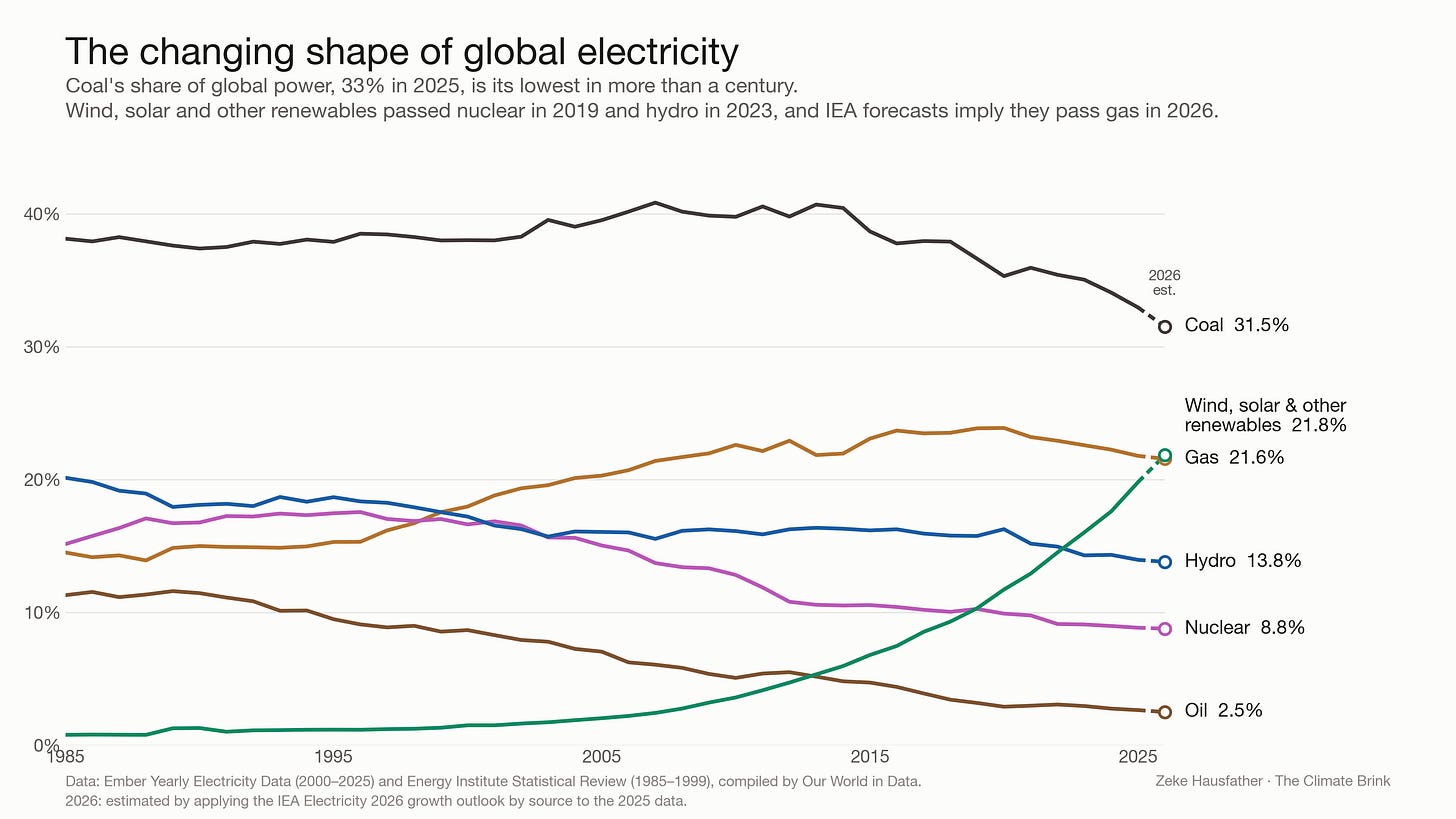
Non-hydro renewables went from 2.0% of global electricity in 2005 to 19.8% in 2025. The IEA expects them to reach 21.8% in 2026, just ahead of gas at 21.6%. Fossil generation has kept growing, though: it is about 50% higher than in 2005, coal set a record in 2024 and gas did the same in 2025. Critics such as Vaclav Smil and Jean-Baptiste Fressoz say clean energy is being piled on top of fossil fuels rather than replacing them.
Hausfather argues that this compares today with 2005 when it should compare today with a world that never built the wind and solar. Demand rose 75% (13,600 TWh) over the period, mostly from industry, EVs, air conditioning and data centers in emerging economies. Wind and solar met 5,400 TWh of that growth and fossil fuels met 6,100 TWh. Since 2015, wind and solar have covered 57% of demand growth against 29% for fossil fuels. In 2025 they covered 99%, according to Ember.