Today's stories are about limits and who pays: water for lithium, warming's extra hurricane damage, tree survival, a permitting fight and Virginia power bills.
Picked from 47 new articles across 13 sources · arrow keys for other days
Today in 30 seconds
30s left
Imperial County projects Lithium Valley needing up to 100,000 acre-feet of water yearly, five times what non-farm uses now get. story 1 ↓
Climate Central estimates warming added 7 mph to Isaias's winds, and sea-level rise added 6.5 inches to its peak surge. story 2 ↓
Ethiopia has planted 47 billion seedlings and spends up to 1% of its federal budget on restoration. Studies put survival at 50–80%. story 3 ↓
Plumbers, laborers and operating engineers endorsed the Senate permitting bill. The electricians' union hasn't, and its call may shape transmission reforms. story 4 ↓
Virginia approved Dominion fuel charges plus a $922 million bond to spread them out. Typical fuel charges have doubled since 2021. story 5 ↓
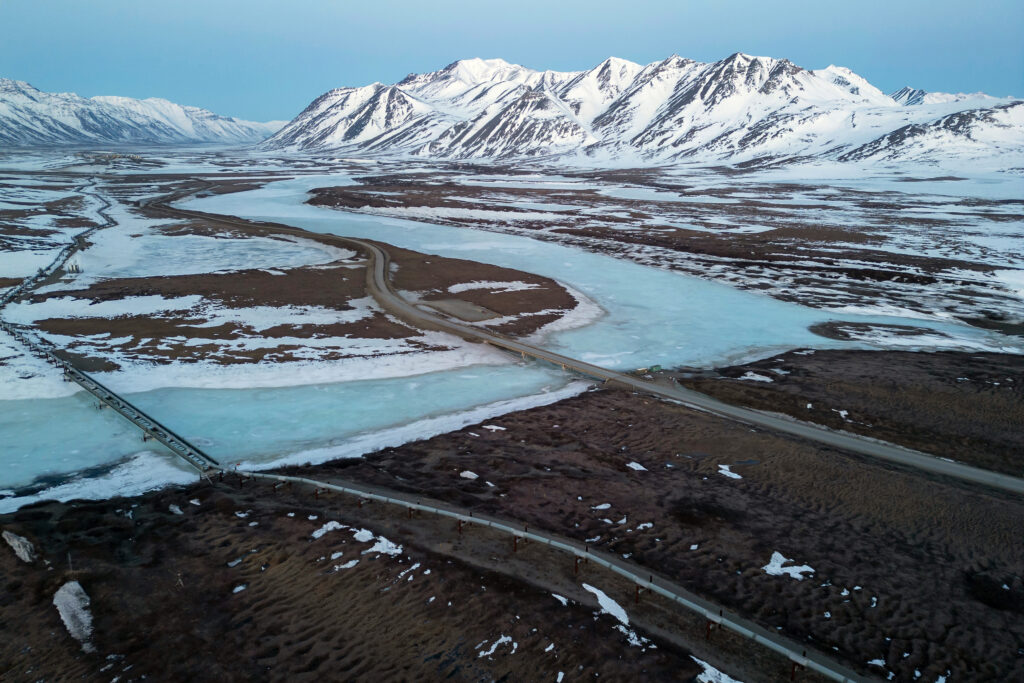
Oil companies no longer need environmental reviews before winter exploration in Alaska's Western Arctic, the largest tract of federally managed public land.
1/5Inside Climate News· By Johanna Hansel, Carla Samon Ros, Wyatt Myskow· Oct 11
California's Salton Sea lithium plan needs water the region may not have
A Columbia–Inside Climate News investigation finds that U.S. lithium projects sit mostly in drought-prone, low-income places. At California's Salton Sea, the water planned for lithium is water that farms and a shrinking lake would have to give up.
Why it matters · Water, not ore, may set the limit on domestic lithium. How it gets reallocated in drought shows whether the clean-energy supply chain can scale without new local harms.
Know this first
Context from the editor, not the article · 32 sec
1 · Three ways to get lithium
Lithium comes from hard-rock mines, from brine left to evaporate in huge ponds, or by direct lithium extraction. That third method pumps brine through sorbents or filters that capture lithium, then reinjects the brine underground. It is newer and not yet proven at scale.
2 · The Salton Sea
The Salton Sea is a California lake formed by a 1905 canal breach and fed mostly by farm runoff. Hot, mineral-rich geothermal brine lies beneath it and already feeds geothermal power plants. That brine is the target for lithium.
3 · Colorado River cuts
2/5Yale Climate Connections· Jeff Masters· Oct 10
Climate change added wind and storm surge to Hurricane Isaias, analysis finds
Hurricane Isaias hit the Florida Panhandle as a Category 2 storm on Oct. 9. Climate Central estimates human-caused warming made its winds about 7 mph stronger and its storm surge about 6.5 inches higher.
Why it matters · Damage rises far faster than wind speed or water depth, so small warming-driven increases can add billions to the bill. That matters for insurance, flood defenses and grid planning.
Know this first
Context from the editor, not the article · 31 sec
1 · Hurricane categories
The Saffir-Simpson scale rates hurricanes by sustained wind speed. Category 2 is 96–110 mph and Category 3 is 111–129 mph. Category 3 and above count as major hurricanes. The scale ignores rain and storm surge.
2 · Storm surge basics
Storm surge is the rise in sea level above normal tides, caused mostly by a hurricane's winds pushing water ashore. It is usually the deadliest and most damaging part of a landfalling hurricane. Higher baseline seas let the same surge reach farther inland.
3 · Extreme-event attribution
Attribution science compares a weather event in today's climate with a modeled world without human greenhouse emissions. It estimates how much warming changed the event's likelihood or intensity. Quick analyses like this one are usually not yet peer reviewed.
3/5Grist· Samuel Abate· Oct 10
Ethiopia has planted 47 billion seedlings. How many will survive?
Ethiopia's Green Legacy Initiative has planted more than 47 billion seedlings since 2019, toward a goal of 50 billion by 2030. Early data are encouraging. Experts say keeping the trees alive matters more than the planting count.
Why it matters · This is one of the largest restoration programs anywhere, and it tests whether huge, state-led tree planting can restore farmland and store carbon in a poor, climate-exposed country.
Know this first
Context from the editor, not the article · 31 sec
1 · Why tree counts mislead
Seedling numbers are easy to report but say little about results. Many planted trees die within a few years from drought, grazing or neglect. What counts is how many survive, along with the soil, water and other plants around them.
2 · Erosion on cleared slopes
Tree roots and ground cover hold soil in place and help rain soak into the ground. When steep farmland is cleared, heavy rain strips off the fertile topsoil and carves gullies. Crop yields fall and landslides become more likely.
3 · Earlier restoration examples
China's Loess Plateau is a heavily eroded region where restoration started in the 1990s. It is often cited as a large success. Its Grain for Green program, begun in 1999, paid farmers to stop farming slopes and replant them.
4/5Heatmap· Matthew Zeitlin· Oct 7
Building trades back Senate permitting bill, but the electricians' union holds back
Most construction unions have endorsed a bipartisan Senate bill to speed up permits. The electrical workers' union, which is strong inside utilities, hasn't, because the bill's transmission rules cut into utilities' control over new power lines.
Why it matters · The union's choice could decide whether the bill's transmission reforms, which matter most for the grid, hold together or get watered down to protect utilities.
Know this first
Context from the editor, not the article · 31 sec
1 · Why permitting reform matters
Big US energy projects, including power lines, pipelines and solar farms, need federal environmental reviews under laws like the National Environmental Policy Act. Reviews and the lawsuits that follow can add years. Long-distance transmission lines crossing many states have been especially slow to build.
2 · How utilities earn money
Most US power companies are regulated monopolies. Regulators let them earn a set return on the capital they invest, called the rate base. So building new lines themselves raises their profits, which gives them a reason to protect that role.
3 · Unions and climate politics
5/5Utility Dive· Charles Paullin· Oct 7
Virginia approves Dominion fuel charges and $922 million bond to spread costs
Virginia regulators let Dominion Energy recover $2.69 billion in projected fuel costs. They also approved bonds to spread $922 million of past overruns across seven years, which cuts the immediate bill increase by more than half.
Why it matters · It's a concrete case of fossil fuel price swings and a tight regional power market reaching household bills, and of financing tools that hide part of the cost now and add interest later.
Know this first
Context from the editor, not the article · 31 sec
1 · What a fuel factor is
Most U.S. utilities pass fuel and purchased-power costs straight to customers through a separate charge, without earning profit on it. The charge is set from a forecast. When actual costs exceed the forecast, the shortfall ("underrecovery") is collected later.
2 · How utility securitization works
A state law creates a dedicated, unavoidable charge on customer bills. Bonds backed by that charge raise cash now and repay the utility. Because the charge is so secure, the bonds pay low interest, but customers still pay interest for years.
Seven Western states share the over-allocated Colorado River under rules written about a century ago. Its reservoirs are near record lows. Imperial Valley farmers hold some of the oldest and largest rights to its water, so they face the biggest cuts.
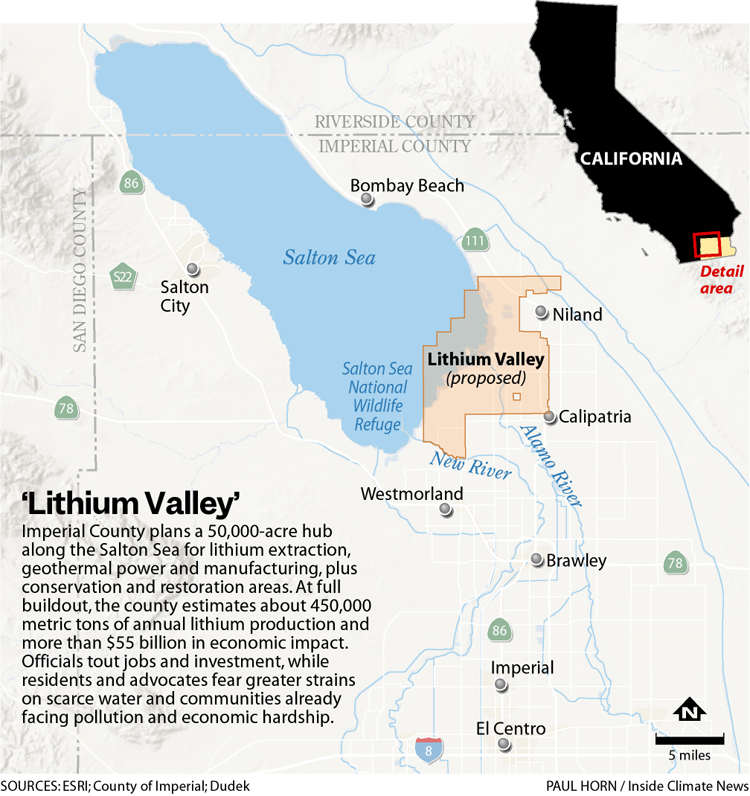
Map of the planned Lithium Valley zone on the Salton Sea's southeastern shore.1 / 4
A joint investigation by Columbia Journalism Investigations and Inside Climate News finds that America's lithium rush is heading into its driest and poorest places. The clearest case is "Lithium Valley," a 51,000-acre zone that Imperial County, California, has laid out on the shore of the shrinking Salton Sea.
The national pattern
Working from S&P Global corporate filings, the reporters tracked about 540 proposed lithium mines worldwide. At least six new U.S. mines are expected by 2030, with 13 more to follow, mostly in the Southwest. By the reporters' analysis, nearly two-thirds of U.S. projects sit beside highly vulnerable communities. Almost all are in counties where drought risk is projected to rise sharply. A study co-authored by Northwestern's Jennifer Dunn finds that most lithium mining areas won't have enough water for the industry by mid-century.
The Salton Sea math
Hot brine under the lake is rich in lithium. The county's plan relies on 1 (DLE), which runs brine through tanks that capture lithium and then reinjects it. DLE is pitched as using less water than evaporation ponds or open-pit mines, but it has never run commercially in the U.S. Some studies suggest its freshwater use may be higher than other methods. Dunn notes that water for cleaning and preparing the brine often goes uncounted.
The main developer, 2, has asked for 6,500 3 a year. One acre-foot is about 326,000 gallons. The reporters estimate that it and a second developer could use up to 50,000 at full output. The county itself projects up to 100,000 acre-feet for a full buildout, about five times the water now available for all non-farm uses in the county. Meanwhile the 4, which holds the region's senior Colorado River rights, must cut at least 250,000 acre-feet a year from 2027.
Who gives up water, and who gets paid
The leading idea is a "5" that pays farmers to conserve and sells the saved water to lithium firms on 30-year contracts. But the Salton Sea is fed by farm runoff. Less runoff exposes more polluted lakebed, which blows into towns where childhood asthma already runs about four times the state rate. An appeals court has faulted the county's approval for relying on a "hypothetical supply" of water and for not assessing the dust.
The money is uneven too. Farmers pay about $20 an acre-foot, while nearby households pay nearly $1,000 a year for treated water. Under the state lithium tax, the town of Calipatria would get about $270,000 a year and the county about $3.8 million. No binding 6 are required, and a federal requirement for them was dropped in January 2025.
Supporters, including county officials, say delays are costing jobs. General Motors has already walked away from a supply deal with the main developer. The open question is whether the water exists at all.
An investigation by Columbia Journalism Investigations and Inside Climate News puts numbers on a tension the energy transition hasn't solved: most new American lithium is planned for places that are short of water and short of money. Its sharpest example is "Lithium Valley," a 51,000-acre zone on the southeastern shore of California's Salton Sea in Imperial County.
The national picture
The reporters used corporate filings compiled by S&P Global to identify about 540 proposed lithium mines worldwide, along with the companies and investors behind them. In the U.S., about 100 mining projects of all kinds are moving through permitting. At least six new lithium mines are expected to be producing by 2030, with 13 more after them, most of them in the dry Southwest.
By the reporters' analysis of income, age and race data, nearly two-thirds of proposed and developing U.S. lithium mines sit next to some of the country's most socially and economically vulnerable communities. Imperial County tops the list. Federal data show that almost all of these projects are in counties where drought risk is expected to rise sharply, and nearly six in ten are where drought is projected to do the most severe damage. A study co-authored by Jennifer Dunn of Northwestern University concludes that most lithium mining areas won't have enough water by mid-century to meet the industry's demand. "The engineering is not going to get you over the hump," she said. It has to be "a local discussion about how we want to use water."
Fights have already started elsewhere. In Amargosa Valley, Nevada, where wells are running dry, a company dropped its lithium plans after the Biden administration paused mining there in January 2025. The Trump administration's Bureau of Land Management has since approved another company to drill about a mile away, and the Timbisha Shoshone Tribe and environmental groups sued in February. In Green River, Utah, a company plans to drill into an aquifer along a tributary of the Colorado River.
Why the Salton Sea, and why water is the catch
Geothermal brine beneath the Salton Sea holds enough accessible lithium for 375 million electric cars, according to company and government figures. The article notes that the actual recoverable amount is disputed. With $5 million in state funding, the county has written a regulatory framework for the zone. Two projects have local approval. The plan depends on 1 (DLE), which pumps brine through tanks where lithium is captured, then reinjects the brine. Supporters say DLE uses less land and water than evaporation ponds or open-pit mines. Lithium Valley would be its first commercial-scale use in the U.S.
2 (CTR), the largest developer, has asked for 6,500 3 a year for its "Hell's Kitchen" project. An acre-foot is about 326,000 gallons. CEO Rod Colwell says demand will fall as recycling improves: "Water does not get wasted." Others are less sure. One study that industry and government agencies often cite notes that DLE's freshwater use may actually exceed that of other extraction methods. Anthropologist James Blair of Cal Poly Pomona points to water depletion at a commercial DLE site in Argentina. Dunn says project presentations often leave out hidden uses, such as water for cleaning or for preparing brine before extraction.
The reporters' own estimate: if CTR and competitor EnergySource reach full production and use as much water per ton as studies suggest, they could consume up to 50,000 acre-feet a year. The county projects up to 100,000 acre-feet for a full buildout, including environmental mitigation. That is roughly five times the water now available for all non-agricultural uses in the county.
This comes as supply shrinks. The 4 (IID), the local agency that holds the region's senior Colorado River rights, has committed to cutting at least 250,000 acre-feet a year starting in 2027. Further federal cuts are expected.
Where the water would come from
No official supply plan exists yet. County supervisor Ryan Kelley proposes a "5": farmers would conserve water, deposit the savings as credits with IID and be paid for them, and IID would sell the credits to lithium developers on fixed 30-year contracts.
The problem is that the Salton Sea lives on farm runoff. Water saved on farms is water that never reaches the lake. As the lake shrinks, it exposes a lakebed laced with decades of pesticides and other pollutants, which blows into towns as dust. Imperial County's childhood asthma rate is already about four times the state and national averages. A state appeals court has ruled against the county's approval of Hell's Kitchen. It found the county had not shown that enough water existed, noted that no agreements secured the "hypothetical supply," and said the county hadn't assessed what diverting more water from the sea would do to air quality. IID has said it won't take responsibility for added dust.
There is already a track record of damage. In October 2024, a CTR affiliate settled with the Environmental Protection Agency (EPA) after the agency found the company had dumped soil into about 27 acres of wetlands connected to the sea and drained up to 1,200 acres.
The water economics are lopsided. Farmers pay about $20 per acre-foot, enough for a couple of households for a year. Treated water in Calipatria and neighboring Niland averages nearly $1,000 a year per household, well above the state water board's affordability threshold. Some Niland families illegally pump from contaminated canals. Senior water rights protect farmers from uncompensated cuts, so conservation becomes something they get paid for. The region's earlier solar boom followed the same pattern: landowners profited from water transfers, while farmworkers lost jobs as fields were taken out of farming, and few permanent solar jobs appeared.
Who gets the money
California's 2022 lithium tax charges up to $800 per ton above a threshold. A fifth goes to Salton Sea restoration and the rest to the county. Under the county's plan, about 10% goes to community benefits. Calipatria would get an estimated $270,000 a year, and the county about $3.8 million. Activist William Cooper doubts the town's share will cover repairs to its corroded sewer system. CTR once threatened to leave over the tax. It later received a $30 million state tax credit tied to local hiring. The federal government is finalizing a $1.3 billion loan to EnergySource and has put CTR on a federal permitting fast-track list.
Neither the state nor the county requires legally binding 6. In January 2025 the Trump administration dropped a Biden-era requirement for federally funded projects to submit community benefit plans. CTR is drafting a voluntary "good neighbor agreement," but Colwell says the company won't negotiate with groups that sued.
What's unresolved
Delays carry costs. General Motors has backed out of a deal to buy lithium from CTR, and Kelley argues "we should have already been in production by now." But the core questions are open: how much freshwater DLE really uses at scale, where 50,000 to 100,000 acre-feet would come from during Colorado River cuts, and who pays for the dust when the sea shrinks further.
Remember
Imperial County's own estimate of Lithium Valley's water need is about five times current non-farm supply.
Water saved on farms for lithium would otherwise feed the Salton Sea, so it could mean more toxic dust.
DLE's water advantage over other extraction methods is unproven at commercial scale.
Radar view of Isaias at landfall near Destin: Category 2, 105 mph winds, 971 mb pressure.1 / 3
Hurricane Isaias came ashore near Destin, Florida, around 9:30 p.m. EDT on Oct. 9 as a Category 2 storm. It had sustained winds of 105 mph and a central pressure of 971 millibars. Strong 1 (winds changing speed and direction with height, which tears at a storm's structure) had cut it down from a 120-mph peak in its final hours. By the next morning it had over 900,000 customers without power in Florida, Alabama and Georgia, and one person had been killed by a falling tree. Jeff Masters, a former NOAA Hurricane Hunter writing for Yale Climate Connections, expects damage of several billion dollars.
How warming showed up
2, a climate research nonprofit, put out a rapid attribution estimate. Its main findings:
Wind: Gulf waters warmed by climate change made Isaias's forecast winds about 7 mph stronger, roughly a 6% increase.
Ocean heat: Isaias 3 over water about 1.4°C (2.4°F) warmer than it would have been without climate change, with surface temperatures above 31°C (88°F). Climate change made that warmth 4 to 600 times more likely, depending on location. In the southwest Gulf, where the storm formed, the figure was 600 to 800 times.
Sea level: Human-caused warming has raised local sea level by about 6.5 inches since 1900. At Pensacola, sea level has risen just over 12 inches since 1923, and nearly half of that rise is attributed to climate change.
Why small numbers matter
Masters argues the small-looking increases matter because damage does not scale evenly. A NOAA damage table puts a 5% rise in wind at about 50% more damage.
Surge works on thresholds. Coastal areas are generally built so that only a 4 (1% chance in any year) floods them widely. Once water tops that base height, each extra inch spreads across a wide area. FEMA estimates 1 inch of water in a 2,500-square-foot home causes $27,000 in damage, and 12 inches causes $72,000. A 2021 Climate Central paper attributed $8.1 billion of Hurricane Sandy's $62.5 billion in damage to 3.8 inches of climate-driven sea-level rise.
Isaias's highest measured surge was 5.59 feet above the normal high-tide line at Panama City Beach. That is the gauge's second-highest reading since 1995, behind Hurricane Opal's 6.84 feet.
Caveats
The 7 mph figure came from a press release on landfall day and was based on forecasts. Shear then weakened the real storm. None of these estimates are peer reviewed yet, and the article doesn't explain Climate Central's methods.
Hurricane Isaias made landfall near Destin, Florida, around 9:30 p.m. EDT on Friday, Oct. 9, 2026. It was a Category 2 storm on the Saffir-Simpson wind scale, with sustained winds of 105 mph (165 km/h) and a central pressure of 971 millibars. It had peaked at 120 mph, which is Category 3. In its last hours over water it ran into 40–60 knots of 1, meaning winds that change speed and direction with height and tear at a hurricane's structure. That weakened it before landfall. Isaias was moving fast, at 18 mph, and fell apart quickly. By 5 a.m. Saturday it was a post-tropical cyclone with 35 mph winds.
By 9 a.m. Saturday, Isaias had over 900,000 customers without power across Florida, Alabama and Georgia. One death, from a falling tree in Florida, was blamed on the storm. Jeff Masters is a meteorologist who flew with NOAA's Hurricane Hunters from 1986 to 1990 and now writes for Yale Climate Connections. He expects a bill of several billion dollars. He doubts the storm will be damaging enough for its name to be retired. Most of the heavy rain and thunderstorms were in the storm's northern half, so the coast cleared quickly. The remnants were expected to bring flooding rain, gusty winds and a few tornadoes across the Southeast.
The surge record
The highest surge at any NOAA tide gauge was 5.59 feet above 2, the average of each day's higher high tide. It was recorded at Panama City Beach. That is the gauge's second-highest level since 1995, behind Hurricane Opal's 6.84 feet that year. Next on the list are Dennis (5.43 feet, 2005), Ivan (5.08 feet, 2004) and Michael (3.79 feet, 2018).
What the attribution says
3 is a nonprofit that does rapid 4. This kind of analysis compares a weather event in today's climate with a modeled world without human greenhouse emissions. Its estimates for Isaias, released on landfall day, cover three effects.
Wind. Climate Central meteorologist Daniel Gilford said Gulf waters warmed by climate change made Isaias's forecast winds about 7 mph stronger than they would otherwise have been. That is about 6% of the storm's wind speed.
Ocean heat. Isaias 5 over water about 1.4°C (2.4°F) warmer on average than in a world without warming. Surface temperatures were above 31°C (88°F). Climate change made that warmth 4 to 600 times more likely, depending on where in the Gulf you look. The southwest Gulf, where Isaias first organized, stood out at 600–800 times more likely. Warmer water also lets storms carry more moisture. That worsened flood risk in southern Alabama, the Florida Panhandle and Big Bend, and southwest Georgia.
Sea level. Human-caused warming has raised sea level by about 6.5 inches since 1900 in the area that took Isaias's biggest surge. At the Pensacola tide gauge, sea level has risen just over 12 inches since the gauge was installed in 1923. Climate Central attributes nearly half of that rise to human-caused climate change. The rest comes from natural factors.
The article does not describe Climate Central's models or how uncertain these numbers are. It reports only the headline estimates.
Why 6% and 6.5 inches are not small
Masters argues that both numbers matter more than they look, because damage rises much faster than the hazard does.
Wind. Masters cites NOAA's damage multiplier table: a 5% increase in hurricane winds gives about 50% more damage. The table shows damage climbing steeply as wind rises. Applied loosely to Isaias, a 6% wind increase would suggest damage roughly half again as large as in a world without warming. This is an illustrative rule of thumb, not a calculated figure for this storm.
Surge. Masters calls coastal flooding "a game of inches and thresholds." Coastal communities are generally designed so that only a 6, which has a 1% chance in any year, floods large areas. Below that height, the water mostly stays out. Once it tops the threshold, each additional inch spreads over a wide area.
An illustrative case: suppose a neighborhood sits just above where a given storm's surge would peak in a world without warming. Add 6.5 inches of climate-driven sea level and the same storm floods homes instead of just reaching them. FEMA figures show how fast that adds up. One inch of water in a 2,500-square-foot home causes about $27,000 in damage, and 12 inches causes about $72,000. Most of the cost comes from the first inch.
There is precedent for putting a dollar figure on this. A 2021 Climate Central paper estimated that $8.1 billion of the $62.5 billion in damage from Hurricane Sandy in 2012 came from 3.8 inches of sea-level rise caused by human warming. That is about 13% of the total. Total sea-level rise in New York City from 1900 to 2012 was larger, about 12.9 inches. Much of it came from sinking land and natural changes in ocean currents, which the study did not count as climate change.
What to keep in mind
The wind number is from a forecast. Gilford's 7 mph figure appeared in a press release on Oct. 9, before landfall, and describes the storm. Shear then weakened Isaias from 120 to 105 mph. The article does not say whether the estimate holds for the storm that actually hit.
Masters' wider argument, made across his series of posts, is that warming adds to several hazards at once: hotter water, wetter storms and higher baseline seas. Each looks modest alone. Together, and because damage rises steeply, they raise the cost.
Remember
Damage rises steeply with hazard: about 5% more wind means roughly 50% more damage, per a NOAA table.
The first inch of floodwater in a home causes most of the cost: $27,000 of the $72,000 for a foot.
Climate Central's 7 mph wind estimate was made from forecasts before landfall, then shear weakened the real storm.
Volunteers near Addis Ababa during the national planting drive in August, when the government says 800 million seedlings went in.1 / 2
Since 2019, tens of millions of Ethiopians have planted more than 47 billion seedlings under the 1, a national tree-planting campaign. Its goal is 50 billion by 2030. In August, the government says 26.6 million people planted 800 million seedlings in a single day.
The problem
In the early 1900s, forests covered an estimated 35–40% of Ethiopia. By 1989 the figure was under 3%, after a century of clearing land for crops, grazing and fuel. The highlands were losing about 1 billion metric tons of topsoil a year. Land degradation now costs an estimated $4.3 billion a year in lost harvests. More than 100 million Ethiopians depend on farming, and 15.8 million needed food aid in 2024. Climate change makes it worse: heavier downpours wash soil away, and longer droughts dry out land that no longer has shade.
What's being done
Restoration began after the famines of the 1970s and 1980s. Communities built terraces and 2, which are low barriers of rock and logs placed across gullies to slow runoff. The Green Legacy Initiative scaled this up by handing out free seedlings and enlisting farmers, schools and churches. In 2024 the government created a fund that receives 0.5–1% of the federal budget, about $73–145 million a year.
Early results
The government says forest cover rose from 17.2% in 2019 to 23.6% in 2023. The article doesn't explain how this squares with the under-3% figure from 1989; definitions of "forest" vary.
Yearly forest loss fell from more than 350 square miles in 2013 to about 100 in 2023.
A 2026 study of 44,500 seedlings planted in southern Ethiopia in 2023 found about 80% survived. Survival was higher for older seedlings, trees planted in the wet season, and planters who had been trained.
One farmer in the Gurage Zone planted grasses, fodder and fruit trees along his fields. His barley yield rose from about 1,800 to 3,200 pounds per acre.
Caveats
Elsewhere, results are often worse: a 2022 study of 176 reforestation projects in Asia found about half of planted trees died within five years. Restoration ecologist Emiru Birhane Hizikias argues the campaign has grown faster than the systems that care for seedlings after planting. A ministry adviser disputes this, citing advisers who visit farms. Soil scientist Endalkachew Wolde-Meskel says the real goal is restoring how the whole landscape works, not just planting trees.
Climate change is also a moving target. This summer's 3 brought record-dry June and July rains to parts of Ethiopia and delayed planting. Nobody knows whether today's drought-tolerant species will cope with conditions decades from now.
Ethiopia says its citizens have planted more than 47 billion seedlings in seven years. The planting runs through the 1, a government campaign launched in 2019 that aims for 50 billion by 2030. Each year includes a mass planting day. This August, government figures say 26.6 million people planted 800 million seedlings, about 30 each, up from 714.7 million the year before. The campaign is one reason development experts give for Ethiopia being picked to host next year's UN climate conference.
A headline number like this is easy to produce, so the real question is what the trees are actually doing.
The problem being solved
In the early 20th century, forests covered an estimated 35–40% of Ethiopia, mostly in the cool, fertile highlands. As the population grew, trees were cleared for farms, pasture, fuel and building. Once soils wore out, farming moved onto marginal land such as steep slopes. Tilling those slopes without plant cover let rain wash the topsoil into rivers and reservoirs. By 1989, forest cover was under 3%, and the highlands were losing about 1 billion metric tons of topsoil a year.
The costs are concrete. Land degradation is estimated to cost $4.3 billion a year in smaller harvests and lost farm income. More than 100 million Ethiopians make their living from agriculture. In 2024, 15.8 million people, about 12% of the population, were estimated to need food aid, and climate shocks and crop losses are among the main causes. Climate change makes the damage worse in two ways. Heavier rain strips bare soil and triggers landslides; in July 2024, two landslides in Geze Gofa district killed at least 257 people. Stronger droughts, with no tree shade, dry the land quickly.
How the effort works
The planting is the latest layer of work that began after the famines of the 1970s and 1980s. The government and donors kept livestock off worn-out land and planted trees. They also built terraces and 2, which are low barriers of rock and logs placed across gullies to slow runoff. By the 2000s, these programs were running at growing scale.
The Green Legacy Initiative turned this into a mass movement. It handed out free seedlings and enlisted farmers, civil servants, schools and religious groups. In 2024 the government set up the Green Legacy and Landscape Restoration Special Fund, which gets 0.5–1% of the federal budget, about $73–145 million a year. That is an unusually large commitment for a low-income country.
The more careful projects stack several measures together. In Humbo and Boloso Sore districts of the Wolaita Zone, communities build check dams to stabilize gullies. They dig 3, crescent-shaped pits that catch rain and let it soak in, and plant trees alongside grasses and other vegetation. In Abijata-Shalla National Park, workers added 4, low earth ridges that run along the slope to slow runoff. Kumera Wakjira, who heads Ethiopia's wildlife authority, says more water soaked into the ground and lake levels rose. Fish and fish-eating birds such as cormorants returned, and Grant's gazelles and wild dogs spread into new areas.
On one farm, this is how it plays out. Since 2019, Niku Argane in the Gurage Zone has planted grass, fodder, fenugreek and fruit trees along the edges of his fields. Their roots hold the soil, they slow water during heavy rain, and they feed his cows, goats and sheep. His barley yield rose from about 1,800 to roughly 3,200 pounds per acre, an increase of nearly 80%. This is one farmer's account, not a controlled study.
The numbers so far
Forest cover: the government reports 17.2% in 2019 rising to 23.6% in 2023. The article doesn't reconcile this with the under-3% figure for 1989. Forest-cover estimates depend heavily on how "forest" is defined and measured, so the series should be compared with care.
Deforestation: annual loss fell from more than 350 square miles in 2013 to about 100 square miles in 2023.
Erosion: studies of restored areas found large drops, though the article gives no figures.
Survival: a 2026 study tracked more than 44,500 seedlings planted in southern Ethiopia in 2023 and found about 80% survived. Survival was much higher for older seedlings, for wet-season planting, and where planters had been trained.
For comparison, a 2022 study of 176 reforestation projects in Asia found that about half of planted trees died within five years. Aad Kessler of Wageningen University puts it bluntly: reforestation "almost always fails," but at this scale "even if 30 percent of the trees survive, it's still huge."
The dispute over aftercare
Restoration ecologist Emiru Birhane Hizikias of Nord University says it is a political "blessing" that the prime minister leads the campaign. But he argues it has outgrown the systems needed to make it work, putting seedling counts ahead of survival. Abreham Berta Aneseyee, an adviser to the Agriculture Ministry, disagrees. He says forestry and farming experts visit farms to advise on planting depth, care, soil bunds, and protecting trees from cutting. The 2026 finding that training improves survival suggests both points hold: aftercare works where it reaches people.
Endalkachew Wolde-Meskel of the Center for International Forestry Research makes a broader point: planted trees alone don't make a forest. That also takes grasses and other plants growing back, soil and water conservation, and management by local communities.
The China comparison
Kessler compares the effort to China's 5. There, a World Bank-backed watershed project and the 1999 6 program, which paid farmers to stop farming slopes, converted more than 11,500 square miles of rain-fed cropland to forest or grassland by 2016. Vegetation cover rose 25% in a decade. One key difference is that China paid farmers to take land out of farming, while Ethiopian smallholders still need that land to eat. Kessler says the two share one philosophy: "Do it massively, and then see where you end up." His own projects involve farmers in decisions about what to restore. He thinks that approach is better but slower.
What remains open
Climate change keeps moving the target. The 7 (Intergovernmental Panel on Climate Change) projects more frequent and more intense rain in East Africa. Research suggests 8 events are becoming stronger. This summer, the Famine Early Warning Systems Network, a US-funded food-security monitor, linked El Niño to some areas' driest June and July on record. One Amhara farmer couldn't plant his crops or his government-supplied seedlings until August. In the dry Afar and Somali regions the program uses drought-tolerant species, but no one knows whether they will survive conditions decades from now. The article also has no figures on carbon stored, long-term survival beyond the first years, or independent checks of the government's forest data.
Remember
What matters is how many seedlings survive: about 80% in one Ethiopian study, versus about half in many Asian projects.
Survival was much higher with older seedlings, wet-season planting and trained planters, so aftercare matters as much as planting.
Funding of 0.5–1% of the federal budget makes this unusually committed state restoration for a low-income country.
Construction unions usually back any big project, fossil or clean. They fought Democrats over the Keystone XL oil pipeline and the Green New Deal, then praised Biden's 2021 infrastructure law and 2022 Inflation Reduction Act.
Image: Heatmap
Construction unions are lining up behind the 1, a Senate permitting bill negotiated by two Democrats and two Republicans. Heatmap's Matthew Zeitlin reports that one major union hasn't joined them: the International Brotherhood of Electrical Workers (2). The holdout is about the bill's transmission rules.
A reversal of the usual sides
"Hardhat" unions (plumbers, laborers, equipment operators, linemen) want big projects of any kind. They backed the Keystone XL oil pipeline, which Biden canceled in 2021. In 2019 several of them signed an AFL-CIO letter calling the Green New Deal "not achievable or realistic." They later praised Biden's 2021 infrastructure law and 2022 Inflation Reduction Act.
This time environmental groups are opposed or silent, and most trades are on board. The plumbers' union (UA), the Laborers' International Union (LIUNA) and the Operating Engineers, all former Keystone supporters, have endorsed BAAJA. "In our industry, uncertainty means one thing: unemployment," said UA President Mark McManus.
The bill's two halves
Permitting: changes to the National Environmental Policy Act (3, which requires federal environmental reviews) and the Clean Water Act.
Transmission: more state and federal oversight of how utilities expand their grids, and limits on "4," which lets an incumbent utility claim new lines in its territory before rivals can bid.
The 5, the investor-owned utilities' trade group, likes the permitting sections and is "reviewing" the transmission ones. Many in Washington see those sections as hostile to utilities. Big environmental groups such as the Natural Resources Defense Council take the opposite view, supporting the transmission sections and distrusting the permitting ones.
Why the IBEW's choice matters
The IBEW has just over 900,000 members and more than 800 locals, and it is especially strong inside utilities. It says it is "reviewing the language." Watchdog David Pomerantz argues that the union carries more weight with Democrats than utilities do. It has fought data center moratoria, defended right-of-first-refusal rules, and in Illinois opposed cutting ComEd's allowed profit rate.
The IBEW also has 6 on the long-distance, high-voltage lines that the bill aims to speed up. Todd Tucker of the Roosevelt Institute puts the dilemma this way: some members work for utilities that are "getting rolled by this legislation," while others build new projects. The union has to choose between tying itself to its current employers' business model and betting that new construction jobs will "net out positive."
The article gives no estimates of jobs or miles of new line.
The Senate's new permitting deal, the 1, was negotiated by two Democrats and two Republicans. Much of organized construction labor now backs it. Heatmap's Matthew Zeitlin reports that one important union hasn't taken a side yet: the International Brotherhood of Electrical Workers (2). Its hesitation lines up with the main industry group for investor-owned utilities, and both come back to the same part of the bill, its rules on transmission.
A decade of hardhat unions vs. climate Democrats
"Hardhat" or building-trades unions represent construction workers, utility linemen, operating engineers (who run heavy equipment), plumbers and pipefitters. Their main interest is simple: more large projects. Todd Tucker, who directs industrial policy at the Roosevelt Institute, a progressive think tank, describes them as "supportive of building pretty much anything, whether it's fossil, whether it's data centers, whether it's clean energy."
That has caused repeated friction with Democrats. The trades pushed hard for Keystone XL, a pipeline meant to carry oil from Alberta's tar sands into the US. Obama opposed it and Biden canceled it in 2021. In 2019 the AFL-CIO, the largest US labor federation, wrote to the authors of the Green New Deal, Senator Ed Markey and Representative Alexandria Ocasio-Cortez, calling their plan "not achievable or realistic." The signers included the United Mine Workers, the IBEW and eight other trades and federations. Together they represented a little under 3 million of the AFL-CIO's roughly 12.5 million members.
Under Biden, the policy itself won the unions back. Infrastructure spending, manufacturing subsidies, prevailing-wage rules (which require locally typical union-level pay on funded projects), and support for nuclear power and carbon capture all created work. North America's Building Trades Unions called the 2021 infrastructure law the "single greatest infrastructure investment in our nation's history." The Laborers' International Union (LIUNA) praised the 2022 Inflation Reduction Act.
Who supports BAAJA, and who doesn't
On this bill the usual sides have flipped. Environmental groups are opposed or quiet, and most trades are in favor. Three unions that sided with Keystone XL have endorsed it:
The UA (plumbers and pipefitters), which signed the anti-Green New Deal letter and had a 3 with Keystone's developer. A project labor agreement is a pre-negotiated contract that sets union terms for an entire project. "In our industry, uncertainty means one thing: unemployment," said General President Mark McManus.
LIUNA. President Brent Booker called the bill "monumental."
The International Union of Operating Engineers, which had urged Biden's transition team to keep Keystone's permits.
The National Association of Manufacturers and the US Chamber of Commerce support it too.
The bill's two halves
Two parts of the bill split the coalition differently.
Permitting. It changes the National Environmental Policy Act (4, the 1970 law requiring federal environmental reviews of major projects) and the Clean Water Act. The article doesn't give the specific changes.
Transmission. It encourages more state and federal oversight of how utilities build out their grids. It also limits "5," the rule in some places that lets the incumbent utility claim any new transmission line in its territory before competitors can bid.
The 6, the trade group for investor-owned utilities, has long wanted NEPA and Clean Water Act reform. Its CEO Drew Maloney said EEI was "encouraged" by the permitting sections and was "reviewing" the transmission ones. In Washington, especially among Republicans, those transmission sections are widely seen as hostile to incumbent utilities and as a sign that utility influence is waning. Ratepayer advocates argue that utility-built projects often grow the 7, the capital base on which utilities earn a regulated return, more than they improve reliability.
Big environmental groups such as the Natural Resources Defense Council hold the opposite position: they like the transmission sections and distrust the permitting ones. Senator Kevin Cramer, a North Dakota Republican and former utility regulator, has warned utilities to "not get carried away" pushing for changes.
Why the IBEW matters
The IBEW has just over 900,000 members: construction electricians, utility linemen, technicians and operators. Its membership is especially strong inside utilities, and it has more than 800 locals spread across the country. An IBEW spokesperson said the union is "reviewing the language" and noted that it represents workers "across affected industries (utilities, transmission, construction, etc.), so the details are very important."
David Pomerantz, executive director of the Energy and Policy Institute, a utility watchdog, isn't surprised the IBEW and the utilities are both staying neutral. He argues the union is especially effective on utility issues because "among Democrats, the IBEW right now is much more palatable than the utilities." The article gives examples of the union siding with utility interests:
It has opposed data center moratoria in New England, the Mountain West, New York and the Kansas City area.
A union policy brief defends right-of-first-refusal rules for "prioritiz[ing] unionized utilities."
An IBEW local in Illinois intervened in a rate case against a proposed cut to the 8 for ComEd, a Chicago-area utility. Return on equity is the regulated profit rate on shareholders' investment.
The IBEW has also won project labor agreements on the long-distance, high-voltage transmission lines that clean-energy advocates hope the bill will speed up. Tucker sums up the conflict: "Some of their members work for the utilities and the utilities are getting rolled by this legislation, but some of the members work in construction and building." He frames the choice like this: does the union tie its strategy to "the current business model of your current employers," or bet that the new construction jobs "are going to net out positive"?
What remains unclear
The article doesn't quantify anything. It gives no estimate of how many jobs or how many miles of line the bill would add, and no breakdown of IBEW members between utility jobs and construction jobs. It doesn't spell out the NEPA changes either. It also leaves open whether the IBEW's support is actually needed to pass the bill or only helps with Democrats. Zeitlin's point is that the IBEW's eventual position is a useful signal of whether the transmission sections survive as written.
Remember
Utilities and environmental groups mirror each other: utilities like the permitting half, environmental groups like the transmission half.
Ending incumbents' right of first refusal would open new transmission lines to competitive bidding, which cuts into how utilities make money.
The IBEW's members are split between utility employees and construction workers, which is why its stance is a key signal.
PJM Interconnection runs the wholesale power market and grid for 13 states plus Washington, D.C. Dominion, Virginia's largest utility, buys power from PJM when its own plants can't meet demand. Rising data-center load has made PJM supply tighter.
Image: Utility Dive
Virginia's 1, the state's utility regulator, last month approved Dominion Energy's new 2. That is the bill charge through which Dominion recovers its fuel and purchased-power costs, at cost and without profit. It covers $2.691 billion in projected fuel costs for 2026–2027 and $65.8 million under-collected in 2024–2025.
Regulators also approved a $922 million 3 of fuel costs under-collected in 2025–2026. A charge is added to bills, bonds backed by that charge raise the money now, and customers repay the bonds over seven years.
The bill math
For a typical residential customer each month:
Collecting the $922 million in one year would have added $21.79.
With securitization, the fuel factor rises $7.97 and the bond charge adds $2.26, for $10.23 in total.
The trade-off, as customer advocates note, is that interest makes the total cost higher over time.
Why costs overshot
Dominion blamed the cold around Winter Storm Fern (January 23 to February 2). High demand forced it to buy more power from 4, the regional grid operator and wholesale market. Dominion testified that purchased-power costs rose 28%. Scott Gaskill, its regulatory affairs vice president, argued that nobody could have justified forecasting "a $600 million January and $90 power prices."
The commission's own staff pushed back
This is the second round. In 2023 the commission approved a roughly $1 billion fuel securitization, which Dominion attributed partly to the Ukraine war. Those bonds aren't paid off yet. Carol Myers, a deputy director in the SCC's accounting and finance division, called repeated securitizations "untenable" and warned of "5," meaning customers paying for two at once. By her analysis, a typical residential fuel charge reaches $43.59, up from $20.45 in 2021. She said tightening supply has put "significant upward pressure" on Dominion's purchased-power costs, and that extreme weather makes it worse.
"I don't think we can keep doing this," she said.
What could change
Environmental groups, represented by the Southern Environmental Law Center and the Sierra Club, blamed uneconomical coal plant decisions, the Iran War and liquefied natural gas exports for the volatility. They pushed for more renewables and for 6, which would make Dominion absorb part of any overrun so it has a reason to hold costs down. A new law signed by Gov. Abigail Spanberger requires scrutiny of whether Dominion's fuel use is cost-effective. It took effect July 1 and will first apply in next year's fuel case.
The article gives no interest rate or total financing cost for the new bonds.
The decision
Last month the Virginia 1, the state's utility regulator, approved Dominion Energy's new 2. The fuel factor is the separate bill charge through which Dominion recovers what it spends on fuel and purchased power, at cost. The approval covers $2.691 billion in projected fuel costs for the 2026–2027 rate year, plus about $65.8 million that Dominion under-collected in 2024–2025.
The commission also approved a 3, which the legislature had authorized, for about $922 million in fuel costs Dominion under-collected in the 2025–2026 rate year. Securitization works like this: a dedicated charge is added to bills, bonds backed by that charge raise money now, and customers pay the bonds off over time. In this case the repayment period is seven years.
What it does to a bill
The numbers are for a typical residential customer each month:
Without securitization: recovering the $922 million in one rate year would have added $21.79.
With securitization: the fuel factor rises $7.97 and the new securitization charge adds $2.26, for a total of $10.23.
The immediate increase is roughly halved. The catch, which customer advocates point out, is that the deferred money carries interest. Customers pay more in total; they just pay it over seven years.
Why costs overshot
Dominion's case, made at a two-day hearing, centered on weather. Cold weather around Winter Storm Fern (January 23 to February 2) pushed up demand. Dominion's own plants couldn't cover it, so it bought more power from 4, the regional grid operator and wholesale market that serves 13 states and Washington, D.C. Purchased-power costs pass through the fuel factor too. Katherine Farmer, Dominion's energy market strategic advisor, testified that purchased-power costs rose 28% for the 2026–2027 rate years.
Scott Gaskill, Dominion's vice president of regulatory affairs, agreed that fuel costs are "becoming more volatile and more difficult to forecast as supply and demand across PJM has tightened." He argued that this shortfall couldn't have been anticipated: "If we had come in our fuel forecast last year and said, 'Hey, we're planning on a $600 million January and $90 power prices,' I would have had no basis for justifying that."
This has happened before
This is not the first time. In 2023 the commission approved a securitization of about $1 billion in deferred fuel costs. At the time, Dominion blamed global events, including the war in Ukraine. Gaskill said that case was different. The commission's own staff saw a pattern.
Carol Myers, deputy director in the SCC's Division of Utility Accounting and Finance, called "the repeated securitizations of deferred fuel costs on an ongoing basis" untenable. Her points:
The 2023 bonds haven't been paid off, so customers will now pay for two securitizations at once. She called this "5."
Under the approved request, a typical residential customer's fuel charge reaches $43.59, up from $20.45 in the 2021 fuel year, more than double. (The article doesn't say what period this covers, but it is presented alongside the monthly figures.)
Staff believes tighter conditions have "likely put upward pressure on power prices and significant upward pressure on the Company's purchased power expenses," and that extreme weather makes this worse.
"I don't think we can keep doing this," Myers said. "Continuing down this path, it's dangerous and puts customers in a bad position."
The environmental groups' argument
The Southern Environmental Law Center (SELC) represented Appalachian Voices, and the Sierra Club also took part. They blamed the volatility on Dominion's uneconomical decisions about running coal plants, the Iran War, and liquefied natural gas exports that have raised domestic gas prices. They asked the commission for two things:
More renewable energy, which has no fuel cost to pass through.
Fuel 6 mechanisms, which would make Dominion absorb part of any overrun. Under the current system the utility recovers fuel costs dollar-for-dollar, so it has no financial reason to hold them down. Cost-sharing would give it one.
A new law signed by Gov. Abigail Spanberger took effect July 1. It requires scrutiny of whether Dominion's fuel use is cost-effective, and it will apply in next year's fuel case, not this one. SELC attorney Grayson Holmes said the General Assembly has signaled that the commission "can and should" consider cost-sharing.
What to make of it
Securitization is a real tool for spreading out a one-time shock: the bond rates are low because repayment is backed by a charge every customer must pay. Its weakness is the one Myers identified. If shocks recur every few years, deferral stops smoothing costs and starts stacking them, with interest on each layer.
The article leaves several things unanswered:
What the interest rate on the new bonds is, and the total extra cost over seven years.
How much of the overrun came from gas prices and how much from PJM wholesale power.
Whether the commission addressed cost-sharing in this order.
How the new law's cost-effectiveness review will actually work.
Next year's fuel case, the first under that law, will show whether the pattern changes.
Remember
Securitization cut the immediate bill increase from $21.79 to $10.23 a month, but interest raises the total cost.
Dominion's 2023 fuel bonds of about $1 billion are still being repaid as a new $922 million round begins.
Fuel costs pass through dollar-for-dollar today. A new Virginia law adds a cost-effectiveness review starting next year.
These are rapid, unreviewed estimates. Quick attribution is useful for public understanding, but the ranges are wide: "4 to 600 times more likely" spans more than two orders of magnitude.
The damage multipliers are rules of thumb. The jump from 5% more wind to 50% more damage is a general relationship, not a damage model for this storm. The article does not estimate what share of Isaias's losses warming caused, as the Sandy paper did.
Some confusion about intensity. A 7 uncrewed surface vessel crossed the eye while Isaias was Category 3 and recorded gusts above 90 knots (103 mph). The storm reached land a category lower. Gilford also called Isaias "the first hurricane of the season," which is unusual for October. The article does not comment on either point.