Planning for Overshoot, Paying for the Grid · Morning Gist
Wednesday, October 215 stories · 15 min
Planning for Overshoot, Paying for the Grid
The UN gives up on holding warming to 1.5C and the IPCC stalls, while US utilities and regulators decide who pays for grid growth.
Picked from 25 new articles across 13 sources · arrow keys for other days
Today in 30 seconds
30s left
UNEP now says the world will pass 1.5C. Its new targets, cuts of 18% by 2030 and 45% by 2035, aim to keep peak warming to 1.7-1.8C. story 1 ↓
The IPCC meeting in Addis Ababa ended with no report schedule and no budget, and the panel's money could run out by late 2028. story 2 ↓
Central Georgia EMC will link up to 50 MW of Base Power home batteries from 2027, testing the model outside Texas. story 3 ↓
Virginia Governor Spanberger's conditions for the Dominion-NextEra merger include a six-year rate freeze and $29 monthly bill credits for four years. story 4 ↓
Trump's EPA promises new oil and gas methane rules after scrapping Biden's. The Permian alone emits about 5.1 million tonnes a year, mostly unreported. story 5 ↓
ABB's US orders rose 82% as utilities rush to refurbish and expand the grid.
1/5Carbon Brief· Carbon Brief Staff· Oct 21
UN says 1.5C will now be breached; new goal is a short overshoot
The UN Environment Programme's annual emissions gap report says warming will pass 1.5C. The best remaining path peaks at 1.7–1.8C and returns to 1.5C by 2100. Current pledges point to about 2.6C.
Why it matters · The report replaces the IPCC's 2019-based 1.5C targets, cited in many COP decisions, with new ones measured from 2025. These are likely to become the yardstick for national pledges.
Know this first
Context from the editor, not the article · 25 sec
1 · What the gap report is
Each year the UN Environment Programme compares where national pledges would take global emissions with what the Paris Agreement's temperature goals require. The difference between the two is the "emissions gap".
2 · Pledges called NDCs
Under Paris, each country submits a nationally determined contribution (NDC), its emissions target, every five years. The third round covers 2035. Some targets are "conditional": they depend on climate finance or other outside support.
3 · Overshoot, explained
An overshoot pathway lets warming rise above 1.5C for a while, then pulls it back down. That requires net-negative emissions, meaning more CO2 is removed from the air than is emitted.
2/5Carbon Brief· Carbon Brief Staff· Oct 20
UN climate science panel fails again to schedule its next reports
For the sixth meeting in a row, governments on the UN climate science panel couldn't agree when its next reports come out, or how to pay for them. The talks in Ethiopia were suspended without a decision.
Why it matters · Without these reports, the 2028 global stocktake, which shapes countries' next emissions targets, may have to rely on 2021–22 science for mitigation and adaptation.
Know this first
Context from the editor, not the article · 27 sec
1 · What the IPCC is
The Intergovernmental Panel on Climate Change reviews published climate research. Scientists write its reports, but governments approve the schedule, the budget and each report's summary line by line, and they decide by consensus.
2 · Assessment cycles
Each cycle produces three working group reports: physical science (WG1), impacts and adaptation (WG2) and mitigation (WG3). The last cycle, AR6, finished in 2021–23. The current one, the seventh assessment report, is called AR7.
3 · The global stocktake
Under the Paris Agreement, countries review collective climate progress every five years. That review guides their next national targets. The first stocktake ended at COP28 in 2023. The second ends at COP33 in late 2028.
3/5Utility Dive· Brian Martucci· Oct 20
Georgia co-op to network up to 50 MW of home batteries
Central Georgia Electric Membership Corp., a member-owned utility, will work with startup Base Power to install up to 50 MW of home batteries from 2027. The goal is to cut peak demand and power-supply costs as data centers arrive.
Why it matters · The deal tests whether batteries in customers' homes can lower peak-driven transmission and capacity costs in a regulated market, not only in Texas's deregulated one.
Know this first
Context from the editor, not the article · 25 sec
1 · Why peaks are expensive
Utilities pay for generating capacity and transmission largely based on their highest demand moments. Shaving even a few hours of peak load can cut those charges, whatever happens during the other hours of the year.
2 · Electric cooperatives
Rural electric cooperatives are nonprofit utilities owned by their customers, called members. Most buy wholesale power rather than generate it, so lower purchase costs flow directly into members' bills.
3 · Regulated vs. restructured markets
In restructured markets like most of Texas, customers choose a retail electricity provider. In regulated markets like Georgia, one utility serves each area, so a battery company must partner with that utility.
4/5Utility Dive· Charles Paullin· Oct 20
Virginia governor sets conditions for Dominion-NextEra merger, including six-year rate freeze
Virginia Governor Abigail Spanberger says regulators should approve the $67 billion Dominion-NextEra utility merger only if Dominion freezes base residential rates for six years, roughly triples bill credits and takes a cut to its allowed return.
Why it matters · The merger would create the world's largest regulated electric utility, and the conditions attached will shape who pays for Virginia's data-center-driven grid buildout.
Know this first
Context from the editor, not the article · 26 sec
1 · How utility profits are set
Regulated utilities earn an allowed return on the money invested in their grid. Regulators set that return partly through the mix of cheap debt and costlier shareholder equity, so the mix changes customers' bills.
2 · Who decides in Virginia
The State Corporation Commission (SCC) regulates Virginia utilities and must approve the merger. The governor, attorney general and SCC staff file testimony in the case, but the commission makes the decision.
3 · Why Virginia's grid is strained
Northern Virginia has the world's largest concentration of data centers. Their fast-growing demand is pushing Dominion to plan large amounts of new generation and transmission, and the question is who pays for it.
5/5Inside Climate News· By Dylan Baddour· Oct 20
Trump's EPA promises its own oil and gas methane rules after scrapping Biden's
The Environmental Protection Agency says it will propose methane rules for oil and gas this month, after blocking Biden-era rules. In the Permian Basin, emissions remain high, mostly unreported, and cheap to waste.
Why it matters · Methane is the fastest lever on near-term warming, and US oilfields show that rules on paper, gas prices and enforcement set what actually reaches the air.
Know this first
Context from the editor, not the article · 26 sec
1 · Why methane gets priority
Methane traps far more heat than carbon dioxide but breaks down in about a decade. Cutting it lowers warming within years, which is why scientists call it the fastest lever on near-term temperature rise.
2 · Flaring versus venting
Oil wells bring up natural gas, which is mostly methane. Operators can sell it, burn it off in a flare (making less-potent CO2), or vent it raw. Venting does the most climate damage.
3 · How federal rules get made
The EPA publishes a proposed rule, takes public comment, then may issue a final rule. A new administration can delay, exempt or rewrite rules, and Congress can change parts of them by law.
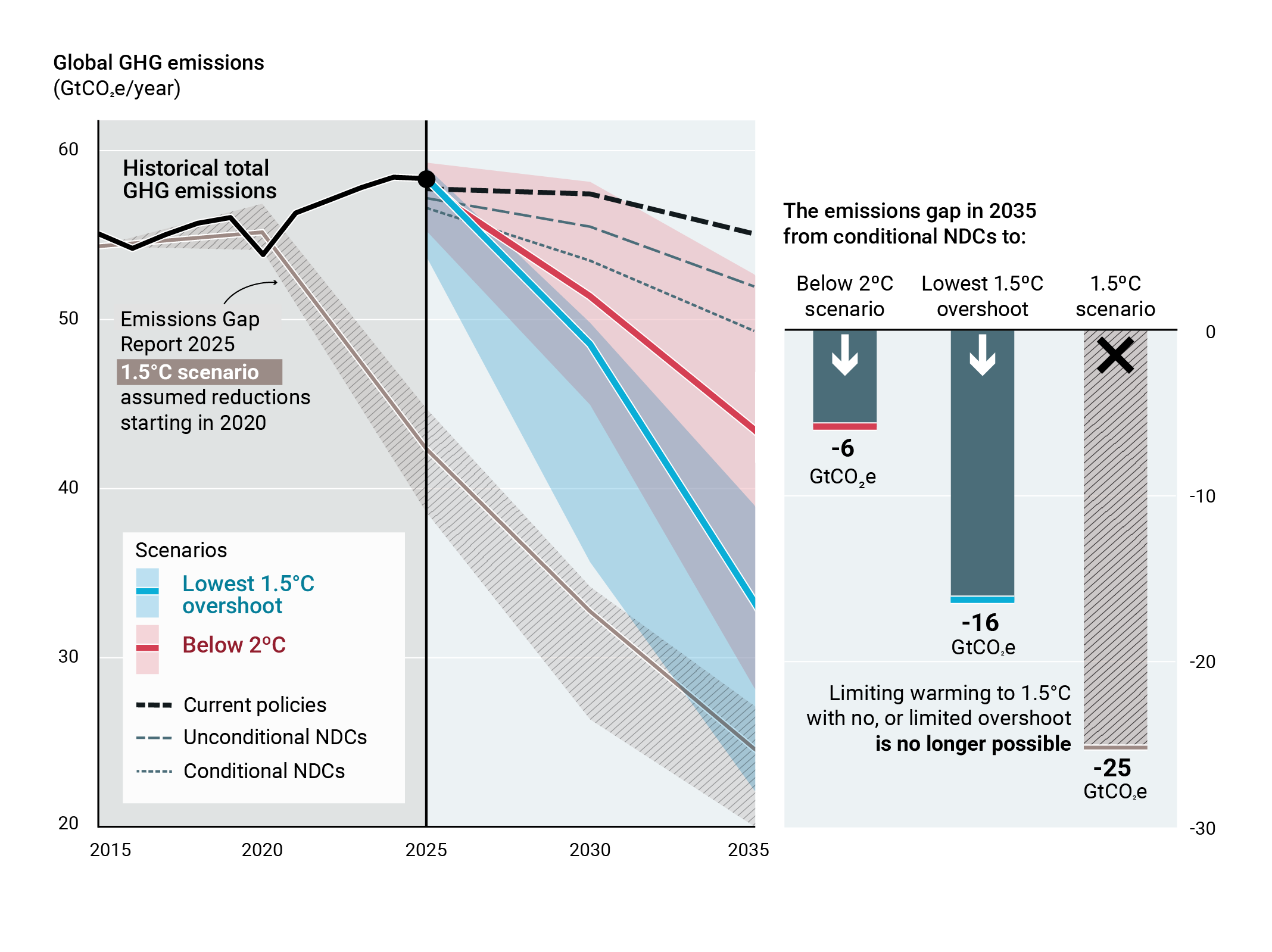
Pledge scenarios against the new 2C and lowest-overshoot pathways, showing the 2035 emissions gap.1 / 4
The 1 has published its 2026 emissions gap report, titled "The point of return". It concludes that a temporary breach of the Paris Agreement's 1.5C limit is now "imminent and unavoidable" after decades of weak action. In UNEP's view, the task now is to keep that overshoot as small and short as possible, then bring warming back to 1.5C by 2100.
Why the old targets were dropped
Earlier reports measured pledges against pathways from the 2. Those pathways assumed deep cuts would start around 2020. Emissions kept rising instead, and they are now about 80% above the 2030 level those pathways needed. So the report uses a new set of pathways in which serious cuts begin in 2025.
The "lowest 1.5C overshoot" pathway has warming peak at 1.7–1.8C mid-century (66% chance) and fall back to 1.5C by 2100 (50% chance). It requires emissions cuts, measured from 2025 levels, of:
18% by 2030
45% by 2035
69% by 2040
net-zero CO2 around 2050
That works out to about 5.7% a year for a decade, which is steeper than the 5% a year that would have been enough had cuts started in 2019. The new figures replace the AR6 benchmarks (43% by 2030 and 60% by 2035, from 2019 levels) that COP decisions have often cited. Holding warming below 2C would need cuts of 11% by 2030 and 24% by 2035.
Where the world actually is
Global emissions in 2025 were 58.4bn tonnes of CO2-equivalent (3), roughly the same as 2024. Fossil-fuel CO2 rose 0.4–1.1%. A drop in wildfire and land-use emissions offset that rise. US emissions grew by 133m tonnes, driven by more coal power and higher electricity demand.
If every pledge were met in full, emissions would fall only 5–8% by 2030 and 11–15% by 2035. The report projects end-of-century warming using 4, a simple climate model that emulates the larger ones. Under current policies, warming reaches 2.8C, with a 10% chance of exceeding 3.4C. Meeting all pledges gives 2.6C. Adding every net-zero target gives 2.1C. These estimates are 0.2–0.3C higher than last year's, because of the US withdrawal from Paris and revised historical emissions data.
The report's rule of thumb is that each five-year delay in starting cuts locks in about another 0.1C.
What's working
Renewable capacity grew three times faster than 2015 projections assumed, so energy-sector CO2 rose 40% less than expected. Renewables are the only area on track for 2030. Moving away from fossil fuels and stopping deforestation are the furthest behind. To end deforestation by 2030, the slowdown in forest loss would have to speed up more than tenfold.
The 1 has published its 2026 emissions gap report, titled "The point of return". It says a breach of the Paris Agreement's 1.5C limit is now "imminent and unavoidable". The report no longer asks whether warming can be held at 1.5C. It asks how far above 1.5C warming will go, for how long, and how quickly it can be brought back. According to UNEP, the best remaining outcome is a peak of about 1.7–1.8C around mid-century, with warming returning to 1.5C by 2100. Getting there would take much deeper cuts than anything countries have pledged.
Emissions in 2025: flat, with caveats
Global greenhouse gas emissions in 2025 were 58.4bn tonnes of CO2-equivalent (2). That is about 0.16GtCO2e below 2024, a difference smaller than the uncertainty in the data. Because the figures are provisional, the report declines to say which direction emissions moved. The longer trend is slowing growth: 1.7% a year over 1990–2015, and 0.8% a year since 2016.
The parts of the total moved in different directions. CO2 from burning fossil fuels rose 0.4–1.1%. Nitrous oxide and fluorinated gases rose faster, but they are small shares of the total. Methane held steady. Emissions from land use, land-use change and forestry (3) fell by slightly more than the other increases combined. Part of that drop came from fewer wildfires as El Niño conditions ended. The report expects the current "super" El Niño to push LULUCF emissions back up in 2026.
Among the six largest emitters, only the US rose noticeably, by 133m tonnes CO2e. The causes were a colder winter, higher gas prices, rising electricity demand and a rebound in coal power. Emissions in China, the EU, India, Russia and Indonesia were roughly flat. Solar power and electric vehicles cut emissions in the power and road-transport sectors. Growth in international aviation and shipping still pushed total transport emissions up. Data centres produce less than 1% of global emissions, although their electricity demand is projected to double by 2030.
Pledges: more of them, little more ambition
Nationally determined contributions (4) are the targets each country submits under Paris. The third round, which covers 2035, was due in February 2025, and 95% of countries missed that deadline. By 1 September 2026, 124 countries had submitted, covering 75% of global emissions. The new pledges use more verifiable formats, such as standardised baselines. They have not, however, extended targets to more sectors or gases. Fully met, they would cut 2035 emissions by only 3.5GtCO2e below the 2030 targets.
The "implementation gap" is the difference between where current policies lead and what the pledges promise. It has narrowed, but mainly because the US left the Paris Agreement and no longer counts as a pledging country. The report calls this "policy changes, not policy progress". Of the G20, 14 of 17 members (counting the EU as one) have filed 2035 targets. All except Japan, the EU and the UK would have to cut emissions faster than their current policies imply to reach their own net-zero dates.
Why the benchmarks changed
Earlier gap reports measured pledges against pathways from the 5. Those pathways were built around 2015–20 and assumed deep cuts from about 2020. That did not happen. Emissions are now around 80% above the 2030 level needed for 1.5C with no or low overshoot, which the report says is "no longer feasible". UNEP has therefore switched to new pathways in which ambitious action starts in 2025:
Below 2C: a 66% chance of staying under 2C all century. Cuts from 2025 levels of 11% by 2030, 24% by 2035 and 37% by 2040.
Lowest 1.5C overshoot: a peak of 1.7–1.8C (66% chance) and a return to 1.5C by 2100 (50% chance). Cuts of 18% by 2030, 45% by 2035 and 69% by 2040, with net-zero CO2 around 2050. The pathway also applies limits on how much land can go to bioenergy and carbon removal, to protect food supply and biodiversity.
These numbers replace the AR6 benchmarks of 43% by 2030 and 60% by 2035, which were measured from 2019 levels. The two sets look different partly because their baselines differ. The required pace has also risen: 5.7% a year over the next decade, against 5% a year had cuts started in 2019. The goal of minimising overshoot follows the "6" package agreed at COP30 in Brazil, the first COP text to acknowledge that 1.5C will likely be overshot. Because the reference pathways changed, this year's gaps cannot be compared directly with earlier reports.
Pledges fall far short of either pathway. Fully met, they would cut emissions 5–8% by 2030 and 11–15% by 2035.
Temperature outcomes
The report runs each scenario through 7, a simple climate "emulator" that reproduces the behaviour of larger models at much lower cost. All figures below are end-of-century warming with a 66% chance:
Scenario
Warming by 2100
Current policies
2.8C (10% chance of >3.4C)
Unconditional NDCs
2.7C
All NDCs, including conditional
2.6C
All NDCs plus net-zero pledges
2.1C
These are 0.2–0.3C higher than last year's estimates, because of the US withdrawal and revised historical data. Even the most optimistic case ends up 0.25C above the lowest-overshoot pathway. The report's rule of thumb on delay: every five years before cuts begin locks in about another 0.1C. It warns that a few more decades of slow progress could make 2C itself unavoidable.
What's working and what isn't
The report checks progress against nine action areas from the first 8. The stocktake, agreed at COP28 in 2023, is the formal Paris review of collective progress. Renewables are the clear success. Capacity grew three times faster than 2015 projections assumed, and energy-sector CO2 rose 40% less than expected. They are the only area on track for 2030, and the report says that depends on supportive policies continuing.
Two areas are furthest behind. The first is the move away from fossil fuels. Fossil energy use is still rising, though more slowly than projected. Coal may peak by 2030, but oil and gas use is likely to keep growing. The second is deforestation, the largest source of land-use emissions. Ending it by 2030 would require the slowdown in forest loss to speed up more than tenfold.
The report also sets fuel milestones for the "minimum collective effort", the smallest contribution from each fuel that is still compatible with the lowest-overshoot pathway. Coal energy falls 15% by 2030, 55% by 2035, 75% by 2040 and 90% by 2050, all from 2025 levels. Oil falls 5% and gas 0% by 2030. Both then drop steeply, reaching cuts of 65% for oil and 75% for gas by 2050.
Open questions
The return to 1.5C depends on an "ambitious and sustainable" scale-up of CO2 removal. Carbon Brief's write-up does not say how large that scale-up must be. The report's timing also matters: the IPCC's seventh assessment has no settled timetable, so UNEP's figures are likely to serve as the de facto 1.5C targets for now. Disclosure: Carbon Brief's deputy editor, Simon Evans, is an observer on the report's steering committee.
Remember
UNEP's 2025-based targets (18% by 2030, 45% by 2035) replace the IPCC's 2019-based 43% and 60%.
The narrower implementation gap comes from the US leaving Paris, not from new policies.
Renewables beat 2015 forecasts threefold; fossil phase-down and deforestation are the furthest behind.
Direct contributions to the IPCC since 1988: the US, historically the top donor, stops after 2024.1 / 2
The 1 is the UN body whose reports sum up climate science for governments. Last week, at its 65th session in Addis Ababa, governments again failed to agree when its next round of reports will come out. It is the sixth meeting in a row to fail on this question. Chair Jim Skea suspended the talks on Friday evening. No budget was approved either, leaving the panel in what its leaders call a "serious funding crisis". Skea called the meeting a "profound disappointment". No date has been set to resume.
Why the timing matters
The 2 has three parts: physical science (WG1), impacts and adaptation (WG2) and mitigation (WG3). Many countries want all three ready for the second 3. That is the Paris Agreement's five-yearly review of progress, which ends at the 4 summit in late 2028 and guides countries' next emissions targets. Skea had said a 2028 publication needed a decision by the end of 2026, which made this meeting the deadline.
The split
Every option on the table approves WG1 in May 2028. The working group co-chairs proposed approving WG2 and WG3 between June and September 2028. India and Saudi Arabia proposed April and July 2029, which is after the stocktake. Russia, Kenya, Iran, Iraq and China also favour more time. They say developing countries need it to review and approve the reports properly. Developed countries and small island states reply that delay hurts the most vulnerable most. Both sides argue in the name of inclusivity.
A 5 whittled seven options down to four but reached no consensus. The secretariat's compromise text would have let authors keep working through 2027 without fixing approval dates. Algeria, India, Iraq and Saudi Arabia rejected it outright. Skea suspended the session after several developing-country delegations had gone home.
The money
2025 contributions were 5.3m Swiss francs (£4.8m) below 2023 levels, while costs have risen.
By July 2026, only 16 donors had paid, for a total of 2.8m francs.
The US, historically the largest donor, has given nothing since 2024.
Finishing AR7 needs about 8m francs a year. At 2025 funding levels, the trust fund empties by the end of 2028.
Even a stopgap approval of the 2026–27 budgets was blocked, by Saudi Arabia, India and Russia.
The science continues, for now
The working groups report steady progress. Nearly 120 authors pledged to keep writing. The 6, which reports from inside the sessions, warns that the dispute between governments is now "spilling over to authors". Bill Hare of Climate Analytics says a session must resume this year, at least to approve the 2027 budget.
The 1 is the UN body that assesses climate research. Last week its 65th session (IPCC-65) met in Addis Ababa and ended without agreeing when its 2 will be published. That makes six plenaries in a row that have failed on this question. On Friday evening the chair, Prof Sir Jim Skea, suspended the meeting. Governments also failed to approve a budget for the rest of the cycle, which leaves the panel in what its leadership calls a "serious funding crisis". Skea called the week a "profound disappointment" and "among the most difficult IPCC meetings". The IPCC says it will reconvene at the "earliest opportunity" but has not set a date.
Why this meeting was the deadline
AR7 has three working group reports: WG1 on physical science, WG2 on impacts and adaptation, and WG3 on mitigation. Drafting is well underway, but the panel's member governments have to agree the approval dates. In April, Skea said the reports could only be finished by the end of 2028 if a schedule was agreed before the end of 2026. Addis Ababa was the last plenary scheduled before that cutoff.
The reason 2028 matters is the second 3. This is the Paris Agreement's five-yearly review of collective progress, and it concludes at 4 in late 2028. Its findings feed into the next round of national emissions targets and climate finance decisions.
The options on the table
Before the meeting, the secretariat circulated three options. WG1 would be approved in May 2028 under all three. They differ on the other two reports:
Option 1 (the working group co-chairs' original proposal): WG2 in June 2028, WG3 in July 2028.
Option 2 (the co-chairs' revised version): WG2 in July 2028, WG3 in September 2028.
Option 3 (submitted by India and Saudi Arabia): WG2 in April 2029, WG3 in July 2029. Both reports would arrive after the stocktake.
During the week the list grew to seven options and then shrank to four. The fourth, from Haiti, would approve WG1 in April 2028, WG2 in July 2028 and WG3 in October 2028.
Who wants what
India, Kenya, Russia and Saudi Arabia have pushed hardest for the later timeline. Iran, Iraq and China backed it too. They argue that developing countries need more time to prepare, review and approve the reports. China opposed holding more than three plenaries a year and said the reports need not be tied to the stocktake. Kenya said publishing afterwards "did not mean science would not inform policy".
On the other side are developed countries and small island developing states. They say delay hurts the most vulnerable countries most. Vanuatu cited the International Court of Justice's 2025 advisory opinion that countries have binding obligations to protect the climate. The Netherlands called it "inconceivable" that the panel would accept missing the stocktake when its own co-chairs say the 2028 schedule is feasible.
Both sides framed their case around inclusivity. They even fought over wording: one camp called the 2028 plans "rushed" and the other called the 2029 plan "delayed". The 5 set up to resolve the timeline, chaired by Brazil and Ireland, argued about its own mandate for most of the week. On Friday morning it reported that it was a "long way from consensus".
How it ended
The secretariat then offered a draft decision. It did not choose a timeline. Instead it would let the co-chairs keep working through 2027 "without prejudging" approval dates. It would put the four remaining options in an annex to record progress, and it would fund a second delegate from each developing country at approval sessions. Algeria, India, Iraq and Saudi Arabia said the text could not serve as a basis for decisions. By 8:29pm several small-island and other developing-country delegations had left; Antigua and Barbuda had said 6pm was its deadline. Skea ruled that continuing would no longer be inclusive and suspended the session.
The 6 (ENB), which reports from inside these closed-door sessions, still saw "room to compromise". It noted that most countries wanted to keep the panel's tradition of following the co-chairs' advice on scheduling, which in practice means Option 1.
The money
The IPCC trust fund is paid for by its parent bodies, the World Meteorological Organization (WMO) and the UN Environment Programme (UNEP), plus voluntary contributions from governments and the UN climate convention (UNFCCC). The secretariat's figures:
Contributions in 2025 were 5.3m Swiss francs (£4.8m) lower than in 2023, while costs have risen.
By early July 2026, only 16 donors had paid in, for a total of 2.8m francs.
The US was historically the largest donor but has given nothing since 2024.
Finishing AR7 needs about 33m francs, just over 8m a year. The bare minimum is 5.8m a year, which leaves no buffer.
If contributions stay at 2025 levels, the fund runs out by the end of 2028, before the reports are delivered.
Budget work usually happens in the 7, a technical committee co-chaired by Kenya and Australia. This time it stalled over whether to delete whole budget lines. Belize, France, Germany, Panama and the Netherlands said two delegations had threatened "no budget" unless their conditions were met. Saudi Arabia and India argued that some 2027 budget lines "favoured one option" for the timeline. Skea replied that most lines apply to every option. On the final evening he asked delegates to approve just the 2026 and 2027 budgets so work could continue. Saudi Arabia, India and Russia objected. The Democratic Republic of the Congo called the delay an "immediate danger to the viability" of the panel.
The science itself
The working group co-chairs reported steady progress. A special report on cities is due in 2027; its second-order draft drew more than 25,000 review comments. Skea said "the engine room of the IPCC is working". Nearly 120 AR7 authors signed a letter pledging to keep working. The ENB cautioned, though, that friction among governments is now "spilling over to authors". Bill Hare of the research group Climate Analytics urged a resumed session this year, at least to pass the 2027 budget. More than half of the authors, who work unpaid, are from developing countries. WG1 contributing author Fabrice Lambert called for professional UN negotiators and facilitators to run future sessions.
Other unresolved business
Reports from the last four sessions remain unapproved; a working huddle reached only preliminary principles for how to record dissenting views. A review of the panel's procedures was deferred. The panel also agreed to set up an informal advisory group on AI use, though any guidance it produces will need the panel's sign-off. Proposals to broaden the gender action team's mandate were pushed to IPCC-66, whose date and venue have not been set.
What's open
The article can't say when, or whether, the session resumes. It also can't say whether a 2028 timeline is still achievable after this deadline, or whether donors will close the funding gap.
Remember
A handful of countries can block decisions, because the IPCC works by consensus.
The IPCC's trust fund empties by the end of 2028 at 2025 contribution levels; the US has paid nothing since 2024.
The authors' scientific drafting continues, but the governments' dispute is starting to disrupt their work.
A Base Power home battery installation, the kind of unit CGEMC will network into a 50-MW fleet.
1, a customer-owned utility serving 14 counties southeast of Atlanta, will deploy up to 50 MW of home batteries with 2, a company that installs and runs residential batteries. The program starts in 2027. It is Base's first utility partnership outside Texas and one of its first in a regulated market, where a single utility serves each area.
Why a co-op wants batteries
CGEMC expects large new loads. Several data centers are proposed in its territory, including a 240-MW Equinix campus near Hampton. Much of what a utility pays for power supply depends on its demand at peak hours. The plan is to charge the batteries when wholesale prices and demand are low, then discharge them at peaks.
Base spokesperson Gabriel Federman says the main value in Georgia is "transmission and reducing 3." Capacity obligations are the generating capacity a utility must pay for, usually sized to its peak demand. Transmission charges are also often tied to peaks. Lower the peak and both bills shrink. The article gives no dollar figures.
How the model works
Base installs and maintains large backup batteries at little or no direct cost to homeowners. In return, it or a partner utility controls them day to day: shaving peaks, softening price spikes, and buying energy cheap to use when it's expensive. Each unit stores 39.2 kWh. Base says one can supply up to 36 hours of backup in an outage.
Base reports more than 750 MWh across more than 30,000 homes. It operates as a retail electricity provider in Texas and in 4's Illinois zone (PJM is a large regional grid operator), and partners with utilities such as Austin Energy and El Paso Electric. In Texas the value comes from peak-shaving and 5. In Georgia it comes from transmission and capacity savings. Federman argues the principle is the same in both.
A September analysis by consultancy ICF found that home batteries offer the same wholesale benefits as large grid batteries. ICF said they can also ease local grid congestion, improve resilience and delay distribution upgrades.
Who is buying, and why
Investor-owned utilities earn a regulated return on infrastructure spending. Co-ops and municipal utilities don't, so they have strong reasons to avoid costly investments and keep wholesale costs down. That makes them natural early buyers.
Open questions
The article doesn't say how many homes will enroll, what the deal costs, or how CGEMC will balance grid use against keeping enough charge for outages. Even at full size, the fleet is about a fifth of one proposed data center campus. It can trim peaks but won't replace new supply.
1, a customer-owned utility serving 14 counties southeast of Atlanta, plans to deploy up to 50 MW of small batteries installed in members' homes. It is partnering with 2, a company that installs and runs residential batteries. The program begins in 2027. It is Base's first utility partnership outside Texas and one of its first in a regulated utility market. The announcement came on Oct. 13, 2026.
The problem: load growth and peak-driven costs
CGEMC's territory could see large new loads. Several data center projects are proposed or under development there, including a 240-MW Equinix campus near Hampton. That one campus is nearly five times the size of the planned battery fleet. A utility facing that kind of growth needs more capacity, especially at the hours of highest demand. Those hours drive much of what it pays for power supply.
CGEMC's plan follows a simple pattern. It will charge the batteries when wholesale prices and member demand are low, then discharge them during peak demand. Base spokesperson Gabriel Federman says the value in Georgia comes mainly from "transmission and reducing 3." Capacity obligations are the amount of generating capacity a utility must secure or pay for, usually sized to its peak demand. Transmission charges are also commonly tied to a utility's contribution to system peaks. If thousands of homes stop drawing from the grid during those few critical hours, the measured peak falls, and so do those charges. The article does not give CGEMC's actual peak load or how its costs are allocated, so the dollar savings can't be estimated from it.
How the Base Power model works
Base installs and maintains fairly large backup batteries in homes at little or no direct cost to the homeowner. Customers get a heavily discounted subscription. Several companies offer this kind of deal. In restructured markets, they work through retail choice frameworks, where the company acts as the customer's electricity provider. In regulated markets, where one utility serves each area, they partner with that utility.
Base is a retail electricity provider in Texas and in the Illinois zone of 4, the grid operator covering much of the mid-Atlantic and Midwest. In parts of Texas it also partners directly with public power utilities, including Austin Energy. Separately, it runs a resilience-focused pilot with El Paso Electric. That utility is 5, meaning it owns generation, transmission and distribution, and it sits outside 6, the deregulated Texas grid.
Each Base battery holds 39.2 kWh. Base says one can supply up to 36 hours of backup during an outage. When the grid is working, Base or its utility partner dispatches the fleet to shave peaks, soften price spikes, and earn 7 value, which means buying energy cheap and using it when it is expensive. Base says its fleet now totals more than 750 MWh across more than 30,000 homes. That works out to about 25 kWh per home on average, below the current unit size. This suggests earlier or mixed configurations, though the article doesn't say.
The article gives no per-home power rating, so it doesn't say how many homes 50 MW means. As an illustration only: if each unit discharged at 10 kW, the program would need about 5,000 homes.
Different markets, same pitch
Federman argues the value streams differ by market but the core proposition is the same: distributed batteries lower power-supply costs. In Texas, that means cutting transmission and energy costs through peak-shaving and arbitrage. In Georgia, the focus is transmission and capacity.
A September analysis by the consultancy ICF found that large transmission-connected batteries and customer-sited batteries both deliver wholesale-level benefits. ICF said distributed battery energy storage systems (8) add further value. They can relieve congestion on local distribution lines, improve local resilience, and let utilities put off grid upgrades.
Why co-ops and public power are early adopters
The article notes that ownership structure shapes incentives. Investor-owned, vertically integrated utilities earn a regulated rate of return on what they spend on infrastructure, so building assets can be profitable for them. Member-owned co-ops like CGEMC and nonprofit municipal utilities like Austin Energy have no such incentive. They want to keep wholesale costs and capital spending low. In every market structure, these utilities are turning to storage connected to the distribution grid, from networked home batteries to multi-megawatt units at substations and industrial sites.
CGEMC CEO George Weaver presents the deal as good for both the grid and participating members. He says it adds "flexible local capacity" while giving households backup power.
What remains open
The announcement leaves key questions unanswered:
Economics: what CGEMC pays Base, what members pay, and the expected savings per MW.
Scale: how many homes will take part, and how fast enrollment will happen. "Up to 50 MW" is a ceiling, not a commitment.
Dispatch limits: how CGEMC balances discharging for the grid against keeping charge in reserve for members' outages. Batteries emptied at the evening peak can't also cover a storm that night.
Proportion: 50 MW is modest next to proposed data center loads like the 240-MW Equinix campus. The fleet can trim peaks, but it does not replace new generation or transmission for that growth.
Watch whether the Georgia rollout reaches its full 50 MW. That would show whether the subscription home battery model can work beyond Texas.
Remember
In Georgia, home batteries earn their value mainly by cutting peak-based transmission and capacity charges, not from energy arbitrage.
Co-ops and municipal utilities earn no return on infrastructure, which pushes them toward cheaper distributed storage.
At up to 50 MW, the fleet is small next to proposed loads like a 240-MW data center campus.
Gov. Abigail Spanberger at a September 2026 press conference on data center accountability in Richmond.
Virginia Gov. Abigail Spanberger has said what it would take for her to back the proposed $67 billion merger of Dominion Energy, the state's main regulated utility, and NextEra Energy. The combined company would be the largest regulated electric utility in the world. Her conditions start with a six-year freeze on 1.
The decision belongs to the 2 (SCC), which regulates Virginia's utilities. Spanberger's office laid out her terms in expert testimony filed with the commission.
What she is asking for
Bigger bill credits. $29 a month per customer for four years. The companies first offered $10 a month for two years, then stretched that to four years after pushback, including from Lt. Gov. Ghazala Hashmi. Over four years, her version comes to about $1,392 per customer, against $480 under the companies' current offer.
The witness, consultant Richard McCann of M.Cubed, argued that these commitments need "mandatory, comprehensive enforceability provisions." He said the commission should reject the merger unless they are "substantially addressed" or alternatives are found.
A crowded case
The governor isn't alone. Virginia's attorney general and the SCC's own staff also filed testimony opposing the deal unless their conditions are met, and local communities have pushed back hard.
Dominion and NextEra announced the merger in May. They argued that a combined company could build out Virginia's grid more cheaply to serve fast-growing demand from data centers. They have also promised more clean energy in line with the 5, the state's decarbonization law. In a joint statement, the companies said they are reviewing the filings and will respond through the commission's process.
What isn't known yet
The article doesn't put a dollar value on the rate freeze or the capital-structure change. It also doesn't say whether the companies would accept terms this steep, or when the SCC will rule. Spanberger planned a media call on Tuesday to explain her proposal.
Virginia Gov. Abigail Spanberger, a Democrat, has filed her terms for the proposed $67 billion merger of Dominion Energy and NextEra Energy. Dominion is Virginia's main state-regulated utility. NextEra is the Florida-based parent of Florida Power & Light and one of the largest renewable developers in the US. Together they would form what the article calls the largest regulated electric utility in the world. Spanberger isn't asking regulators to block the deal. She is asking them to approve it only if a set of conditions is met, led by a six-year freeze on 1.
"Any proposed merger involving Virginia's primary state-regulated utility must benefit families, small businesses, and Virginia's workforce — not just the shareholders of these multi-billion-dollar corporations," she said Monday.
Who decides, and why the deal exists
The 2 (SCC), Virginia's utility regulator, must approve the merger. Parties to the case, including the governor's office, file testimony, and the commission weighs it.
Dominion and NextEra announced the deal in May. Their case is that a combined company could build out Virginia's grid more cheaply to meet rising demand from data centers. Northern Virginia hosts the world's largest cluster of data centers, so serving them will take large investments in generation and transmission. The open question is how much of that cost lands on households.
The governor's conditions
The terms appear in testimony from Richard McCann, an environmental consultant with the firm M.Cubed, filed on behalf of Spanberger's office.
Rate freeze. A six-year freeze on base residential rates. In utility rate-setting, base rates cover the utility's own costs and return on investment. Fuel and some other costs usually pass through separately as 3. The article doesn't say whether riders would also be frozen, so customers' total bills could still change.
Bill credits. $29 a month for four years. Dominion and NextEra first offered $10 a month for two years and extended that to four years after criticism, including from Lt. Gov. Ghazala Hashmi. Spanberger describes her number as "a tripling." Per customer over four years, the two offers compare like this:
Companies' current offer: $10 × 48 months = $480
Governor's proposal: $29 × 48 months = $1,392
Capital structure. Raise the debt share of Dominion's 4 from 48% to 60%, which cuts equity from 52% to 40%. Here's why that matters. Regulators set a utility's allowed return as a weighted blend of what it pays lenders and the higher return it may earn for shareholders. Shifting the mix toward debt lowers the blended rate.
An illustrative example, with assumed numbers not taken from the article: say equity earns 9.7% and debt costs 5%.
At 52% equity and 48% debt, the blend is 0.52 × 9.7 + 0.48 × 5 ≈ 7.4%.
At 40% equity and 60% debt, it is 0.40 × 9.7 + 0.60 × 5 ≈ 6.9%.
On every $10 billion of grid investment, that half-point gap is about $50 million a year. The real gap would be larger, because equity returns are also grossed up for income taxes. The trade-off is that a more heavily indebted utility can look riskier to credit-rating agencies, which can raise its borrowing costs. The article doesn't say how the companies or the SCC view that risk.
Cost allocation. The testimony calls for a "5" method. This is a way of dividing the fixed costs of power plants among customer classes based on how likely each plant is to be needed in each hour. Costs then follow the hours when the system is actually stretched, not a simple average. The article doesn't say how this would shift costs between households and data centers.
Other commitments. Better disconnection policies for customers behind on bills, plus energy-efficiency, clean-energy and labor and workforce commitments. McCann wants all of it backed by "Mandatory, Comprehensive Enforceability provisions." He also says the commission should reject the petition unless these commitments "are substantially addressed or alternative solutions are identified."
Other opposition
The governor's filing arrived alongside filings from Virginia's attorney general and from SCC staff. Both oppose the deal unless their own proposed terms are adopted. Local communities have also pushed back hard. The article doesn't detail what the attorney general or the staff asked for.
The companies have already moved once. Besides lengthening the bill credits, they promised more clean energy consistent with the 6, the 2020 law that requires Dominion to reach 100% carbon-free electricity by 2045. Their joint response to the governor was noncommittal: the testimony "reflects a wide range of viewpoints and interests," and they will address the issues "through the Commission's established process."
What's still open
The article leaves the key numbers unknown:
The cost of a six-year freeze. It depends on how much new investment Dominion would otherwise have recovered through base rates over that period, and on whether riders are included.
Whether NextEra's shareholders would accept these terms. Lower returns, larger credits and a long freeze together could change the deal's economics.
The timeline. The article gives no date for an SCC ruling.
Spanberger planned to explain her proposal on a media call Tuesday.
Remember
The companies' bill credit offer grew from $10/month for two years to four years; the governor wants $29/month.
Raising Dominion's debt share from 48% to 60% would lower the return customers fund, but could raise its credit risk.
The governor, attorney general and SCC staff all oppose the merger unless their own conditions are met.
A Permian Basin flare. Burning methane turns it into CO2, which is less potent; failed flares release it unburned.1 / 2
The Environmental Protection Agency (EPA) says it will propose new methane rules for the oil and gas industry this month. Administrator Lee Zeldin announced the plan, but the article doesn't say what the rules will contain. After the proposal comes a public comment period, and possibly a final rule.
Ten years of back and forth
The Obama administration proposed methane standards in 2015, and the first Trump administration rolled them back. Biden's EPA then wrote detailed rules. They banned routine 1 and 2, required leak checks, set equipment standards and charged a fee on excess emissions. Supporters projected the rules would prevent 58 million tons of methane from 2024 to 2038.
The second Trump administration has taken them apart:
The 3, the administration's budget law, delayed the fee by 10 years.
Zeldin announced broad exemptions to the new-well flaring ban one week before it took effect in May 2026.
The administration has proposed ending all greenhouse gas reporting by companies.
Why the Permian matters
Pound for pound, methane traps more than 80 times as much heat as CO2 over 20 years. Fossil fuels produce about 20% of global methane emissions, behind livestock and landfills, and wetlands. The 4 in West Texas is the worst-emitting of six major oil and gas basins studied. A 2026 study estimated its emissions at 5.1 million tonnes a year, close to 1% of the global total by some estimates. The International Energy Agency's 2026 tracker found no sign that fossil-fuel methane is falling.
The gas comes from venting pipeline valves, flares that fail to burn it, compressor stations and well blowouts. A May 2026 study by Texas A&M scientist Gunnar Schade found venting to be the largest source of oil and gas methane in the basin.
Wasting gas often pays
A March 2026 report from the think tank 5 found that most Texas releases are never reported. It says the state regulator, the 6, doesn't rigorously check the figures companies do report. The underlying problem is price. Above about $4 per 7 (million British thermal units, the unit gas is priced in), selling gas beats wasting it. West Texas prices have stayed mostly below that level for 15 years. RMI concludes that reporting alone won't change behavior and that strict rules are needed.
Skepticism about any rule
Activist Sharon Wilson films leaks with a $50,000 infrared camera. She says enforcing even good rules across such a huge area "would take an army." Julia Kane of the watchdog group Fieldnotes reviewed industry comments filed during rulemaking. She argues companies want a rule with "very few teeth" so they can say they're regulated without changing much.
The announcement
Environmental Protection Agency (EPA) Administrator Lee Zeldin has said the Trump administration will propose its own methane rules for the oil and gas industry this month. After the proposal comes a public comment period, and possibly a final rule. The article doesn't say what the proposal will contain. What it does lay out is ten years of rules that came and went, while emissions from the country's largest oilfield stayed high.
A decade of rules that didn't stick
The Obama administration proposed methane standards in 2015, and the first Trump administration rolled them back. In his first week in office, President Biden signed an executive order titled "Tackling the Climate Crisis at Home and Abroad." Over the next few years his EPA wrote a detailed set of rules. They banned routine 1 and 2, required companies to check for leaks, set standards for equipment, and charged a fee on excess methane. "These were a really hard set of rules to work on just in terms of the volume of technical information," said Joseph Goffman, a former EPA assistant administrator who worked on them. The Texas Methane Network, a coalition of environmental groups, says the rules relied on cost-effective, off-the-shelf technology and were projected to prevent about 58 million tons of methane between 2024 and 2038.
The second Trump administration has taken most of that apart:
The fee was due to start in 2025. The 3, the administration's major budget law, delayed it by 10 years.
The routine-flaring ban for new wells took effect in May 2026. One week earlier, Zeldin announced broad exemptions to it.
Reporting: the administration has proposed ending all requirements for companies to report greenhouse gas emissions, methane included.
Why methane, and why the Permian
Methane is the second-largest contributor to global warming after carbon dioxide. Pound for pound, it absorbs more than 80 times as much heat as CO2 over 20 years. In 2021 the UN Environment Programme called cutting methane "the strongest lever we have to slow climate change over the next 25 years." That hasn't happened. Atmospheric methane keeps setting records, and so does global production of coal, oil and gas. The International Energy Agency's 2026 global methane tracker found "no sign that methane emissions from fossil fuel operations are falling, despite well-known and proven mitigation pathways." 2026 looks on track to be the warmest year on record.
Fossil fuels are not the biggest source. The Global Methane Budget, published last year through the European Geosciences Union (EGU), ranks livestock and landfills first and wetlands second. Fossil fuels come third, at about 20% of global methane emissions. Within that 20%, the 4 of West Texas and New Mexico stands out. A 2026 EGU study of six major oil and gas basins found it the top emitter. A 2026 study in Environmental Science & Technology put its emissions at 5.1 million metric tons a year, which by some estimates is close to 1% of all global methane emissions from one oilfield.
How the gas gets out
Gas comes up with oil and leaves the system in several ways. It leaks from wells and processing plants. It is vented from pressure valves on pipelines. It is released when companies clear out equipment during routine maintenance. Flares that malfunction let unburned methane through. Compressor stations blow off tall plumes to relieve backed-up pipelines. Blowouts, when failed equipment lets gas erupt from a well, cause the largest single releases. During widespread disruptions such as storms, whole networks spanning hundreds of miles can open emergency valves at the same time.
Most of this is invisible. Sharon Wilson, 72, founder of a group called Oilfield Witness, has documented it for over 20 years with an 5, a $50,000 infrared device that shows gases the eye can't see. She says these releases are almost never reported to state regulators or recorded in official datasets. Gunnar Schade, an atmospheric scientist at Texas A&M University, measured "methane plumes at all times of day from all directions." Wells are packed so densely that emissions often can't be traced to a single site. His May 2026 study found venting to be the largest source of methane from oil and gas there.
The economics: wasting gas often pays
The clearest mechanism in the article comes from a March 2026 report by 6, an energy think tank. It found that most Permian methane releases in Texas are never reported. It also found that the state's oilfield regulator, the 7, "does not rigorously enforce reporting and seems not to test the validity of the gas volumes that are reported."
Behind that is a price signal. Capturing gas and piping it to market costs money. Venting or flaring it costs almost nothing. RMI's data show that releases fall when gas prices rise. Kevin Gauthier, a geoscience advisor at RMI, says that above about $4 per 8 (million British thermal units, the standard unit for pricing gas), selling gas appears to beat wasting it. West Texas prices have stayed mostly below that level for 15 years. In practice, for much of that time an operator choosing between building pipeline capacity and venting has had little market reason to build. RMI concludes that "reliable reporting alone is unlikely to change the behavior" and that "stringent rules will be required."
What a new rule might look like
Two people the article quotes doubt that rules alone will change much. Wilson says the oilfields are so vast and empty that "even if we had the best rules you could think of, we don't have enough people to enforce those. It would take an army." Julia Kane, a researcher at the watchdog group Fieldnotes, reviewed company comments filed during rulemaking. She argues the industry doesn't want regulation repealed. It wants a rule full of holes. "The companies want to be able to say that they're well regulated," she said. "They don't actually want to be well regulated." That, she says, is why the administration probably won't drop methane rules altogether.
What's still unknown
The article leaves the main questions open. It doesn't say which requirements the new proposal will keep, such as leak detection, equipment standards or limits on flaring. It doesn't say how the rule would be enforced if mandatory reporting ends. The emissions estimates come from aircraft, satellites and ground studies rather than company reports, and the gap between those numbers and the official ones is itself the problem. Watch for the proposal's text and its exemptions, and for whether West Texas gas prices rise above about $4 per MMBtu. In this basin, that price may affect emissions as much as any rule does.
Remember
One basin, the Permian, emits about 5.1 million tonnes of methane a year, close to 1% of global emissions.
RMI found that wasting gas tends to stop paying only above about $4/MMBtu, and West Texas rarely gets there.
The Biden rules' methane fee is delayed to the mid-2030s, and the new-well flaring ban has broad exemptions.
A lower return for Dominion. Raise the debt share of Dominion's 3 from 48% to 60%. Regulators let utilities earn a higher return on shareholder equity than on debt, so more debt lowers the overall return built into rates.
A different cost-allocation method. The testimony calls for "4," which splits the fixed cost of power plants according to when the system is likely to need them, not by a simple average.
Other terms. Better disconnection policies, energy-efficiency and clean-energy commitments, and labor protections.