Tariff Placeholders and Homemade Power Plants · Morning Gist
Monday, October 265 stories · 16 min
Tariff Placeholders and Homemade Power Plants
Trade fights over solar and wind imports, a California test of grid programs customers would actually join, and a rural backlash against data centers.
Picked from 43 new articles across 13 sources · arrow keys for other days
Today in 30 seconds
30s left
UC San Diego will let 200 California households write their own virtual power plant rules, then run them through a grid simulator. story 1 ↓
Commerce blocked about 60 solar importers suspected of stockpiling before the December 3 tariff deadline. Importer numbers doubled to more than 400 after August. story 2 ↓
Trump declared wind turbine imports a security threat but set no tariffs, reportedly just to meet a 90-day legal deadline. story 3 ↓
The Iran war oil shock is pushing poor countries toward solar on their own. Vietnam's electric two-wheeler sales nearly doubled. story 4 ↓
Gallup finds 70% of Americans oppose data centers. In rural Ohio, many of the same people oppose solar and wind too. story 5 ↓
An Oregon town declared a state of emergency over the state's pause on data center permits, warning of large financial losses.
1/5Canary Media· Jeff St. John· Oct 22
California study lets 200 households design their own virtual power plants
A University of California, San Diego-led project will spend 12 months having 200 homes with solar, batteries and electric vehicles set the rules for hypothetical virtual power plants, then simulate how those rules affect California's grid.
Why it matters · Virtual power plants could defer costly grid upgrades, but few customers sign up. Knowing which program terms people will actually accept is the missing data.
Know this first
Context from the editor, not the article · 28 sec
1 · What a virtual power plant is
A virtual power plant (VPP) pools many home devices, such as batteries, thermostats and EV chargers, so a utility or aggregator can shift or cut demand at peak times, the way a power plant would add supply.
2 · Who runs VPPs today
Most VPPs are designed top-down by utilities, tech companies or vendors like Tesla and Sunrun. The operator sets the rules: how often it can dispatch devices, how much battery it can drain, and what it pays.
3 · Why California cares
California has millions of rooftop solar systems and fast-rising electricity rates. Peak demand during heat waves strains the grid, and only a small share of homes with suitable devices join any VPP program.
2/5Heatmap· Alexander C. Kaufman· Oct 22
Commerce Department blocks about 60 solar importers suspected of stockpiling before tariffs
The U.S. Commerce Department has blocked about 60 solar importers in recent weeks to stop panel stockpiling before polysilicon trade limits take effect December 3, according to Roth analyst Philip Shen.
Why it matters · How strictly these import limits are enforced will shape U.S. solar panel prices and supply for utility-scale projects in 2027 and after.
Know this first
Context from the editor, not the article · 28 sec
1 · What Section 232 is
Section 232 of the Trade Expansion Act of 1962 lets the president restrict imports that the Commerce Department finds threaten national security. It requires no ruling that foreign producers traded unfairly, so the government can act quickly and broadly.
2 · Why polysilicon matters
Polysilicon is the refined silicon that nearly all solar cells are made from. Most of the world's supply comes from China, so trade limits on it affect the price and supply of almost every imported solar panel.
3 · The stockpiling problem
When a trade measure is announced but takes effect later, importers can rush to bring in cheap goods before the deadline. That weakens the measure for months and can upset domestic prices.
3/5Heatmap· Alexander C. Kaufman· Oct 23
Trump says wind turbine imports threaten security but imposes no tariffs
President Trump formally agreed with a Commerce Department finding that imported wind turbines threaten national security, but he imposed none of the recommended tariffs. A source says the move only preserves his legal option to add tariffs later.
Why it matters · US wind developers still face tariffs that could come at any time, and China's push to use only Chinese parts is shaping how Europe treats Chinese turbine makers.
Know this first
Context from the editor, not the article · 29 sec
1 · Section 232 investigations
Section 232 of the Trade Expansion Act of 1962 lets the Commerce Department investigate whether imports threaten national security. The president then has a fixed window to accept or reject the findings and decide whether to act, for example with tariffs.
2 · US wind's rough year
Under Trump, US wind projects have been stuck behind permitting holds and reviews across several federal agencies. Developers have also had to plan around the risk of new tariffs on imported turbines, blades and other parts.
3 · China's turbine dominance
Chinese makers such as Goldwind and Mingyang Smart Energy lead the world in turbine output and are moving into Europe. The EU is still deciding what conditions Chinese suppliers must meet to sell there.
4/5Grist· Austin Corona· Oct 22
Iran war oil shock widens rich-poor gap as poor countries go solar on their own
The IMF's October report finds that the oil price spike from the US–Israel war on Iran has hit poor fuel-importing countries hardest. Households there are buying rooftop solar and electric motorbikes, but little planning or financing backs them.
Why it matters · The oil shock is a live test of whether cheap solar and electric vehicles cushion poor economies, and of who pays for the grids that make them work.
Know this first
Context from the editor, not the article · 30 sec
1 · Why importers suffer most
Countries that buy most of their oil and gas abroad pay world prices in scarce foreign currency. A price spike drains public budgets and raises the cost of food, fertilizer and freight all at once.
2 · The development lenders
The IMF and World Bank were set up in 1944 to lend money to countries and advise them on finance. Regional banks such as the Asian Development Bank do similar work. Together they are the main public source of infrastructure finance for poor countries.
3 · Rooftop solar and grid costs
Grid costs are usually recovered through electricity bills. When richer households generate their own power and buy less from the grid, those fixed costs are spread across fewer customers. This is often called the utility death spiral.
5/5Inside Climate News· By Dan Gearino· Oct 22
Rural opposition to data centers echoes the fight against wind and solar
Inside Climate News reporter Dan Gearino finds that rural fights against data centers use many of the same arguments as fights against wind and solar. He argues renewable developers should win trust by being open, unlike data center builders.
Why it matters · Local acceptance limits how fast renewables get built. If anger at data centers spills onto solar and wind, or pushes states to take siting power away from towns, that changes how projects get built.
Know this first
Context from the editor, not the article · 28 sec
1 · Why data centers are contentious
AI and cloud computing are driving a wave of very large data centers. They draw heavy grid power, and some run on gas turbines or diesel generators on site. Many are proposed in rural areas where land and power connections are available.
2 · Who decides where projects go
In most U.S. states, townships and counties control land use through zoning. That lets them restrict or ban wind farms, solar farms and data centers. Some states have moved part of that authority to state regulators.
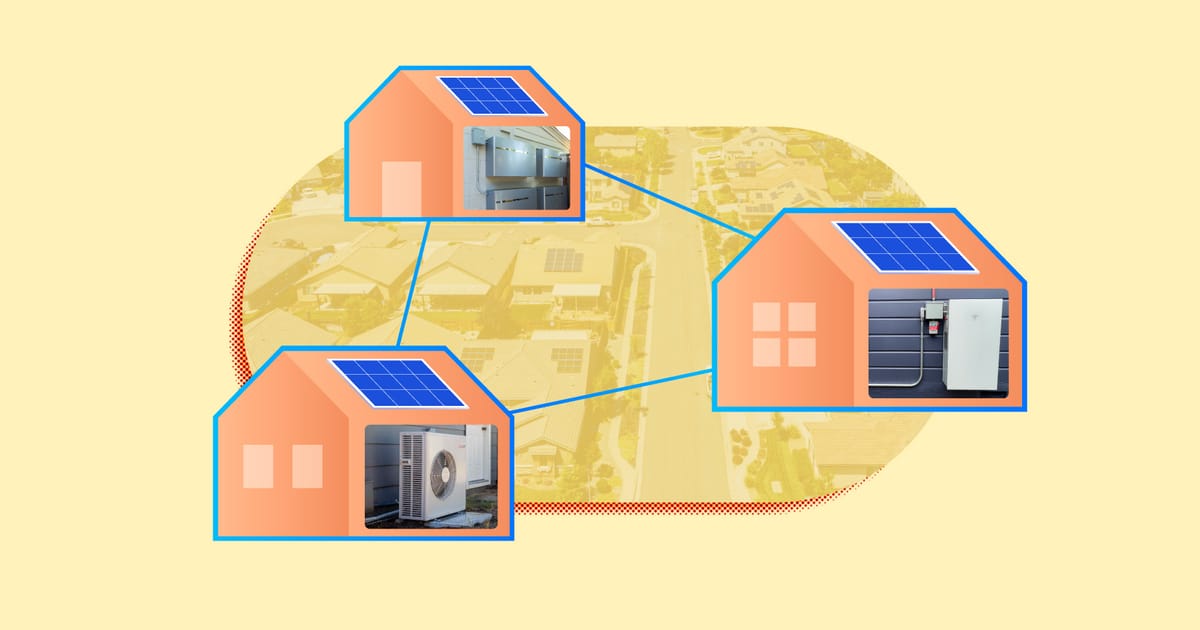
On Wednesday the 1, led by the Design Lab at the University of California, San Diego (UCSD), launched a new research phase. Its idea is to let households design 2 (VPPs) themselves instead of having utilities and vendors write the rules for them. A VPP pools home devices such as batteries, thermostats and EV chargers so their combined demand can be shifted or cut at grid peaks.
The setup
Over 12 months, about 200 volunteer households will form what the project calls a 3. All of them have connected equipment, including solar panels, home batteries, electric vehicles, heat pumps and smart thermostats, from a range of manufacturers. Researchers will survey them on the usual VPP trade-offs: how often they'd accept their air conditioning being turned down in a heat wave, and how much battery charge they want kept in reserve for a blackout.
The surveys also ask what motivates people to share energy. Thomas Familia, a former utility energy analyst now at Arizona State University, says some households will want to maximize savings, some want more clean energy, and some want to help neighbors who rely on medical equipment.
From preferences to grid impact
The work runs in three stages:
Surveys shape a range of hypothetical VPP programs.
4, a San Diego startup that tracks home energy use, estimates how each home's hour-by-hour electricity profile would change if it joined those programs.
5, a UCSD-backed test facility, feeds those changed profiles into grid-simulation software and hardware to estimate the effect on California's real grid. DER stands for , meaning small power sources and loads spread across homes and businesses.
Co-lead Andrew Krause, CEO of the contractor Northern Pacific Power Systems, hopes that "homeowners will self-organize around the right programs if they have a sense of control." The aim is data that utilities and policymakers can use to design programs for the millions of Californians who could join a VPP but haven't.
What to watch
The programs are hypothetical, so the study measures what people say they would accept and estimates the effect through simulation. No household actually gets dispatched. The article doesn't say how results will be published or whether utilities have committed to using them.
Krause also raises an equity worry. He sees solar-led electrification as a way to offset rising rates, but fears that wealthy households may use solar and batteries to leave the grid entirely. That would leave everyone else paying for increasingly costly utility infrastructure.
On Wednesday the 1, led by the Design Lab at the University of California, San Diego (UCSD), launched a new phase of research. Its premise departs from how 2 are usually built. Instead of a utility, a tech company or a vendor like Tesla or Sunrun writing the program rules, the households taking part would help write them.
The problem: lots of devices, few participants
A virtual power plant (VPP) links many small, distributed devices, such as home batteries, smart thermostats, EV chargers and heat pumps, so that an operator can shift or reduce their demand, or discharge stored energy, when the grid is stressed. Done at scale, this can stand in for 3 and defer some grid upgrades.
California has plenty of the hardware. According to the article, though, only a handful of VPP options exist and most eligible households aren't in any of them. Every VPP depends on terms someone has to accept: how often devices get dispatched, how far a thermostat moves, how much battery charge the operator can use, and what the household gets paid. Operators currently set those terms with limited evidence about what customers actually want. The terms that get the most people to enroll may not be the ones that deliver the most grid value, and nobody has much data on that trade-off.
The 4
Over the next 12 months, about 200 volunteer households will make up what the project calls its Living Laboratory. Each has connected equipment from a range of manufacturers: solar panels, home batteries, electric vehicles, heat pumps, smart thermostats and other devices.
Researchers will survey them on two kinds of question. The first covers standard VPP parameters, for example:
How often they'd accept their air conditioning being turned down during a heat wave.
How much battery charge they want held back in case of a blackout.
The second covers motivation. Thomas Familia, a former utility energy analyst and now a postdoctoral scholar at Arizona State University, says some households will want to maximize financial returns, some will want to use more clean energy, and some may want to help neighbors who need to run life-sustaining medical equipment. "We want to make it clear there's a personal relationship between the VPP and the household itself," he said.
How preferences become grid data
The project then turns survey answers into grid effects in three stages.
Program design. The team uses the survey results to build a range of hypothetical VPP programs, each a set of rules about what's shared, when, and for what incentive.
Here is an illustration of how this could work; the numbers are invented, not from the project. Suppose one program lets the operator use batteries down to 50% charge on summer evenings, and another stops at 80% because members value backup power more. Balto's data would show how each rule changes evening grid imports for participating homes. DERConnect would then scale that change up to estimate how much peak load each design could remove. Planners could weigh a design's grid value against how many people say they'd join it.
Why the organizers think it matters
Krause, CEO of Northern Pacific Power Systems, a California solar, battery and home-electrification contractor, asks: "What would happen if we put customers in a simulated environment, tweaked the rules, and found compelling, sophisticated program designs that give people agency to achieve their desired outcomes?" He argues that "homeowners will self-organize around the right programs if they have a sense of control." The intended users of the results are policymakers, utilities and companies trying to reach the millions of Californians who might be interested in VPPs but aren't participating.
Krause also has a wider argument. He believes "solar-led electrification" can help Californians offset high and rising electricity rates and make EVs and electric heating and appliances affordable. He also worries that wealthy households could use solar and batteries to "defect" from the grid entirely. The fixed cost of increasingly expensive utility infrastructure would then fall on fewer, less affluent customers. Programs that reward people for staying connected and sharing energy are one counterweight to that.
Caveats and open questions
Stated, not revealed, preferences. The programs are hypothetical. Households report what they would accept, and the grid effect is simulated. People often tolerate less disruption in a real heat wave than they predict in a survey.
Sample. 200 volunteers who already own a full set of connected devices are early adopters, likely wealthier and more engaged than the typical customer the project wants to reach.
Path to adoption. The article doesn't say how findings will be published, which utilities or regulators are involved, or whether any real program will be built from the results.
Funding and metrics. The article doesn't give the project's budget, its funder, or which grid metrics DERConnect will report, such as peak reduction or feeder congestion.
The study's main contribution may be the dataset itself: a link between specific program terms, household behavior and simulated grid outcomes, which VPP designers have so far mostly had to guess at.
Remember
Most VPPs set rules top-down; this project asks customers which terms they'd accept, and why.
Survey answers are converted into hourly load changes, then grid impacts via the DERConnect simulator.
Results are hypothetical and come from 200 early adopters, so real-world enrollment may differ.
The U.S. Commerce Department has blocked roughly 60 solar importers over the past several weeks, 10 of them in the past week, according to an investor note from 1 analyst Philip Shen reported by Heatmap. The aim is to stop companies stockpiling foreign panels before new trade restrictions take effect.
The rule and the deadline
In August, Commerce restricted imports of 2, the refined silicon nearly all solar cells are made from. It used 3, a trade law provision that lets the government limit imports on national security grounds. The agency gave the industry 120 days to prepare, a window that closes on December 3.
A delay like that invites a rush. Importers have every reason to bring in as much cheap equipment as possible before the deadline, which could blunt the policy for months. Commerce said at the outset that it would watch for this.
The numbers
About 200 approved importers were bringing in solar panels before the August decision.
That count has since more than doubled, to over 400.
About 60 have now been blocked.
So Commerce has removed around 30% of the roughly 200 new entrants. The article doesn't explain how importers get approved, why these were blocked, or how much product the new importers have already brought in.
No carveout expected
Industry speculation had suggested Commerce might soften the rule, with an exemption for 4 developers, who buy panels in bulk on long contracts, or a delay to the December 3 start. Shen said his sources "with direct access to the Commerce Department" say carveouts are "not being worked on." Commerce did not respond to a request for comment. Unnamed sources passed on by an analyst are not confirmation, but the blocks fit an agency planning to enforce the rule as written.
What's still unknown
The key questions for developers are how much inventory slipped in anyway, how far panel prices will rise after December 3, and how long stockpiles will last. The report puts no number on any of them.
Also in the briefing
Senator Sheldon Whitehouse warned that the Justice Department's move to reopen permits for New England Wind, a 2.6-gigawatt offshore wind project, could "blow up" a Senate deal to speed up energy permitting. Google expanded a "5" deal with Voltus tenfold, to 1 gigawatt, on the 6 grid. A virtual power plant pools many small energy sources and batteries so the grid can draw on them together.
The U.S. Department of Commerce has started enforcing its promise to stop importers stockpiling foreign solar equipment ahead of new trade restrictions. In a note to investors this week, Philip Shen, an analyst at the investment bank 1, said the agency has blocked roughly 60 solar importers over the past several weeks, 10 of them in the past week alone. The report comes from Heatmap's daily newsletter.
The restriction and its countdown
In August, Commerce issued a decision under 2, the trade law provision that lets the government restrict imports on national security grounds, imposing new limits on 3. Polysilicon is the purified silicon at the base of almost every solar cell. The limits do not take effect at once. Commerce gave the industry 120 days to prepare, and that window ends on December 3.
A grace period like this sets up an obvious incentive. If panels and components will soon cost more or be harder to bring in, importers want to land as much inventory as they can before the deadline. Done at scale, that stockpiling could cushion the market from the new policy for months, which undercuts the reason for having it. Commerce said when it announced the decision that it would watch for this.
What the numbers show
Shen's figures suggest the government had reason to worry:
Before the Section 232 decision, about 200 approved importers were bringing solar panels into the U.S.
In the months since, that number has more than doubled to over 400.
Commerce has blocked about 60 importers in recent weeks, including 10 last week.
Put another way, the importer roster grew by roughly 200 entities, and Commerce has so far removed about 60, or around 30% of that increase. A jump that fast points to companies being formed or registered to move goods through before the window closes, though neither the article nor Shen's note, as reported, says this directly. The article also doesn't explain how importers get approved, what grounds Commerce used to block them, or whether the blocked firms can appeal. It doesn't say how much product came in through the new importers.
Will the policy be softened?
Roth's memo noted speculation in the industry that Commerce might soften the policy before it takes effect. The two options under discussion were a carveout for 4 developers, who buy panels in very large volumes and sign contracts years ahead, or a delay to the December 3 start. Shen said sources "with direct access to the Commerce Department" told him such carveouts are "not being worked on." Commerce did not respond to Heatmap's request for comment.
This is secondhand, unnamed sourcing passed on by a sell-side analyst. It is a useful signal but not confirmation. Still, the blocking of importers fits with an agency that intends to enforce the rule as written, not weaken it.
What remains unclear
Several questions matter for solar developers and buyers. The article does not answer them:
How much inventory got in anyway. Blocking 60 importers says nothing about how many panels the other new entrants have already landed.
Price effects. Neither the expected rise in panel prices after December 3 nor how long stockpiles could last is quantified.
Who is hit hardest. Utility-scale developers lobbied for relief. If none comes, projects that budgeted for cheaper imported panels may have to reprice.
Elsewhere in the same briefing
The same newsletter covered other policy fights. Senator Sheldon Whitehouse, a Rhode Island Democrat who helped broker a Senate deal to speed up federal permitting for energy projects, told Politico "this is how you blow up a permitting deal." He was responding to the Justice Department's petition to reopen permits for New England Wind, a 2.6-gigawatt offshore wind project from the developer Avangrid. Columbia University's Center on Global Energy Policy (CGEP) released a tool estimating that the bill could save transmission lines about eight years of delay.
Google expanded its deal with Voltus, a company that pools many small energy resources into a "5," from 100 megawatts to 1 gigawatt in 6, the grid operator for the Mid-Atlantic and Midwest. General Motors led a $108 million round for Peak Energy, which makes 7. Cindy Taff, chief executive of the startup Sage Geosystems, argued that next-generation geothermal won't follow solar's cost curve. Solar got cheap by mass-producing near-identical units, she wrote, while every geothermal well is drilled into different rock.
Remember
The solar importer count doubled from about 200 to over 400 after the August polysilicon ruling, a sign of a pre-deadline rush.
Commerce has blocked about 60 importers, roughly 30% of the new entrants, ahead of the December 3 start.
Analyst sources say no utility-scale carveout or delay is being worked on, though Commerce hasn't confirmed this.
OSW chart of China's 2026 push to replace foreign wind technology with domestic parts.
What happened
On Thursday, President Trump issued a 1 declaring that imported wind turbines and their parts "threaten to impair the national security of the United States." That confirms a Commerce Department investigation opened last summer under 2, a 1962 trade law that lets the government restrict imports on national-security grounds. Commerce had recommended tariffs. The White House imposed none.
Why there were no tariffs
It's easy to read this as a gesture toward Democrats, whose votes the White House wants for a bipartisan infrastructure deal. Wind policy has been pulling in several directions at once. The Justice Department just reopened permitting decisions on two big offshore wind farms. The Pentagon advanced two onshore projects stuck in a months-long federal blockade.
Heatmap's Alexander C. Kaufman reports a simpler reason from a source with direct knowledge of the White House's thinking. Under Section 232, the president has 90 days after Commerce releases its findings to respond. If he misses that window, he loses the legal right to act on them. The source called the proclamation "the minimum viable product": just enough to keep the option of tariffs open for later. Trump did the same in July with imported aircraft parts, accepting the threat finding but imposing no tariffs.
For developers, the risk has been postponed, not removed. The article doesn't say what tariff rates Commerce proposed.
China is pulling its supply chain inward
Chinese turbine makers such as 3 and 4 already lead the global market and are expanding into Europe. Until recently, they bought many components from abroad. The 5 (6), a state-backed Polish think tank, reviewed 1,686 procurement documents from Chinese utilities. It found 293 that order foreign technology replaced with Chinese equivalents or require domestic parts:
251 replace foreign equipment in wind farms that are already running.
42 set local-content rules for new projects.
No single mandate drives this. OSW says it works through "opaque administrative measures," and older notices are often deleted, so the real scale is likely larger. The same push covers grid equipment, solar, batteries and coal plants.
OSW focused on wind because the EU hasn't yet decided what conditions to set for Chinese suppliers. China removing European parts at home while selling turbines in Europe matters to that debate. Kaufman notes that Poland's early skepticism of Russian gas proved right in 2022, and argues its warning deserves attention.
What's open
Whether the White House will use the tariff option it kept, and when, is still unknown. So is the full extent of China's localization drive.
A finding, but no tariffs
On Thursday, President Donald Trump issued a 1 declaring that imported wind turbines and their components "threaten to impair the national security of the United States." That language confirms the conclusions of an investigation the Commerce Department opened last summer under 2. Section 232 is a 1962 trade law that lets the executive branch restrict imports on national-security grounds. Commerce had recommended tariffs. The White House did not impose any.
Why it looks like a concession, and why it probably isn't
The obvious reading is political. The White House is trying to win Democratic votes in Congress for a bipartisan infrastructure deal, and holding off on wind tariffs could be a bargaining chip. The administration's recent actions on wind point in several directions at once. In the past week, the Department of Justice reopened permitting decisions on two major offshore wind farms. The Pentagon, meanwhile, advanced two onshore wind projects out of the many caught in a bureaucratic blockade that has held up the sector for months.
Heatmap's Alexander C. Kaufman reports a narrower explanation from a source with direct knowledge of White House thinking. Section 232 sets a deadline: the president has 90 days after Commerce releases its findings to respond to them. According to the source, if Trump had let that three-month window pass without acknowledging the conclusions, he would have lost the legal right to act on them. The source called the proclamation "the minimum viable product": the least the president could do to keep the option of imposing tariffs later, based on this same investigation.
There is a precedent. In July, Trump took the same approach with imported aircraft parts. He accepted that foreign dependence posed a threat but declined to impose tariffs at the time.
For wind developers, this means the risk has been postponed, not removed. The national-security finding is now on the record, so tariffs on turbines and parts could follow whenever the White House chooses. That uncertainty affects equipment orders and project financing even if no tariff ever arrives. The article doesn't say what tariff rates Commerce recommended or which components it targeted.
China is pulling its turbine supply chain inward
Wind supply chains are also tightening on the other side of the world. Chinese turbine makers already dominate the global market, and companies such as 3 and 4 Smart Energy are now pushing into Europe. Until recently, Chinese turbine builders bought many components from Europe and elsewhere. That is changing.
The 5 is a state-backed Polish think tank in Warsaw, known by its Polish acronym 6. It analyzed 1,686 wind-sector procurement documents issued by Chinese utilities and their subsidiaries. It found 293 that either call for foreign technology to be replaced with Chinese alternatives or require domestic parts in new installations:
251 covered replacing foreign equipment in wind farms that are already operating.
42 set local-content requirements for new projects.
So most of the activity involves removing foreign parts from existing plants, not just favoring Chinese suppliers for new builds. OSW says the same localization push extends to grid equipment, solar panels, batteries and coal-fired power plants.
No single law or mandate drives this. OSW says it works "through a collection of opaque administrative measures, which is why procurement records are the place to uncover it." The think tank adds that those records sit on fragmented platforms and older notices are often deleted. In its words, the findings are "the visible portion of something likely larger." The 293 documents are therefore a minimum count, not a full measure.
Why OSW focused on wind
OSW argues that wind matters most to Europe right now because the EU "has not yet decided how to treat Chinese suppliers in this sector." Chinese manufacturers are just establishing themselves in Europe while the EU debates the conditions for their access. If China is removing European parts from its own wind farms while selling Chinese turbines in Europe, that is an argument for imposing reciprocal conditions.
Kaufman suggests taking the warning seriously because of where it comes from. Poland was skeptical of Europe's reliance on Russian gas for decades, and Russia's 2022 invasion of Ukraine proved that skepticism right. Poland is now building wind power quickly, both onshore and offshore. Kaufman argues that when such a country raises concerns about Beijing's control of a supply chain, it deserves attention. That is the author's judgment, not a finding of the study.
Elsewhere in energy this week
The same newsletter covered several other developments:
What's still unknown
The article leaves the main question open: whether and when the White House will use the option it has preserved. It doesn't report the size of the recommended tariffs or say whether the infrastructure negotiations will affect the timing. On China, OSW's data shows the direction of change but not its full extent, because many procurement notices are deleted.
Remember
Formally accepting a Section 232 finding keeps tariffs legally available later, so the threat to wind imports remains.
Most of China's localization notices (251 of 293) remove foreign parts from wind farms already operating, not just from new builds.
OSW says deleted and scattered records mean the 293 notices understate China's localization drive.
Battery-powered rickshaw at a 2025 Kathmandu expo. EVs are over 70 percent of new vehicles sold in Nepal.
The 1's October report on the world economy says the oil price spike from the United States' and Israel's war on Iran is widening the gap between rich and poor countries. Wealthy economies have absorbed the shock better, helped by growth from artificial intelligence and by energy systems that draw on many sources. Poor countries that import most of their fossil fuels have taken the worst of it. The IMF expects their per-person income gap with advanced economies to widen through the early 2030s.
How an oil shock compounds
Wars in the Middle East and Ukraine have destroyed refineries and closed shipping routes. Higher fuel prices then push up the cost of fertilizer and anything moved by engine. The effect then spreads into government finances:
a slower economy brings in less tax
investors grow wary of lending to governments with weaker income
governments turn to riskier, more expensive loans
debt costs crowd out spending on public services.
A transition nobody planned
Households and firms are not waiting for governments. In Vietnam, sales of electric mopeds and motorcycles nearly doubled after the war began and now make up 28 percent of new two-wheelers sold. Pakistan's rooftop solar had effectively doubled the country's electricity capacity in the two years before the war. Once the war started, that solar kept power prices fairly stable. That is a sharp contrast with the shock Pakistan suffered after Russia invaded Ukraine in 2022.
This bottom-up shift has costs, the article notes. When wealthier households switch to rooftop solar and use the grid less, poorer households are left paying for grid upgrades. 2 (electric vehicles) also outrun infrastructure:
Ethiopia leads Africa in EV adoption. It has doubled its generation with the 3, a hydropower project that came online last year. Yet it has only 13 public charging stations and regular blackouts.
Nepal also runs on hydropower. EVs are over 70 percent of new vehicles sold there, but the vehicle fleet is growing faster than chargers and grid upgrades.
Who pays
Building grids is the job development lenders exist to do, but they are pulling back. In June the 4 dropped its climate lending goal, after the Trump administration urged it and the IMF to move away from climate work. The US, European countries and China have also cut infrastructure funding for poor countries. Rich nations have pledged over a trillion dollars in climate finance by 2035, but payments are still ramping up, and past pledges were missed.
Boston University economist Rebecca Ray says getting off oil is "the only solution" to this weakness. She sees one hopeful sign: the shock has made 5 widely accepted as a matter of economic stability.
The 1's October report on the world economy says two forces are pulling rich and poor countries further apart: an oil price spike driven by the United States' and Israel's war on Iran, and the economic boost from artificial intelligence. Wealthier countries have absorbed the war-related shocks better. They have AI-driven growth and energy systems that draw on many sources, not one imported fuel. Poorer countries that import most of their fossil fuels have suffered most. "The world's poorest countries are likely to see their productivity and growth momentum decelerate and the gap in their per capita incomes relative to those in advanced economies widen," the report states, a trend it projects through the early 2030s.
Grist's Austin Corona uses the report to make a broader argument. In poor countries, people are already starting an energy transition by buying cheap electric motorbikes and rooftop solar. What is missing is the planning and money to make that transition orderly and fair.
Why the shock hits importers hardest
Wars in the Middle East and Ukraine have destroyed refineries and closed shipping routes, pushing up oil and gas prices. Higher fuel costs then raise prices elsewhere. Fertilizer gets more expensive, and so does anything carried by fuel-burning engines. In countries where households and governments already struggle to afford necessities, these increases hit hardest.
The article traces a second-order effect through public finances. It works like a chain:
Higher fuel prices slow the economy.
A slower economy means less tax revenue.
Investors see weaker government income and become reluctant to lend.
Governments turn to riskier loans at higher interest rates to stay afloat, on top of already high borrowing costs.
Debt service crowds out spending on people, and the country can stay stuck in financial trouble.
So an oil shock is not a one-time price increase. It can damage a poor country's ability to borrow for years afterward.
The bottom-up transition
Families and firms are responding on their own, and the article says the war has sped up trends that started before it.
Where the unplanned transition breaks down
The article names three problems.
Grid cost shifting. Grid upgrades are usually paid for through electricity bills. When wealthier households install rooftop solar and buy less grid power, the remaining customers carry a bigger share of those costs, and those customers tend to be poorer. To illustrate with made-up numbers: if a grid's fixed costs are split across 100 customers and the 20 richest mostly leave, the other 80 each pay a quarter more. The article says the dynamic is leaving poorer households to fund grid improvements, though it gives no figures for Pakistan or elsewhere.
Generation without delivery. New power is only useful if it reaches users reliably. Ethiopia doubled its generation, yet it has only 13 public charging stations and regular blackouts, which leaves its EV boom "potentially precarious." Nepal's EV fleet is likewise growing faster than the chargers and grid technology needed to support it. Unmanaged EV charging can also strain grids that were never planned for it.
State capacity. A full, planned transition takes organization and money that many of these governments do not have.
The lenders are stepping back
Grids are exactly the kind of project development institutions exist to fund. More than 40 allied nations founded the IMF and the 4 in 1944. With regional lenders such as the 5, they offer loans, research and financial advice to developing countries. Critics have long said they put debt repayment ahead of borrowers' well-being, which can worsen inequality and help corporate profiteering.
Today, the article reports, these institutions are not stepping up. In June the World Bank abandoned its climate-related lending goal, after the Trump administration called for it and the IMF to move away from climate issues. Major funders, including the US, European nations and China, have cut infrastructure funding for poor countries. "Developing countries have been caught in a downward spiral of decelerating growth and increased vulnerability," said Shekhar Aiyar, director of the Indian Council for Research on International Economic Relations. "At the same time, there has been a vast scaling back of 6," meaning direct aid from rich governments to poorer ones.
Rich countries have pledged over a trillion dollars for climate projects in developing nations by 2035. But annual payments are designed to ramp up over time and are not fully available yet, and similar past promises were often not met.
What remains open
Boston University economist Rebecca Ray puts it simply: "Getting off oil is the only solution to this long-standing, but currently very acute, economic vulnerability. The question is, who's going to pay for it?" She sees one positive: 7 is "now more widely understood" as critical to macroeconomic stability.
The article leaves several questions unanswered. It does not say how much grid investment Ethiopia, Nepal or Pakistan would need, or how utilities might change tariffs to stop costs shifting onto poorer customers. It also does not cover whether private or Chinese finance could fill the gap left by multilateral lenders. And it does not quantify how much the solar and EV uptake has actually cut fuel import bills. The evidence that bottom-up adoption helps is real but mostly anecdotal. The evidence that it is uneven and under-supported is clearer.
Remember
Pakistan's rooftop solar, which effectively doubled its capacity, kept power prices stable through this oil shock, unlike in 2022.
Ethiopia has doubled its generation and leads Africa in EVs, but has only 13 public chargers and regular blackouts.
When richer households leave the grid for solar, poorer customers can end up paying for grid upgrades.
Ohio law lets counties block wind and solar projects. Many rural communities have done so in recent years, often after organized local campaigns citing views, property values and farmland.
A sign in Sunbury, Ohio, which will soon vote on a measure banning large data centers.
Opponents of data centers in rural Ohio say the projects will change the character of a place, harm air and water, and lower property values. Dan Gearino of Inside Climate News has covered local fights against wind and solar for years, and he notes those are the same arguments. In Pickaway County, south of Columbus, residents fought a large solar project in 2022. The county is now a center of data center opposition, though the resistance comes from different villages and townships. When Gearino asks data center critics whether their case resembles the anti-renewables case, most of them reject the comparison.
Why opposition forms before anyone has a neighbor
Jeffrey Jacquet, a rural sociologist at Ohio State University, points to 1. The idea is that people's views on something stay abstract until they experience it directly, and get more precise once they do. Someone who has never lived next to a data center or a solar farm forms an opinion from social media, friends and party politics. Jacquet says hostility tends to ease once people live near such projects.
Gearino adds his own reasons for the early suspicion:
Distrust of big tech. People know Amazon, Meta and 2 far better than any wind or solar developer.
Few long-term jobs. Data centers, wind farms and solar farms all offer little lasting local employment to make up for the disruption.
Judging by the worst case. xAI's data centers near Memphis, known for noise and emissions, often stand in for the whole industry. Opponents of renewables share photos of badly run solar sites in the same way.
The numbers on overlap
3 polling in March found that seven in 10 Americans oppose data centers. An April Gallup poll found support for renewables falling but still high. 66% want more emphasis on solar and 55% on wind. The shares wanting less have grown to 16% for solar and 24% for wind. Indiana renewables advocate John Smillie says many people in the large anti-data-center group are also anti-renewable.
Smillie argues the two cases are not equally strong. Data centers that rely on gas or diesel generators pollute the air nearby. Gearino says he has seen no reliable evidence for the health harms claimed against wind and solar, such as panel runoff reaching groundwater.
Who gets to say no
When enough towns block projects, companies lobby states to take over siting decisions. Illinois and Michigan have done this for wind and solar. Gearino thinks Ohio could do the same if local bans on data centers spread. Sunbury, Ohio, will soon vote on banning large data centers. Jacquet opposes these state takeovers. He argues that the threat of local refusal pushes developers to drop the worst parts of their plans and add community benefits.
Gearino's advice to renewable developers is to avoid behaving like data center developers. That means no 4 and no secrecy, and making sure residents hear about a project from the developer before they hear rumors.
Opponents of data centers in rural Ohio say the projects will change the look and feel of a place, harm air and water, and lower property values. Dan Gearino, who writes Inside Climate News's weekly Inside Clean Energy newsletter, has heard those arguments before. He spent years covering local campaigns to limit or ban wind and solar across Ohio, and the objections are almost the same. His column asks why these two very different kinds of development meet the same resistance, and what renewable developers should learn from it.
Same places, different people
The geography overlaps without being identical. Pickaway County, just south of Columbus, saw a fight over a large solar project in 2022. It is now a center of data center opposition, though the resistance is coming from different villages and townships than the ones that fought the solar farm. Sunbury, Ohio, will soon vote on a measure that would ban large data centers.
Gearino describes a pattern in his interviews. When he asks data center critics whether their arguments resemble the ones used against wind and solar, they nearly always reject the idea and find his "grand theory of resisting everything" amusing. He suggests the common root is not a shared set of facts but shared feelings: a lack of control and a fear of change, especially in rural places. Whether the specific objections are accurate is a separate question.
A theory of how opinions form
Jeffrey Jacquet, a rural sociology professor at Ohio State University who studies the social effects of renewable and fossil fuel development, agrees the two kinds of opposition have traits in common. He is wary of reading too much into that. "People have their reasons for opposing stuff, and it's sort of hard to second-guess those or to play like some sort of logical consistency game," he said.
His preferred framework is 1, a social science idea that a person's views on a topic become more precise with first-hand experience and stay more abstract without it. As an illustration (Gearino's article doesn't use this example), consider a resident who has never lived within sight of a solar farm. Their picture of one is built from whatever reaches them: a Facebook group's photos of a muddy, badly drained site, a neighbor's story, a partisan talking point. Someone who has lived beside a well-run array for three years has concrete knowledge of the noise, traffic and views. The first person's opinion can be strong, but it is general.
Jacquet says people with no direct experience "try to make decisions on the information they have, which comes from all sorts of different places and it gets mediated through different factors like the political party they belong to." Once people actually live with these projects, he says, their attitudes tend to soften and opponents become less hostile. The article doesn't give data on how much or how fast that happens.
Gearino's three reasons for early suspicion
Gearino offers his own explanation for why rural residents recoil before they know what a project will be like as a neighbor:
Distrust of large companies, especially tech. Residents may never have lived near a data center, but they are inclined to question the motives of Amazon, Meta, 2 and others. Energy companies have trust problems too, but no wind or solar developer is nearly as well known.
Thin long-term benefits. A community wants benefits large enough to justify the disruption. Data centers, wind farms and solar farms all employ few people once construction ends.
Generalizing from the worst cases. One notorious project becomes the lens for every similar proposal. For data centers it is xAI's facilities in the Memphis area, known for noise and emissions. Gearino says few renewable projects can match the worst data centers for disregard of a place's appearance. Even so, anti-renewable Facebook groups circulate photos of barren landscapes, poor drainage and blight that do the same job.
What the polling shows
John Smillie, an Indiana renewable energy advocate, describes the overlap as a Venn diagram. "The anti-data center bubble is very big," he said, putting it at up to about 70% of the public, with other groups overlapping it. He says people have gotten angry at him for pointing out that many of those in the anti-data-center group are also anti-renewable.
3's numbers back the size of that group:
March report: seven in 10 Americans oppose data centers.
April energy poll: 66% say solar should be emphasized more than it is now, and 55% say the same for wind.
The other side: 16% want less emphasis on solar and 24% want less on wind. Both shares have risen, and Gallup found support for wind and solar falling over the past decade.
Gearino suspects that a poll of the rural Midwest would show more opposition to wind and solar, though still less than to data centers. Many respondents there, he thinks, dislike "all of the above."
Overlap is not equal merit
Gearino and Smillie both argue that the two cases do not have equally strong evidence. Data centers that rely heavily on on-site natural gas or diesel generators produce air pollution for nearby communities, so health concerns have a real basis. Opponents of wind and solar raise health claims too, such as runoff from solar panels contaminating groundwater. Gearino says he has yet to see evidence of harm from any reliable source. Data center critics "have more facts on their side," Smillie said.
Gearino notes this may not matter much in practice. The decisions are made by local officials, and they respond to the community's mood more than to how good the evidence is.
The fight over who decides
When enough local governments block development, companies tend to push for laws that move siting authority to state or federal officials. Illinois and Michigan are among the states that have passed laws limiting local governments' power to stop wind and solar projects. Gearino thinks that if enough Ohio communities ban data centers, a state law weakening or overriding those bans is easy to imagine.
Jacquet opposes this kind of 4. "The ability for communities to say 'no' is important because it ultimately leads to better projects over time," he said. In his view, the threat of refusal pushes developers to cut the most onerous parts of their plans and add community benefits. The tension is plain: local veto power slows clean energy buildout, but Jacquet argues it also improves the projects that do get built.
The lesson Gearino draws
Gearino's advice to wind and solar developers is direct: don't behave like data center developers. Assume residents will start out distrustful and work against that with transparency. Avoid 5 and secrecy. Make sure the community hears about a project from the developer first, not through rumors that send people to social media to form their first impressions. Under construal-level theory, that first abstract impression is what a developer has to win.
The column leaves several questions open. It offers no data on how much attitudes actually soften after projects are built. It doesn't say whether data center anger is measurably lowering local approval of renewables. And it doesn't predict whether Ohio lawmakers will move against local data center bans.
Remember
Gallup: 70% of Americans oppose data centers, while 66% still want more emphasis on solar and 55% on wind.
Health complaints about gas- and diesel-powered data centers have a real basis. Claimed health harms from solar haven't been reliably shown.
Illinois and Michigan took siting power over renewables away from towns. Ohio could do the same over data center bans.
Household load profiles.5, a San Diego startup whose software tracks and analyzes home energy use, collects data on how each home's hour-by-hour electricity usage would change under each program.
Grid simulation.6, a UCSD-backed test facility, runs those modified profiles through grid-simulation software and hardware to estimate the effect on California's real grid. DER stands for 7, the umbrella term for small generation, storage and flexible loads located at homes and businesses. "We pipe those responses back to DERConnect, and they simulate the impact on the grid," said co-lead Andrew Krause.
Nuclear licensing. The 7, the US nuclear safety regulator, finalized a rule letting reactor startups use test data from Department of Energy and Pentagon demonstration programs in their commercial license applications. The rule applies under two main licensing pathways, Parts 50 and 53. Companies must still show they comply with NRC requirements and explain how their commercial design differs from the demonstration unit.
Minerals and data centers. Wood Mackenzie, an energy and mining consultancy, warned that AI data center demand is adding to already stressed metal markets. Copper is at record highs, and Indonesia has restricted nickel exports. The firm says new mine projects are not being approved fast enough despite high prices. US refineries ran at more than 95% of capacity from May to September, the highest for those months since 1998, according to the Energy Information Administration.
Fusion. The Commerce Department is putting $175 million of leftover 8 money into fusion startup Helion in exchange for a non-voting equity stake. It is the department's largest commitment to a single company in the sector.
Lebanon's rooftop solar. War has made large solar and wind projects hard to finance, but Lebanon's small-scale solar grew from under 100 megawatts of capacity in 2020 to 1.5 gigawatts now, driven by repeated grid failures.
Vietnam: sales of electric mopeds and motorcycles nearly doubled after the war broke out. They now account for 28 percent of new two-wheelers sold.
Pakistan: rooftop solar in cities had effectively doubled the country's electricity capacity in the two years before the war. After the war began, the panels kept electricity prices fairly stable. That protected Pakistan from the kind of economic shock it suffered after Russia invaded Ukraine in 2022. The comparison is the clearest evidence in the piece that distributed solar works as a buffer against imported-fuel price swings. The article gives no detailed price figures, though.
Ethiopia: it has moved ahead of other African countries to become a global leader in electric vehicle (2) adoption. The 3, a large hydropower project on the Blue Nile that came online last year, doubled national electricity generation.
Nepal: also relying on hydropower, it now sees EVs make up over 70 percent of new vehicles sold.