China Ships Carbon Cuts; America Untangles Wires · Morning Gist
Friday, October 305 stories · 16 min
China Ships Carbon Cuts; America Untangles Wires
China's clean-tech exports cut emissions abroad, while U.S. lawmakers, grid operators and analysts work out how to fit more power onto a strained grid.
Picked from 38 new articles across 13 sources · arrow keys for other days
Today in 30 seconds
30s left
China's 2026 clean-tech exports will avoid ~450 million tonnes of CO2, mostly from solar, with three-quarters of savings in the global south. story 1 ↓
The bipartisan permitting bill would let states ask FERC to penalize utilities that block interregional power lines, targeting the incentives stalling transmission. story 2 ↓
Ember finds 3% of data centers could shift power use by 2030, trimming peak demand 0.1–0.6%; on-site power and batteries help more. story 3 ↓
PJM may let batteries use existing plants' grid connections with separate buyers, a fast capacity fix; approval could take until late 2027. story 4 ↓
300 miles is now typical US EV range; two ~$37,000 models top 310 miles, a range that cost $94,000 a decade ago. story 5 ↓
DOE offered Constellation a conditional loan of up to $5 billion to uprate 15 reactors, adding about 1.1 GW of nuclear capacity.
1/5Carbon Brief· Lauri Myllyvirta· Oct 29
China's 2026 clean-tech exports will avoid about 450 million tonnes of CO2
An analysis for Carbon Brief estimates that the solar panels, wind turbines, batteries and electric vehicles China exports in 2026 will cut about 450 million tonnes of CO2 a year abroad. That is close to 2% of emissions outside China.
Why it matters · It puts a number on how much Chinese manufacturing drives decarbonisation in other countries, and on who gains, as tariffs and arguments over "overcapacity" shape trade policy.
Know this first
Context from the editor, not the article · 28 sec
1 · What 'avoided emissions' means
An estimate of the CO2 that would have been emitted if exported solar panels or EVs had not replaced grid power or petrol. It rests on assumptions about what gets displaced and how long the equipment lasts.
2 · China's manufacturing dominance
China makes most of the world's solar panels and batteries and a large share of EVs and wind turbines. The US and EU have answered with tariffs and accusations of state-subsidised "overcapacity" flooding their markets.
3 · Capacity factor and grid intensity
A capacity factor is how much a plant actually generates compared with its maximum. Grid intensity is the CO2 emitted per unit of electricity. Sunnier places on coal-heavy grids get more CO2 savings from each panel.
2/5Heatmap· Robinson Meyer· Oct 29
How the bipartisan permitting bill would get long power lines built
A Senate permitting bill would let federal regulators approve interstate power lines, require grid regions to plan together, and penalize utilities that block them. A utility watchdog argues utility resistance, not landowners, is the main obstacle.
Why it matters · Interregional transmission is close to a halt in the U.S. These provisions go after the business incentives behind that, so they could change more than the louder fights over environmental review.
Know this first
Context from the editor, not the article · 27 sec
1 · Why long lines matter
High-voltage lines that link regions let cheap power, such as Great Plains wind, reach expensive markets. That lowers costs and improves reliability. The U.S. builds few regional lines and almost no lines between regions.
2 · Who runs the grid
About two-thirds of Americans get power from investor-owned utilities that hold local monopolies. In much of the country, regional transmission organizations (RTOs) such as PJM and MISO run markets and plan lines. The Southeast has no RTO.
3 · How utilities earn money
State regulators let utilities add capital projects to a "rate base" and earn a set return on it. That return is often 8–12%. So utilities profit from building things, not from keeping costs down.
3/5Latitude Media· Maeve Allsup· Oct 29
Ember: only 3% of data centers could shift their power use by 2030
The think tank Ember finds that most data centers run work that can't be paused, so moving computing in time would barely dent grid peaks. On-site generation and batteries would do far more.
Why it matters · Regulators are deciding now whether "flexible" data centers can connect to the grid faster, so it matters what kind of flexibility actually works.
Know this first
Context from the editor, not the article · 29 sec
1 · Why data center flexibility matters
Data centers are adding gigawatts of demand faster than grids can build lines and plants. If they cut their grid draw during the few hours of peak stress, utilities can connect them sooner and avoid building capacity that is rarely used.
2 · Firm vs non-firm interconnection
A firm connection guarantees power at all times. A non-firm connection is granted faster, but the grid operator can curtail the customer when the system is strained. The customer must then cut use or run its own power.
3 · Who runs US grids
ERCOT runs most of Texas's grid, PJM covers 13 mid-Atlantic and Midwest states, and SPP covers the central plains. FERC, the federal regulator, oversees the interconnection rules of PJM and SPP, but not ERCOT.
4/5Canary Media· Jeff St. John· Oct 29
PJM rule change could let batteries use existing power plants' grid connections
PJM, the largest US grid operator, has proposed letting projects that combine solar and batteries split each part's value in its markets. That could get batteries onto existing grid connections fast, but federal approval may take a year.
Why it matters · PJM is short of capacity and data-center demand is pushing prices up. Batteries placed at plants that already have grid connections are among the quickest and cheapest fixes available.
Know this first
Context from the editor, not the article · 30 sec
1 · What PJM is
PJM Interconnection runs the grid and wholesale power markets for 13 states plus Washington, D.C. It is the largest US grid operator. Data-center growth has tightened its supply, and recent capacity auctions set record prices.
2 · Capacity markets
Besides paying for energy delivered, PJM runs a capacity market. It pays resources to promise they will be available years ahead, during peak demand. Batteries can earn this by discharging when solar or wind output drops.
3 · Surplus interconnection service
Surplus interconnection service (SIS) lets a plant that is already connected add new equipment, such as batteries, using spare room on its existing grid connection. This skips the multi-year queue for new hookups. FERC has required grid operators to offer it since 2018.
5/5Inside Climate News· By Dan Gearino· Oct 29
300 miles is now a typical electric car range in the US
US government figures for 2027 models put the median electric car range at 311 miles, and even the cheapest model tops 200. A decade ago, 300-plus miles cost about $94,000. Cheaper batteries made the difference.
Why it matters · Range was one of the main reasons people gave for not buying an EV. If it stops being a barrier, price, charging access and policy decide how fast EVs cut oil demand.
Know this first
Context from the editor, not the article · 31 sec
1 · What range anxiety is
Range anxiety is the fear of running out of charge mid-trip with nowhere to plug in. Surveys have long ranked it among the top reasons drivers hesitate to buy an electric car, along with price and charger access.
2 · Where range numbers come from
fueleconomy.gov is the US Department of Energy and EPA site that lists official efficiency and range ratings for each model year. These ratings come from standard lab tests, so cold weather and fast highway driving often deliver less.
3 · Battery cost per kilowatt-hour
Battery pack prices are quoted in dollars per kilowatt-hour (kWh) of storage. The pack is the most expensive part of an EV, so when the cost per kWh falls, carmakers can fit bigger batteries, and more range, at the same price.
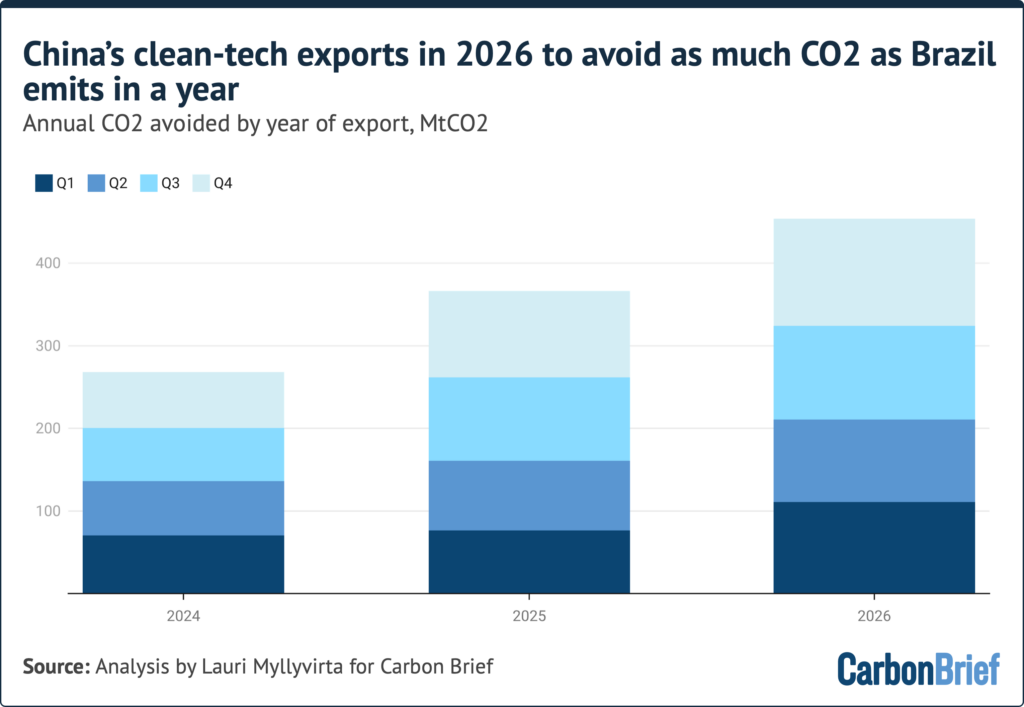
Annual CO2 avoided by Chinese clean-tech exports, compared with emissions outside China; the 2026 bar includes a projected fourth quarter.1 / 4
The solar panels, wind turbines, batteries and electric vehicles China exports in 2026 are on track to avoid about 450 million tonnes of CO2 (1) a year in other countries. That is close to 2% of emissions outside China, and roughly Brazil's annual fossil-fuel CO2. The analysis is by Lauri Myllyvirta of the 2, writing for Carbon Brief. The effect grew 26% year on year in the first three quarters of 2026, after 36% growth in 2025. The fourth quarter is a projection, not data.
How it's counted
Each exported product is matched to the country where it ends up. A solar panel is credited with that country's average output per unit of capacity (its 3) and its average grid CO2 per unit of power. An EV is credited with the fuel a petrol vehicle would have burned, minus emissions from charging. Totals are counted over assumed lifetimes: 20 years for solar and wind, 10 for cars and batteries, 5 for two-wheelers. The emissions from manufacturing in China are subtracted.
The method assumes each product displaces fossil energy. It doesn't ask whether the same equipment would have arrived from another supplier anyway.
What it shows
Manufacturing payback is short. In 2025, making the exports emitted about 170Mt in China and avoided 370Mt a year abroad, so the emissions were repaid in about six months.
Solar dominates. China exported 436 4 of panels and parts in 2025. Over their lifetimes they avoid about 6,400Mt. Wind avoids 180Mt and EVs and batteries 170Mt.
Lifetime avoided emissions from each year's exports went from 5,000Mt (2024) to 6,800Mt (2025) and are on track for 8,400Mt (2026), about the annual emissions of the US and India combined.
Despite higher tariffs, solar exports to the US rose 13% in 2026 once shipments re-routed through third countries are counted.
Crowding out?
Myllyvirta argues that the exports have mostly been additional, growing the market rather than taking sales from rivals. The value of EV exports from Germany, Mexico, Japan and others grew faster than China's. Wind is an exception: China gained there while other exporters lost sales globally. Falling prices also cut the value of rivals' sales even when their volumes held steady.
China-linked power projects abroad have doubled since 2022 but remain small. In 2025, 8.4GW of solar projects with Chinese involvement came online, against 436GW of solar equipment exported. The risk to watch: China's own solar market has slumped in 2026, and exports could overtake domestic installation, adding to trade tensions.
China's exports of clean-energy equipment in 2026 are on track to avoid about 450 million tonnes of CO2 (1) a year in other countries. That is nearly 2% of all emissions outside China, and roughly what Brazil emits from fossil fuels each year. The estimate comes from Lauri Myllyvirta, lead analyst at the Centre for Research on Energy and Clean Air (CREA, a Helsinki-based research group), writing for Carbon Brief. An earlier version of the analysis found that 2024 exports cut emissions outside China by about 1%.
The effect is growing quickly. Avoided emissions from these exports rose 26% year on year in the first three quarters of 2026, after a 36% rise in 2025. One caveat on the 2026 figure: the fourth quarter is not real data. It is projected forward from the growth rate in the first three quarters.
How the estimate is built
The method links each exported product to the country where it finally ends up, then asks what that product displaces there.
Generating equipment. Each gigawatt of solar or wind is credited with the destination country's average 2 (how much it actually produces) and is assumed to displace power at that country's average grid CO2 intensity. Both figures come from 3, an energy think tank. Missing values are filled with regional, then global, medians. Every EU country gets the EU-average grid, to avoid distortions from re-export hubs such as the Netherlands.
Vehicles and batteries. Each EV is assumed to replace an equivalent combustion vehicle's fuel, minus the emissions from charging on the local grid. Exported batteries are converted into equivalent cars.
Electric two-wheelers. These are credited with displacing motor-vehicle travel for 48% of their use. The figure comes from real-world e-bike studies, and the author calls it a key uncertainty.
Lifetimes. Solar and wind are assumed to last 20 years, cars and batteries 10, and two-wheelers 5.
Manufacturing. The emissions from making the equipment in China are subtracted, using average Chinese emission intensities.
The hardest step is tracing solar shipments. Customs data records only where a shipment goes first. Panels and cells often pass through third countries, sometimes to get around US tariffs. The analysis uses 4 trade data to find countries that import Chinese solar goods and export them again. It counts those onward exports as Chinese, up to the amount each country imported from China.
One point the article doesn't address: the method credits every exported product with displacing fossil power. It doesn't ask whether the same panels or cars would have been installed anyway with supply from somewhere else. The results are best read as the gross climate effect of the equipment China supplies, not as savings that exist only because China made it.
The numbers
In 2025, making the exported equipment emitted about 170 MtCO2 inside China. The same equipment avoided 370 MtCO2 a year abroad, so on aggregate the manufacturing emissions are paid back in about six months.
Solar dominates. In 2025 China exported finished panels and intermediate parts (wafers and cells) equal to 436 5 of capacity once assembled. That figure is in GW DC, the panels' own rating, rather than AC, the rating of the grid connection. China also exported 8GW of wind turbines. Together these will generate about 720 6 a year. For 2026 exports the figure is about 800TWh, comparable to the output of around 100 coal plants.
Lifetime avoided emissions from 2025 exports break down like this (illustrative share of the total in brackets):
Technology
Lifetime avoided CO2
Solar
6,400Mt (~94%)
Wind
180Mt
EVs and batteries
170Mt
Electric two-wheelers
40Mt
The 39 million EVs exported in 2025 were mostly two-wheelers (36 million). The rest were 2.2 million battery cars, 160,000 plug-in hybrids, 15,000 buses and 30,000 trucks. China also exported 305 gigawatt-hours of batteries, enough for about 5 million more cars.
Lifetime totals keep rising: 5,000Mt for 2024 exports, 6,800Mt for 2025, and 8,400Mt on track for 2026, about the annual emissions of the US and India combined. In the first three quarters of 2026, shipments of electric cars and heavy vehicles grew 61%, wind turbines 45%, batteries 39%, solar 22% and two-wheelers 21%.
Where the savings land
Most export value goes to the global north. But 76% of lifetime avoided emissions in 2026 so far fall in the global south, and 52% in south and south-east Asia alone. Three things drive this: large volumes, dirtier grids and stronger sun. India ranks first by country. The US is second, ahead of the whole EU, with Thailand, Saudi Arabia, South Africa and Australia next.
The US outranks the EU even though the EU imports more of every technology. Because US solar output per unit of capacity and US grid CO2 intensity are both higher, each gigawatt installed there avoids three times as much CO2 as in the EU. Once re-routing through third countries is counted, Chinese solar exports to the US rose 13% in 2026 despite tariffs raised sharply in June 2025. Myllyvirta argues this shows demand is resilient. Cutting reliance on China would therefore mean building more manufacturing in the US or in third countries.
Exports to Gulf states fell because of the war in the region. EV exports to Latin America and south-east Asia more than doubled, which the author attributes to the oil crisis.
Projects abroad are small by comparison
As of July 2026, there were 69GW of China-linked renewable projects operating overseas, with another 100GW under construction and 280GW planned. They are backed by 3.5GW of storage in operation and 21.4GW in the pipeline. China has also built six reactors in Pakistan (3.3GW), and a seventh, the 1.2GW Chashma-5, is due around 2030. Expected output from newly operating projects doubled between 2022 and 2025.
That is still small next to equipment exports. In 2025, 8.4GW of Chinese-involved solar projects came online, against 436GW of solar equipment exported. Local and other non-Chinese developers do almost all of the building. Xi Jinping pledged in 2021 to stop building coal plants abroad, but the article notes gaps, especially "7" coal plants that power industrial parks in Indonesia.
Is China crowding others out?
Myllyvirta argues that the exports have mostly been additional: they have added to the market rather than displacing other suppliers. The value of EV exports from other producers, led by Germany, Mexico, Japan, the UK and South Korea, grew more than China's. Exports of heat pumps, inverters and electrolysers grew both from China and from elsewhere.
There are exceptions:
Wind: China displaced other suppliers at the global level, though mostly by selling into growing markets rather than taking existing ones.
Solar and heat pumps: where tariffs apply, other producers took share from China, and Chinese goods moved to new markets.
Fossil-fuel cars: China clearly displaced other exporters.
Falling prices also mean that rivals who only held their sales volumes steady have seen the value of those sales shrink.
What's unresolved
Clean energy produced a third of China's GDP growth in 2025, and 16% of its net export growth in the first half of 2026. Most output still stays at home: only 43% of solar cells and panels, 17% of batteries, 13% of EVs and 7% of wind turbines were exported in 2025. But China's domestic solar and storage markets dropped sharply in 2026 after a record 2025. If solar exports overtake domestic installation, Myllyvirta expects complaints about "unfair" trade to grow. China's position as a supplier might also lead it to back the COP31 presidency's proposed global electrification target.
Remember
Solar accounts for about 94% of lifetime avoided CO2. The EVs, batteries and wind turbines matter far less in this accounting.
Where a panel is installed matters: the same gigawatt avoids three times as much CO2 in the US as in the EU.
China-linked power projects abroad are tiny next to equipment sales; local developers build almost everything.
Next month Congress takes up the Bipartisan American Affordability and Jobs Act (BAAJA), a permitting package four senators released in September. Most of it is contested: changes to environmental review, easier pipeline approvals, and limits on presidents revoking permits. The power grid section is the exception. The Natural Resources Defense Council called it a "green flag." John Podesta, the former Biden climate adviser and a critic of the bill, called it "pretty strong." On Heatmap's Shift Key podcast, Robinson Meyer asked David Pomerantz of the Energy and Policy Institute, a group that watches utilities, how that section works.
Permitting and planning
Today a line that crosses several states needs approval from each one. Under the bill, if one state refuses or stalls, the Federal Energy Regulatory Commission (1), which oversees interstate power, can approve the line if it finds the line benefits the public. Lines of 345 2 or more can apply to FERC and the states at the same time. Pomerantz says this is still not as easy as getting a gas pipeline approved, but it comes close.
The bill also makes the regional transmission organizations (3) that run grid regions plan in compatible ways and coordinate with their neighbors. Almost no lines get built between regions today. If incumbents won't build a line the plan calls for, other developers can. 4, meaning stringing higher-capacity wire on an existing route, would skip review under the National Environmental Policy Act (5). New lines would have to use the best available conductors.
The real obstacle, by Pomerantz's account
Pomerantz argues that utilities, more than landowners, have stalled transmission. A line that imports cheap power undercuts the generators a utility already owns. NextEra put over $20 million into a 2021 Maine ballot campaign against a line carrying Canadian hydropower. Entergy joined the 6 grid region in 2013 while under federal antitrust investigation. After that, MISO's transmission planning hours rose from about 1,000 to nearly 6,000. MISO approved more than $20 billion of regional lines in 2024, none of them in Entergy's southern territory. Economist Catherine Hausman estimated new lines would cost Entergy about $850 million in net revenue.
The newest provision lets a state refer a utility's local transmission spending to FERC. A joint federal–state team could then investigate whether that spending is wasteful or blocks regional plans. If so, it could cut the utility's allowed profit or impose fines. Pomerantz expects utilities to fight hardest against this.
Why now, and the risks
Pomerantz credits a "ratepayer revolt." He says investor-owned utilities' rates have risen faster than inflation, while public utilities' rates have not, and Republicans now back accountability measures. Utilities are still lobbying hard: Southern Company spent over $3 million on in-house federal lobbying in a single quarter. Southeastern utilities may try to get exempted. The bill also only works if FERC uses its new powers well.
Congress will take up the Bipartisan American Affordability and Jobs Act (BAAJA) next month. Four senators released the permitting package in September. Most of it is in dispute among climate and clean-energy advocates: changes to environmental review law, easier approval for both clean energy and pipelines, and new limits on presidents revoking energy permits. The power grid section is the exception. The Natural Resources Defense Council listed it among the bill's "green flags." John Podesta, the former Biden climate adviser who has criticized the package, called it "pretty strong." He said it could justify passing the bill if other problems were fixed.
Robinson Meyer, Heatmap's founding executive editor, notes that agreement doesn't get much coverage. On the Shift Key podcast he interviewed David Pomerantz, executive director of the Energy and Policy Institute (EPI), about how the grid provisions work. EPI is a watchdog that investigates utility and fossil-fuel lobbying. Pomerantz spent eight years at Greenpeace before joining it.
The problem: long lines don't get built
Pomerantz focuses on high-voltage lines that connect regions. He says these are critical for the energy transition and would be worth building for cost and reliability even without it. Regional transmission has "basically ground to a halt," he says, and lines between regions, for example from the PJM grid region in the Mid-Atlantic to 1 in the Midwest, are hardly being built at all.
Mechanism 1: a federal backstop for permits
Today an interstate line must win approval from every state it crosses, so a single state can stop it. Under the bill, if a state rejects a high-voltage line or takes too long, the Federal Energy Regulatory Commission (2) can step in. FERC is the agency that regulates interstate electricity. It can approve the line if it finds the line benefits the public. Lines of 345 3 and above can file at FERC and the states at the same time instead of one after the other. Meyer says the bill directs FERC to find a line in the public interest when it meets set criteria, rather than just allowing it to.
Pomerantz compares this with gas pipelines. Their federal approval comes from the Natural Gas Act, a New Deal-era law. He says the bill doesn't make lines quite as easy to approve as pipelines, "but it's a lot closer." He accepts that landowners will object, and says the bill keeps their right to comment and to ask for a line to be rerouted. He argues the trade-off is uneven: opponents mostly object to the view, while the coal plants that more transmission would eventually push out damage people's lungs.
Mechanism 2: planning together, and competition
Regional transmission organizations (4) run markets and plan lines across multi-state areas. They grew out of reforms that began in the late 1990s. Before that, individual utilities decided on their own whether to build lines. Each RTO plans differently, which Pomerantz says no one would design from scratch. BAAJA requires consolidated, compatible planning within regions and coordination with neighboring regions. If an RTO identifies a needed line and the incumbent utilities don't build it, other developers get a route to build it themselves. Pomerantz describes the transmission title as strongly pro-competition.
Two smaller provisions follow. 5 an existing right of way, meaning replacing wires with higher-capacity ones, would be exempt from review under the National Environmental Policy Act (6). New lines must use "advanced transmission technologies," including the best available conductors. Existing lines must be upgraded wherever the benefits exceed the costs, and that spending is presumed prudent so utilities can recover it.
Why would utilities need to be pushed toward cheap upgrades? Because of how they earn money. Regulators let a utility add capital spending to its "7," the asset base it charges customers for. The cost is recovered over decades plus a set return on equity, often 8–12%. Pomerantz puts it this way: for capital spending, a utility "want[s] higher costs." A cheap fix earns less than a new build.
Pomerantz's diagnosis: utilities, not just landowners
Debate over permitting focuses on landowner, conservation and tribal opposition. Pomerantz argues the bigger reason long lines haven't been built is utility resistance. A line that imports cheaper power cuts into the value of the generators the local utility owns. His examples:
NextEra put more than $20 million into Mainers for Local Power, most of what that group spent on a 2021 referendum to ban a line carrying Canadian hydropower to New England. The referendum passed, but courts overruled it and the line went ahead. NextEra owns nuclear and gas plants in the region.
Entergy, which serves Louisiana, Arkansas and part of Texas, joined MISO in 2013 while facing a Department of Justice antitrust investigation into its transmission practices. MISO's transmission planning hours rose from about 1,000 in 2014 to nearly 6,000 by 2018. MISO approved more than $20 billion of regional lines in 2024, all in the Midwest and none in the South. Economist Catherine Hausman estimated new lines would cost Entergy about $850 million in net revenue. Pomerantz also says Entergy backed a Texas law that would block other companies from building a line connecting the Texas grid to the rest of the country. MISO later canceled that line.
Southern Company has told FERC for a decade that regional transmission adds no new value in the Southeast.
The Southeast has no RTO. There, 8 utilities such as Southern Company and Duke own the power plants, the transmission and the local wires. The current draft of BAAJA still applies its planning rules to them. Pomerantz expects them to lobby for an exemption.
Mechanism 3: going after local spending
Pomerantz calls this the bill's most unexpected and important provision. Utilities do build transmission, but mostly local, lower-voltage lines that rarely cross state lines. Those are easier to permit and earn high returns, and Pomerantz says their need is often questionable. The bill would let a state refer a utility's local transmission planning to FERC if it believes the projects aren't cost-effective or are getting in the way of regional plans. A joint team of FERC and state investigators would examine the case. If it finds obstruction, it could cut the return the utility earns on those local lines or impose fines. Pomerantz expects utilities to make killing this provision their top priority.
Why now
Senate disclosures for the third quarter show that almost all the major utilities lobbied on BAAJA. Southern Company's in-house team spent more than $3 million on federal lobbying, the utility trade group Edison Electric Institute (EEI) $1.6 million, and Entergy just over $0.5 million. Pomerantz says they have lost so far because utilities are politically weak. He points to a bipartisan "ratepayer revolt": investor-owned utilities' rates have risen faster than inflation, while co-ops' and municipal utilities' have not. He also notes that in 2025 the Trump Justice Department asked for public comment on rules that protect incumbent power providers from competition. He calls Republican support for utility-accountability provisions "unheard of five years ago." Meyer sums it up: Democrats realizing they dislike permitting laws, and Republicans realizing they dislike utilities.
What's unresolved
The bill hands FERC new authority, and Pomerantz names whether FERC uses it well as the main risk. Utilities may also recover their influence after the midterms. The Southeast exemption fight is still to come. The interview also covers data centers. Pomerantz argues the bill helps keep them on the grid rather than in off-grid gas plants, and makes them pay more. But the available transcript cuts off before it describes the data center provision.
Remember
Lines of 345 kilovolts and above could apply to FERC and the states at the same time, removing the delay of approving one after another.
After Entergy joined MISO, the region's transmission planning hours rose almost sixfold, and none of its 2024 lines reached the South.
The provision utilities most want removed lets regulators cut their profit on wasteful local lines.
Ember's chart, likely showing peak-demand cuts from data center load shifting across the nine markets studied.1 / 2
The energy think tank Ember estimates that only about 3% of global data center capacity will be able to shift its electricity use by 2030. Shifting means moving computing to another time or place when the grid is strained. The finding undercuts a popular idea: that data centers can ease grid stress mainly by rescheduling their work.
Why flexibility matters now
In June, the 1, the US power-market regulator, told grid operators to justify or revise their rules for connecting large loads. Flexible data centers could connect sooner in exchange for easing off during grid stress. That could also spare other customers the cost of infrastructure built for rare peaks. A data center can do this by moving computing, by cutting use on request, or by switching to on-site power.
Most computing can't wait
Ember finds that 87% of data center capacity will run cloud services and corporate IT alongside 2, the real-time answering of user queries. That work can't easily be paused. AI training, which can be delayed, makes up about 13% of the market. The article doesn't explain how that 13% becomes 3% shiftable.
Across nine markets, load shifting would cut peak demand by only 0.1–0.6% by 2030 in the US and most other countries. Texas contributes the most in the US, at up to 0.4%. In Ireland and Malaysia, where data centers are a bigger share of peak demand, the figure is about 1.5%.
Ember's Texas example covers two AI campuses, Stargate Abilene and Comanche Circle, with 5.6 gigawatts (GW) of new load. At typical utilization they would average 2.7 GW. Load shifting could free about 0.55 GW in a grid emergency. Switching fully to on-site power could free all 2.7 GW, about 2% of the forecast 2030 peak for 3, the Texas grid operator.
Enter batteries
Today, most developers who want fast power build on-site gas turbines, despite risks from equipment shortages, pipeline limits and price shocks. Rules for non-firm connections, which are faster but can be curtailed, already exist in ERCOT and in 4, the central-US grid. 5, the mid-Atlantic and Midwest grid operator, must file new rules by November 16 after FERC rejected its plan.
The research platform Currence models up to 285 GWh of US data center batteries by 2035, more than half of it in PJM. That assumes half of data center load goes flexible and uses batteries to ride out curtailments. How long those batteries must run depends on the rules. If ERCOT spreads curtailments evenly, each site needs about 1.3 hours by 2030. If it cuts the newest connections first, they need at least 5.3 hours. In PJM and SPP that could reach 7 hours by 2035.
Lithium-ion remains cheapest up to eight hours. Beyond that, some non-lithium long-duration storage is nearing cost parity.
The energy think tank Ember released research estimating that only about 3% of global data center capacity will be able to shift its electricity use by 2030. Shifting means moving computing to a different time or place when the grid is strained. A separate analysis from research platform Currence suggests that grid rules being written now could make batteries the main source of data center flexibility. That could mean a US battery market of up to 285 gigawatt-hours (GWh) by 2035.
Why flexibility is on the table
Data center demand is growing faster than grids can add transmission and generation. In June, the 1, which regulates interstate power markets, directed grid operators to justify or revise their rules for connecting large loads. That followed Department of Energy orders to speed up those connections.
A "flexible" data center can ease the strain in one of three ways:
moving computing to other times or locations
cutting consumption when the grid operator asks
switching to on-site power when the grid is constrained
In return, it may get a faster grid hookup. Other customers may also avoid paying for infrastructure built only to serve a few peak hours a year.
Why most computing can't move
Ember's main finding is about what data centers actually do. By its estimate, 87% of capacity will still run cloud services and corporate IT alongside 2, which means answering user queries in real time. That work has to happen when users want it, so it can't easily be paused or moved elsewhere.
Data centers dedicated to AI training are a better fit, because a training run can be delayed or slowed. They will make up about 13% of the market. The article doesn't explain how Ember gets from 13% training capacity to 3% shiftable capacity. Presumably not every training site can or will flex.
How much that cuts peaks
Ember modeled nine major markets, including Texas, California and New York. In the US and most other countries, data center load shifting would cut peak demand by 0.1% to 0.6% by 2030. Texas contributes the most in the US, at up to 0.4%. Where data centers make up a larger share of peak demand, as in Ireland and Malaysia, the reduction rises to about 1.5%.
Ember compared two tools. On-site generation lets a data center stop drawing from the grid at the peak, so it gives the most relief in a crisis. Load shifting does something different: it helps squeeze more out of the existing grid, avoiding new infrastructure that would sit mostly idle. Ember's view is that the two work best together.
A worked example in Texas
Ember looked at two planned AI campuses in Texas: Stargate Abilene and Comanche Circle. Together they add about 5.6 gigawatts (GW) of load by 2030. US data centers typically run at 48% utilization, so their average draw would be about 2.7 GW. Both plan to combine a connection to 3, the Texas grid operator, with on-site generation.
During a grid stress event:
Load shifting at the two sites could free up about 0.55 GW.
Switching fully to on-site generation could free up the whole 2.7 GW. That is about 2% of ERCOT's forecast 2030 peak.
That is roughly a fivefold difference. Ember concludes that scaling flexible data centers will depend less on rescheduling computing and more on alternative power supplies.
The gas problem and the rule-writing
Right now, developers who want fast, reliable power are mostly turning to gas turbines "4", meaning on site, on the customer's side of the grid connection. The article notes that this route has risks: equipment shortages, mechanical failures, pipeline constraints and price shocks.
The bargain on offer is a faster connection in exchange for being curtailed when the grid is stressed. Its terms are being set now:
ERCOT and 5 (Southwest Power Pool, covering the central US) have already adopted 6 pathways.
FERC rejected 7's data center curtailment plan earlier this month. PJM runs the grid across 13 mid-Atlantic and Midwest states and is revising its framework ahead of a November 16 filing deadline.
Currence's battery estimate
Currence models a US market of up to 285 GWh of batteries at data centers by 2035. Its key assumption is that half of forecast data center load uses some form of flexibility and covers curtailments with batteries. PJM makes up more than half of that market, because it combines concentrated data center demand with a constrained grid. The article notes that states in the region may end up deciding who gets curtailed first.
Currence also flags a feedback loop. Each new flexible data center uses up spare grid capacity, so curtailments get longer and more frequent for everyone. That means today's standard four-hour battery may soon fall short. How short depends on the curtailment rules:
Scenario
Storage needed per site
ERCOT, curtailments spread evenly, 2030
~1.3 hours
ERCOT, "last-in-first-curtailed", 2030
at least 5.3 hours
PJM and SPP, last-in-first-curtailed, 2035
up to 7 hours
Under "last-in-first-curtailed", the newest connections are cut first, so they carry most of the burden. The choice between that and an even split is a policy question, and it largely decides the size of the battery market.
Which batteries
Currence says lithium-ion is still the technology to beat for durations up to eight hours. It is cheap, made at scale worldwide and has high round-trip efficiency, meaning little energy is lost between charging and discharging. That makes it the likely near-term pick for data centers.
Beyond eight hours, some non-lithium 8 is nearing cost parity in certain scenarios. Currence sees several uses for it:
"Bring-your-own-capacity" deals, where a data center supplies grid-side (front-of-meter) resources to offset its demand. This suits LDES technologies that grid operators count heavily toward reliability, known as high 9.
Replacing diesel backup generators at sites with full grid connections.
Smoothing the sharp load swings when AI training jobs start and stop.
Government procurement programs are currently the biggest buyers of non-lithium LDES. Data centers are second.
What stays open
Both studies are forecasts built on assumptions. Ember's depends on its split between workload types. Currence's 285 GWh assumes half of data center load goes flexible, which is a scenario, not a prediction. The article also doesn't say how on-site gas and batteries compare on cost or emissions as sources of flexibility. And the decisive rules on who gets curtailed first are still being written in PJM and by its states.
Remember
Shifting compute frees about a fifth of the grid relief that on-site power does: 0.55 GW versus 2.7 GW in Ember's Texas case.
Curtailment rules, either spread evenly or newest-first, can change required battery duration from about 1.3 hours to over 5 hours.
Lithium-ion leads up to eight hours of storage; longer-duration alternatives are approaching cost parity beyond that.
1 runs the grid for 13 states plus Washington, D.C., and it is short of capacity, the power it can count on at peak demand. Batteries placed at existing power plants could help quickly. Canary Media reports that PJM has proposed a market-rule change to make that practical, but federal approval may not come until late 2027.
The shortcut
The tool is 2 (SIS). Each plant's grid connection has a fixed capacity, and solar or wind farms rarely use all of it. SIS lets the owner add a battery that uses the spare room, skipping PJM's multi-year queue for new connections. The battery charges when the solar farm is producing and discharges in the evening, without needing new wires.
Other grid operators use this. In PJM, no new SIS project has moved forward, even after clean energy groups pushed 3 (the Federal Energy Regulatory Commission) in 2024 to make PJM drop unusual technical study requirements.
The real blocker: contracts
Generators sell their output through long-term 4 (PPAs). PJM treats a "5," such as solar plus batteries at one site, as a single unit in both its energy and capacity markets. So a solar farm can't keep serving its existing buyer while selling a new battery's capacity to someone else, such as a data center. Katie Siegner of 6, an energy research nonprofit, says that makes such deals nearly impossible. LevelTen Energy's Connor Valaik says 7, which runs the grid across much of the central US, already lets owners add storage and sell its capacity separately.
The fix
PJM's proposal would let hybrid projects report each component's contribution separately. Siegner calls it "an itemized receipt" that "makes it easier to split the bill." Batteries could then go onto existing plants, or into the tens of gigawatts of approved clean projects that haven't been built yet.
Data centers are likely buyers. Regulators want them to bring their own capacity, and this month FERC rejected PJM's plan to require exactly that. Several states also push in this direction: Illinois, Maryland and New Jersey have storage targets, and Indiana and Virginia require big utilities to study their surplus interconnection capacity.
Caveats
The article gives no estimate of how much storage this would unlock. Contracts would still need renegotiating. And the approval timeline is long. As Advanced Energy United's Gordon puts it: "We're not talking about physical limitations to the grid. We're just talking about this quagmire of administrative processes."
1 is the grid operator for 13 Mid-Atlantic and Midwestern states plus Washington, D.C. It is short of capacity, the power it can count on when demand peaks. One of the fastest ways to get more is to add batteries at power plants that are already connected to the grid. In practice, almost none of that is happening in PJM. Canary Media's Jeff St. John reports that PJM has now proposed a market-rule change aimed at one of the two main obstacles. If the federal regulator signs off, that could free up a lot of battery storage that developers already want to build.
The shortcut that isn't being used
The tool is called 2, or SIS. Every power plant connects to the grid at a "point of interconnection," which comes with a set amount of injection capacity. A solar farm rarely uses all of it: its output is zero at night and drops on cloudy days. SIS lets the owner add a new resource, typically a battery, that uses the leftover room. The owner doesn't have to send the battery through the regular interconnection queue, which in PJM has meant waiting several years.
Here is an illustrative example (the numbers are not from the article). A 100-megawatt solar farm with a 100 MW connection could add a 50 MW battery that charges from the panels at midday and discharges in the evening. Total output never goes above the 100 MW the wires were already studied for, so the grid needs no new physical upgrade. The battery then provides evening capacity, exactly when PJM's system is most stretched.
Other grid operators have made this work. PJM had two obstacles.
Barrier one: the studies
In 2024, clean energy groups asked 3, the Federal Energy Regulatory Commission, to make PJM change how it studies the grid impacts of adding resources to an existing project. They pointed to technical requirements PJM imposed that other grid operators did not. Those changes have been made. But according to Advanced Energy United's Gordon, no new SIS project has moved forward in PJM since then. (Advanced Energy United is a clean energy trade group.) The second obstacle still blocks them.
Barrier two: one plant, one market unit
The second obstacle is about contracts. Generators usually sign long-term 4 (PPAs) with utilities, companies or cities, promising to deliver energy and capacity for years. Adding a battery at the same connection means changing those deals. That gets hard when the owner wants to sell the battery's capacity to a different buyer.
PJM requires a "5," a project that combines more than one technology, to be treated as a single "market unit" in both its energy market and its capacity market. Katie Siegner of 6, an energy research nonprofit, says that makes deals with separate buyers nearly impossible. Under the current rules, a solar farm couldn't keep supplying its existing customer while also adding a battery whose capacity goes to a data center trying to offset its own load on the grid. "The solar and battery might have different offtakers, different obligations," she said.
Connor Valaik of LevelTen Energy, which runs marketplaces for these deals, contrasts this with 7 (SPP), the grid operator for much of the central US. He says SPP lets owners add "surplus storage" even where an existing PPA is held by a different buyer, and sell the storage's capacity rights separately.
The proposed fix
PJM's proposal would let hybrid projects report what each component contributes, separately, in both the energy and capacity markets. Siegner calls it "an itemized receipt": "It makes it easier to split the bill." Batteries could then be added at existing plants. They could also be built into the tens of gigawatts of clean power projects that already have permission to connect to PJM's grid but haven't been built.
State policy points the same way. Illinois, Maryland and New Jersey have energy storage targets. Indiana and Virginia have passed laws requiring big utilities to study how much surplus interconnection capacity they have.
Who might pay
Data centers are the obvious buyers. State and federal regulators are pushing them to bring their own capacity so household customers don't carry the cost of their growth. PJM's main attempt to deal with this has stalled. This month FERC rejected PJM's plan to require data centers and other "large loads" to supply their own capacity or risk being cut off during grid emergencies. That leaves developers looking for quick alternatives, and Siegner counts surplus interconnection among the best. "If you threw a battery onto an existing solar project, given how capacity-constrained PJM is today, you could find someone as an offtaker," she said.
The catch: time
The rules aren't in force yet. Even if PJM moves fast, FERC approval could take until late 2027. Gordon calls the pace "frustrating": "We're not talking about physical limitations to the grid. We're just talking about this quagmire of administrative processes and legal rights."
What's still unknown
The article doesn't estimate how many megawatts of storage the fix could unlock, how much spare capacity PJM's existing connections actually have, or how many projects are waiting on the change. Siegner's "enormous" pent-up demand is a judgment, not a measured number. It's also unclear whether splitting the market units would fix everything. Developers still have to renegotiate existing PPAs, and PJM could add new conditions when it writes the final rule. The 2024 study reforms are a warning here: removing one barrier produced no projects because a second one was still in place.
Remember
PJM's barrier to adding batteries is a market-accounting rule, not the physical capacity of its grid.
Fixing grid-impact studies in 2024 produced zero new projects because the contract barrier was still in place.
FERC rejected PJM's plan to make data centers supply their own capacity, so they need alternatives like this.
2027 model-year EV ranges from fueleconomy.gov, from 209 miles at the bottom to 512 at the top.1 / 2
The median electric car on sale in the US for the 2027 model year goes 311 miles on a charge, according to 1, the government's official ratings site. The lowest-rated model still manages 209 miles. A decade ago, the only way to get more than 300 miles was a Tesla Model S costing $94,000.
Dan Gearino, who writes Inside Climate News's weekly clean-energy newsletter, argues that 2, the fear of getting stranded with nowhere to charge, isn't dead yet but is "fading fast."
Why range went up
Batteries got cheaper. According to 3, an energy research firm, the global average lithium-ion battery pack cost $108 per 4 in 2025. That was 8% less than in 2024 and more than 90% less than in 2010. When storage costs less, carmakers can fit bigger packs at the same price. Better efficiency helps too. The Lucid Air Grand Touring has the longest rating at 512 miles, and it gets about 5 miles per kilowatt-hour, which is unusually high.
Range vs. price
Long range is no longer limited to luxury cars, but it still costs more:
Top: Lucid Air Grand Touring AWD, 512 miles, $114,900
Median: Audi S6 e-tron and Hyundai Ioniq 9 AWD Performance, about 311 miles, $79,600 and $71,250
Value picks: Chevrolet Equinox FWD, 319 miles for $36,795; Toyota bZ XLE FWD Plus, 314 miles for $37,980
Bottom: VinFast VF 7 Plus, 209 miles
For comparison, the lowest-range EV a decade ago was a Smart Fortwo convertible with 57 miles. In 2011 there were four models, and the best of them went 94 miles. Today there are more than 100.
The oil connection
Pavel Molchanov, an analyst at the investment firm Raymond James, expects 500 miles to be normal by 2030. EVs made up 25% of new car and light-truck sales worldwide but less than 10% in the US, according to the 5. Raymond James estimates that the EVs already on the road cut oil demand by 2.2 million barrels a day, or 2–3% of global demand. Molchanov expects that cut to more than double by 2030 and thinks oil demand will have peaked by then. Demand fell this year because of the Iran war. He says it may never fully recover: "It is not inconceivable that 2025 was the peak."
What's still unsolved
Public chargers are still scarce in some states. Gearino's argument is that those gaps matter less when one charge can carry a car across a state. His own threshold is 240 miles, about the drive from Des Moines to St. Paul. Any 300-mile car covers that without stopping. The article uses official ratings, though. It doesn't look at how much range drops in winter or at sustained highway speeds.
The median electric vehicle in the US for the 2027 model year is rated at 311 miles per charge, according to 1, the Department of Energy and EPA site that publishes official range ratings. Even the lowest-rated model on the list goes 209 miles. Ten years ago, the only car that topped 300 miles was a Tesla Model S that started at $94,000.
Dan Gearino writes Inside Climate News's weekly Inside Clean Energy newsletter. He went through the federal data and concludes that 2, the fear of being stranded mid-trip with nowhere to charge, "is fading fast" but isn't gone. He credits two causes: better batteries and more public chargers.
The problem range solves
For most of the EV era, a driver who wanted long range had two choices: pay luxury prices or plan every long trip around chargers. Range matters most where chargers are scarce. Gearino notes that some states and regions still have few public chargers. His argument is that long range shrinks the problem without fixing it: "these gaps in the system are less of an issue when a typical battery has enough range to cross an entire state."
Why range rose: cheaper storage, plus efficiency
The battery pack is the most expensive part of an EV. Its price is quoted per 3 (kWh) of storage. According to 4, an energy research firm, the global average lithium-ion pack cost $108/kWh in 2025. That was 8% less than in 2024 and more than 90% less than in 2010. Pavel Molchanov, who covers renewable energy and clean technology at the investment firm Raymond James, called it "an astonishing number."
There are two ways to add range. One is a bigger battery, which cheaper cells make affordable. The other is more efficient driving, meaning more miles from each kWh. The longest-range 2027 model, the Lucid Air Grand Touring AWD with 19-inch wheels, is rated at 512 miles. Lucid, based in Newark, California, says it gets there by designing its motors, battery and other parts for efficiency. The car goes about 5 miles per kWh, which the article calls much higher than typical. A rough calculation shows what that buys. At 5 mi/kWh, a 75 kWh pack gives about 375 miles. At 3.5 mi/kWh, the same pack gives about 260. These figures are illustrative, not from the article.
The 2027 lineup, by range and price
Position
Model
Range
Base price
Top
Lucid Air Grand Touring AWD (19" wheels)
512 mi
$114,900
Median
Audi S6 e-tron
~311 mi
$79,600
Median
Hyundai Ioniq 9 AWD Performance
~311 mi
$71,250
Value
Chevrolet Equinox FWD
319 mi
$36,795
Value
Toyota bZ XLE FWD Plus
314 mi
$37,980
Bottom
VinFast VF 7 Plus
209 mi
n/a
The table shows that the median-range cars are still expensive. Gearino says they're out of reach for most buyers. The more important change is at the low end of the price range. Two models under $38,000 beat the median range, and they cost far less than the $94,000 Tesla did ten years ago. VinFast is a Vietnamese brand building a US dealer network, and it has stopped listing the VF 7 on its website. Its VF 8 is rated at 256 miles and starts at $40,400.
How far it has come
Ten years ago, the Tesla Model S AWD-100D led at 335 miles for $94,000. The bottom of the list was the Smart Fortwo Electric Drive Convertible: 57 miles for $28,750. Department of Energy data goes back further. In 2011 there were four EV models: the BMW 1 Series ActiveE, the Nissan Leaf, and two versions of the Smart Fortwo. The BMW had the longest range at 94 miles. Today there are more than 100 models, and the median range keeps rising.
The oil demand link
Molchanov's report goes beyond cars. He expects 500 miles of range to be considered normal by 2030. According to the 5, a research group, EVs made up 25% of global new car and light-truck sales but less than 10% in the US. Raymond James estimates that the EVs on the road today reduce global oil demand by 2.2 million barrels per day compared with a world without them. That is 2–3% of total demand. Molchanov expects the figure to more than double by 2030, which is one reason he expects global oil demand to have peaked by then.
Oil demand is down in 2026 compared with 2025 because of the Iran war. Molchanov expects it to rebound when the war ends. He also says demand may never fully recover, because of geopolitical changes in response to the war and because EVs keep gaining market share. "It is not inconceivable that 2025 was the peak," he said. This is an analyst's forecast, not a measurement.
A personal threshold
Gearino gives a practical test. For him, range anxiety ends at 240 miles. That's about the drive from the Des Moines area, where he grew up, to St. Paul, Minnesota, where he went to college. It's also roughly the round trip from his home in Columbus, Ohio, to Cleveland or Cincinnati. Any of today's 300-mile cars can make those trips without recharging.
What the article leaves open
The numbers are official ratings, and the article doesn't discuss how real driving compares. In general, cold weather and sustained highway speeds can cut range a lot below the rated figure. Rising range and falling cost per kWh also don't automatically mean lower car prices. The article gives no figures for how many affordable long-range models actually sell. Charging gaps are acknowledged but not measured.
Policy is also unsettled. Other items in the same newsletter note that Democrats are split on whether to restore federal EV purchase credits of up to $7,500 if they win Congress. Critics had attacked those credits as mainly helping affluent households. Separately, Ford says its Fathom pickup, due in early 2027 at a $28,350 base price, will include an 6. That would let the truck's battery back up a home for much less than the $7,000–$10,000 that current 7 systems cost, though the extra equipment's price hasn't been disclosed.
Remember
Two models under $38,000 beat the 2027 median range of 311 miles. Range now depends less on price.
Battery packs averaged $108/kWh in 2025, more than 90% cheaper than in 2010.
One analyst estimates EVs already displace 2.2 million barrels of oil a day and expects that to double by 2030.
The south gets most of the benefit. Most export value goes to rich countries, but 76% of lifetime savings fall in the global south, thanks to dirtier grids and more sun. India ranks first and the US second. Each gigawatt of solar avoids three times as much CO2 in the US as in the EU.