Sixteen Lines, Fifteen Measures, One Wizard · Morning Gist
Sunday, October 183 stories · 10 min
Sixteen Lines, Fifteen Measures, One Wizard
A lost Benedetti poem on longing, a huge study showing obesity can't be summed up in one number, and Merlyn's advice for getting through disappointment.
Picked from 37 new articles across 14 sources · arrow keys for other days
Today in 30 seconds
30s left
Maria Popova translates "Ruta," a 16-line poem found in Benedetti's papers after his death, which treats getting what you want as one stop, not the end. story 1 ↓
A study of 4.3 million Chinese adults tested 15 obesity measures against BMI. A different measure won for each disease. story 2 ↓
None of the measures predicted cancer well, which suggests body fat raises the risk of different diseases in different ways. story 2 ↓
In The Once and Future King, Merlyn tells young Arthur that learning is the cure for sadness because it never runs out. story 3 ↓
Also worth reading: after the dinosaurs died out, a huge fungus nicknamed D. rex took over the forests.
1/3The Marginalian (Maria Popova)· Maria Popova· Oct 17
An unpublished Benedetti poem about a map you already carry
Maria Popova has translated "Ruta," an unpublished poem by the Uruguayan writer Mario Benedetti. It follows a speaker who finds a map in his pocket, walks a path he has already walked, then puts the map back.
Why it matters · The poem treats getting what you want as one stop on a longer road, and it does this in sixteen lines without moralizing.
Know this first
Context from the editor, not the article · 27 sec
1 · Who Mario Benedetti was
Mario Benedetti (1920–2009) was a Uruguayan poet, novelist and essayist, and one of Latin America's most widely read writers. His plain, conversational verse is often set to music. Political repression drove him into exile from 1973 to 1985.
2 · What The Marginalian is
The Marginalian is Maria Popova's long-running solo blog, called Brain Pickings until 2021. She pairs literature, philosophy and science around questions of how to live, and often translates and records poems.
3 · Machado's path made by walking
Popova's opening echoes a well-known line by the Spanish poet Antonio Machado: "caminante, no hay camino, se hace camino al andar." It means "traveler, there is no road; the road is made by walking."
2/3Nautilus· Jake Currie· Oct 17
In 4.3 million Chinese adults, no one obesity measure predicted every disease
Chinese researchers tested 15 obesity measures on health data from 4.3 million adults. Each disease had a different best predictor, and every link was modest at best. No single replacement for body mass index emerged.
Why it matters · Obesity sounds like one thing, but this study suggests body fat raises the risk of different diseases in different ways, so one number can't capture the whole picture.
Know this first
Context from the editor, not the article · 33 sec
1 · What BMI measures
Body mass index is weight in kilograms divided by height in metres squared. Adolphe Quetelet, a Belgian statistician, devised it in the 1830s to describe populations. It can't tell muscle from fat, or show where fat sits on the body.
2 · Why fat location matters
Visceral fat, which is packed around the abdominal organs, is more metabolically active than fat under the skin. It is tied more closely to insulin resistance and heart disease, so two people with the same BMI can carry very different risks.
3 · Measuring predictive power
Epidemiologists test a risk measure in two ways. They check whether higher values go with more disease, and they check how well the measure sorts people who later get sick from people who don't. A measure can pass the first test and still fail the second.
3/3The Marginalian (Maria Popova)· Maria Popova· Oct 17
T.H. White's Merlyn prescribes learning as the cure for sadness
Maria Popova picks out a passage from T.H. White's Arthurian novel in which the wizard Merlyn tells the sulking young Arthur that the one remedy for sadness that never fails is to learn something.
Why it matters · It is an old claim worth testing against your own experience: curiosity holds up under loss better than comfort does, because learning never runs out.
Know this first
Context from the editor, not the article · 25 sec
1 · White's retelling of Arthur
T.H. White (1906–1964) was an English novelist. The Once and Future King (1958) gathers his Arthurian novels. The first part, The Sword in the Stone, follows the boy Arthur, nicknamed the Wart, before he becomes king.
2 · Merlyn's unusual curriculum
In White's version the wizard Merlyn knows Arthur's destiny and teaches him by turning him into animals. Each creature's society shows him a different kind of order, power or cooperation.
3 · The Marginalian
Maria Popova's long-running, reader-funded blog, formerly Brain Pickings. Her posts usually build on a single quoted passage and then link it to other writers on the same theme.
Maria Popova has published her English translation of "Ruta" ("Roadmap"). The poem was never published by Mario Benedetti, the Uruguayan poet and novelist who died in 2009. It turned up among his papers after his death. The post pairs the Spanish text with a recording by her Patagonian friend Manuel Gutiérrez, set to a piece by the cellist Zoë Keating.
Popova's argument
Popova begins with a claim of her own. Nobody can map the route of your life for you: not parents, heroes, lovers, self-help books or Shakespeare. You make the path by walking it. Along the way you treat goals as destinations. Once you reach them, they turn out to be way-stations, and you start wanting something else.
She calls this a 1 of longing. A Möbius strip is a twisted loop with only one side, so you can travel along it forever without reaching an edge. Popova argues the loop does two things. It causes much of our suffering. It also drives creative life: the urge to make something that says "I am." In her words, "It is our incompleteness that maps the territory of the possible in us."
What happens in the poem
The poem's sixteen lines tell a small story.
The speaker finds a map in his pocket. He doesn't know where it leads, but he follows it anyway, "with all my nostalgias in hand."
The map is "an atlas of the soul." It records "what I have committed and what awaits me."
On the ground he sees footprints, and they are his own. The path has been walked before.
The "vastness of before" disappears, and everything feels "stronger, surer."
He reaches the riverbank he has always longed for.
At that point he does something unexpected. He "heeds his own advice," puts the map back in his pocket, and leaves it there "awaiting another tomorrow."
Why the ending matters
A neater poem would end at the river, with the longing fulfilled. Benedetti keeps the map. Popova says the poem doesn't give an answer but "whispers the living question back to you." Getting what you wanted doesn't end the journey. It only means the map is waiting for the next one.
The footprints work the same way. The route was already inside him and was already his. Following it felt like discovery, but it was closer to recognition.
Popova suggests two companion pieces from her archive: Benedetti's poem urging readers to stop waiting and start living, and C.S. Lewis on what we are really longing for.
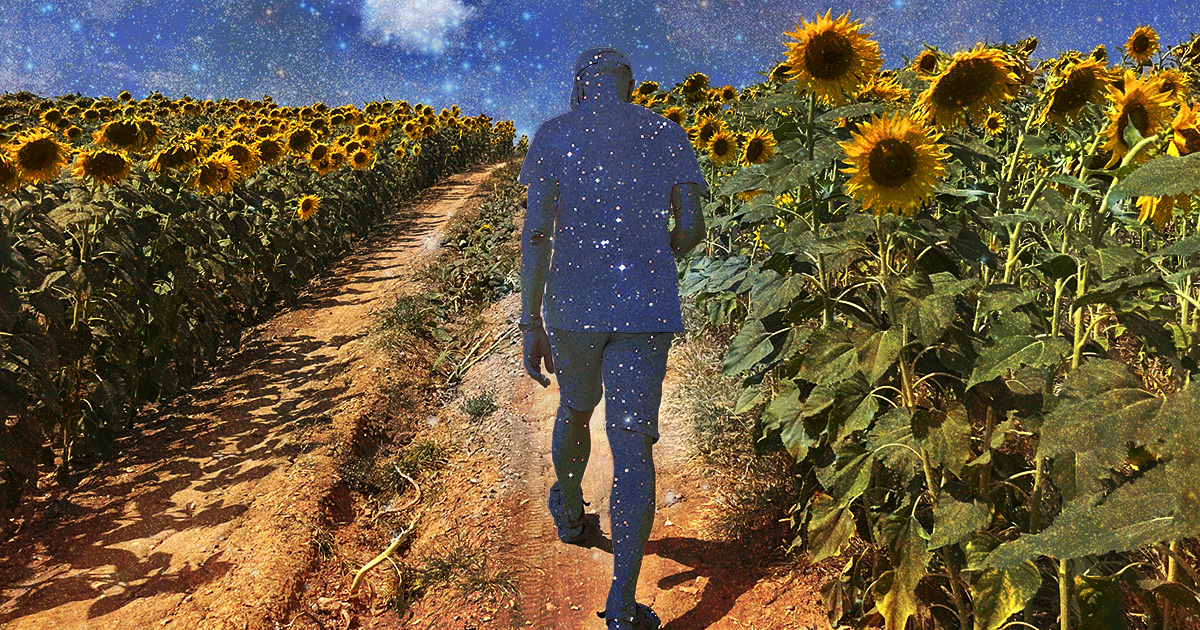
Maria Popova has published her English translation of "Ruta" ("Roadmap"), a short poem by the Uruguayan writer Mario Benedetti. Benedetti never edited or published it. It was found among his papers after his death in 2009. The post sets the original Spanish beside the translation. It also includes a recording of the poem read by Popova's Patagonian friend Manuel Gutiérrez, whom she describes as a performer who works through theater, music and humor. The music under the reading is "Sun Will Set" by the cellist Zoë Keating, used with her permission. The accompanying image shows Popova's father walking through sunflower fields in Bulgaria, layered under a picture from the 1, a large survey telescope in Chile.
The post is short: one paragraph of argument, the poem, and the translation. Most of its substance is in the poem and in Popova's word choices as translator.
Popova's argument: longing as a loop
Popova opens with a claim. Nobody else can map the route across "the wilderness of your own life." That includes parents, teachers, heroes, lovers, self-help books and "Shakespeare's sonnets." Some people give you signposts, and some become turning points. But the path is one "you ultimately make by walking." The phrase echoes Antonio Machado's line "se hace camino al andar" ("the road is made by walking"), although she doesn't cite him.
Her next point is about desire. We "mistake dreams and desires for destinations." Once we reach them, they turn out to have been "way-stations," and we start longing for something else. She calls this a "2 of longing." A Möbius strip is a band of paper with a half-twist, joined into a loop with only one side, so you can travel along it forever without reaching an edge. Popova argues the loop has two faces:
It is "the root of everything we suffer in the fangs of the 3." The Wanting Monster is her own recurring name for insatiable desire, though this post doesn't define it.
It is also "the root of our creative vitality": the restless urge to make something and leave a mark that says "I AM," a "monument to having been."
Her conclusion is that "It is our incompleteness that maps the territory of the possible in us." Being unfinished isn't a failure. It is what gives a life somewhere to go. She says Benedetti captures this paradox without offering an answer, instead whispering "the living question back to you."
The poem, step by step
"Ruta" tells a compressed story in sixteen lines. Benedetti uses spaced slashes ("/") inside some lines as pauses. Popova keeps them.
1. Finding the map. "La encontré en mi bolsillo / era una ruta": "I found it in my pocket / it was a roadmap." The map isn't handed down by anyone. It is simply already there. This fits Popova's claim that no one else draws your route.
2. Following without knowing. The speaker doesn't know where it leads but follows it anyway "en un 4." Merodeo means roaming or prowling about without a fixed aim. Popova renders it as "aimless wanderlust." He travels "with all my nostalgias in hand," so the past comes along on the walk.
3. What the map contains. It is "an atlas of the soul / of consciousness / of what I have committed and what awaits me." In Spanish, cometer usually goes with errors or offenses. So "what I have committed" suggests a record of misdeeds, not just of events. The map holds both the past and the future.
4. The footprints. "On the ground I saw footprints that were my own / and so it was a path already trodden." This is the poem's turn. The unknown route turns out to be familiar, and the traveler has been here before. You can read this as repetition, the Möbius loop again. You can also read it as recognition: the route was his all along.
5. The sea recedes. "El 5 de antes ya no estaba." Piélago is a literary word for the open sea or the deep. Popova translates it as "the vastness of before had vanished." The overwhelming openness is gone, and "everything was stronger, surer."
6. Arrival. "Suddenly I landed on the riverbank / the river that had always been my longing." The goal is reached.
7. The map goes back in the pocket. "Only then did I heed my own advice / I tucked the path into my pocket once more / and there it remained, awaiting / another tomorrow." The Spanish "otro mañana" uses the masculine mañana, which means "the future" as a noun, not just "tomorrow" or "morning." The map is saved for a future that hasn't arrived yet.
Why the ending carries the poem
A more conventional poem would stop at the river: longing named, longing fulfilled. Benedetti adds four lines that undo that closure. The speaker doesn't throw the map away, and he doesn't take it as proof he is finished. He keeps it. That is Popova's way-station idea in miniature: the river he always longed for turns out not to be the last stop.
The poem also doesn't say what the speaker's "own advice" was. The reader has to infer it from what he does: stop here, and keep the means to set out again. The poem raises the question and leaves it to the reader, which is the quality Popova points to.
What the post leaves open
Popova doesn't say when Benedetti wrote the poem, why he left it unedited, or how it came to light. It's also unclear whether "unedited" means unpublished, unrevised or both. She makes no claim about how "Ruta" relates to the rest of his work. That leaves out, for example, his years in political exile (1973–1985), which a reader might be tempted to hear in a poem about maps, nostalgia and returning to familiar ground. Her translation makes interpretive choices, such as "wanderlust" and "vastness," that sharpen some meanings and soften others. Reading the Spanish alongside it shows where.
She recommends two companion pieces: Benedetti's "clarion call to stop waiting and start living," and C.S. Lewis on "what we long for in our existential longings."
Remember
Popova argues that longing which never settles causes our suffering and also drives creative work.
In the poem, finding your own footprints makes an unknown road feel like a familiar one.
The speaker reaches his longed-for river, then keeps the map for "another tomorrow" instead of throwing it away.
Body mass index (BMI) has been criticised for decades, yet it is still the standard obesity measure. A new study in Science Bulletin, summarised in Nautilus, asked whether any rival does better at predicting disease. The answer: several do, but each only for some diseases.
The problem with BMI
BMI uses two numbers, height and weight. It can't tell muscle from fat, and it can't show where fat sits, even though fat around the abdominal organs is known to matter more for health. It survives because it costs nothing to calculate, every clinic records it, and nearly two centuries of research use it. A replacement has to justify extra measurements and the loss of comparability with all that older data.
The study
Chinese medical researchers analysed health data on 4,258,033 adults aged 35 to 75 from the 1, a large population study in mainland China. They compared 15 obesity indices in three families. Body shape indices are built from body measurements. Visceral fat indices estimate fat around the organs. Metabolic indices are built from blood tests. The team asked two questions about each index: did higher values go with more disease, and how well did the index sort high-risk people from low-risk ones?
What they found
For most indices, higher values went with more cardiovascular disease and diabetes. The links to 2, a long-term lung disease, and to cancer were weaker. Some were nonlinear, and some went the opposite way.
Each disease had a different best predictor:
Heart and blood vessel disease: the Chinese visceral adiposity index, an estimate of fat around the organs calibrated for Chinese adults.
Caveats
Even the best links were moderate, and the article gives no figures for how much better the winners did than BMI. Everyone in the study was from mainland China, so the results may not apply to other ethnic groups. That caveat matters, since people of East Asian descent tend to carry more 6 at the same BMI than people of European descent.
The author, Jake Currie, concludes that BMI will be with us for a while. A more interesting reading is that excess fat harms different organs in partly different ways, so no single number will ever capture "obesity risk".
A study in Science Bulletin, summarised by Jake Currie in Nautilus, set out to answer a question doctors have asked for decades: is there a better way than 1 to tell who will get sick from excess weight? The answer it found was more awkward than a simple yes or no. Several measures beat BMI for particular diseases, but none beat it for all of them.
Why BMI is hard to replace
BMI uses only two numbers, height and weight. It ignores how much of the weight is muscle, how much is fat, and where the fat is. Waist size, the shape of the body and blood chemistry are all known to affect health, and BMI captures none of them. Its weaknesses are well known. What keeps it in use is convenience and continuity. It costs nothing to calculate, every clinic records it, and almost two centuries of research use it. Any replacement has to justify the cost of extra measurements and the loss of comparability with all that older data.
What the researchers did
A team of Chinese medical researchers used health data on 4,258,033 adults aged 35 to 75 from the 2, a large population study in mainland China. The article doesn't describe how the cohort was recruited. The team compared 15 obesity indices in three families:
Body shape indices, built from body measurements such as height, weight and waist size.
Visceral fat indices, which estimate the fat stored around the abdominal organs.
Metabolic function indices, which use blood measurements.
The article names only a few of the 15 measures. From general knowledge of the field:
The Chinese visceral adiposity index (CVAI) estimates 3. It combines age, BMI, waist size and two blood fats, triglycerides and HDL ("good") cholesterol, and was calibrated on Chinese adults.
The triglyceride-glucose (TyG) index is the logarithm of fasting triglycerides multiplied by fasting glucose, halved. It is widely used as a cheap stand-in for .
The team ran two tests on each index. First, did higher values go with higher risk of four chronic diseases: cardiovascular disease, diabetes, 6 and cancer? Second, how well did each index separate high-risk people from low-risk people?
What they found
The associations. For most indices, higher values went with more cardiovascular disease and diabetes, which is the pattern you would expect. The links to COPD and cancer were weaker and less tidy. Some indices showed nonlinear relationships, where risk rose and then levelled off or fell. Some even showed inverse ones, where higher scores went with lower risk. The authors conclude that no single measure is likely to capture the full range of obesity-related risk.
Sorting people by risk. Each disease had a different best predictor:
Cardiovascular disease: the visceral fat estimate, CVAI.
Diabetes: the metabolic measure, the TyG index. That fits, since diabetes is at heart a disorder of blood sugar.
COPD: the body shape index, ABSI. This was the surprise, because ABSI is usually used to estimate risk of early death, heart disease and diabetes. Currie suggests it makes sense because abdominal fat can restrict breathing.
Cancer: none of the indices had a strong link to it.
A rough way to picture this (an analogy, not from the study): each index is like a different instrument on a car's dashboard. The fuel gauge is good for one problem, the temperature gauge for another, and no single dial warns you of everything.
Caveats
Two caveats stand out. First, even the best predictors were only moderately good. Choosing the right index for a disease improved predictions, but none of them pins down who will get sick. The article gives no performance figures, so we can't tell how much better the winners were than BMI. Second, everyone in the cohort lived in mainland China, and the authors warn the results may not carry over to other ethnic groups. That matters here because at a given BMI, East Asian populations tend to carry more visceral fat than European ones. The CVAI was built for Chinese adults for exactly this reason.
What it means
Currie concludes that BMI is likely to stay in use for some time. A more interesting reading is that the study questions the idea of "obesity risk" as one quantity. Excess fat seems to harm the heart, blood sugar control and the lungs through partly separate routes, each better tracked by a different measure. The open question is practical. Would a clinic do better to collect waist size and a fasting blood test and calculate several indices, one per disease? Or are the gains, modest even in a 4-million-person study, too small to be worth giving up the simplicity of BMI? The article doesn't say how large the gains over BMI were, and that is the number the decision depends on.
Remember
Fat around the organs best predicted heart disease, blood chemistry predicted diabetes, and waist-heavy body shape predicted lung disease.
None of the 15 obesity measures had a strong link to cancer, and even the best links were only moderate.
The study covered only mainland Chinese adults, and fat distribution at a given BMI differs between ethnic groups.
Cover of T.H. White's The Once and Future King, the source of Merlyn's advice.
Maria Popova's latest piece on 1, her long-running blog about books and ideas, is short. It is built around one passage from T.H. White's 2 (1958), his retelling of the King Arthur legend, which was one of Ursula K. Le Guin's lifelong favourite books.
Childhood heroes
Popova starts with the cellist Yo-Yo Ma. In a letter written for her anthology 3: Letters to a Young Reader, he named King Arthur as one of his three childhood heroes. Ma was born in France to Chinese parents and grew up as an immigrant in America. He says the Arthur stories, full of "adventure, heroism, human frailty and accidental destiny," helped him believe that improbable dreams were worth chasing.
Popova argues that White's novels hold more practical wisdom about courage and decent living than most versions of the legend. She also points out a nice irony in the passage she chose: it shows learning shaping the character of Arthur himself.
The lesson
In White's book, Merlyn the wizard knows the boy will become king. He educates him by turning him into a fish, a hawk, an ant, a goose and a badger, so that each animal society teaches him something about leadership. The key scene is an ordinary one. Arthur, back in human form, is sulking over some disappointment, and Merlyn tells him:
"The best thing for being sad… is to learn something. That is the only thing that never fails."
Merlyn goes through the worst life can bring: old age, sleepless nights, losing your only love, a world "devastated by evil lunatics," your honour trampled. His answer to all of it is the same: "Learn why the world wags and what wags it." It is the one thing, he says, that the mind can never use up, be estranged from or regret.
He then lays out the scale of it. Astronomy takes a lifetime, natural history three, literature six. After "a million lifetimes" of biology, history and economics, you can move on to making a cartwheel from the right wood, or spend "fifty years learning to begin to learn" to fence well, and then go back to mathematics "until it is time to learn to plough."
Why the claim holds together
The logic is simple. Love, health and reputation can all be taken from you or can turn against you. Curiosity can't, and it can't be exhausted either. Popova links this to the astronomer Maria Mitchell's remark that the more knowledge we gain, "the more is our desire." The supply of things to learn grows as you learn them. That endlessness is the comfort.
The piece is mainly a well-chosen quotation with a short frame around it. Popova doesn't test Merlyn's claim. She points readers to related writing by Rebecca Solnit, Martha Nussbaum and Mary Oliver.
Maria Popova's latest post on 1, her reader-funded blog about books and ideas, is a short appreciation of one passage. It comes from T.H. White's 2 (1958), the Arthurian novel Ursula K. Le Guin counted among her lifelong favourites. In the passage, the wizard Merlyn tells the young Arthur that the one reliable cure for sadness is to learn something. The post is brief, so this telling is brief too. It covers the frame, the passage and the argument packed inside it.
The frame: Arthur as a hero for children
Popova starts with the cellist Yo-Yo Ma. In a letter written for her anthology 3: Letters to a Young Reader, which collects letters to children about why reading matters, Ma describes how books helped him get through childhood. He was born in France to Chinese parents and was trying to find his footing as an immigrant in America. He names King Arthur as one of his three great heroes. In his words, the stories offered "adventure, heroism, human frailty and accidental destiny." Popova suggests they helped him believe in dreams as improbable as a boy with no homeland becoming the world's best-known cellist.
From there Popova makes her own claim. Underneath the adventure, Arthurian tales hold "treasure troves of wisdom on fortitude, courage, and the art of honorable living," and she argues that White's novels have the richest supply. She also notes a neat irony in the passage she chose. A story that shaped readers like Ma includes a scene in which learning shapes Arthur himself.
How White's Merlyn teaches
White's book collects his Arthurian novels. The first part, 4, covers Arthur's boyhood before anyone knows he will be king. White's Merlyn knows what is coming. Instead of lecturing the boy, he turns him into animals: a fish, a hawk, an ant, a goose and a badger. Each animal society is a working model of a way to organise power, so Arthur experiences rule by force, regimented obedience, cooperative migration and other kinds of order from the inside. (The book's wider arc, where these lessons feed Arthur's later ideas about kingship, is general knowledge about the novel rather than something Popova explains.)
The scene Popova quotes involves no magic. Arthur comes to Merlyn in his own human form, sulking over an ordinary disappointment. Popova calls such disappointment "that small, merciless mallet for our fragility."
The passage
Merlyn's answer:
"The best thing for being sad… is to learn something. That is the only thing that never fails. You may grow old and trembling in your anatomies, you may lie awake at night listening to the disorder of your veins, you may miss your only love, you may see the world about you devastated by evil lunatics, or know your honor trampled in the sewers of baser minds. There is only one thing for it then — to learn. Learn why the world wags and what wags it. That is the only thing which the mind can never exhaust, never alienate, never be tortured by, never fear or distrust, and never dream of regretting."
The speech is built in two parts. First comes a list of losses that rises in scale: the body failing, then love lost, then the world itself going wrong, then the self dishonoured. These are the things people normally turn to for consolation, and Merlyn presents each one as something that can fail or be taken away. Then comes a list of the ways learning can't let you down, five negatives in a row: it can't be exhausted, can't become estranged from you, can't torture you, can't be feared or distrusted, and can't be regretted. Every other comfort is vulnerable in at least one of those ways. A love can be lost, and a reputation can turn into a source of torment.
Endlessness as the point
Merlyn then describes how much there is to learn:
"You can learn astronomy in a lifetime, natural history in three, literature in six. And then, after you have exhausted a million lifetimes in biology and medicine and 5 and geography and history and economics — why, you can start to make a cartwheel out of the appropriate wood, or spend fifty years learning to begin to learn to beat your adversary at fencing. After that you can start again on mathematics, until it is time to learn to plough."
Two details are worth noticing. The first is that the list mixes scholarship with craft. Making a cartwheel from "the appropriate wood," fencing and ploughing sit alongside science and literature, so learning here includes skills of the hands as well as the mind. The second is the ironic arithmetic. A million lifetimes is a joke, but it carries the argument. If the supply of things to learn can never run out, a sad person can never reach the end of the cure.
Popova links this to the astronomer Maria Mitchell's line that "we have a hunger of the mind which asks for knowledge of all around us, and the more we gain, the more is our desire." Put together, the claim works like this. Most pleasures fade as you get used to them. Curiosity does the opposite, because each answer opens more questions. That self-renewing quality is what makes it work against despair.
What the piece doesn't do
This is a quotation post, not an essay that defends its argument. Popova doesn't ask whether Merlyn is right, or when he might be wrong. For example, grief or depression can make concentration impossible, and some knowledge, such as how a disaster unfolded, can torment rather than soothe. Nor does she go into White's own fairly troubled life, which would add weight to the passage. She points readers instead to related pieces she has written about Rebecca Solnit on how books console, Martha Nussbaum on living with fragility, and Mary Oliver on sorrow. She also links earlier posts on how Bruce Lee, Lewis Carroll and Albert Einstein each thought about learning.
The lasting value is the passage itself. It is a clear statement of an old idea, close to the Stoic and monastic traditions, written for a boy who will one day carry a kingdom. Its practical advice is plain: when life goes wrong, ask how something works.
Remember
Merlyn's case rests on endlessness: the more you learn, the more there is to learn, so the cure never runs out.
White counts crafts like wheelmaking, fencing and ploughing as learning, alongside science and literature.
The scene has no magic in it: Arthur's lesson comes from an ordinary sulk, not from being turned into an animal.
Diabetes: the 3. It combines fasting blood fats and blood sugar, and is widely used as a cheap stand-in for 4.
COPD: a 5, which measures how much weight is carried around the middle relative to overall size. One plausible reason is that abdominal fat can restrict breathing.
Cancer: no index had a strong link to it.
4
A 5 (ABSI) divides waist size by a combination of BMI and height. Two people with the same BMI get different scores if one carries more weight around the middle.