Guns, Fake Supercentenarians and Feynman's Grief · Morning Gist
Tuesday, October 205 stories · 16 min
Guns, Fake Supercentenarians and Feynman's Grief
Today's reads cover how odd things become normal, from Renaissance firearms and Christian fidelity to suspect age records and a skeptic's private grief.
Picked from 22 new articles across 14 sources · arrow keys for other days
Today in 30 seconds
30s left
Lorenzo de' Medici owned five guns in 1492. By 1539 Cosimo had 91, and Italy had made firearms ordinary through prizes, guilds and craft. story 1 ↓
Saul Justin Newman says one validator approved about half of all extreme-age records, even dismissing a woman who denied her own age. story 2 ↓
Neither Beijing nor Washington is its country's biggest city. A columnist argues that rivalry between power centers keeps both nations dynamic. story 3 ↓
Drawing on Kyle Harper, an essay argues Roman sexual freedom belonged to free men at slaves' expense, and that Christian mutual fidelity was historically unusual. story 4 ↓
In 1946, sixteen months after his wife died, Richard Feynman wrote her a love letter he never sent. James Gleick found it after his death. story 5 ↓
Also worth a look: reporting on the Cornell Seven case, where the accused, the victim, the person who exposed her and bystanders were all doxed.
1/5Aeon· Catherine Fletcher· Oct 19
How Renaissance Italy turned the "Devil's weapon" into everyday kit
The historian Catherine Fletcher traces how Italy's 16th-century states took up firearms despite poets condemning them. Citizen militias, shooting contests, hunting and luxury craftsmanship made guns respectable. Banditry, accidents and new ideas of manhood came with them.
Why it matters · It shows a feared technology becoming normal through institutions, prizes and craftsmanship rather than argument, and it shows the social costs arriving alongside.
Know this first
Context from the editor, not the article · 28 sec
1 · The Italian Wars
From 1494 to 1559 France and Spain fought, on and off, to dominate the Italian peninsula. Italy was a patchwork of separate states such as Florence, Venice, Milan, Siena and Mantua, and their territory became the battlefield.
2 · No standing armies
Italian states of the time kept no permanent armies. They raised forces for each war as it came and relied heavily on mercenary companies. Machiavelli and others distrusted those hired troops as disloyal.
3 · Matchlock versus wheellock
A matchlock fired when a smouldering cord, the 'match', touched the powder. A wheellock struck sparks from a spinning steel wheel, so there was no lit cord. It was costlier and fussier, but it could be carried hidden.
2/5Nautilus· Saul Justin Newman· Oct 19
How shaky paperwork and credulous experts produced "verified" super-old people
In a book excerpt, demographer Saul Justin Newman argues that records of the world's oldest people rest on weak checks and on validators with poor judgment. Three cases show errors, fraud and tall tales being accepted.
Why it matters · Claims about how and where people live past 110 depend on these records being right. If the data rests on credulity, so do the lessons drawn from it.
Know this first
Context from the editor, not the article · 28 sec
1 · Who certifies extreme ages
People aged 110 or older are called supercentenarians. Groups such as the Los Angeles-based Gerontology Research Group check their birth records, and Guinness World Records relies on those checks to name the world's oldest people.
2 · Why the records matter
Researchers use verified extreme ages to model the limits of human lifespan and to study what long-lived people have in common. One wrong birth date can create a record holder who never existed.
3 · Newman's earlier challenge
Newman is best known for research arguing that claims of extreme old age cluster where birth records are poor and pension fraud pays. It won him an Ig Nobel Prize in 2024. This excerpt comes from his book Morbid.
3/5Works in Progress· Oct 19
Why China and America draw strength from having many power centers
A Works in Progress columnist argues that the US and China are powerful partly because neither is run from one dominant city. Rival regions and business elites keep pushing against the capital, and that friction keeps both countries dynamic.
Why it matters · It offers a simple, checkable lens for comparing countries: count where money, talent and ambition actually sit, and ask how freely people can move between those places.
Know this first
Context from the editor, not the article · 26 sec
1 · Primate cities
Geographers call a city a "primate city" when it is several times larger than its country's next city and also holds most of the political, financial and cultural power. London and Paris are classic examples.
2 · China's hukou system
Hukou is China's household registration system. It ties public services such as schooling and healthcare to a person's registered hometown, so migrants to big cities often can't fully access them.
3 · Deng's special economic zones
From 1980, Deng Xiaoping created coastal special economic zones such as Shenzhen. They had looser rules that allowed foreign investment and market pricing, and they became test beds for dismantling China's planned economy.
4/5Works in Progress· Oct 19
Roman sexual freedom applied mainly to free men, at slaves' expense
An essay in Works in Progress, drawing on Kyle Harper's book From Shame to Sin, argues that Roman sexual tolerance was mostly free men's licence to use slaves. On this account, Christianity's harsh rules also extended moral concern to people who had none.
Why it matters · It overturns a familiar story about pagan freedom and Christian repression. It also shows that a norm most Westerners take as obvious, mutual fidelity, has a specific and unusual origin.
Know this first
Context from the editor, not the article · 21 sec
1 · The popular story
A common view holds that Greece and Rome were relaxed and accepting about sex, including sex between men, until Christianity arrived and imposed shame, guilt and repression.
2 · Late Antiquity
Late Antiquity is roughly the 3rd to 7th centuries AD. In this period the Roman Empire became officially Christian, and church thinkers and imperial law began reshaping everyday morality.
3 · Slavery in Rome
Roman law treated enslaved people as property with almost no legal rights. Their owners could use their bodies, including sexually, and could sell them into prostitution.
5/5The Marginalian (Maria Popova)· Maria Popova· Oct 19
Richard Feynman's unsent love letter to his wife, written 16 months after she died
Physicist Richard Feynman explained away even a clock that stopped at the moment his wife Arline died. Sixteen months later he wrote her a love letter anyway. Biographer James Gleick found it decades later.
Why it matters · It shows that a strict skeptic can still grieve in ways his own reasoning can't account for, and that holding both isn't a contradiction.
Know this first
Context from the editor, not the article · 29 sec
1 · Who Feynman was
Richard Feynman (1918–1988) was an American physicist. He won a Nobel Prize and was famous as the "Great Explainer" for his lectures and books. He was openly skeptical of any claim that science or reason couldn't test.
2 · Tuberculosis before antibiotics
Tuberculosis is a bacterial disease that usually attacks the lungs. In the early 1940s there were no reliable antibiotics. Patients were sent to sanatoriums for rest and isolation, and many died slowly, with periods of remission along the way.
3 · The Manhattan Project
This was the secret US program in the Second World War to build the atomic bomb. Its main weapons laboratory was at Los Alamos, New Mexico. Mail going in and out was checked by military censors.
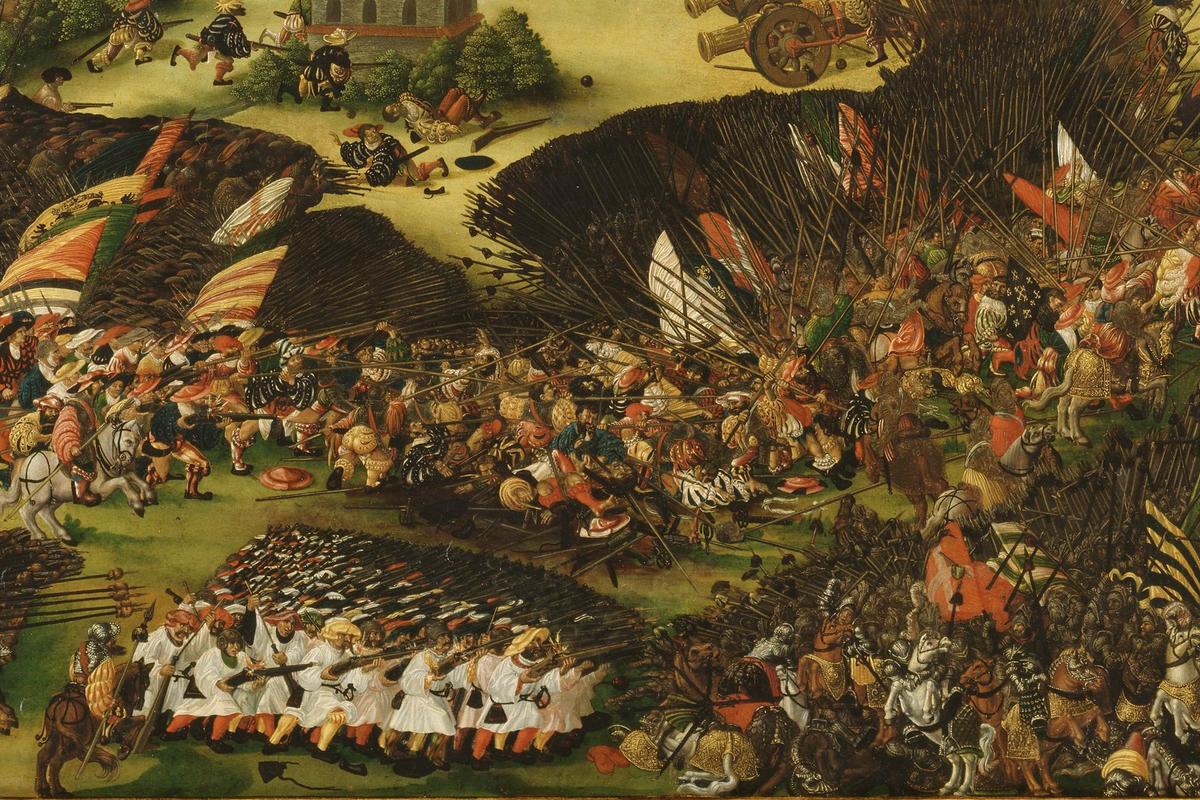
The standard military firearm of the time, fired by a smouldering cord pressed into the powder.
The Battle of Pavia (1525), one of the great clashes of the Italian Wars, with firearms in use.1 / 4
Lorenzo de' Medici, the great patron of Renaissance art, left five firearms when he died in 1492. In 1539 his descendant Duke Cosimo had 91. Writers of the time called guns the Devil's work. The poet Ariosto called the gun a "foul and pestilent discovery" that would end gallantry. The historian Catherine Fletcher's essay explains how guns became normal in 16th-century Italy anyway.
Militias did most of the work
Italian states kept no standing armies and relied on mercenaries they didn't trust. During the 1 (1494–1559), when France and Spain fought over the peninsula, the states turned to citizen militias. Fletcher calls these the single biggest driver of gun ownership. Florence's militia of 1506, which Machiavelli helped found, was to have at least 10,000 men, one in ten carrying a gun. Monthly target practice began in 1508. In 1525 a Venetian official proposed 12,000 men, two-thirds of them armed with guns. By 1540 Modena required one rural household in three to own one.
The militias often performed badly. During the 1530 siege, Florence gave 2 (long, wooden-stocked guns) to shoemakers and still fell. Governments kept expanding them all the same.
Prizes and prestige
Shooting contests offered real money. Lucca's prizes included a silver cup worth almost 20 3, at a time when a soldier might earn under 30 ducats a year. They also gave guns a new image: Lucca's decree presented them as defenders of "dear liberty".
At court, craftsmanship did the same job. The 4 struck its own spark instead of using a burning cord, so it could be carried hidden and didn't give a hunter away. It was expensive and became a status symbol. Gunsmiths decorated luxury pieces with classical gods and Christian scenes. Titian painted Charles V in 1548 dressed as a Spanish cavalryman who carried a wheellock. In 1553 officials in Mantua began giving their duke ceremonial guns where they had once given crossbows.
The costs
Guns spread to farmers and hunters, and then to bandits. In the late 1570s one writer complained that "every low herdsman or shepherd" carried a wheellock. By 1600 guns were the most common homicide weapon in Bologna, though still used in only a third of killings. Most gun crime involved threats, not shooting, and accidents happened too. Women rarely owned guns. Fletcher, drawing on other historians, links guns to a tougher, more military idea of masculinity.
She ends on an ambivalence that never went away. Some people carried guns only because they felt they had to, and once guns were everywhere, not owning one was itself a choice.
A puzzle in the inventories
When Lorenzo de' Medici, the great Florentine patron of Renaissance art, died in 1492, the inventory of his possessions listed five portable firearms. By early 1539 his descendant Duke Cosimo de' Medici kept 91 in his storerooms in Florence. The historian Catherine Fletcher's essay explains how that happened. Over those same decades, literature kept calling guns diabolical, unchivalrous and unmanly.
The literary record is consistent. Ludovico Ariosto's epic poem Orlando Furioso (1532) calls the gun a "foul and pestilent discovery" that would put an end to gallantry and valour. Leonhard Fronsperger, a former captain of the ducal armoury in Munich, called gunpowder "indispensable" but also "horrible" and "unmanly". Fletcher's point is that records of what people owned, built, licensed and prosecuted tell a different story.
The engine: citizen militias
Fletcher's central claim is that militias were "the single most important factor" in spreading guns through 16th-century Italy. The Italian states kept no standing armies and depended on mercenaries. Florence's founding provision for its militia in 1506, a body best known for Niccolò Machiavelli's part in creating it, stated that "little hope" could be placed "in foreign and hired arms". It called for at least 10,000 men from Florentine territory, one in ten armed with a firearm. It also ordered 500 handguns (schioppetti) and money for powder and shot to be kept in the city hall.
The model was German, where city dwellers had a centuries-old duty to keep arms for civic defence. One early constable was a German, Giovanni Tedesco. He set up target practice, and from 1508 that became monthly drill across the militia. Another constable came from Spain, the country then leading in the use of small arms. On the Venetian frontier in Friuli, which bordered Ottoman lands, militias carried handguns from the 1490s.
The plans grew. In 1525 Giovanni Moro, a Venetian official, proposed a militia of 12,000 men, two-thirds of them with firearms. Each would get powder and lead for practice, and contests would be held three times a year. By 1540 the ruler of Modena required one countryside household in three to own a gun. The historians Michael Mallett and John Hale estimated that after the later 1520s about one rural household in 15 in Venetian territory had a firearm. In their words, the government "was calculatedly accepting a risk to public order".
The plans also often failed. In the Republic of Siena between 1525 and 1555, 20 to 33 per cent of adult men served in the militia, and each 500-man battalion had 150 to 200 arquebusiers (soldiers with the 1, a long gun with a wooden stock). A report from 1543 nonetheless judged the force short of men, guns and helmets. During the siege of Florence in 1530, shoemakers and cutlers were handed arquebuses, and the city still fell to the Spanish-backed Medici. Even so, governments kept expanding their militias.
Prizes and a new story about guns
Shooting contests reinforced the drill, and the prizes were generous. Venice began a competition in 1506 for archers on its galleys. In 1518 the first prize was damask cloth worth 32 2 plus 6 ducats in cash. In 1520 the Republic of Lucca set up thrice-yearly contests with prizes including a silver cup worth almost 20 ducats. A soldier might earn less than 30 ducats a year, so a single win could be worth about a year's pay.
Fletcher argues that the contests also gave guns a better image. Lucca's decree urged citizens to prefer "death over the loss of dear liberty". In that language the gun became a tool for defending the republic rather than an instrument of the Devil.
At court: beauty and novelty
Among the elite, craftsmanship did similar work. The 3, a self-igniting mechanism probably developed in Germany and sketched by Leonardo da Vinci in his notebook known as the 4, needed no burning match. That meant it could be carried hidden, and in hunting it gave off no glow or smell to warn the prey. It was expensive and sometimes unreliable, and it became a status symbol. Cosimo took four German-style wheellocks with him when he travelled. Titian's 1548 portrait of Emperor Charles V after the Battle of Mühlberg, which Fletcher describes as the first portrait of a European ruler with a handgun, shows him dressed as one of the Spanish cavalry who carried wheellocks.
Luxury guns were decorated with hunting scenes, figures from classical myth and biblical heroines. A German pistol dated 1548 combines Lucretia, the Roman heroine, with the Crucifixion. In Europe's religious wars the gun was becoming a weapon of true Christianity against heretics. Novelty pieces, such as a pollaxe combined with a gun, or a boar-spear fitted with two small guns that was given to Cosimo, belonged to the court taste for machines meant to provoke wonder. They also advertised their makers as possible suppliers of weapons by the thousand. Fletcher's clearest sign that guns had been accepted comes from 1553, when Mantuan officials began giving their duke ceremonial firearms where they had once given crossbows.
The goldsmith Benvenuto Cellini, a rare writer who admitted guns were fun, shot pigeons among Rome's ruins during a plague in the 1520s. He mixed his own gunpowder and said the sport eased his "naturally melancholy disposition".
Guns in the hands of shepherds and bandits
Ordinary people had other reasons to own guns. Farmers used them against pests, and hunters used them for game. In 1552 a cowherd named Vincenzo got a hunting licence in Bologna, with the standard ban on carrying arms in churches, markets or festivals. In the late 1570s an anonymous writer proposed gun control across states, warning that "every low herdsman or shepherd" now carried a wheellock arquebus.
Crime followed. By 1600 guns were the most common homicide weapon in Bologna, though they accounted for only a third of cases. Fletcher notes that most gun crime involved threats rather than planned killing. In one case near Brescia in 1554, a gang of 20 used arquebuses to frighten stewards into handing over carts. Accidents happened too: in Bologna in 1575 a man examining an arquebus killed an elderly woman named Giovanna when it went off. Crime and politics blurred together. An exile, or 5, often turned bandit. Under the early Medici dukes, officials seized weapons that might have been meant for an uprising, and in 1539 a Brescian dissident was found with about 25 guns.
Guns and manhood
Fletcher finds few women gun owners. In Ferrara's siege preparations of 1552, six of the 18 female heads of household had guns, but siege conditions suspended normal gender rules. One study of Bologna's court records found only a single woman with a firearm. She draws on other historians to argue that guns helped redefine elite masculinity as "rugged, militaristic", and that they made the routine brawls between men more dangerous.
What stays open
Nobody has a firm count. The militia figures leave out guns bought second-hand from soldiers or won at gambling. The sources also say little about how ordinary men felt about carrying them. Fletcher notes that some people applying for licences felt pushed into owning guns for self-defence, and she ends by observing that once guns became common, choosing not to own one was itself a decision.
Remember
States spread gun ownership on purpose, through militia quotas and contests, knowingly accepting risks to public order.
Decoration and ceremony did cultural work, turning a 'diabolical' weapon into a courtly gift and an emblem of liberty.
Most early gun crime relied on threats rather than shooting: the gun was used to frighten people into giving in.
Demographer Saul Justin Newman's new book, Morbid: Debunking Modern Longevity Science, argues that the records of the world's oldest people are much less solid than they look. In this excerpt he compares exposing a famous case to watching part of a film set topple: once the saloon turns out to be plywood, you start doubting the whole street.
The woman nobody believed
Adele Dunlap was once listed as America's oldest woman. For almost a decade she said her papers were wrong and she was ten years younger. Asked how it felt to be 113, she replied, "I'm 104." She was overruled. Her age had been validated by the 1 (GRG), which tracks 2, people aged 110 and older. Robert Young, the GRG's director, who also certifies age records for Guinness World Records, told her she was mistaken.
Newman's point is that validation is supposed to reject claims when the life story contradicts the paperwork. Here, the person's own contradiction was simply ignored.
The validator
Newman then looks at Young himself. Young's master's thesis puts forward a "biological superiority hypothesis" about Black longevity, using evidence such as a comedy film and the saying "black don't crack." This matters, Newman argues, because by his account Young has validated about half of all extreme-age data. Young also recruited subjects for the 3, a leading clinical study of people aged 100 or more. He did it by searching news stories and waiting for unsolicited emails. The study's authors called 4, meaning distortion from how cases are found, "likely minimal," though they had no way to measure it.
Motive and myth
Next comes Irma Borgoglio, 103, of a small Italian village. Police found her propped up in her kitchen, frozen, next to an empty chest freezer. Her unemployed son had kept collecting her pension. Newman's point is that pensions create a steady reason to keep the dead "alive" on paper.
The largest case is Charlie Smith, listed by Guinness in 1979 as 137. Social Security officials had told him his age and then lost the file. Smith claimed to be the last Union soldier and to have ridden with Billy the Kid, and his stated age drifted by 12 years. He was still a VIP guest at the Apollo 17 launch, where he insisted nobody was going to the moon.
What's missing
The excerpt is anecdotal. It doesn't estimate how many validated records are wrong or how much the errors distort research, and it questions Young's credibility rather than auditing his cases. Newman's broader statistical work, which the excerpt doesn't present, carries that weight.
This essay is adapted from Morbid: Debunking Modern Longevity Science, a new book by the demographer Saul Justin Newman. Nautilus reprinted it from MIT Press Reader. Newman argues that the records of the world's oldest people are less solid than they look. He compares debunking a widely accepted case to watching part of a film set fall over. The saloon in the spaghetti western turns out to be painted plywood, and suddenly you suspect the whole street is cardboard. The excerpt doesn't present new statistics. It works through cases, each one meant to show a different way the system that certifies extreme ages goes wrong.
How age validation is supposed to work
People who reach 110 are called 1. Their ages are "validated" by groups such as the 2 (GRG), a Los Angeles-based body that tracks them. Guinness World Records relies on that validation to name record holders. In principle, a validator checks documents for consistency, and if cross-examination turns up flaws in a person's life story, the claim is dropped. Newman's point is that this safeguard often fails to work.
The woman who said she was younger
Adele Dunlap was once listed as the oldest woman in the United States. She was a former smoker and an occasional drinker. For almost a decade she insisted that her paperwork was wrong and that she was ten years younger than her records said. Nobody took her seriously. Asked how it felt to be 113, she answered, "I'm 104." The reporter overruled her: the GRG had validated her age. Robert Young, the GRG's director, who also certifies age records for Guinness, told her she was mistaken. The Obamas sent her a card for her 113th birthday. She remains a supercentenarian on paper.
For Newman, the case reverses the supposed logic of validation. A contradiction from the person herself, about the most basic fact of her biography, wasn't treated as a flaw that should sink the claim. It was treated as confusion that the paperwork could correct.
The validator
Newman then turns to Young. Validation depends on the validator's judgment, he argues, and Young's judgment is open to question. Young's master's thesis, from Georgia State University, puts forward what he calls a "biological superiority hypothesis" about African-American longevity. As evidence it cites the Eddie Murphy comedy Coming to America, the saying "black don't crack," and a theory that thick skin protects the internal organs. It also speculates about race and sprinting speed based on the 2008 Olympics. Newman points out that Nazi race science used similar reasoning, and that Young confuses physical fitness with 3, which means reproductive success.
This would matter little, Newman writes, if Young weren't so central to the field. By Newman's account, Young has validated roughly half of all extreme-age data. He also assembled the 4, described as the "gold standard" clinical study of Americans aged 100 or more. Young decided who counted as 100, screened the cases and handled age validation. He found subjects by searching the internet for news stories about old people and by waiting for unsolicited emails. The study's authors concluded that "5 is likely minimal." Ascertainment bias means distortion caused by how cases are found. Newman notes that the authors had no way of measuring it. If anyone who makes the news or sends an email can get into the sample, the sample reflects who gets noticed, not who is actually old.
The mother in the freezer
The second case shows a motive. Irma Borgoglio, 103, lived on the top floor of an apartment building in the small Italian village of Bellavista di Trivero, with her unemployed son Pierangelo Bussolera, who was 63. Visitors kept being told she was in bed. Neighbours had overheard arguments about money, and those "suddenly stopped in March." Eventually the police came to check on her. They found her propped upright in the kitchen, frozen solid, next to an empty chest freezer that Pierangelo had hauled up the stairs himself. He had been collecting her pension the whole time.
It's easy to dismiss cases like this as absurd one-offs. Newman's argument is that the same incentive is everywhere: a pension that keeps paying while the recipient is "alive". And the same readiness to accept an implausible story "scales remarkably well."
The 137-year-old
The scaled-up version is Charlie Smith. In 1979 Guinness listed him as the world's oldest person, at 137. Social Security officials said they had found documents showing he was sold into slavery in New Orleans in 1859. The story Newman tells is that Smith, a fruit picker, needed an ID. The Social Security Administration found a file, told him he was 113, and then lost the file.
Smith's stories grew from there. He said he was the last surviving American slave, the last Union soldier of the Civil War and the first African-American Freemason. That last honour actually belongs to Prince Hall and 14 others in 1774. He said he came from "Galina, Africa," a Liberian port that doesn't exist. He also claimed to have been a cowboy who shot lions in Texas and to have ridden with Billy the Kid to arrest President Garfield's assassin. His own figures didn't add up either: in 1975 he said he was 144 when the official count was 132. None of it hurt his standing. He was a VIP guest at the launch of Apollo 17, where he loudly declared the moon landings fake, and then he repeated it to Walter Cronkite on CBS. Ripley's Believe It or Not!, the BBC and a PBS film all featured him. The New York Times memorialised him as "perhaps" 137. "It was all pure bullshit," Newman writes.
What the excerpt shows, and what it doesn't
The three cases fail in different ways. In the first, a validator overrules the subject. In the second, fraud has an obvious money motive. In the third, a tall tale outgrows its source and gets officially stamped. Together they support Newman's broader claim that extreme-age data deserves suspicion by default.
The excerpt is still a set of anecdotes. It doesn't say what share of validated supercentenarians are wrong, how a better validation method would work, or how much these errors distort the research built on the data, including the New England study. Newman's earlier statistical work on where extreme ages cluster is the stronger evidence for those claims, and this piece only points to it. The attack on Young's thesis is pointed, but it is an argument about one person's credibility. It isn't a direct audit of the cases he validated. The obvious question Newman raises but doesn't answer here is how many of the other buildings on the street are cardboard.
Remember
By Newman's account, one validator, Robert Young, has certified roughly half of all extreme-age data.
Pensions give families a steady reason to keep a dead relative "alive" on paper.
The excerpt relies on anecdotes; it doesn't measure how widespread the errors are.
Vienna is five times the size of Graz, Austria's second city. Paris is seven times the size of France's next city, Seoul six times Korea's. These are 1, places that dwarf every rival and hold most of a country's political, financial and cultural elite.
Washington, DC and Beijing don't fit the pattern. Shanghai is bigger than Beijing, and DC isn't among the five largest US metro areas. In a Works in Progress column, the author argues that this gives both countries "productive friction". The capital must keep competing with other hubs, and that helps explain how both combine social dynamism with powerful, jealous states.
China's regions
Shanghai stand-up comedians must clear their scripts with censors, but jokes about regional stereotypes pass. Shanghainese worship money. Northeasterners turned into drunks after their economy collapsed but stay loyal and funny. Beijingers talk beautifully about everything and do nothing else.
Behind the jokes, the author sees distinct macro regions: the Sichuan–Chongqing mountain zone, coastal Fujian and Guangdong, the Hubei–Hunan heartland and others. Coastal areas look outward, and mountain people are skilled at dodging orders from the center. Deng Xiaoping's coastal 2, which had looser rules to open China to markets, made Shenzhen a magnet that still pulls people south. The author has often watched local officials ignore "senseless directives" from Beijing.
America's regions
In the US, the author reads local elite cultures: Miami prizes looking hot, Boston is bookish, and the 3 feels stuck. 4 cities such as Nashville, Dallas, Phoenix and Houston are openly pro-growth. A Houston businessperson explained that the city lacks good weather and scenery, so its leaders work harder to attract people.
How the two differ
Mobility. China's 5 household registration system still blocks many migrants from schools and healthcare in big cities. America sorts its talent efficiently into a few hubs, such as San Francisco for AI and New York for finance, and draws ambitious people from abroad as well.
Spread-out wealth. Citing economists Owen Zidar and Eric Zwick's book The Everywhere Millionaire, the author notes that car-dealership and dental-clinic owners have built up wealth in ordinary towns across the US.
The state borrows what business builds
The Treasury didn't build the global banking network that runs through US banks, but it uses it to project power. Beijing didn't plan Shenzhen's monopoly on many electronics products, but it benefits from it.
The author's advice to individuals is to move where ambitious peers gather, since most countries can't change their structure. The argument rests on two countries and plenty of anecdote. It's a provocative lens, not a proof.
Countries with one center, and countries with many
The column starts with a measurement. Vienna has five times as many people as Graz, Austria's second city. London is four times the size of the next British city, Seoul six times the next Korean city, and Paris seven times the next French one. These are 1, cities that dwarf every rival and also hold their country's political, financial and cultural elite in one place.
Washington, DC and Beijing don't fit that pattern. Beijing is smaller than Shanghai. DC is not among the five largest US metro areas. The columnist argues that this is a strength. Because the capital has to keep asserting itself against other hubs, the US and China gain "productive friction", which is part of how they combine social dynamism with "jealous states", governments that guard their own power.
China's regions, as seen through comedy
The author approaches China's regional character through stand-up comedy in Shanghai. Comedians must submit scripts to censors in advance, and anything political is cut. Jokes about regional stereotypes are allowed. Shanghainese worship money and their husbands are henpecked. People from Liaoning and the rest of the northeast turned into conniving drunks after the local economy collapsed, but are redeemed by humor and loyalty. Beijingers can talk beautifully about anything, and that is all they can do.
The point behind the jokes, the author says, is that China consists of distinct macro regions. These include the southwestern mountain zone around Sichuan and Chongqing, the coastal provinces of Fujian and Guangdong, the populous heartland of Hubei and Hunan, and about half a dozen more. Central governments have tried for millennia to impose one will on all of them. Xi Jinping has more tools of control than any emperor had, yet new investment still doesn't flow to Beijing by default.
The author ties regional character to geography. Coastal areas look outward. Mountain people have developed "greater wiles" for avoiding orders from the center. Politics in the capital has sometimes increased regional autonomy. Deng Xiaoping set up 2 on the southeastern coast as a beachhead in his fight against the planned economy. Shenzhen's rise then pulled China's population south, and people are still leaving dry, state-dominated northern cities for warmer, more market-friendly southern ones.
The author also describes from personal experience how often local governments ignore or quietly undermine "senseless directives" from Beijing. Enforcement thins out quickly outside big cities, and sometimes even Beijing's own local enforcers look the other way.
America's regions
The author's favorite pastime when traveling in the US is reading the culture of local elites. In Miami, "to a first approximation", the most cherished value is to look hot. Boston is more bookish and perhaps less practical. 3 states such as Pennsylvania and Michigan, where the author's family and home are, are pleasant but feel stuck. 4 cities such as Nashville, Dallas and Phoenix are optimistic and genuinely pro-growth. A Houston businessperson told the author: "We don't have great weather or natural beauty. Our leaders know that, which is why they work especially hard to attract people." The author points to Houston's population boom as the evidence.
Washington doesn't drive most big American changes and often seems barely aware of Silicon Valley.
Two kinds of polycentrism
Both countries have many centers, but the author argues they differ in two ways.
Mobility. China still restricts movement through 5, the household registration system. Shanghai and Beijing deny many would-be migrants access to local schools and medical care, which holds back social mobility across the country. In the US, sorting is "more efficient". The most ambitious people gather in a few places, mainly New York and San Francisco, plus DC and Boston. Each field has an obvious home base, whether it is AI, algorithmic trading, energy or performing (Broadway, Hollywood, or "Hollywood for ugly people", a joke usually aimed at DC). Ambitious people from around the world join them there.
Distributed wealth. The author cites The Everywhere Millionaire by economists Owen Zidar and Eric Zwick. The book documents how many quietly wealthy Americans own car dealerships, dental clinics or early tanning salons. Their fortunes are modest by billionaire standards, but they put deep money into communities in ordinary states. Even after Detroit's decline, automotive wealth left its suburbs with large homes, country clubs, museums and universities.
When business builds and the state borrows
In both countries, the author says, business elites and the state are "locked in a dance" in which each tries to take the lead. Sometimes that weakens the state. Sometimes it accidentally extends the state's reach. The US Treasury didn't build the global financial network that runs through American banks, but it makes heavy use of the system Wall Street built. Chinese planners didn't plan for China to become the chokepoint for so many manufactured goods, but Deng would have been pleased that Shenzhen is the world's only maker of many electronics products.
What individuals can do
The column ends on a practical note. Britain, France and South Korea can't easily change their centralized structure, but individuals can choose where to live. In China, people can still get away from the center by moving to the mountains or the coast. Ambitious people anywhere can move to a 6, such as San Francisco or Miami, and gain from being surrounded by ambitious peers.
What the column leaves open
This is a short essay built on observation, not a study. The causal claim, that having many centers makes a country powerful, rests on two cases and a contrast with mid-sized primate-city states. It doesn't address counterexamples. The column also leaves its own tension unresolved. It says hukou limits China's mobility, yet it counts escape to the regions as a benefit. Whether China's polycentrism works mainly through resistance to the center, and America's mainly through sorting talent into hubs, is suggested but never spelled out.
Remember
Beijing and Washington are not their countries' largest cities, unlike London, Paris or Seoul.
China's polycentrism works partly through regions resisting or ignoring the center; America's through efficient sorting of talent.
States often exploit systems business built: the Treasury uses Wall Street's network, Beijing uses Shenzhen's chokepoints.
An essay in Works in Progress takes on a familiar story: classical Antiquity was relaxed and accepting about sex until Christianity came along and repressed it. The author says they believed this until reading historian Kyle Harper's From Shame to Sin: The Christian Transformation of Sexual Morality in 1. Their conclusion is that the story is "so incomplete as to be fundamentally misleading."
Permissive for whom?
Rome was permissive in some ways. A free Roman man could have sex with enslaved people and prostitutes, male or female, children included. Nobody expected husbands to be faithful, and most men seem to have been what we would call bisexual. Slave prostitution was widespread, so coerced sex was everywhere. Sex cost about as much as a loaf of bread.
Women got none of this freedom. They had to be virgins at marriage and faithful afterwards, and tight rules on modesty governed how they behaved. When ancient writers mentioned lesbianism at all, they mocked it.
Sex between men followed a rule of rank, not a rule of tolerance. The 2, a Roman law whose text is lost, seems to have punished men who penetrated a freeborn Roman male. It also punished men who agreed to be penetrated, who were called 3, or "half man." Penetrating slaves was allowed because slaves counted as "breathing furniture."
What Christianity changed
Christians condemned all sex outside marriage. That gave rise to something new: male fidelity. Romans allowed one wife but no duty to be faithful to her. Judaism banned sex outside marriage but allowed several wives. Christians put the two together and asked each spouse to be faithful to the other. The author doubts that any other major civilization came up with exclusive mutual fidelity on its own.
Christians also began to limit the worst exploitation, though most of them accepted slavery itself. A law of 428 banned pimps, fathers and slave-owners from selling women for sex against their will. Offenders were sent to the mines. Free women pushed into prostitution by poverty could ask bishops or judges for help.
The austere part is real
Early Christian writers were "relentlessly negative" about desire. At best they saw it as a neutral animal appetite. More often they called it sinful, and they ranked virginity above marriage. The idea that desire could be ennobling came later, in the Middle Ages.
So, the author argues, the strict rules came from two sources: distrust of desire, and the extension of moral concern to people who had no rights. In practice much of the old predatory sexual life carried on. But, quoting Orwell, "a mask can alter the expression of a face."
An essay in Works in Progress challenges the standard account of sex in the ancient world. In that account, a tolerant, sex-positive Antiquity was crushed by puritanical Christianity. The author admits to having "passively accepted" this view until reading Kyle Harper's From Shame to Sin: The Christian Transformation of Sexual Morality in 1. Late Antiquity is roughly the 3rd to 7th centuries AD, when the Roman Empire became Christian. The author's verdict is that the old picture "is not entirely wrong" but is "so incomplete as to be fundamentally misleading." The essay retells Harper's findings and adds the author's own reading of them.
Where Rome really was permissive
The permissive half of the story is accurate. Free Roman men were fully permitted to have sex with male and female slaves and with prostitutes, including children. Men were under no duty to be faithful. Sex outside marriage was not just tolerated in practice but accepted in principle, even if wives found it hurtful. Men often preferred boys or women, but the essay says this was a matter of taste, not identity. Most men seem to have been what we would now call bisexual.
The material conditions matter here. Only a small minority of Romans owned slaves, but slave prostitution was widespread, so "coerced sex was ubiquitous." The essay notes that sex cost about the same as a loaf of bread.
Where it was not
That freedom belonged to one group: free men. Women lived under what the author calls the "timeless code" of most premodern societies. They had to be virgins at marriage and faithful afterwards, and strict rules on modesty governed them. In the Greek-speaking provinces many women seem to have worn face veils in public. Classical authors rarely mention lesbianism, and when they do, they treat it with contempt and ridicule.
Sex between men is the most surprising part of the picture. Its legal basis was the 2, a law whose original text is lost. From references in contemporary writers, historians infer that it probably punished two kinds of men. One was any man who sexually penetrated a free Roman man or boy. The other was any man who consented to being penetrated, a person called 3, or "half man."
The rule was about rank, not about who you desired. A free man could penetrate; a free man could not be penetrated. Slaves sat outside the system because their status approximated that of "breathing furniture." In the author's words, Roman "tolerance of homosexuality" was "strictly a licence for free men to sexually penetrate unfree ones." The Greek-speaking East was only slightly more flexible. There, freeborn men could be penetrated during adolescence but not later.
The invention of male fidelity
Christianity overturned nearly all of this. Sex within marriage was allowed, somewhat reluctantly. All sex outside marriage was condemned morally, and many kinds were also violently banned by law.
The essay highlights one result: male fidelity. The author treats it as a synthesis of two older traditions:
Rome allowed a man only one wife, which was unusual among ancient societies, but did not require him to be faithful to her.
Judaism condemned sex outside marriage but allowed a man several wives.
Christianity combined the Roman one-wife rule with the Jewish ban. The result was that each man should be faithful to one woman, just as each woman should be faithful to one man.
The author calls the novelty of this "hard to overstate." It is not clear, they write, that any other major civilization has independently invented the ideal of exclusive mutual fidelity, though it later spread to many non-Christian cultures. They also wonder whether it will outlast Christianity's decline in Europe.
Early Christians knew how radical they were being. 4, a 4th-century preacher, told his listeners that most people thought adultery meant only sleeping with a married woman. He insisted that a married man's affair "even with a public whore, a slave girl" was also adultery: "Your wife did not come to you, and leave behind her father and mother and her entire household, in order to be humiliated." The theologian 5 said that "the laws were made by men, and they are disposed against women." The author is careful to add that these writers were "certainly not consistent feminists."
Slavery and coerced prostitution
In theory, Christianity bases a person's moral worth on their relationship to God, not their social position. That might have led Christians to question slavery. In practice it rarely did. Most early Christians accepted slavery without question. The great exception was 6, whom the author calls history's first recorded abolitionist.
Christians did, however, start to limit the worst abuses. The clearest case is the Christianized Empire's campaign against forced prostitution. A law of 428 banned pimps, fathers and slave-owners from selling women for involuntary sex. Offenders were to be arrested and sent to the public mines. The law itself said this was "less of a punishment than that of a woman who is seized by a pimp and compelled to endure the filth of an intercourse that she did not will." It also covered legally free women driven into prostitution by poverty. They could seek relief from bishops, judges or 7, a type of local official.
The austere half is also real
The author then asks whether early Christians saw anything good in desire. Medieval Christians later did: they noticed that erotic longing resembled love of God, with its self-abandonment, sense of incompleteness and wish to become worthy. Early Christians, with very few exceptions, did not. Their most optimistic view was that desire is a morally neutral animal appetite. More commonly they held it to be sinful in itself. They often ranked virginity above marriage and accepted marriage mainly for having children and as a concession to human weakness, though they did value friendship and charity between spouses. On this point, the author concedes, early Christians really were "the austere fanatics of popular mythology."
Two motives, one outcome
The essay's central claim is that Christian strictness had two sources. One was hostility to desire. The other was extending moral concern to "the rightless people of the classical world": slaves, prostitutes and wives. The author says this extension was "extremely haphazard" even in theory. In practice Antiquity's "vivid, predatory sexual life" often went on under a thin Christian surface.
The essay leaves some questions open. It does not try to measure how much behavior actually changed, and it rests almost entirely on Harper's book. It ends with Orwell instead: "An illusion can become a half-truth, a mask can alter the expression of a face." The author argues that seventeen centuries under that Christian ideal have surely changed Europeans.
Remember
The Romans judged sex between men by rank. Penetrating a free man was a crime, and being penetrated was shameful.
A law of 428 sent pimps who forced women into prostitution to the mines and gave poor women a way to ask for help.
Early Christians treated desire as an appetite at best. The idea that erotic love could be noble came in the Middle Ages.
Richard and Arline in the 1940s, before her tuberculosis diagnosis forced them to plan around illness.1 / 4
After Richard Feynman died in 1988, his widow Gweneth sent biographer James Gleick a box of unread papers. In it Gleick found a love letter Feynman had written to his first wife, Arline, 488 days after her death. "My heart stopped," Gleick told Maria Popova, who retells the story on The Marginalian. He had never had an experience like it as a biographer.
A rationalist in love
Feynman, the Nobel-winning physicist, distrusted anything that reason couldn't test. He met Arline as a teenager in Far Rockaway, New York. She loved philosophy and art. When she insisted everything has two sides, he gave a paper strip a half-twist and taped the ends together. That makes a 1, a surface with only one side.
Then Arline fell ill. Her doctors thought she was dying and kept it from her. Under family pressure, Feynman went along with the lie, and he carried a "goodbye love letter" in case she found out. She did. He told her the truth and asked her to marry him. The diagnosis turned out to be 2. In 1941, before antibiotics, that was a slow death sentence. Princeton threatened to cut his PhD funding if he married. His mother said such a marriage "ought to be" unlawful. They married anyway in June 1942, with two strangers as witnesses. He didn't kiss her on the lips for fear of infection.
3 and the clock
While Feynman worked on the 4, the secret wartime atomic bomb program at Los Alamos, Arline was in a 5 in nearby Albuquerque. She sent him coded letters for fun, which worried the military censors. When they asked for a key, she started cutting her letters into jigsaw pieces. She died on 16 June 1945, at 84 pounds. That night the clock in her room stopped at 9:21, the moment of her death. Feynman wouldn't accept anything mystical in that. He had repaired the clock several times, and he concluded it had jammed when a nurse picked it up to read the time.
The letter
Sixteen months later he wrote to her anyway: "I find it hard to understand in my mind what it means to love you after you are dead." He mourns their unfinished projects, such as learning Chinese and getting a movie projector. Every woman he meets since "seem[s] ashes," he writes. "You, dead, are so much better than anyone else alive." He signed it "Rich," then added: "PS Please excuse my not mailing this — but I don't know your new address."
Popova reads the letter as "touchingly human" rather than a betrayal of his rationalism. The man who explained away the clock still wrote to someone who no longer existed. The joke at the end shows he knew it.
In the months after Richard Feynman died in 1988, James Gleick was writing Genius: The Life and Science of Richard Feynman. Feynman's widow, Gweneth, sent him a box of unread papers. In it Gleick found a letter that overturned his idea of who Feynman was. "My heart stopped," Gleick told Maria Popova, who retells the story on The Marginalian. "I have never had an experience like that as a biographer, before or since."
The letter is a love letter to Feynman's first wife, Arline. He wrote it in October 1946, 488 days after she died. To see why it's so startling, you need to know how far Feynman went to keep out anything that looked mystical, and what he and Arline went through.
A courtship of opposites
The two met as teenagers on the beach in Far Rockaway, New York. Feynman loved science. Arline loved philosophy and art. He took an art class just to be near her, which Popova says started his little-known lifelong habit of drawing. Their arguments show how differently they thought. Arline admired 1, the 17th-century philosopher who claimed to prove God's existence from the idea of a perfect being. Feynman thought the proof was lazy reasoning. When she insisted there are two sides to everything, he cut a strip of paper, gave it a half-twist and taped the ends together. That makes a 2, a surface with only one side. He proposed in his junior year of college, and she said yes.
An illness, and a lie
Then Arline fell ill with symptoms no one could explain. A lump came and went on her neck, and she had fevers with no clear cause. At one point she was in hospital with suspected typhoid. Gleick writes that Feynman began to feel "the special powerlessness that medical uncertainty can inflict on a scientific person." He questioned the doctors, trying to push them toward a more methodical diagnosis. Arline recovered, then relapsed. Her doctors privately believed the illness was terminal and decided not to tell her.
Feynman and Arline had promised each other to always tell the truth. Both families, the doctors and his sister Joan, who called him heartless, pressured him to go along with the doctors. He gave in and told Arline she had glandular fever. Meanwhile he carried a "goodbye love letter" in his pocket, sure she would never forgive him. Soon after, she overheard her mother crying to a neighbour. When she confronted him, he told her the truth, handed her the letter and asked her to marry him.
Marriage against the odds
The diagnosis turned out to be a rare form of 3, probably caught from unpasteurised milk. At first Feynman was relieved, because it wasn't Hodgkin's disease or lymphoma. Popova argues he underestimated it. This was 1941, and the first successful medical use of penicillin was still a year away. Without antibiotics, tuberculosis was a slow death sentence. There were other obstacles too. Princeton, where Feynman was doing his PhD, threatened to cut off his fellowship funding if he married. His mother thought he was marrying out of pity and worried about the stigma of the disease. "I was surprised to learn such a marriage is not unlawful," she wrote. "It ought to be."
They married on 29 June 1942 in a city office on Staten Island. Their only witnesses were two strangers called in from the next room. He was afraid of infection, so he didn't kiss her on the lips. Afterwards he drove her, in a borrowed station wagon fitted with mattresses, to a charity hospital in Browns Mills, New Jersey.
4 and coded letters
Feynman was recruited to the 5 and moved to Los Alamos. Arline moved into a 6 in nearby Albuquerque. She wrote him letters in code because she knew he loved puzzles. That alarmed the lab's military censors, who told Feynman coded mail was against the rules and asked that each letter include a key. Arline enjoyed this even more. She cut holes in her pages, blacked out passages with ink, and mail-ordered a jigsaw kit to cut letters into puzzle pieces.
Underneath the jokes, she was dying. In every letter he told her he loved her, including the line "I have a serious affliction: loving you forever." In early 1945, two and a half years into the marriage, they made love for the first time. Each had been afraid of harming the other. Her weight fell to 84 pounds. Feynman had come to see the medicine of the day as a mutilation of the scientific method, and he pinned his hopes on an experimental drug made from mould. She began coughing up blood.
On 16 June 1945 the sanatorium called the Los Alamos computing room where he worked. He borrowed a colleague's car, and he was at her bedside when she died at 9:21 p.m. The next morning he arranged her cremation and collected her belongings. On the last page of the small notebook where she had recorded her symptoms, he wrote: "June 16 — Death."
The stopped clock
One detail shows how Feynman thought. The clock in Arline's room had stopped at exactly 9:21, the moment she died. He knew how easily that could feed mystical thinking, so he worked out a physical cause. He had repaired the clock several times during her stay. The mechanism was unreliable, and he concluded it had jammed when the nurse picked it up in the dim light to read the time of death. For Feynman, as Popova puts it, anything that seemed mystical was a mystery whose physical answer hadn't been found yet.
The letter
That is why the 1946 letter is so striking. It begins "D'Arline, I adore you, sweetheart." He says he hadn't written in almost two years because he was "stubborn and realistic" and "thought there was no sense to writing." He admits: "I find it hard to understand in my mind what it means to love you after you are dead — but I still want to comfort and take care of you." He remembers their half-finished projects: learning to make clothes, learning Chinese, getting a movie projector. He calls her the "idea-woman." He says that every woman he has met since "seem[s] ashes," and that "You, dead, are so much better than anyone else alive." It closes: "I love my wife. My wife is dead. Rich." Then a postscript: "Please excuse my not mailing this — but I don't know your new address."
Popova presents the letter as "touchingly human," not as a contradiction. The man who reasoned away the clock still wrote to someone who no longer existed. The postscript shows he knew exactly what he was doing. Popova doesn't try to explain this in psychological terms, and the article leaves open whether Feynman ever wrote to Arline again or what he made of the letter later. The piece is mostly a retelling of Gleick's biography with Popova's commentary. Its value is in the documents: Feynman's own words, and Arline's.
Remember
Feynman carried a "goodbye love letter" while he went along with doctors in hiding Arline's prognosis from her.
Military censors asked Arline to include a key with her coded letters, so she started cutting them into jigsaw pieces.
His letter to his dead wife ends with a joke about not having her new address.