Seeing Things That Aren't Quite There · Morning Gist
Wednesday, October 215 stories · 16 min
Seeing Things That Aren't Quite There
Five long reads on what we have reason to believe: gut feelings, AI fears, invisible matter, and lovers who swap clothes to become each other.
Picked from 29 new articles across 14 sources · arrow keys for other days
Today in 30 seconds
30s left
Philosopher Marc Moffett argues intuitions justify belief like perception does: by presenting a situation as real, not by how they feel. story 1 ↓
A joke about an AI "permanent underclass" now drives real fear among Stanford students and laid-off engineers, though the influencer who spread it calls it nonsense. story 2 ↓
Nine Indian paintings from about 1700–1900 show Krishna and Rādhā swapping clothes, which the gallery reads as love trying to erase difference. story 3 ↓
Ethan Siegel says dark matter's existence is settled. The open question is how "hot" and clumpy it is, measured without detecting a particle. story 4 ↓
Ada Palmer and Ken Liu call computing one revolution, not six, and trace AI fears to scripted jobs, distrust of leisure and reinvented aristocracy. story 5 ↓
1/5Aeon· Marc A Moffett· Oct 20
Gut feelings can be rational, philosopher argues, for the same reason sight is
In an Aeon essay, philosopher Marc Moffett argues that everyday hunches and philosophers' thought-experiment intuitions work like perception. They present things as actual, and that gives us a reasonable basis for belief.
Why it matters · It treats a "creepy vibe" and a famous thought-experiment verdict as one mental capacity, giving gut feelings a principled place between blind trust and dismissal.
Know this first
Context from the editor, not the article · 25 sec
1 · The regress of reasons
If every belief needed another belief to justify it, justification would never end. Philosophers answer with infinite chains (infinitism), loops (coherentism), or basic starting points that need no further support (foundationalism).
2 · Seemings as evidence
An influential view, phenomenal conservatism, holds that if something seems true to you, you have some justification to believe it unless you have a reason for doubt. Perception is the standard example.
3 · Famous thought experiments
The trolley problem asks whether you may push one person to their death to save five. Fake-barn cases ask whether a lucky true belief counts as knowledge. Most people answer both instantly, without argument.
2/5Big Think· Namir Khaliq· Oct 21
How a joke about an AI "permanent underclass" became real fear
Namir Khaliq spent time in the San Francisco Bay Area tracing the "permanent underclass" meme, the idea that AI will make most human work worthless. It began as satire, but it now shapes how young technologists plan their careers.
Why it matters · It shows how a joke can turn into a belief system. It also shows the question beneath it: what happens to self-worth in a culture built on work when work stops paying.
Know this first
Context from the editor, not the article · 26 sec
1 · The "underclass" idea
Economist Gunnar Myrdal brought "underclass" into American debate in the 1960s to mean society's lowest stratum. By 1979 a Carnegie Council report was warning of a "permanent underclass": poverty that keeps reproducing itself when young people aren't prepared for work.
2 · Doomers and accelerationists
Silicon Valley's AI debate has two loose camps. One fears AI could escape human control or wreck society. The other, often called effective accelerationism ("e/acc"), wants faster innovation and less regulation and expects abundance.
3 · AGI
Artificial general intelligence (AGI) is a hypothetical AI that matches or beats humans at essentially every cognitive task. If it existed, most knowledge work could be automated.
3/5The Public Domain Review· Oct 20
Why Indian painters showed Krishna and Rādhā swapping clothes
The Public Domain Review gathers Indian miniature paintings of the god Krishna and his lover Rādhā dressed in each other's clothes. It argues the images show love as a wish to erase difference, a wish that never fully succeeds.
Why it matters · It links a Sanskrit grammar quirk, Roland Barthes' writing on love and Indian court painting in one argument: that wanting to become the other person is central to love.
Know this first
Context from the editor, not the article · 27 sec
1 · Krishna and Rādhā
Krishna is a major Hindu god who, in devotional stories, grows up among cowherds. Rādhā is a gopī, a cowherd woman, and his most beloved. Their love is a central subject of Indian devotional poetry and painting.
2 · Indian miniature painting
Small, detailed paintings made for royal patrons from about the 1500s to the 1800s, often illustrating poems. The hill courts of northern India, home to the Nainsukh family of painters, are known for lyrical scenes of Krishna's love life.
3 · Barthes' A Lover's Discourse
Roland Barthes' 1977 book breaks the experience of being in love into short entries such as "Union" and "Waiting". Each describes one recurring state or fantasy of the lover.
4/5Big Think· Ethan Siegel· Oct 21
Astronomers have moved from "does dark matter exist?" to "what kind is it?"
Astrophysicist Ethan Siegel argues that whether dark matter exists is long settled. The live question is what kind it is, and four observational methods can test this by mapping the small dark-matter clumps it should form.
Why it matters · It shows how a field gets past a public debate it considers settled, and how you can learn what an invisible substance is without ever catching a particle.
Know this first
Context from the editor, not the article · 29 sec
1 · What dark matter is
Dark matter is a proposed form of matter that has gravity but gives off no light. Astronomers infer it because galaxies and galaxy clusters behave as if they hold far more mass than their stars and gas can supply.
2 · The cosmic microwave background
The cosmic microwave background (CMB) is leftover radiation from about 380,000 years after the Big Bang. Its tiny temperature ripples record how much ordinary matter and how much dark matter the early universe held.
3 · The rival explanations
There are two main alternatives to dark matter. One says the missing mass is ordinary matter we can't see. The other, modified gravity (MOND is the best-known version), changes the law of gravity so no extra mass is needed.
5/5Asterisk· Oct 20
Ada Palmer and Ken Liu argue computing is one revolution, not six
Historian and novelist Ada Palmer and writer Ken Liu argue that today's AI fears really come from decades of devaluing work. They propose separating income from meaning, and keeping only the AI uses that actually help.
Why it matters · It changes the AI debate from "what will the machine do" to "who arranged work and power this way," and it uses history and fiction as tools for thinking it through.
Know this first
Context from the editor, not the article · 25 sec
1 · The Gutenberg analogy
Johannes Gutenberg's movable-type press (around 1450) is the standard example of a technology that remade society. Tech leaders often compare their products to it, implying sweeping, inevitable change is just ahead.
2 · Who is talking
Ada Palmer teaches early modern European history at the University of Chicago and wrote the Terra Ignota novels, set in the 25th century. Ken Liu writes science fiction and fantasy, including the Dandelion Dynasty series.
3 · The interviewer's angle
Beatrice Erkers runs Foresight Institute's Existential Hope program, which promotes hopeful visions of the future. She asked why imagined futures keep drifting toward empire and catastrophe rather than human flourishing.
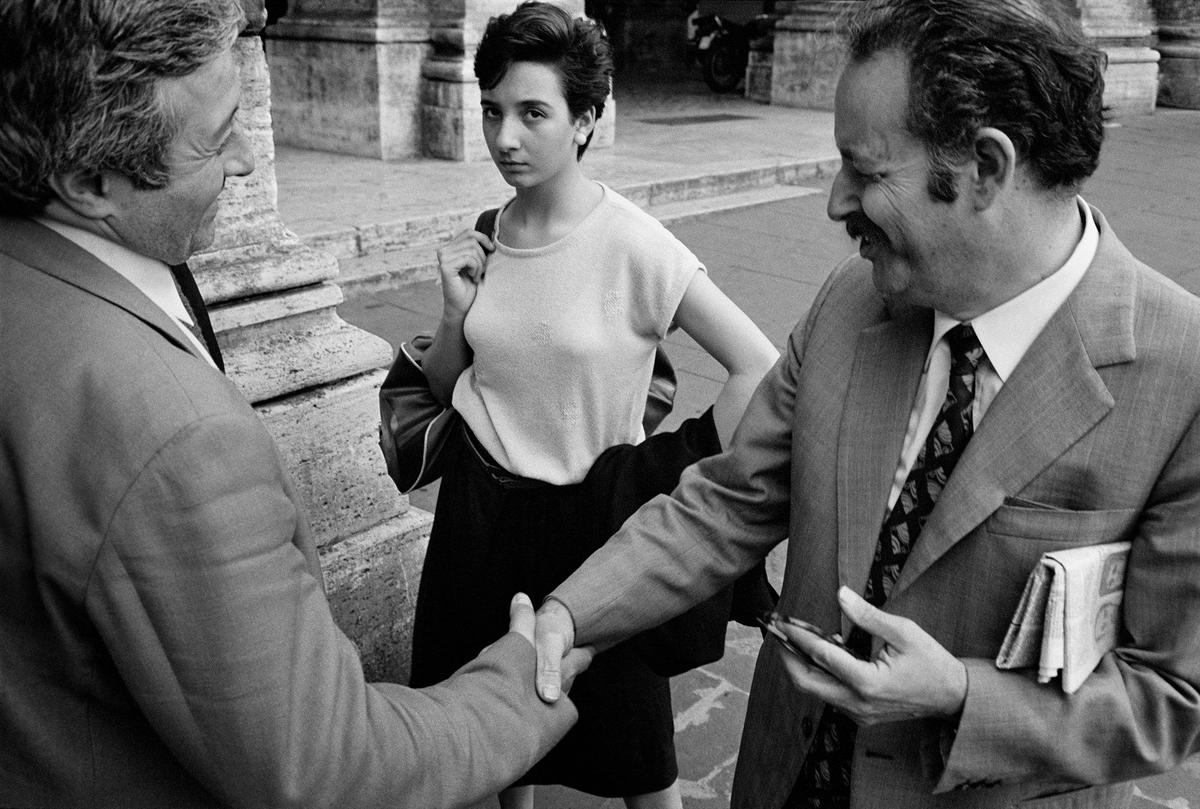
Two men shake hands while a woman looks on warily: the kind of unexplained 'vibe' the essay examines.
In an essay for Aeon, the philosopher Marc A Moffett argues that gut reactions are often rational. Examples include "he's creepy", "this looks like phishing" and "this deal feels off". His case is that they work the same way perception does.
Two kinds of intuition, one capacity
Philosophers have written a lot about 1. This is the intellectual sense that 2 + 2 = 4, or the verdicts people reach in thought experiments. In the 2, most people feel at once that pushing a bystander to his death to save five others is wrong. In Carl Ginet's fake-barn case, you look at the one real barn in a region full of convincing facades. Your belief that it's a barn is true, yet you don't seem to know it.
Moffett says these exotic cases are the same capacity we use in everyday imagining. Picture telling a friend his husband cheated: his pain seems like a reason to stay quiet. You don't infer that and you don't literally see it. It just presents itself.
What makes perception justify belief
A visual experience of a tree isn't a belief, but it gives you a reason to believe there's a tree. That holds unless something defeats it, such as knowing you took a hallucinogen. This lets some beliefs rest on something other than further beliefs, which stops an endless chain of justification.
The usual explanation is that the feel of perception, its vivid "what it's like" quality, does this work. John Bengson's 3 applies the same idea to intuition and says intuitions carry an intellectual felt quality.
Why the feel can't be it
Moffett raises two objections. First, many reflective people report no special feeling when something "seems right". This is the 4, pressed by Timothy Williamson and Ernest Sosa. Second, people with 5 have perceptions that feel normal, yet the world doesn't seem real to them. So how an experience feels doesn't settle whether it presents its content as real.
A posture, not a glow
Moffett's alternative is 6, which he describes as a way of taking in content rather than a feeling. It sits between belief, which commits you to the truth, and imagination, which merely entertains. A seeming presents something as actual without committing you to it. It also happens to you: you don't choose an intuition any more than you choose to see a tree. Believing what is presented is the mind's default, "less like drawing a conclusion and more like yielding to a disclosure."
He says the same capacity runs through perception. A snake expert and a novice may see identical shapes, but she sees a copperhead.
The verdict
On this view, vibes are neither proven right nor mere noise. They can be defeated, but they are the same kind of state behind all our basic contact with the world. The essay doesn't say how to tell a good hunch from a biased one.
People constantly act on judgments they can't spell out: he gives off a creepy vibe, this email looks like phishing, something about this deal is off. In an essay for Aeon, the philosopher Marc A Moffett argues that acting on such reactions is often fully rational. His case rests on the claim that intuition and perception share a feature, though it isn't the feature philosophers usually point to.
The neglected kind of intuition
Moffett notes that philosophers have said little about everyday intuitions. Most of their attention has gone to 1: the intellectual "seeming" that 2 + 2 = 4, or the verdict a thought experiment produces. He wants to show that these are one capacity. The philosopher's intuition, he says, is a specialised use of the same ability that keeps you out of a stranger's car.
Thought experiments link the two. In the 2, developed by Philippa Foot and Judith Jarvis Thomson, a runaway trolley will kill five people unless you push a bystander off a bridge into its path. Most people feel at once that pushing him is wrong. In Carl Ginet's fake-barn case, you are driving through countryside full of barn facades that look real from the road, and you happen to look at the one real barn. Your belief that it's a barn is true and seems justified, yet nearly everyone senses that you don't know it.
Moffett argues that these exotic cases are continuous with ordinary imagining. Suppose you are deciding whether to tell a friend his husband has been unfaithful. You picture his hurt, and that pain seems like a reason to stay quiet. You don't infer this and you don't literally see it. It presents itself. The trolley and barn verdicts arrive the same way: unbidden, before any deliberation, and we trust them.
Why perception is the model
The puzzle is where that trust comes from. Perception has a known causal route: light reaches the eyes. Intuition has no organ and no obvious object it makes contact with.
Moffett places the question inside the regress problem. If only beliefs could justify beliefs, justification would never end. He takes the 3 route, which holds that some beliefs rest on something other than further beliefs. Perception shows how this can work. A visual experience of a tree is not a belief. You can see a tree and not believe it's there, perhaps because you suspect your drink was spiked. Yet the experience still supports the belief. On the view developed by Jim Pryor and Michael Huemer, if it seems to you that there is a tree, you have some justification to believe it. You don't first need to show that your eyes work, though contrary evidence can defeat that justification.
So what gives the experience its force? The standard answer is phenomenology, meaning what the experience is like. Perception feels vivid and revealing. John Bengson's 4 carries this over to intuition: intuitions justify because they have a matching intellectual "felt quality" that presents their content as true. Moffett calls this the phenomenal strategy.
Two problems with "it's how it feels"
The first problem is the 5, pressed by Timothy Williamson and Ernest Sosa. Many reflective people say they feel no special intellectual experience when a claim "seems right". Either they can't introspect accurately, which is an uncharitable conclusion, or phenomenology isn't what does the justifying.
The second problem comes from 6. People with this condition say their perception feels normal inside: colours and shapes are intact. Yet the world doesn't seem real to them. Moffett calls this the mirror image of a perfect hallucination. Derealisation gets the world right but feels like no disclosure. A hallucination gets it wrong but feels completely convincing. So neither the information an experience carries nor how it feels is enough to present its content as actual. Moffett calls that missing property 7.
Presentationality as a posture
Moffett's answer is that presentationality is a cognitive posture, a way of taking in a content, not a feeling. He places it between two familiar attitudes. Belief is assertive: it commits you to the truth of something. Imagination is non-assertive: it entertains a possibility without treating it as real. A seeming sits in the middle. It presents something as actual without committing you to it, so it offers a route to belief that is direct but can be overturned.
Seemings are also happenings, not actions. You don't decide to have an intuition any more than you decide to see a tree. Moffett argues that this passivity is what lets a seeming present its content as actual. Once something is presented that way, believing it is a mind's default response. In his words, belief-formation is "less like drawing a conclusion and more like yielding to a disclosure."
On this view the absent-intuition challenge goes away. No special intellectual glow is needed. Someone can feel nothing distinctive and still grasp a content as actual.
Intuition inside perception
Moffett then argues that intuition does work inside ordinary perception. Drawing on P F Strawson, he notes that we see a child reaching for a toy or a car coming too fast, not patches of colour. His example: you and a trained herpetologist, a snake expert, see the same snake, and your sensory experiences may be identical. To you it is "a snake". To her it is Agkistrodon contortrix, the copperhead. The difference lies in the concepts at work, not in what you see. He says this is why expertise can change experience without changing how things look.
He also answers a sceptic who says this is just skill at applying concepts. Applying a concept, such as judging that Gollum betrays Frodo in The Lord of the Rings, is a judgment, and judgments need a basis. The intuition that the scene is a betrayal comes before the judgment and makes it reasonable. "Intuition does not compete with concept application. It enables it."
What remains open
Moffett's conclusion is moderate. Vibes are neither "vindicated wholesale" nor "dismissed as mere noise". They are fallible, but they are the same kind of state that underlies all our basic contact with the world. A thought experiment is that same capacity, tightly controlled and aimed at one concept.
The essay leaves several practical questions unanswered. It doesn't say how to tell a trustworthy hunch from a biased one, beyond noting that seemings can be defeated. It doesn't engage the experimental work showing that thought-experiment verdicts vary across people and framings. And defining presentationality as a "posture" names the property more than it explains how the mind produces it.
Remember
Derealisation shows that an experience can feel completely normal yet fail to present the world as real.
Moffett places 'seemings' between belief and imagination: they present things as real without committing you to them.
Expertise changes what perception presents, such as seeing a copperhead rather than just a snake, without changing how things look.
The "permanent underclass" is the idea that AI will push the value of human work toward zero and leave behind everyone who hasn't already got rich. It began as a Silicon Valley joke. Reporting for Big Think, Namir Khaliq found that in the Bay Area it is now being taken seriously.
From sociology to satire
The phrase is old. In 1979 a Carnegie Council report warned of a "permanent underclass," a self-perpetuating culture of poverty. In summer 2025 it went viral on X as satire, spread above all by influencer Jayden Clark (@CreatineCycle). Clark co-coined "1," or e/acc, a pro-innovation, anti-regulation creed. He tweeted that he was skipping his birthday to "accumulate capital in order to escape the permanent underclass." He says he thinks the idea is "kind of ridiculous," and that many technologists don't understand basic economics.
Who isn't laughing
Others took it straight. Parv Mahajan, a 20-year-old Georgia Tech student, wrote a widely read post on 2, a rationalist forum: "Probably, lots of jobs will be gone soon." He has since left school for AI-safety research and expects his own job to be automated around 2032.
At Stanford, sophomore Saheb Gulati says friends text him in a panic. He argues the fear cuts deep because these students' whole identity rests on joining the elite. Many respond by dropping out to found AI startups. With activist Sneha Revanur, Gulati built 3, a guidance site for students offering an alternative to that rush.
The fear isn't only among students. Khaliq's former roommate left Big Tech to found a startup because "software engineering feels done." A Midwestern engineer with 20 years' experience has had no work for 18 months after a layoff: "I'm probably the underclass now." He suspects AI was a convenient excuse for cost-cutting rather than the real cause.
The question underneath
Law professor Joan Williams argues that AI may do to white-collar workers what automation did to blue-collar ones. Because many of the exposed workers are young men, she sees a danger to democracy: "There's nothing so dangerous as a man without a future."
Philosopher Nick Bostrom, author of Superintelligence, is more hopeful but names a deeper obstacle: people have tied their self-worth to being useful. He suggests schools that teach people to be "great at leisure." Williams replies that Americans have equated work with moral worth since the Puritans, and that a basic income won't satisfy them.
Khaliq closes with Gulati, who wants his peers to stop trying to personally "make it out" and start rebuilding institutions. The article offers no hard data on AI's effect on jobs. It documents the anxiety, not the economics.
In late 2025, Parv Mahajan, a 20-year-old computer science student at Georgia Tech, posted an essay on 1, a rationalist forum popular in the Bay Area. It opened: "I turn 20 in January, and the world looks very strange. Probably, lots of jobs will be gone soon. Probably, the smartest thing alive will no longer be human." He had stopped going to lectures. "If there are a few years left," he wrote, "I want to spend them fully."
Writing for Big Think, Namir Khaliq treats that post as a symptom. A growing set of writing argues that AI could create a "permanent underclass": everyone who fails to entrench themselves before superintelligence pushes the value of human labour toward zero. Khaliq went to the Bay Area to find out why young, bright people had turned so pessimistic, and what they were doing about it.
A meme with an academic past
The phrase is older than the internet. Economist Gunnar Myrdal popularized "underclass" in the 1960s. In 1979 the Carnegie Council on Policy Studies in Higher Education warned of "a permanent underclass," a self-perpetuating culture of poverty that would form if young people weren't readied for jobs. Online, the phrase was linked to AI by at least 2024. In summer 2025 it took off as a sardonic joke.
The person who spread it most is Jayden Clark, 28, known online as @CreatineCycle. Clark moved from Australia to San Francisco in 2017 to study saxophone, ended up founding a startup, and now works as a tech influencer with more than 40,000 X followers. In 2022 he co-wrote, under pseudonyms, the Substack post that coined "2," or e/acc, describing it as "simply the self-awareness of capitalism." On his birthday in July 2025 he tweeted that he was "accumulating capital in order to escape the permanent underclass." Weeks later: "you have 2 years to create a podcast."
Clark says he never meant any of it. "I just don't think a lot of technologists in the Bay Area understand how basic economics work," he told Khaliq. In June he broke character to say the underclass "doesn't exist and it will all be fine." Khaliq notes that the meme still pays Clark's bills, and asks whether the rest of the workforce is in on the joke.
Two camps, one mansion
At 3, a 10-bedroom estate in Hillsborough, entrepreneur Rocky Yu hosts weekly hackathons and venture capital dinners for researchers from OpenAI, Anthropic, Google and xAI. Yu places himself in the "abundance" camp: "We have atomic bombs, but the Earth is still here." He even sees AI-driven unemployment as a chance to find "a meaning beyond… living for work and working for a living." Khaliq's dry reply is that AGI House has only 10 bedrooms.
Stanford's status panic
At Stanford, sophomore Saheb Gulati has become the person friends text when they worry about the underclass. He thinks the fear hits hard there for a reason. Your "entire self-concept," he says, rests on joining the American elite, so being told you'll be knocked off the top "is very taxing on your psyche." Khaliq links this to Yale law professor Daniel Markovits's argument that meritocracy traps elites in an endless struggle to avoid "elimination."
The common response is to drop out and build an AI startup before the window shuts. Gulati calls that myopic. With Sneha Revanur, a youth AI-safety activist, he built 4, a guidance site for students caught between extreme advice and career centres that assume "you'll still have 40 years of employment." Revanur worries most about extinction-level risk. Even so, she sees job loss as the issue "most likely to drive people to the polls," and argues that mass unemployment could itself break democracy.
The people already falling
Khaliq's former roommate quit Big Tech to start an AI company. AI has cut build times "to two days, if not hours," and "software engineering feels done. If you stay in your job, you're kind of a sitting duck." He agreed with a viral post by venture capitalist Deedy Das. Das wrote that about 10,000 people had passed $20 million in wealth over five years, while everyone earning under $500,000 felt they could never catch up.
"Paul" is a pseudonymous Midwestern engineer with more than 20 years in the field. He was laid off from a major tech company and has had no paycheck for over 18 months. He thinks AI was more scapegoat than cause: blaming "forces beyond our control" plays better in the press than admitting to cost-cutting. Either way, he says, "I'm probably the underclass now."
Joan Williams, a law professor at UC Law San Francisco who studies economically precarious people, sees a familiar pattern. AI may do to white-collar workers what automation and outsourcing did to blue-collar workers. The software workforce skews young and male, which she calls a social tinderbox: "There's nothing so dangerous as a man without a future."
Bostrom's other worry
Philosopher Nick Bostrom made the AI-doom argument academically respectable with Superintelligence (2014). His newer book, Deep Utopia, asks what people would do if machines handled everything. He expects a painful transition: graduates may see their own wages fall while some blue-collar wages rise, and parents may feel all that homework "will be for naught." He thinks the deeper obstacle is cultural. People have tied self-worth to being useful. Quoting Keynes ("we have been trained too long to strive and not to enjoy"), he proposes schools that teach conversation, friendship, art and spirituality, which he calls being "great at leisure."
Williams thinks that won't work in the United States. Americans, she says, have tied moral worth to work since the 17th-century Protestant settlers. She calls 5 a product of "the grandiosity of Silicon Valley": "Do you want your son to earn just a basic income?"
Where it leaves things
Mahajan has since left school to do safety research at 6, an AI safety nonprofit in Berkeley. He works almost every day and expects his own job to be automated "by like 2032-ish." He disagrees with OpenAI researcher Boaz Barak's reply essay, "You will be OK."
Khaliq ends with Gulati, who argues for solidarity over escape. In Gulati's view, post-AGI questions about health, education and democracy have "essentially zero people working on them," so the work is to rebuild institutions rather than to get yourself out personally. The piece gives no data on how big AI's actual effect on jobs is. Its evidence is the anxiety itself, gathered in one unusually anxious region.
Remember
The phrase dates to a 1979 report on poverty; AI culture recycled it, first as satire and then sincerely.
Elite students' fear is partly about losing status, which pushes many toward solo startup gambles over collective responses.
Bostrom and Williams agree the hard problem is meaning, not income, but disagree on whether people can adapt.
Krishna and Rādhā in each other's clothes, one of nine Indian miniature paintings in the collection.
The Public Domain Review, a non-profit that publishes out-of-copyright art with short essays, has collected nine Indian paintings made between about 1700 and 1900. All of them show the Hindu god Krishna and his lover Rādhā wearing each other's clothes. The unsigned essay that comes with them argues that the scenes picture love as a wish to erase all difference between two people, and that the wish never quite succeeds.
Two names, one word
The essay starts with grammar. The Sanskritist Eric M. Gurevitch points out that 1, the great poet of classical Sanskrit, opens his fifth-century epic Raghuvaṃśa by comparing the god Shiva and his consort Pārvatī to a word's sound and its meaning, which can't be separated once the word is understood. Kālidāsa doesn't write "Pārvatī and Shiva". He writes one compound word in the Sanskrit 2, a grammatical form for exactly two things, and Pārvatī's name loses its own ending inside it. The essay puts this next to Roland Barthes' line about the lover's fantasy: "a point without an elsewhere."
What the paintings show
In some paintings the couple just look at each other in their borrowed clothes. In others they swap roles too: Rādhā sings to Krishna or leads him on a walk, and he puts his crown on her head and lets her fix his hair. The wider tradition goes further. The lovers are covered in lotus petals until they can't be told apart. They share one flute, or they gaze into a mirror as if their faces could merge.
The author argues that this "rejects 3," the idea that lovers fit together because they are different, "in favor of a radical empathy." Krishna and Rādhā aren't a model married couple the way Rama and Sita are. Rādhā is a low-born cowherd woman, married to someone else, and not one of Krishna's wives. When her husband finds them together, Krishna dresses as the fierce goddess 4, and Rādhā pretends to be worshipping her.
Built to break
The essay says pictures of Rādhā heartbroken are probably as common as pictures of bliss. Krishna leaves for his wives or flirts with other cowherd women. Then the roles flip again: the god is sent away, sends go-betweens to plead for him, and kneels at her feet. Reconciliation is certain, and so is the next offence. Gurevitch's line closes the essay: even in perfect closeness, the desire "to separate, recombine, be together in different ways continues to exist."
The essay is short. It says little about where each painting was made or who it was for, and the "radical empathy" reading is the author's own interpretation.
The Public Domain Review, a non-profit that publishes out-of-copyright art and texts with short essays, has collected nine Indian paintings made between about 1700 and 1900. All of them show Krishna, the Hindu god, and Rādhā, his cowherd lover, wearing each other's clothes. The unsigned essay that comes with them argues that the images express one particular idea of love: a wish to remove every difference between two people. It also argues that the wish can never be fully met.
A grammar of fusion
The essay starts with two quotations that set up its argument. The first is from Roland Barthes' A Lover's Discourse, in the entry called "Union": "In the 1 form I fantasize… I want there to be a point without an elsewhere." The second is from the Sanskritist Eric M. Gurevitch, writing about the opening of the Raghuvaṃśa, a fifth-century epic by 2, the most celebrated poet of classical Sanskrit. Gurevitch translates the lines as: "As signifier and signified are entangled / when the meaning of a word is understood, / so too are Pārvatī and Shiva, / the parents of the world."
Gurevitch's point is that the English hides something. Sanskrit has a dual number, a grammatical form for exactly two things, alongside singular and plural. Kālidāsa doesn't write "Pārvatī and Shiva" as two words joined by "and". He writes pārvatīparameśvarau, one compound word in the dual. Pārvatī's name loses its own case ending, and the whole word takes the gender of its last part. Inside the grammar, the goddess and the god become a single unit. The comparison to signifier and signified works the same way: a word's sound and its meaning can't be pulled apart once you understand the word.
The essay takes this as an example of a theme found all through Indian literature and art: closing the gap between two bodies. Sometimes the gap is huge. In Kālidāsa's Meghadūta ("Cloud Messenger"), a separated lover sends a message to his wife across the whole subcontinent. Sometimes the gap is just the plain, unbearable fact that two people are two and not one.
What the paintings show
The paintings handle the swap in several ways. In some, the lovers simply look at each other in their borrowed clothes, tenderly or amused by their own game. In others they also swap roles. Rādhā sings to Krishna or leads him as they walk. He puts his crown on her head and lets her fix his hair.
According to the essay, the wider body of Rādhā–Krishna poetry and miniature painting pushes further toward fusion. The lovers cover themselves in lotus petals until you can hardly tell god from 3. They wind together so that each has one hand on Krishna's flute and one leg in the same dance pose. They look into a mirror as if their faces might merge in it. The most extreme version shows them as two halves of one body. This image type, called 4 ("half-woman"), is usually reserved for Shiva and Pārvatī.
Empathy, not complementarity
The essay's main claim is about what the clothes swap means. It argues that the exchange, and especially the role reversal that comes with it, "rejects 5 in favor of a radical empathy." Complementarianism is the idea that partners are different by nature and fit together because of those differences. Here, the essay says, love means wanting to understand the other person completely, and that means overturning imposed difference instead of accepting it.
The essay sets this against another famous Hindu couple. Rama and Sita, from the epic Ramayana, stand for faithful, constant marriage. Krishna and Rādhā stand for "something more anarchic." Most sources don't make Rādhā Krishna's wife. She is his illicit, low-born lover, judged unfit to join his divine consorts, and she is married to someone else. The essay tells a story where her husband catches the two together. Krishna dresses as a woman again, this time as 6, the fierce goddess, and Rādhā quickly pretends to be worshipping at Kālī's feet.
The cycle of separation
The essay argues that the pull between them is matched by stronger forces that separate them. It says scenes of Rādhā heartbroken are probably as common as scenes of bliss. Krishna has left to join his wives, or he is flirting with other gopīs. When she is angry, the roles flip again. The god is humbled and sent away by a mortal woman. He has to use go-betweens to plead for him and has to kneel to stroke her feet in apology.
These quarrels follow a fixed pattern. Reconciliation is certain, and so is the next offence. The cycle "has recurred already many times over." The essay ends with Gurevitch: "Even when we are perfectly close to each other, a yearning, longing, desire, to separate, recombine, be together in different ways continues to exist." Read this way, the clothes swap is one move in an endless game of coming together and parting, not a final merger.
What the piece leaves open
This is a short gallery essay, not a research article. It doesn't say which court or region produced each painting, apart from two works attributed to the Nainsukh family, a famous line of painters from the hill states of northern India. It doesn't say who commissioned the paintings or what devotional practice they served. It also doesn't name the poems behind them, beyond the captions noting that the paintings come from a 7 manuscript (poems credited to the poet Surdas) and from a series illustrating the 8, Jayadeva's 12th-century poem about Krishna and Rādhā. The reading of the swap as "radical empathy" is the author's interpretation. It isn't backed by evidence about how the painters or their viewers understood these scenes.
Remember
Kālidāsa fused Shiva and Pārvatī into one dual-number Sanskrit word, so the grammar itself imitates the lovers' union.
The author reads Krishna and Rādhā's role reversal as empathy that overturns imposed difference, not lovers fitting together through their differences.
Pictures of separation are about as common as pictures of union. The tradition treats parting and reunion as an endless cycle.
Colliding clusters: X-ray gas (pink) sits apart from where most of the gravity is (blue), evidence for dark matter.1 / 4
The question has changed
Most public arguments about dark matter ask whether it exists. In a Big Think essay, astrophysicist Ethan Siegel argues that this is the wrong question. He says researchers settled it decades ago, and the open problem is which kind of dark matter we have. He thinks astronomy can answer that even if no lab ever catches a dark matter particle.
Why existence counts as settled
Several independent measurements agree:
The amounts of light elements made in the Big Bang cap ordinary matter at 4.9% of the universe.
The 1, the leftover glow of the early universe, implies about 27% dark matter, roughly five times the ordinary matter.
The way galaxies cluster gives the same 5-to-1 ratio.
2 (light bent by mass) shows clusters weigh 5 to 6 times more than their visible matter.
In colliding galaxy clusters, most of the gravity sits apart from the hot gas, which holds most of the ordinary matter.
Siegel says no alternative fits all of this without adding something that acts just like dark matter.
Hot, warm or cold
Candidates are sorted by how fast the particles moved in the early universe. Hot dark matter moved near light speed, which smears out small structures. Cold dark matter was slow and clumped early. Warm sits in between. Maps of how galaxies are arranged already rule out hot and most warm versions.
Siegel's key point is about clumps. In the hot, dense early universe, dark matter should have picked up the same tiny density ripples as everything else. A galaxy's dark matter halo should then contain many smaller sub-halos, not just one smooth cloud. How many there are and how small they get depends on the particle's mass. So mapping the clumps tells you about the particle.
Four ways to map the clumps
The 3. Light from a distant quasar (a bright, black-hole-powered galactic core) passes through gas clouds. Each cloud absorbs one hydrogen wavelength, leaving a "forest" of lines. This already sets the strongest limits on hot and warm dark matter.
Intracluster light. Stars stripped from galaxies drift through a cluster and settle into its gravity, so their faint glow traces where the dark matter is.
Quadruple lenses. When a foreground galaxy splits a background source into four images, small dark clumps shift those images in measurable ways.
The caveat
Siegel gives no verdict on which model wins. He also notes that standard simulations ignore gas and stars, which can blur what the measurements mean.
The argument
Public talk about dark matter usually asks whether it exists at all. In a Big Think essay, astrophysicist Ethan Siegel argues that this is the wrong question. He calls the people who doubt dark matter "an extraordinarily slim minority" and says the issue has been settled for decades. The question working researchers now ask is which kind of dark matter fills the universe. Siegel's main point is that astronomy can answer this without a laboratory ever detecting a dark matter particle.
Why researchers consider existence settled
Siegel lists several independent lines of evidence, and they agree with one another:
1, the forging of the lightest elements in the universe's first minutes. The amounts of those elements we see today fix ordinary matter at 4.9% of the universe's energy content, and no more.
The 2 (CMB), the leftover glow of the early universe. Its pattern of fluctuations implies about 27% dark matter and 5% ordinary matter, a ratio of roughly 5 to 1.
Large-scale clustering, meaning how galaxies are spread across space. This includes the 3 feature, a preferred spacing between galaxies left by sound waves in the early universe. Both give the same 5-to-1 ratio.
4, the bending of light by mass. It shows that galaxies and clusters weigh 5 to 6 times more than their ordinary matter can explain.
Colliding galaxy clusters. In these, the hot gas that glows in X-rays, which holds most of the ordinary matter, ends up in a different place from where most of the gravity is.
Siegel says no single alternative explains all of these unless it adds something that behaves exactly like dark matter. The particle itself has never been detected, and he notes there is no guarantee it ever can be.
Hot, warm or cold
The next question is what kind of dark matter it is. Astrophysicists sort the candidates by how fast the particles were moving early in cosmic history compared with their mass:
Hot: light particles moving close to the speed of light for much of cosmic history. Fast particles stream out of small clumps before they can collapse. The result is shallow gravitational wells on small scales and very little small structure.
Warm: fast at first, then slowing down at intermediate times. This gives medium-depth wells.
Cold: particles that were either heavy or born slow, so they could clump very early. This gives the deepest wells, even on small scales.
As a rough analogy (not Siegel's), think of trying to pile sand versus marbles shot from a cannon. Only slow material settles into small heaps. Maps of the cosmic web, the network of filaments and clusters that galaxies form, already rule out hot dark matter and most warm versions. Siegel says at least 98% of dark matter must be cold or warm.
The "spherical cow" problem
Most computer simulations assume the simplest possible case: dark matter that is cold, never collides with anything, exerts no pressure, and feels only gravity. Siegel calls this the "spherical cow" version, after the physicists' joke about oversimplifying a problem until it can be solved. These simulations produce standard density profiles for the dark matter halos around galaxies, meaning how density falls off with distance from the center. Two common ones are the 5 and the Moore profile. A third, the isothermal profile, assumes the particles interact with one another. According to a caption in the article, the isothermal profile fits observations better, but the simulations fail to reproduce it.
Siegel also points to a prediction that can be tested. Particles in the early universe collided often enough to share the same distribution of energy, a state called thermal equilibrium. Dark matter would then have taken on the same pattern of tiny density ripples, which 6 (the brief, extremely rapid expansion thought to have started the Big Bang) left on everything. If so, a big halo should not be smooth. It should be full of smaller sub-halos, and those of smaller ones still. How much of this substructure exists, and how small the smallest clumps are, depends on the particle's mass and on when it stopped interacting. So measuring the substructure reveals the particle's properties.
Four ways to see the clumps
1. The 7. Light from a distant quasar (a very bright galactic core powered by a black hole) passes through clouds of gas on its way to us. Neutral hydrogen in each cloud absorbs a specific wavelength, the Lyman-alpha line. Because each cloud sits at a different distance, the expanding universe shifts its absorption line to a different place in the spectrum. The result is a "forest" of lines, one per cloud. That includes clouds with no stars, which would otherwise be invisible. The depth of each line at each distance tracks how small and medium structures grew. Siegel says this already gives the tightest limits on hot and warm dark matter. New survey telescopes should improve it: the Vera Rubin Observatory, the Euclid space telescope, the SPHEREx sky-mapping mission and the Nancy Grace Roman Space Telescope.
2. Intracluster light. In galaxy clusters, stars get stripped from galaxies and drift between them. Over long periods these loose stars settle into the cluster's overall gravity, so their faint glow traces both the main halo and its sub-halos. Hubble only first captured this light in 2018, in the cluster Abell S1063. Deeper, sharper images of more distant clusters could show how substructure changes over cosmic time.
3. Quadruple gravitational lenses. Sometimes a foreground galaxy lines up with a background source so precisely that we see four copies of it, a pattern called an 8. The brightness and positions of the four images are sensitive to small clumps of dark matter inside the lensing galaxy. Eight such systems have already set what the article calls the strongest model-independent limits on dark matter's mass and temperature. Large surveys are expected to find many more.
4. Stellar streams. When the Milky Way's tidal forces tear apart a globular cluster (a dense ball of old stars) or a small satellite galaxy, its stars spread out into a long stream. A dark sub-halo passing through a stream disturbs it. Several streams at different distances from the galactic center can map how dark matter is spread out and how much of it sits in clumps. Siegel says that in 2026 astronomers found the first globular-cluster stream outside the Milky Way, which suggests the method could work in other galaxies too.
What's left open
This is an essay arguing a position, not a report of new results. Siegel doesn't say which model the evidence currently favors beyond "cold or mostly cold." He doesn't explain how the measurements turn into a particle mass. He also mentions only briefly that simulations leave out the effects of gas and stars. That gap matters: ordinary matter reshapes halo centers, so it can be hard to tell whether a mismatch with observations points to new physics or to a missing ingredient in the simulation. His larger claim, that the existence debate no longer interests researchers, is his own judgment. The article gives no figures on how widely that view is shared.
Remember
Separate measurements of the early universe and of galaxy structure all give about five times as much dark matter as ordinary matter.
The faster dark matter moved early on, the more it smoothed out small clumps, so counting clumps shows what kind it is.
Gas absorption lines, stray cluster starlight, quadruple lenses and stellar streams can all map dark matter without detecting a particle.
In a conversation published by Asterisk, historian and novelist Ada Palmer and science fiction writer Ken Liu question the way tech culture tells the story of AI. The interviewer was Beatrice Erkers of Foresight Institute's 1 program. Palmer is the author of the 2 novels; Liu wrote the Dandelion Dynasty series.
One revolution, not six
Silicon Valley likes to compare each new product to Gutenberg's printing press. Palmer rejects the idea of "six Gutenberg revolutions in a row." The personal computer, the internet, phones, social media and generative AI are all one revolution, the computer. Gutenberg's press likewise kept producing new effects for decades, through pamphlets and then newspapers. Both writers distrust talk of inevitability. Palmer argues that "Great Forces" history, where economic gears grind until something gives, removes human choice just as 3 does. It also excuses whoever is in power.
The sledgehammer behind the fridge
Liu argues that AI didn't cause job losses; a century of "mechanizing humans" set them up. Customer service, once a respected profession, was turned into scripts, and scripts are easy to hand to a language model. Palmer's analogy: everyone blames the strange new food straining the refrigerator. Nobody looks at the man who has been hitting it with a sledgehammer for weeks, which stands for decades of weakening unions and workers' rights.
The 4
A job does two things, Liu says: it pays you and it gives you meaning. Society should separate them. Palmer notes that old science fiction pictured freed humans doing only art and philosophy. She thinks many would rather garden, teach or care for injured bats. She calls this future the "Etsy economy," where people make things and buy them from each other. She traces the fear of idle masses back to Machiavelli, who agreed with the Roman historian Livy that people should be kept busy. She points out a double standard: readers enjoy novels about idle aristocrats while fearing an idle public. She argues that much of Silicon Valley's "meritocracy" is aristocracy with a new excuse.
Keep the useful 10%
Liu dismisses AI for office emails and slide decks but values it for science, such as protein folding. Palmer uses Cory Doctorow's terms. People in charge of the machine ("centaurs") tend to like AI. People made to serve it ("5") tend to hate it. Her example is Bowling Green, Kentucky, which used a language model to sort about 8,000 survey responses. Its top concerns, an English-language program and one bad intersection, had been on no politician's radar. She compares AI to radium: we dropped about 90% of its early uses and kept the useful ones.
Their closing argument is that despair, not technology, is what defeats people. Palmer's hope is ending poverty, which would free the human brains that spend so much effort worrying about the next meal.
The magazine Asterisk has published a conversation between two people who build fictional worlds for a living. Ada Palmer is a historian of early modern Europe at the University of Chicago and author of the 1 quartet. Ken Liu is a science fiction and fantasy writer. They were interviewed by Beatrice Erkers of the 2 program at Foresight Institute, a group that promotes constructive visions of the future. The editor, Clara Collier, added follow-up questions. Erkers wanted to know what human flourishing would really look like. Most of the answers turned out to be about work, and about assumptions behind it that go back two thousand years.
One revolution, not six
Palmer starts by asking why Silicon Valley keeps reaching for the Renaissance and the age of empires. Her first answer is that people in a crisis search the past for alternatives. French revolutionaries dressed as imagined Romans, and the Renaissance followed the Black Death. Her second answer is that these are the periods we link with disruptive technology: the printing press and the Industrial Revolution. Her third is about fiction. Empire is easy to write because power sits with a few dramatic characters. "Just try writing fiction about the European Union," she says.
Then comes the line the piece is named after. Silicon Valley people ask her whether we have really had "six Gutenberg revolutions in a row, 10 years apart." She says no. The personal computer, the internet, the cell phone, social media and generative AI are all stages of one change, the computer. In the same way, Gutenberg's press kept producing new effects for decades, through news networks, then pamphlets, then newspapers. Her complaint is that commentators analyse the last five years when they should be looking at the last twenty.
Both writers distrust stories of inevitability. Liu notes that history is often used to justify power. Venice, wanting to look like a great Christian city, stole St. Mark's body from Alexandria. Palmer adds that historians moved away from 3, which credits events to a few heroes, and often replaced it with 4, where vast economic gears grind until the system tips. She argues that both erase ordinary people's agency. If change is inevitable, nobody has to answer for it.
The guy behind the refrigerator
Liu says job losses to AI were set up long before AI arrived, through what he calls the "gradual mechanization of humans." His example is customer service. Forty years ago it was a respected profession. It was then broken down into scripted tasks, and once a job is a script, swapping in a language model is easy. Palmer offers an analogy for this. You fill a new refrigerator with something strange, such as synthetic meat, and the fridge struggles. Everyone blames the new food. Meanwhile a man behind the fridge has been hitting it with a sledgehammer for weeks. In her analogy the sledgehammer stands for decades of weakening unions, skills and employee rights.
The 5
Liu argues that a job does two separate things: it pays the bills and it gives people meaning. Society should separate the two. Palmer notes that the classic science fiction futures of automation came in three types. In one, people without work kill themselves in large numbers. In another, robots rise up. In the third, people live in paradise domes and do art and philosophy. That last vision assumes freed humans want only high-status pursuits. She thinks many would choose gardening, teaching, or nursing injured bats and seagulls. Those vocations already exist but pay badly, and much of that work, like childcare and elder care, has historically been coded female. Her playful version of this future is the "Etsy economy": everyone makes handmade things and buys them from each other. Palmer claims that 6 trials, where people receive regular unconditional payments, repeatedly show people becoming more active, not lazier. The interview gives no specific studies.
Collier objects that this future depends on automating a lot of hard work. How do humans keep real power? Liu answers that you can no more give power to AI than to your refrigerator. The risk is handing power to the few people who control AI, and the fix is the old one: spread power out and stop states from monopolizing knowledge. Palmer argues that the wheel, horses and washing machines all cut drudgery without weakening anyone. What weakens people is institutions and policy.
Two categories of people
Palmer splits the fear of idleness into two claims. A: many people would stop working if they could. B: idle people are dangerous. She traces B to Machiavelli's Discourses, where he agrees with the Roman historian Livy that a state should be founded somewhere hard, to keep ordinary people busy. She also points to a double standard. The same readers enjoy novels about idle Regency aristocrats. That suggests a belief that some people can be trusted with leisure and others cannot. She argues that humanity keeps reinventing aristocracy, and that much of what Silicon Valley calls meritocracy is a new version of it. Liu's caveat is that some people get their happiness from ranking above others. How many such people there are, and whether they could break the system, is unclear.
Keep the useful 10%
Liu calls most office uses of AI, emails and PowerPoint, "absolutely useless." He sees the real value in science: protein folding, theorem proving, searching chemical possibilities. Collier pushes back from both sides. Software engineers say AI has transformed their work, while many biomedical scientists say the benefits are oversold. Palmer borrows Cory Doctorow's terms. In a "centaur" setup the human is in charge and the machine helps. In a "reverse centaur" the human serves the machine, for example by correcting its output. People in the first setup tend to like AI and people in the second tend to hate it. Her small-scale example is Bowling Green, Kentucky. The city used a language model to sort about 8,000 survey responses its tiny staff could never have read. The top issues were funding for an English-as-a-second-language program and one dangerous intersection, and neither was on any politician's radar. Her middle-ground model comes from radium. We once put it in face cream and cough syrup, then dropped the roughly 90% of uses that hurt us and kept power, medicine and space systems.
Despair is how we lose
Palmer worries less about whether imagined futures are dark or bright than about everyone imagining the same one. A creative-writing colleague told her that only two students in the major were not writing dystopia. She points out that the wave of dystopian fiction began around 2000, about fifteen years before life started to feel bad to most people. Fiction's value, she argues, is that it puts an idea on equal footing with reality. 7, choosing officials by lottery, looks perfect in the abstract when set against 250 years of hacked American democracy. A story can show sortition being corrupted, and then you are comparing one flawed system with another.
For their own contributions, Liu imagines a personal AI with 8, running on your own hardware, used as a mirror for self-examination, as his character Julia does. Palmer offers Terra Ignota's "9" jobs, which people do because they feel called to them, kept separate from the jobs someone simply has to do. She notes it needs no new technology. Her final hope is ending poverty. Human brains are most of Earth's computing power, she says, and much of it goes to worrying about tomorrow's lunch. Liu hopes that capacity turns toward contemplation and the nature of consciousness.
Remember
Once a job is reduced to a script, replacing the person with software is easy; the scripting came long before the software.
Fear of idle masses goes back to Machiavelli and Livy, yet people happily read about idle aristocrats.
Fiction lets you test a perfect-on-paper idea like sortition against reality, flaws included.