Letters to Pacino, Libraries of Babel · Morning Gist
Thursday, October 224 stories · 13 min
Letters to Pacino, Libraries of Babel
Today's pieces look at finding sense in noise: inside a mother's paranoia, in island DNA, in endless machine text, and in Descartes' old tests for minds.
Picked from 32 new articles across 14 sources · arrow keys for other days
Today in 30 seconds
30s left
Joe Mullich wrote his paranoid mother's letters to celebrities when he was eight. He says it showed him a logic inside her delusions, and that it cost him something. story 1 ↓
Native Hawaiian DNA traces their ancestors back to Easter Island. Island-hopping left founder effects more than ten times stronger than in Europeans, with medical risks almost nobody has studied. story 2 ↓
A former Penguin Classics editor traces today's fears of 'AI slop' back through Shelley, Butler, Eliot and Borges's library of gibberish. story 3 ↓
Agüera y Arcas argues that language models pass Descartes' 1637 tests for telling machines from humans, which reopens his split between mind and matter. story 4 ↓
Scott Alexander asks why so many unconnected ancient cultures independently drilled holes in human skulls.
1/4Psyche· Joe Mullich· Oct 21
At eight, he wrote his paranoid mother's letters to celebrities
Writer Joe Mullich remembers ghostwriting his mother's letters to celebrities, begging them to stop a plot she believed was aimed at her. He found that putting her words on paper made her fears make sense.
Why it matters · It's a small, exact account of how close listening can find sense inside someone's delusion, and of what that translating costs a child.
Know this first
Context from the editor, not the article · 28 sec
1 · Persecutory delusions
These are fixed false beliefs that someone is plotting against you: spying, poisoning, conspiring. They show up in several mental illnesses. The essay never names a diagnosis for the author's mother, and it doesn't try to.
2 · Word salad
Clinicians use this informal term for speech so disorganised that the words don't seem to connect. It's linked to severe thought disorder. Mullich uses it to describe how his mother sounded when she was at her most agitated.
3 · Tilting at windmills
In Cervantes's novel Don Quixote, the deluded knight charges at windmills because he thinks they are giants. The phrase now means fighting imaginary enemies. Mullich turns it around to make his main point.
2/4Nautilus· Jake Currie· Oct 21
Native Hawaiian DNA traces their ancestors back to Easter Island
Geneticists studying Native Hawaiian genomes traced their ancestors to Easter Island, 4,400 miles away. The chain of small founding voyages along the way concentrated a few rare disease-causing genes, which doctors barely know about.
Why it matters · The same DNA that records one of humanity's great voyages also carries a medical cost, and that cost is invisible to doctors because almost no one has studied it.
Know this first
Context from the editor, not the article · 29 sec
1 · The Polynesian expansion
Starting roughly 3,000 years ago, Polynesian seafarers settled almost every habitable island in a vast Pacific triangle bounded by Hawaii, New Zealand and Easter Island. They had no metal tools, compasses or writing, and navigated by stars, swells and memorized knowledge.
2 · Founder effects
When a small group leaves to start a new population, it carries only part of the original gene pool. By chance, a variant that was rare can become common in the new group, along with any diseases it causes.
3 · Bottlenecked populations studied before
Finns and the Amish are textbook founder populations. Each has a known set of inherited disorders that are rare elsewhere but common at home, which has shaped local genetic screening.
3/4Big Think· Henry Eliot· Oct 21
Before ChatGPT, novelists had already pictured machine writing and drowning in text
Henry Eliot, formerly an editor of Penguin Classics, traces today's AI anxieties through two centuries of fiction. He argues that stories which named these fears long ago show why human-written literature will last.
Why it matters · It treats "AI slop" as an old problem. The deepest fears aren't about machines being bad at writing. They are about meaning, provenance and finding anything true in endless text.
Know this first
Context from the editor, not the article · 27 sec
1 · What "AI slop" means
Slang for cheap, plentiful machine-generated text and images that fill feeds and search results. The worry is less that each item is bad than that the sheer volume makes real, trustworthy work harder to find.
2 · How language models write
Large language models like ChatGPT learn statistical patterns from huge amounts of human text. Then they predict likely next words. That lets them imitate a style, but it says nothing about whether anything is being meant.
3 · The uncanny valley
A phrase the roboticist Masahiro Mori coined in 1970. Things that look almost human, but not quite, unsettle us more than things that are plainly artificial. It builds on Freud's 1919 essay "The Uncanny."
4/4Big Think· Blaise Agüera y Arcas· Oct 21
Large language models reopen Descartes' split between mind and matter
Blaise Agüera y Arcas argues that Descartes split soul from body to make science possible, leaving puzzles about mind, meaning and purpose. He says AI that handles language now forces us to close that split.
Why it matters · It ties AI debates to a 400-year-old choice that still shapes how science treats consciousness, purpose, animals and meaning.
Know this first
Context from the editor, not the article · 25 sec
1 · Descartes' dualism
René Descartes (1596–1650) held that the world is made of two kinds of thing: extended matter, which runs like clockwork, and an immaterial thinking mind. Philosophers call this mind-body dualism.
2 · Aristotle's three souls
Aristotle described three levels of soul: a nutritive soul shared by all living things, a sensitive soul for animals that perceive and move, and a rational soul unique to humans.
3 · The stochastic parrot debate
A 2021 paper by Emily Bender, Timnit Gebru and colleagues called large language models "stochastic parrots": systems that stitch words together by statistical pattern without grasping meaning. The label became shorthand for AI skepticism.
An informal clinical term for speech so jumbled that the words seem unrelated to each other.
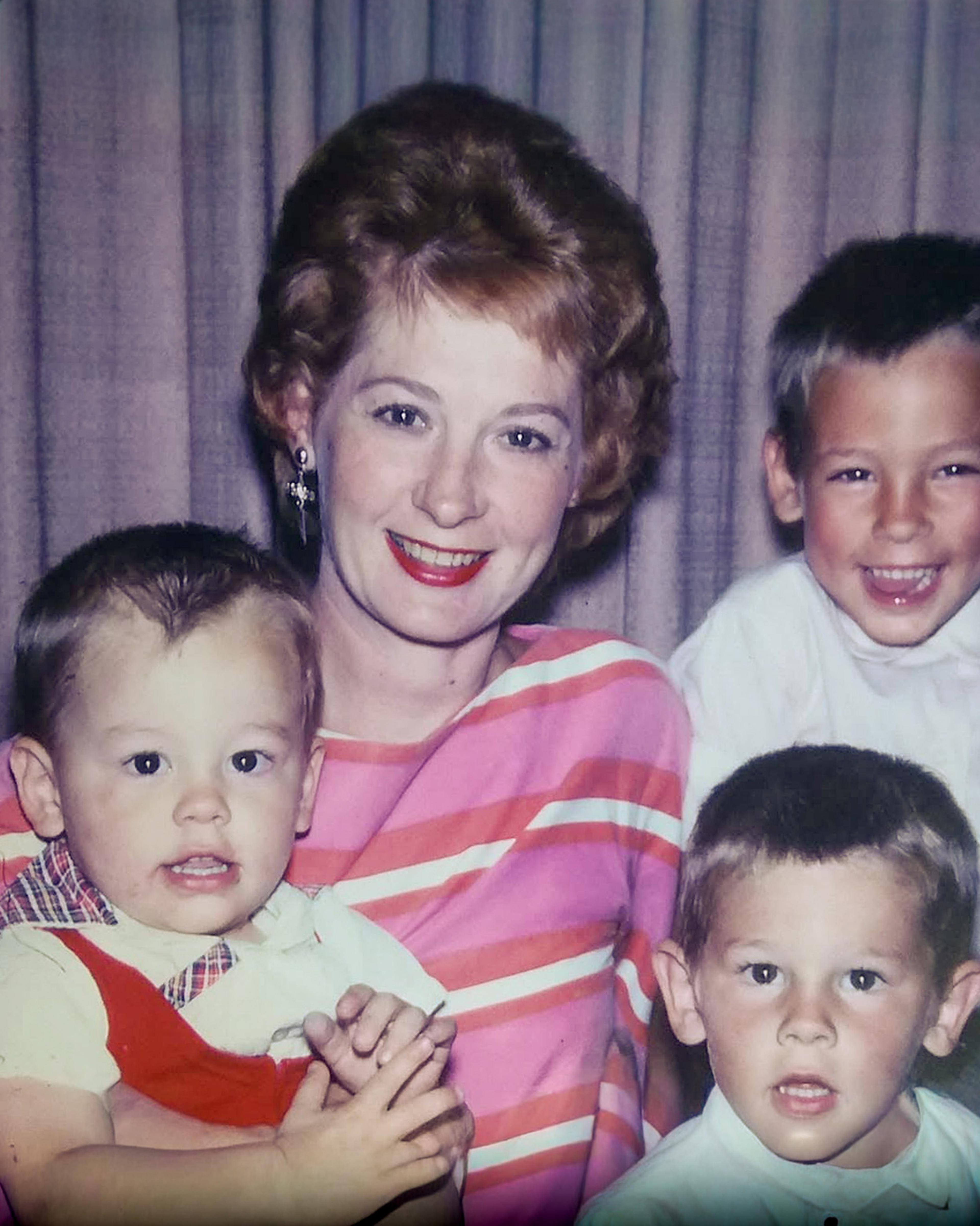
The author (top right) as a child with his mother and brothers, the family the essay describes.
In an essay for 1, the writer Joe Mullich goes back to the afternoon when, aged eight, he wrote a letter to Al Pacino for his mother. She wanted the actor to stop a conspiracy against her.
The household
His mother believed people were spying on her. One week it was an office mate at the US Postal Service she was sure worked for the CIA. Another time it was the neighbour, Mrs Bottomfield, whom she often threatened to kill. When things got bad she paced the patio and talked them through out loud. Her son paced alongside her and tried to change the subject.
The letters were her answer. She wrote to celebrities like Neil Armstrong, Walter Cronkite and Sean Connery and asked them to step in. At first the boy only proofread them. Over time he changed so much that she started dictating and left the writing to him.
How the translating worked
That day she found him reading "2" in 3. The word means using a big word when a small one would do. She decided Pacino, as "an artist", would understand it, and that it would show him they were serious. Then she talked, sometimes after 15 minutes of silence, in contradictory bursts. Mullich didn't take notes. He doodled. He had learned that her meaning was "in-between the words": in her tone, her pauses, the way her voice rose and fell.
On the page, one stray fact led him to another, and a connection appeared that he hadn't heard while she was talking. The finished letter was short. She was a single mother of three. Her co-workers were "getting in her business". Nobody was on her side. "All I want is what everyone wants, to be left in peace." He added the capitals and exclamation marks because he knew she liked how they looked.
She was amazed. "How did you know all that?" "You just told me." She squeezed his hand, which he says shocked him, because she wasn't affectionate. They mailed the letter from a box three streets away, chosen "for security reasons", to an A. Pacino he picked at random from the phone book. Then they went for ice cream.
What he took from it
Mullich calls those minutes perhaps the only real connection the two of them ever had. Writing kept him inside "the bubble of her madness" without being swallowed by it. He draws on 4: if you really see windmills as giants, charging them isn't foolish, it's survival. He argues that everything makes sense from the right angle. That afternoon, he says, he understood he was a translator, someone who hears both what people say and what they mean.
Joe Mullich's essay in 1 goes back to one afternoon in his childhood. He was eight, his mother's thoughts were spinning, and he sat in the family breakfast nook writing a letter to Al Pacino. She wanted the actor to rescue her from a conspiracy. It's a memoir, not an argument. Still, it makes a claim. Mullich argues that even a delusion has an inner logic you can reach if you listen hard enough, and that learning to reach it decided what kind of person he became.
A crisis a week
His mother saw a new crisis every week. In the week he describes, she was certain an office mate at the US Postal Service was a CIA operative sent to spy on her. At other times the threat was Mrs Bottomfield next door, a neighbour she often threatened to kill for spying. When the fear took hold she paced the patio and worked it through out loud. Her son paced with her and told her about his third-grade class, trying to pull her attention somewhere else. It usually didn't work.
She had her own fix: letters to famous people asking them to step in. Over the years she wrote to Neil Armstrong, Walter Cronkite, Sean Connery and many names the boy didn't know. At first he only proofread them. His corrections grew so large that she started dictating and let him do the writing. Mullich never says what illness she had. The essay describes her behaviour and leaves out diagnosis and treatment.
The magic word
That day began with a word. Mullich loved language even then, and he was reading the 2 feature "It Pays to Increase Your Word Power". Third on the list was "3": using a big word when a small one would do. He laughed. His mother read it over his shoulder and saw an opening. Al Pacino would understand that word, she said, because "he's an artist". If they used it in the letter, he would know they were serious. The boy ran to get his notebook. He always kept a supply of #2 pencils sharpened. He knew the minutes after one of her "walking fits" decided how the rest of her day would go.
How the translating worked
She sat gripping the edge of the table so hard her knuckles went white. Sometimes she said nothing for a few seconds, sometimes for 15 minutes. Then, in Mullich's words, "the dam burst". Thoughts came out in turbulent currents, often contradicting each other, which only made her more frantic.
He didn't write any of it down. He doodled. He had learned that her meaning "was never in the words themselves but in-between the words": in her tone, her pauses, her voice going up and down. While she spoke it sounded like radio static. The understanding came afterwards, when he sat down to write. One stray fact would stand out and lead him to a second, and a link would appear that he had missed in the noise. "In the middle of the tornado that was her mind lurked an eerily calm coherence," he writes, and he could reach it only "by listening and writing my way to its centre."
The finished letter shows what the translating did. It was short and urgent. It was a FEDERAL matter. They plotted against her. She was a single mother of three small children. The children's father, "mama's boy", did nothing. Pacino should use his connections. "All I want is what everyone wants, to be left in peace." It was signed "You Will Know", with a postscript telling Pacino he was very handsome. Mullich added the underlines, capitals and exclamation marks because he knew she liked how they looked.
Without her frantic voice, the plea made sense to him. She really did complain that co-workers were "getting in her business" and that supervisors ignored her. The letter didn't make the conspiracy true. It found the real grievance underneath it: feeling alone, unheard and pushed around at work.
Seeing herself on the page
When he read it aloud she asked, "How did you know all that?" He answered, "You just told me." She held the yellow legal paper like a Gideon Bible. Mullich suspects she didn't know what she thought until someone wrote it down, and that seeing it written showed her how big it was to her. She tipped her cigarette at him like a salute and squeezed his hand. That shocked him, because her usual touch was a jab in the jeans as one of her sons walked past, so they checked every narrow hallway before going in.
The rest of the afternoon had its own rules. In the phone book he found a list of Pacinos (A., Alberto, Albert) and picked one at random. She had him address it to "Senor" Al Pacino with a tilde, "He's Italian". She wrote "personal and confidential" on it, left off the return address, and walked to an "anonymous" mailbox three streets away. She was so happy she even waved at Mrs Bottomfield, who backed into her house. Then they went for ice cream at Thrifty. She told him not to tell his brothers: "They wouldn't understand like you do." "Another day, another secret," he writes.
What he takes from it
Mullich calls those letter-writing sessions the only times he and his mother shared the same reality, and perhaps the only true connection they had in his lifetime. He describes the arrangement carefully. The notebook let him stand inside "the bubble of her madness" without being consumed by it. The distance it gave him is what let her trust him, for a few minutes at least, since she couldn't trust anyone for long.
His key image comes from 4. If you really see windmills as giants coming to destroy you, charging them with a lance is survival, not folly. "Everything makes sense if you find the proper angle to view it from." He was a quiet child who liked to sit under tables and listen to adults. In that breakfast nook, he says, he saw what he was: a translator, someone who could hear both what people said and what they meant.
The essay leaves some things unsaid. It never asks what being the keeper of his mother's secrets cost him, or whether making her fears sound coherent ever made them worse. Readers will have to bring those questions themselves.
Remember
Mullich found his mother's meaning in her tone and pauses, not her words, and wrote nothing down while she talked.
Underneath the conspiracy, the letter found a real grievance: isolation and being ignored at work.
The notebook let him stay close to her without being pulled into her fears.
Historical photograph of Hawaiians eating poi, from the National Library of New Zealand.
Native Hawaiians descend from people who sailed from Easter Island, about 4,400 miles to the southeast. That is the conclusion of a new study in 1, led by Stanford geneticist Alexander Ioannidis. The same genetic evidence shows that Hawaii's long settlement route left its people with concentrated disease risks that medicine has mostly overlooked.
The voyagers
Hawaii is one of the most isolated places on Earth, and people have lived there for nearly a thousand years. They belong to the 2, seafarers who settled the scattered islands of the Pacific during Europe's Middle Ages. They had no metal tools, navigational instruments or writing, and passed their wayfinding knowledge down orally.
The team's earlier work had traced the expansion from Fiji and Tonga east to the Cook Islands, Tahiti and 3, then to Easter Island in the early 1200s. The new study adds one more step: Easter Island to Hawaii, the only Polynesian island group in the Northern Hemisphere.
How the route shows up in DNA
The key is the 4. A small group settling a new island carries only part of its home population's genetic variation. By chance, a rare variant can become common in the new community.
As an illustration (not from the study), a gene variant carried by 1 person in 500 might happen to be carried by one of 30 people in a canoe. In the new colony, that variant now sits at a few percent.
The researchers say two things made this especially strong in Polynesia:
New island populations grew quickly, so later arrivals couldn't dilute the founders' gene pool.
Each island was settled from the one before, so the genetic 5 stacked up.
"By the time you've gotten all the way to Hawaii, you're at the end of a series of founder effects, so it's really intense," Ioannidis said. He says the effect in Eastern Polynesians is more than ten times stronger than in well-studied European founder populations such as Finns and the Amish.
The medical cost
The team found three harmful gene variants that each occur in 2 to 4 percent of Native Hawaiians. They are linked to a dislocated eye lens, vision loss and kidney failure. Ioannidis notes there are no testing guidelines for these conditions and no insurance coverage, "because these are conditions we don't even know about." He argues the population deserves urgent attention from geneticists.
The Nautilus article is short. It doesn't give the sample size, the methods, or the specific genes. It also doesn't explain how Easter Island was distinguished from other long-proposed sources, such as the Marquesas and Tahiti.
A study published in 1 uses the genomes of living Native Hawaiians to work out where their ancestors came from. The answer is Easter Island, about 4,400 miles to the southeast. The same genetic record shows that the long chain of voyages behind Hawaii's settlement left its people with an unusually concentrated set of inherited disease risks. Medicine has barely started to look at them.
The work comes from a team of geneticists and anthropologists led by Alexander Ioannidis of Stanford University. Nautilus's write-up is brief, so it doesn't give the sample size, the methods, or the names of the genes involved. What follows is what the article reports, with general background added where the article assumes it.
A long way from everything
Hawaii is one of the most isolated island groups on Earth, with thousands of miles of open ocean on every side. People have still lived there for nearly a thousand years. They belong to the 2, a culture of long-distance voyagers who explored and settled the islands of the South and Central Pacific while Europe was in its Middle Ages. They did it without metal tools, navigational instruments or writing. Their wayfinding knowledge was passed down orally.
"Hawaii is the only Polynesian island in the Northern Hemisphere, so it's a long way from everything," Ioannidis said. That isolation is what makes the question of origins interesting.
Retracing the route
The team's earlier genetic work had already rebuilt the outline of the expansion. Polynesian peoples spread to Fiji and Tonga, then pushed east to the Cook Islands, Tahiti and 3, and reached Easter Island (Rapa Nui) in the early 1200s. The new study adds the last leg: the ancestors of Native Hawaiians came from Easter Island. That means Hawaii was settled at the far end of a long sequence of island hops, rather than directly from the central Polynesian islands.
How a route gets written into DNA
The method rests on the 4. When a small group leaves a large population to settle somewhere new, it carries only a sample of the parent population's genetic variation. By luck of the draw, a variant (an 5) that was rare back home might be carried by several of the founders. Once the new community grows, that allele can be common.
An illustrative example, not taken from the study: suppose an allele turns up in 1 in 500 people in a large population. A canoe carrying 30 settlers would usually include no carriers. But sometimes it would include one or two, and then the allele's frequency in the new colony jumps to a few percent at a stroke.
Two more factors made the effect especially strong in Polynesia, according to the team.
Rapid growth after settlement. Founding populations expanded quickly. That locked in the new gene pool, and later arrivals were too few to dilute it.
Compounding. Each island was settled by a subset of the previous island's people, so the 6 stacked. Hawaii's founders were a sample of Easter Islanders, who were a sample of Mangarevans, and so on back along the chain.
"By the time you've gotten all the way to Hawaii, you're at the end of a series of founder effects, so it's really intense," Ioannidis said. Because each population carries a distinctive pattern of narrowed variation, the sequence of bottlenecks can be read back as a route.
More than ten times stronger
The headline number is about scale. "In the Eastern Polynesians, such as Native Hawaiians, the founder effects are more than an order of magnitude, so more than 10 times, larger than what we have in the populations of European descent we've studied so well," Ioannidis said.
The comparison groups are the classic European founder populations, Finns and the Amish. Both have somewhat higher risks of particular genetic disorders, and both have been studied closely enough that those disorders are well catalogued. Finland, for example, recognizes a set of conditions known as its "disease heritage."
The medical cost
Native Hawaiians show the same pattern. The team identified three harmful alleles that occur at between 2 and 4 percent. The article calls this "slightly higher" frequency, though for a disease variant that is well above what is typical in large, mixed populations. The conditions linked to these alleles include a dislocated lens in the eye, vision loss and kidney failure. The article doesn't say which genes are involved or how the conditions are inherited.
The researchers argue that the problem is neglect rather than biology. "We don't have recommendations for genetic testing, and there's no reimbursement from insurance because these are conditions we don't even know about," Ioannidis said. "This is a population that should be getting research resources and attention from geneticists even more urgently."
The point is structural. Genetic screening guidelines, and the insurance coverage that depends on them, are built from studies of the populations that have been sequenced most, which are mostly of European descent. A founder population that hasn't been studied ends up with concentrated risks and no screening for them.
What's left open
The article leaves several questions unanswered:
How many people were sampled.
How the Easter Island link was distinguished from links to neighbouring islands such as the Marquesas or Tahiti, which have long been candidates for Hawaii's source.
Whether the study found any evidence of later contact or migration.
What exactly "more than 10 times larger" measures.
The Easter Island result is a bold claim about a long-debated question, and readers will want the paper itself before treating it as settled.
The underlying argument is clear, though. The genome of a voyaging people works as a historical record of their route, and the same process that wrote that record produced a medical blind spot that can be fixed.
Remember
Stacked founder events can act as a record: each island hop leaves a narrower, recognizable genetic signature.
Eastern Polynesian founder effects are reportedly more than ten times those of Finns or the Amish.
Genetic screening follows research attention, so understudied founder populations have concentrated risks that nobody screens for.
An artist's picture of Borges's Library of Babel: endless stacks of books with digital glitches.
Eight years ago, on a Mumbai panel called "Imagination Is an Algorithm," Henry Eliot was cast as the defender of human poetry. He was then an editor of 1. Across from him, the Israeli poet Eran Hadas read poems produced by software he was building. Eliot's trouble was that they weren't bad. They had arresting words and images. Still, they felt uncanny.
His answer then, sharpened in this Big Think essay: the poems were beautiful "in the way that a waterfall or a flower is beautiful." A poem is also communication. One mind sets down an insight and another revives it. Finding meaning in machine verse may be like seeing shapes in clouds. The question matters more now. A ChatGPT pastiche of William Carlos Williams that Eliot quotes is genuinely decent. The novelist Sarah Hall even put a "Human Written" badge on the cover of her 2025 novel Helm.
The fears are old
Eliot argues that fiction got here first:
E.T.A. Hoffmann's "The Sandman" (1816): a student falls for Olimpia, who turns out to be a clockwork doll. He had read her blank stare as adoration. It is the 2, the unease at the almost-human, before the phrase existed.
Mary Shelley's Frankenstein (1818): Victor tears up a mate for his creature because he fears his creations will breed and threaten humanity. Eliot compares this to Geoffrey Hinton, a pioneer of 3, the technique behind modern AI. Hinton left Google in 2023 to warn about the technology he helped build.
Samuel Butler's 4 (1872): written in the wake of Darwin, it contains a treatise warning that machines evolve faster than animals. "The servant glides by imperceptible approaches into the master."
George Eliot's 5 (1879): a character dreads having "too much of everything done in too short a time." He pictures a planet of "mute orations, mute rhapsodies… and no consciousness there even to enjoy the silence." In other words, machines writing for machines.
The library of everything
The image Eliot rates as most prescient is Jorge Luis Borges's 1941 story "6." It describes an endless library holding every possible book of a fixed length, made from 25 symbols. So it contains every truth, every lie and your own true obituary. Nearly all of it is gibberish, and there is no way to tell which is which. Its librarians wander in despair. Eliot sees it in today's endless feeds and the blurring line between true and false.
The argument
Eliot finds this reassuring rather than grim. Stories that name a fear make it easier to examine and make readers feel less alone. Fiction rehearses futures before we arrive in them. So, he concludes, human-written literature will stay essential. That conclusion is asserted more than argued. The tour itself is the stronger part of the essay.
Henry Eliot met his first machine-written poem eight years ago, at a bookshop in Mumbai. The panel was called "Imagination Is an Algorithm." One of the other panelists was the Israeli poet Eran Hadas, who was developing software to generate poetry. Eliot was then an editor of the 1 series, and he understood his role: to defend Keats, Rimbaud and Shakespeare against algorithmic word salad.
The problem, he writes in this Big Think essay, was that Hadas's poems weren't bad. They were sparse and barely punctuated, but they had evocative images, striking vocabulary and productive juxtapositions. They sounded like poems. Yet they were uncanny, and Eliot spent years working out why.
Beauty without a speaker
His answer at the time was that the poems were beautiful "in the way that a waterfall or a flower is beautiful." He has since sharpened the point. A poem is beautiful, but it is also communication. A poet crystallizes an insight, and a reader, perhaps centuries later, revives and reimagines it. An understanding passes between two people. With a machine poem, Eliot asks, is there anyone on the other end? Or is finding meaning in it "as one-sided as spotting shapes in the clouds"?
The question has grown harder because the output has improved. Eliot asked ChatGPT for a poem in the style of William Carlos Williams. He got "Rain at the Bus Stop": rain holding on the sleeve of a blue coat, then joining "the dark pavement / already / full / of sky." His verdict: "Not bad." Telling human from machine writing is now difficult enough that the novelist Sarah Hall put a "Human Written" badge on the cover of her 2025 novel Helm. Eliot likens it to a fair-trade label for provenance.
Two hundred years of rehearsal
Eliot's thesis is that literature has been working through these anxieties for at least two centuries. He builds the case chronologically.
The uncanny. In E.T.A. Hoffmann's 1816 story "The Sandman," the student Nathanael falls for the beautiful, oddly cold Olimpia. He takes her fixed gaze for adoration and her silence for modesty. She is a clockwork doll. Freud made the story central to his 1919 essay "The Uncanny." In 1970 the roboticist Masahiro Mori named the "2," the revulsion we feel at things almost but not quite human. Eliot says he slides into that valley reading the ChatGPT poem.
The creator's regret. In Mary Shelley's Frankenstein (1818), the assembled body Victor thought beautiful turns monstrous the moment it lives. Later he agrees to build his creature a mate, then tears it apart. He imagines the pair breeding "a race of devils" that would make humanity's existence "precarious and full of terror." Eliot compares Victor's about-face to Geoffrey Hinton. Hinton's work on artificial 3, the learning technique behind today's AI, later won him a Nobel Prize. In 2023 he left Google to warn about the risks. He told the BBC that GPT-4 already "eclipses a person" in general knowledge, and that its reasoning would improve fast.
Machines as a species. Darwin's On the Origin of Species (1859) and industrial automation fed into Samuel Butler's 1872 satire 4 (an anagram of "nowhere"). Its people use only simple tools. Five centuries earlier they destroyed their machines after a revolution inspired by The Book of the Machines. That treatise argued machines were evolving faster than animals and that "the servant glides by imperceptible approaches into the master." It asked: "Are we not ourselves creating our successors in the supremacy of the earth?"
Too much, too fast. George Eliot's last finished work, 5 (1879), includes a chapter called "Shadows of the Coming Race." In it, Theophrastus argues with his friend Trost, who welcomes a world where all labor is done by machinery. Theophrastus compares that future to fables of people with djinns at their command, forced to keep them busy, who "found too much of everything done in too short a time." Henry Eliot sees this in language models that give instant, plentiful, neatly formatted answers to any prompt. Theophrastus also fears machines that reproduce. By then, he predicts, dependent humans will have become "pale, pulpy, and cretinous." His closing image is a planet of beings "blind and deaf as the inmost rock" that carry out all the workings of language: "mute orations, mute rhapsodies, mute discussions, and no consciousness there even to enjoy the silence." Machines that can't feel, writing for machines that can't understand.
The library of everything and nothing
The essay's headline claim rests on Jorge Luis Borges's 1941 story "6." Borges imagines a universe built of identical hexagonal rooms full of books. Each book has 410 pages of 40 lines, each line about 80 characters drawn from 25 symbols, and no two books are alike. The library holds every possible combination.
The arithmetic shows why that is a nightmare. This is our illustration, not the essay's. One book holds 410 × 40 × 80 = 1,312,000 characters. With 25 choices for each, the number of distinct books is 25 to the power 1,312,000, roughly a 1 followed by 1.8 million zeros. Somewhere in there is "the minutely detailed history of the future," "the true story of your death," and thousands of false catalogues of the library alongside the one true catalogue. A book that differs from a true history by a single word is as likely to turn up as the real one. Almost everything is noise, and nothing marks which is which.
So the library is complete and useless. Its people dwindle to solitary librarians searching for meaning, many falling into despair or suicide. Eliot maps this onto endlessly refreshing social feeds and a fading line between true and authentic. That is the "slop" of the headline. The danger isn't a bad machine poem but an ocean of plausible text with no way to find the true parts.
Eliot's conclusion, and its limits
Eliot takes comfort from all this. Shelley, Butler, George Eliot and Borges have already named today's fears. Reading such stories makes us feel less alone, and fears "captured in words are more examinable and less overwhelming." Literature also adapts, rehearsing futures before we live in them. Hence his confidence that human-written literature will survive and stay essential, as "an exchange of understanding between human minds."
That is a hopeful claim more than a demonstrated one. The essay shows that writers anticipated these fears. It doesn't show why that guarantees a place for human writing once machine text is cheap and convincing. And spotting prophecy after the fact is always easier than it was at the time. The best part of the piece is the tour itself, and the clear distinction it draws between beauty and communication.
One coda: in June, Dan Shipper, CEO of the AI company Every, released an AI-generated 3D simulation of Borges's library that you can walk through and read. As Eliot notes, the history of your future you find there may well be one of the false ones.
Remember
Eliot's objection to machine poems is about communication, not quality: there may be nobody meaning anything.
Borges's library is the sharpest model of 'slop': every truth is in there, but it can't be found among near-copies.
Victorian writers feared machines that reproduce and evolve, decades before computers existed.
Blaise Agüera y Arcas, a longtime AI researcher at Google, argues in a Big Think essay that large language models have reopened a wound Descartes cut into Western thought almost 400 years ago.
The cut
In the 17th century, science could explain falling bodies but not life or mind. René Descartes solved this with his "1." He dropped two of Aristotle's three levels of soul: the nutritive soul of plants and the sensitive soul of animals. Plants and animals became clockwork that could be fully explained by mechanism. Only humans kept an immaterial, immortal rational soul, as the Church required.
This freed science to study almost everything. It laid the groundwork for Newton, Lavoisier and Darwin, and Pavlov later credited Descartes with the idea of the reflex. But it left a seam: how does an immaterial soul move a body? Agüera y Arcas says three monsters came through it. The first is the 2, a little man in the brain who needs a smaller one inside him, forever. The second is the ghost in the machine. The third is the zombie, a being who acts like us but has no inner experience.
Descartes' two tests
Descartes believed no machine could ever match two human abilities. One was general reason, which handles "all the occurrences of life." The other was language: parrots can say words without understanding them. For centuries he seemed right. "Good old-fashioned AI," rule-based systems programmed task by task, beat humans at narrow jobs but couldn't reason about new situations or talk meaningfully.
Large language models now pass both tests, the author argues. The 2021 "3" critique, which says these models stitch words together without meaning, repeats Descartes almost word for word. Agüera y Arcas says it was always more philosophical than evidential. It assumes that manipulating symbols can't produce meaning. Yet computers only shuffle ones and zeroes and brains only fire neurons. If that rules out meaning for one, it rules it out for the other.
The wider wound
He traces other puzzles to the same split:
the fantasy of a perfectly detached observer
the gap between facts and values
the ban on purpose in nature, despite biology saying a kidney's purpose is to filter blood
the rule against crediting animals with thought
the "4" of consciousness, which he says seems hard only because the zombie assumes dualism
He is careful not to overclaim. Language models don't work like brains and aren't people. His point is that "AI and minds share nothing" is now as shaky as the old idea that an immaterial essence separates humans from other animals. He ends with an appeal rather than a proof: treat intelligence as collective, and widen the circle of care.
Blaise Agüera y Arcas, a longtime AI researcher at Google, has written an essay for Big Think arguing that large language models have reopened a cut Descartes made in the 17th century. The cut divided matter from mind. In his account, it made modern science possible and also let in three "philosophical monsters" that still haunt our thinking about minds, human or artificial.
He opens with an image from Philip Pullman's The Subtle Knife, in which a blade cuts windows between worlds. The edges of those windows turn out to be wounds, and through them leak ghosts that prey on the living. Descartes' "1," he suggests, was a knife of the same kind.
The cut
In the early modern period, science, magic and religion all counted as "philosophy." As physics advanced, life and mind were the things it couldn't yet explain. How could mere matter feel, act on purpose, or reproduce?
Descartes answered by taking away two of Aristotle's three levels of soul: the nutritive soul shared by plants and the sensitive soul of animals. On his view, clockwork mechanisms explain plants and animals completely, with no animating spirit needed. Only humans kept a soul, Aristotle's rational one, which was immortal, immaterial and indivisible, as Church doctrine required. The author notes that this was partly prudence. Galileo had been persecuted, and when Julien Offray de La Mettrie extended the mechanism to humans in L'homme machine (1748), he published anonymously and still got in trouble once he was identified.
The deal paid off. Treating nearly everything as mechanism cleared the ground for Newton's physics, Lavoisier's chemistry, and a biology without "2," the idea that living things run on a special life force. That path led on to Lamarck and Darwin. Pavlov later credited Descartes with inventing the reflex, the idea that a stimulus reaches a response along a definite nerve pathway. That makes Descartes a plausible candidate for the first neuroscientist.
The three monsters
The cut left a seam. If the soul is immaterial, how does it receive what the senses report and move the body? Descartes pointed to "Gland H," which we now call the pineal gland. Agüera y Arcas jokes that the H might as well stand for 3: a little man in the brain pulling the levers, who would need a smaller man inside him, and so on forever. Drop the homunculus and keep dualism, and you have the ghost in the machine, Gilbert Ryle's 1949 mocking phrase for an immaterial mind. Banish both while granting that a body could still behave intelligently, and you get the zombie: a being identical to us outside but with no inner experience. He calls the three "a funhouse mirror image of the Holy Trinity."
Descartes' tests, and why they held so long
Descartes thought two things showed that humans were more than machines. The first was reason, which he called "an universal instrument." No machine could have enough specialised parts to cope with "all the occurrences of life." The second was language. Parrots can utter words but cannot show that they understand them.
For about 350 years, the author argues, this looked right. Early computers and "good old-fashioned AI" (4, rule-based systems programmed task by task) could beat humans at narrow jobs. They failed at what any person can do: reason about new situations and put words together to express a thought. Ada Lovelace's 1843 remark that a computer "can [only] do whatever we know how to order it to perform" seemed to stand. The AI winters of the 1970s and 1990s, periods when funding and enthusiasm collapsed, seemed to confirm it.
Large language models, he says, now do what Descartes ruled out: they perform arbitrary tasks in the language domain. The "5" objection echoes Descartes' parrot almost exactly. Agüera y Arcas notes it dates from 2021, when models were much weaker. Back then, chats with them were a Rorschach test: some people saw the "sparks" of intelligence, others only "embers," the titles of two 2023 papers on opposite sides.
His central move is that the objection "was always more philosophical than evidentiary." It rests on John Searle's 1980 claim that manipulating symbols (syntax) can never produce meaning (semantics). But any machinery manipulates symbols. A computer holds only ones and zeroes, whatever they encode. A brain holds only firing neurons, whatever they encode. If symbol manipulation rules out meaning in one, it rules it out in the other. So what do we mean by "meaning"? In a Cartesian world, he argues, meaning is ghostly by definition.
The wound's other forms
He traces several modern puzzles back to the same cut:
On that last point he grants Descartes something. A rule-following machine can't convincingly imitate an intelligent social being. If it could, we would have had Gemini, Claude and ChatGPT decades ago. Language models are not programmed task by task. They learn by generalising from examples and feedback, and interpretability work, which inspects a model's internal workings, often finds internal representations that mirror human ones. He cites work on brain-like vision networks, the "Platonic representation hypothesis" that different models converge on similar representations, and a 2026 study describing a "global workspace" in language models.
What he claims, and what he doesn't
He is careful about the limits. These models do not work the way brains do, and they are not equivalent to people. His claim is narrower: the dogma that human minds and AI share nothing is getting harder to defend, just as the idea of an immaterial human "essence" setting us apart from other animals always was.
His conclusion is more an appeal than an argument. He wants agency, purpose and value to come back into the world, not as one being's private endowment but as the basis for relationships of mutual understanding. Humanity, he writes, was never a crowd of self-contained souls but "a collective intelligence" whose growth depends on "its widening circle of care."
The essay doesn't tackle the hardest questions it raises. It does not say what meaning is once the ghost is gone, or how to tell real understanding from very good imitation. Nor does it engage the strongest current skeptics beyond the 2021 parrot paper. It works best as a diagnosis: much of today's AI argument repeats a 1637 argument without knowing it.
Remember
Descartes' tests for telling machines from humans were general reasoning and meaningful language, the abilities language models now display.
The argument that syntax can't produce meaning applies equally to brains, which also only manipulate signals.
He makes a narrow claim: AI isn't humanlike, but 'nothing in common' with human minds is no longer defensible.
The "blind spot": the scientist imagines standing outside the system being studied, with perfect objectivity, when in fact the observer is part of the world.
The fact-value gap: this assumes facts can be seen from "nowhere," Thomas Nagel's phrase for a perspective belonging to no one. He insists that rejecting the 6 does not mean relativism, which he says quietly assumes the same view.
The ban on 7, the idea that purpose has no place in nature. It sits badly with biology, which routinely says things like "one purpose of the kidney is to filter urea."
The anthropocentrism/anthropomorphism trap: we are told not to treat nature as existing only for us, yet also not to credit animals with thought or emotion. Bees that appear to play and elephants that seem to use name-like calls challenge the second rule.
The "8" of consciousness: David Chalmers' question of why physical processes come with subjective experience at all. The author argues it feels hard only because the zombie assumes a dualist universe.