Expensive Money, From CoreWeave to Brasília · Morning Gist
Tuesday, October 274 stories · 11 min
Expensive Money, From CoreWeave to Brasília
Today's edition looks at what borrowing really costs: an AI company paying 15%, a country stuck near 9% real rates, and who pays for retirement.
Picked from 30 new articles across 16 sources · arrow keys for other days
Today in 30 seconds
30s left
CoreWeave borrows at about 15% now that big tech's cash flow no longer covers AI spending, and it needs credit markets to stay open. story 1 ↓
Brazil's constitution locks in 90% of federal spending. That pushes up inflation, holds down saving and keeps real interest rates near 9%. story 2 ↓
Only about 14% of private-sector workers can get a pension, down from 45% in the late 1970s. A retiree argues for bigger, tax-funded Social Security. story 3 ↓
A son won a three-night family Monopoly game by betting everything on hotels. His index-investor father explains why one win proves little about risk. story 4 ↓
A retired couple in their 70s works out how to use a TIPS ladder to cover a possible Social Security benefit cut in the early 2030s.
1/4Net Interest· Marc Rubinstein· Oct 23
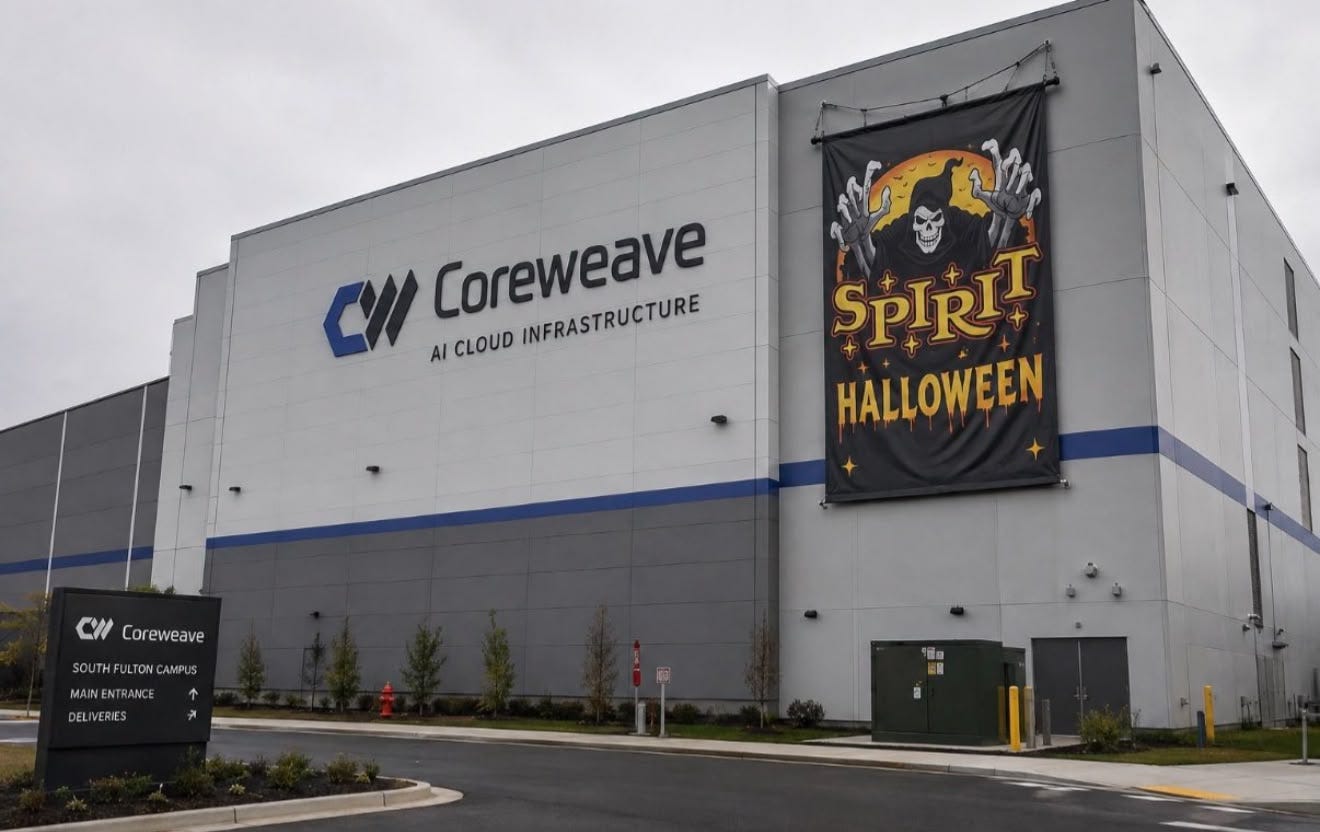
CoreWeave's 15% borrowing costs show strain in how AI gets funded
Marc Rubinstein argues that AI spending now depends on outside money. CoreWeave rents out AI chips with borrowed money, and its unsecured debt now yields 15%. That rising cost could break its business model.
Why it matters · If AI's buildout depends on cheap outside money, a company's cost of capital becomes a warning sign for the whole boom, and for investors exposed through index funds and credit.
Know this first
Context from the editor, not the article · 27 sec
1 · Capex versus cash flow
Capital expenditure (capex) is spending on long-lived assets like data centers. A company whose operating cash flow covers its capex funds itself. When capex runs ahead of cash flow, it has to borrow or sell shares.
2 · Spread lending
Banks and other lenders earn the gap, or spread, between what they charge borrowers and what their own funding costs. If funding costs rise faster than they can raise prices, profits shrink and growth stalls.
3 · Bond yields as signals
A bond's yield is the annual return investors demand to hold it. Safe companies with investment-grade ratings borrow at low yields. Yields in the mid-teens mean the market sees serious risk of default.
2/4Marginal Revolution· Tyler Cowen· Oct 26
Why Brazil's borrowing costs are among the world's highest
Tyler Cowen highlights an Economist analysis: Brazil's constitution locks in rising public spending, which keeps inflation stubborn and saving low. The result is a real interest rate of 9% or more, above Russia's.
Why it matters · It shows how rules about government spending can set a country's cost of capital, and with it what companies, homebuyers and governments pay to borrow.
Know this first
Context from the editor, not the article · 24 sec
1 · Real interest rate
The interest rate after subtracting expected inflation. A 15% loan when prices are expected to rise 5% costs about 10% in real terms. That real figure is what actually discourages borrowing and investment.
2 · Brazil's central bank
The Banco Central do Brasil (BCB) sets the country's benchmark policy rate, called the Selic. It raises the Selic to fight inflation, which raises borrowing costs across the economy.
3 · Who Milei is
Javier Milei, Argentina's president since late 2023, campaigned with a chainsaw and made sharp, fast cuts to public spending to bring down inflation. His name has become shorthand for radical austerity.
3/4HumbleDollar· R Quinn· Oct 26
A retired pension holder argues for higher Social Security, funded by higher taxes
HumbleDollar writer R Quinn says traditional pensions are mostly gone and many households save too little on their own. His fix is higher Social Security benefits paid for with higher taxes, which amounts to forced saving.
Why it matters · Whether to rely on personal accounts or on bigger mandatory programs shapes your future taxes, your benefits, and how much you need to save yourself.
Know this first
Context from the editor, not the article · 34 sec
1 · Two kinds of retirement plan
A defined benefit (DB) pension promises a set monthly income for life, usually based on salary and years of service. A defined contribution plan, such as a 401(k), promises nothing fixed. Its value depends on what goes in and how investments perform.
2 · Vesting
Vesting means you have earned a permanent right to employer-funded benefits. For private DB pensions, federal law allows up to five years before full vesting, or a gradual schedule of up to seven years. Workers who change jobs often may leave before they qualify.
3 · How Social Security is funded
Social Security pays retirement benefits out of a 12.4% payroll tax, split between employer and employee, on wages up to a yearly cap. Its trustees project that reserves will run out in the early-to-mid 2030s unless Congress raises taxes, cuts benefits, or does both.
4/4HumbleDollar· D.J.· Oct 27
A three-night family Monopoly game, and what it shows about risk
A HumbleDollar writer played a three-night Monopoly game with his family. His son, who spent nearly all his cash on hotels, crushed the cautious "index investor" parents. The writer explains why he still won't invest that way.
Why it matters · It's a simple case of a risky strategy winning in one setting, and it shows why one good result says little about how a strategy holds up in real markets.
Know this first
Context from the editor, not the article · 28 sec
1 · How Monopoly rewards concentration
In Monopoly, owning every property of one color doubles the basic rent and lets you build houses and hotels. Rent then climbs steeply. On the standard US board, Boardwalk's rent goes from $50 bare to $2,000 with a hotel.
2 · Behavioral finance
Behavioral finance studies how people's psychology, such as how much risk they can stand, overconfidence or the comfort of steady income, shapes their money decisions. Traditional economics tends to assume people decide purely rationally.
3 · Index vs. dividend investing
Index investors buy a broad slice of the whole market to spread out risk and let returns compound over time. Dividend investors favor companies that pay out steady cash, valuing the regular income over maximum growth.
Marc Rubinstein, who writes Net Interest, a newsletter about financial companies, argues that AI has become a financing story as much as a technology story. Through 2025, operating cash flow at the biggest tech companies more than paid for their capital investment. In 2026 it stopped doing so. Meta now says it may need to raise "hundreds of billions of dollars" of 1, meaning new shares, over several years starting as early as this fall.
This write-up covers only the free opening. The full analysis is paywalled.
Who gets the money first
Rubinstein holds up Elon Musk as the operator who treats capital access as a competitive weapon. SpaceX's initial public offering (2, its first sale of shares to the public) in June raised $85.7 billion. That strengthened its balance sheet enough to win 3 credit ratings, a signal of low default risk. SpaceX then sold another $25 billion of bonds. Rubinstein says the timing let it lock in money before competitors came looking for theirs.
CoreWeave, the counterexample
CoreWeave started in 2017 mining the cryptocurrency Ethereum in a garage. It pivoted to renting out 4, the chips that run AI models, after crypto prices collapsed in 2019. It now runs 51 data centers drawing 1.5 5 of power, leased to Microsoft, OpenAI and Meta. Its contracts have grown from 2.9 to 4.2 gigawatts since last November, and it expects to spend $35–39 billion this year building toward that.
Rubinstein argues that CoreWeave is really "a 6," a lender that doesn't take deposits and so lives on market funding. Its business is a spread: rent out GPUs for more than the money costs. To illustrate with made-up numbers, an 18% lease return is comfortable against 10% funding and thin against 15%.
The warning sign
Yields on CoreWeave's 7, which isn't backed by specific assets, have reached 15%, and its stock is falling. Rubinstein notes that CoreWeave's trouble started before the wider AI sector's. That makes its funding cost a gauge of the whole boom. Relying on markets, he writes, "works only for as long as they stay kind."
The free excerpt doesn't give CoreWeave's lease yields, debt schedule or customer concentration. Without those, a reader can't tell how close the spread is to breaking.
This is a write-up of the free opening of the essay. The full analysis of CoreWeave's economics is behind Net Interest's paywall.
The shift: AI now needs outside money
Marc Rubinstein, who writes Net Interest, a newsletter about financial companies, opens with a simple claim: AI is now as much a financing story as a technology story. Through 2025, operating cash flow at the largest tech companies more than covered their capital investment. In 2026 that stopped being true. Data centers and chips now cost more than these companies' businesses bring in.
Meta shows the scale of the shift. The company has said it will "need to raise hundreds of billions of dollars [of 1] over a period of several years beginning as early as fall 2026." Raising equity means selling new shares. A company that until recently paid for its own growth is now planning one of the largest fundraisings ever.
Musk as the model of capital access
Rubinstein holds up Elon Musk as the operator who saw this coming. SpaceX's initial public offering (2, its first sale of shares to the public) in June raised $85.7 billion of equity. Rubinstein calls the timing "perfect" because it locked in money before competitors went looking for theirs.
The raise did two jobs. It gave SpaceX a large cash pile. It also made the balance sheet strong enough to win 3 credit ratings, the ratings agencies' signal that a borrower is low-risk. With those ratings, SpaceX could sell another $25 billion of bonds. Rubinstein's view is that Musk treats access to capital as a competitive advantage. He builds a loyal investor base and knows how to use market machinery for his companies.
CoreWeave: a cloud company that works like a lender
CoreWeave is the counterexample. Mike Intrator, Brian Venturo and Brannin McBee founded it in 2017 to mine Ethereum, a cryptocurrency, in Venturo's grandfather's garage. After crypto prices collapsed in 2019, it pivoted to 4 cloud services. It buys graphics processing units, the chips that train and run AI models, and rents their computing power to others.
Today it runs 51 data centers in the US and Europe that draw 1.5 5 of power, leased to customers including Microsoft, OpenAI and Meta. Last November it had contracts to deliver 2.9 gigawatts. That figure is now 4.2 gigawatts, almost three times its current footprint. Getting there costs money: CoreWeave expects to spend $35–39 billion in 2026 alone, and it has to borrow much of it.
That is why Rubinstein calls CoreWeave "in effect, a 6," meaning a lender that doesn't take deposits and so depends on markets for funding. Its brand line is "The Essential Cloud for AI." Rubinstein argues its real job is to channel money from capital markets into GPUs. The business is a spread trade. If CoreWeave can lease new GPU deployments for more than its capital costs, the model works. If that gap shrinks, the model unwinds.
An illustration, with made-up numbers rather than the article's: say a GPU cluster costs $1 billion and earns 18% a year in lease income before other costs. With money at 10%, there is a healthy margin. With money at 15%, most of the margin is gone. Building more then adds risk faster than it adds profit.
The barometer is falling
This is where CoreWeave stands now. Yields on its 7, which isn't backed by specific assets, have reached 15%, and its share price is falling. Both of its main funding sources are getting more expensive at once. Rubinstein's warning comes from watching non-bank lenders through past cycles: "relying on the kindness of markets works only for as long as they stay kind."
He also argues that CoreWeave's trouble started before the wider AI sector's. That makes its spread a gauge of the whole boom. The company is so leveraged and so exposed to funding costs that markets price stress into it first.
What the free portion leaves open
The paywalled section promises to explain the economics of the AI boom through CoreWeave and to say "where the barometer is currently pointing." The excerpt doesn't give CoreWeave's actual lease yields, its debt maturities, how much of the 4.2 gigawatts is already funded, or how much it depends on any single customer. Without those, the reader can't judge how close the spread is to breaking. The opening quotes hint at how executives frame it. Intrator says markets sometimes "misunderstand and act irrationally." Morgan Stanley's Ted Pick says firms must respect "what the market will accept at a given time."
Remember
Since 2026, big tech's operating cash flow no longer covers AI capital spending, so outside funding decides who keeps building.
CoreWeave earns a spread between GPU lease income and its funding cost, the same way a lender does.
Funding costs at the most leveraged AI firms may show stress before the wider sector does.
Tyler Cowen at Marginal Revolution has highlighted an Economist analysis that explains Brazil's economic troubles as one chain of cause and effect. It starts with the public finances and ends with one of the highest borrowing costs in the world.
The headline number
Some analysts put Brazil's 1 at 9% or more. That is the central bank's policy rate minus the inflation expected over the next year. The figure is higher than Russia's, a country at war, and about four times the rate in comparable countries at peace, such as Chile, the Philippines and South Africa. A high real rate makes every loan, business investment and mortgage expensive. That is why the Economist calls it a "crippling cost of capital."
Step one: spending on autopilot
Brazil's constitution runs to 65,000 words, and two of its rules do most of the damage:
It bars cuts to 2 public-sector wages, meaning wages in currency terms before any inflation adjustment.
It links pension, disability and unemployment benefits to the minimum wage, which rises each year with recent inflation and GDP growth.
Together they act as a ratchet. Spending can go up but can't easily come down. Mandatory items now take up 90% of the federal budget, so lawmakers control only about a tenth of it.
Step two: inflation that feeds itself
Indexing benefits to past inflation keeps prices rising. Last year's inflation lifts the minimum wage, which lifts benefit payments, which puts more money into spending and keeps pressure on prices.
Step three: a country that doesn't save
Brazil's 3 is 14% of GDP, which is 12 percentage points below the world average. The article gives two reasons. Inflation has repeatedly eaten into bank balances in the past, so holding cash feels like a losing bet. A generous welfare state also pays for health care, schooling and pensions, so people have less reason to save for them. Most Brazilians earn little in a very unequal country, so spending income right away is the sensible choice.
How it adds up
When a country saves little, the government borrows heavily and inflation stays sticky, the central bank has to hold rates high, and lenders demand a large premium. The Economist's opening line says it would take "true Milei-like ardour," the fervour of Argentina's austerity-minded president Javier 4, to cut through this.
The excerpt is short. It doesn't give the current policy rate, the inflation figures or the analysts' sources, and it offers no reform proposals beyond that comparison.
Tyler Cowen at Marginal Revolution has highlighted a short passage from The Economist that sums up Brazil's economic problems as one causal chain. Spending rules written into the constitution drive up public spending. That spending keeps inflation stubborn and discourages saving. The combination gives Brazil one of the highest real borrowing costs in the world. The excerpt is brief, so this telling stays close to what it says and adds only general background.
The symptom: a very expensive cost of capital
The Economist says some analysts put Brazil's 1 at 9% or more. It defines this as the policy rate of the 2 (Banco Central do Brasil, the central bank) adjusted for next year's expected inflation. The real rate is what borrowing actually costs once you allow for the fact that debts get repaid in money that has lost value.
For comparison, the article says 9% is higher than Russia's real rate and about four times that of "peaceful peers" such as Chile, the Philippines and South Africa. These are middle-income emerging economies like Brazil, but without a war distorting their monetary policy.
Here is why that matters, using illustrative numbers that are not from the article. Suppose a Brazilian firm is weighing a factory expected to return 8% a year after inflation. If borrowing costs 9% in real terms, the factory loses money and doesn't get built. In Chile, where the real rate might be nearer 2–3%, the same project clears easily. Repeat that calculation across thousands of businesses and households and you get less investment, slower growth and costlier housing. The Economist calls this a "crippling" cost of capital.
Root cause one: a constitutional spending ratchet
The article traces the problem to Brazil's public finances, and through them to its 65,000-word constitution. It points to two provisions:
Nominal public-sector wages cannot be cut. Nominal means the figure in reais, before any inflation adjustment. Government pay can rise but not fall.
Pension, disability and unemployment benefits are tied to the minimum wage. The minimum wage is reset every year using recent inflation and GDP growth.
The second rule works like a ratchet. In a year of inflation or growth, the minimum wage rises, and every linked benefit rises with it automatically, without any vote. Because benefits are pegged to growth as well as inflation, they gain in real terms, not just keep pace with prices. Nothing in the mechanism ever lets them come back down. The Economist says this has pushed 3 to 90% of the federal budget. Elected governments therefore have real discretion over only about a tenth of spending, which makes it very hard to cut the deficit through ordinary budgeting.
Root cause two: inflation that perpetuates itself
The article says the same arrangement "perpetuates inflationary pressure." The general mechanism is 4. When payments are automatically adjusted for past inflation, yesterday's price rises are built into tomorrow's incomes and spending. A large, growing flow of government transfers, financed by borrowing, adds demand to the economy. The central bank then has to keep its policy rate high to hold inflation down. It is effectively leaning against the government's fiscal stance.
Root cause three: Brazilians don't save
The third link is saving. Brazil's 5 is 14% of GDP, 12 percentage points below the world average. The article gives three reasons it is rational for households to spend rather than save:
History of inflation. If price rises have regularly eroded your bank balance, holding money looks like a bad deal.
The welfare state covers the big-ticket needs. When the state pays for health care, schooling and pensions, there is less reason to build personal savings for them.
Low incomes. In a very unequal country, most people earn too little to put much aside anyway.
Low national saving matters for interest rates because saving is the pool of money available to lend. When the pool is shallow and the government is a large borrower, the government and private borrowers compete for scarce funds, and the price of those funds, the interest rate, goes up.
Putting the chain together
Read as a whole, the argument runs as follows:
Constitutional rules lock in rising spending.
That spending keeps inflation stubborn and requires heavy government borrowing.
Past inflation and a generous state discourage household saving.
Little saving plus heavy borrowing plus sticky inflation forces high real interest rates.
High rates choke investment.
Each link reinforces the others, which is why the Economist opens by saying it would take "true Milei-like ardour" to break the cycle. The reference is to Javier 6, Argentina's president since late 2023, who made sharp, fast spending cuts to tame inflation. The implication is that incremental reform won't be enough when 90% of the budget is constitutionally fixed.
What the excerpt leaves out
Cowen's post is a short quotation. Readers should know what it doesn't cover:
No current figures for the 7 (Brazil's benchmark policy rate), the inflation forecast, or the public debt level. The 9% real-rate estimate is credited only to "some analysts."
No discussion of other explanations for high Brazilian rates, such as credit-market structure, bank concentration or risk premiums tied to political uncertainty.
No reform agenda. The Milei comparison suggests the scale of change needed but not its content. Changing a constitution also needs supermajorities, which the article doesn't address.
Even so, the core argument is a useful general lesson. A country's interest rates reflect its fiscal rules and saving habits, not just central bank decisions.
Remember
Tying benefits to a minimum wage that rises with inflation and growth makes them grow in real terms every year.
When 90% of a budget is fixed by law, cutting deficits through ordinary budgeting becomes nearly impossible.
Low national saving and heavy government borrowing push up real interest rates for everyone else.
R Quinn retired with a traditional pension after decades at one employer. In a HumbleDollar forum post, he proposes something he wouldn't have backed ten years ago: raise Social Security benefits and fund them with higher taxes. He calls this a form of forced saving for people who won't save on their own.
Pensions are rare, and were never universal
A 1 pays a guaranteed lifetime income funded by the employer. Quinn cites Bureau of Labor Statistics data showing that only about 14% of private-sector workers can get one today, down from a peak of roughly 45% in the late 1970s. Government workers and many public colleges still have them.
He argues that losing pensions matters less than people think. Pensions reward staying with one employer for decades. Most workers change jobs so often that they barely become 2, meaning they barely earn a permanent right to a benefit.
The real gap: no accounts, small balances
Quinn worries more about people with no retirement savings at all. He cites the Federal Reserve's 3 for 2025:
Just over 45% of households headed by someone in their 20s have an IRA or 401(k).
That rises to above 53% in the 30s, 63% in the 40s, and slightly higher in the 50s.
Among households with an account, the median balance grows from $12,600 in the 20s to $250,000 in the 60s and 70s.
Households with no account aren't counted in those balances. Under the common 4, $250,000 supports about $10,000 a year.
People give several reasons for not saving: low income, competing bills, procrastination, low financial literacy, no workplace plan, and fear of investing. Quinn calls these "just excuses." He thinks everyone outside the poorest fifth can save something by paying themselves first, as if it were tax withholding.
Why he wants a public fix
Quinn predicts that widespread under-saving will lead to weaker consumer spending, higher taxes or borrowing to support poorer retirees, more poverty among seniors, and more reliance on family. "Pay now or society pays later," he writes.
The post gives no tax rate, benefit formula or cost. It also doesn't mention that Social Security already faces a funding shortfall: its trustees project reserves will run out in the early-to-mid 2030s.
Quinn asks readers for alternatives but discusses none. Common ones, not from the article, include automatic 401(k) enrollment, now required for most new plans; state auto-IRA programs for workers without a workplace plan; and mandatory personal accounts like Australia's. Each forces or nudges saving in a different way.
R Quinn retired after decades with one employer and still collects a traditional pension. In a forum post on HumbleDollar, a personal-finance site, he says something he wouldn't have said ten years ago: the US should raise Social Security benefits and pay for them with higher taxes. He calls this "a form of forced savings." His reasoning is that too many people don't save for retirement on their own, and society will pay for that later either way.
The decline of pensions
A 1 pays a fixed lifetime income that the employer funds and manages. Quinn cites Bureau of Labor Statistics data showing that about 14% of private-sector workers had access to one in 2025–2026. The share peaked at roughly 45% in the mid-to-late 1970s. Government workers and many public colleges still offer DB plans.
Some private pensions are still paying out. Quinn puts the number of retirees who get benefits from private-sector DB plans, including union plans, at 2.5 million to 3 million. Some of these are paid through annuities that plans bought from life insurers. Another ~926,000 retirees are paid by the 2, the federal agency that takes over failed single-employer plans and pays their benefits.
Quinn argues that losing pensions matters less than people assume. A pension pays off mainly for people who stay with one employer for decades, and few people do. He says the average job tenure is "barely enough" to become 3, meaning to earn a permanent right to a future benefit. (The article gives no tenure figure. For context, BLS has recently put median tenure at around four years, while federal rules let DB plans take up to five years to vest fully.) Someone who changes jobs every few years ends up with several small vested pensions or none.
The bigger problem, in his view
Quinn thinks the more serious issue is how few households have retirement accounts. Using the 4 (SCF), the Federal Reserve's household wealth survey, for 2025, he reports these shares of households with an IRA or 401(k):
Age of household head
Share with an account
20s
45%+
30s
above 53%
40s
63%
50s
a bit higher than 63%
Among households that do have accounts, the median balance rises from $12,600 in the 20s to $250,000 in the 60s and 70s. These medians exclude households with no account, so the typical balance across all households is lower. For someone in their 60s, $250,000 might fund about $10,000 a year under the common 5 of thumb. That is a supplement to Social Security, not a replacement for a paycheck.
He stresses starting early, because compounding does much of the work. Here is an illustrative example that isn't from the article. Investing $100 a month at a 6% annual return from age 25 to 65 grows to about $199,000 from $48,000 of contributions. Starting at 45 grows to about $46,000 from $24,000 of contributions.
"Just excuses"
People give several reasons for not saving: insufficient income, competing obligations, procrastination, limited financial literacy, no access to a plan, unexpected expenses, and fear of investing. Quinn dismisses them as "just excuses." He calls the lack-of-access reason "absurd." Except perhaps for the lowest-income fifth of households, he says, anyone can save something. His method is to save first and treat the money like tax withholding you never see. That means giving up some wants between roughly 20 and 65.
He predicts what widespread under-saving will cost:
weaker consumer spending
older workers staying in jobs longer, crowding out younger ones
more public borrowing or higher taxes to cover shortfalls
a heavier burden on working-age taxpayers
more poverty among seniors and more reliance on family, which drags down the next generation too
The proposal
Since many people either can't or won't save, Quinn wants Social Security to do more of the job: higher benefits funded by higher taxes. "Pay now or society pays later," he writes. The post stops there. It gives no tax rate, benefit formula or cost. It also doesn't address the program's existing gap: the Social Security trustees already project that reserves will run out around the early-to-mid 2030s, so any benefit increase would come on top of closing that gap.
Trade-offs and alternatives
Quinn asks readers for other ideas but doesn't discuss any himself. Common ones in US policy, none of them from the article, include:
Automatic enrollment. Under the 6, most new 401(k) plans must enroll workers by default. Research consistently shows that defaults raise participation sharply. This targets procrastination, which is one of Quinn's "excuses," without a mandate.
State 7. Programs such as CalSavers and OregonSaves enroll employees whose employers offer no plan. They exist because access to a workplace plan strongly predicts whether people save. That cuts against Quinn's view that the lack of access is absurd.
A bigger Social Security benefit has real advantages. It is inflation-adjusted, it lasts for life, and it doesn't depend on investing skill. The costs are that the payroll tax is regressive up to the wage cap and that the extra benefit can't be inherited. Quinn's post sets out the problem and a direction, and leaves the design questions unanswered.
Remember
Private-sector pension access fell from about 45% of workers in the late 1970s to about 14% today.
Median retirement balances reach only about $250,000 by the 60s, and that counts only households with accounts.
Quinn's proposal, more Social Security funded by more tax, gives no tax rate or cost.
D.J., a reader writing on the personal-finance site HumbleDollar, recently played a Monopoly game with his family that ran over three nights. He used it to think about 1: how temperament shapes the risks people take with money.
Three styles
He puts each player into an investing type.
The index investors. He and his wife bought single properties wherever they could, to have "pieces of the action across the board." Like an 2, this gives up the chance of a big win and relies on slow 3.
The property developer. Their older son collected full color sets and built hotels until he had only "a few fives and singles" left.
The 4. The younger son preferred railroads and utilities for their simple, steady income, and kept a 5.
Who won
The developer won. On nights two and three his hotels were almost impossible to avoid, and the rent drained everyone else's cash. The cautious players' properties didn't earn enough to pay those bills. D.J. notes that if the game had stopped after night one, the result might have been different. At that point his son was "definitely in a pickle," with no cash left.
The post doesn't explain the mechanics, but the standard rules make concentration pay. Owning a full color set doubles the rent and is the only way to build. A hotel on Boardwalk charges $2,000, compared with $50 for the bare lot. And the other players have to keep circling the same board, so over time they are almost sure to land there.
Why he isn't switching
D.J. says he has no second thoughts about his "lifetime of diversified index investing and modest spending." Monopoly is "only a game," he writes, and its rules undercut budgeting because spending depends on where the dice land, not on planning. High risk also isn't his temperament.
That fits basic investing logic. Real markets don't force customers onto your property, and a concentrated bet can fail for good. The developer's plan worked only because he survived the cash crunch after night one. It was one family playing one game, which shows what can happen, not what usually does.
The story comes from a reader post on HumbleDollar, a personal-finance site that favors cautious, low-cost investing. The author, D.J., played a Monopoly game with his wife and two sons that ran over three nights. He used it to think about 1: how a person's temperament shapes their choices about risk and reward. The post is short and informal. It reads as a reflection, not a study.
Three styles at one table
D.J. puts each player into an investing category.
The index investors. He and his wife bought single properties wherever they landed, so they had "pieces of the action across the board." An 2 works the same way in real life: it buys a little of everything, gives up the chance of a big win, and relies on 3 over time.
The property developer. Their older son played aggressively. He collected full color sets, then built house after house and hotel after hotel until he had only "a few fives and singles" left. D.J. says watching it made him nervous.
The 4. The younger son took a bit more risk than his parents but went after railroads and utilities. He liked their "simplicity and straightforward income" and didn't want to manage houses and hotels. He also held a good 5. A dividend investor does something similar, favoring companies that pay out steady cash.
What happened
The developer won. On the second and third nights his hotels brought in "oodles of cash flow." They were hard to avoid on any trip around the board, and the rent drained everyone else's cash. The cautious players' spread-out properties didn't earn enough to cover those bills.
Timing mattered. D.J. notes that if the game had ended after the first night, the result might have been very different. At that point the developer was "definitely in a pickle," with no cash left after all his building. Even so, he thinks that in a longer game the son's lead would only have grown.
Why the board rewards betting big
The post doesn't explain the game's mechanics, but the standard rules show why concentration wins. A full color set doubles the basic rent and is the only way to build. Each house raises the rent sharply. On the US board, Boardwalk charges $50 bare and $2,000 with a hotel, 40 times more. A set of scattered single properties can't come close to that.
Monopoly is also a closed loop. The other players have to keep moving around the same 40 squares, so over enough turns, landing on the developer's hotels is close to certain. His bet faced one main risk: running out of cash before the rent started coming in. That is the "pickle" D.J. saw after night one.
Why the lesson doesn't carry over
D.J. says he has no second thoughts about his "lifetime of diversified index investing and modest spending." He gives two reasons. First, Monopoly is "only a game," and its rules "often thwart things like budgeting." Spending there depends more on where the dice send you than on planning. Second, high risk and aggression aren't his temperament.
His wider point fits ordinary investing logic, though he doesn't spell it out. Real markets don't force anyone to keep landing on your property, and a concentrated bet can fail for good, not just for a while. One game, like one investor's lucky run, shows what can happen, not what usually happens. The real lesson from his table may be about survival. The developer's plan worked only because he scraped through the cash crunch after night one. In real life, plenty of concentrated bets don't make it that far.
What's left open
This is one family and one game, so it proves nothing about strategies. D.J. doesn't say what the dividend-investor son's railroads actually earned compared with the parents' scattered properties. He ends by asking other readers what they have noticed while playing.
Remember
Concentrated bets can win big where rules force others to keep paying you, as on a Monopoly board.
The winning son nearly went broke after night one; risky strategies have to survive cash crunches first.
One winning game is a single outcome, not evidence that a strategy is better on average.