Moon Flashes, Burning Trash, Old Scars · Morning Gist
Tuesday, October 135 stories · 16 min
Moon Flashes, Burning Trash, Old Scars
Today's edition has human eyes back at the Moon, heat shields riding along on a spacecraft as it burns up, and two careful medical studies about pain and pregnancy.
Picked from 37 new articles across 10 sources · arrow keys for other days
Today in 30 seconds
30s left
Artemis II astronauts saw meteoroids flash as they hit the Moon during a 54-minute eclipse, probably the faintest flashes anyone has seen by eye. story 1 ↓
In three trials with about 600 patients, anesthetic dripped through a thin tube made IUD insertion tolerable for 98.3% of them. story 2 ↓
Twelve student-built heat-shield capsules will pop out of a Cygnus cargo ship as it burns up and send back live data by satellite. story 3 ↓
Lab-grown human mini-brains exposed to acetaminophen developed normally. Gene changes seen at the highest dose had disappeared by a later check. story 4 ↓
A Landsat image shows Australia's Spider Crater. Its 'legs' are hard sandstone ridges left from a meteorite strike 600–900 million years ago. story 5 ↓
A 1,200-year-old burial in Latvia holds six people killed by bladed weapons, possibly in a Viking raid.
1/5Universe Today· Matthew Williams· Oct 11
NASA releases Artemis II crew's preliminary lunar science observations
NASA has published a preliminary science report from Artemis II, the April 2026 crewed flight around the Moon. Using photos, spoken notes and sketches, the four astronauts recorded impact flashes, the Sun's corona and far-side colours.
Why it matters · This is the first scientific record from human eyes near the Moon since Apollo, and it tests whether trained observers add anything that orbiters can't.
Know this first
Context from the editor, not the article · 29 sec
1 · The Artemis program
NASA's plan to return humans to the Moon. Artemis I (2022) flew an uncrewed Orion capsule around the Moon. Artemis II, launched 1 April 2026, carried four astronauts around the Moon and back without landing.
2 · Near side versus far side
The Moon always shows Earth the same face. The far side, often wrongly called the "dark side", gets as much sunlight as the near side but can't be seen from Earth. Its crust and surface differ noticeably from the near side's.
3 · Why astronauts still observe
Orbiters such as NASA's Lunar Reconnaissance Orbiter map the Moon in great detail. Human eyes adapt quickly, judge subtle colour and texture, and notice brief events like flashes that fixed instruments may miss or weren't pointed at.
2/5Scientific American· Oct 9
Anesthetic dripped through a thin tube eases IUD insertion pain in trials
Swedish gynecologist Helena Kopp Kallner tested squirting local anesthetic into the uterus through a soft 1.3 mm tube before fitting an IUD. Her trials found lower pain scores, and 98.3% of patients called the pain tolerable.
Why it matters · IUDs are among the most effective contraceptives, and fear of a painful fitting is a real barrier, especially now that more young women who've never given birth are choosing them.
Know this first
Context from the editor, not the article · 30 sec
1 · What an IUD is
An intrauterine device is a small T-shaped implant placed through the cervix into the uterus. Hormonal or copper versions prevent more than 99% of pregnancies and last for years, some up to eight or 10.
2 · Why fitting can hurt
The clinician grips the cervix, measures the uterus, then pushes an insertion tube through the cervix's narrow, sensitive upper opening and opens the device's arms inside. It takes under a minute, but that minute can be very painful.
3 · Randomized controlled trials
Patients are randomly assigned to the treatment or a comparison group, so differences in outcome can be credited to the treatment rather than to who chose it or to expectation. Randomized trials are the strongest standard evidence for whether a treatment works.
3/5NASA· Tara Friesen· Oct 9
NASA tests 12 heat-shield capsules by riding a trash ship back to Earth
On its way to burn up in the atmosphere, a Cygnus cargo ship full of space-station trash carried 12 small capsules. They will test new heat-shield materials and shapes for future Moon and Mars missions.
Why it matters · Heat shields are hard to test on the ground. Riding along on a ship that is already being destroyed gets real flight data cheaply and could speed up shields for Mars and Titan.
Know this first
Context from the editor, not the article · 29 sec
1 · Why re-entry is so hot
A spacecraft returning from orbit hits the air at around 7–8 km per second. The air ahead of it is squeezed and heated to thousands of degrees, so a heat shield has to absorb or carry away that energy.
2 · How heat shields work
Some shields, like the space shuttle's ceramic tiles, insulate and survive. Others, called ablators, char and wear away on purpose, and the lost material carries heat off. Ground facilities can't fully recreate real flight conditions, so actual flight data is valuable.
3 · Cargo ships as disposal
Northrop Grumman's Cygnus delivers supplies to the International Space Station. Crews then fill it with waste, and it is steered into a planned re-entry where it breaks up and burns over remote ocean.
4/5The Transmitter· Jill Adams· Oct 13
Lab-grown mini-brains show no clear harm from acetaminophen exposure
A new study treated lab-grown human brain tissue, at a stage matching the late first trimester, with acetaminophen (Tylenol). Growth, structure, cell types and synapses showed no measurable effect.
Why it matters · Population studies can find links but can't show cause. This study looked directly at living human tissue for a way the drug could harm the developing brain, and found none.
Know this first
Context from the editor, not the article · 30 sec
1 · The Tylenol–autism dispute
Some observational studies linked acetaminophen use in pregnancy to autism, and in 2025 US officials promoted the link. Large sibling-comparison studies, such as one of about 2.4 million Swedish children, found no association once family factors were controlled.
2 · What brain organoids are
Organoids are small 3D clusters of tissue grown from human stem cells. Cortical organoids self-organize into layers of neural progenitor cells and neurons that roughly mirror the early fetal cortex. That lets researchers test exposures directly on human tissue.
3 · Correlation versus mechanism
5/5NASA· Oct 13
Landsat image shows Australia's Spider Crater, a worn-down ancient impact scar
On September 20, 2026, NASA's Landsat 9 satellite photographed Spider Crater in Western Australia. Its spider-shaped core is the eroded remains of a meteorite impact. Geologists confirmed the impact from shock-fractured rock found in the field.
Why it matters · Earth erases most of its craters, so the few that survive, and the shock clues used to tell them apart from volcanoes, are rare evidence of ancient impacts.
Know this first
Context from the editor, not the article · 29 sec
1 · Earth hides its craters
Erosion, plate tectonics and sediment burial wipe out most impact craters on Earth. Fewer than about 200 are confirmed. Old ones often survive only as their deep, eroded roots, which can look like volcanic or folded rock.
2 · How big craters form
In a large impact, the shock wave digs out a bowl that can't hold its shape. The floor rebounds upward like a splash, leaving a raised central uplift with collapsed rim zones around it. Geologists call this a complex crater.
3 · Proving an impact
Only shock pressures far above anything volcanoes produce leave certain marks in rock: cone-shaped fractures called shatter cones, and microscopic deformation in minerals such as quartz. These are the accepted fingerprints of an impact.
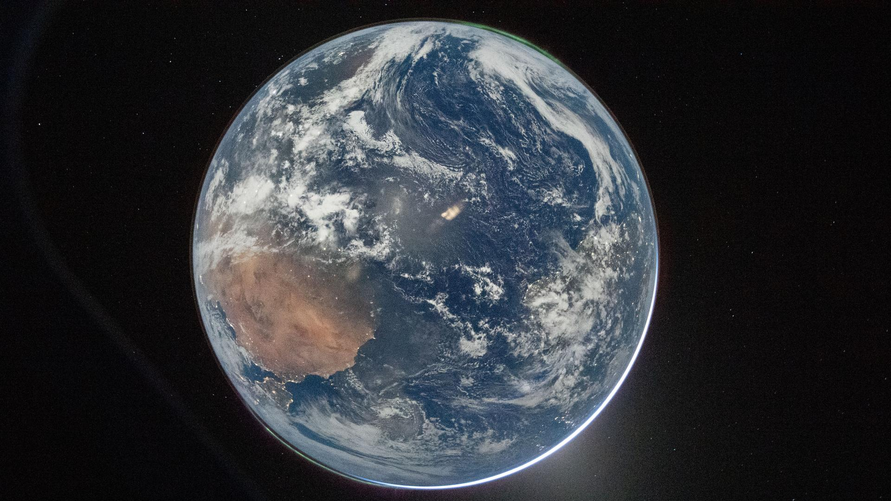
Earth's night side on 2 April 2026, showing weather, auroras and city lights in one frame.1 / 3
NASA has released the preliminary lunar science report from 1, the crewed flight that looped around the Moon in April 2026. Astronauts Reid Wiseman, Victor Glover, Christina Koch and Jeremy Hansen spent 9 days, 1 hour and 32 minutes in the Orion capsule Integrity. Throughout the flight they recorded what they saw in photographs, spoken descriptions, drawings and annotations. NASA has now made that record public, presented as a field guide called Sights & Sounds of Science.
A 54-minute eclipse
As Orion passed behind the Moon, the Moon blocked the Sun completely for 54 minutes. A total eclipse seen from Earth lasts a few minutes at most. This gave the crew almost an hour to watch the 2, the Sun's outer atmosphere and the source of space weather, as its shape changed. With the Sun hidden, they could also see 3, sunlight scattered by interplanetary dust, along with stars, Mars, Saturn and the Milky Way.
Impact flashes
The Moon has no atmosphere, so small meteoroids strike its surface at full speed, and each impact gives off a brief flash. Scientists had asked the crew to watch for these during the eclipse, and they recorded some on video. Judging by their brightness, the impactors were no bigger than about 5 cm across. These are probably the faintest impact flashes anyone has seen with the naked eye. Apollo crews also reported flashes, but nobody has watched for them from near the Moon since then. Counting how often impacts happen matters for protecting future surface habitats and vehicles from strikes and the dust they throw up.
Colour and shadow
The crew reported grey, brown, tan, white, green and blue tones on the far side. Blue indicates titanium-rich volcanic rock, brown iron-rich rock, and green volcanic glass or melted surface material. Scientists will compare these handheld observations with images from NASA's Lunar Reconnaissance Orbiter, which maps the Moon from orbit, to learn how viewing angle changes the Moon's apparent colour and texture. The astronauts also studied the 4, the line between day and night, where low sunlight casts long shadows. Glover described "islands of terrain" completely surrounded by darkness.
What it is and isn't
This is a preliminary report built mostly from what the crew saw and photographed, not from dedicated instruments. Its findings are qualitative. The impact-rate estimates and colour comparisons still need full analysis. Next comes Artemis III, planned for 2027, which will practise docking with a lunar lander in orbit. A landing is planned on Artemis IV in 2028.
NASA has released the preliminary lunar science report for 1, the first crewed flight around the Moon since the Apollo era. The report is published as a field guide, Artemis II: Sights & Sounds of Science, with the full set of reports and some data posted alongside it. It collects what the four astronauts recorded during their 9 days, 1 hour and 32 minutes in space: photographs, spoken observations, drawings and annotations.
The crew launched on 1 April 2026 on NASA's Space Launch System (SLS) rocket. Reid Wiseman, Victor Glover, Christina Koch and Canada's Jeremy Hansen rode in the Orion capsule named Integrity. The flight was not a landing. It was a crewed shakedown of the hardware, and a science opportunity that had not existed for more than 50 years.
Why send people to look?
Robotic orbiters already map the Moon in fine detail. The case for astronauts as observers rests on what human eyes do well. They adapt quickly from bright to dark, they pick out subtle differences in colour and texture, and they catch brief events such as flashes of light that a camera might not be pointed at. Most of this report should be read with that in mind. It is a record made by trained people, not readings from dedicated instruments.
Earth from a distance
On day 2 the crew photographed Earth's night side. NASA's scientists point to how much one frame contains: active weather systems, auroras at both poles, distinct atmospheric layers, a Saharan dust plume, 2 and city lights. Earth-observation satellites mostly image the planet in strips as they pass over, so a single view of the whole globe at once is useful in a different way. According to the article, the Earth's face in this image was lit by the Moon rather than the Sun. Koch said Earth looked "electric blue" rather than the deep royal blue seen in photographs.
An hour-long eclipse
The standout event came as Orion passed behind the Moon on 6 April. The Moon covered the Sun completely for 54 minutes. On Earth, totality lasts a few minutes at most, because the Moon's shadow moves quickly across the ground. Orion was close to the Moon and moving slowly relative to its shadow, so the eclipse lasted far longer.
That gave the crew nearly an hour to watch the 3, the Sun's thin outer atmosphere. From Earth the corona is usually seen only during brief eclipses or with specialised instruments called coronagraphs. The corona drives space weather, the outflow of charged particles that can disrupt satellites and endanger astronauts. The crew watched its shape and structure change over the hour. With the Sun blocked, they could also see zodiacal light, a faint glow from sunlight scattered by interplanetary dust, plus a clear sky of stars, Mars, Saturn, galaxies and the Milky Way. Hansen remarked that the stars seemed to have depth, appearing nearer or farther according to their brightness.
Counting impact flashes
The Moon has no atmosphere to burn up incoming meteoroids, so even small ones hit the surface at full speed. Each impact releases enough energy to melt a small patch of ground and throw up a plume of 4, the loose dust and rock that covers the surface. It also produces a brief flash of light. Telescopes on Earth occasionally catch these flashes, and Apollo astronauts reported seeing them from lunar orbit.
The science team planned ahead for the eclipse. Inside the Moon's shadow the surface was dark and the Sun's glare was gone, the best possible conditions for spotting faint flashes. That stretch also coincided with a planned loss of communications. The crew filmed the flashes and sent the video afterwards to the Lunar Science Team at NASA's Johnson Space Center in Houston.
Based on the flashes' brightness, scientists estimate the impacting objects were no more than about 5 cm (2 inches) across. Even objects that small hit fast enough to be visible from space. These flashes were likely the faintest ever seen with the naked eye. The practical value is statistical. Each recorded flash helps pin down how often impacts of a given size happen, and that affects how future habitats, landers and ascent vehicles must be shielded, from direct hits and from the dust they kick up. The article does not say how many flashes were recorded or give a rate estimate. That analysis appears to be still to come.
Reading the far side's colours
Samples returned by China's Chang'e-6 mission from the far side have shown that the Moon's two hemispheres had different geological histories. The Artemis II crew studied the far side with handheld cameras and paid attention to colour. They reported grey, black, brown, tan, white, green and blue. The report links these tones to composition:
Blue: titanium-rich volcanic rock
Brown: iron-rich rock
Green: volcanic glass or regolith melted by impacts
Scientists will compare the crew's observations with data from NASA's 5, a spacecraft that has mapped the Moon from orbit since 2009. The aim is to learn how colour, tone, brightness, contrast and texture change with viewing angle. That knowledge could help future crews interpret the geology around them and spot possible resource sites.
Along the 6
The crew also studied the terminator, the boundary between lunar day and night. There the Sun sits low, so long shadows make relief stand out. The article says these lighting conditions resemble those around the South Pole–Aitken Basin, where NASA, China and others plan to build habitats. Craters and peaks miles deep and high showed in sharp relief along the Moon's edge, or 7, especially when the Sun backlit it during the eclipse. Glover described "islands of terrain out there that are completely surrounded by darkness," a sign of steep local variation in height.
What remains open
The report is explicitly preliminary, and most of it is qualitative: descriptions, images and sketches rather than calibrated measurements. Its most quantitative claims, the size of the impactors and what the colours mean for composition, depend on comparisons and modelling that are still to be done. The impact data may be the most consequential result, but its value depends on how many flashes were captured and how well their brightness can be calibrated, and the article does not report either.
NASA says the results are already feeding into planning. Artemis III, scheduled for 2027, will practise docking and crew transfers between Orion and a 8, the lander vehicle, in Earth orbit. Artemis IV, planned for 2028, is meant to land astronauts on the Moon.
Remember
Seen from behind the Moon, the eclipse lasted 54 minutes, far longer than any totality seen from Earth.
The impacting meteoroids were estimated at under 5 cm across, probably the faintest impact flashes ever seen by eye.
The findings are mostly qualitative observations; impact rates and colour-composition links still need full analysis.
Helena Kopp Kallner, a gynecologist at Sweden's Karolinska Institute, has tested a simple way to cut the pain of having an 1 fitted. She described the work on Scientific American's Science Quickly podcast. Before the device goes in, she slides a soft plastic tube into the uterus and fills it with local anesthetic.
The problem
IUDs prevent more than 99% of pregnancies and can stay in place for years. Fitting one can still hurt. The clinician grips the cervix with a clawed instrument called a 2, measures the uterus with a probe, then pushes the insertion tube through the 3, the sensitive upper opening of the cervix. Inside the uterus the device's folded arms spring open and are pushed into place.
The usual remedies have weak support. Ibuprofen or paracetamol taken beforehand doesn't prevent insertion pain in trials, though it helps with pain afterward. A 4, meaning anesthetic injected with a needle beside the cervix, is painful in itself. Kopp Kallner thinks this pain was overlooked because it is brief, and because IUDs used to go mostly to women who had already given birth, who tend to feel less pain. Now many go to young women who haven't.
The method
A catheter 1.3 mm wide and soft enough to bend double carries 10 milliliters of 5, a local anesthetic, into the uterus. The fluid flows back out through the cervix and pools in the vagina, so the cervix sits in it too. The tenaculum is then attached to that soaked tissue, which may numb it as well, though this hasn't been studied much.
The evidence
A pilot trial of about 80 patients used a weaker concentration and came out "near significance," meaning the result fell just short of statistical significance. A larger trial with a stronger dose found clear benefit. Patients marked their pain in real time on a 6, a 10 cm line running from no pain to the worst imaginable. Pain scores fell, and 98.3% of patients rated the pain tolerable.
Across three randomized trials of about 600 people, Kopp Kallner reports consistent results and no rise in infection or other complications. On that basis she argues clinicians can adopt the method now.
What's missing
The interview gives no average pain scores, no figures for the comparison group, and doesn't say what that group received. Without those, the size of the benefit can't be judged here. The full paper is the place to check.
Helena Kopp Kallner is a professor at Sweden's Karolinska Institute and a senior consultant in obstetrics and gynecology at Danderyd Hospital. She has led trials of a low-tech fix for a common complaint, the pain of having an 1 fitted. In an interview on Scientific American's Science Quickly podcast, she described the approach. Before the device goes in, the clinician threads a thin, soft catheter into the uterus and floods it with local anesthetic. She reports that across roughly 600 randomized patients the method lowered pain scores and raised the share of patients who found the procedure tolerable to 98.3%.
Why IUDs, and why the pain matters
IUDs are small T-shaped devices placed in the uterus through the cervix. Hormonal versions release a progestin. Copper versions release copper ions that hinder sperm movement and fertilization. Both prevent more than 99% of pregnancies. A copper IUD placed within five days of unprotected sex also works as emergency contraception, more than 99% of the time. Kopp Kallner calls them "fit-and-forget": nothing to take daily or monthly, and some models last eight to 10 years. Hormonal IUDs also tend to make periods lighter and less painful. Those traits make them a good fit for young, highly fertile women who don't want to become pregnant soon.
The catch is the fitting. The U.S. Centers for Disease Control and Prevention now recommends that clinicians talk with patients about pain relief before insertion. Yet there is little agreement on what works.
Where the pain comes from
Kopp Kallner walks through the standard procedure:
A holds the vaginal walls apart so the cervix is visible. In the U.S. the cervix is often swabbed with antiseptic.
With a skilled provider the whole sequence takes less than a minute. In her words, "it can be a very painful minute."
Why existing options fall short
The most common approach worldwide is ibuprofen or paracetamol taken beforehand. Kopp Kallner says many trials have shown it doesn't prevent insertion pain, though it does help with pain afterward. The next most common option is a 5, an anesthetic injected with a needle into the tissue on both sides of the cervix. Studies show the injection itself hurts, so many gynecologists and midwives save it for patients they expect to struggle. Other choices include anesthetic creams, conscious sedation and general anesthesia.
She offers two reasons the problem was neglected. The pain is brief, so it was easy to dismiss. And IUDs used to be given mostly to women who had finished having children. Women who have given birth, especially vaginally, report less insertion pain. Recent trials of other remedies have found them either ineffective or painful in themselves. Kopp Kallner argues that clinicians who favor untested methods may be offering patients a placebo, and that "women deserve a method that has actually been proven to be effective."
The method
The idea came from her own clinic, where she fits many IUDs for young women with severe period pain, some of them autistic. She wanted something simple.
The catheter is 1.3 mm wide and soft enough to bend in any direction. She shows it to patients still in its package to reassure them. It is attached to a syringe holding 10 milliliters of 6, a local anesthetic in the same family as lidocaine. The catheter slides through the cervix into the uterus and the anesthetic is injected, with no needle involved. The fluid runs slowly back out through the cervix and pools in the vagina, so the cervix sits soaking in it. The tenaculum is then clipped onto that soaked tissue. Kopp Kallner suspects this numbs the cervix too, but says it hasn't been studied much.
How the evidence built up
Pilot trial (~80 patients) used a lower mepivacaine concentration. The result came close to statistical significance but missed it, which she called "so annoying." The pilot also showed that placing the device was by far the most painful step. Later trials therefore stopped scoring pain at the tenaculum and sounding steps.
Larger trial used a higher concentration and found the method worked.
Overall, she says three trials with about 600 randomized participants have produced consistent findings, with no complications and no rise in infection risk.
Pain was measured in two ways. The first was a 7 (VAS), a 10 cm line with no pain at one end and unimaginable pain at the other. Her example for that end: having your legs sawn off with a rusty saw and no anesthesia. Patients held the sheet during the procedure and marked it on cue at each step. That captures pain as it happens rather than as remembered afterward. The second was a simple question: was the pain tolerable? Kopp Kallner argues this is the outcome that matters most to patients. Pain scores went down, and the share answering "tolerable" rose to 98.3%. She adds that she was citing that figure from memory ("I think it was").
What the interview doesn't tell us
This is a podcast conversation, not the paper. It does not name the journal and gives no average VAS scores for either group. It doesn't say what the comparison group received, whether a placebo flush, nothing, or another drug. It gives no tolerability rate for the comparison group, which is what would show how much 98.3% is an improvement. It is also unclear whether the 600 participants include the pilot, and whether all three trials came from the same team or hospital. Independent replication elsewhere would strengthen the case.
Kopp Kallner's position is clear. She considers the evidence sufficient and wants clinicians to adopt the method now. She also urges patients to ask for it, because "doctors are hard to convince to try something new." Readers who want to judge the size of the effect should go to the published trials.
Remember
Pills like ibuprofen taken beforehand don't prevent insertion pain in trials, though they help with pain afterward.
The anesthetic goes in through a soft tube with no needle, avoiding the pain a paracervical block injection causes.
The interview gives no numbers for the comparison group, so the size of the benefit can't be judged here.
A KREPE-3 capsule floating inside the Cygnus XL cargo ship before undocking; it carries a 3D-printed heat shield.1 / 2
NASA is testing future heat shields on a ship full of garbage. When Northrop Grumman's 24th cargo mission left the International Space Station this month, its 1 XL spacecraft carried station trash and 12 small experimental capsules. The ship is meant to burn up in the atmosphere. The capsules are meant to eject as it breaks apart and report how their heat shields perform.
Why do it this way
Re-entry heats the air around a spacecraft to thousands of degrees. Ground facilities can't fully reproduce that, and dedicated test flights are expensive. The experiment, 2 (Kentucky Reentry Probe Experiment, the third in a series), gets flight data cheaply by riding a vehicle that is already coming down. "We're essentially hitching a ride," said Ames Research Center engineer Keith Peterson. It is led by the University of Kentucky with NASA and partners. Funding comes partly from 3, a NASA program that supports research in states that get less federal science money.
How it works
Astronauts switched the capsules on before undocking. University of Kentucky students designed the capsules, which carry sensors for temperature, pressure, motion, magnetic field and light. They relay data by satellite during the descent, so the readings get back even if the capsules don't.
What's on board
Caveats
This is a launch announcement, not a result. No data has been released, and NASA's claims about MERINO describe its design goals, not flight findings. The capsules are small, and their trip down from Earth orbit is gentler than a return from the Moon or a landing on Mars or Titan. Applying the results to full-size shields will depend on the same computer models some capsules are there to test.
When Northrop Grumman's 24th cargo mission for NASA left the International Space Station in October 2026, it carried two loads: a hold full of station trash and 12 small experimental capsules. The cargo ship, a 1 XL, was headed for a planned, destructive re-entry. The capsules were built to eject as it broke apart and report how their heat shields held up on the way down.
The experiment is called 2, short for Kentucky Reentry Probe Experiment. It is the third in a series run by the University of Kentucky with NASA, the state of Kentucky, and federal and commercial partners. Funding comes partly through NASA's Established Program to Stimulate Competitive Research (3), which supports research in states that receive less federal research money. The article doesn't describe the first two KREPE flights or what they found.
The problem: testing shields is hard
A spacecraft coming back from orbit, or faster from the Moon or Mars, compresses the air in front of it until that air is thousands of degrees hot. Engineers can test materials on the ground in plasma wind tunnels, but no single facility reproduces the full mix of heating, pressure, tumbling and chemistry of a real descent. Flight data closes that gap, and it is normally very expensive to get.
KREPE avoids most of the cost by using a re-entry that is already happening. "We're essentially hitching a ride on a vehicle that's already coming back to Earth," said Keith Peterson, a materials engineer at NASA's Ames Research Center in California.
How the experiment works
Before Cygnus undocked, astronauts loaded it with waste and switched on the capsules. University of Kentucky students designed the capsules, which carry sensors for temperature, pressure, motion, magnetic field and light. When the cargo ship breaks up, the capsules are released and fall on their own. As they fall they relay their readings through satellites in real time, so researchers get data even though the capsules aren't recovered. The article doesn't say what happens to them afterward. Live relay matters because a capsule that burns up or is lost at sea can still return its measurements.
What's flying
The 12 capsules split into two groups. Some test materials. Others test shapes and the computer models used to predict re-entry.
What we know so far
So far, nothing. The article reports a launch of the experiment, not results. No temperatures, pressures or performance comparisons have been released yet. Statements that the materials are "more flexible, faster to produce, and less expensive" are NASA's own descriptions, not findings from this flight. Any data will also need analysis before it shows anything firm.
Trade-offs and open questions
The approach is cheap, but it has limits. The capsules are small, and Peterson frames the data as insight into how larger shields might behave. That means scaling up from them relies on the same computer models some capsules are there to test. A trip down from low Earth orbit is also slower and cooler than a return from the Moon or Mars, and very different from entering Mars's thin air or Titan's thick haze. So these flights test materials in real conditions, but not the exact conditions they're meant for. The article doesn't say how NASA will adjust for that difference. It also doesn't say how many capsules are expected to send back complete data.
Still, the logic holds up: it costs little to put a new material on a vehicle that is coming down anyway. Repeating that each time a Cygnus is disposed of gives developers a steady supply of real flight tests between expensive dedicated missions.
Remember
No results have been released yet; this is the launch of the experiment, not a finding.
Live satellite relay means the data gets back even though the capsules are never recovered.
A folding shield like ADEPT could protect payloads wider than the rocket that launches them.
Population data can show whether two things go together. It can't show how one might cause the other. Lab studies look for a biological route, and if none turns up, the case for a causal effect gets weaker.
Image: The Transmitter
A new study exposed lab-grown human brain tissue to acetaminophen, the active ingredient in Tylenol. It found no detectable harm to how that tissue grows or is organized. The result comes from The Transmitter's weekly autism-research roundup. It adds lab evidence to a question that population studies have mostly settled: taking the drug during pregnancy does not appear to raise a child's chance of autism.
Why test it in a dish
Earlier observational studies reported a link between acetaminophen use in pregnancy and autism, and US officials publicly promoted the idea in 2025. But large studies that compare siblings, which controls for shared genes and family circumstances, found the link disappears. Studies of populations can't show a mechanism, though. They can't show whether the drug actually does something to developing neurons.
What the researchers did
The team used 1. These are small 3D clusters grown from human stem cells that organize themselves into tissue resembling the early fetal cortex. They added acetaminophen at a stage that models the late first trimester, a period when brain cells are forming quickly.
They then measured:
organoid size and how many cells survived
2, meaning how the cells were arranged into layers
the balance between 3, which go on to make neurons, and mature neurons
the density of synaptic puncta, small stained dots that mark connections between neurons
Results
None of these measures changed. At the highest dose, some genes changed activity. When the researchers checked again at a later time point, gene expression had no detectable differences.
Caveats
The roundup doesn't give the doses, the journal, or whether the paper is peer-reviewed, so treat it as one supporting study. Organoids lack blood vessels, the placenta and the mother's metabolism. That means a negative result can't rule out every way the drug might act in a real pregnancy. It does fit the large population studies, which found no increased risk.
Also spotted this week
The Transmitter's weekly autism-research roundup leads with a new lab study. Its researchers exposed human brain organoids to acetaminophen, the active ingredient in Tylenol and paracetamol, and found no measurable effect on how the tissue develops. The roundup gives only a short summary. This write-up stays within what it reports and adds background on why the question matters.
The question behind the study
Acetaminophen is the pain and fever medicine most often recommended during pregnancy. Some observational studies reported that children of mothers who took it were somewhat more likely to be diagnosed with autism or ADHD. In 2025, US federal officials publicly pointed to the drug as a possible cause of autism, which turned a scientific dispute into a public one.
Observational links like these are vulnerable to 1, where a third factor drives both the exposure and the outcome. The fever, infection or pain that leads someone to take the drug could matter, and so could genes shared between parent and child. Large sibling-comparison studies tackle this by comparing children of the same mother, one exposed in the womb and one not. The best known, of about 2.4 million Swedish children, found the association disappeared under this comparison. The roundup says the new organoid results are "consistent with large-scale studies" showing no increased likelihood of autism.
Population data has a gap, though. It can tell you whether risk goes up, but not whether the drug does anything to developing brain cells. That is the gap this study targets. If acetaminophen directly harmed the developing cortex, you would expect to see it in human cortical tissue exposed to the drug.
How the experiment works
Cortical organoids are small 3D tissue clusters grown from human stem cells. With the right chemical signals, the cells organize themselves into structures like the early fetal cortex. These include zones of 2, dividing cells that give rise to neurons, and neurons that migrate outward and start forming connections. Organoids are not miniature brains. They lack blood vessels, immune cells and a body around them. But they are one of the few ways to watch human cortical development under controlled conditions.
The researchers added acetaminophen at an organoid stage that models the late first trimester, when progenitors are dividing quickly and the first neurons are forming. They then checked several features of normal development:
Size: an overall sign of growth.
Viability: whether cells survived.
What they found
None of the structural or cell-level measures changed. Organoid size, survival, organization, cell-type balance and synaptic puncta density all looked like those of untreated organoids.
The only signal came from gene activity. At the highest dose, some transcriptional changes appeared, meaning some genes were switched on or off differently. At a later time point, the researchers found no detectable changes in gene expression. One reading is that the cells briefly responded to a high dose and then went back to normal. The roundup doesn't say which genes were involved, how the highest dose compares with blood levels in pregnant people, or how many organoids or stem-cell lines were tested.
How much weight to give it
This is a careful negative result, and it has real limits:
Missing details. The summary doesn't name the journal or say whether the paper is peer-reviewed, and it doesn't give doses. Treat the finding as supporting evidence, not a final answer.
What organoids can't model. The placenta, the mother's liver breaking down the drug, inflammation, and exposure over months are all absent. A drug could act through any of these.
Absence of evidence. Finding no effect on these measures doesn't rule out subtle effects the study didn't measure.
What the study does do is fill a gap that population studies can't. The epidemiology found no increased risk, and this study looked for a direct biological route and found none in human tissue. The two lines of evidence agree.
Other autism papers in the roundup
The roundup also lists, by title only:
The roundup doesn't describe the findings of these papers beyond their titles.
Remember
Acetaminophen didn't change organoid growth, layering, cell balance or synapse density at a stage modeling the late first trimester.
Gene changes appeared only at the highest dose and were gone by the later check.
Organoids lack a placenta and the mother's metabolism, so the result supports the 'no link' evidence but can't settle it alone.
Landsat 9 view of Spider Crater, Sept. 20, 2026: pale sandstone ridges radiating from the eroded central uplift.
On September 20, 2026, NASA's 1 satellite photographed Spider Crater on the Kimberley Plateau in Western Australia. Landsat 9 is an Earth-observing satellite run jointly with the US Geological Survey. NASA's Earth Observatory published the image as the answer to its monthly "Puzzler" quiz. It isn't a new discovery. It's a clear view of how geologists recognise an ancient impact once most of the crater has worn away.
What you're looking at
Pale rock ridges radiate from a central point across orange desert, like a spider's legs. The full impact structure is an oval about 13 by 11 kilometres. The spider-shaped core is about 4 kilometres across.
Geologists interpret the spider as the remains of a 2. In a large impact, the shock digs out a temporary bowl too big to hold its shape, and the floor rebounds upward into a raised centre. As an analogy, think of the column of water that jumps up after a stone hits a pond, except here it's rock and it froze in place. In that uplift, rock layers were tilted on edge. Over hundreds of millions of years, softer rock eroded away, while tough sandstone beds survived as the "legs."
How we know it was an impact
For decades, its origin was disputed, and some researchers argued it was volcanic. An eroded crater can look a lot like other domes in the rock. Fieldwork settled it. Geologists found 3 throughout the central dome. These are cone- or fan-shaped fractures that form only when an intense shock wave passes through rock. Volcanoes can't make them.
Later lab studies examined 4 and 5 grains from the sandstone. Extreme pressure leaves microscopic damage in these minerals. The article says this damage can help reconstruct the angle at which the meteorite struck. One cited study (Cox and colleagues, 2021) is titled "Asymmetric shock deformation at the Spider impact structure," which hints at a slanted hit. NASA's piece doesn't give the angle those studies found.
How old it is
The impact's age is uncertain. Estimates based on the surrounding rocks place it between about 900 million and 600 million years ago, in the late 6. The window is wide because nothing from the impact itself has been dated directly. The age is bracketed by the rocks it cuts and the rocks that came after.
This is an image story built on earlier peer-reviewed research, which NASA cites. Two questions remain open: when exactly the impact happened, and at what angle the meteorite came in.
NASA's Earth Observatory has published a new satellite view of Spider Crater, an ancient impact structure on the Kimberley Plateau in Western Australia. The image was taken on September 20, 2026 by the 1, the main camera on 2. Landsat 9 is a joint Earth-observing satellite run by NASA and the US Geological Survey. The picture was posted as the answer to the Earth Observatory's monthly "Puzzler," a quiz that asks readers to identify a feature from above. Nothing new was discovered here. The value of the piece is that it shows how geologists took a strange shape in the desert and proved it was the scar of a meteorite strike.
What the image shows
Seen from above, a cluster of short, pale rock ridges spreads out from a central point across orange and tan ground. It looks like a spider's legs. The whole impact structure is oval, about 13 by 11 kilometres. The spider-shaped centre is only about 4 kilometres across.
Geologists read the spider as the remains of a 3. When a large meteorite hits, the shock wave digs out a deep, temporary bowl. Large bowls can't hold their shape. The compressed floor rebounds upward, a bit like the column of water that leaps up after a stone drops into a pond (an analogy, not an exact physical match), but in rock and frozen in place. Geologists call the result a "complex crater": a raised centre surrounded by slumped, faulted rings.
The ridges themselves are sandstone. In the uplift, rock layers were pushed up and tilted on end. Over hundreds of millions of years, softer layers wore away and the tougher sandstone beds stayed standing as ridges. The original bowl, its rim and any melted rock have long since eroded. What remains is roughly the crater's root system.
Why its origin was hard to pin down
For decades after it was discovered, the feature's origin was disputed. Some researchers proposed a volcanic cause. This kind of confusion is common with old craters. Once the bowl has eroded, a ring of tilted beds around a dome can look like other things, such as a volcanic intrusion pushing up overlying rock or a structural dome left by folding.
The evidence that settled it
Fieldwork settled the question. Geologists found 4 throughout the central dome. These are fan- or cone-shaped fracture surfaces with fine grooves running along them. They form only when an intense shock wave passes through rock, which happens in impacts and nuclear explosions but not in volcanic eruptions or ordinary faulting. Field geologists generally treat shatter cones as diagnostic of an impact. Finding them all through the dome is strong evidence.
Later lab work went down to the crystal scale. Researchers studied 5 and 6 grains from the sandstone. Very high pressures leave characteristic damage in these minerals, such as sets of thin parallel deformation planes in quartz. According to the article, analyses like these can help reconstruct the angle at which the meteorite came in. One reference listed by NASA, Cox and colleagues (2021) in Meteoritics & Planetary Science, is titled "Asymmetric shock deformation at the Spider impact structure." The title suggests the shock damage is lopsided, as an impact at a slant rather than straight down would produce. The NASA piece does not give the angle or direction those studies inferred.
The reference list also shows how the case was built up over time:
Space Shuttle radar imaging of the site (McHone et al., 2002)
Map-scale studies of how the structure formed and how old it is (Abels, 2005)
Analysis of the central uplift itself (Kenkmann and Poelchau, 2013)
How old is it?
The date is poorly constrained. Based on the regional rocks, estimates fall between about 900 million and 600 million years ago. That places the impact in the late 7, before animals with hard shells appear in the fossil record. The range spans 300 million years because no rock from the impact itself has been dated directly. The age is bracketed by the rocks it cuts through and the rocks that came later. This is typical for deeply eroded craters, where the impact melt that could be dated by radioactive decay has usually been lost.
What to take from it
This is an image feature, not a research result. The scientific claims come from earlier peer-reviewed work, which NASA lists. The approach still applies to every crater candidate: a suggestive shape only raises the question; field evidence of shock answers it. The open questions here are the ones the article flags. The impact's age is uncertain by hundreds of millions of years, and the detailed impact geometry is still being reconstructed from the shocked crystals.
Remember
Spider Crater's "legs" are erosion-resistant sandstone ridges from a central uplift. The original crater bowl is gone.
Shatter cones, found throughout the central dome, ruled out a volcanic origin.
The impact's age is known only to within 300 million years: roughly 600–900 million years ago.
The uterus is curved, so it has to be straightened. That is usually done with a 2, a two-clawed instrument that grips the cervix. Some women feel nothing. Others find this step very painful.
A 3, a straight probe, measures the depth of the cervix and uterus so the device ends up at the top of the uterine cavity.
Insertion has three painful moments. The insertion tube passes the 4, the highly sensitive upper end of the cervix. The device's folded arms are released and stretch the cavity. Then the opened device is pushed up to the top.
Space shuttle ceramic tile, a well-understood baseline.
A 3D-printed heat shield from NASA's Johnson Space Center and Oak Ridge National Laboratory.
4, layers of carbon and heat-resistant resin fibers stitched together like felt. NASA says it is cheaper, faster to make and more flexible than traditional materials. It's aimed at Mars, where the thin atmosphere means less heating.
A two-cone capsule with a tungsten tip, built to check computer models of re-entry against real measurements.
A capsule shaped like 5's protective shell. Dragonfly is NASA's planned mission to Saturn's moon Titan. This capsule is coated in 6, a material that wears away to carry off heat and has already flown on the Curiosity and Perseverance Mars landers.
7, an umbrella-shaped shield that opens up. A full-size version could be packed folded into a rocket, letting a heat shield be wider than the rocket that launched it.
A heat-flux sensor from Germany's University of Stuttgart.
A known reference. Some capsules carry the ceramic tile material from the space shuttle, a well-understood baseline.
A 3D-printed heat shield from the Additive Manufacturing of Thermal Protective Systems project, developed at NASA's Johnson Space Center and Oak Ridge National Laboratory. Printing shields could make custom shapes faster to build.
4 (Materials Engineered for Re-entry using Innovative Needling Operations), flown on two Ames capsules. It is made of layers of carbon and 5 fibers needled together like felt. (Phenolic is a heat-resistant resin.) NASA says MERINO is more flexible, quicker to make and cheaper than traditional materials. Its target is Mars: the thin Martian atmosphere means lower heating on landing, so lighter protection can do the job.
The Kentucky Instrumented Conical Hypersonic Experiment, a two-cone capsule. It has a tungsten tip on a forward cone layered with carbon and heat-resistant plastic fibers, and a rear cone wrapped in MERINO. Its stated purpose is to check computer models of re-entry against measured data.
A Dragonfly-shaped capsule.6 is NASA's planned rotorcraft mission to Saturn's moon Titan. This capsule copies the shape of Dragonfly's 7, the protective outer shell around the lander, to test whether that shape stays stable in flight. It is covered in 8 (Phenolic Impregnated Carbon Ablator), an Ames-developed material that has already flown on the Stardust comet-sample return and the Curiosity and Perseverance Mars landers.
9 (Adaptable Deployable Entry and Placement Technology), an umbrella-shaped shield that opens to increase its surface area and slow the descent. A full-size version could be folded inside a rocket and opened in space, so a vehicle could carry a heat shield wider than the rocket that launched it.
Partner payloads, including a heat-flux sensor from the University of Stuttgart in Germany. It measures how heat moves across a surface during re-entry.
4 (a sodium-channel gene linked to autism): losing the gene disrupted connections between the cortex and the striatum, a deep brain region. The researchers studied this in "5," made by fusing organoids of different brain regions (Neuron).
Profound autism: how common it is and how it is assessed, in a population-based study (Journal of the American Academy of Child & Adolescent Psychiatry).
A method that maps neural connections in organoids by sequencing (a bioRxiv preprint, not yet peer-reviewed).
6 mutant macaques: behaviors and neuronal markers in a monkey model of a gene tied to autism (Neuron).
Cytoarchitecture: how cells are arranged into organized layers and zones.
Cell-type proportions: the balance of progenitors and neurons, which would shift if the drug pushed cells to mature too early or too late.
3: puncta are small dots that show up when proteins at synapses (connections between neurons) are stained. Counting them gives a rough measure of how much connection-building is happening.
Gene expression: which genes the cells were switching on and off.
4 and brain circuits (Neuron). SCN2A codes for a sodium channel that neurons need to fire, and losing it is a strong genetic risk factor for autism. The study used 5, organoids of different brain regions fused together. It reports that SCN2A deficiency disrupts connections between the cortex and the striatum, a deep region involved in movement and habit.
Profound autism prevalence (Journal of the American Academy of Child & Adolescent Psychiatry). "Profound autism" describes autistic people who have intellectual disability, little or no spoken language, or both, and who need constant support. This is a population-based look at how common it is and how it gets assessed.
Connectomics by sequencing in organoids (bioRxiv preprint, not yet peer-reviewed). Connectomics means mapping which neurons connect to which. This study does it with genetic sequencing and reports self-organizing rules in organoid networks.
Adaptive behavior and autism outcomes (Autism). It compares the development of everyday skills in children at high and low likelihood of autism, such as younger siblings of autistic children.
6 mutant macaques (Neuron). SHANK3 is a synapse gene whose loss causes Phelan-McDermid syndrome, a condition that often includes autism. The paper reports behaviors and neuronal markers in first-generation mutant monkeys.