Patchy supernova debris, a rippling Jovian disk and abrupt menopause shifts each upend a tidy model, plus a gene-editing route to breeding pairs from one male.
Picked from 39 new articles across 10 sources · arrow keys for other days
Today in 30 seconds
30s left
UCL papers argue patchy debris from ordinary supernovae, not hypernovae, explains odd ancient stars. A smooth-mixing assumption may have created the evidence. story 1 ↓
Juno data show Jupiter's magnetic disk ripples, crumpled by reconnection sites across about 100° of longitude, over minutes to more than an hour. story 2 ↓
A CRISPR tool, Y-CUT, deletes the Y chromosome so cloned male mouse embryos become fertile females. The work is not yet peer-reviewed. story 3 ↓
Earl Miller revisits Moran and Desimone's 1985 study showing single neurons track attention apart from eye movements. story 4 ↓
Records from over a million women show menopause brings sudden jumps in bone, liver and kidney markers, with no matching jumps in men. story 5 ↓
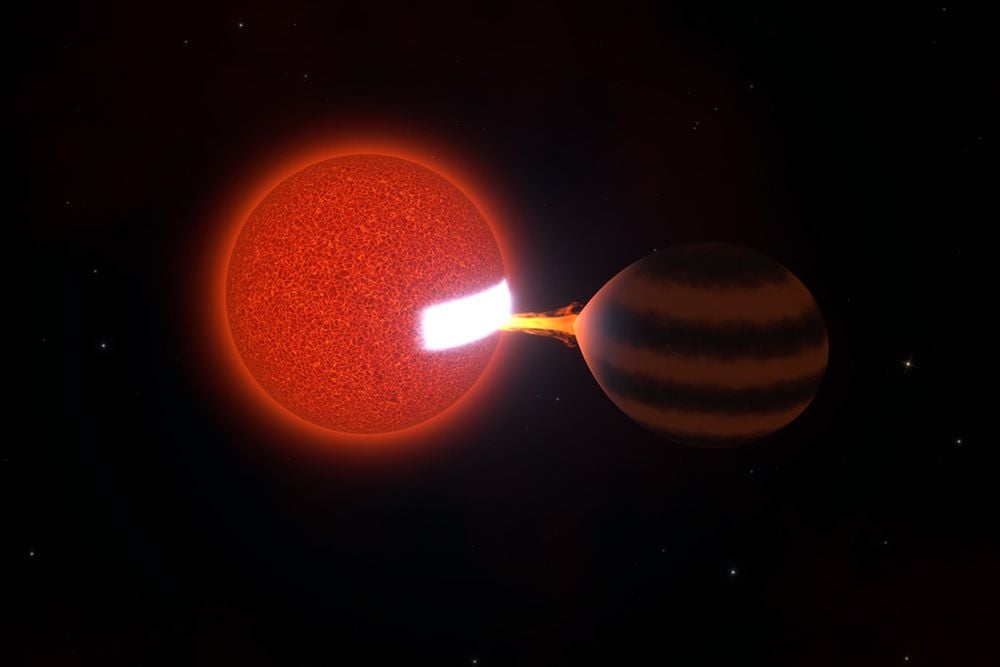
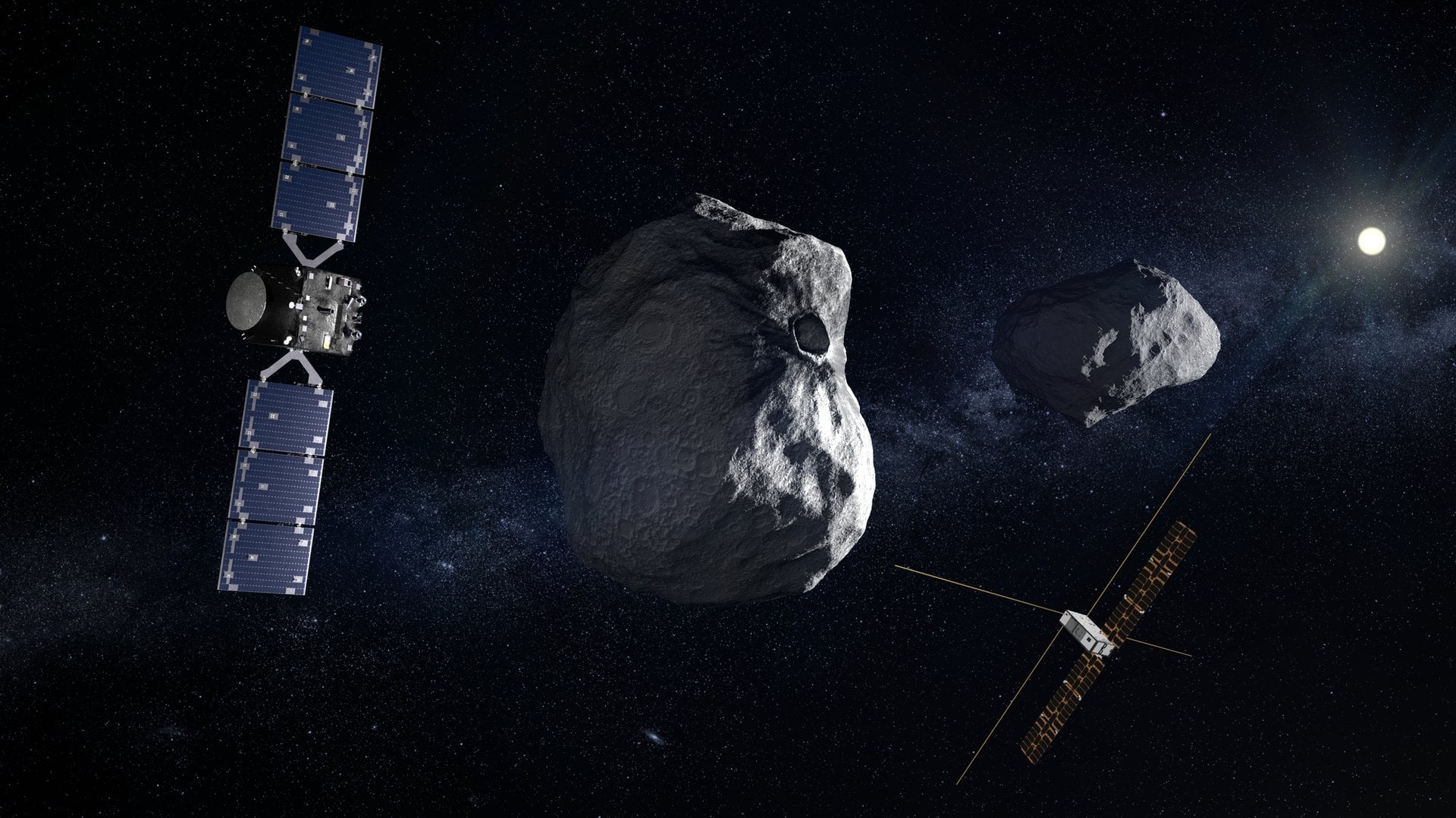
ESA's Hera reaches the Didymos–Dimorphos asteroid pair next month to inspect what NASA's 2022 DART impact did.
1/5Universe Today· Evan Gough· Oct 13
Hypernova evidence may come from a bad mixing assumption
Two UCL astronomers modelled supernova debris as unevenly mixed rather than evenly blended. Ordinary supernovae, plus one neutron star merger, then matched four odd ancient stars better than the hypernovae once used to explain them.
Why it matters · It shows how one hidden modelling assumption can create evidence for a whole class of explosion, and it weakens how we read the chemistry of the oldest stars.
Know this first
Context from the editor, not the article · 26 sec
1 · Metals and stellar fossils
To astronomers, a "metal" is any element heavier than helium. The earliest stars formed from almost pure hydrogen and helium, so very metal-poor stars alive today are chemical fossils of the first generations of stellar explosions.
2 · Reading a star's ancestry
A star keeps the chemical makeup of the gas it formed from. Astronomers compare its pattern of element amounts with the yields predicted by models of exploding stars to infer which explosion enriched that gas.
3 · Two sources of heavy elements
Ordinary supernovae make many elements but not the heaviest ones. Elements such as silver and uranium also come from neutron star mergers, or possibly from rare, highly magnetic, fast-spinning explosions.
2/5Universe Today· Matthew Williams· Oct 13
Juno data show Jupiter's magnetic disk ripples instead of staying smooth
A team led by Shandong University analysed Juno spacecraft data and found that Jupiter's huge disk of magnetised plasma crumples into rotating waves during active periods. Many small sites where magnetic field lines break and rejoin cause it.
Why it matters · It overturns a simple picture of the largest structure around Jupiter and shows that Earth's magnetic environment is a poor guide to how a fast-spinning giant planet behaves.
Know this first
Context from the editor, not the article · 29 sec
1 · What a magnetosphere is
A planet's magnetic field carves out a region of space, the magnetosphere, that traps charged particles. Jupiter's is the largest in the Solar System, and its field is roughly 20,000 times stronger than Earth's.
2 · Io feeds a plasma disk
Jupiter's volcanic moon Io releases roughly a tonne of material per second. It becomes charged plasma. Jupiter spins once every 9.9 hours, and that rotation flings the plasma outward into a thin, ring-shaped magnetodisk with an electric current sheet at its centre.
3 · Magnetic reconnection
When magnetic field lines pointing in opposite directions get pressed together, they can break and rejoin in a new arrangement. This releases stored energy and accelerates particles. At Earth, reconnection in the night-side magnetotail drives auroral substorms.
3/5Scientific American· Oct 13
Gene editing turns cloned male mouse embryos into fertile females
Researchers cloned a male mouse, then used a gene-editing tool to delete the Y chromosome from some of the cloned embryos. Those embryos grew into healthy, fertile females that bred with the male clones.
Why it matters · When a species is down to a few animals, the sex of the survivors can decide whether it lives on. This shows a way, so far only in mice, to get both sexes from one male.
Know this first
Context from the editor, not the article · 28 sec
1 · How mammal sex is set
Most mammal males carry one X and one Y chromosome (XY), and females carry two X chromosomes (XX). A gene on the Y starts male development, so an embryo without a Y normally develops as a female.
2 · Cloning by nuclear transfer
Somatic cell nuclear transfer, the method behind Dolly the sheep, moves the nucleus of a body cell into an egg whose own nucleus has been removed. The embryo that results carries the donor's genome, including its sex chromosomes.
3 · Missing-X females
An XO individual has a single X and no second sex chromosome. XO mice are female and can breed. In humans the same makeup causes Turner syndrome, which usually means infertility.
4/5The Transmitter· Earl K. Miller· Oct 14
The 1985 monkey study that showed neurons track attention, not just eyes
In 1985, Jeffrey Moran and Robert Desimone recorded single neurons in monkeys' visual cortex. They showed that attention changes how those neurons respond even when the eyes don't move. Earl Miller explains why that mattered.
Why it matters · It was early, direct evidence that the brain does internal work between seeing and acting, which opened the door to studying cognition at the level of single cells.
Know this first
Context from the editor, not the article · 28 sec
1 · Receptive fields
Each neuron in the visual cortex responds only to stimuli in a particular patch of the visual field, called its receptive field. Recording one neuron's spikes shows how strongly it responds to what falls in that patch.
2 · The sensorimotor view
Through the mid-20th century, brain activity was often described as a chain running from sensory input to motor output. Anything in between was hard to measure in neurons without it being confused with preparing to move.
3 · Covert attention
People can attend to something off to the side without looking at it. Because the eyes stay still, any change in neural activity can't simply be a signal that the eyes are about to move.
5/5Scientific American· Oct 13
Menopause brings sudden shifts in bone, liver and kidney tests, not gradual drift
Researchers at Israel's Weizmann Institute averaged hundreds of millions of routine blood and bone tests from over a million women. Bone, liver, kidney and blood-fat markers shifted abruptly at menopause instead of changing slowly with age.
Why it matters · If menopause is a sharp change across the whole body, then the timing of screening and of hormone therapy may matter more than medicine has assumed.
Know this first
Context from the editor, not the article · 27 sec
1 · What menopause is
Menopause is when the ovaries stop releasing eggs and estrogen production falls sharply. It is usually dated to 12 months after a woman's last period, most often around age 50, after several years of irregular cycles.
2 · Estrogen acts body-wide
Estrogen is best known as a reproductive hormone, but bone, liver, kidney, blood vessels and brain cells all carry estrogen receptors. Losing estrogen could therefore plausibly affect organs far from the reproductive system.
3 · Gradual versus abrupt
Many health measures slowly worsen with age in both sexes. The hard part is telling a change caused by menopause apart from ordinary ageing, since both happen in the same decade of life.
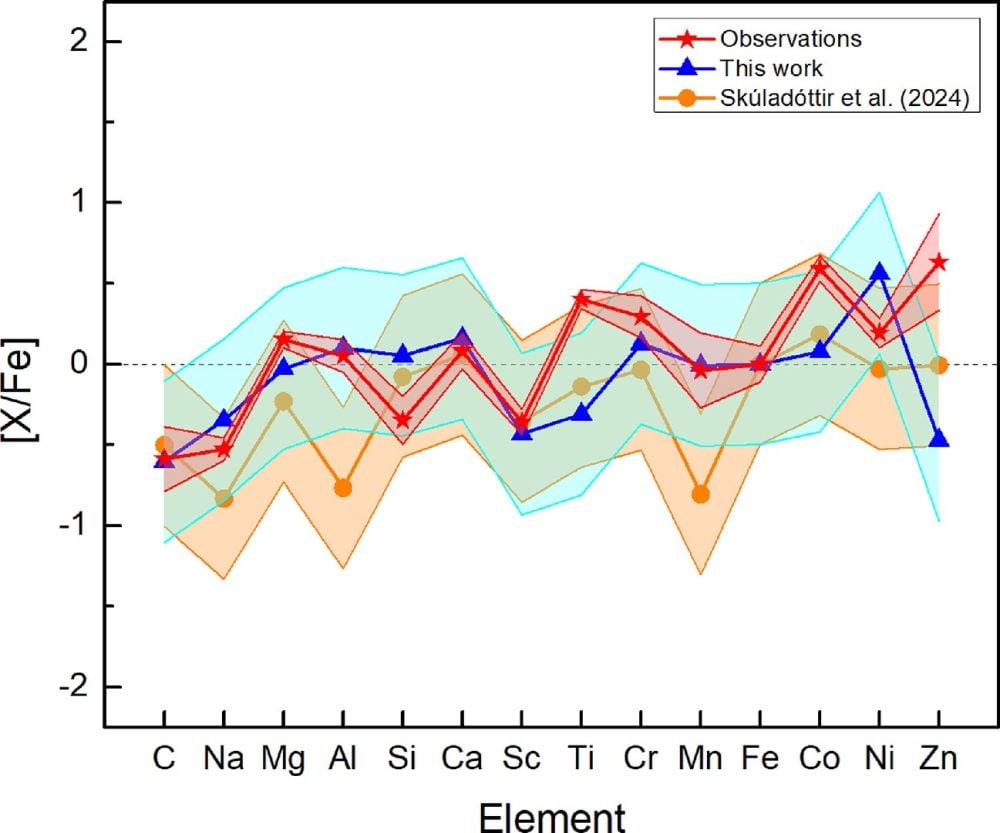
Measured element ratios (red) compared with the new normal-supernova fit (blue) and the earlier hypernova fit (orange).1 / 2
Two papers in Monthly Notices of the Royal Astronomical Society, a peer-reviewed journal, argue that the best evidence for 1 comes from a bad assumption. A hypernova is a proposed extreme stellar explosion. The authors are Anmol Aggarwal and Ralph Schoenrich of University College London's Mullard Space Science Laboratory.
The claim under test
Most supernovae, about 70%, are 2: the core of a massive star falls in on itself and blows the star apart. A hypernova would be the most extreme version. It would come only from stars above about 30 solar masses, be about ten times as luminous, and release around 10^52 3 of energy, against about 10^51 for a normal explosion. Direct evidence is thin. Much of the case rests on a few very metal-poor stars in the Milky Way's 4 and in the nearby Sculptor dwarf galaxy. ("Metal" means any element heavier than helium.)
Astronomers assumed each of these stars formed from the evenly mixed debris of one earlier explosion. Their element ratios matched no normal supernova model, and hypernova models fit best.
Patchy debris
Aggarwal and Schoenrich dropped the even-mixing assumption. A massive star is layered like an onion before it explodes, and real supernova debris doesn't blend neatly. "Oxygen might predominantly fly in one direction, sulphur in another," Aggarwal said. A new star might form from some layers more than others. In an analogy of ours, it's a spoonful of a layered cake rather than the blended average.
In the first paper, models allowing this patchy mixing explained three supposed hypernova stars better with ordinary supernovae. The second paper took on a halo red giant rich in heavy elements. Earlier work had credited it to a 5, a fast-spinning, magnetic version. That work ruled out a 6 because the star seemed to form too early. But the star's fast, backward orbit suggests it came from a dwarf galaxy the Milky Way absorbed. Stars there formed more slowly, and enriched gas often escaped. A normal supernova plus a neutron star merger fit "significantly better," the authors write.
How far this goes
"All the evidence we see for hypernovae is suddenly gone," Aggarwal said. The papers are more cautious. They show these four stars don't require hypernovae, "we do not preclude other scenarios." The article gives no fit statistics. It also doesn't address whether a more flexible model fits better simply because it has more to tune.
The deeper open question is mixing itself. "We still don't know how well the supernova material gets mixed before it forms new stars," Schoenrich said. That affects every model of how galaxies build up their elements.
Two papers in Monthly Notices of the Royal Astronomical Society, a peer-reviewed journal, challenge some of the best evidence that 1 exist. A hypernova is a proposed extreme kind of stellar explosion. The authors are Anmol Aggarwal, a PhD student at University College London's Mullard Space Science Laboratory, and his colleague Ralph Schoenrich. They argue that a handful of chemically strange ancient stars don't need hypernovae to explain them. Ordinary supernovae can do it, once you drop the assumption that exploding-star debris mixes evenly before new stars form from it.
"All the evidence we see for hypernovae is suddenly gone," Aggarwal said in a press release. The papers themselves are more careful than that, as described below.
What a hypernova is supposed to be
Most supernovae, about 70%, are 2 (CCSNe). They happen when the core of a massive star runs out of fuel and falls in on itself. A hypernova is the most energetic version. Only stars above roughly 30 solar masses could produce one. It would be about ten times as luminous as a normal CCSN and would throw out material at much higher speeds. In numbers, a normal core-collapse explosion releases about 10^51 3 of energy and a hypernova about 10^52 erg. One variant, the 4, comes from a fast-spinning, strongly magnetic star. It has been proposed as a source of the heaviest elements.
According to the article, direct evidence for hypernovae has always been thin. Much of the case has rested on indirect clues: the chemistry of a few very metal-poor stars.
How the old argument worked
Astronomers call every element heavier than helium a "metal". The first stars formed from gas with almost no metals. So stars that are still extremely metal-poor today are the closest thing we have to samples of the early universe. Several such stars sit in the Milky Way's 5, the sparse, roughly spherical cloud of old stars around the galactic disc. Another is in the Sculptor dwarf spheroidal galaxy, a small satellite of the Milky Way.
The standard approach made two assumptions:
Each metal-poor star was enriched by a single earlier explosion.
That explosion's debris mixed evenly before the star formed.
Researchers then compared each star's element ratios with the predicted output, or "yields", of model explosions. Some stars matched no normal supernova. For those, hypernova models gave the best fit, and those fits became evidence that hypernovae happen.
The new idea: stars made from pieces of an explosion
Aggarwal and Schoenrich question the second assumption. Before it explodes, a massive star is layered like an onion, with heavier elements toward the centre and lighter ones toward the surface. Observed supernova remnants are not well blended. "Oxygen might predominantly fly in one direction, sulphur in another," Aggarwal said. "New stars might form from a mix of pieces of the supernova, not its overall mix of elements."
They call this "6", meaning randomness in how the debris mixes. Their models let a new star take in different fractions of each layer of a normal supernova, then ask what combination best fits each observed star.
An illustrative analogy (ours, not the authors'): picture a layered cake thrown against a wall. Blend the whole cake and you get one predictable average flavour. A spoonful scraped from one patch of wall might be mostly frosting. If you only ever compare spoonfuls with the blended average, a frosting-heavy spoonful looks as if it came from a different cake. The patchy-mixing model says some "hypernova" stars are just unusual spoonfuls of an ordinary cake.
Results, paper one
The first paper re-examined three metal-poor stars that had been attributed to hypernovae. In each case, the authors report, a normal, less energetic supernova with uneven distribution of its debris explained the abundances better. Their figure compares the measured element ratios with both their fit and the earlier hypernova fit, and the new fit tracks the data more closely. The article gives no fit statistics, though. The authors' broader message is about method: the field should stop treating one odd star as a fingerprint of one particular explosion. Instead it should allow "enrichment by fractions of a supernova."
Results, paper two
The second paper looks at one red giant in the halo with an especially unusual makeup, including heavy elements that ordinary supernovae don't make. Those elements usually come from 7 (NSMs), or possibly from magnetorotational hypernovae. Earlier work had ruled out a merger. Its reasoning: the star is so metal-poor that it must have formed very early. In that work's model, the Milky Way enriched its gas quickly, so too little time would have passed for neutron stars to form and then collide.
Aggarwal and Schoenrich challenge that timeline. The star moves very fast, and in the opposite direction to most stars in the galaxy. That suggests it formed in a dwarf galaxy that the Milky Way later absorbed. In small galaxies, stars form more slowly. Explosions also tend to blow enriched gas out of the galaxy entirely, so a star can stay metal-poor even if it formed later, after neutron star mergers had time to happen. With patchy mixing included, a normal core-collapse supernova plus a neutron star merger gave what the authors call "a significantly better match to the data" than the hypernova.
Caveats
The authors don't claim hypernovae are impossible. They show these particular stars don't require them. "We do not preclude other scenarios," they write of the red giant. Aggarwal's "evidence is gone" line goes further than that.
The sample is small: four stars across the two papers. The article doesn't say whether other evidence for hypernovae survives. It also doesn't explain how many free parameters the mixing model adds. A model that can choose fractions of each layer is more flexible, and that alone makes good fits easier.
The physics underneath is still unsettled. "We still don't know how well the supernova material gets mixed before it forms new stars," Schoenrich said, "despite decades of work." Their results point to some mixing, but incomplete mixing.
Why it reaches beyond hypernovae
If debris from a single explosion stays patchy, models of how galaxies build up their chemistry need to change. So does any inference that reads a specific type of explosion from one star's element pattern. Schoenrich argues that this has to be built into models of galactic chemical evolution and of the interstellar medium.
Remember
The evidence for hypernovae rested on assuming that supernova debris mixes evenly before new stars form.
If stars form from uneven pieces of normal explosions, the authors find the four 'hypernova' stars fit better.
The authors don't rule out hypernovae. How supernova debris actually mixes is still unsolved after decades of work.
Diagram of Jupiter's magnetosphere showing Io's plasma torus (red) and magnetic field lines (blue), the setting for the magnetodisk.1 / 2
The finding
Jupiter's 1 is a vast ring of charged gas, or plasma, flattened around the planet's equator. Scientists long pictured it as a smooth sheet that bobs up and down as Jupiter rotates. A peer-reviewed study in Science China Earth Sciences, led by researchers at Shandong University, uses data from NASA's 2 spacecraft to argue that during active periods the disk crumples into rotating ripples.
How the disk works
The disk is built from material shed by Io, Jupiter's volcanic moon. Jupiter spins once every 9.9 hours, and the rotation flings that plasma outward and stretches the planet's magnetic field into a thin disk. Through its middle runs a 3, a thin layer of electric current where the magnetic field flips direction. Jupiter's magnetic axis is tilted from its spin axis, so the sheet wobbles. Normally a spacecraft crosses it twice per rotation.
What Juno saw
During several active episodes, Juno crossed the sheet again and again instead of twice per rotation. Each time it recorded the same magnetic signature, plus bursts of energised electrons and ions. Those bursts are hallmarks of 4, in which oppositely directed field lines break and rejoin, releasing energy. The team also worked out which way the sheet was tilted at each crossing. The orientations showed it wasn't just rising and falling. It was moving like a wave, with ripples lasting from a few minutes to over an hour.
The proposed cause
The authors conclude that many small reconnection sites, spread over about 100 degrees of longitude, keep breaking field lines and shoving the sheet away from its resting position. Because the disk spins so fast, the rippled sheet is carried around with the planet.
This differs from Earth. In Earth's 5, the night-side region stretched out by the solar wind, reconnection launches a kink wave that travels away from the reconnection site. At Jupiter, the evidence points to a whole sheet that is rippled and rotating.
Why it matters, and what's uncertain
The authors suggest the ripples could change how Io's particles are accelerated and transported. They could also complicate the link between the disk and Jupiter's 6, the charged upper atmosphere where its auroras form. These effects are proposals, not measurements.
The popular write-up doesn't say how many events were studied. Juno measures only one point at a time, so the wave shape is inferred from its track, not imaged directly. Juno's extended mission runs until September 2028, which leaves room for more passes to test the picture.
The finding
Planetary scientists have long pictured Jupiter's 1 as a smooth sheet. It is a vast, flattened ring of charged gas around the planet, and in the standard picture it just bobs up and down as Jupiter spins. A study in the peer-reviewed journal Science China Earth Sciences now argues that during active periods the sheet crumples into rotating ripples. The international team was led by researchers at Shandong University in China. They base the claim on data from 2, the NASA spacecraft that has been orbiting Jupiter since 2016.
What the magnetodisk is
Jupiter's volcanic moon Io sheds sulphur- and oxygen-rich material that becomes ionised and forms a doughnut of plasma along Io's orbit called the 3. Jupiter rotates once every 9.9 hours and drags that plasma around with it. The rotation flings the plasma outward and stretches the planet's magnetic field lines into a thin disk near the equator. Along the middle of the disk runs a 4, a thin layer of electric current where the field's direction flips. Above the sheet the field points roughly away from Jupiter. Below it, the field points roughly back toward the planet.
Jupiter's magnetic axis is tilted about 10 degrees from its spin axis. That is general background; the article doesn't spell it out. Because of the tilt, the disk wobbles like a tilted plate on a turntable. A spacecraft sitting at one spot would see the sheet sweep past it twice per rotation: once going up, once going down. In the smooth-disk picture, that is all Juno should see.
What Juno actually saw
During several events the team identified as 5 in the disk, Juno crossed the current sheet over and over instead of twice per rotation. Reconnection is the process in which oppositely directed field lines break and rejoin, releasing energy. On almost every crossing Juno recorded the same clear magnetic signature, along with bursts of energised electrons and ions. Particle bursts like these are the expected by-product of reconnection.
The team also worked out which way the sheet was tilted at each crossing. The orientations did not fit a sheet simply rising and falling. They fit a sheet moving like a wave, with ripples lasting from several minutes to more than an hour.
An analogy (ours, not the authors'): picture a flag on a spinning carousel. The smooth-disk model says the flag only tilts up and down once per turn. Juno found the flag also flapping with smaller ripples along its length. Each ripple is carried around with the carousel, so an observer standing still sees the fabric pass back and forth many times.
The proposed mechanism
The authors conclude that many small reconnection sites are scattered across about 100 degrees of Jupiter's longitude. Each site breaks the disk's field lines and pushes the current sheet away from its equilibrium position. Because the disk rotates so fast, the whole rippled sheet is carried around with the planet, and Juno samples the ripples as they rotate past.
Why this differs from Earth
Earth's version of a current sheet sits in the 6, the stretched night-side part of the magnetosphere shaped by the solar wind. There, reconnection launches a "kink" wave, a bend in the sheet that travels away from the reconnection site. At Jupiter the signatures instead point to a sheet that is rippled throughout and rotating. The difference comes down to what dominates. At Earth, the solar wind shapes the tail. At Jupiter, the planet's rotation and Io's plasma control the magnetodisk.
Why it matters
The authors suggest the rippling could affect how Io's volcanic particles are accelerated and moved through the magnetosphere. It could also complicate the link between the magnetodisk and Jupiter's 7, the charged upper atmosphere. That link carries the currents that power Jupiter's auroras. The overall picture, in the team's words, is a "highly structured, dynamic environment" rather than a simple rotating sheet.
What remains open
The popular article leaves out several details. It doesn't say how many events were analysed or how often active periods happen. It doesn't say how the team separated true ripples from Juno's own motion through the sheet. It also gives no numbers on how much the rippling changes particle transport. The links to Io's particles and to the ionosphere are presented as possibilities, not measurements.
Juno can only sample the sheet at one point at a time. So the 100-degree spread of reconnection sites and the wave shape are inferences built from a single track, not direct images. Juno's extended mission runs until September 2028, which allows more passes to test the picture. Before Juno, NASA's Galileo was the only spacecraft dedicated to studying Jupiter.
Remember
Juno crossed the current sheet repeatedly instead of twice per 9.9-hour rotation, which points to ripples rather than a smooth wobble.
Many small reconnection sites spread over about 100 degrees of longitude appear to keep pushing the sheet off balance.
Earth's reconnection sends kink waves away from one spot; Jupiter's fast rotation carries a whole rippled sheet around.
The male donor mouse with his newborn clones: female on the right, male on the left.
Researchers have turned cloned male mouse embryos into healthy, fertile females, and those females bred with male clones of the same donor. Scientific American reports this is the first time it has been done. The study is a 1 and has not yet been peer-reviewed.
Why it matters
When an endangered species is down to a few animals, the survivors may be the wrong sex to breed. Cloning one male only gives you more males. To be useful for rescue, cloning would need to produce both sexes.
In mammals, males usually carry an X and a Y chromosome (XY), and females carry two X chromosomes (XX). A gene on the Y starts male development. An embryo left with just one X, written 2, develops as a female.
How it was done
The team's tool, called 3, is based on 4, the gene-editing system that cuts DNA at chosen sites. It removes the whole Y chromosome from male embryos. The article doesn't explain how Y-CUT gets the cell to lose the entire chromosome. The researchers say they took the idea from the Okinawa rubble goby, a fish that can switch sex.
They first tested Y-CUT on male embryos made by 5, where eggs are fertilized with sperm in the lab. Next they made cloned males by 6. This means putting the nucleus from one of the donor's body cells into an egg whose own nucleus had been removed. The cloned embryos treated with Y-CUT were born to surrogate mothers as healthy XO females. Apart from the missing Y, their genomes were identical to the donor's. Untreated clones were male.
The breeding test
The female clones mated with male clones and had offspring with normal XX or XY chromosomes. That result is what supports the conservation pitch: in principle, one male donor could be the start of a breeding pair.
Limits
You still need a male. The method can't help a species where only females are left.
XO females aren't fertile in every species. XO rodents can breed, but many mammals can't, including horses and humans. The article suggests a future tool that adds a second X might help, but none exists yet.
No peer review. The article also gives no success rates.
Genetic diversity. The article doesn't mention this, but a pair copied from one animal carries a single genome, which is extreme inbreeding.
Ben Novak of 7, a nonprofit that promotes biotechnology for wildlife conservation, was not involved in the study. He calls it "a really neat foundational breakthrough in reproductive science." He also sees possible long-term uses "for extreme cases of species revival." For now it is a proof of concept in mice.
Researchers have made fertile female mice from a male mouse's clones. They cloned a male, used a gene-editing tool to remove the Y chromosome from some of the cloned embryos, and those embryos grew into healthy females. The females then mated with male clones of the same donor and had normal offspring. Scientific American reports this is the first time cloned male embryos have been turned into females. The work is a 1, which means it has not yet been peer-reviewed. The article also doesn't name the paper or say where it was posted.
The problem: survivors of the wrong sex
When a species is down to a handful of animals, the sex of the survivors decides a lot. If only males are left, or only one male, cloning can make more copies of him, but copies of a male are all male. They can't breed with each other. For cloning to rescue a species, it would have to produce both sexes from whatever animals remain.
In mammals, sex is mostly set by the sex chromosomes. Males usually carry an X and a Y (XY), and females carry two X chromosomes (XX). A gene on the Y starts male development. Take the Y away and the embryo is left with a single X, written 2, and it develops as a female.
What the team did
According to the article, the researchers took their idea from the Okinawa rubble goby, a Japanese fish that can switch sex. Their tool, 3, is based on 4, the gene-editing system that cuts DNA at sites chosen by a guide sequence. Y-CUT removes the whole Y chromosome from male embryos. The article doesn't say how Y-CUT gets the cell to lose the entire chromosome rather than just cutting it.
The work went in two steps:
A test on ordinary embryos. The team first used Y-CUT on male mouse embryos made by 5 (IVF), where eggs are fertilized with sperm in the lab. It worked.
Use on clones. Next they made cloned male embryos by 6. This means taking the nucleus out of one of the donor male's body cells and putting it into an egg whose own nucleus had been removed. They treated some of these cloned embryos with Y-CUT and transferred them into surrogate mothers.
The surrogates gave birth to healthy, fertile XO females. Apart from the missing Y, these females had exactly the donor male's genome. Untreated cloned embryos became male clones, so a single donor yielded clones of both sexes. In a photo from the study, the donor male is shown with his newborn female and male clones.
The key test: breeding
Being born healthy is not enough. The females also had to reproduce, and they did. They mated with the male clones and had offspring with normal XX or XY chromosomes.
As a worked example: an XO mother passes on either her X or no sex chromosome at all, and an XY father passes on an X or a Y. A pup that gets an X from each parent is XX, a normal female. One that gets the mother's X and the father's Y is XY, a normal male. So the next generation goes back to standard chromosome sets. This is general genetics, not a breakdown the article gives.
That breeding result is the basis for the conservation claim. In principle, one male could be the starting point for a breeding pair.
Outside view
Ben Novak, lead scientist at 7, was not involved in the study. Revive and Restore is a nonprofit that promotes biotechnology for wildlife conservation. Novak called the result "a really neat foundational breakthrough in reproductive science." He said that being able to change how many chromosomes an embryo has, and which ones, "will open up a new avenue of functional genomic science." He also said the method could have long-term uses "for extreme cases of species revival." That is a guarded way of putting it.
Limits
You still need a male. The method turns a male into females, not the other way round. A species with only females left gets nothing from it.
XO females aren't fertile in every species. XO mice and other rodents can breed, but many mammals can't with that chromosome makeup, including horses and humans. In humans, XO causes 8. The article suggests a future tool that adds a second X to XO embryos might help, but no such tool exists yet.
What's still open
The questions that matter are whether the result holds up in peer review and whether it works in species other than mice. Getting cloning to work at all is hard in many species, and XO infertility rules out much of the mammal family tree. For now this is a proof of concept in mice. It shows sex chromosomes can be edited in cloned embryos to get both sexes from one donor. It isn't yet a conservation tool.
Remember
Deleting the Y chromosome from a cloned male embryo makes an XO female who has the donor's genome otherwise.
The female clones bred with male clones and had normal XX and XY offspring.
The method needs a living male, and only works where XO females are fertile, which excludes horses and humans.
Earl K. Miller, a neuroscientist who studies cognitive control, picked a 1985 Science paper for The Transmitter's "This paper changed my life" series. The paper is Jeffrey Moran and Robert Desimone's "Selective attention gates visual processing in the 1." Miller calls it "a first glimpse into the 'middle' of brain processing." The piece is a short interview, not new research.
The problem
Neurons in some brain areas fire more when an animal attends to something. Earlier studies, though, had tied attention shifts to upcoming actions, such as an eye movement toward a target. So it was unclear whether that extra activity reflected attention or just the brain preparing to move. That fit the dominant 2 view at the time, which treated the cortex as pathways carrying signals from input to output.
The experiment
Moran and Desimone recorded single neurons in extrastriate cortex, the visual areas beyond primary visual cortex. They studied 3, which means focusing on a location without moving the eyes. Monkeys learned to attend to stimuli at one spot within a neuron's 4, the patch of visual space it responds to, and to ignore stimuli at another spot. After a set of trials, a cue switched their attention to the other spot.
The stimuli stayed the same and the eyes didn't move. Only attention changed. So any change in a neuron's response had to come from attention. The interview gives no numbers. The paper is widely remembered for showing that neurons responded mainly to the attended stimulus and much more weakly to the ignored one, as if the receptive field shrank around it.
Why it mattered
Miller's summary is that attention can change neural activity independently of motor action. That pointed to processing that is neither pure sensory input nor pure motor output. He sees it as a milestone for cognitive neuroscience. The lesson he stresses is about method: "Experimental design is everything." In his view, the best studies vary each factor independently, so that each one's effect can be separated from the others.
It also changed his own path. He read the paper as a graduate student at Princeton and went on to do his postdoc in Desimone's lab.
Since then
Miller says the field has moved away from tracing spikes from input to output. Researchers now describe the cortex in terms of activity patterns across populations of neurons, signals that loop back between areas, and feedback tied to expectations and goals. He credits this paper with an early demonstration of 5 on what the eyes see. These are his views as one researcher. The piece doesn't go into later debates or replications.
The Transmitter runs a series called "This paper changed my life," in which researchers name the study that redirected their careers. In the latest entry, Earl K. Miller, a systems neuroscientist best known for work on the prefrontal cortex and cognitive control, chose a two-author paper from 1985: Jeffrey Moran and Robert Desimone, "Selective attention gates visual processing in the 1," published in Science. Miller calls it "a first glimpse into the 'middle' of brain processing." The piece is a short interview, edited for length, so there are no new data here. What it offers is a working scientist's account of why one experiment mattered, and how it still shapes his view of the cortex.
The problem: attention or a plan to move?
Researchers already knew that neurons in some brain areas fire more when an animal attends to a stimulus. The trouble was what that extra activity meant. Miller notes that earlier work had linked shifts of attention to impending actions. If a monkey is about to move its eyes to a spot, neurons that represent that spot may already be ramping up. So was the extra firing attention, or just the brain getting ready to make an eye movement?
That confound mattered because of the framework of the time. Miller describes it as a 2 view, in which the cortex is a set of pathways carrying spikes from input to output. In that picture there is little room for an internal state like attention. Activity is either driven by the stimulus or tied to the coming response.
The experiment
Moran and Desimone studied covert attention: focusing on a location or object without moving the eyes. They trained monkeys to attend to stimuli at one location within a single neuron's 3, the patch of visual space that neuron responds to, and to ignore stimuli at another location. After a run of trials, a cue told the monkey to switch its attention to the other location. The recordings came from single neurons in extrastriate cortex, the visual areas beyond primary visual cortex.
The logic is in the design. The visual input stayed the same, with stimuli at both locations. The eyes didn't move toward either one. The only thing that changed was where the animal was paying attention. Any difference in the neuron's response therefore had to come from attention. It couldn't come from the stimulus, and it couldn't come from preparing a movement.
The interview doesn't give the size of the effect. As general background, the paper is widely remembered for showing that when both stimuli sat inside the receptive field, the neuron responded mainly to the attended one and much more weakly to the ignored one. In effect, the receptive field shrank around the attended object. That is the "gating" in the title.
What it showed
Miller sums up the result this way: attentional modulation can happen independently of motor action. The paper revealed processing in the middle stages of the cortex that "are not reducible to either sensory input or motor output." He calls it a key milestone in the emergence of cognitive neuroscience.
He also says that, as far as he knows, it was the first clear example of an experiment designed to separate sensory influences from motor ones in this way. That separation is what pushed the field past the sensorimotor framework.
Miller's lesson: design is everything
Asked what other neuroscientists underappreciate about the paper, Miller points to method rather than finding. "Experimental design is everything," he says. The strongest studies, he argues, use fully balanced designs in which each factor is varied independently of the others.
Here is an illustration (not taken from the paper's actual trial structure). Picture a 2×2 grid: stimulus at location A or B, attention at A or B. If attention only ever went where the stimulus was, or where the eyes were about to go, the factors would move together and you couldn't tell which one drove the neuron. If every combination appears, each factor's effect can be read out separately.
How it changed one career
Miller first read the paper as a graduate student in Charlie Gross's lab at Princeton, working on high-level vision in the temporal cortex. It convinced him that cognition could be studied in neurons, and that he wanted to study it. He went on to do his postdoctoral work in Desimone's lab. "This paper literally changed my scientific (and life) trajectory," he says.
Forty years on
Miller describes a large shift in how the cortex is understood. The older view traced spiking activity along pathways from input to output. The current one describes cortical function in terms of:
4: patterns across many neurons at once, rather than single cells;
5: areas and neurons feeding signals back to each other, not only forward;
feedback signals tied to expectations and task goals.
He places Moran and Desimone's paper as an early step in that shift. It showed that attention can change sensory representations through 6, meaning signals from higher areas reshaping lower ones, rather than acting only through feedforward pathways that drive behavior.
What the piece leaves open
This is a retrospective, not a review. It doesn't cover replications, effect sizes, or later debates, such as where in the brain the top-down attention signal comes from or how attention effects differ across visual areas. It also doesn't say how fully the population-dynamics view has replaced the older one. Those claims are Miller's own summary of the field. The original 1985 paper is the place to check the numbers.
Remember
Holding the stimulus and the eyes fixed while switching attention let the study isolate attention from movement.
Miller's main lesson is methodological: vary each factor independently so its effect can be separated from the others.
The study is an early landmark in the shift from input-output models toward feedback and population-level views of the cortex.
Menopause may hit the body less like a slope and more like a step. A study in 1 led by Uri Alon of the 2 in Israel analysed health records from more than a million women in the United States and Israel. Bone, liver, kidney, blood chemistry and blood-fat markers all showed sudden "jumps" at the onset of menopause. Earlier work had suggested these changes were gradual.
"Menopause is not a slow part of aging. It's an abrupt, body-wide transition," Alon told Scientific American. He points out that nearly every cell in the body carries receptors for 3, the hormone whose production falls when the ovaries stop releasing eggs.
Why it was hard to see
Menopause usually arrives around 50, the same decade in which bones, kidneys and cholesterol drift with age in everyone. Small studies are too noisy to tell a sharp change from a smooth trend. The team instead pooled hundreds of millions of routine clinical tests and averaged them around menopause onset. At that scale random noise cancels out, and a real break shows up as a kink in the curve.
What changed
Bone: a jump toward bone loss.
Kidney and liver: abrupt shifts in function tests.
Iron and 4: these improved, probably because monthly bleeding stops.
The article doesn't report how large the jumps were or how menopause timing was determined.
Checks on the result
The finding surprised the researchers ("the hair on the back of our necks stood up," Alon says), so they tested it. Men with the same age distribution showed no jumps, which argues against the cliff being an artefact of ageing. U.S. and Israeli records gave similar results.
Hormone therapy
Women on 5, which replaces some of the lost estrogen, showed smaller jumps, especially in bone, liver and kidney markers. The authors suggest some women might benefit from starting therapy earlier, before menopause, but say more research is needed. This is observational data: women who choose the therapy may differ in health or access to care, so only a trial can show cause and effect.
The caveats
A sharp average across a million women doesn't mean each woman goes through a cliff. Individual paths may vary, and the article doesn't say how much. The timing result looks solid. Its implications for treatment are still preliminary.
The finding
A study in 1 reports that menopause looks less like a slope and more like a step. Researchers led by Uri Alon, a systems biologist at the 2 in Rehovot, Israel, analysed health data from more than a million women in the United States and Israel. Across markers of bone density, liver health, kidney function, blood chemistry and blood fats, they found sudden "jumps" at the onset of menopause instead of the gradual drift earlier work had suggested.
"Menopause is not a slow part of aging. It's an abrupt, body-wide transition across bone, liver, kidney, blood chemistry, fats, and more," Alon told Scientific American.
Why this has been hard to see
Menopause is the point at which the ovaries stop releasing eggs and 3 production drops. Its effects outside reproduction are poorly mapped. The main difficulty is timing. Menopause usually arrives around age 50, the same decade in which cholesterol creeps up, bones thin and kidney function declines in both sexes. Studies that follow a few hundred or a few thousand women give noisy measurements, and that noise can make a sharp change look like a smooth trend. Separating "this happened because estrogen fell" from "this happened because she got older" takes a lot of data.
How the team did it
The researchers took a population-wide approach. Instead of tracking individual women closely, they pooled routine clinical results from medical records, which the article puts at hundreds of millions of health tests. They then averaged those results around the onset of menopause. With that many data points, random noise largely cancels out. What remains is the average path of each marker, so a real discontinuity would show up as a visible kink in the curve.
An analogy (ours, not the study's): one person's daily weight bounces around too much to show the day a new diet started. Average the weigh-ins of a million people aligned on their start dates, and a sudden shift stands out clearly.
The article doesn't say how the team identified each woman's menopause date from the records, or how large the jumps were in clinical units. Those details matter for interpreting the result, and readers would need the paper itself to get them.
What jumped, and which way
Bone: a "jump in the direction of bone loss," consistent with estrogen's known role in protecting bone.
Kidney and liver: sudden changes in tests of both organs' function.
Blood chemistry and fats: abrupt shifts as well. The article doesn't give the direction for each marker.
Iron and 4: these jumped in a favourable direction. Alon thinks the likely reason is that monthly blood loss stops.
Alon explains the breadth of the effect by the fact that estrogen has receptors in almost every cell in the body.
Stress-testing the cliff
The result surprised the team. When they first saw it, Alon says, "the hair on the back of our necks stood up. So we tested it hard." The article describes two checks:
A male comparison group. Running the same analysis on men with the same age distribution produced no jumps. That argues against the cliff being an artefact of age itself, or of how tests are ordered in middle age.
Two countries. Records from the U.S. and Israel showed similar jumps, despite different health systems and populations.
Hormone therapy
Women taking 5, which replaces some of the lost estrogen, tended to show smaller jumps in some tests, "especially in bone, liver and kidney," according to Alon. The researchers suggest some women might benefit from starting therapy earlier, before menopause. They and the article both say more research is needed.
That caution is warranted. In observational records, women who choose hormone therapy can differ from those who don't in health, income and access to care, so smaller jumps among users don't prove the therapy caused them. Only a trial can settle that.
What remains open
Averages versus individuals. A sharp population average does not mean every woman goes through the same cliff. Some may change abruptly, others gradually or barely at all. The article doesn't report how much women varied.
Clinical size. Without effect sizes, it's unclear whether the jumps are big enough to change screening or treatment decisions.
Mechanism. Estrogen loss is the obvious explanation, but the study shows when the changes happen, not exactly how each organ responds.
Design limits. This is an analysis of routine medical records, not a controlled study. The male comparison and the cross-country replication make the timing result fairly robust. Conclusions about treatment are still preliminary.
The core claim is that menopause marks a distinct, body-wide physiological transition rather than just another stretch of ageing. It rests on a very large dataset and two sensible controls, and it reframes a common life event as something medicine should measure more closely.
Remember
Averaging hundreds of millions of routine tests revealed abrupt shifts that smaller, noisier studies had blurred into gradual trends.
Not every jump was harmful: iron and hemoglobin improved, likely because menstrual blood loss ends.
Smaller jumps in hormone therapy users are an observational hint, not proof that earlier therapy helps.
No peer review. The result hasn't been independently checked, and the article reports nothing about how efficient the process was: how many embryos were treated, how many survived, or how healthy the offspring were in the long run.
Genetic diversity. The article doesn't raise this, but it's a basic point in conservation genetics: a breeding pair copied from one animal is about as inbred as it gets. Their offspring come from a single genome. The method could create a pair, but it can't add the genetic variety a population needs over the long term.