Dark matter splits, centenarians don't add up · Morning Gist
Thursday, October 155 stories · 14 min
Dark matter splits, centenarians don't add up
A galaxy crash backs dark matter as a real substance, Blue Zones lose their records, and new studies find microplastics reactive and AI enzymes improving.
Picked from 51 new articles across 10 sources · arrow keys for other days
Today in 30 seconds
30s left
Three dim galaxies with no dark matter may come from one ancient crash that pulled dark matter away from gas, which is a setback for modified gravity. story 1 ↓
Saul Newman traces Blue Zone centenarian hotspots to missing birth records and unregistered deaths, which undercuts the diet advice built on them. story 2 ↓
Water at the surface of five common microplastics forms reactive molecules that can damage proteins and membranes, according to a Columbia study in Nature. story 3 ↓
AI-designed enzymes that cut chosen proteins worked 19% and 92% of the time once designers specified where a key water molecule sits. story 4 ↓
Zircon dating puts Oklahoma's buried 10-mile Ames crater at 370 million years old, during the Late Devonian extinction and 97 million years younger than thought. story 5 ↓
Voyager 1 will be one light-day from Earth on November 18 and is still sending back data from interstellar space.
1/5Quanta Magazine· Robin George Andrews· Oct 14
Three dim galaxies lacking dark matter may come from one ancient collision
Astronomers propose that three faint, nearly dark-matter-free galaxies formed when two galaxies collided. The dark matter passed straight through while the gas piled up. Most experts say this supports dark matter being a real substance.
Why it matters · If dark matter can be physically separated from ordinary matter, it is a real substance and not a quirk of gravity. That narrows down one of physics' biggest open questions.
Know this first
Context from the editor, not the article · 32 sec
1 · Why astronomers invoke dark matter
Stars at the edges of galaxies orbit too fast for the visible matter to hold them. Light also bends around galaxies more than visible mass explains. An unseen mass, dark matter, would account for both. It has never been directly detected.
2 · Weighing a galaxy by its stars
The faster a galaxy's stars move, the more total mass, visible plus dark, must be pulling on them. If you measure the stars' speeds, you can estimate the total mass and compare it with the mass of the visible stars and gas.
3 · The rival idea: modified gravity
2/5Scientific American· Oct 14
Researcher Saul Newman argues the evidence for Blue Zones is badly flawed
Demographer Saul Newman says the "Blue Zones", places supposedly full of 100-year-olds, rest on bad records: destroyed birth certificates, unregistered deaths and anecdotes. He makes the case in a new book and a podcast interview.
Why it matters · Blue Zones shape popular diet and health advice. If the age data underneath them is wrong, so are the lifestyle lessons drawn from them.
Know this first
Context from the editor, not the article · 27 sec
1 · What Blue Zones are
A term popularized in the 2000s by writer Dan Buettner and demographers for regions with unusually many centenarians: usually Okinawa, Sardinia, Ikaria in Greece, Nicoya in Costa Rica, and Loma Linda in California.
2 · How ages get verified
Demographers can't measure age directly. They rely on documents such as birth certificates, baptism records and death registrations. Extreme ages are only as trustworthy as the paperwork, and errors pile up at the oldest ages.
3 · The lifespan-limit debate
Researchers have long argued over whether human lifespan has a hard ceiling or whether death risk levels off at very old ages, a pattern called a mortality plateau. Leading journals have published papers on both sides.
3/5Scientific American· Oct 14
Microplastics turn the water around them chemically reactive, study finds
Columbia University chemists report in Nature that water touching microplastic surfaces makes highly reactive molecules. That could explain why microplastics are linked to inflammation, but it hasn't yet been shown in living tissue.
Why it matters · The finding gives a possible physical cause for health links that have so far been only statistical, and it suggests plastic's surface area may matter as much as its chemistry.
Know this first
Context from the editor, not the article · 31 sec
1 · Microplastics and health links
Microplastics are plastic fragments smaller than 5 mm. They have been found in blood, artery plaque and brain tissue, and their presence has been tied to heart attack, stroke and dementia. These are correlations. Nobody has shown how the particles would cause harm.
2 · What oxidative stress is
Cells make reactive oxygen-containing molecules all the time and use antioxidants to keep them in check. When the reactive molecules win, they damage proteins, fats in membranes and DNA, and inflammation follows. That imbalance is called oxidative stress.
3 · Water behaves differently at surfaces
4/5Ars Technica Science·
John Timmer
· Oct 14
AI-designed enzymes cut chosen proteins, built around borrowed catalytic cores
Baker-lab researchers kept the catalytic cores of a crayfish zinc protease and a yeast cysteine protease, used AI tools to design wholly new scaffolds around them, and got enzymes that cut chosen protein sequences up to 10¹⁰ times faster.
Why it matters · Designing enzymes, not just binders, is the harder half of protein engineering; these results map exactly where today's AI tools succeed and where they still rely on luck.
Know this first
Context from the editor, not the article · 25 sec
1 · Proteins and peptide bonds
Proteins are chains of amino acids joined by peptide bonds, formed by removing a water molecule. Each amino acid also carries a distinctive side chain, and those side chains give a protein its chemistry.
2 · What enzymes do
Enzymes are proteins that speed up chemical reactions, often by holding reacting parts in exact positions. Their speed-up is quoted as a multiple: a factor of 10⁹ means a billion times faster than uncatalyzed.
3 · The Baker lab
David Baker's University of Washington group shared the 2024 Nobel Prize in Chemistry for computational protein design. Its tools, including RFdiffusion and ProteinMPNN, are widely used and openly released.
5/5Live Science· Harry Baker · Oct 14
Buried Oklahoma crater is 97 million years younger than thought
University of Texas geologists studied tiny zircon crystals from Oklahoma's buried Ames crater. They dated the impact to 370 million years ago, not 467 million. That puts it during one of Earth's five great mass extinctions.
Why it matters · Crater dates feed the timeline we use to judge whether space impacts helped drive mass extinctions, and zircon dating keeps finding that the older dates were wrong.
Know this first
Context from the editor, not the article · 29 sec
1 · Dating ancient impacts
Old craters erode or get buried, so their age has to be worked out indirectly. Fossils in nearby rock give a rough age. Minerals whose internal 'clocks' get reset by impact heat and shock give a more direct one.
2 · What zircon is
Zircon (zirconium silicate) is a very hard mineral found in most rocks. It traps uranium, which decays at a known rate, and it records the heat and shock it has been through. That makes it a favorite tool for geologists dating rocks.
3 · The Late Devonian extinction
Starting about 372 million years ago, oxygen-starved oceans killed up to half of all marine species over several million years. It counts as one of Earth's 'Big Five' mass extinctions.
Some physicists argue that no dark matter exists and that gravity simply behaves differently at very weak strengths. The best-known version is MOND, proposed in 1983. Under it, a galaxy's visible matter alone sets how its stars move.
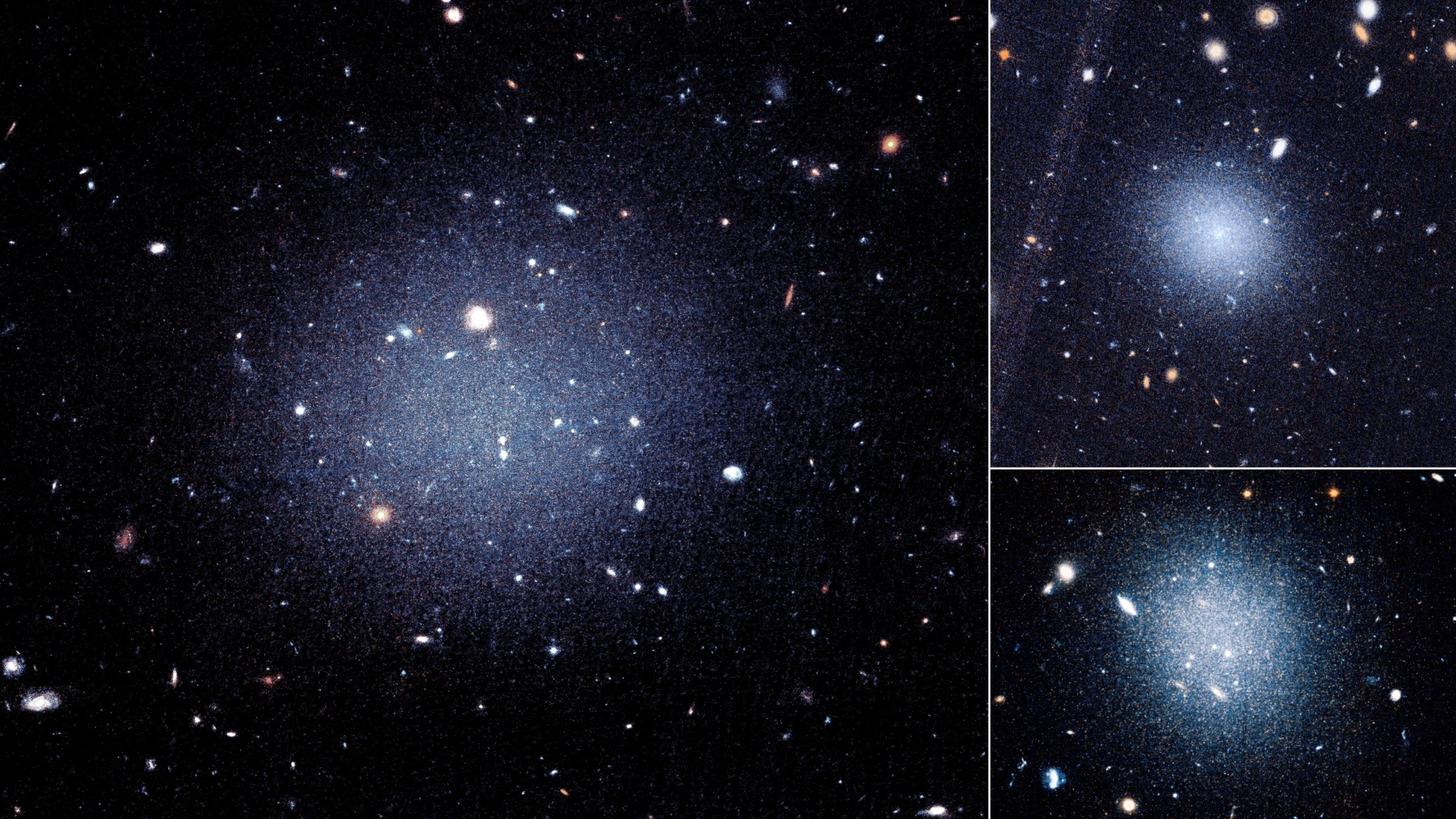
DF2, DF9 and DF4: faint, star-poor galaxies that hold almost no dark matter.1 / 3
Three faint, sparse galaxies about 65 million light-years away, called DF2, DF4 and DF9, hold almost no 1. A paper published in June 2026 in The Astrophysical Journal proposes how they got that way. Most experts say the explanation also supports the idea that dark matter is a real substance.
Why that's strange
Dark matter, thought to make up 85% of all matter, is the unseen mass that keeps galaxies' outer stars from flying off. It also helps gas clump into stars. Nearly every galaxy is dominated by it.
DF2, found in 2018, is about the size of the Milky Way but has 200 times fewer stars. Astronomers used the 2 in Hawai'i to measure how fast its stars move. Faster stars mean more total mass pulling on them. DF2 turned out to hold at most one four-hundredth of the dark matter expected. DF4 followed in 2019 and DF9 in 2026. DF9 weighs about 100 million suns, which ordinary matter alone can account for. A normal share of dark matter would make it 100 times heavier. All three lie along a line, as neighbors.
The proposed origin
Ordinary gas feels electromagnetism, so when two clouds meet they collide and pile up. Dark matter seems to feel only gravity, so it passes through almost without friction. In the paper's scenario, two galaxies collided head-on. Their dark matter kept going and their gas clumped in the middle, forming three new galaxies that struggle to make stars.
Astronomer Aaron Romanowsky offers an analogy: jousting knights crash to the ground in a heap while their horses keep running. A similar split of gas from dark matter is seen in the 3, a pair of colliding galaxy clusters.
Bad news for modified gravity
4 (modified Newtonian dynamics) is the main alternative to dark matter. It says only visible matter exists and that gravity behaves differently when it is very weak. Under MOND, visible matter alone sets how a galaxy's stars move, so there is nothing a collision could strip away. "It's easier to remove matter… than it is to turn off a law of nature," says physicist Shyam Balaji.
Not settled
The collision is inferred, not observed, and the article doesn't describe the paper's methods. Kinwah Wu of University College London notes that the trio lacks the wispy streams a crash usually leaves behind. He suggests a group of massive galaxies stripped the dark matter instead. Stacy McGaugh, a modified-gravity supporter, calls the collision "plausible, albeit an exceptional one." He argues that until the galaxies' origin is pinned down, they say nothing firm about dark matter. And even if dark matter is a substance, nobody yet knows what it is.
About 65 million light-years away sit three faint, washed-out galaxies called DF2, DF4 and DF9. Yale astrophysicist Michael Keim says they have "this ghostly appearance." The stranger thing is that they hold almost no 1. A paper published in June 2026 in The Astrophysical Journal, with Keim among the authors, gives an origin story for all three. Long ago, two ordinary galaxies collided. The dark matter kept going and the gas did not. If that's right, the trio is awkward for theories that replace dark matter with modified gravity.
Why a galaxy without dark matter is a puzzle
Dark matter is thought to make up 27% of the universe's contents and 85% of its matter. As far as anyone can tell, it interacts only through gravity. It explains why the fast-moving outer stars of galaxies don't fly off. It also explains why gas could clump tightly enough to form stars in the first place, and why galaxies bend passing light more than their visible mass should (2, the bending of light by mass). "Almost all galaxies are dominated by dark matter," says Shyam Balaji, a theoretical physicist at King's College London. Chamkaur Ghag of University College London is blunter: "You wouldn't get galaxies without dark matter."
So DF2 was a shock when it turned up in 2018. It is about the size of the Milky Way but has 200 times fewer stars. Astronomers used the 3, a pair of large telescopes in Hawai'i, to track how its stars move. Faster stars mean more mass pulling on them, so the speeds give an estimate of total mass. DF2 came out lighter than expected even for such a sparse galaxy. It held at most one four-hundredth of the dark matter predicted, which made it the first dark-matter-deficient galaxy ever found. DF4 followed in 2019. In 2026 a third, DF9, was announced. It weighs about 100 million suns, which is consistent with ordinary matter alone. With a normal dark-matter share it would be about 100 times heavier.
There was one more clue. The three galaxies lie along a line, as neighbors, which suggests a shared origin.
The collision mechanism
The proposed story depends on a basic difference between the two kinds of matter. Ordinary gas and dust feel all four fundamental forces, including electromagnetism. When two clouds of gas meet, they collide, heat up, slow down and clump. Dark matter, as far as anyone knows, feels only gravity. Two halos of dark matter passing through each other feel almost no friction or drag.
So in a head-on collision between two galaxies, the dark matter would sail through and keep going. The gas would pile up in the middle. In the paper's scenario, that leftover gas condensed into three new galaxies with almost no dark matter. Each then struggled to form stars, because the extra gravity that normally helps gas collapse was gone.
Aaron Romanowsky of San José State University offers an analogy. Picture two jousting knights who crash and fall to the ground in a heap while their horses keep running at full speed. The knights are the gas and the horses are the dark matter.
The article doesn't describe the paper's methods, such as simulations or how the timing of the collision was worked out. The collision is an inferred history, not something anyone watched.
A familiar precedent
The idea echoes the 4, two massive galaxy clusters 3.8 billion light-years away that collided long ago. In it, maps of hot gas and maps of total mass (traced by lensing) point to different places. The dark matter and ordinary matter were pulled apart in the crash. The James Webb Space Telescope recently observed the cluster again. Keim and colleagues argue that the DF trio shows this kind of separation even more clearly.
Why it hurts modified gravity
5 (modified Newtonian dynamics), proposed by Mordehai Milgrom in 1983, says there is only visible matter. In this view, gravity weakens less than Newton predicts when the pull is very weak, as in the outskirts of galaxies. That alone would hold spinning galaxies together.
Under MOND, a galaxy's visible matter fully determines how its stars move. Two galaxies with similar visible matter should behave alike. You can't take away part of a law of nature in one place and leave it in another. Dark matter is different: it is a substance, so a collision can remove it. "It's easier to remove matter, cold dark matter, through something like a collision, than it is to turn off a law of nature," Balaji says. Keim adds that once ordinary matter is separated from dark matter, you'd expect the stripped galaxies to struggle to form stars. That is what the three galaxies show. As Balaji puts it, "The absence of dark matter is, in a way, some evidence of dark matter."
Ghag notes that MOND was already under pressure. In 2015, 6 (the Laser Interferometer Gravitational-Wave Observatory) detected gravitational waves for the first time. Scientists found that these waves travel at light speed over huge distances, which points to gravity working the same way everywhere. "It's fine and healthy to have alternative theories," says UC Irvine physicist Daniel Whiteson, "but let's also be frank about whether the theory fits the data. MOND does not."
Where the disagreement lies
Not everyone accepts the collision story. Kinwah Wu of University College London points out that the trio lacks the wispy, fluid-looking streams you'd expect after a galaxy crash. He proposes another route: the three passed through a group of massive galaxies, which stripped away their dark matter. That would still mean dark matter was physically removed.
The sharpest skeptic quoted is Stacy McGaugh of Case Western Reserve University, a longtime supporter of modified gravity. He calls the collision "plausible, albeit an exceptional one," and grants that "if that's what's happened, then the rest follows." But he isn't convinced it's the only possible route. Without a settled origin, he argues, the galaxies say nothing firm about what dark matter is.
That is the real open question. The case against MOND here depends on the galaxies' history, which has to be inferred. Even if the history holds, the result says only that dark matter is a substance. It doesn't say which one. The leading candidates still include 7 (weakly interacting massive particles), an elusive type of neutrino, and atom-sized black holes left over from the early universe. "We don't know which dark matter candidate is the right one," Whiteson says.
Remember
The three galaxies line up as neighbors, which points to a shared origin.
Dark matter can be removed from a galaxy, but a modified law of gravity can't be turned off in one place.
The argument depends on an inferred history. Rivals propose stripping by a galaxy group, or keep their doubts.
The "1" are a handful of regions supposedly full of people who live past 100. They have inspired best-selling books, a Netflix series and many diet plans. Saul Justin Newman, a senior research fellow at University College London and Oxford, thinks the evidence for them is mostly bad paperwork. He makes his case in a new book, Morbid: Debunking Modern Longevity Science, and in an interview on Scientific American's Science Quickly podcast.
This is an interview, not a new study. The claims are Newman's, and the people he criticizes don't respond in the episode.
The core problem: age comes from records
Nobody can measure a person's age directly. Demographers read it from birth certificates and death registrations. If those documents are missing or wrong, a "105-year-old" may be nothing of the kind. Newman gives several examples:
Okinawa, Japan. He says 2 cluster where American bombing in World War II destroyed town-hall birth records. American personnel replaced them, working in an unfamiliar language and calendar. In Japan, the head of a household registers a death, so a family wiped out together could go unrecorded. In 2010, he says, about 236,000 listed centenarians, roughly 82 percent of Japan's total, turned out to be long dead.
Loma Linda, California. Newman says the man who identified it as a Blue Zone admitted his editor had asked him to find an American one.
Ikaria, Greece. The only Greek centenarian the Blue Zones named was said to be 102 and a 30-year lung-cancer survivor. An investigative report found documents putting him in his 90s, and his doctor said he never had cancer.
How he got pulled in
Newman studied the evolution of lifespan and later plant flowering time. About eight years ago a friend sent him a Nature paper claiming human lifespan has a hard ceiling. Newman says its authors had used a column of life-expectancy figures that rounded to zero at age 100. They had also missed that the number of countries in their sample rose and fell along with their trend line. He is still pushing for a retraction.
He goes further against a rival Science paper, which found that the yearly risk of death levels off at very old ages. Newman says only one of 861 possible modeling choices produced that result, and he suggests possible fraud. That is his allegation, not an established finding.
The bigger picture
Newman argues that the longevity business sells pills because the real advice can't be sold: exercise, don't smoke, don't drink, see a doctor. Real longevity research, he says, already exists, and it's called medicine. His point that age claims are only as good as the records behind them holds up. His broader verdict on the field is one combative critic's view, and he gives no new data in this conversation.
Saul Justin Newman, a senior research fellow at University College London and the University of Oxford, has a new book called Morbid: Debunking Modern Longevity Science. On Scientific American's Science Quickly podcast, he told host Rachel Feltman why he doesn't believe in 1. These are the handful of places where people supposedly reach 100 at unusually high rates, and they have inspired best-selling books, a Netflix series and many diet plans. Newman says the age data behind them is in "terrible shape."
This is an interview, not a new study. Every claim below is Newman's, and none of the researchers he criticizes responds in the episode.
How he got here
Newman's doctoral thesis was on the evolution of lifespan. His later work involved predicting flowering time in plants, a field where he says changing an organism's lifespan is "trivial" and has been understood for at least 150 years. He got pulled into human longevity about eight years ago, when a friend sent him a Nature paper arguing that human lifespan has a hard ceiling somewhere around 115 to 125 years.
Newman says the paper had about a dozen pages of problems, and he highlights two:
The wrong column.2 often list remaining life expectancy at each age twice, once at full precision and once rounded. According to Newman, the authors used the rounded column. At age 100 that rounds down to zero, which makes it look as if gains at extreme old age had stopped.
A shifting sample. The paper reported that the maximum age reached rose and then fell. Newman notes that the number of countries in the dataset also rose and then fell. When he looked within each country, he found that maximum lifespan kept increasing.
He says he is still trying to get the paper retracted.
He also attacks a rival paper in Science that argued the opposite, using records of Italians aged 105 and older. It concluded that death risk reaches a "3." Newman's analogy is Russian roulette: you face roughly a 50 percent chance of dying each year, with no fixed endpoint, so a long enough streak of luck is always possible. His objection is to the model, which defined "midlife" as ages 65 to 80. He says that if you shift that assumption in any direction, the result goes away. By his count, only one of 861 possible input choices gave a 4 result. He calls that "either research fraud or an extraordinary coincidence." This is an allegation, not an established finding.
What he says is wrong with Blue Zones
The underlying problem is simple. Nobody can measure a person's age directly; it has to be read from documents. When the documents are wrong or missing, a claimed age of 105 means nothing. Newman's examples:
Okinawa. He says 5 cluster where American bombing in World War II destroyed town halls and their birth records. US personnel then issued replacement certificates in an unfamiliar language and calendar, and errors crept in. Japan has a second problem: the head of a household registers a death. If a firebomb kills the whole household, no one registers anyone's death. Newman says that in 2010, about 236,000 people, roughly 82 percent of Japan's listed centenarians, turned out to have been dead for years. He adds that Blue Zone demographers, who had studied the region since 1976, hadn't noticed.
Loma Linda, California. This is the only American Blue Zone. Newman says that when he pressed its discoverer for the data, the man admitted his editor had asked him to find an American Blue Zone, so he found one. Newman describes it as a town off the freeway between Los Angeles and Las Vegas, and says that admission was the whole of the evidence.
Ikaria, Greece. Newman cites a recent investigative report on the only Greek centenarian the Blue Zones named. The man was said to be 102 and to have survived lung cancer for 30 years. According to the report, his personal documents put him in his 90s, and his doctor said he never had cancer. The story had already run in the New York Times.
He also tells the story of Charlie Smith, once billed as America's oldest man. Newman says the Social Security Administration told Smith he was 113 and then lost the file. Smith went on to meet a president and attend an Apollo launch. Newman thinks he was probably about 68.
The wider critique
Newman goes beyond demography. He calls the telomere theory of aging "junk." 6 are protective caps on the ends of chromosomes that shorten each time a cell divides. The usual story is a trade-off: short telomeres cause aging, but they also stop cancers from growing. Newman's objection is that cancers have never been seen to stop growing on their own, while everyone ages. So, he argues, the mechanism meant to balance the trade-off has never been observed. Many biologists still treat telomere shortening as one contributor to aging, and the episode doesn't present their side.
He explains the field's weak standards in terms of money. The real advice, he says, is to exercise, not smoke, not drink and see a doctor, and none of that can be sold. That leaves room for pills, overseas clinics and pitches aimed at billionaires and committed athletes. He says one researcher spent about $8 billion of other people's money on nothing. His proposal is to close the US 7 and put its budget, "probably double it," into fundamental medical research. "We already do it," he says of longevity research. "It's called medicine."
What to make of it
Newman's main point stands on its own: claims of extreme age are only as good as the records behind them, and the Okinawa registry failure is a concrete example. Still, this is one critic's account, given in a comic, combative style, and he openly says he has grown more cynical. The interview doesn't give the defenders' side, specific citations, or any new quantitative analysis of the Blue Zones themselves. Readers should treat it as a strong, well-informed challenge, not a settled verdict. The basic advice survives either way: exercise, don't smoke and limit alcohol.
Remember
Extreme-age claims are only as reliable as birth and death records, and those records fail most where records are poorest.
Newman says Japan found about 236,000 'centenarians' in 2010 were long dead and had never been registered.
These are one critic's claims in an interview; the researchers he accuses, including of possible fraud, don't respond.
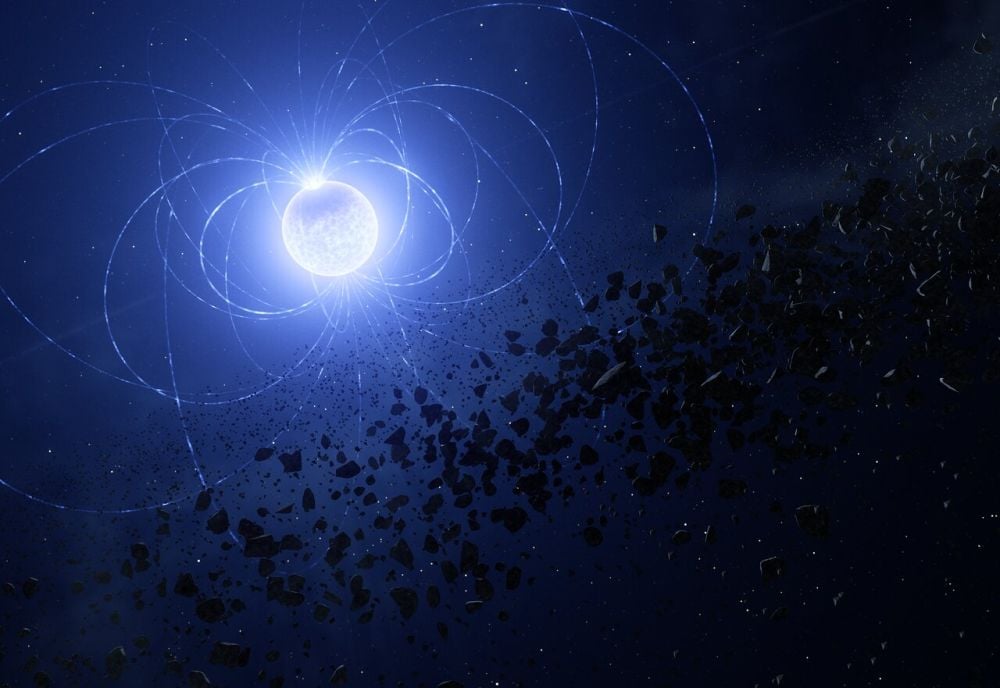
In bulk liquid, each water molecule joins a shifting network of hydrogen bonds. Next to a water-repelling surface that network breaks up, and the result can be strong local electric fields and unusual chemistry not seen in ordinary water.
Image: Scientific American
The finding
Microplastics have been statistically linked to heart attacks, strokes, dementia and brain tumors, but nobody has known what about them would cause harm. Bulk plastic is chemically inert enough to store food in. A new Nature paper co-led by Wei Min, a chemist at Columbia University, offers a candidate mechanism. Water touching a microplastic's surface becomes chemically active and produces highly 1 that can modify proteins, cell membranes and other biological molecules.
Why size matters
Breaking plastic into tiny pieces keeps the volume the same but greatly increases the exposed surface. Min's example: grind a credit card into particles about 10 microns across, roughly a tenth the width of a hair, and its surface area rises more than 200-fold. Any chemistry that happens only at the surface grows by the same factor.
How the water changes
The team tested five common plastics: polystyrene, polyethylene, polyvinyl chloride (PVC), polypropylene and polyethylene terephthalate (2, used in drink bottles). All are 3, meaning they repel water.
In liquid water, each molecule sits in a shifting web of 4 with its neighbors. Next to a water-repelling surface, molecules can't form their usual bonds. Min says this rearranges them, changes the local electric environment and makes the water more chemically reactive. Bulk water stays ordinary. The thin layer touching plastic does not.
What it could explain
Earlier lab work showed that 5 cause inflammation, 6 (reactive molecules outrunning a cell's antioxidant defenses) and weaker 7, the cell's energy producers. Reactive molecules made at the particle surface would fit all three.
Martin Wagner, a toxicologist at the Norwegian University of Science and Technology who was not involved, argues that this changes the picture: microplastics may themselves be "a source of oxidative species," and oxidative stress is not just a side effect of the body reacting to them.
Caveats
This is a chemistry result, not proof of harm in people. Min says how it might damage living human tissue "is still unclear," and his team's next goal is to measure biological effects directly. The article doesn't say which reactive molecules form, in what amounts, or how they were detected. It also doesn't address whether the proteins and fats that coat particles inside the body would block the effect. The health links themselves are still correlations.
The finding
A team led partly by Wei Min, a chemist at Columbia University, reports in Nature that 1 do not sit inert in water. Water molecules right next to a plastic particle's surface become chemically active and produce what the researchers call highly reactive species. These are short-lived molecules that can chemically alter whatever they touch, including proteins and cell membranes.
That matters because of an open puzzle. Microplastics have been found in human tissue, and their presence has been statistically linked to heart attacks, strokes, dementia and brain tumors. Lab studies have also shown that they cause inflammation, 2 (more 3 than a cell's antioxidant defenses can handle) and lower activity in 4, the cell's energy producers. What has been missing is a mechanism. Bulk plastic is chemically quite inert. You can store food in it. So why would small pieces of it hurt cells?
Why the surface is the story
Min's answer starts with geometry. As plastic breaks into smaller pieces, the volume stays the same but the exposed surface grows sharply. Min's example: grind a credit card into particles about 10 microns across (roughly a tenth the width of a human hair) and its total surface area rises more than 200-fold.
A rough check of that number, using our own illustrative figures: a credit card is about 86 × 54 × 0.76 mm. That gives a volume of about 3,500 cubic millimetres and a surface of about 9,500 square millimetres. A sphere 10 microns across has 0.6 square microns of surface per cubic micron of volume. Turn all that plastic into such spheres and the total surface comes to about 2.1 million square millimetres, roughly 220 times the original card. Any chemistry that happens only at the surface gets multiplied by the same factor.
How the water changes
The five plastics tested are among the most common: polystyrene, polyethylene, polyvinyl chloride (PVC), polypropylene and polyethylene terephthalate (5, the plastic in drink bottles). All are 6, meaning they repel water.
Min explains the chain of events this way. In liquid water, each molecule is held in a constantly shifting network of 7 with its neighbors. At a water-repelling surface, water molecules can't form their usual set of these bonds. Their arrangement changes. The new arrangement alters the local electric environment, and that in turn changes how reactive the water is. In ordinary bulk water nothing happens. In the thin layer touching plastic, reactive molecules form.
An analogy (ours, not the paper's): think of a crowd holding hands in a dense grid. At the edge of the grid, people have a free hand, and the free hands are where something can grab on. Breaking plastic into dust creates an enormous amount of edge.
Min says the common assumption that plastics are inert comes from studying the bulk material and misses what happens once it fragments: "Fragmentation creates enormous amounts of new surface area."
What it could explain
According to the article, the study shows that these plastic–water interfaces can disturb proteins, cell membranes and other biological molecules. If that happens inside the body, it would explain the inflammation and oxidative stress seen in earlier experiments.
Martin Wagner, a toxicologist at the Norwegian University of Science and Technology who was not involved, calls the findings exciting and argues that they change how the field thinks about exposure. "It implies microplastics themselves are a source of oxidative species," he says, "and oxidative stress is not a secondary effect of exposure." The usual view has been that cells damage themselves by overreacting to a foreign particle. Wagner's reading is that the particle may be doing the chemical damage directly.
What remains open
This is chemistry, not yet medicine. Min says plainly that how this might damage living human tissue "is still unclear." His team's next goal is to connect the surface chemistry to quantitative measurements of biological effects.
Several things the article does not cover:
Which reactive species form, and how much. The article doesn't name the molecules or give amounts.
Methods. It doesn't say how the reactive molecules were detected or how the biological effects were tested.
Real-world conditions. Microplastics in the body get coated with proteins and fats, which could hide or change their surfaces. Whether the effect survives that coating isn't addressed.
Particle size and type. The article doesn't say whether some plastics are worse than others or how the effect scales below 10 microns.
The human health links themselves also remain associations. The plausible mechanism now proposed makes cause and effect more believable, but it doesn't prove it.
Remember
The proposed harm comes from surface chemistry, not toxic additives, so smaller particles could be worse simply because they have more surface.
If Wagner is right, microplastics cause oxidative stress directly instead of only through the body's reaction to them.
No one has yet shown the effect in living tissue, so the health links remain correlations.
Forming a peptide bond releases water; proteases reverse this, splitting water to break the bond.
Peptide bonds — the links that hold amino acids into chains — are remarkably tough. Left alone in water, one would take several hundred years to fall apart. Living things get around this with 1, enzymes that catalyze the break, and they are everywhere: digestion, blood clotting, hormone activation.
In two papers in Nature, researchers mostly from David Baker's lab at the University of Washington report building proteases from scratch with AI design tools, keeping only the chemical heart of a natural enzyme and inventing everything around it.
Keep the core, redesign the rest
Both projects started from a known natural protease: a zinc-dependent one from a crayfish gut, and a 2 from yeast. In a 3, a zinc ion holds the target bond, the enzyme's key amino acids and a water molecule in place; the enzyme strips a proton off the water so it can attack the bond. In a cysteine protease, a cysteine in the enzyme attacks directly, briefly bonding to the target before water finishes the job.
Either way, a few amino acids must sit in exactly the right positions. The team fed those positions to 4, which invents a protein 5, with two constraints: hold the catalytic amino acids in place, and leave room beside them for a chosen target sequence. Then 6 filled the backbone with specific amino acids — compatible with the fold, with the catalytic site, and with gripping the target. predictions showed the results resembled nothing in structural databases.
What worked
For the cysteine protease, 13 of 69 designs cut their target — a 19 percent hit rate — all weaker than the yeast original. The zinc designs mostly failed until the team added one constraint: place a water molecule at the correct spot. Without it, 14 of 89 worked; with it, 35 of 38.
Then they mutated nearby non-catalytic amino acids at random. The best cysteine variant sped up bond cleavage by a factor of 10⁹ while staying specific; the best zinc version reached 10¹⁰, thirty times its parent design. Finally, they designed zinc proteases against proteins tied to Alzheimer's and 8 and cut the targets inside cells — though retargeting an existing design failed, forcing a fresh start.
The honest caveat
As the authors stress, you cannot currently tell these tools "make this reaction fast." You can only specify geometry. The designs folded correctly and bound correctly, yet missed the subtle details evolved enzymes have — which is why random mutation still helped. Therapies remain distant: proteins are hard to deliver, provoke immunity, and intracellular targets would need the gene delivered instead.
Peptide bonds are the links that join amino acids into protein chains, and they are chemically dull in the best way: estimates put the half-life of a lone peptide bond in water at several hundred years. Yet proteins in the real world rarely last long, because life evolved a small number of tricks for catalyzing that break and then diversified them into an enormous family of 1 — protein-cutting enzymes found in digestion, blood clotting, hormone activation and immune signaling.
In two papers published in Nature, researchers working mainly in David Baker's lab at the University of Washington report short-circuiting that evolutionary diversification. They took the catalytic core of two natural proteases, threw away essentially the whole rest of the protein, and used AI protein-design software to invent new scaffolds around those cores. The resulting enzymes can be aimed at chosen amino-acid sequences, and the team used them to cut proteins associated with neurological disease.
Why designing a protease is hard
Breaking a peptide bond is the reverse of making one: a water molecule is split, and its parts are added to the two halves of the bond. Both the bond and the water are stable, so without a catalyst almost nothing happens. That makes a protease an unforgiving design target — a near-miss produces no measurable activity at all, rather than a weak version of the right answer.
Worse, catalysis demands that a handful of specific amino acids sit within a fraction of a nanometre of each other in precise orientations. Everything else in a natural protease exists to hold them there, and often to decide what gets cut. Some proteases are promiscuous, cutting beside any amino acid; the protease that activates insulin recognizes one particular sequence.
The two mechanisms used here work differently. In a 2, a positively charged zinc ion coordinates the target peptide bond, key enzyme residues and a water molecule at once; the enzyme partly pulls a proton off that water, activating it to attack the bond. In a 3, a cysteine residue in the enzyme attacks directly, forming a temporary covalent intermediate in which half the target protein is chemically tethered to the enzyme; a water molecule later splits that intermediate, releasing the second fragment.
The design pipeline
Both projects followed the same recipe, starting — as evolution does — from something that already works. One used a zinc protease from a crayfish's digestive system, the other a cysteine protease from yeast. Both had known structures and known catalytic residues.
Step one was 4, software that generates a protein 5, the repeating chain of peptide bonds that a protein folds into. It was given two constraints: any backbone it produced had to hold the catalytic amino acids in the geometry catalysis requires, and it had to accommodate a specified target sequence right next to that catalytic centre.
Step two was 6, which walks along a finished backbone choosing which amino acid sits at each position. Each choice had to satisfy three things at once: compatibility with the backbone folding as planned; in the active region, compatibility with forming a working catalytic site; and nearby, compatibility with gripping the intended target sequence.
They ran this many times over. For the cysteine protease: 12 backbones, filled with 69 different amino-acid sets. For the zinc protease: 135 designs. 7, a structure-prediction model, was used to check the predicted shapes, and searches found nothing closely resembling them in structural databases — evidence the tools were inventing rather than regurgitating known folds.
Testing, and the water problem
The assay was neat. Each candidate was expressed as one long fusion protein containing the protease, its intended target sequence, and a fluorescent protein. If the protease worked, it cut itself apart and released the fluorescent tag.
The cysteine designs gave 13 working proteases out of 69, a 19 percent success rate — all substantially less active than the yeast enzyme they were modelled on.
The zinc work exposed a subtler failure. Early designs did not explicitly include the water molecule that participates in the reaction, and only 14 of 89 showed even weak activity. Modelling the failures revealed why: water often ended up sitting in the spot where the reaction needed to happen, blocking it. So the team added the water molecule's position as an explicit design constraint — and 35 of 38 designs showed activity. One constraint, a roughly fivefold jump in hit rate.
Activity was still well below the natural starting enzymes. To push further, the researchers took amino acids near the active site that play no catalytic role and swapped in every alternative not predicted to wreck the structure. Some variants were far better. The best cysteine protease accelerated cleavage of its target bond by a factor of 10⁹ while staying highly specific for the intended sequence. The zinc "v2" design, incorporating such mutations, was 30 times more active than its parent and accelerated cleavage by 10¹⁰. One zinc design was more active still but cut indiscriminately — a reminder that speed and specificity trade off.
As a demonstration, they designed zinc proteases aimed at proteins implicated in Alzheimer's and 8, and cut those targets in cells. Notably, retargeting an existing design to a new sequence worked poorly; they had to restart the whole pipeline.
What the limits say about the tools
The researchers are candid about what this does and does not show. The software succeeded at everything it was actually asked to do: produce proteins that fold, place catalytic residues roughly correctly, and bind a chosen sequence. All of those are geometric constraints.
What you cannot currently specify is catalytic activity itself. There is no way to tell RFdiffusion2 "make this reaction fast." So the designs lacked the subtle details that make evolved enzymes superb catalysts — which is precisely why randomly mutating nearby positions, making small structural tweaks no constraint had captured, still produced large gains. Structure is necessary for function but not sufficient. The authors note the software is only a few years old, and constraints beyond atomic position may be addable.
Therapeutic use is further off than the Alzheimer's demonstration might suggest. Proteins are hard to deliver to where they are needed and can provoke immune responses. If the target sits inside a cell, the cell would likely have to manufacture the protease itself, meaning gene delivery — a separate, unsolved problem.
Remember
Adding one explicit constraint — where the reacting water sits — lifted the zinc protease hit rate from 14/89 to 35/38.
Designed enzymes stayed weaker than their natural models until random mutation of non-catalytic nearby residues tuned them up.
Current tools can specify geometry but not catalytic speed, so good structure does not guarantee a good catalyst.
Satellite view of Oklahoma with the buried Ames crater's outline, mapped by ground-penetrating radar, overlaid.1 / 2
Ames crater lies buried beneath northern Oklahoma. It is about 10 miles (16 km) wide, the fourth-largest impact structure in the U.S. Geologists thought it formed about 467 million years ago. A new peer-reviewed study in Meteoritics and Planetary Science moves the date to about 370 million years ago, which places the impact during one of Earth's five great mass extinctions.
A crater found by accident
A rock about the size of the Eiffel Tower hit at more than 70,000 mph. A shallow sea covered the area then, and seafloor sediment later buried the crater completely. Oil prospectors found it only in 1991, when they drilled into it by accident.
The old date came from marine fossils in and around the structure. They matched the 1, a burst of large impacts around 467 million years ago, probably from a single parent body that broke apart in space. But fossils date the sediment, not the impact itself. The article doesn't explain how the team squares those fossils with the new age.
What the 2 showed
Elizabeth Catlos of the University of Texas at Austin and colleagues analysed zircon crystals from inside the crater. Zircon is a very durable mineral whose internal structure records extreme heat and pressure. The article says the team examined fracture patterns in the crystals but gives few details of the method and no error bars. "No matter what technique we used, it was coming back to this younger signal," Catlos said.
Zircon work has been pushing other crater ages later too. Australia's 3 came out about 500 million years younger than first thought, and Scotland's 4 impact about 200 million years younger. Co-author Danny Stockli wants to re-date more North American craters.
A link to the extinction, not a cause
The new age puts Ames in the 5 (Late Devonian) extinction. That event began about 372 million years ago, ran for several million years, and wiped out up to half of marine life as the oceans lost oxygen. Volcanism-driven global cooling is the likely trigger. The researchers say Ames did not cause the extinction. They suggest its dust may have added to regional cooling, an idea the article presents without direct evidence.
Open questions remain: how precise the new date is, and how many other "Ordovician" craters will survive the same scrutiny.
A crater moved by 97 million years
Ames crater lies buried under northern Oklahoma. It is about 10 miles (16 km) across, the fourth-largest impact structure in the U.S. For decades geologists thought it formed about 467 million years ago. A new study puts it at about 370 million years ago. Elizabeth Catlos, a geologist and planetary scientist at the University of Texas at Austin, led the work, which appeared July 7 in the peer-reviewed journal Meteoritics and Planetary Science. The new age lands the impact during the 1 mass extinction, one of the five largest die-offs in Earth's history.
A crater nobody can see
The impactor was a rock about the size of the Eiffel Tower, moving at more than 70,000 mph (110,000 km/h). At the time a shallow sea covered the area. Seafloor sediment then buried the crater, so nothing shows at the surface today. No one knew it was there until 1991, when oil prospectors drilled into it by accident. Researchers have since mapped its outline with 2, which bounces radio waves off buried structures.
Because nobody can look at the crater directly, its age was first estimated from fossils. Marine animal fossils in and around the structure dated to roughly the time of the 3. That was a stretch around 467 million years ago when unusually many large space rocks hit Earth, probably because a single parent body broke apart somewhere in the solar system. Ames seemed to belong to that group.
One weakness of fossil dating here: fossils give the age of the sediment, not of the impact itself. A later impact could easily dig into older fossil-bearing rock. The article doesn't say how the team accounts for the Ordovician fossils, but that is the obvious way the two dates could disagree.
Reading the crystals
The team looked at 4 crystals, tiny grains of the very durable mineral zirconium silicate, taken from rock inside the crater. Zircon survives almost anything, and its internal structure keeps a record of extreme heat and pressure. The article says the researchers analysed fracture patterns in the crystals. It doesn't explain the rest of the method or give error bars on the 370-million-year date.
As general background, zircon dating usually works because the crystals trap uranium, which decays into lead and helium at known rates. A violent event like an impact can partly or fully reset those radioactive clocks, so a resettled grain records when the impact happened rather than when the crystal first formed. Shock from an impact also leaves distinctive damage, which helps separate impact-altered grains from ordinary ones.
Catlos said the result held up across methods: "No matter what technique we used, it was coming back to this younger signal."
A pattern of revisions
Ames isn't the only crater to move. Zircon analysis is now one of the main ways to date ancient craters, and it keeps pushing ages later. In July, Australian researchers reported that the 5 crater is about 500 million years younger than first thought. In 2025, a study found that the impact behind Scotland's 6 Member happened about 200 million years later than earlier estimates. Zircons have also been used recently to refine the age of the Moon.
Co-author Danny Stockli, dean of UT Austin's Jackson School of Geosciences, wants to apply the same approach to more North American impact sites to build a more accurate timeline. If older dates are routinely off by hundreds of millions of years, any claimed cluster of impacts, the Ordovician event included, deserves another look.
Ames and the extinction
The Frasnian-Famennian event, also called the Kellwasser event or the Late Devonian mass extinction, began about 372 million years ago and lasted several million years. As much as half of all marine life died out as the oceans lost oxygen. The leading explanation is global cooling driven by increased volcanic activity.
The researchers stress that Ames did not cause the extinction. An impact this size is far too small for that. The roughly 180 km Chicxulub crater linked to the dinosaurs' end gives a sense of scale. The team suggests instead that dust thrown into the air by the impact may have added to regional atmospheric cooling. That is a plausible extra stress on top of the main cause, not a demonstrated effect. The article cites no evidence, such as an impact debris layer, linking Ames to particular extinction horizons.
"We're basically taking a major pawn out of the Ordovician Meteor Event and dumping it into the Frasnian-Famennian event," Catlos said.
What's still open
Several questions remain. How precise is the 370-million-year date, and does it fall before or during the worst pulses of the extinction? How do the Ordovician fossils fit with the younger age? And how many other craters credited to the Ordovician shower will hold up under the same test? The study is dedicated to co-authors Andrew Parisi and Michael Brookfield, who died before it was published.
Remember
Fossils date the surrounding sediment, not the impact, so dates for buried craters based on fossils can be badly off.
Zircon analysis keeps shifting ancient crater ages by hundreds of millions of years, which calls supposed impact clusters into question.
Ames was too small to cause the Late Devonian extinction; at most its dust added some regional cooling.