Today is about precise measurement: a trapped antiparticle, a kink in the solar wind traced to its source, a shrinking pulsar orbit, and autism counts that change with definitions.
Picked from 47 new articles across 10 sources · arrow keys for other days
Today in 30 seconds
30s left
Northwestern physicists held a single positron near absolute zero for a month and will compare its magnetic moment with the electron's. story 1 ↓
Solar Orbiter used oxygen and carbon ions to trace a 2.75-million-km kink in the solar wind to million-degree heating near a coronal hole. story 2 ↓
After five years of timing by China's FAST telescope, the lightest known neutron-star pair passed three relativity tests. Its 2.36-hour orbit shrinks 2.7 m a year. story 3 ↓
A CDC study finds 17% of autistic 8-year-olds have profound autism, against 27% in 2023. Changing the definition alone moves rates by up to 71%. story 4 ↓
Webb found gas around the Milky Way's central black hole that matches nearby stars' metals, pointing to supernovas but muddying the black hole's history. story 5 ↓
Naloxone use fell while US overdose deaths dropped, so it doesn't explain the decline. The real cause is still unclear.
1/5Scientific American· Oct 21
Physicists hold a single antimatter particle in a trap for a month
A Northwestern University team slowed positrons, the antimatter twins of electrons, and held one in a field-only trap for a month. They plan to check whether it is an exact mirror of the electron.
Why it matters · Matter beat antimatter after the Big Bang and nobody knows why. A precise comparison of electron and positron is one direct way to look for the answer.
Know this first
Context from the editor, not the article · 30 sec
1 · Antimatter and annihilation
Every particle has an antimatter partner with the same mass and opposite charge. The positron is the electron's partner. When a particle meets its partner, both are destroyed and turn into energy, so antimatter can't touch an ordinary container.
2 · The matter–antimatter puzzle
Theory says the Big Bang made matter and antimatter in roughly equal amounts. Most of it annihilated, but a small surplus of matter survived and formed everything we see. Physicists still don't know what caused that imbalance.
3 · Magnetic moment
Electrons and positrons behave like tiny magnets. The magnetic moment is the strength and direction of that magnet. It is one of the most precisely measured quantities in physics, so even a tiny difference between partners would show up.
2/5Universe Today· Andy Tomaswick· Oct 21
Solar Orbiter traces a giant magnetic switchback back to the Sun's corona
The European Space Agency's Solar Orbiter flew through a huge S-shaped kink in the Sun's magnetic field. The ions trapped inside it show the kink formed in the Sun's million-degree outer atmosphere, not out in space.
Why it matters · Where switchbacks form shapes how the solar wind is heated and sped up. This wind fills the solar system and drives space weather that reaches Earth.
Know this first
Context from the editor, not the article · 28 sec
1 · The solar wind
The Sun constantly sheds a supersonic stream of charged particles, called plasma, into space. It carries the Sun's magnetic field with it. This wind fills the solar system and drives space weather near Earth.
2 · What switchbacks are
Switchbacks are sudden S-shaped kinks where the solar wind's magnetic field briefly folds back on itself. NASA's Parker Solar Probe, which dives close to the Sun, has recorded huge numbers of them since 2018.
3 · The origin debate
There were two main ideas about where switchbacks form. One says turbulence in the wind creates them as it travels outward. The other says they are born in the corona, the Sun's outer atmosphere, which is heated above a million degrees.
3/5Live Science· Andrey Feldman · Oct 21
Lightest known neutron star pair passes three tests of general relativity
Chinese astronomers timed radio pulses from a newly found pair of neutron stars, the lightest pair known. They measured three effects predicted by Einstein, and his theory matched the stars' motion to within about 1%.
Why it matters · Pulsars in tight orbits are among the best labs for testing gravity, and decades more timing of this one could show how matter behaves inside neutron stars.
Know this first
Context from the editor, not the article · 28 sec
1 · Pulsars as clocks
A pulsar is a spinning neutron star whose radio beam sweeps past Earth once per rotation. The spin is so steady that astronomers can predict when each pulse will arrive, often to within microseconds.
2 · Gravitational waves shrink orbits
General relativity predicts that two masses orbiting each other give off gravitational waves, ripples in space-time. The waves carry away energy, so the orbit slowly tightens. In 1974 the Hulse-Taylor pulsar binary gave the first evidence that this happens.
3 · Timing reveals the orbit
As a pulsar orbits, its pulses arrive a little early or late, depending on where it is in the orbit. Fitting those small shifts over years gives the orbit's size, shape and changes with great precision.
4/5The Transmitter· Brianna Abbott· Oct 22
CDC study finds 17% of autistic 8-year-olds have profound autism
CDC researchers used a new consensus definition on 2022 records and found that nearly 17% of autistic U.S. 8-year-olds have profound autism. The 2023 estimate was 27%, and other definitions shift the figure a lot.
Why it matters · The study shows a prevalence number depending on how a condition is defined and what records exist. Here the definition decides how many families get counted as needing round-the-clock support.
Know this first
Context from the editor, not the article · 31 sec
1 · How the CDC counts autism
The CDC's Autism and Developmental Disabilities Monitoring Network reviews existing health and education records of 8-year-olds at sites across the U.S. It doesn't examine children itself, so it can only use whatever tests clinicians and schools happened to record.
2 · Where 'profound autism' came from
In 2021 a Lancet Commission, an expert panel convened by the medical journal The Lancet, proposed the term "profound autism" for autistic people likely to need 24-hour care as adults. It wanted to separate this group's needs from those of autistic people who live more independently.
3 · Adaptive functioning
5/5Live Science· Elizabeth Howell · Oct 21
Webb telescope finds metal-rich gas around the Milky Way's central black hole
The James Webb Space Telescope found gas rich in heavy elements around Sagittarius A*, our galaxy's central black hole. The elements probably came from exploding stars, and they may affect how the black hole feeds.
Why it matters · It bears on an open question: why our galaxy's black hole eats so little. It also shows a limit on how astronomers can reconstruct its past.
Know this first
Context from the editor, not the article · 29 sec
1 · Astronomers' 'metals'
To astronomers, a metal is any element heavier than hydrogen and helium, including oxygen and carbon. Stars make these elements by fusion. Explosions and stellar winds then scatter them, and later stars form from the enriched gas.
2 · Sagittarius A*
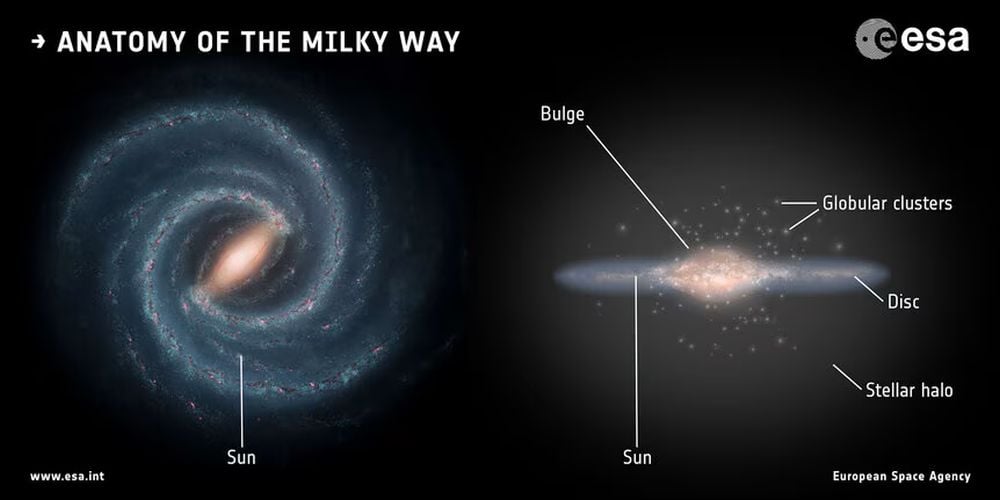
The supermassive black hole at the Milky Way's centre is about 4 million times the Sun's mass and roughly 26,000 light-years away. Compared with similar black holes in other galaxies, it takes in very little material and is unusually dim.
3 · Why infrared
Dust hides the galactic centre from visible-light telescopes, but infrared light gets through. Warm gas also glows at specific infrared wavelengths, one set for each element. Those patterns tell astronomers what the gas is made of.
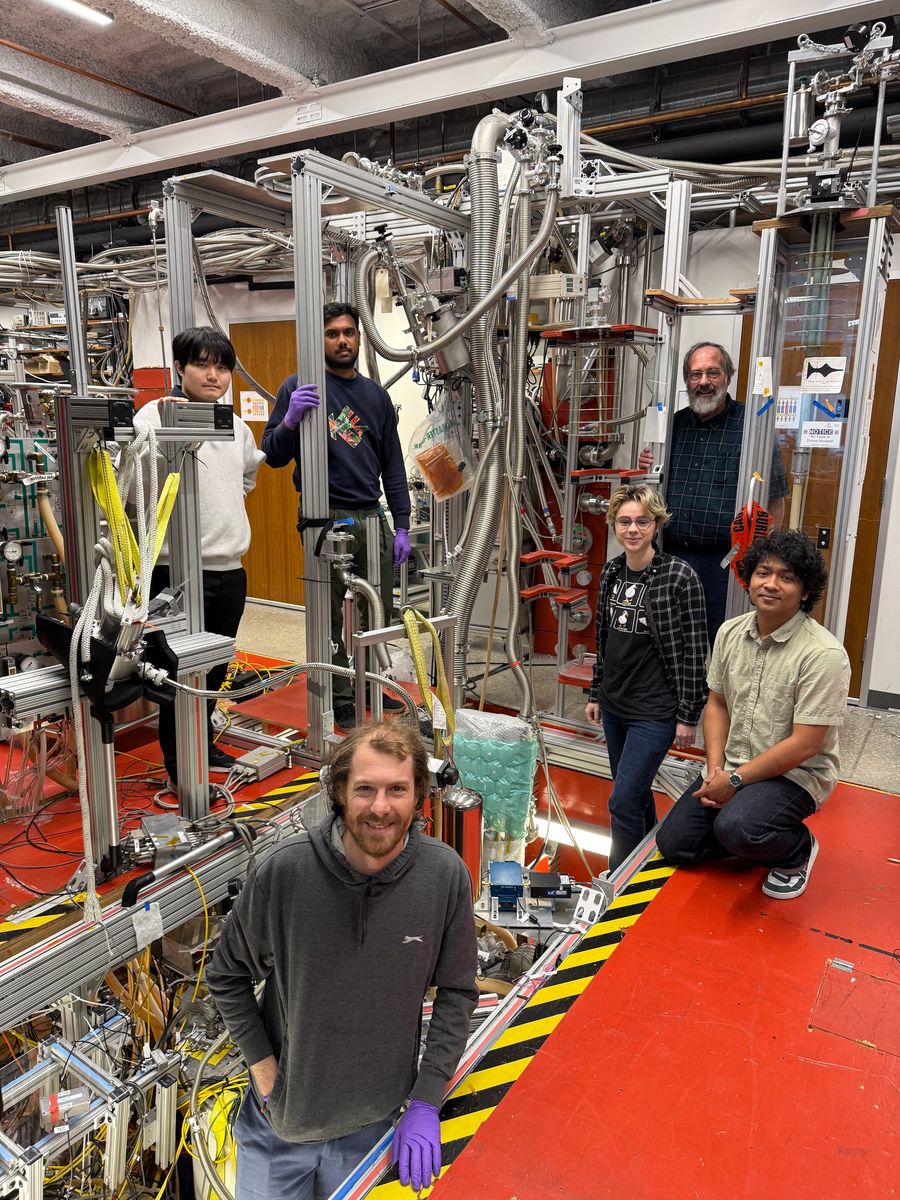
Gerald Gabrielse (top right) and his Northwestern team in the lab where they held a positron for a month.
Physicists at Northwestern University have trapped a single 1, the antimatter partner of the electron, and kept it for a month. The team, led by Gerald Gabrielse, reported the result in 2, a peer-reviewed journal. They say the trap could hold the particle indefinitely.
Why antimatter is hard to keep
Antimatter is destroyed when it touches ordinary matter, so no material container can hold it. Positrons are also born fast. "The big challenge is to persuade these positrons to slow down and then capture them," Gabrielse says.
How the trap works
The positrons come from 3, a radioactive isotope with a 4 of about two and a half years that gives off positrons as it decays. The fast positrons pass through a thin, cold sheet of tungsten and lose energy as they bounce through its crystal structure. Some are annihilated along the way. The ones that make it through "get popped out" at the far side.
Electromagnetic fields then steer the slowed positrons into a vacuum chamber held three-tenths of a degree above absolute zero. There, an electric field above and below and a magnetic field around the sides hold a single positron in place. Nothing solid touches it. "If you want to hold on to antimatter, you have to hold it in a container without walls," Gabrielse says.
What it's for
The month in the trap is a first step, not a measurement. The goal is the positron's 5: how strong a tiny magnet it is and which way it points. Getting it means measuring two energies. One is the energy needed to flip the particle's spin. The other is the energy needed to lift it from its lowest-energy (ground) state to the next state up.
Gabrielse's group has already measured the electron's magnetic moment to one part in 10 trillion with a similar trap. The 6, physicists' best theory of particles, predicts that the positron's value is the exact opposite of the electron's. If the two differed, that could help explain why the universe is made of matter. Theory says the Big Bang made equal amounts of both, and only a small surplus of matter survived.
Roni Harnik, a Fermilab theorist who was not involved, calls the trap "an exciting development" that will let physicists test a basic symmetry of nature. The article gives no timeline for the positron measurement and doesn't say how precise it is likely to be.
A team led by Gerald Gabrielse at Northwestern University has trapped a single 1 and held it for a month. The positron is the antimatter partner of the electron. The team reported the work in 2, a peer-reviewed journal, and says the setup could keep the particle indefinitely. Holding the positron is not the discovery itself. It is the tool for a measurement that could test one of the deepest assumptions in physics.
The problem: a particle you can't touch
Every particle of ordinary matter has an antimatter partner with the same mass and the opposite charge. When a particle meets its partner, the two annihilate. Antimatter therefore can't sit in a flask or on a lab bench, because any contact with the walls destroys it. Positrons are easy enough to make. Radioactive decay produces them all the time. But they come out fast, and a fast particle can't be held. "The big challenge is to persuade these positrons to slow down and then capture them," Gabrielse says.
Step one: a radioactive source
The team starts with 3, a radioactive isotope with a 4 of about two and a half years. When a sodium-22 atom decays, it gives off a positron. A long half-life means the source keeps producing positrons for years.
Step two: slowing them down in tungsten
The positrons are fired into a thin, cold sliver of tungsten. As they move through the metal's 5, the regular grid of its atoms, they collide again and again and lose energy with each hit. Gabrielse compares it to a pinball. Every collision could end in annihilation. "Every time they bang into something, there's a chance of annihilation, but it doesn't always happen," he says. "If they make it to the end, they get popped out." The positrons that survive leave the far side much slower than when they went in. Physicists call this kind of energy-absorbing material a moderator.
Step three: a container without walls
Electromagnetic fields then guide the slowed positrons along a channel into a vacuum chamber cooled to 0.3 degrees Celsius above absolute zero. The vacuum means there are almost no stray atoms for the positron to hit. Inside, an electric field above and below the particle and a magnetic field around the sides keep it suspended in empty space. This combination of fields is the standard design called a 6, though the article doesn't use that name. "If you want to hold on to antimatter, you have to hold it in a container without walls," Gabrielse says.
The cold has a purpose beyond keeping things tidy. It leaves the particle in its lowest-energy quantum states, where single, well-defined changes can be seen.
What they want to measure
The target is the positron's 7. Each electron or positron acts like a tiny bar magnet, and the magnetic moment describes that magnet's strength and direction. To get it, the team must measure two energies:
The spin-flip energy: how much energy it takes to turn the particle's spin, and so its tiny magnet, upside down.
The excitation energy: how much energy it takes to lift the particle from its ground state (lowest energy) to its first excited state in the trap.
Comparing the two gives the magnetic moment. Both are absorbed in exact amounts, so they can be measured very precisely if the particle stays still long enough to probe it again and again. A trap that holds one positron for weeks makes that possible.
Why compare it with the electron
Gabrielse's group has already used a similar trap to measure the electron's magnetic moment to one part in 10 trillion. The positron measurement is meant to sit beside that one. The 8, physicists' best theory of particles and forces, predicts that the positron's magnetic moment is exactly opposite to the electron's. "We're looking to see if they have an exactly opposite magnetic moment," Gabrielse says.
That prediction comes from a deep symmetry. Roni Harnik, a theoretical physicist at Fermi National Accelerator Laboratory who was not involved in the work, describes it this way. "Turn every particle to its antiparticle, look at physics through a mirror (flipping left and right) and press the 'rewind button' to reverse the flow of time. Our most basic theories say that physics stays the same." Physicists call this 9, from charge, parity (the mirror flip) and time. If the positron's magnet were even slightly different from the electron's, the symmetry would be broken.
The bigger question
Cosmologists think the Big Bang produced roughly equal amounts of matter and antimatter. Most of it annihilated, but a small excess of matter was left to form stars, planets and people. No one knows where that excess came from. A difference between electron and positron would be a clue to how matter won. The magnetic moment is one of many places physicists are looking. Other experiments compare masses, charges and decay rates of particles and their antiparticles. Harnik calls the new trap "an exciting development that will enable us to test a basic symmetry."
What's still open
The result so far is about capture and storage, not new physics. The trap has held one positron for a month, which shows that long, repeated measurements are possible. But the positron's magnetic moment hasn't been reported yet. The article doesn't say when it will be, or whether the team expects to match the electron's one-in-10-trillion precision. It also doesn't say how many positrons get through the tungsten or how long it takes to catch one. There's a small inconsistency as well. The article first says the particle was held "for months at a time," then specifies a month.
Most important, the Standard Model predicts no difference. The likeliest outcome of the measurement is that the two magnetic moments match. That would still be useful: a tighter limit on how far CPT symmetry could be broken, which narrows where the explanation for the matter surplus can hide. A mismatch would be a major discovery, but nothing so far points to one.
Remember
The milestone is holding one positron for weeks. The measurement that could reveal new physics hasn't been done yet.
Theory predicts the electron and positron magnets are exact opposites. Any difference would break a basic symmetry of nature.
The likeliest result is a match. Even that tightens limits on explanations for why matter outnumbers antimatter.
Parker Solar Probe image of the solar wind streaming away from the Sun, the flow that carries switchbacks.
A team led by Jesse T. Coburn has followed a single magnetic "1" back to its birthplace in the Sun's corona, the hot outer atmosphere. This is the first time anyone has done that. The work, published in the peer-reviewed journal Nature Astronomy, rests on a lucky crossing by 2, the European Space Agency's Sun-watching spacecraft, on 2 March 2022.
The question
Switchbacks are sharp S-shaped kinks in the magnetic field carried by the solar wind, the stream of charged particles flowing off the Sun. NASA's Parker Solar Probe has seen huge numbers of them. They affect how the wind flows, but nobody knew where they form. Turbulence in the wind might twist them up in open space, or the Sun might launch them from the corona.
A 90-minute fly-through
Solar Orbiter was about halfway between Earth and the Sun when its magnetometers and particle sensors registered a switchback for about an hour and a half. The craft was moving at 30–40 km/s and the switchback was sweeping past at about 450–460 km/s. From that, the team puts the structure at about 2.75 million kilometres long in the direction pointing away from the Sun.
Reading the ions
The key evidence came from the 3. Near the Sun, extreme heat strips electrons from atoms such as oxygen and carbon. As the plasma flows outward and cools, the ions stop losing electrons, but they don't regain them either. Their charge is "frozen in", so it records the temperature of the place they came from.
Inside the switchback, highly charged oxygen and carbon ions were more common than usual, and helium was below expected levels. The plasma had been heated above a million degrees Celsius, which points to the corona. The team then used images taken at the same moment by NASA's 4, an Earth-orbiting satellite. They traced the plasma to a closed magnetic loop next to a 5, a darker region where field lines open out into space.
How it was launched
Closed-loop plasma ending up in the open solar wind suggests 6. In this process a loop anchored at both ends touches an open field line. The lines snap and reconnect, and some hot loop plasma is flung outward as a kink.
There was a complication, though. Particles that were simply flung out should travel straight. These moved in step with the magnetic field, like an 7, a ripple that travels along field lines the way a wave travels along a plucked guitar string. The authors conclude that switchbacks are born in reconnection and then shaped by wave dynamics.
Caveats
This is one event, so it shows that at least some switchbacks start in the corona. It doesn't show that all do, and it doesn't rule out turbulence making others. The article also doesn't say why helium was depleted.
A team led by Jesse T. Coburn has, for the first time, followed a single magnetic "1" in the solar wind back to where it was born on the Sun. The paper appears in the peer-reviewed journal Nature Astronomy. It depends on a lucky encounter: on 2 March 2022, the European Space Agency's 2 happened to fly straight through one of these structures and record what was inside it.
The puzzle
The solar wind is a supersonic flow of charged particles, called plasma, that streams continuously from the Sun. It carries the Sun's magnetic field out into the solar system. Spacecraft that fly close to the Sun, especially NASA's Parker Solar Probe, have found the wind full of "switchbacks". These are sudden kinks where the magnetic field folds back on itself in an S shape before returning to its usual direction. Switchbacks affect how the particles in the wind flow, and so they affect how much of the solar wind the rest of the solar system receives.
Their origin has been an open question with two main answers:
Made in transit. Turbulence inside the wind twists the field into switchbacks as the plasma travels outward through space.
Made at the Sun. Switchbacks are launched from the corona, the Sun's outer atmosphere, which is heated above a million degrees.
The two answers lead to different pictures of how the wind is heated and accelerated. Telling them apart is hard because a spacecraft only measures the plasma at its own location. It sees the switchback long after it formed, and it can't watch it form.
The encounter
When the crossing happened, Solar Orbiter was roughly halfway between Earth and the Sun. Its magnetometers and particle sensors recorded switchback conditions for about an hour and a half. The spacecraft was moving at about 30–40 km/s and the switchback was sweeping past at about 450–460 km/s. From those speeds the team puts the structure's length along the direction pointing away from the Sun at around 2.75 million kilometres. That is several times the distance from Earth to the Moon and a few times the Sun's radius. Most switchbacks Parker has recorded have been much smaller, and this one's size made a long, detailed measurement possible.
How the ions record their birthplace
The decisive measurements came from the 3, which measures the composition and electric charge of heavier ions in the wind. The method relies on what physicists call 4.
Near the Sun, the plasma is hot enough that collisions strip electrons from atoms such as oxygen and carbon. The hotter the plasma, the more electrons are removed. As the plasma moves outward it thins and cools. Collisions become rare, so the ions stop losing electrons, and they also don't pick electrons back up. The charge each ion carried when it left the hot region stays fixed for the rest of its journey.
An analogy: think of each ion as a sealed thermometer. It records the highest temperature it reached and keeps that reading after it leaves. A reading taken halfway to Earth still tells you how hot the plasma was at its source.
Inside the switchback, Solar Orbiter found more highly charged oxygen and carbon ions than usual, along with less helium than expected. The team reads the ion charges as evidence that the plasma had been heated above one million degrees Celsius. Only the corona reaches those temperatures, so plasma that turbulence had stirred together later in space would not be expected to carry this signature. The article does not explain what the helium shortfall shows on its own.
Pinpointing the source
To check, the researchers turned to the 5, a NASA satellite that images the Sun continuously from orbit around Earth. They used its observations from the time of the crossing to trace the plasma back to a specific place. It came from a closed magnetic loop next to a 6.
These two features are different kinds of magnetic structure:
Coronal loops are hot arcs of plasma with both ends anchored in the Sun's surface. Their field lines are closed, so plasma is normally trapped inside them.
Coronal holes are darker, cooler regions where field lines stretch out into interplanetary space. Plasma escapes freely along these open lines.
The launch mechanism
Plasma that started on a closed loop and ended up in the open solar wind must have escaped somehow. The authors conclude that it got out through 7. In this process, a closed loop presses against a neighbouring open field line, and the two lines break and reconnect in a new arrangement. The loop is temporarily opened, and some of its superheated plasma is flung outward along the newly opened line. That kink in the field, carrying hot loop plasma, is what became the switchback Solar Orbiter crossed.
Not quite a slingshot
The particle motions did not fit a simple slingshot picture. Plasma that was just ejected should have moved more or less in a straight line. Instead the particles moved in step with the magnetic field, which is the signature of an 8. This is a magnetic wave that travels along field lines, much as a wave travels along a plucked guitar string, with the plasma moving with the field as it bends.
The resulting picture combines both mechanisms. Reconnection in the corona creates and launches the switchback, and wave dynamics in the plasma then shape it as it travels. Turbulence-style wave physics therefore still matters, but as a shaping process after launch rather than as the origin.
What remains open
One event. This is a single switchback, and an unusually large one. It shows that at least some switchbacks come from the corona. It does not show that all do, or that turbulence never makes them further out. Testing that needs more traced crossings, including smaller switchbacks.
Tracing uncertainty. Linking a parcel of plasma measured halfway to Earth with a specific spot on the Sun depends on modelling the path the field and wind took in between. The article doesn't describe how certain that link is.
The bigger mystery. Why the corona is so much hotter than the Sun's visible surface remains unsolved. Switchbacks born from reconnection may be part of how energy moves out of the corona, but this paper doesn't settle that.
The article also places the result in a broader stream of new solar data. Parker Solar Probe gets close to the Sun, and Solar Orbiter combines close-up sampling with remote imaging. Tracking a single structure from its source to a measurement in space requires both kinds of observation, and this case shows how they can be combined.
Remember
Ions keep the electric charge they had when they left the corona, so their charges act as a thermometer reading of where the plasma came from.
This switchback came from a closed loop that reconnected with an open field line next to a coronal hole.
It was one large event, so the result shows that some switchbacks form in the corona, not that all do.
Artist's illustration of two neutron stars giving off gravitational waves as their orbit slowly tightens.
Astronomers have found the lightest known pair of neutron stars. 1 are the collapsed cores of exploded stars, each with more mass than the Sun packed into a ball about 20 kilometers across. The two stars in PSR J1856-0039 orbit each other about every 2 hours and 22 minutes. By timing radio pulses from one of them, a team led in part by JinLin Han of the Chinese Academy of Sciences found that Einstein's general relativity describes the pair's motion to within about 1%. The work was published in 2, a peer-reviewed journal.
A clock in a tight orbit
One star is a 3: a spinning neutron star whose radio beam sweeps past Earth about 43 times a second, steady enough to use as a precise clock. Its orbit with the other neutron star shifts when each pulse arrives, and those shifts reveal the orbit in detail. Only about 30 such double neutron star systems are known. The orbit here, about 2.36 hours, is the second-shortest among them. It is tighter than both the famous double pulsar (2.45 hours) and the 1974 4, which gave the first evidence for 5.
6, China's Five-hundred-meter Aperture Spherical Radio Telescope, found the pulsar in 2020. The team observed it 17 times through 2025.
Three effects, one consistency check
The timing showed three relativistic effects:
The orbit is shrinking by about 2.7 meters a year as the pair gives off gravitational waves, ripples in space-time.
The oval orbit rotates 17.6 degrees a year, about 150,000 times faster than the comparable drift in Mercury's orbit.
Time dilation: gravity and speed both slow the pulsar's clock, and the amount changes around the orbit. This shifts pulses by up to half a millisecond.
Each effect depends on the two stars' masses. Any two of them are enough to work out both masses. The third is an independent check: if general relativity is right, all three must give the same masses, and they do. The pulsar has about 1.3 solar masses and its companion 1.19, one of the lightest neutron stars known. The pair should merge in about 82 million years, probably forming a neutron star of about 2.26 solar masses, or possibly a black hole.
Caveats and next steps
The 1% agreement is looser than the double pulsar's 0.01%, which came from 16 years of data compared with five here. "Unfortunately, we could not beat this description of gravity," Han said. Physicists are hoping to find a crack in the theory.
Over the coming decades, the team hopes to detect 7, in which the pulsar's spin twists the space-time around it. That would show how mass is spread out inside the star, a clue to how matter behaves at neutron-star densities.
Astronomers have found the lightest known pair of neutron stars. 1 are the collapsed cores of exploded stars, each holding more mass than the Sun in a ball about 20 kilometers across. The system, called PSR J1856-0039, lies roughly 4,200 to 6,500 light-years away. Its two stars circle each other about every 2 hours and 22 minutes. Using five years of timing data, the team measured three separate effects predicted by Einstein's general theory of relativity. All three agree with the theory to within about 1%. The work, led in part by JinLin Han of the National Astronomical Observatories of the Chinese Academy of Sciences, was published September 15 in 2, a peer-reviewed journal.
Why double neutron stars are valuable
One of the two stars is a 3: a neutron star that spins and sweeps a radio beam across Earth, like a lighthouse. Its spin is so regular that the pulses work as a very precise clock. When that clock orbits a second compact, heavy object, the orbit leaves small marks on when each pulse arrives. Gravity is strong and the stars move fast in such systems, so relativistic effects that are tiny in the solar system become big enough to measure.
Such systems are rare. Han says only about 30 double neutron star systems are known. The first, the 4 found in 1974, gave the first evidence for 5. Its orbit shrank at exactly the rate Einstein's theory predicts for a pair losing energy to those waves. Later the "double pulsar," which orbits every 2.45 hours, matched the predicted rate to within about 0.01%. Orbits like these keep shrinking until the stars merge, the kind of event the LIGO and Virgo gravitational-wave detectors recorded in 2017.
Finding and timing the pair
The pulsar turned up in 2020 in a survey of the Milky Way's disk by 6, China's Five-hundred-meter Aperture Spherical Radio Telescope and the world's largest single-dish radio telescope. Han's team has found about 900 pulsars with it. This one stood out after follow-up observations. It spins about 43 times a second, and the two stars are separated by roughly twice the distance from Earth to the Moon. Han calls the orbital period of about 2.36 hours its "most attractive feature." It is the second-shortest known among such systems and shorter than both the double pulsar's and Hulse-Taylor's, so the relativistic effects should be stronger.
The team observed it 17 times between 2020 and 2025, sometimes long enough to cover a full orbit. They recorded when the pulses arrived and fitted those times to orbital models that include relativistic corrections. Han credits FAST's sensitivity with timing precision that would be hard to match elsewhere.
The three effects
Orbital decay. The stars give off gravitational waves and draw about 2.7 meters (9 feet) closer each year.
7. The oval orbit slowly rotates, by 17.6 degrees per year. That is about 150,000 times faster than the relativistic drift of Mercury's orbit, which was a famous early test of general relativity.
Time dilation. Both strong gravity and high speed slow a clock. On an oval orbit the pulsar's distance and speed keep changing, so its clock speeds up and slows down along the way. This shifts pulse arrival times by up to about half a millisecond.
How three effects become a test
The logic is what makes this a test and not just a measurement. In general relativity, each of these effects depends on the two unknown masses (plus orbital properties that timing already pins down). So each measured effect fixes a curve of possible mass pairs. As an illustration: if you plot the pulsar's mass on one axis and the companion's on the other, the measured orbital decay allows only mass combinations along one line. The rotation rate allows another line.
Any two lines cross at one point, which gives both masses. The third measurement is the check. If general relativity is right, its line must pass through the same point. If gravity worked differently, the three lines would miss each other. Here they meet, to about 1%. The resulting masses are about 1.3 solar masses for the pulsar and 1.19 for the companion, the lowest combined mass of any known double neutron star. The companion is one of the lightest neutron stars known. The article says simulations suggest supernovae can't produce neutron stars much lighter than that.
The pair should merge in about 82 million years. The researchers estimate the result will probably be a neutron star of about 2.26 solar masses, though it might instead collapse into a black hole.
How strong is the result?
This test is less precise than the double pulsar's, and Han says so. The double pulsar test used 16 years of data, compared with about five years here. The value of the new system is its record low mass and its very tight orbit, which push the test into a slightly different range of conditions. Physicists hope to find cracks in general relativity that would point to new physics. "Unfortunately, we could not beat this description of gravity," Han said. A 1% agreement is a confirmation, not a sharp new limit. Precision should improve as more timing data comes in.
What comes next
The team wants to detect 8, in which a spinning mass twists the space-time around it and makes nearby orbits wobble. Han expects this will take monitoring "probably over decades." The goal goes beyond testing relativity again. Measuring frame dragging would give the pulsar's moment of inertia, which depends on how its mass is spread out inside. That would put a new limit on how matter behaves at the extreme densities in neutron star cores, one of the main open questions in nuclear physics and astrophysics. The article does not say how large the frame-dragging signal is expected to be, or how precisely the moment of inertia might eventually be measured.
Remember
Measuring three relativistic effects over-determines two masses, so the third measurement directly tests general relativity.
The companion's 1.19 solar masses sits near the lowest mass that simulations say supernovae can produce.
Decades of timing could detect frame dragging and reveal how matter behaves in neutron-star cores.
Adaptive functioning means everyday practical skills such as communicating, self-care, safety and getting along with others. Standardized questionnaires score it against what is typical for a child's age. It measures something different from IQ.
Image: The Transmitter
The U.S. 1 (CDC) now estimates that nearly 17 percent of autistic 8-year-olds have 2. Its 2023 estimate was 27 percent. The new figure comes from a peer-reviewed study in the Journal of the American Academy of Child & Adolescent Psychiatry. The bigger finding is how much the number moves depending on how the condition is defined.
A contested label
A 3 (an expert panel convened by the journal The Lancet) coined "profound autism" in 2021. It meant autistic people who will need 24-hour care as adults, usually with an IQ below 50 or limited verbal ability. The 2023 CDC figure used that definition.
This year a 4 group, more than 70 researchers, clinicians, caregivers and autistic people who voted over several rounds, tightened it. A child must have 5 far below age level (everyday skills such as self-care and communication) plus either an IQ below 50 or minimal to no speech. A federal advisory body, the 6, has proposed a different definition that leaves out IQ entirely.
What the study found
Researchers applied the Delphi definition to 2022 records on 7,084 autistic children. The records came from 13 sites in the CDC's 7, which tracks autism by reviewing health and education records. Only 54 percent of the children had all the needed measures, so the team estimated the missing values statistically.
Across sites, the rate ranged from 10 percent in Utah to 35 percent in Laredo, Texas. Differences in how communities assess children may explain some of that range.
Compared with the Delphi definition, the alternatives gave:
Lancet criteria: 34% higher
IQ cutoff raised to 70: 71% higher
No IQ, only speech and adaptive scores: 33% lower
Why it dropped, and what it doesn't mean
Matthew Siegel of Boston Children's Hospital, a Delphi member not involved in the study, points to two causes. The stricter definition takes in fewer children. And far more children are now diagnosed with autism overall, so profound cases are a smaller share. The two estimates use different definitions and years, so the drop doesn't mean fewer high-need children. Siegel still calls 17 percent "a big group of children and families who need intensive support."
Caveats
UCLA's Catherine Lord warns that the missing data probably aren't random. IQ is hardest to measure in the children most likely to have profound autism. Siegel adds that none of the definitions directly measures the core question: whether a person needs an adult caregiver available around the clock. Every definition relies on proxies, and he calls that a gap the field still has to fill.
A lower number, with caveats
The U.S. 1 (CDC) now estimates that nearly 17 percent of autistic 8-year-olds in the United States have 2. In 2023 the CDC put the figure at 27 percent. The new study appeared this month in the peer-reviewed Journal of the American Academy of Child & Adolescent Psychiatry. It also shows how much the answer depends on which definition you use and on what data are available.
What "profound autism" means, and why people disagree
The 3 on the Future of Care and Clinical Research in Autism coined the term in 2021. It meant autistic people who will need 24-hour care as adults and who, in most cases, have an IQ below 50 or limited verbal ability. The commission said the label shouldn't be applied to children younger than 8. The CDC's 2023 estimate applied this definition to data from 2000 to 2016.
Not everyone accepted the Lancet criteria, and studies have used different ones. Earlier this year a 4 group came up with a new definition. A Delphi process has experts vote anonymously over several rounds until they converge. This group had more than 70 researchers, caregivers, autistic people and clinicians. Their definition requires two things:
5 far below age level (everyday practical skills, scored against age norms), and
either an IQ below 50 or minimal to no verbal ability.
The adaptive-functioning requirement is the main change from the Lancet version. Also this year, the federal 6 (IACC), which helps the government decide how to spend its autism research budget, proposed its own definition. It leaves IQ out entirely. That puts it at odds with both the Lancet and Delphi groups.
"What is considered profound autism for one person might not be considered profound autism for another person," says study investigator Joshua Anbar of Arizona State University. An agreed definition matters, he says, so that this high-need group can be described consistently.
What the team did
Anbar and colleagues applied the Delphi definition to 2022 records for 8-year-olds at 13 sites in the CDC's 7. This network estimates autism rates by reviewing children's existing health and education records. The team also reran the numbers under competing definitions.
The first problem was missing data. Of 7,084 autistic children:
61% had a recorded IQ
74% had enough information to judge verbal status
56% had adaptive-functioning scores
54% had everything the definition needs
To fill the gaps, the researchers used a statistical method that predicts missing values from the information that does exist (8).
Results
Under the Delphi definition, close to 17 percent of autistic 8-year-olds met the criteria. The rate varied widely across sites, from 10 percent in Utah to 35 percent in Laredo, Texas. Anbar says differences in how communities evaluate and diagnose children may explain part of that spread.
Each alternative definition changed the result by a large amount, compared with the Delphi definition:
Definition
Change in prevalence
Lancet 2021 criteria
34% higher
Delphi with IQ cutoff raised to 70
71% higher
Verbal status + adaptive scores only, no IQ
33% lower
These are relative changes. As a rough illustration (my arithmetic, not the paper's), starting from about 17 percent they work out to roughly 23, 29 and 11 percent. The last of these approximates an IQ-free approach like the IACC's, though the article doesn't say the study tested the IACC wording exactly.
"It makes the point that depending on how you define it, depending on what you have access to, you're going to come out with different rates," says Catherine Lord, a psychiatry professor at UCLA. She served on the Lancet and Delphi groups but wasn't involved in the study.
Why the number fell from 27 percent
Matthew Siegel of Boston Children's Hospital, a Delphi member not involved in the study, gives two reasons. First, the stricter definition, with its adaptive-score requirement, takes in fewer children. Second, the total number of children diagnosed with autism has grown, so even a steady number of profound cases is a smaller share. "The group that meets profound autism [is] getting a little smaller, more precise, and at the same time the denominator is getting bigger," he says.
That means the drop from 27 to 17 percent doesn't show fewer children with very high needs. The two estimates use different definitions and different years of data, so they can't be compared directly. Siegel still calls 17 percent sobering: "That's a big group of children and families who need intensive support and services."
The caveats
Missing data may not be random. Lord points out that IQ is hardest to measure in exactly the children most likely to have profound autism. If their scores are missing more often, filling the gaps from children who were tested could bias the estimate, and the article doesn't say in which direction. She ties this to how diagnosis works: a busy psychiatrist or pediatrician can diagnose autism, but a full assessment of what a child can do takes time that physicians often don't have.
The site-to-site spread is hard to read. A range of 10 to 35 percent could reflect real differences between communities, differences in assessment and record-keeping, or both. The study can't fully separate these.
Every definition is a proxy. Siegel's main criticism covers all the definitions. The concept rests on whether a person needs round-the-clock access to an adult caregiver, and no definition measures that directly. IQ, verbal status and adaptive scores stand in for it. "That's a key gap in the field that's begging to be filled," he says.
What's still open
The field hasn't settled on one definition. The Delphi and IACC versions disagree on whether IQ belongs at all. Until definitions line up and records reliably include IQ, verbal and adaptive measures, estimates of profound autism will shift with the method. That matters for planning services, because the count of children needing intensive care depends on these choices.
Remember
The drop from 27% to 17% mostly reflects a stricter definition and more autism diagnoses overall, not fewer high-need children.
Only 54% of children had the full records needed, and the missing data likely skew toward the most affected children.
Every current definition uses IQ, speech or adaptive scores as stand-ins; none measures the need for 24-hour care directly.
Infrared views of the galactic centre, zooming in toward Sagittarius A* (white star) at different wavelengths.
The 1 has found gas rich in heavy elements swirling near 2, the supermassive black hole at the centre of the Milky Way. The study was led by McGill University doctoral student Nicole Ford and published Oct. 19 in The Astronomical Journal. It follows a related paper the team published in May.
What "metals" means here
To astronomers, a metal is any element heavier than hydrogen and helium, such as oxygen, carbon or iron. Stars build these elements by fusion near the end of their lives, then spread them into space. The researchers think the metals near Sgr A* came from 3, the explosions of massive stars.
How they saw it
Dust blocks visible light from the galactic centre, but infrared light gets through. Using infrared, JWST picked up the heat signatures of individual gas clouds near the black hole and measured how much metal each held. Elements glow at their own specific wavelengths, which is how their amounts are read. The article doesn't say which instrument was used.
The gas has the same composition as several nearby stars. The team takes this to mean the stars and the gas formed at about the same time from the same material.
Why it matters for the black hole
Sgr A* takes in far less material than comparable black holes, and does so more slowly. "Part of understanding why this is happening means looking at the properties of the materials available for it to consume," Ford said.
According to the team, metals change how fast gas cools, and cooling affects how easily the black hole can draw the gas in. The general physics: metal atoms shed heat by radiating light much better than hydrogen or helium can. Gas that cools loses the pressure that held it up against gravity and can fall inward more easily.
The downside
The team's earlier paper found that gas emissions near Sgr A* are shaped by conditions in the local clouds. Astronomers had hoped to use that gas as a record of when the black hole was last active. Because local conditions shape its glow, the researchers say it can't serve that purpose on its own, which makes the black hole's history harder to reconstruct.
Caveats
The work is peer-reviewed, but the news report gives no figures: not how much metal was found, how far it exceeds expectations, or which elements dominate. The team also suggests the result could shed light on how Earth got its heavy elements. That is a broad motivation, not something this study shows.
What was found
The 1 has measured unexpectedly large amounts of heavy elements in gas clouds near 2, the supermassive black hole at the centre of the Milky Way. The results appeared on Oct. 19 in The Astronomical Journal. The first author is Nicole Ford, a doctoral student in astrophysics at McGill University in Montreal. The paper follows a related study the team published in The Astrophysical Journal in May.
In astronomy, "metals" means every element heavier than hydrogen and helium, so oxygen, carbon, iron and gold all count. Stars build these elements by nuclear fusion, mostly late in their lives. Dying stars throw the material into space, and later generations of stars form from the enriched gas. The researchers think the metals near Sgr A* came from 3, the explosions of massive stars, which blasted them into the area around the black hole.
How the measurement works
JWST orbits the Sun at 4, about 1.5 million kilometres from Earth on the side facing away from the Sun. The cold conditions there let it observe in infrared. That matters for the galactic centre, which thick dust hides from visible-light telescopes. Infrared light passes through the dust.
The team picked up the heat signatures of individual gas clouds swirling near the black hole and measured how much metal each one held. The article doesn't name the instrument or the method. The usual approach is 5. Warm gas glows at a fixed set of wavelengths for each element, much as each element has its own barcode. The strength of those lines shows how much of each element is present.
The stars and the gas match
The metal-bearing gas has the same chemical makeup as several nearby stars. The researchers read this as evidence that the gas and those stars formed at about the same time, from the same material. A cluster of massive stars would have formed, some of them would have exploded, and their debris would have been left as the gas seen today. That is one plausible reading. The article doesn't say how closely the compositions match or how old the stars are.
According to the McGill team's statement, this could help astronomers understand how metals are spread around supermassive black holes in more distant galaxies. It could also help explain how Earth got its own heavy elements, since the Sun and planets formed from gas that earlier stars had enriched. The article doesn't say how the galactic-centre result connects to the Solar System's history, so treat that as the team's broad motivation rather than a finding.
Why metals matter for a black hole's diet
Sgr A* is an odd supermassive black hole. "We see that it's eating a lot less material than other supermassive black holes, and more slowly," Ford said. Working out why means studying what is available for it to eat: gas, dust and the stars orbiting it.
The team argues that metals affect how fast gas cools, and cooling affects how easily the black hole can pull the gas in. Here is the general physics behind that claim. Hot gas pushes back against gravity with its own pressure. To lose heat, gas has to radiate energy, and metal atoms are much better at this than hydrogen or helium because they have many more ways to emit light. Metal-rich gas therefore cools faster, loses pressure support, and can more easily clump or sink inward. Metal-poor gas stays hot and puffed up for longer.
A rough analogy: two balloons of hot air sit near a drain. The one that sheds its heat faster shrinks and falls in sooner. Whether that speeds up or slows down Sgr A*'s feeding overall depends on details the article doesn't report.
Why the mystery gets harder
The headline result has a downside. The team's May paper found that gas emissions near the black hole are shaped by conditions in the local clouds. Astronomers had hoped to use the glow of this gas as a record of Sgr A*'s past, a sign of when it last flared into activity. If the gas's own environment largely sets its behaviour, the gas can't be relied on for that. The researchers say directly that the gas alone cannot stand in for how often the black hole has been active.
What's still unclear
The article gives no numbers: not how much metal was found, how much more than expected, or which elements. It also doesn't say how many stars match the gas, how confident the supernova explanation is, or how strong the effect on 6 might be. The work is peer-reviewed, but the Live Science report gives only a summary. Readers who want the measurements will need the paper itself.
Remember
The metal-rich gas matches the chemistry of nearby stars, which points to a shared origin, probably supernova debris.
Metals help gas cool, which may affect how readily Sgr A* takes it in. That matters because it eats unusually little.
Local cloud conditions shape the gas's glow, so the gas alone can't reveal the black hole's past activity.